AgriTech: what are the biggest unsolved problems?
Whether you're building or investing in the agritech market, our report covers everything you need to know: the players, the money, and what's coming next.
Summary
The biggest unsolved problems in AgriTech are climate-resilient crop production, agricultural water scarcity, soil degradation, fertilizer emissions, and making reliable farming technology affordable. These challenges remain difficult because scientific advances often fail to translate into consistent results and attractive economics on real farms.
Investment has become more selective. Global agrifoodtech funding fell to $16.2 billion in 2025, nearly 70% below its 2021 peak, even as upstream agricultural technology investment increased. Investors are still interested in innovation, but there is much less patience for products that cannot demonstrate commercial value.
The contrast between precision guidance and vertical farming is revealing. Autosteering reached 70% of large US crop farms in 2023 because farmers could see its operational benefits. Meanwhile, highly funded indoor farming companies such as Bowery and Plenty struggled with production costs that technology alone could not overcome.
Scale remains a major dividing line. Large farms can spread expensive machinery across thousands of acres, while small farmers often cannot justify the same equipment. Shared machinery and service-based models help, but seasonal demand, transportation, and maintenance create new economic problems.
Agricultural robotics is advancing faster in specialized jobs than in complete farm automation. Autonomous orchard sprayers, laser weeders, and tractor systems already perform useful work, but the economics become less convincing when supervision, downtime, unpredictable conditions, and reliable human labor are included.
Agricultural AI and biological inputs share an uncomfortable limitation: field conditions are much messier than controlled experiments. AI systems struggle to distinguish the causes of crop stress, while microbial fertilizers can behave differently depending on soil, weather, and crop genetics. Both need more independent, multi-season field evidence.
Water efficiency is particularly deceptive. Drip irrigation and precision scheduling can reduce water use per unit of production, yet total water depletion may continue rising if farmers expand irrigated land or shift to thirstier crops. Better technology cannot replace water accounting and limits on extraction.
Climate-resilient crops face a similarly complex problem. Drought tolerance, heat resistance, disease resistance, and high yields involve interacting biological traits. Improving one does not guarantee improvements in the others, and developing varieties that work across different agricultural environments still takes years.
Soil restoration and agricultural carbon payments face a mismatch between biological timelines and financial expectations. Soil improvements may take years to become measurable, while carbon credits require credible verification, permanence, and proof that the changes would not otherwise have occurred.
Some of agriculture's most valuable improvements may be relatively unglamorous. Roughly 13.2% of food is lost between harvest and retail, and affordable refrigeration, storage, equipment access, and distribution can deliver more immediate value in some markets than another sophisticated software platform.
Our conclusion is that AgriTech's greatest challenge is delivering several improvements simultaneously: stronger yields, better climate resilience, lower resource consumption, and acceptable farmer economics. The technologies most likely to succeed are those that solve expensive, recurring farming problems without asking farmers to absorb unreasonable financial or operational risk.

Written by the New Market Pitch teamWe track new markets so founders and investors can move faster. About us
Why does AgriTech still have so many unsolved problems?
AgriTech still has major unsolved problems because agricultural technology is improving faster than farmers can afford, adopt, and reliably benefit from it.
The investment figures show how sharply expectations have changed. According to AgFunder's Global AgriFoodTech Investment Report 2026, global agrifoodtech funding reached $16.2 billion in 2025, down approximately 3% from 2024 and almost 70% below the 2021 peak of more than $50 billion.
Yet investment in upstream technologies, including agricultural production, biological systems, and farm equipment, actually increased 7% to $9 billion in 2025. Deal numbers fell 12%, meaning investors were putting more money into fewer companies.
Agricultural innovation still attracts substantial capital, but investors have become much more selective about which businesses can turn scientific progress into revenue.
Agricultural conditions vary between fields, weather can change an entire season's economics, and farmers have limited room for expensive mistakes. A technology that performs well in controlled trials can lose much of its value once maintenance, financing, labor, and variable crop yields enter the equation.
Even successful products can take years to gain widespread adoption. Agricultural guidance systems needed roughly two decades to move from limited commercial use to mainstream adoption among large US crop farms.
Is AgriTech solving the problems farmers actually care about?
AgriTech is addressing genuine farming problems, but the industry still produces too many technologies whose financial benefits are difficult for farmers to prove.
The USDA's September 2026 forecast illustrates the pressure. US net farm income was expected to fall 5.5% in inflation-adjusted terms in 2026, while total production expenses were projected to increase 4.5% to $492.8 billion.
Fertilizer, lime, and soil-conditioner expenses were forecast to rise 15.3%, while fuel and oil expenses were expected to jump 28.8%. These are precisely the costs that new agricultural technologies promise to reduce.
But a farmer purchasing a precision-fertilizer system needs to know how much fertilizer it will save, whether yields will change, and how long the equipment will take to pay for itself.
Autosteering offers a useful comparison. USDA research published in December 2024 found that 70% of large US crop farms used autosteering in 2023, compared with single-digit adoption rates in the early 2000s. Farmers could see the benefits in reduced overlap, easier operation, and more precise fieldwork.
Agricultural startups also face a difficult commercial environment. Bowery Farming shut down in 2024, while Plenty entered Chapter 11 restructuring in March 2025 despite years of investment in advanced indoor production.
Farmers care about the return on their investment. When a product cannot demonstrate that return clearly, impressive technology is rarely enough.
If you want more recent data on this point, please see our latest AgriTech market report.

A good product starts with a real problem. In our report covering the agritech market, we show you the ones customers still live with.
Why is farming technology still too expensive for small farms?
Modern farming technology remains too expensive for many small farms because machinery, software, and financing costs are spread across much smaller areas of land.
USDA research found that 70% of large US crop farms used autosteering in 2023, compared with 52% of midsize farms. Adoption was substantially lower among small family farms.
A $100,000 machine used across 3,000 acres has very different economics from the same equipment operating on 150 acres. Larger farms can spread depreciation, maintenance, and financing costs across many more units of production.
Globally, the problem is enormous. A cross-country study covering 106 countries, published through CGAP, found that farms smaller than two hectares represented approximately 84% of farms but controlled only 12% of agricultural land in the sample.
Companies such as Hello Tractor in Africa and EM3 AgriServices in India have tried to address this problem by providing shared access to machinery. Farmers can pay for equipment services without purchasing and maintaining an entire machine themselves.
However, those models introduce their own difficulties. Equipment must travel between farms, seasonal demand can concentrate into a few weeks, and breakdowns can disrupt several customers simultaneously.
Can agricultural robots actually replace farm workers?
Agricultural robots can already replace some repetitive farm tasks, but fully autonomous farming is still far from becoming economically practical across most agricultural operations.
John Deere has developed autonomous tractor systems, Carbon Robotics sells laser-based weed-control equipment, and GUSS Automation has commercialized autonomous orchard sprayers.
These machines target activities with clear operating requirements. Spraying orchard rows and identifying weeds are easier to automate than managing an entire farm through unpredictable weather, machinery failures, and changing field conditions.
The economics remain demanding. A 2025 study published in Smart Agricultural Technology modeled autonomous machinery on a US corn-and-soybean farm. Autonomous equipment became attractive under severe labor shortages, while conventional machinery remained more profitable when reliable labor was available under the study's assumptions.
Farmers still need to consider equipment prices, supervision, maintenance, field capacity, and downtime. In seasonal farming, completing work during a narrow planting or harvesting window can matter more than the number of hours a machine operates autonomously.
For now, specialized robots have a much clearer commercial future than fully autonomous farms.

If you build or invest in the agritech market, you need to know which business models pay off now and which ones are fading. That's why our report covering it has a whole section on it.
Why can't agricultural AI reliably predict crop problems?
Agricultural AI can identify crop problems increasingly well, but reliably predicting their causes and recommending the right treatment remains much harder.
Companies such as Taranis, CropX, and EOS Data Analytics use field imagery, sensors, and agricultural data to identify vegetation patterns, soil conditions, and potential crop stress.
A satellite image might show declining crop health, for example, without identifying whether the cause is drought, nitrogen deficiency, disease, soil compaction, or several factors together.
The problem becomes more serious when an AI model trained in one agricultural region is applied elsewhere. Soil composition, crop varieties, rainfall, cultivation methods, and pest populations can change the relationship between observed symptoms and their underlying causes.
Agricultural AI also depends on fragmented data. Farmers may operate John Deere, CNH, or AGCO machinery alongside independent irrigation systems and farm-management software. Records can be incomplete or difficult to transfer between platforms.
This is particularly problematic because crop yields are usually measured once per growing season. Unlike online software, agricultural AI cannot generate millions of immediate experiments to determine which recommendations actually work.
We need more independent field trials comparing AI-guided decisions against conventional farming practices across multiple seasons and locations.
Can precision agriculture really solve the global water crisis?
Precision agriculture can substantially improve irrigation efficiency, but agricultural water scarcity will remain unsolved wherever total water consumption continues increasing.
According to the FAO's State of the World's Land and Water Resources for Food and Agriculture 2025, agriculture accounts for more than 70% of global freshwater withdrawals.
Companies such as Netafim, CropX, and Jain Irrigation offer technologies that improve irrigation delivery or help farmers decide when and how much water to apply.
Drip irrigation, soil-moisture sensors, and automated scheduling can reduce waste and improve control compared with poorly managed traditional irrigation.
However, saving water at the field level does not necessarily mean a river basin or aquifer retains more water.
A 2026 study published in Agricultural Water Management examining China's Ebinur Lake Basin found that expansion of irrigated agricultural land could offset improvements in water-use efficiency.
Better irrigation can make farming more productive, but it can also encourage farmers to expand cultivated areas or switch to more water-intensive crops. And that can wipe out much of the original benefit.
The biggest remaining challenge is controlling total water depletion. Irrigation technology needs to work alongside groundwater limits, reliable water accounting, and crop choices suited to local conditions.
If you want more recent data on this point, please see our latest AgriTech market report.

Learning from others' mistakes is the cheapest lesson there is. In our market report about farm technology, we look at what broke startups before you, so you don't repeat it.
Can AgriTech develop crops that survive extreme climate conditions?
AgriTech can improve crop resistance to drought, heat, and disease, but developing varieties that maintain high yields under several extreme conditions remains one of agriculture's hardest scientific problems.
Companies such as Inari and Pairwise are using advanced genetics and gene editing to improve agricultural traits, while public breeding programs continue developing varieties adapted to difficult environments.
The challenge is that climate resilience involves several biological characteristics interacting simultaneously.
A drought-tolerant crop might perform well during water shortages but remain vulnerable to extreme heat during flowering. A variety resistant to a particular disease might still suffer substantial losses in waterlogged or saline soils.
Breeding also involves difficult trade-offs. Improvements in stress tolerance can sometimes reduce yield potential under favorable conditions, and results from controlled environments do not always transfer to commercial farms.
Time makes the challenge harder. Developing, testing, multiplying, and distributing a new crop variety can require years, even when modern genetic techniques accelerate part of the process.
The FAO's 2025 land and water assessment estimates that agricultural production must increase substantially by 2050 to meet demand for food, feed, and fiber.
Why are biological fertilizers still so unreliable?
Biological fertilizers still produce inconsistent results because microorganisms that work well in laboratories can behave very differently once applied to commercial agricultural fields.
Companies such as Pivot Bio, Indigo Agriculture, and Sound Agriculture have developed products intended to improve nutrient availability, crop performance, or interactions between plants and soil microorganisms.
The opportunity is substantial. Biological products could reduce some dependence on conventional fertilizers, particularly nitrogen inputs, without requiring farmers to abandon productive agricultural systems.
But microorganisms operate within complex ecosystems. Their survival and activity depend on temperature, moisture, soil chemistry, crop genetics, and competition from existing microbial populations.
A June 2026 review published in Rhizosphere examined why microbial biofertilizers frequently struggle when moving from controlled experiments to field conditions. Problems included product delivery, microbial establishment, persistence, and inconsistent biological activity.
Manufacturing creates another challenge. A biological formulation must remain stable during storage, shipping, and application before it can perform in the soil.
The commercial test is whether a biological product can repeatedly deliver meaningful savings or yield improvements across different soils and growing seasons.

When you build or invest in the agritech market, you need clarity, not confusion. In our document detailing everything you need to know about agritech, we always try to put numbers on and quantify whatever is usually vague and confusing.
Can agriculture cut fertilizer emissions without losing crop yields?
Agriculture can reduce fertilizer emissions without necessarily sacrificing yields, but the cheapest available production methods and many common field practices still create substantial greenhouse gas emissions.
The International Energy Agency's Breakthrough Agenda Report 2025 estimated that fertilizers generate approximately 1.23 billion tonnes of CO2-equivalent emissions annually.
Around 60-70% of fertilizer-related emissions occur during use, with the remainder associated with production.
Cleaner fertilizer manufacturing alone would therefore leave substantial nitrous oxide emissions from agricultural soils.
The financial constraints are also significant. The IEA estimated that ammonia made using carbon capture costs approximately 30% more than conventional production, while electrolysis-based ammonia costs around three times as much without policy incentives.
Precision application, nitrification inhibitors, improved crop rotations, and biological nitrogen products could help reduce field emissions.
The IEA's analysis suggests that global nitrogen-use efficiency would need to rise from approximately 55% to 70% by 2050 under a pathway consistent with net-zero fertilizer emissions. That would require more than doubling the recent annual rate of improvement.
We see fertilizer emissions as a combined industrial and agricultural problem. Cleaner ammonia production, better nitrogen management, and reliable biological alternatives will all be needed. The economics will have to change too, because farmers cannot be expected to absorb every additional cost.
If you want more recent data on this point, please see our latest AgriTech market report.
Why can't AgriTech stop crop pests and diseases?
AgriTech can detect many agricultural pests and diseases earlier, but preventing large crop losses remains difficult because pathogens evolve, pesticide resistance spreads, and effective treatments are often limited.
The FAO estimates that plant pests and diseases can destroy up to 40% of global crop production annually, while plant pests cause trade losses exceeding $220 billion.
These are broad global estimates rather than losses affecting every crop equally, but they show the potential scale of the problem.
Companies such as Taranis, Plantix, and SeeTree use imagery and other agricultural data to identify crop-health problems. Better monitoring can help farmers intervene before infestations become severe.
However, detecting a disease is only useful when an effective treatment exists and can be applied quickly.
Fungal pathogens can develop resistance to fungicides, insects can become resistant to insecticides, and new pests can enter agricultural regions through trade or changing climatic conditions.
Disease outbreaks can also move faster than agricultural monitoring and response systems.

In our report covering the agritech market, we look at what the winners do differently, so you can learn from the best instead of guessing.
Why is damaged farmland so difficult to restore, and can carbon farming help?
Damaged farmland takes years to restore, and carbon farming still cannot reliably measure or pay for enough of that restoration to make it attractive to many farmers.
The FAO's 2025 land and water report estimated that more than 1.6 billion hectares worldwide had been degraded by unsustainable land-use and management practices. Over 60% of human-induced land degradation occurs on agricultural land.
Soil degradation takes several forms. Erosion removes productive topsoil, excessive irrigation can increase salinity, heavy machinery can compact soil, and repeated cultivation can reduce organic matter.
Cover crops, reduced tillage, crop rotations, and organic amendments can help under appropriate conditions. But results vary with local soil, climate, crop selection, and management.
A farmer adopting cover crops may face additional seed costs and operational complexity before seeing measurable improvements in soil health. Reduced tillage can improve some soil properties while creating different weed-management requirements.
Carbon farming offers a potential financial incentive. Farmers can receive payments for practices that increase soil carbon or reduce emissions, but credits depend on proving that those changes actually occurred.
A January 2026 study in the Journal of Environmental Management examined soil-carbon measurements from 151 plots in western Kenya. Portable near-infrared measurements showed weak agreement with laboratory measurements, with reported R² values of 0.10-0.11. Agreement between two laboratories was also limited, with an R² of 0.34.
A July 2026 study in npj Sustainable Agriculture proposed a digital soil-mapping approach that could improve monitoring. Its modeled 430-acre project over five years required a 12% uncertainty deduction, while larger and longer projects could potentially reduce that deduction.
The two studies examined different measurement methods, but both illustrate how uncertainty and monitoring costs complicate carbon payments.
Carbon farming also faces permanence and additionality problems. Stored carbon may be released if farming practices change, and some farmers might have adopted the same practices without carbon payments.
Farmers need financing that supports restoration over several years, backed by credible measurements and improvements in agricultural productivity.
Why hasn't vertical farming replaced traditional agriculture?
Vertical farming has failed to replace conventional agriculture because growing crops indoors is still too expensive for most agricultural products, particularly those sold at commodity prices.
Plenty is a revealing example. In September 2024, the company announced a Virginia vertical farm designed to produce more than four million pounds of strawberries annually. In March 2025, Plenty entered Chapter 11 restructuring and emerged in May with a narrower focus on premium strawberries.
Bowery Farming shut down in 2024, despite raising substantial investment for advanced indoor growing systems.
These failures exposed how difficult it is to recover the cost of buildings, climate-control systems, lighting, automation, and electricity through agricultural sales.
The economics differ significantly between crops. Premium strawberries and leafy greens can command much higher prices than wheat, rice, or corn. Grain production also requires enormous output volumes, making expensive indoor growing systems particularly difficult to justify.
Vertical farming can still provide advantages where consumers value consistent quality, freshness, local production, and year-round availability.
| Production approach | Main advantage | Biggest economic constraint |
|---|---|---|
| Open-field farming | Low infrastructure costs | Weather exposure |
| Traditional greenhouse | Protection from weather | Heating and construction |
| High-tech greenhouse | Better control of growing conditions | Capital and energy |
| Hydroponic greenhouse | Precise nutrient and water delivery | Equipment and maintenance |
| Vertical leafy-greens farm | High production per unit of floor space | Electricity and selling prices |
| Vertical strawberry farm | Premium year-round production | Capital recovery and operating costs |
| Indoor grain production | Controlled growing environment | Very unfavorable commodity economics |
If you want more recent data on this point, please see our latest AgriTech market report.

In our research about farm technology, we always try to gather several sources and make estimates that make sense, so you can work with solid numbers.
Why does so much food still get lost after harvest?
AgriTech has made progress in food preservation, but inadequate storage, refrigeration, transportation, and market access still cause enormous agricultural losses.
The FAO estimates that approximately 13.2% of food is lost after harvest and before reaching retail markets.
Separately, UNEP estimates that around 19% of food available to consumers is wasted in households, food services, and retail. The two figures describe different stages and use different denominators.
Post-harvest losses are particularly costly for perishable products such as fruits, vegetables, dairy, and fish. Poor refrigeration or delayed transportation can destroy the value of otherwise successful harvests.
ColdHubs in Nigeria and Ecozen in India have developed cooling solutions aimed at agricultural markets where reliable refrigeration remains difficult to access.
The obstacle is usually broader than installing a refrigerator. Cooling systems need dependable energy, affordable financing, maintenance, enough paying customers, and functioning distribution networks.
In markets with severe post-harvest losses, improving cold-chain infrastructure may deliver more immediate benefits than introducing another productivity tool.
Can livestock farms cut methane emissions without raising costs?
Livestock farms can already reduce methane emissions using certain feed additives and management practices, but applying those solutions economically across grazing and small-scale farming systems remains extremely difficult.
Enteric methane from cattle is a major source of agricultural greenhouse gas emissions. Feed additives containing 3-nitrooxypropanol, or 3-NOP, have demonstrated meaningful methane reductions in controlled studies.
Bovaer is one commercial example. Its performance depends on dosage, diet, and feeding conditions, while adoption also depends on regulation, producer costs, and market incentives.
The biggest limitation is that additives must reach animals consistently.
That is relatively straightforward on dairy farms where cattle receive controlled feed rations. It becomes considerably harder when animals graze across large areas and obtain most of their food directly from pasture.
Other approaches include seaweed-derived compounds, selective breeding, improved forage, and methane-reduction vaccines under development.
None has yet demonstrated a universally affordable and practical way to reduce methane across the full diversity of global livestock systems.

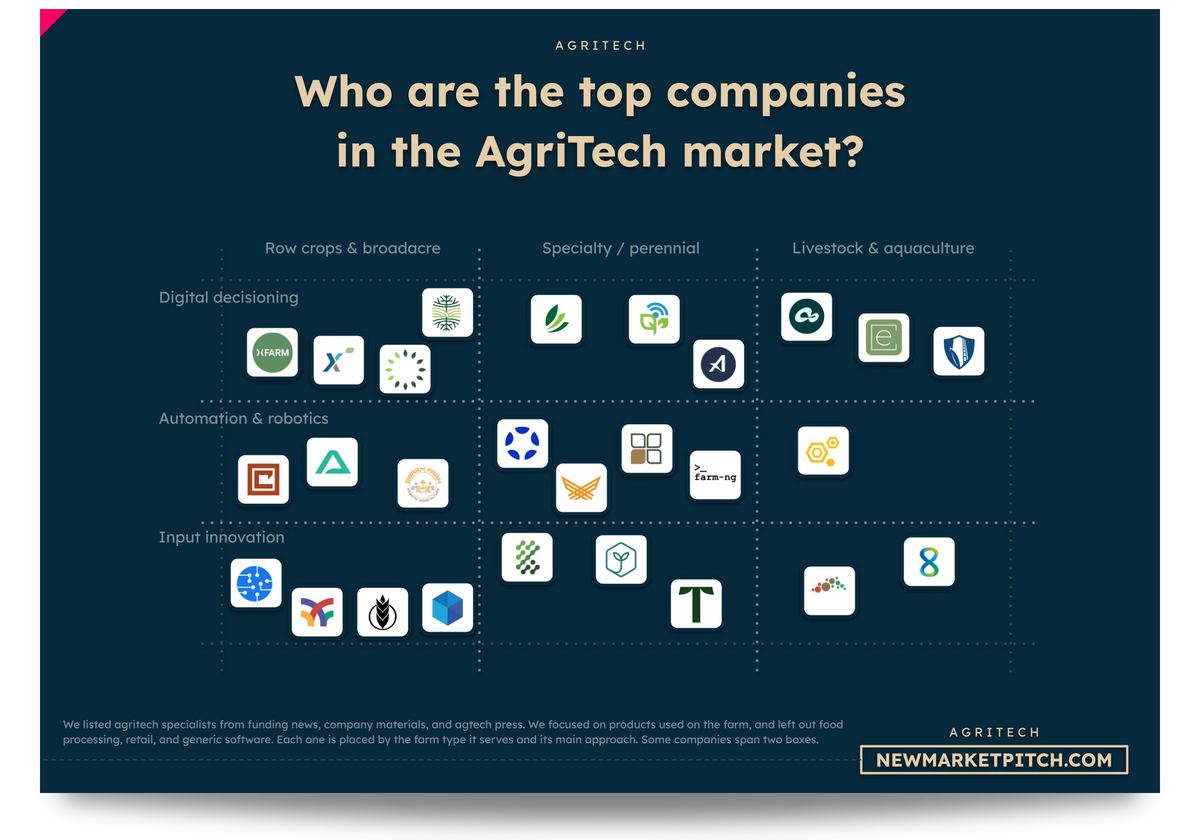
In our market report about farm technology, we turn what is vague and complex into simple, useful visuals. Market maps like this one show you at a glance where every startup stands.
Why is AgriTech struggling to reach farmers in developing countries?
AgriTech struggles to reach many farmers in developing countries because access to credit, machinery, storage, and reliable markets often matters more than access to advanced software.
AgFunder's Developing Markets AgriFoodTech Investment Report 2025 found that investment across developing markets reached $3.7 billion in 2024, increasing 63% from the previous year.
But the headline concealed heavy concentration. India received approximately $2.5 billion, including a $1.4 billion investment in grocery-delivery company Zepto.
That single transaction represented roughly 38% of all developing-market agrifoodtech funding reported for the year. Removing it would leave approximately $2.3 billion, showing how misleading the apparent boom can be when assessing technology reaching farmers.
Companies such as Apollo Agriculture, Hello Tractor, and DeHaat have taken different approaches to agricultural finance, equipment access, farm services, and market connectivity.
These models address practical constraints. A farmer may need affordable inputs or timely access to machinery before crop-monitoring software can create much value.
Local infrastructure also affects commercial viability. Weak mobile connectivity, unreliable electricity, expensive transportation, and limited distribution networks increase the cost of delivering agricultural services.
Which AgriTech problems are the hardest to solve today?
The hardest AgriTech problems today are climate-resilient crop production, agricultural water scarcity, soil degradation, and emissions reduction, because existing technologies still cannot solve them consistently at an affordable cost.
We compared the major challenges using the scale of their agricultural impact, the reliability of available solutions, and the practical barriers to widespread adoption.
The ranking is qualitative. Different problems use different measurements, and some overlap. Nevertheless, the available evidence separates widespread resource constraints from narrower technology-adoption challenges.
Water scarcity affects agricultural production across entire regions, while crop genetics must adapt to several increasingly difficult stresses. Soil restoration can take years, and fertilizer emissions originate from both industrial manufacturing and biological processes in fields.
Problems such as automation and agricultural AI are also significant, but they already have commercially useful applications in particular settings.
| Unsolved problem | Evidence of scale | Main barrier | Severity |
|---|---|---|---|
| Water scarcity | Agriculture uses over 70% of freshwater withdrawals | Unsustainable total water consumption | Critical |
| Climate-resilient crops | Heat, drought and flooding threaten agricultural yields | Multiple interacting biological stresses | Critical |
| Soil degradation | Over 60% of human-induced land degradation occurs on agricultural land | Slow restoration and financing | Critical |
| Fertilizer emissions | Approximately 1.23 billion tonnes CO2e annually | Production costs and field emissions | Critical |
| Crop pests and diseases | Up to 40% of crop production can be lost annually | Resistance and evolving biological threats | Critical |
| Small-farm technology access | Small farms dominate farm counts in many countries | Machinery costs and fragmented markets | Critical |
| Agricultural robotics | Commercial deployments remain task-specific | Equipment costs and operating reliability | High |
| Biological fertilizers | Field results remain variable | Microbial performance across different conditions | High |
| Agricultural AI | Precision tools are widespread but predictive reliability varies | Incomplete data and difficult causal prediction | High |
| Post-harvest food losses | Approximately 13.2% lost before retail | Storage, cooling and distribution | High |
| Agricultural carbon verification | Substantial measurement disagreement documented | Measurement uncertainty and permanence | High |
| Vertical farming | Multiple major operators closed or restructured | Energy, capital and production costs | High |
If you want more recent data on this point, please see our latest AgriTech market report.

Our document detailing everything you need to know about agritech gets updated several times a month, so you always get the latest view of where things stand.
Are AgriTech's biggest problems getting easier to solve?
Some AgriTech problems are becoming easier to solve, particularly precision farming and specialized automation, but progress on water scarcity, soil degradation, and agricultural emissions remains much slower.
The strongest evidence of successful adoption comes from precision machinery. According to USDA research, autosteering moved from single-digit adoption rates in the early 2000s to use by 70% of large US crop farms in 2023.
That is a major commercial achievement over approximately two decades. It shows that farmers will adopt new technologies at scale when the benefits are clear and reliable.
But the environmental picture remains difficult.
According to FAO statistics published in 2025, global agrifood systems generated 16.5 billion tonnes of CO2-equivalent emissions in 2023, approximately 21% more than in 2001. Their share of global greenhouse gas emissions fell from 38% to 32% during that period, but their absolute emissions continued rising.
Meanwhile, the FAO's latest land and water assessment documented extensive degradation of agricultural land and continued pressure on freshwater resources.
What are the biggest unsolved problems in AgriTech?
The biggest unsolved problems in AgriTech are making agriculture resilient to climate change, reducing water and soil degradation, cutting emissions without reducing yields, and delivering affordable technologies that work reliably for ordinary farmers.
After comparing the available evidence, we would place climate resilience and sustainable resource use at the top of the list.
Water scarcity affects the foundations of agricultural production. Soil degradation reduces long-term productivity, while crop breeding must keep pace with increasingly difficult climatic conditions. Fertilizer and livestock emissions add another layer of complexity because the cheapest solutions are not always the cleanest.
Commercial adoption remains the second major challenge. Agricultural AI, robotics, and biological products are advancing, but farmers still need consistent results and attractive economics before making them standard parts of their operations.
The difference between precision guidance and vertical farming is particularly revealing. Guidance achieved widespread adoption among large farms because its operational benefits were clear. Vertical farming attracted substantial investment but repeatedly struggled to make its production costs competitive.
We therefore expect the most valuable AgriTech breakthroughs to come from technologies that combine scientific progress with practical farm economics.
The next decade will be shaped by whether agricultural innovation can deliver better yields, stronger climate resilience, and lower resource consumption simultaneously, at prices farmers can actually afford.

In our report covering the agritech market, we don't want to repeat what boring consulting reports say. Instead, we show you the real and latest market signals that matter.
Our methodology
This analysis examines AgriTech's biggest unsolved problems using evidence available through October 2026. We assessed agricultural productivity, climate resilience, water and soil constraints, biological innovation, automation, farm economics, and technology adoption. The aim was to establish which challenges remain the hardest to solve at commercial scale, rather than simply identifying technologies that have attracted attention or investment.
We compared each problem across three main dimensions: its scale of impact on agricultural production or the environment, the demonstrated reliability of available solutions, and the financial or operational barriers preventing widespread adoption. Our severity classifications are qualitative editorial judgments, not scores generated by a statistical model. Different challenges overlap, and their underlying measurements are not directly comparable.
We prioritized original institutional datasets, peer-reviewed research, and first-hand company disclosures. In particular, we used agricultural investment data from AgFunder, farm-income and technology-adoption statistics from USDA, land and water assessments from FAO, fertilizer-emissions analysis from the IEA, and research on irrigation, autonomous machinery, microbial inputs, and soil-carbon measurement.
We also distinguished technical performance from economic viability. A technology's success in trials or individual commercial deployments does not establish its profitability across different farms. For robotics, biological fertilizers, agricultural AI, and carbon farming, we gave particular attention to operating conditions, field variability, monitoring requirements, and the time needed to demonstrate consistent results.
The investment figures refer to the broader agrifoodtech sector and should not be interpreted as funding for farm-level AgriTech alone. Likewise, agricultural water withdrawals, fertilizer emissions, total agrifood-system emissions, and food-loss estimates measure different activities and boundaries. We retained those distinctions when comparing the challenges.
Key sources for agricultural investment and farm economics include AgFunder's Global AgriFoodTech Investment Report 2026, AgFunder's Developing Markets AgriFoodTech Investment Report 2025, USDA's Farm Sector Income Forecast, USDA's precision agriculture adoption research, and CGAP's analysis of the global distribution of smallholder farms.
For agricultural resources, biological systems, and emissions, we used FAO's State of the World's Land and Water Resources for Food and Agriculture, Agricultural Water Management's research on irrigation expansion in the Ebinur Lake Basin, the 2026 Rhizosphere review of microbial inoculants, the IEA's Breakthrough Agenda Report on fertilizers, FAO's plant production and protection assessment, and FAOSTAT's greenhouse gas emissions analysis for 2001-2023.
For automation, soil-carbon verification, and commercial viability, we examined Purdue University's research on autonomous farm machinery economics, John Deere's autonomous technology announcement, Carbon Robotics' LaserWeeder documentation, the Journal of Environmental Management's soil-carbon measurement study, npj Sustainable Agriculture's digital soil-mapping research, and Plenty's March 2025 restructuring announcement and May 2025 restructuring completion.
Food-loss estimates were drawn from FAO's food loss and waste statistics and UNEP's Food Waste Index Report 2024. We used these sources to separate losses occurring before retail from waste at retail and consumer stages, rather than combining measures with different denominators.
Our final ranking reflects a comparison of the available evidence, with greater weight given to challenges that affect agricultural production at large scale and remain difficult to address reliably or affordably. That approach helps explain why water scarcity, climate-resilient crops, soil degradation, and fertilizer emissions rank above technologies that already work commercially in narrower settings.

In our research about farm technology, you will always find fresh funding data, taken straight from our own verified funding database.
Written by the New Market Pitch teamWe track new markets so founders and investors can move faster. About us