What are the top AI customer support startups by revenue?
Whether you're building or investing in the AI customer support market, our report covers everything you need to know: the players, the money, and what's coming next.
Summary
Sprinklr leads our ranking of AI customer support startups with $857M in FY2026 revenue, followed by Freshworks at $839M in 2025 and Fin at $400M in company-wide ARR as of March 2026.
Sprinklr leads Freshworks by only $18M on those selected figures. They cover different fiscal periods, though, so the gap is not a same-year comparison.
The three leaders make most of their money from broader software platforms. Their size does not tell us who earns the most from autonomous AI customer support alone.
Fin’s AI agent was approaching $100M ARR when the wider business reached $400M. That puts the new product at roughly one-quarter of the recurring-revenue base, without treating the two figures as interchangeable.
Sierra is a standout among newer autonomous-agent vendors: it reached $200M ARR in August 2026 after hitting $100M just two quarters earlier. Decagon’s roughly $100M run-rate is an external estimate, not an equivalent disclosure.
Fifteen companies have selected figures above $100M, with Decagon and Gorgias estimated around that line. This group spans helpdesks, phone systems, managed services and AI agents, so one headline ranking hides several distinct businesses.
Voice automation has its own serious revenue tier. Retell AI reported an $80M annualized run-rate and Omilia $60M ARR, while voice calls carry costs for telephony, speech processing and low-latency inference.
In ecommerce, Gorgias stands out at an estimated $100M in AI-product ARR. Smaller specialists focus on repetitive order, delivery and refund requests, where integrations matter as much as the conversational interface.
Outcome-based pricing changes the growth equation. Fin’s published $0.99 charge for qualifying outcomes rewards volume, but falling prices will push vendors toward more complicated, higher-value tasks.
Acquisitions are accelerating the contest: Salesforce bought Fin, NICE bought Cognigy, and Zendesk bought Ultimate and Forethought. Meanwhile, Genesys and Zendesk remain far larger benchmarks, and rising startup revenue alone tells us little about profitability or job losses.

Written by the New Market Pitch teamWe track new markets so founders and investors can move faster. About us

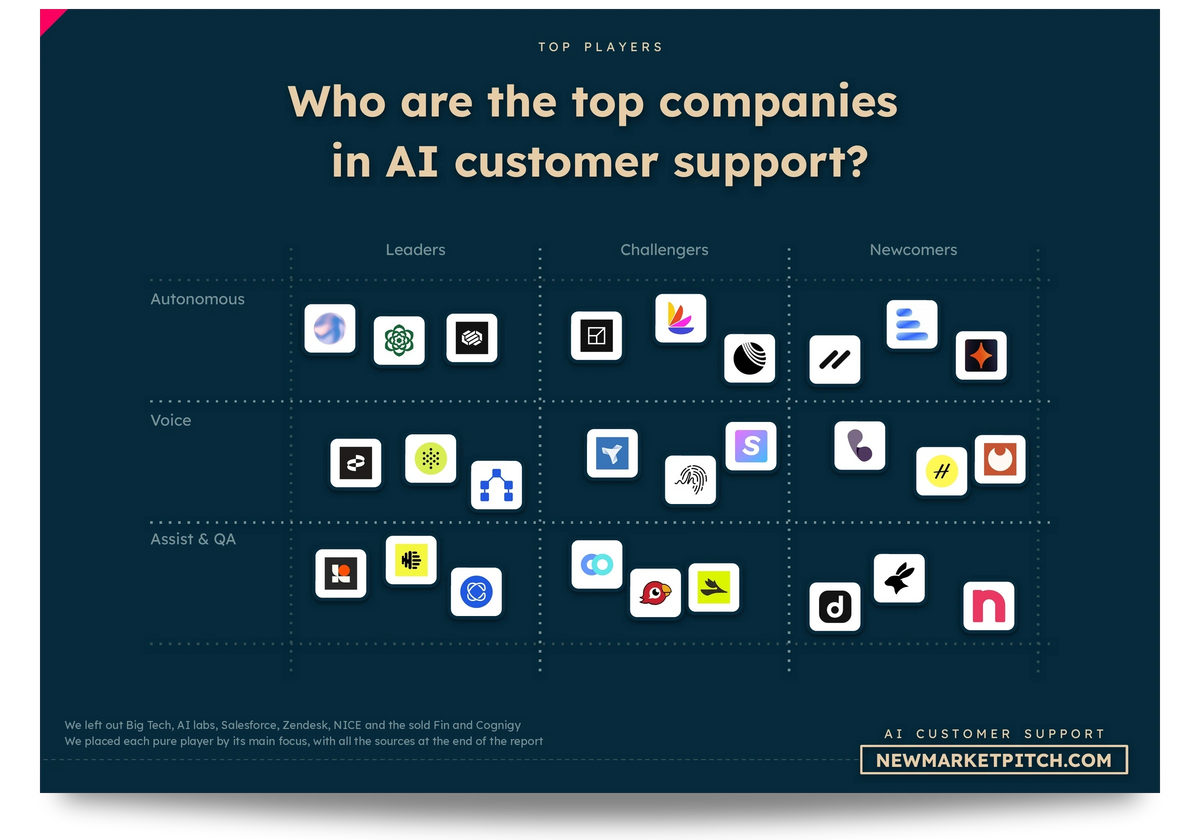
In our report covering the AI customer support market, we turn what is vague and complex into simple, useful visuals. Market maps like this one show you at a glance where every startup stands.
The ranking of top startups in the AI customer support market by revenue
Below is a table ranking the startups of this market by their current revenue scale. You can find our methodology at the end of this page.
If you want a deeper understanding of the market and its current dynamics, get our report on the AI customer support market.
| Ranking | Company | Latest Metric | Metric Type | Freshness | Disclosed When | Source Quality | Confidence | Segment | Why This Ranking | Local Metric | Country |
|---|---|---|---|---|---|---|---|---|---|---|---|
| 1 | Sprinklr | $857M | Fiscal-Year Revenue | Fresh · 9mo | Mar 11, 2026 | Filed / Audited | High | Contact Center Platforms | Recent reported revenue narrowly exceeds Freshworks, but also includes social media and marketing products. | us | |
| 2 | Freshworks | $839M | Annual Revenue | Fresh · 10mo | Feb 2026 | Filed / Audited | High | AI Helpdesk | Audited revenue follows Sprinklr closely; Freshservice employee-support products are outside the customer-support market. | us | |
| 3 | Fin | $400M | ARR | Fresh · 7mo | Mar 2, 2026 | Company Disclosed | Medium | Automated Support Agents | Company-wide ARR exceeds other private startups; the standalone Fin agent is much smaller. Formerly Intercom; acquired by Salesforce in Sep 2026. | us | |
| 4 | Dialpad | >$300M | ARR | Aging · 24mo | Oct 15, 2024 | Company Disclosed | Medium | Contact Center Platforms | Larger last-disclosed ARR than Aircall but 24 months old and includes non-support business telephony. | us | |
| 5 | Aircall | $250M | ARR | Very Fresh · 0mo | Oct 29, 2026 | Company Disclosed | Medium | Contact Center Platforms | Exceptionally current ARR supports a high position; sales calling remains part of the broader company perimeter. | fr | |
| 6 | Talkdesk | ~$279M | ARR | Very Fresh · 3mo | Jul 12, 2026 | Third-Party Estimate | Low | Contact Center Platforms | Model suggests greater scale than Aircall but rests on traffic and pricing assumptions, so ranks below direct disclosures. | us | |
| 7 | Uniphore | >$200M | ARR | Fresh · 11mo | Nov 2025 | Company Disclosed | Medium | Contact Center AI | CEO-disclosed ARR offers stronger evidence than modeled Talkdesk scale; enterprise AI products outside support are included. | us | |
| 8 | EliseAI | >$200M | ARR | Very Fresh · 4mo | Jun 10, 2026 | Company Disclosed | Medium | Vertical Support Agents | More current than Uniphore at a similar threshold, but includes housing leasing and healthcare workflows beyond support. | us | |
| 9 | Sierra | $200M | ARR | Very Fresh · 2mo | Aug 31, 2026 | Company Disclosed | Medium | Automated Support Agents | Nearly pure-play support-agent ARR and very recent; ranked beside EliseAI, whose threshold was reported as above $200M. | us | |
| 10 | SoundHound AI | $169M | Annual Revenue | Fresh · 10mo | Feb 26, 2026 | Filed / Audited | Medium | Voice Support Agents | Recognized revenue gives stronger accounting evidence than ARR but also includes restaurant, automotive and non-support voice AI. | us | |
| 11 | Kore.ai | ~$110M | ARR | Aging · 19mo | Jun 2025 | Credible Reported | Medium | Automated Support Agents | Older reported ARR puts it below large recent platforms; its company perimeter also includes internal employee agents. | us | |
| 12 | Crescendo | >$100M | ARR | Very Fresh · 6mo | Apr 22, 2026 | Company Disclosed | Medium | AI-Native Contact Centers | Direct current ARR provides strong commercial evidence; outcome-based AI service includes human escalations and acquired operations. | us | |
| 13 | Cresta | >$100M | ARR | Very Fresh · 6mo | Apr 30, 2026 | Company Disclosed | Medium | Contact Center AI | Similar recent threshold to Crescendo, with a more software-centric agent-assist and contact-center AI mix. | us | |
| 14 | Capacity | >$100M | ARR | Very Fresh · 4mo | Jun 18, 2026 | Company Disclosed | Medium | Support Workflow AI | Direct and fresh ARR matches the Cresta threshold; acquisitions and internal workflow products broaden its scope. | us | |
| 15 | Front | >$100M | ARR | Fresh · 13mo | Sep 9, 2025 | Company Disclosed | Medium | AI Helpdesk | Older ARR remains solid but covers the broader shared-inbox collaboration platform, placing it below newer agentic peers. | us | |
| 16 | Decagon | ~$100M | Revenue Run-Rate | Very Fresh · 3mo | 2026 | Third-Party Estimate | Low | Automated Support Agents | Pure-play and current annualized revenue, but model-based evidence ranks below directly disclosed $100M ARR milestones. | us | |
| 17 | Gorgias | ~$100M | ARR | Fresh · 9mo | Jan 2026 | Third-Party Estimate | Low | Ecommerce Support AI | Estimated support-agent product ARR lacks direct verification and differs from consolidated revenue; ranks below Decagon. | us | |
| 18 | Retell AI | $80M | Revenue Run-Rate | Very Fresh · 1mo | Company Disclosed | Medium | Voice Support Agents | Direct and very recent $80M annualized revenue places it below companies near $100M ARR and above less authoritative estimates; this is not recognized annual revenue. | us | ||
| 19 | Sanas | ~$77M | ARR | Very Fresh · 2mo | Third-Party Estimate | Low | Contact Center AI | The ~$77M ARR estimate is commercially substantial but ranks below Retell because its source is modeled rather than company-disclosed, and speech enhancement is narrower than full-service automation. | us | ||
| 20 | Wonderful | ~$70M | Revenue Run-Rate | Very Fresh · 2mo | 2026 | Third-Party Estimate | Low | Automated Support Agents | Current estimated run-rate indicates scale, but includes implementation services and expanding non-support AI agents. | il | |
| 21 | Yellow.ai | ~$70M | ARR | Fresh · 9mo | Jan 2026 | Third-Party Estimate | Low | Automated Support Agents | AI-support segment estimate matches Wonderful run-rate numerically, but scope and assumptions differ substantially. | us | |
| 22 | Omilia | $60M | ARR | Very Fresh · 2mo | Aug 6, 2026 | Company Disclosed | Medium | Voice Support Agents | CEO-disclosed recent ARR is more dependable than larger estimates immediately above, though below their implied scale. | gr | |
| 23 | Parloa | >$50M | ARR | Fresh · 10mo | Dec 18, 2025 | Company Disclosed | Medium | Voice Support Agents | Reported recurring-revenue threshold trails Omilia, with direct company evidence and a pure-play contact-center AI focus. | de | |
| 24 | ASAPP | ~$40M | ARR | Fresh · 9mo | Jan 2026 | Third-Party Estimate | Low | Contact Center AI | Recent but third-party AI product estimate receives less weight than Parloa direct ARR. | us | |
| 25 | Help Scout | >$35M | ARR | Very Fresh · 4mo | Jun 30, 2026 | Company Disclosed | Medium | AI Helpdesk | Founder-sourced recurring-revenue scale is stronger than similarly sized models, but includes conventional helpdesk subscriptions. | us | |
| 26 | respond.io | $35M | ARR | Very Fresh · 4mo | Jun 16, 2026 | Company Disclosed | Medium | Omnichannel Support AI | Direct, current ARR ranks just below Help Scout threshold; platform also serves sales and marketing conversations. | my | |
| 27 | Cognigy | ~$37M | Annual Revenue | Aging · 22mo | Third-Party Estimate | Low | Automated Support Agents | Reported historical revenue puts Cognigy near providers with $35M ARR; less weight is placed on this older secondary figure. Acquired by NICE in Sep 2025. | de | ||
| 28 | Observe.AI | ~$28.3M | ARR | Very Fresh · 3mo | Jul 12, 2026 | Third-Party Estimate | Low | Support Quality AI | AI contact-center ARR is modeled from public signals rather than disclosed, weakening comparisons with direct figures nearby. | us | |
| 29 | Boost.ai | ~$28M | Annual Revenue | Fresh · 10mo | Company Disclosed | High | Automated Support Agents | Recent Norwegian revenue is disclosed in EUR rather than modeled; a definitive Oct 2026 agreement to join Automation Anywhere does not alter its 2025 standalone scope. | €25M | no | |
| 30 | PolyAI | ~$24M | Fiscal-Year Revenue | Fresh · 9mo | Jun 7, 2026 | Filed / Audited | High | Voice Support Agents | Filed consolidated group revenue is stronger than estimated ARR, but lower in amount than Boost.ai revenue. | £18M | gb |
| 31 | fonio.ai | $17.5M | ARR | Very Fresh · 0mo | Oct 20, 2026 | Company Disclosed | Medium | Voice Support Agents | The newest direct ARR milestone trails PolyAI audited revenue but has stronger freshness. | at | |
| 32 | Vapi | >$10M | Revenue Run-Rate | Very Fresh · 5mo | May 12, 2026 | Derived / Implied | Low | Voice Support Agents | An investor describes an eight-figure annual run-rate without a precise value. The displayed lower bound is implied and is less reliable than company-disclosed amounts nearby. | us | |
| 33 | Crisp | >$10M | ARR | Very Fresh · 3mo | Jul 2, 2026 | Derived / Implied | Low | AI Helpdesk | Eight-figure ARR implies only a lower bound, not a precise value; ranks below fonio.ai despite possible higher actual scale. | fr | |
| 34 | Ultimate | ~$11.1M | Segment Revenue | Aging · 22mo | Oct 2026 | Credible Reported | Low | Automated Support Agents | Only one Finnish legal entity is covered, excluding much of the Berlin operation; this is a partial figure and should not be compared as consolidated revenue. | €10.3M | de |
| 35 | Sobot | ~$10.7M | Annual Revenue | Fresh · 10mo | Aug 10, 2026 | Third-Party Estimate | Low | Contact Center Platforms | Estimated annual revenue is weaker than audited accounts; the underlying Sobot business dates to 2014 even though its Singapore-facing profile cites a newer launch. | sg | |
| 36 | eDesk | ~$10.5M | Annual Revenue | Fresh · 10mo | Jul 2025 | Third-Party Estimate | Low | Ecommerce Support AI | Estimated recognized-revenue scale is less certain than the ARR lower bound above and includes conventional ecommerce support. | ie | |
| 37 | Chatbase | >$10M | ARR | Very Fresh · 4mo | Jun 16, 2026 | Company Disclosed | Medium | Automated Support Agents | The $10M ARR threshold is directly supported by a customer case study, but full 2026 recognized revenue is not disclosed. | us | |
| 38 | Maven AGI | ~$7M | ARR | Fresh · 9mo | Jan 2026 | Third-Party Estimate | Low | Automated Support Agents | Pure-play support AI estimate ranks below Chatbase direct ARR because third-party methodology is not auditable. | us | |
| 39 | Gnani.ai | ~$6.4M | Fiscal-Year Revenue | Aging · 19mo | Mar 30, 2026 | Credible Reported | Medium | Voice Support Agents | Company operating income is a stronger financial indicator than estimated ARR for smaller competitors; however, it is 19 months old and the legal-entity perimeter may differ from group sales. | INR 539M | in |
| 40 | Siena AI | ~$5.9M | Annual Revenue | Fresh · 16mo | Sep 2, 2026 | Third-Party Estimate | Low | Ecommerce Support AI | An estimated $5.9M annual revenue figure is informative but weak; the company separately reports hundreds of consumer-brand customers in Oct 2026. | us | |
| 41 | Kapture CX | >$4.9M | Fiscal-Year Revenue | Historical · 31mo | Credible Reported | Low | Contact Center AI | FY2024 Indian operating-company revenue is over two years old; later enterprise expansion may make it a poor proxy for present scale. | >INR 409M | in | |
| 42 | Synthflow AI | ~$5M | ARR | Fresh · 10mo | 2025 | Credible Reported | Low | Voice Support Agents | A recruiting partner references a $5M ARR baseline, but the exact date and trajectory are unclear. The $50M figure is a target, not realized revenue. | de | |
| 43 | Bland AI | ~$3.8M | Annual Revenue | Aging · 22mo | 2025 | Third-Party Estimate | Low | Voice Support Agents | Old modeled revenue understates possible current voice-agent scale; actual current revenue is not publicly verified. | us | |
| 44 | Fini | $190K | Monthly Revenue | Fresh · 10mo | 2025 | Credible Reported | Low | Automated Support Agents | Monthly revenue cannot be directly compared with annual figures and is not annualized here; evidence is founder-reported. | nl | |
| 45 | Mosaic AI | ~$1M | Bookings | Very Fresh · 4mo | Jun 9, 2026 | Company Disclosed | Low | Support Workflow AI | Newly contracted ARR is a partial monthly sales flow, not total ARR or recognized annual revenue; it sits below full-company financial figures. | il | |
| 46 | DigitalGenius | ~$962K | Annual Revenue | Historical · 34mo | Aug 10, 2026 | Third-Party Estimate | Low | Ecommerce Support AI | Only a very old modeled revenue figure is available; current AI-agent sales may differ greatly and cannot be inferred from it. | gb | |
| 47 | Ada | >550 AI agents deployed | Other Scale Signal | Fresh · 7mo | Mar 3, 2026 | Company Disclosed | Low | Automated Support Agents | Extensive enterprise deployments indicate adoption, but agent count cannot establish revenue or a defensible monetary rank. | ca | |
| 48 | Replicant | >1B minutes automated | Other Scale Signal | Fresh · 8mo | Feb 5, 2026 | Company Disclosed | Low | Voice Support Agents | Cumulative usage demonstrates production scale but is not recurring revenue, so it follows companies with financial disclosures. | us | |
| 49 | Gradient Labs | >20 production customers | Other Scale Signal | Very Fresh · 4mo | Jun 2026 | Company Disclosed | Low | Automated Support Agents | Production deployments demonstrate B2B traction, not the contract values needed for a revenue ranking. | gb | |
| 50 | Hyro | >45 health systems | Other Scale Signal | Fresh · 12mo | Oct 21, 2025 | Company Disclosed | Low | Vertical Support Agents | Healthcare-provider adoption demonstrates real production use but includes both patient self-service and operational workflows, without comparable revenue. | us | |
| 51 | Tidio | >300K businesses | Other Scale Signal | Undated | Company Disclosed | Low | Ecommerce Support AI | Broad company adoption includes free or low-value accounts, so it cannot be interpreted as paid revenue. | pl | ||
| 52 | Kapa.ai | >200 customer companies | Other Scale Signal | Undated | Company Disclosed | Low | Automated Support Agents | More than 200 deployed enterprise customers make it better evidenced than unquantified adoption claims, but no ARR or total revenue is published. | dk | ||
| 53 | Pylon | >1,500 customers | Other Scale Signal | Undated | Company Disclosed | Low | AI Helpdesk | Over 1,500 customer companies indicate product adoption, but paying status and revenue per account are not disclosed. | us | ||
| 54 | Forethought | >1B interactions monthly | Transactions | Fresh · 10mo | Mar 11, 2026 | Credible Reported | Low | Automated Support Agents | Interaction throughput is broad and non-monetary; the company was acquired by Zendesk in 2026. | us | |
| 55 | Quiq | >200 enterprise customers | Other Scale Signal | Undated | Company Disclosed | Low | Automated Support Agents | Customer relationships establish an operating footprint, but the absence of revenue prevents reliable placement. | us | ||
| 56 | Yuma AI | >140 ecommerce brands | Other Scale Signal | Undated | Company Disclosed | Low | Ecommerce Support AI | Current deployments provide more useful evidence than the older 100-client milestone, but brand counts are not recognized revenue. | us | ||
| 57 | Verloop.io | >20M interactions monthly | Transactions | Very Fresh · 3mo | Jul 9, 2026 | Credible Reported | Low | Automated Support Agents | Monthly interaction volume confirms material usage but cannot establish revenue; acquired by Nurix AI, renamed NuPlay AI, in Jul 2026. | in | |
| NR | Netomi | Not disclosed | Other Scale Signal | Undated | Credible Reported | Low | Automated Support Agents | Product adoption is evident but no reliable revenue, paid-customer, or throughput figure was established; funding is not revenue. | us | ||
| NR | Kustomer | Not disclosed | Other Scale Signal | Undated | Company Disclosed | Low | AI Helpdesk | Independent after separation from Meta; 2022 takeover has ended. Without revenue or a comparable paid-customer figure, this position is provisional. | us | ||
| NR | Dixa | Not disclosed | Other Scale Signal | Undated | Company Disclosed | Low | AI Helpdesk | Private support platform; financial scale is not publicly quantified. Without revenue or a comparable paid-customer figure, this position is provisional. | dk | ||
| NR | Aisera | Not disclosed | Other Scale Signal | Undated | Company Disclosed | Low | Automated Support Agents | Acquired by Automation Anywhere in Nov 2025, but no standalone customer-support revenue is publicly quantified. | us | ||
| NR | Balto | Not disclosed | Other Scale Signal | Undated | Company Disclosed | Low | Support Quality AI | Real-time call coaching vendor; publicly visible operating scale lacks a reliable revenue measure. Without revenue or a comparable paid-customer figure, this position is provisional. | us | ||
| NR | Level AI | Not disclosed | Other Scale Signal | Undated | Company Disclosed | Low | Support Quality AI | Contact center QA and agent-assist products fit, but monetary scale remains undisclosed. Without revenue or a comparable paid-customer figure, this position is provisional. | us | ||
| NR | Glia | Not disclosed | Other Scale Signal | Undated | Company Disclosed | Low | Contact Center AI | Financial-services customer interaction platform; revenue from AI support not disclosed. Without revenue or a comparable paid-customer figure, this position is provisional. | us | ||
| NR | UJET | Not disclosed | Other Scale Signal | Undated | Company Disclosed | Low | Contact Center Platforms | AI contact-center software is core, but no comparable company revenue verified. Without revenue or a comparable paid-customer figure, this position is provisional. | us | ||
| NR | Lorikeet | Not disclosed | Other Scale Signal | Undated | Company Disclosed | Low | Automated Support Agents | Automates inbound service conversations, but revenue has not been publicly established. Without revenue or a comparable paid-customer figure, this position is provisional. | au | ||
| NR | Gladly | Not disclosed | Other Scale Signal | Undated | Company Disclosed | Low | AI Helpdesk | AI-native customer service platform, with no independently supported company-wide revenue figure. Position is provisional without a revenue disclosure. | us | ||
| NR | Regal | Not disclosed | Other Scale Signal | Undated | Company Disclosed | Low | Voice Support Agents | AI phone agents for sales and customer service; sales-only activity is outside this ranking. Position is provisional without a revenue disclosure. | us | ||
| NR | Giga AI | Not disclosed | Other Scale Signal | Undated | Company Disclosed | Low | Voice Support Agents | Voice customer-support automation vendor, without a publicly attributable company revenue figure. Position is provisional without a revenue disclosure. | us | ||
| NR | Rasa | Not disclosed | Other Scale Signal | Undated | Company Disclosed | Low | Automated Support Agents | Conversational AI platform used for customer support, although also sold to other use cases. Position is provisional without a revenue disclosure. | us | ||
| NR | Ema | Not disclosed | Other Scale Signal | Undated | Company Disclosed | Low | Support Workflow AI | Enterprise AI agents include service-support workflows, but most revenue is not attributable to external customer support. Position is provisional without a revenue disclosure. | us |

Our research about AI customer support tools gets updated several times a month, so you always get the latest view of where things stand.
Which AI customer support startups make the most revenue today?
Sprinklr currently ranks first among AI customer support startups with $857M in FY2026 revenue, followed by Freshworks at $839M in 2025 and Fin, formerly Intercom and now part of Salesforce, at $400M ARR as of March 2026.
The gap between Sprinklr and Freshworks is just $18M, or approximately 2.1% of Freshworks' reported revenue. Both companies have substantial businesses outside AI customer support, which explains why their financial scale is much larger than that of most newer autonomous-agent startups.
Fin's $400M figure covers the broader company, including its original customer messaging products. Its AI agent was approaching $100M ARR when CEO Eoghan McCabe disclosed the company-wide figure.
Below the top three, Dialpad, Aircall and Talkdesk represent the large communications-platform businesses. Uniphore and EliseAI have crossed $200M ARR, while Sierra reached $200M ARR as of August 2026 through its autonomous customer-agent platform.
Below $100M, the market becomes much harder to measure. Voice specialists, ecommerce automation vendors and smaller AI-native platforms are already generating meaningful revenue, although many rely on estimates or disclose run-rates rather than recognized annual sales.
| Rank | Startup | Revenue or commercial scale | Metric and period |
|---|---|---|---|
| 1 | Sprinklr | $857M | Fiscal-Year Revenue, FY2026 |
| 2 | Freshworks | $839M | Annual Revenue, 2025 |
| 3 | Fin | $400M | ARR, Mar 2026 |
| 4 | Dialpad | >$300M | ARR, Oct 2024 |
| 5 | Aircall | $250M | ARR, Oct 2026 |
| 6 | Talkdesk | ~$279M | Estimated ARR, Jul 2026 |
| 7 | Uniphore | >$200M | ARR, Nov 2025 |
| 8 | EliseAI | >$200M | ARR, Jun 2026 |
| 9 | Sierra | $200M | ARR, Aug 2026 |
| 10 | SoundHound AI | $169M | Annual Revenue, 2025 |
| 11 | Kore.ai | ~$110M | Reported ARR, Mar 2025 |
| 12 | Crescendo | >$100M | ARR, Apr 2026 |
| 13 | Cresta | >$100M | ARR, Apr 2026 |
| 14 | Capacity | >$100M | ARR, Jun 2026 |
| 15 | Front | >$100M | ARR, Sep 2025 |
| 16 | Decagon | ~$100M | Revenue Run-Rate, Jul 2026 |
| 17 | Gorgias | ~$100M | Estimated product ARR, Jan 2026 |
| 18 | Retell AI | $80M | Revenue Run-Rate, Sep 2026 |
| 19 | Sanas | ~$77M | Estimated ARR, Aug 2026 |
| 20 | Wonderful | ~$70M | Revenue Run-Rate, Aug 2026 |
| 21 | Yellow.ai | ~$70M | Estimated support ARR, Jan 2026 |
| 22 | Omilia | $60M | ARR, Aug 2026 |
| 23 | Parloa | >$50M | ARR, Dec 2025 |
Why are AI customer support startups growing so fast now?
AI customer support startups are growing quickly because businesses can now automate complete customer conversations and the tasks that follow them, opening a much larger market than traditional chatbots could address.
Sierra reached $100M ARR in seven quarters and $200M in nine quarters, according to its August 2026 announcement. EliseAI reported crossing $200M ARR in June 2026 after five consecutive years of doubling its business. Cresta confirmed to Axios in April 2026 that it had exceeded $100M ARR.
These companies are selling quite different products. Sierra builds autonomous customer agents, EliseAI automates housing and healthcare operations, and Cresta combines autonomous agents with tools that help human contact-center employees.
What connects them is the kind of work customers are willing to pay for. An AI agent can increasingly retrieve account information, change reservations, handle billing questions and complete service requests through connected systems.
There is also a financial incentive. Customer service is a large recurring expense, so even a modest reduction in the cost of handling routine requests can justify substantial software spending. Large companies can deploy these systems across millions of interactions rather than a few experimental use cases.
These are real businesses now. Their economics still vary sharply between software subscriptions, consumption charges and managed services.

In our market report about AI customer support tools, we look at what the winners do differently, so you can learn from the best instead of guessing.
Is Sprinklr really the biggest AI customer support startup?
Sprinklr is currently the biggest AI customer support startup in our revenue ranking, with $857M in FY2026 consolidated revenue, although only part of that business comes from AI-powered customer service.
According to its FY2026 financial results, Sprinklr generated $857.2M in revenue, up from $796.4M in FY2025. That represents approximately 8% annual growth, with subscription revenue rising from $717.9M to $756.3M.
Sprinklr originally focused on social media management before expanding into customer experience, contact-center software and AI-driven service. Its revenue therefore includes marketing and other software products that are not directly comparable with the autonomous agents sold by Sierra or Decagon.
Freshworks is similarly diversified, while Fin combines its established messaging platform with a newer AI-agent business.
We can confidently call Sprinklr the largest startup by the revenue measure used in our ranking. But there is no reliable disclosure proving it generates more revenue from autonomous AI customer support specifically than every other company.
Is Freshworks catching up with Sprinklr in revenue?
Freshworks is already remarkably close to Sprinklr in revenue, with $839M reported for 2025 against Sprinklr's $857M for FY2026.
The $18M difference makes this one of the closest comparisons near the top of the ranking. Sprinklr reported 8% annual revenue growth in FY2026, while Freshworks' SEC filing put its 2025 consolidated revenue at $838.8M.
Freshworks has two major product lines: Freshdesk, which handles external customer support, and Freshservice, which is mainly used for employee IT and service management. Sprinklr combines customer service with social media management, marketing and other customer-experience products.
Both companies have an advantage that newer AI-agent vendors must build from scratch: an established customer base, integrations into corporate systems and years of enterprise sales relationships.
Their biggest challenge now is persuading existing customers to spend more on AI automation while companies such as Sierra, Cresta and Decagon compete directly for that spending.
Freshworks has nearly matched Sprinklr's reported scale, but the different financial periods do not establish that it has overtaken the company.

In our document detailing everything you need to know about AI customer support, you will always find fresh funding data, taken straight from our own verified funding database.
How much revenue does Fin, formerly Intercom, actually make?
Fin ranks third among AI customer support startups with $400M in company-wide ARR as of March 2026, while its autonomous support agent was approaching $100M ARR.
CEO Eoghan McCabe disclosed those figures in March 2026. The numbers suggest that the Fin agent was approaching one-quarter of the company's recurring-revenue base, although the exact contribution was not reported.
Intercom spent years building a customer messaging and support software business before Fin became its main AI product. A substantial part of the $400M still reflected that broader platform.
Salesforce agreed to acquire Fin for approximately $3.6B in June 2026 and completed the acquisition in September. The company remains eligible in our startup ranking following that recent acquisition.
At closing, Salesforce said Fin served more than 30,000 companies. Its plan is to combine Fin's specialized customer-service agents with Salesforce's broader Agentforce platform.
Fin's existing software revenue gives it a strong commercial base. The next question is how much of that business can shift toward autonomous resolutions rather than traditional support subscriptions.
How big is Sierra compared with other AI customer support startups?
Sierra ranks ninth among AI customer support startups with $200M ARR as of August 2026, making it one of the largest companies focused primarily on autonomous customer-facing agents.
Its growth has been unusually fast. Sierra reached its first $100M ARR in seven quarters, then added another $100M within two quarters, according to its founders.
The company has also built a significant presence among large enterprises. In its earlier disclosures, Sierra reported relationships with more than 40% of Fortune 50 companies and strong penetration among major banks and healthcare businesses.
Those customers are important because Sierra's product targets complicated customer interactions rather than only basic website questions. Larger enterprises have more support volume, more systems to integrate and potentially much larger contracts.
Decagon's estimated ~$100M revenue run-rate and Crescendo's >$100M ARR show that Sierra is facing serious competition from other AI-focused vendors. Yet Sierra's selected $200M ARR remains substantially larger than those figures.
Sierra reached that level less than three years after entering the market. Plenty of enterprise software companies take much longer.

Learning from others' mistakes is the cheapest lesson there is. In our report covering the AI customer support market, we look at what broke startups before you, so you don't repeat it.
Which AI customer support startups have passed $100 million in revenue?
Fifteen AI customer support startups have selected monetary figures at or above the $100M threshold, while Decagon and Gorgias are additionally estimated around $100M.
The first fifteen include Sprinklr, Freshworks, Fin, Dialpad, Aircall, Talkdesk, Uniphore, EliseAI, Sierra, SoundHound AI, Kore.ai, Crescendo, Cresta, Capacity and Front.
However, these figures measure different things. Sprinklr's $857M is reported fiscal-year revenue, while Aircall's $250M is ARR. SoundHound AI's $169M reflects recognized consolidated sales, including voice AI applications outside customer support.
Among the newer AI-agent businesses, the threshold is becoming more common. Crescendo and Cresta each reported >$100M ARR in April 2026, while Capacity passed the same milestone in June.
The quality of the evidence also varies near this level. Front directly reported >$100M ARR in September 2025, whereas Decagon's ~$100M annualized revenue and Gorgias' ~$100M AI-product ARR come from third-party estimates.
We've reached a point where $100M is no longer an exceptional revenue milestone across the broader AI customer support industry. Among independent, recently founded autonomous-agent specialists, it remains a much smaller group.
Can Decagon catch Sierra in AI customer support revenue?
Decagon is becoming a major competitor to Sierra, but the selected revenue figures still show Sierra at roughly twice its scale: $200M ARR versus Decagon's estimated ~$100M annualized revenue.
Sacra estimated Decagon's revenue run-rate at approximately $100M in July 2026. Sierra's founders disclosed $200M ARR as of August, giving us stronger direct evidence for Sierra's figure.
Both companies target enterprise support automation. Their agents can access business systems, respond to customers and carry out tasks that previously required human support employees.
Decagon has attracted large enterprise customers and significant investment, but those achievements do not establish that its revenue has caught Sierra's. The estimated run-rate also needs to be distinguished from recognized annual revenue.
The market is crowded beyond these two companies. Cresta's >$100M ARR comes from a combination of AI assistance and automation, while Crescendo's >$100M ARR includes an operating model with human escalations and managed service delivery.
For now, Sierra retains a clear advantage on the figures used in our ranking. Decagon has reached a scale where closing that gap is a realistic competitive question rather than a purely hypothetical one.

Your time is limited. In our research about AI customer support tools, we put numbers on each part of the market, so you can see where it makes sense to focus.
Are AI agents making more money than traditional customer support software?
Traditional customer support software companies still generate the largest revenues, but autonomous AI-agent startups are reaching nine-figure recurring revenue much faster than earlier generations of support software businesses.
Freshworks generated $839M in 2025, while Fin reached $400M in company-wide ARR as of March 2026. Both developed substantial businesses before autonomous customer-service agents became commercially viable.
Sierra reached $200M ARR in less than three years of operations. Crescendo and Cresta have each exceeded $100M ARR, while Decagon's estimated annualized revenue is around $100M.
Part of the explanation is pricing. Traditional helpdesks commonly charge for employee seats, subscriptions and additional software features. Autonomous agents increasingly charge for usage, completed conversations or specific outcomes.
Fin, for example, publishes a $0.99 price for qualifying AI-agent outcomes. The bill can rise as an agent handles more work, even with fewer human support employees.
There is still no consistent public evidence that AI-agent startups have better profit margins than conventional helpdesk businesses. Their software bills can include substantial model inference, implementation and customer-support costs.
What we can already see is that autonomous agents are creating large revenue streams without requiring companies to first build traditional helpdesk platforms.
Which smaller AI customer support startups already make serious revenue?
The AI customer support market has a sizeable group of smaller businesses generating tens of millions in recurring or annual revenue, well beyond the handful of companies dominating media coverage.
Omilia reported $60M ARR in August 2026, while Parloa disclosed >$50M ARR in December 2025. Both specialize in voice-based customer-service automation.
Help Scout reported >$35M ARR in June 2026, while respond.io reached $35M ARR during the same period. Their products serve different needs: Help Scout provides conventional customer-support software with AI capabilities, whereas respond.io handles customer communications across messaging channels, including sales and marketing use cases.
Boost.ai reported €25M of annual revenue in 2025, according to Nordic Capital's investment information. PolyAI recorded £18M in FY2026 revenue, based on UK company financial information.
There is a long tail of credible businesses, too. Fonio.ai reported $17.5M ARR in October 2026, Chatbase exceeded $10M ARR, and Maven AGI carried an estimated ~$7M ARR as of January 2026.
Some figures are less comparable. Fini's $190K is monthly revenue, while Mosaic AI's ~$1M reflects newly contracted ARR during a short period rather than its total company revenue.
| Rank | Startup | Revenue or commercial scale | Metric and period |
|---|---|---|---|
| 24 | ASAPP | ~$40M | Estimated product ARR, Jan 2026 |
| 25 | Help Scout | >$35M | ARR, Jun 2026 |
| 26 | respond.io | $35M | ARR, Jun 2026 |
| 27 | Cognigy | ~$37M | Estimated Annual Revenue, 2024 |
| 28 | Observe.AI | ~$28.3M | Estimated ARR, Jul 2026 |
| 29 | Boost.ai | €25M | Annual Revenue, 2025 |
| 30 | PolyAI | £18M | Fiscal-Year Revenue, FY2026 |
| 31 | fonio.ai | $17.5M | ARR, Oct 2026 |
| 32 | Vapi | >$10M | Implied Revenue Run-Rate, May 2026 |
| 33 | Crisp | >$10M | ARR, Jul 2026 |
| 34 | Ultimate | €10.3M | Segment Revenue, 2024 |
| 35 | Sobot | ~$10.7M | Estimated Annual Revenue, 2025 |
| 36 | eDesk | ~$10.5M | Estimated Annual Revenue, 2025 |
| 37 | Chatbase | >$10M | ARR, Jun 2026 |
| 38 | Maven AGI | ~$7M | Estimated ARR, Jan 2026 |
| 39 | Gnani.ai | INR 539M | Fiscal-Year Revenue, FY2025 |
| 40 | Siena AI | ~$5.9M | Estimated Annual Revenue, Jun 2025 |
| 41 | Kapture CX | >INR 409M | Fiscal-Year Revenue, FY2024 |
| 42 | Synthflow AI | ~$5M | Reported ARR, 2025 |
| 43 | Bland AI | ~$3.8M | Estimated Annual Revenue, 2024 |
| 44 | Fini | $190K | Monthly Revenue, 2025 |
| 45 | Mosaic AI | ~$1M | New ARR Bookings, May–Jun 2026 |
| 46 | DigitalGenius | ~$962K | Estimated Annual Revenue, 2023 |

In our market report about AI customer support tools, we always try to gather several sources and make estimates that make sense, so you can work with solid numbers.
Are AI voice customer support startups making big money now?
AI voice customer support startups are already generating tens of millions of dollars annually, with Retell AI reporting an $80M revenue run-rate and Omilia disclosing $60M ARR.
Retell's September 2026 milestone shows how quickly demand for automated phone agents has grown. Omilia reached its $60M ARR figure after a tenfold increase in recurring revenue, according to comments from its CEO reported by TechCrunch in August 2026.
Parloa reported >$50M ARR in December 2025. PolyAI recorded £18M in FY2026 turnover, while fonio.ai disclosed $17.5M ARR in October 2026.
SoundHound AI ranks higher overall with $169M in 2025 consolidated revenue, although much of its business goes beyond customer support, including restaurant and automotive voice applications.
Voice agents face challenges that text chatbots can sometimes avoid. A phone conversation requires fast responses, reliable speech recognition, interruption handling and the ability to transfer complicated cases without losing context.
That makes voice a specialist market, with costs for speech processing, telephony and real-time inference that text support often avoids.
Is Retell AI bigger than Vapi and Bland AI?
Retell AI has the strongest disclosed revenue figure among Retell, Vapi and Bland AI, reporting an $80M annualized revenue run-rate as of September 2026.
Vapi's commercial scale is much less precisely documented. TechCrunch reported in May 2026 that an investor described the company as generating a healthy eight-figure annualized recurring revenue run-rate, implying >$10M without establishing an exact amount.
Bland AI's available ~$3.8M figure is a third-party estimate of its 2024 annual revenue. That estimate is too old to stand in for Bland's current business.
All three companies provide technology for automated phone conversations, although their platforms can also handle sales, scheduling and other workflows unrelated to customer service.
Retell currently has stronger direct evidence of substantial commercial revenue. The available disclosures are too uneven to establish precise differences in today's underlying sales across all three businesses.

If you build or invest in the AI customer support market, you need to know which business models pay off now and which ones are fading. That's why our report covering it has a whole section on it.
Is ecommerce AI customer support smaller than enterprise AI support?
Ecommerce-focused AI customer support startups generally report lower revenue than the biggest enterprise AI-agent vendors, although Gorgias stands out with an estimated ~$100M in AI customer-service product ARR.
That January 2026 estimate places Gorgias well ahead of several smaller ecommerce specialists. eDesk carries an estimated ~$10.5M in 2025 annual revenue, Siena AI approximately $5.9M from June 2025, and DigitalGenius around $962K based on an older 2023 estimate.
Ecommerce support is particularly suitable for automation because many customer questions follow predictable patterns: checking order status, tracking shipments, processing returns and managing refunds.
Companies such as Gorgias can integrate directly with online-store systems, allowing AI agents to perform actions instead of merely answering questions.
Enterprise-focused companies such as Sierra and Cresta often handle more complex customer relationships, including financial services, healthcare and telecommunications. Those deployments may involve larger contracts and more extensive integrations.
Gorgias demonstrates that ecommerce AI support can become a nine-figure business. The other available figures suggest that the category has fewer companies at that scale than the broader enterprise support market.
Why do companies still pay so much for contact-center platforms when AI agents exist?
Contact-center platforms still generate substantial revenue because companies need phone systems, routing, analytics, security and human-agent tools even as more customer requests become automated.
Dialpad reported >$300M ARR in October 2024, Aircall reached $250M ARR in October 2026, and Talkdesk was estimated at ~$279M ARR in July 2026.
Aircall's recent acquisitions show how these companies are adapting. It acquired voice AI specialist Vogent in May 2026 and Piper AI in June, adding automation capabilities to its existing communications software.
The business already served more than 24,000 customers when co-founder Olivier Pailhès returned as CEO in October. That gives Aircall a large installed customer base for introducing AI features.
Other vendors have a similar advantage. A company using an established contact-center platform may prefer adding AI features to its existing system rather than moving communications, employee workflows and reporting to another provider.
However, there is a growing risk that specialized AI-agent companies capture much of the value created by automating support work, leaving traditional platforms to handle the underlying communications infrastructure.

In our report covering the AI customer support market, we don't want to repeat what boring consulting reports say. Instead, we show you the real and latest market signals that matter.
Are AI customer support startups replacing human agents?
AI customer support startups are replacing some routine support tasks, but a significant part of the industry still makes money by helping human agents handle calls more effectively.
Cresta exceeded $100M ARR in April 2026 with products covering agent assistance, analytics and autonomous AI. Sanas was estimated at ~$77M ARR in August 2026, largely from real-time speech enhancement for contact-center employees.
Uniphore reported >$200M ARR as of November 2025 across enterprise AI applications, including customer-service capabilities.
These products address different problems from fully autonomous customer agents. Speech enhancement can improve how clearly a human employee is understood. Agent-assist software can suggest answers, summarize calls or identify compliance problems.
Sierra and Decagon focus more directly on handling customer requests autonomously, including actions that would previously have required employees to navigate several systems.
No reliable industry-wide figure isolates the number of support jobs lost because of these startups. Their sales show demand for automation, not its net effect on employment.
Which AI customer support startups are growing the fastest?
Sierra and EliseAI have some of the strongest documented growth records among large AI customer support startups, while smaller businesses such as respond.io have also reported exceptionally high annual growth.
Sierra went from $100M ARR to $200M within two quarters, based on its August 2026 disclosure. The company had previously taken seven quarters to reach its first $100M.
EliseAI reported five consecutive years of 100% annual growth when announcing that it had passed $200M ARR in June 2026. Five successive doublings would represent a 32-fold increase from the starting revenue base, although the announcement did not include a complete year-by-year financial history.
Respond.io disclosed 169% annual growth alongside $35M ARR in June 2026. That percentage exceeds a 100% annual growth rate, but it starts from a much smaller revenue base and covers a different period.
The companies also operate in different markets. Sierra concentrates on enterprise customer-facing agents, EliseAI serves housing and healthcare operations, and respond.io handles omnichannel business messaging.
These are unusually fast growth rates. Picking a single winner would require matching financial periods and accounting methods that the companies do not consistently disclose.

In our research about AI customer support tools, we like to show you the big picture. We know your time is precious, so we make every page quick to read and packed with as much learning as possible per minute.
Can AI customer support startups keep growing if automated resolutions get cheaper?
AI customer support startups can keep growing as automated resolutions become cheaper, but usage-based businesses will need more volume or more valuable tasks to offset lower prices.
Fin publishes a $0.99 charge for qualifying AI-agent outcomes. At that price, one million billable outcomes would produce $990K in usage charges, while ten million would produce $9.9M. These are illustrative calculations based on published pricing, not Fin's disclosed revenue.
If the average price per outcome fell by half, the company would need roughly twice the billable volume to maintain the same usage revenue, assuming other revenue sources remained unchanged.
That creates pressure for vendors focused mainly on simple questions. Answering an order-status request or retrieving a help-center article is becoming easier for competing products to replicate.
More complicated workflows offer greater scope for differentiation. An agent that completes a refund, changes a financial product or handles a multi-step account problem may provide more value to customers.
Inference costs may also decline, potentially improving margins even when selling prices fall. But we cannot assume vendors will keep all those savings when competition is already increasing.
Basic answers are getting cheaper. The bigger opportunity is handling the entire customer request.
Why are Salesforce, NICE and Zendesk buying AI customer support startups?
Large software companies are buying AI customer support startups because autonomous agents are becoming central to the products they already sell to customer-service departments.
Salesforce completed its approximately $3.6B acquisition of Fin in September 2026. The deal added Fin's customer-agent technology, engineering team and more than 30,000 existing customer companies.
NICE acquired Cognigy in September 2025. Cognigy ranks twenty-seventh in our startup ranking with an estimated ~$37M of 2024 revenue.
Zendesk acquired Ultimate in 2024 and Forethought in March 2026. Ultimate ranks thirty-fourth with €10.3M in 2024 revenue from a Finnish legal entity, which does not represent its entire historical business.
Boost.ai, ranked twenty-ninth with €25M in 2025 revenue, entered a definitive acquisition agreement with Automation Anywhere in October 2026. The same buyer had acquired Aisera in November 2025.
The buyers want agents that work across the enterprise systems their customers already use.
The acquisition prices themselves are separate from revenue. The acquired startups retain their ranking positions under our methodology, while the established buyers remain outside the startup ranking.

When you build or invest in the AI customer support market, you need clarity, not confusion. In our market report about AI customer support tools, we always try to put numbers on and quantify whatever is usually vague and confusing.
Which AI customer support startups have lots of customers but undisclosed revenue?
Several AI customer support startups have substantial production usage without publishing comparable revenue figures, including Ada, Replicant, Forethought and Tidio.
Ada reported more than 550 enterprise AI agents deployed as of March 2026. Replicant disclosed more than one billion cumulative automated phone minutes through February 2026.
Forethought, acquired by Zendesk in March 2026, was reported to handle more than one billion customer interactions per month by 2025. Tidio reports more than 300,000 businesses using its products, although the figure includes accounts that may not pay.
These adoption measures describe very different things. A cumulative total includes activity over the company's history, monthly interactions reflect current throughput, and business accounts may include free users.
Other companies have narrower but meaningful footprints. Hyro serves more than 45 health systems, Kapa.ai reports more than 200 customer companies, and Pylon reports more than 1,500 customers.
We keep those operating figures separate; multiplying users or interactions by hypothetical prices would invent revenue.
| Rank | Startup | Disclosed commercial scale | Period |
|---|---|---|---|
| 47 | Ada | >550 AI agents deployed | Mar 2026 |
| 48 | Replicant | >1B minutes automated | Through Feb 2026 |
| 49 | Gradient Labs | >20 production customers | Jun 2026 |
| 50 | Hyro | >45 health systems | Oct 2025 |
| 51 | Tidio | >300K businesses | Undated |
| 52 | Kapa.ai | >200 customer companies | Undated |
| 53 | Pylon | >1,500 customers | Undated |
| 54 | Forethought | >1B interactions monthly | 2025 |
| 55 | Quiq | >200 enterprise customers | 2026 |
| 56 | Yuma AI | >140 ecommerce brands | Undated |
| 57 | Verloop.io | >20M interactions monthly | Jul 2026 |
Which well-known AI customer support startups still don't disclose revenue?
Several well-known AI customer support startups still have no reliable public revenue figure, including Netomi, Kustomer, Dixa, Aisera, Balto, Level AI and Glia.
Other notable companies without a comparable monetary figure include UJET, Lorikeet, Gladly, Regal, Giga AI, Rasa and Ema.
Their products range from enterprise contact-center platforms and automated support agents to voice calling, quality assurance and workflow automation. Some have major customers or substantial funding, but neither proves how much revenue the business generates.
Corporate ownership changes make certain companies especially interesting. Aisera was acquired by Automation Anywhere in November 2025, while Kustomer returned to independent ownership after its separation from Meta.
Neither business has a clearly comparable standalone revenue figure in public disclosures.
We therefore leave these companies without a monetary ranking rather than assign estimated sales based on customer counts, funding rounds or market attention.

A good product starts with a real problem. In our document detailing everything you need to know about AI customer support, we show you the ones customers still live with.
Can AI customer support startups compete with Zendesk and Genesys?
AI customer support startups are becoming serious competitors to established vendors such as Zendesk and Genesys, although the older platforms still operate at a much larger financial scale.
Genesys reported nearly $2.9B in Genesys Cloud ARR as of July 2026. Zendesk's company-wide ARR was estimated at $2B as of December 2025, while NICE reported $2.95B in FY2025 consolidated revenue.
These companies are established players and remain outside our startup ranking.
For comparison, Sprinklr's $857M and Freshworks' $839M represent substantial businesses, but both remain well below those billion-dollar benchmarks. Fin's $400M ARR also illustrates the difference between a fast-growing challenger and a mature enterprise software platform.
AI-native companies do not necessarily need to replace an entire contact center to compete. Sierra, Cresta and Decagon can sell automation capabilities to enterprises that continue using existing communications and support infrastructure.
So a startup can win a meaningful share of support spending without replacing the underlying contact-center platform.
What types of AI customer support startups make the most money today?
The AI customer support startups making the most revenue today are broad customer-experience and communications platforms, while autonomous-agent specialists are becoming increasingly important businesses of their own.
Sprinklr and Freshworks benefit from large existing software portfolios. Fin combines an established support platform with a fast-growing AI-agent product. Dialpad, Aircall and Talkdesk generate substantial recurring revenue from communications infrastructure and contact-center software.
Among more focused AI providers, Sierra has reached $200M ARR, while Crescendo and Cresta have each exceeded $100M. Retell AI and Omilia demonstrate the commercial opportunity in voice automation, and Gorgias stands out in ecommerce customer support.
The business models differ considerably. A helpdesk vendor may charge per employee seat, a communications platform per user or phone line, and an AI-agent vendor per resolution, interaction or enterprise contract.
As AI capabilities improve, customers are increasingly able to buy the automation separately from the software their human support teams already use.
That is putting pressure on conventional support platforms while opening opportunities for startups that specialize in specific industries, channels or workflows.

In our report covering the AI customer support market, we try to remove everything that could confuse you, especially if you're investing or building in this market.
So what are the top AI customer support startups by revenue overall?
Sprinklr is currently the top AI customer support startup by revenue, followed by Freshworks and Fin. Their selected figures are $857M, $839M and $400M ARR respectively.
Sprinklr and Freshworks hold the first two positions largely because they have established software businesses covering much more than autonomous customer support. Fin has a smaller company-wide recurring-revenue base but a rapidly expanding AI-agent product.
Further down, Sierra stands out among autonomous-agent specialists with $200M ARR as of August 2026. Its growth, alongside the >$100M milestones reached by Crescendo, Cresta and Capacity, shows how quickly this newer category is becoming commercially significant.
There is still a major difference between revenue scale and product leadership. Some companies earn hundreds of millions from broad software portfolios, while others generate smaller but more directly AI-related recurring revenue.
Our conclusion is that the biggest AI customer support startups today remain the companies with established platforms and customer relationships. Yet the fastest-changing part of the market is autonomous automation, where startups can build nine-figure recurring-revenue businesses by completing customer-service work rather than simply giving support teams another software tool.
Our methodology
We rank AI customer support startups by the best documented measure of current commercial scale. The scope covers autonomous service agents, AI-powered helpdesks, contact-center software, voice automation and related customer-support platforms. Sprinklr and Freshworks qualify under the age and listing rules even though their businesses extend well beyond AI support.
A company qualifies if it was founded in 2000 or later, has never been publicly listed or first listed within the last five years, and is independent rather than a longstanding division of an established group. We keep acquisitions completed in the past three years in the ranking and identify the buyer. Mature companies such as Genesys, Zendesk and NICE are benchmarks, not ranked startups.
We use fiscal-year and annual revenue, annual recurring revenue (ARR), revenue run-rates and, when no stronger monetary figure exists, credible estimates or operating-scale disclosures. These are different measures: ARR is a subscription base, a run-rate annualizes a recent period, and bookings are not recognized sales. No revenue is inferred from customer counts, usage or public prices.
For each company we prefer a metric that captures the business fairly, then weigh the reliability and freshness of its source. We identify company-wide figures, narrower product figures, third-party estimates and older periods rather than present them as equally precise. The position of a company in the table is therefore a judgment about evidence and scale, not a strict sorting of unlike headline numbers.
Key primary sources include Sprinklr’s FY2026 results, Freshworks’ SEC filing, Fin CEO Eoghan McCabe’s revenue disclosure, Salesforce’s acquisition announcements, and direct updates from Dialpad, Aircall, EliseAI, Sierra, SoundHound AI, Crescendo, Capacity, Front, Retell AI and respond.io. We also use reporting from Axios and TechCrunch, interviews with founders, and Nordic Capital’s information on Boost.ai.
Selected sources: Sprinklr FY2026 results, Freshworks 2025 SEC filing, Fin CEO’s revenue discussion, Salesforce on Fin acquisition, Dialpad ARR announcement, Aircall ARR announcement, EliseAI ARR milestone, Sierra’s milestones, SoundHound AI 2025 results, Crescendo’s announcement, Axios on Cresta, Capacity’s ARR milestone, Front’s ARR announcement, Retell AI company information, TechCrunch on Omilia, respond.io growth disclosure, Nordic Capital on Boost.ai, Help Scout founder interview, Genesys cloud ARR, NICE 2025 SEC filing.
In our report covering the AI customer support market, we turn what is vague and complex into simple, useful visuals. Market maps like this one show you at a glance where every startup stands.
Written by the New Market Pitch teamWe track new markets so founders and investors can move faster. About us