What are the funding trends in AI data center networking?
Building a startup or looking for your next investment in AI data center networking? Our report gives you the full picture.
Summary
AI data center networking funding is booming in 2026, but the latest trend is not a flood of newly funded startups. Investors are putting dramatically more money behind a fairly stable group of companies, especially businesses they believe can become critical AI infrastructure.
At least $3.505 billion has been invested across 18 current-period deals, up from $939.4 million across 15 deals a year earlier. Funding is up about 273%, while deal activity increased only 20% and the number of funded companies moved from 15 to 16.
The median financing has become the cleaner measure of how much the market has changed. It rose from $25.9 million two years ago to $50 million last year and $145 million today, showing that the financing ceiling has shifted far beyond one exceptional transaction.
The boom is concentrated high up the funding ladder. Twelve of 18 current deals are at least $100 million, compared with only three of 15 last year, while capital raised in smaller and mid-sized financings is actually below the previous comparable period.
The bottom of the funnel looks much weaker than the headline funding number suggests. There are no Seed deals in the current sample, first financings have not increased, and follow-ons now represent 16 of 18 transactions.
Series A has not disappeared with Seed. Quite the opposite: half of current deals are Series A, and the median Series A has reached $50 million. Young networking companies are increasingly arriving at institutional scale almost immediately.
AI network switches have become a genuine second funding center alongside optical interconnect. Switch companies account for four current transactions and about $1.09 billion of capital, while optical companies remain the larger pool with 12 deals and at least $2.275 billion.
Optical networking is being financed against a much more concrete commercial backdrop than a few years ago. Co-packaged optics is entering production roadmaps, link speeds are rising, and NVIDIA and other large infrastructure companies are committing billions to optical technology and manufacturing capacity.
Strategic investors are becoming unusually important. Semiconductor, accelerator, networking and infrastructure companies now participate in roughly two-thirds of current deals, tying startup financing more directly to product validation, compatibility work, manufacturing and the AI data-center supply chain.
The geography is extremely concentrated too. North America accounts for 17 of 18 current deals and 96.4% of capital, although one period is not enough to declare that a permanent geographic shift.
The durable trend is probably not the $3.505 billion headline itself, because giant hardware rounds are lumpy. The more fundamental change is that investors are willing to finance perceived AI networking winners at much larger scale as bandwidth, latency, power and interconnect architecture move closer to the center of AI-system design.

Written by the New Market Pitch teamWe track new markets so founders and investors can move faster. About us

In our report covering the AI data center networking market, you will always find fresh funding data, taken straight from our own verified funding database.
All funding deals in the AI data center networking market over the last years
Below is the table listing all the deals. You can find our methodology at the end of this page.
If you want a deeper understanding of the market and its current dynamics, get our report covering the AI data center networking market.
| Company | Category | Date | Stage | Deal size | What they do | Region | Lead investors | Country | Rank |
|---|---|---|---|---|---|---|---|---|---|
| CScale | Optical Interconnect Systems | September 2026 | Series C | $145M | Develops resilient optical interconnect systems for high-bandwidth, ultra-low-latency AI scale-up networks spanning multiple racks. | North America | Atreides Management; Valor Equity Partners; Premji Invest | United States | |
| PicoJool | Optical Interconnect Systems | September 2026 | Series A | $27.5M | Develops high-speed VCSELs, microVCSELs and optical-link products for scale-up and scale-out AI data-center connectivity. | North America | Socratic Partners | United States | |
| Delos Data | NICs & DPUs | September 2026 | Unknown | >$100M | Develops low-latency AI data-center interconnect hardware and software to move data among accelerators, processors and memory in inference clusters. | North America | Not disclosed | United States | |
| Ayar Labs | Optical Interconnect Systems | September 2026 | Series D+ | $150M | Develops co-packaged optical I/O that connects AI accelerators across racks for high-bandwidth scale-up fabrics. | North America | Not disclosed | United States | |
| Celero Communications | Optical Interconnect Systems | September 2026 | Series C | $275M | Develops coherent DSP silicon optimized for high-bandwidth, low-power optical connectivity across large AI data-center networks. | North America | Atreides Management; Valor Equity Partners; CapitalG | United States | |
| iPronics | Optical Interconnect Systems | September 2026 | Series B | $125M | Builds programmable silicon-photonics optical circuit switches that dynamically configure connectivity within and across AI data-center racks. | Europe | Maverick Silicon; Light Street Capital | Spain | |
| Quintessent | Optical Interconnect Systems | August 2026 | Series A | $40M | Develops DWDM comb lasers and integrated optical connectivity products designed for AI data-center interconnects. | North America | Cycle Capital | United States | |
| Lumilens | Optical Interconnect Systems | August 2026 | Series C | >$700M | Designs and manufactures scale-up and scale-out optical interconnects, including NPO, CPO and pluggable transceivers, for hyperscaler AI data centers. | North America | Atreides Management; Bain Capital Ventures; Meritech; Seligman Ventures; Spark Capital | United States | |
| Eliyan Corporation | Optical Interconnect Systems | July 2026 | Series C | $145M | Develops high-bandwidth electrical and electro-optical chiplet interconnect technology for AI compute, memory and networking systems. | North America | Seligman Ventures | United States | |
| Netris, Inc. | Network Fabric Software | June 2026 | Series A | $15M | Provides hardware-accelerated network automation, abstraction and multi-tenancy software across Ethernet, InfiniBand, NVLink and DPU fabrics for AI clusters. | North America | Andreessen Horowitz | United States | |
| Upscale AI | AI Network Switches | June 2026 | Series A | $190M | Builds an open-standard full-stack AI networking fabric spanning switch silicon, systems and software for scale-up and scale-out AI clusters. | North America | Premji Invest | United States | |
| OpenLight | Optical Interconnect Systems | April 2026 | Series A | $50M | Develops heterogeneous silicon-photonics technology and optical interconnect components, including high-speed modulators and integrated lasers for AI data-center networks. | North America | Matter Venture Partners | United States | |
| nEye Systems | Optical Interconnect Systems | April 2026 | Series C | $80M | Develops chip-scale optical circuit switches that dynamically interconnect GPUs, CPUs and memory in AI data centers. | North America | Sutter Hill Ventures | United States | |
| Aria Networks, Inc. | Ethernet AI Networking | April 2026 | Series A | $125M | Builds AI-native Ethernet switching hardware, network software and telemetry for large AI data-center clusters. | North America | Sutter Hill Ventures | United States | |
| Xscape Photonics | Optical Interconnect Systems | March 2026 | Series A | $37M | Develops silicon-photonic optical interconnect technology for high-bandwidth AI data-center fabrics. | North America | Addition | United States | |
| Eridu | AI Network Switches | March 2026 | Series A | $200M | Develops custom-silicon network switches and systems purpose-built for scale-up and scale-out AI data-center networks. | North America | Socratic Partners; John Doerr; Hudson River Trading; Capricorn Investment Group; Matter Venture Partners | United States | |
| Nexthop AI | AI Network Switches | March 2026 | Series B | $500M | Builds hardware and open networking software for scale-out, scale-across and front-end networks in hyperscale AI data centers. | North America | Lightspeed Venture Partners | United States | |
| Ayar Labs | Optical Interconnect Systems | March 2026 | Series D+ | $500M | Develops co-packaged optical I/O engines and light sources that form scale-up optical fabrics connecting AI accelerators across racks. | North America | Neuberger Berman | United States | |
| Mesh Optical Technologies | Optical Interconnect Systems | February 2026 | Series A | $50M | Designs and manufactures high-speed optical transceivers for moving data within AI and hyperscale data centers. | North America | Thrive Capital | United States | |
| Upscale AI | AI Network Switches | January 2026 | Series A | $200M | Builds full-stack scale-up AI networking infrastructure spanning switch silicon, systems and software for large accelerator clusters. | North America | Tiger Global; Premji Invest; Xora Innovation | United States | |
| Lucidean, Inc. | Optical Interconnect Systems | December 2025 | Seed | $18M | Develops coherent optical transceivers and links for multi-terabit AI and data-center interconnect fabrics. | North America | Entrada Ventures; Koch Disruptive Technologies | United States | |
| Mixx Technologies | Optical Interconnect Systems | December 2025 | Series A | $33M | Develops silicon-integrated optical engines and connectivity fabrics for scale-up AI clusters and data-center networks. | North America | ICM HPQC Fund | United States | |
| LightSpeed Photonics | Optical Interconnect Systems | November 2025 | Seed | $6.5M | Develops compact solderable optical interconnect modules for low-power, high-bandwidth data movement inside AI and HPC data centers. | Asia-Pacific | pi Ventures | Singapore | |
| NcodiN | Optical Interconnect Systems | November 2025 | Seed | ≈$18.4M | Develops photonic interposers with integrated nanolasers for high-bandwidth chip-to-chip interconnects in AI and HPC systems. | Europe | MIG Capital | France | |
| PicoJool | Optical Interconnect Systems | November 2025 | Seed | $12M | Develops VCSEL optical chips and massively parallel optical modules for high-bandwidth AI data-center interconnects. | North America | Playground Global | United States | |
| Celero Communications | Optical Interconnect Systems | November 2025 | Series B | $100M | Develops coherent DSP silicon for high-bandwidth, low-power optical links connecting AI accelerator clusters and data centers. | North America | CapitalG | United States | |
| Upscale AI | AI Network Switches | September 2025 | Seed | >$100M | Builds purpose-built AI networking silicon, systems and network software for ultra-low-latency scale-up and scale-out accelerator fabrics. | North America | Mayfield; Maverick Silicon | United States | |
| Scintil Photonics | Optical Interconnect Systems | September 2025 | Series B | $58M | Develops integrated DWDM photonic light engines for low-power, high-density optical connectivity in AI GPU scale-up networks and co-packaged optics. | Europe | Yotta Capital Partners; NGP Capital | France | |
| OpenLight | Optical Interconnect Systems | August 2025 | Series A | $34M | Develops integrated photonics platforms and PASIC chips for high-bandwidth AI data-center connectivity. | North America | Xora Innovation; Capricorn Investment Group | United States | |
| Teramount Ltd. | Optical Interconnect Systems | July 2025 | Series A | $41M | Develops detachable fiber-to-chip optical interconnect technology for co-packaged optics used in AI and high-performance data-center systems. | Middle East | Koch Disruptive Technologies (KDT) | Israel | |
| EFFECT Photonics | Optical Interconnect Systems | June 2025 | Series D+ | $24M | Develops coherent optical networking solutions for data-center, AI-infrastructure and edge-network interconnects. | Europe | Not disclosed | Netherlands | |
| Avicena | Optical Interconnect Systems | May 2025 | Series B | $65M | Develops microLED-based high-density optical interconnects for AI scale-up networks and disaggregated compute-memory systems. | North America | Tiger Global | United States | |
| Astrape Networks | AI Network Switches | April 2025 | Seed | ≈$6.1M | Develops optical-electronic switching architectures that dynamically bypass network bottlenecks in AI and HPC data centers. | Europe | PhotonVentures; Join Capital; Brabant Development Agency (BOM) | Netherlands | |
| nEye Systems | Optical Interconnect Systems | April 2025 | Series B | $58M | Develops wafer-scale silicon-photonic optical circuit switches for dynamically connecting compute resources in AI data centers. | North America | CapitalG | United States | |
| AttoTude | Ethernet AI Networking | April 2025 | Series B | $50M | Develops THz-over-wire high-speed interconnect systems for scale-up AI and hyperscale data-center networks. | North America | Mayfield | United States | |
| Retym | Optical Interconnect Systems | March 2025 | Series D+ | $75M | Develops programmable coherent DSP semiconductors for high-speed optical connectivity within and between AI data centers. | North America | Spark Capital | United States | |
| Nexthop AI | AI Network Switches | March 2025 | Series A | $110M | Builds customized networking hardware, network operating software and interconnect systems for hyperscale AI clusters. | North America | Lightspeed Venture Partners | United States | |
| Celestial AI | Optical Interconnect Systems | March 2025 | Series C | $250M | Develops Photonic Fabric optical connectivity and switching technology that networks AI processors, memory, servers and racks. | North America | Fidelity Management & Research Company | United States | |
| Hyperlume, Inc. | Optical Interconnect Systems | February 2025 | Seed | $12.5M | Develops microLED-based high-bandwidth optical interconnects for chip-to-chip and board-level connectivity in AI data centers. | North America | BDC Deep Tech Venture Fund; ArcTern Ventures | Canada | |
| Salience Labs | Optical Interconnect Systems | February 2025 | Series A | $30M | Develops silicon-photonic optical circuit switches and fabrics for high-bandwidth, low-latency AI-cluster connectivity. | Europe | ICM HPQC Fund; Applied Ventures | United Kingdom | |
| iPronics | Optical Interconnect Systems | January 2025 | Series A | ≈$20.8M | Builds software-defined silicon-photonic optical circuit switching systems for dynamically connecting GPUs in AI data centers. | Europe | Triatomic Capital | Spain | |
| Ayar Labs | Optical Interconnect Systems | December 2024 | Series D+ | $155M | Develops in-package optical I/O chiplets and light sources for high-bandwidth interconnect among AI processors. | North America | Advent Global Opportunities; Light Street Capital | United States | |
| Enfabrica Corporation | NICs & DPUs | November 2024 | Series C | $115M | Develops ACF SuperNIC silicon and software for connecting GPUs and accelerators over high-performance Ethernet AI fabrics. | North America | Spark Capital | United States | |
| Oriole Networks | Optical Interconnect Systems | October 2024 | Series A | $22M | Develops photonic network fabrics that use optical links to connect AI accelerators for large-scale model training. | Europe | Plural | United Kingdom | |
| Lightmatter, Inc. | Optical Interconnect Systems | October 2024 | Series D+ | $400M | Develops Passage, a 3D-stacked silicon-photonic interconnect platform for linking large numbers of AI processors in data centers. | North America | T. Rowe Price Associates, Inc.-advised investors | United States | |
| Xscape Photonics | Optical Interconnect Systems | October 2024 | Series A | $44M | Develops programmable multi-wavelength silicon-photonics platforms for high-bandwidth AI data-center fabrics. | North America | IAG Capital Partners | United States | |
| AttoTude | Ethernet AI Networking | September 2024 | Series A | $29M | Develops proprietary ultra-high-speed wired interconnect technology for dense AI and hyperscale data-center fabrics. | North America | Sutter Hill Ventures; Canaan Partners; Wing Venture Capital | United States | |
| Black Semiconductor GmbH | Optical Interconnect Systems | June 2024 | Series A | ≈$27.8M | Develops graphene-based optical chip-fabric interconnects that connect large numbers of chips for high-bandwidth computing systems including AI data centers. | Europe | Porsche Ventures; Project A Ventures | Germany | |
| Lumilens | Optical Interconnect Systems | May 2024 | Series A | $31.9M | Designs and manufactures photonic interconnect systems for scale-out and scale-up GPU connectivity in AI data centers. | North America | Not disclosed | United States | |
| Celestial AI | Optical Interconnect Systems | March 2024 | Series C | $175M | Develops a photonic fabric providing high-bandwidth optical connectivity among AI compute and memory resources. | North America | U.S. Innovative Technology Fund (USIT) | United States | |
| Oriole Networks | Optical Interconnect Systems | March 2024 | Seed | ≈$12.6M | Builds all-optical networking fabrics that connect large numbers of AI accelerators for distributed training and inference. | Europe | UCL Technology Fund; Clean Growth Fund; XTX Ventures; Dorilton Ventures | United Kingdom | |
| Quintessent | Optical Interconnect Systems | March 2024 | Seed | >$11.5M | Develops heterogeneous silicon-photonic optical interconnects linking compute and switch chips across data centers. | North America | Osage University Partners | United States | |
| DustPhotonics | Optical Interconnect Systems | February 2024 | Series B | $24M | Develops silicon-photonics ICs for high-speed optical links in hyperscale and AI data-center networks. | Middle East | Not disclosed | Israel | |
| Mixx Technologies | Optical Interconnect Systems | January 2024 | Seed | $3M | Develops silicon-photonic interconnect technology and advanced packaging for scaling AI and HPC compute systems. | North America | Not disclosed | United States |

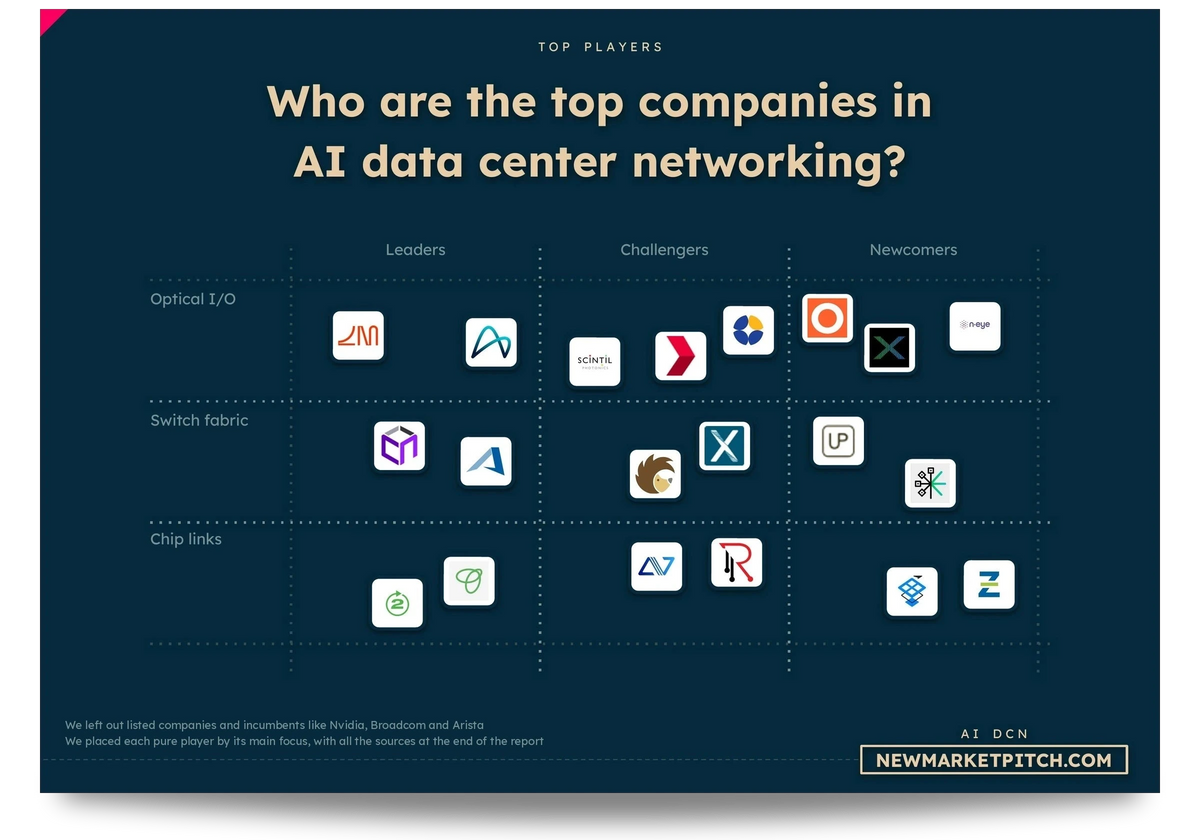
In our research about AI data center networks, we turn what is vague and complex into simple, useful visuals. Market maps like this one show you at a glance where every startup stands.
Is AI data center networking funding really booming right now?
AI data center networking funding is booming today, but the real change is the amount of money going into each successful financing rather than a huge influx of newly funded startups.
We found at least $3.505 billion invested across 18 deals in the current comparable period, versus at least $939.4 million across 15 deals a year earlier and $314.8 million across eight deals two years earlier. Funding has therefore risen about 273% year over year while deal activity is up only 20%.
Round sizes tell the story more clearly. The median financing jumped from $25.9 million two years ago to $50 million last year and $145 million now. Average round size is already above $194 million. We are looking at roughly the same-sized pool of funded companies as last year, but successful companies can now raise sums that were exceptional even quite recently.
The full-year comparison gives useful context as long as we keep the periods separate. Current YTD capital already represents roughly three times the amount raised during all of either 2024 or 2025, even though the current deal count is still below the 21 deals recorded during full-year 2025.
| Funding measure | Current YTD | Same period last year | Same period two years ago | Current change vs last year |
|---|---|---|---|---|
| Deals | 18 | 15 | 8 | +20.0% |
| Unique funded companies | 16 | 15 | 8 | +6.7% |
| Total capital | ≥$3.505B | ≥$939.4M | ≥$314.8M | +273.0% |
| Median round | $145M | $50M | $25.9M | +190.0% |
| Average round | ≥$194.7M | ≥$62.6M | ≥$39.4M | +211% |
| Largest round | >$700M | $255M | $175M | Much larger |
| Follow-on share | 88.9% | 86.7% | 75.0% | +2.2 pp |
| Later-stage deal share | 50.0% | 46.7% | 25.0% | +3.3 pp |
Is one giant AI networking deal making the funding boom look bigger than it really is?
No. The AI networking boom is heavily driven by very large rounds, but there are now enough of them that removing one company does not change the conclusion.
Lumilens' more-than-$700 million financing is the largest current transaction, yet removing it would still leave roughly $2.8 billion invested. The better stress test is to remove the entire megaround tier.
Once we exclude financings above $50 million, current-period capital falls to $169.5 million, below the $218.4 million recorded a year earlier. Using a $100 million cutoff makes the contrast even sharper: current funding below that level is $249.5 million, versus $574.4 million last year.
So the lower and middle parts of the market are not participating in the boom at anything close to the same rate. What has exploded is the number of companies able to raise nine-figure sums. Twelve of the 18 current deals are at least $100 million, up from only three of 15 a year ago.
Concentration gives us another useful clue. The top three rounds account for 48.5% of current capital, almost unchanged from 49.5% last year. The funding surge is spread across a much larger group of giant transactions rather than being dominated by a single freak round.
| Megaround test | Current YTD | Same period last year | Same period two years ago |
|---|---|---|---|
| Total capital | ≥$3.505B | ≥$939.4M | ≥$314.8M |
| Capital excluding >$50M rounds | $169.5M | $218.4M | ≥$139.8M |
| Capital excluding >$100M rounds | $249.5M | $574.4M | ≥$139.8M |
| Deals above $50M | 13 | 7 | 1 |
| Deals above $100M | 12 | 3 | 1 |
| Top-one capital share | ~20.0% | ~27.1% | 55.6% |
| Top-three capital share | 48.5% | 49.5% | 74.9% |
| Top-five capital share | 62.1% | 64.4% | 91.4% |

In our market report about AI data center networks, we always try to gather several sources and make estimates that make sense, so you can work with solid numbers.
Are more AI networking startups getting funded now?
Only slightly. AI networking investors are putting far more money to work today without funding many more companies than they did last year.
We count 16 funded companies, compared with 15 in the previous comparable period. Deal count reached 18 partly because Ayar Labs and Upscale AI each raised twice.
Those repeat financings are revealing. Ayar Labs first closed a $500 million Series E and later added another $150 million. Upscale AI followed a $200 million Series A with a $190 million extension. Several hundred million dollars of additional activity can therefore appear without increasing the number of companies benefiting at all.
That makes the increase in typical round size much more important than the modest gain in startup count. The current market is going deeper on companies investors already like.
Are new AI networking startups struggling to get their first round?
New AI networking startups are not disappearing, but the funding boom currently offers very little evidence of a broader new-company wave.
We identified two first financings in the current period, exactly the same number as one year and two years earlier. As total deal activity increased around them, their share of the market fell from 25% two years ago to 11.1% today.
Follow-ons now represent 16 of 18 deals and at least $3.33 billion of capital. Their median financing has risen to $147.5 million from $41 million a year ago.
We treat the first-financing classification as directional rather than a perfect reconstruction of every company's lifetime fundraising history. Even with that caveat, the pattern is unusually consistent: funding growth these days is coming mainly from investors putting larger amounts behind companies already in the financing ecosystem.
Has Seed funding basically disappeared from AI networking?
For now, yes. Seed funding has disappeared from the current AI data center networking sample even as Series A financing has become much larger.
There were three Seed deals in the same period last year and three two years ago. Today there are none. Yet Series A accounts for nine of 18 current transactions, up from five last year.
That combination is more interesting than a simple shift toward older companies. Young startups are still attracting money, but they are increasingly showing up at institutional Series A scale rather than through small Seed rounds. The current Series A median is $50 million, compared with $34 million last year and $29 million two years ago.
At the other end, Series C has expanded from one deal last year to five today and captures 38.4% of current capital. Very large checks are showing up both for young infrastructure companies and for businesses already moving toward production.
| Stage | Current deal share | Last-year deal share | Two-years-ago share | Current median round |
|---|---|---|---|---|
| Seed | 0% | 20.0% | 37.5% | - |
| Series A | 50.0% | 33.3% | 37.5% | $50M |
| Series B | 11.1% | 26.7% | 12.5% | $312.5M |
| Series C | 27.8% | 6.7% | 12.5% | $145M |
| Series D+ | 11.1% | 13.3% | 0% | $325M |
| Early stage overall | 50.0% | 53.3% | 75.0% | - |
| Later stage overall | 50.0% | 46.7% | 25.0% | - |

Our document detailing everything you need to know about AI data center networking gets updated several times a month, so you always get the latest view of where things stand.
How are one- or two-year-old AI networking startups raising $200 million or $500 million?
Very young AI networking companies can now raise growth-stage amounts because investors increasingly see the network as core AI infrastructure rather than a supporting piece of the data center.
Nexthop AI is a good example. The company closed a $500 million Series B at a $4.2 billion valuation. Upscale AI raised $200 million at Series A and added another $190 million only months later. Eridu emerged from stealth with more than $200 million of funding, including a large Series A.
These financings look unusual by traditional startup standards, yet the products themselves are expensive to develop and deploy. They combine silicon, systems, firmware, software, validation work and close integration with accelerator and data-center architectures. The money has to arrive earlier when a company is expected to build a full infrastructure stack before revenue reaches software-like scale.
Open standards are also making the opportunity easier to underwrite. UALink's first public specification created an open scale-up architecture capable of connecting up to 1,024 accelerators inside an AI pod. That gives startups a clearer technical environment in which they can challenge proprietary networking architectures.
Upscale is already building around this shift. Its current platform spans silicon, systems and software, and the company is working across open networking technologies including UALink, Ultra Ethernet and SONiC. Investors are betting that a new networking leader can emerge from the AI infrastructure transition, much as earlier computing shifts produced major networking companies.
Are AI network switches becoming the hottest part of the market?
AI network switches are currently gaining investor attention faster than any other major category in our AI networking dataset.
Switch companies account for 22.2% of current transactions but 31.1% of capital. Their median financing has reached $200 million, twice last year's $100 million median.
The category was absent from the comparable period two years ago. A year later it represented three deals and roughly $216 million. Today four transactions account for about $1.09 billion.
Nexthop AI's $500 million financing is a major contributor, but the shift extends beyond Nexthop. Upscale has raised multiple large rounds while building an open full-stack AI network, and Eridu has attracted more than $200 million around its own purpose-built architecture.
There is a technical backdrop to all of this. Accelerator clusters are getting large enough that scale-up networking increasingly affects how much useful performance can be extracted from expensive compute. UALink is now a real specification rather than a consortium announcement, while NVIDIA is pushing its own tightly integrated networking architecture. Investors can see a major platform fight forming, and switch startups are being financed accordingly.

In our report covering the AI data center networking market, we look at what the winners do differently, so you can learn from the best instead of guessing.
Is optical networking losing ground to AI switch startups?
Optical networking is still attracting the most AI data center networking capital by far, even though switch companies are taking a larger slice of the market.
Optical Interconnect Systems represent 12 of 18 current deals and at least $2.275 billion. Their relative deal share has fallen from 87.5% two years ago to 66.7% now, but absolute funding has more than tripled from the same period last year.
Round size keeps climbing too. The optical median went from roughly $24 million two years ago to $41 million last year and $135 million currently.
The company examples show how far the category has moved. Lumilens raised more than $700 million. Ayar Labs secured $650 million across two current closes. Celero Communications raised $275 million after validating its 2nm coherent DSP silicon. CScale emerged from stealth with $145 million, while iPronics raised $125 million to scale programmable optical networking.
The market is widening around optics rather than moving away from it. AI switching has become a serious second financing center while optical interconnect remains the biggest capital pool.
| Category | Current deals | Current capital | Current median | What we see now |
|---|---|---|---|---|
| Optical Interconnect Systems | 12 | ≥$2.275B | $135M | Still dominant, much larger rounds |
| AI Network Switches | 4 | $1.090B | $200M | Fastest relative rise |
| Ethernet AI Networking | 1 | $125M | $125M | Still a small sample |
| Network Fabric Software | 1 | $15M | $15M | Newly represented, capital-light |
| Optical Interconnect last year | 11 | ≥$673.3M | $41M | Strong activity, smaller checks |
| AI Network Switches last year | 3 | ≥$216.1M | $100M | Early acceleration |
| Optical Interconnect two years ago | 7 | ≥$285.8M | $24M | Much earlier financing regime |
Why is so much money going into optical networking right now?
Optical networking funding is jumping because the technology is moving closer to large-scale production at the same time that power and bandwidth limits are becoming harder to ignore in giant AI clusters.
Ayar Labs shows this transition clearly. Its $500 million financing is being used to scale high-volume production and testing for co-packaged optics. The company later added $150 million to support product development, validation, manufacturing readiness and further production capacity.
Celero offers another version of the same story. The company raised $275 million after validating a 2nm coherent DSP and says the new capital will push its roadmap and production readiness from 1.6T toward 3.2T optical interconnects.
The industry around these startups is spending heavily too. NVIDIA announced a $2 billion investment in Coherent alongside a multibillion-dollar purchase commitment for advanced laser and optical-networking products. Coherent is expanding its U.S. indium-phosphide manufacturing capacity, and NVIDIA is also investing $2 billion in Lumentum to expand optical capacity and R&D.
Most importantly, co-packaged optics has now entered NVIDIA's production roadmap. Spectrum-X Ethernet Photonics is in production for Vera Rubin systems and is designed around much larger AI factories. That is a much stronger commercial backdrop for optical startups than the mostly forward-looking market they were raising into several years ago.

Theory only gets you so far. In our research about AI data center networks, we dig up the real signals from the field and show you the ones worth watching.
Is networking really becoming one of the main bottlenecks in AI data centers?
Yes. Networking is currently moving much closer to the center of AI-system design because adding GPUs only helps if those GPUs can exchange data fast enough and without wasting too much power.
The companies raising the largest rounds keep attacking different versions of the same problem. Ayar Labs focuses on replacing bandwidth- and power-constrained copper links with optical I/O. Celero is pushing coherent optical connectivity as link speeds rise. Nexthop and Upscale are redesigning switching and network fabrics around synchronized AI workloads rather than conventional cloud traffic.
The large incumbent roadmaps point in the same direction. NVIDIA's Vera Rubin architecture includes Spectrum-X Ethernet Photonics, with the company now talking explicitly about networking for million-GPU AI factories. UALink's open scale-up specification supports more than 1,000 accelerators in a pod.
Those architecture changes are already underway. They help explain why investors are comfortable financing networking companies at levels that would have looked extraordinary when AI clusters were much smaller.
Why are NVIDIA, AMD, Intel and other strategic investors showing up so often?
Strategic investors have become a normal part of AI networking rounds, with industry players now participating in roughly two-thirds of current deals.
That share was 53.3% a year ago and only 25% two years ago. The increase is large enough to look structural rather than incidental.
The participants also have obvious reasons to care. NVIDIA and AMD sell the accelerators being connected. Intel, MediaTek and Qualcomm sit elsewhere in the semiconductor stack. Ciena builds optical networking systems. Wiwynn manufactures hyperscale computing infrastructure.
Ayar Labs' backer list now includes AMD, NVIDIA, MediaTek, Alchip and Wiwynn. NVIDIA participated in iPronics' $125 million financing. Ciena joined Quintessent's $40 million Series A. CScale's investor group includes NVIDIA and Intel Capital.
For a hardware startup, those relationships can reach well beyond financing. Manufacturing knowledge, compatibility work, supply-chain access and customer validation can all influence whether a promising component reaches large deployments. We still should not assume that every corporate investment turns into a major purchase order, but these strategic investors are increasingly sitting inside the commercialization process.
Are AI networking investors becoming more selective?
Yes. AI networking investors currently look much more willing to fund proven or high-conviction companies while the bottom of the financing funnel remains surprisingly thin.
Seed activity is the clearest example, but we see the same pattern elsewhere. First financings have not increased, ordinary-size capital is weaker than last year, and unique company growth remains modest.
At the same time, the companies that clear the bar can raise extraordinary amounts. Nexthop, Ayar Labs, Lumilens, Celero, Upscale and other current winners have all attracted nine-figure checks.
Investor breadth is actually growing around those companies. We counted 24 distinct disclosed lead or co-lead investors, versus 20 last year and 11 two years ago. Several investors are now showing up repeatedly: Premji Invest and Atreides Management each appear on three current deals, while Sutter Hill Ventures, Seligman Ventures, Socratic Partners and Valor Equity Partners each appear more than once.
Today's selectivity does not look like investors pulling away from the sector. There is intense competition to back a relatively tight group of companies that investors believe can become part of the core AI infrastructure stack.

In our market report about AI data center networks, we don't want to repeat what boring consulting reports say. Instead, we show you the real and latest market signals that matter.
Why has AI networking funding become so concentrated in North America?
AI data center networking funding is overwhelmingly North American right now, with 17 of 18 current deals based there.
North America represents 94.4% of transactions and 96.4% of current capital. A year ago, its deal share was only 60%.
Europe has moved in the opposite direction, dropping from five comparable-period deals to one. That single deal is meaningful, Spain's iPronics raised $125 million, so Europe's problem is clearly the number of funded companies rather than an inability to produce a large financing.
The current geography mirrors where much of the AI accelerator, semiconductor, hyperscaler and venture ecosystem sits. It is easier for a young networking company to work closely with potential platform partners, recruit specialist chip talent and build around customers when many of those organizations are nearby.
We would still be careful about calling this a permanent geographic realignment from one current period. The funding concentration is extreme today; the longer-term verdict needs more time.
Can AI data center networking keep raising money at this pace?
AI data center networking can probably sustain much larger rounds than it used to, although repeating the current capital total every year would be a much stronger claim than the evidence supports.
Several changes behind today's financing wave look durable. Co-packaged optics has reached production roadmaps. Open scale-up standards now exist. NVIDIA and other large infrastructure companies are spending billions on optics and manufacturing capacity. Startups are funding silicon development, qualification, supply chains and production rather than only prototypes.
Those activities require real capital, and they will not suddenly become cheap.
What can change quickly is the number of huge rounds available in any particular year. Companies such as Ayar Labs, Nexthop, Upscale and Lumilens have already raised substantial amounts and may not need to return to the market on the same timetable. AI infrastructure funding is also inherently lumpy.
The safer conclusion is that the financing ceiling has shifted upward and successful AI networking companies can now command far larger checks. Whether every year produces a dozen $100 million-plus deals is much harder to know.
What should we actually take away from the AI networking funding boom?
The clearest change in AI data center networking is a sharp increase in funding intensity: investors are committing much larger sums to companies they already believe can become important pieces of the AI infrastructure stack.
As seen above, that confidence is strongest in the upper end of the market. There are far more nine-figure rounds, while smaller financings have not kept pace. The number of funded companies has barely increased, and the entry end of the market remains thin.
Investor attention is also broadening across technologies. Optical interconnect still attracts most of the capital, but AI network switches have become a major funding category in their own right. Those two areas are increasingly tied to the same problem: connecting ever-larger groups of accelerators without letting bandwidth, latency or power consumption undermine the economics of the compute.
The maturity picture has become more unusual too. Established optical companies are raising hundreds of millions for manufacturing and deployment, while very young switch companies can raise growth-like amounts at Series A or B. Company age is becoming less useful as a proxy for financing size.
Strategic capital is another part of the change. NVIDIA, AMD, Intel, MediaTek, Qualcomm, Ciena, Wiwynn and other industry players increasingly appear alongside financial investors, giving the current financing cycle a much stronger connection to the semiconductor and data-center supply chain.
The weak point remains the lower end of the funnel. Today's headline numbers make the market look universally hot, but smaller rounds, Seed activity and first financings tell a more selective story. For founders, the AI networking market has become extremely attractive if investors believe a company can become infrastructure-critical, and much less obviously generous outside that group.
The strongest current funding trend is therefore the change in what investors are willing to spend on a perceived winner. The part we would be most cautious about extrapolating is the annual capital total itself: giant infrastructure rounds arrive unevenly, while the shift toward larger checks, strategic participation and production-scale networking looks much more fundamental.
Our methodology
This analysis examines the latest funding trends in AI data center networking by comparing qualifying financings announced from January 1 through October 7, 2026 with the strictly comparable January 1 through October 7 periods of 2025 and 2024. Full-year 2024 and 2025 figures are used only as secondary context and are not treated as directly comparable periods.
We built the funding dataset from company and investor announcements, regulatory records, official industry organizations, established funding databases, and reputable financial and technology reporting. Material deal amounts, stages, investor participation, company milestones and use-of-funds claims were cross-checked where multiple public sources were available.
Our calculations include qualifying private-company equity financings that met the market-definition and deal-size rules. Debt, grants, loans, unconverted convertibles, public offerings and transactions whose qualifying equity component could not be isolated were excluded from capital calculations. Where a financing package mixed equity with another form of capital, only the identifiable qualifying equity amount was counted.
We applied a strict market-definition test. AI data center networking had to represent a company's core commercial activity at the time of financing, or the financing itself had to be clearly directed toward a qualifying networking product. Companies spanning several networking technologies were assigned to the closest defensible category without inventing precision where the boundaries were genuinely unclear.
Each qualifying financing was treated as a separate deal, while duplicate reporting of the same round was consolidated. Extensions, additional closes and tranches were reviewed individually to determine whether they represented distinct financing events. Celestial AI's 2025 Series C1, for example, was consolidated at its $255 million final-close amount rather than counting the initial and final announcements twice.
First-financing, stage, investor and geographic classifications were based on public evidence rather than inferred from round size. We did not assign an exact value to undisclosed financings or turn approximate and lower-bound amounts into false precision, which is why some totals are shown as minimum figures.
We also performed a separate completeness and quality-control pass focused on missed financings, date boundaries, duplicate rounds, market eligibility and financing structure. That review identified a $52 million AttoTude Series C that was not part of the underlying market dataset used for the calculations above, so it was left outside the statistics rather than added after the analysis.
Key sources used for this analysis include Ayar Labs on its $500 million Series E and co-packaged-optics production plans, Ayar Labs on its additional $150 million financing, Nexthop AI on its $500 million Series B at a $4.2 billion valuation, Upscale AI's financing announcements, Eridu on its more than $200 million of funding, the UALink Consortium on its open scale-up networking specification, NVIDIA on Vera Rubin and Spectrum-X Ethernet Photonics, NVIDIA and Coherent on their optics partnership and manufacturing expansion, NVIDIA and Lumentum on optics capacity and R&D, Celero Communications on its $275 million Series C and 2nm coherent DSP validation, iPronics on its $125 million Series B, and CScale's company press archive.

Learning from others' mistakes is the cheapest lesson there is. In our document detailing everything you need to know about AI data center networking, we look at what broke startups before you, so you don't repeat it.
Written by the New Market Pitch teamWe track new markets so founders and investors can move faster. About us