What are the most valuable AI recruiting startups?
Whether you're building or investing in the AI recruiting market, our report covers everything you need to know: the players, the money, and what's coming next.
Summary
Mercor is the most valuable AI recruiting startup, with a valuation of $20.0B, followed by micro1 at $4.0B and Turing at $2.2B–$2.8B. Mercor, micro1 and Turing lead a market increasingly shaped by demand for specialized human expertise in AI development.
The valuation gap is enormous. Mercor's valuation is more than four times micro1's, and Mercor is worth considerably more than most traditional recruiting software startups combined.
The biggest valuations are coming from AI expert marketplaces rather than conventional hiring platforms. Mercor, micro1 and Turing connect skilled professionals with AI developers, allowing them to generate revenue from ongoing technical projects even when ordinary corporate hiring slows.
Only 5 of the 86 independent startups in our ranking are clearly worth more than $1 billion. Eightfold AI also reaches unicorn territory within its valuation range, while Andela touches the $1 billion threshold.
Revenue growth explains some of the excitement, but headline figures can be misleading. micro1 surpassed a $500M gross annualized revenue run rate in 2026, although paying the experts who perform the work accounts for a substantial share of that revenue.
Traditional recruiting software remains a significant market. Phenom is valued at $1.4B–$1.5B, Eightfold AI at $900M–$1.6B, and Ashby at $450M–$700M. Ashby reported 135% annual revenue growth in 2025, showing that subscription-based recruiting platforms can still expand rapidly.
Employer adoption of recruiting AI has been less consistent than investor enthusiasm. iHire found that AI usage among US employers increased from 4.9% in 2023 to 25.9% in 2025, before slipping to 24.2% in 2026.
AI is spreading faster through administrative recruiting tasks than through candidate evaluation. Writing job advertisements and preparing communications are common uses, while only 9.1% of AI-using employers reported using it for interviews.
The next competitive battle is over who controls the recruiting workflow. Candidate sourcing specialists such as Juicebox compete with broader platforms such as Ashby, Gem and Phenom, while Metaview is expanding from interview documentation into recruiting agents.
Regulation could make the market harder for smaller vendors. New York City's automated hiring rules and the EU AI Act create additional requirements for systems that evaluate candidates or influence employment decisions, potentially favoring companies with stronger compliance capabilities.
Our conclusion is that the highest AI recruiting valuations reflect two very different opportunities. AI expert marketplaces are benefiting from spending on model development, while traditional recruiting software companies must prove they can win recurring employer budgets, retain customers and improve hiring outcomes.

Written by the New Market Pitch teamWe track new markets so founders and investors can move faster. About us

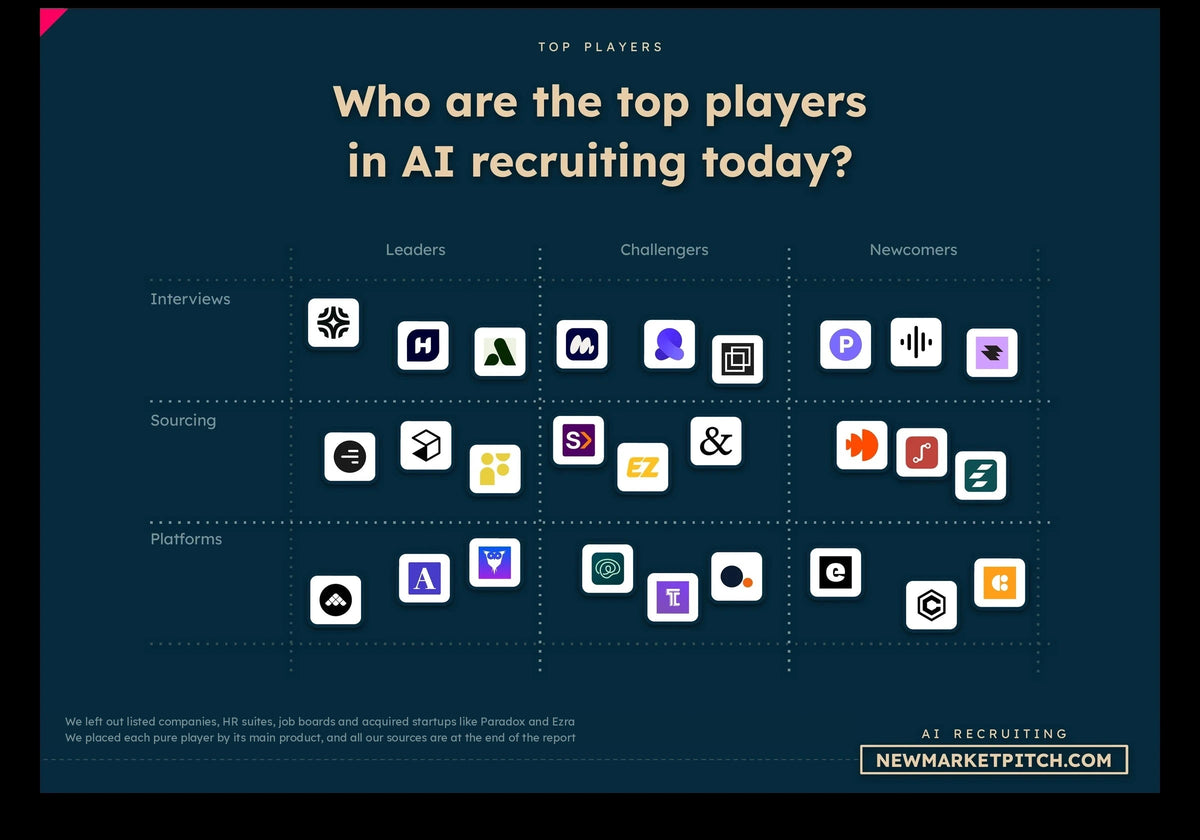
In our report covering the AI recruiting market, we turn what is vague and complex into simple, useful visuals. Market maps like this one show you at a glance where every startup stands.
Top startups in the AI recruiting market ranked by valuation
Here is an updated table that ranks the top startups in the AI recruiting market based on their latest reported or estimated valuations.
If you need to dig deeper and get more detailed data, please check our report covering the AI recruiting market.
| # | Startup | Valuation | Confidence | Valuation basis | Last round | Total funding |
|---|---|---|---|---|---|---|
| Private startups | ||||||
| 1 | MercorAI talent and expert marketplace | $20.0Bas of Aug 2026 | Full | Announced private round valuation | $350MSeries C · Oct 2025 | $484M+valued at 41.4× this |
| 2 | micro1AI expert recruitment and data | $4.0B | Strong | Announced private round valuation | $100M+Series B · Sep 2026 | $140Mvalued at 28.6× this |
| 3 | TuringAI talent and model training | $2.2B–$2.8B | Strong | Revenue or ARR multiple estimate | $43MSeries A · Jul 2026 | $225M+valued at 11.1× this |
| 4 | Job&TalentAI-powered staffing and workforce management | $1.3B–$1.9B | Partial | Comparables-based estimate | ~$103MSeries F · Apr 2025 | $994Mvalued at 1.6× this |
| 5 | PhenomAI-powered talent experience platform | $1.4B–$1.5B | Strong | Implied valuation from raise | $3MSeries E · Apr 2026 | $217M+valued at 6.7× this |
| 6 | Eightfold AIAI talent intelligence and management | $900M–$1.6B | Partial | Comparables-based estimate | $220MSeries E · Jun 2021 | $397Mvalued at 3.2× this |
| 7 | JuiceboxAI-powered candidate sourcing and outreach | $850Mas of Mar 2026 | Full | Announced private round valuation | $80MSeries B · Mar 2026 | $116M+valued at 7.3× this |
| 8 | BraintrustDecentralized technical talent marketplace | $800M | Full | Announced private round valuation | $80MSeries B · Feb 2026 | $121Mvalued at 6.6× this |
| 9 | AndelaGlobal technology talent matching marketplace | $500M–$1.0B | Partial | Comparables-based estimate | $200MSeries E · Sep 2021 | $377Mvalued at 2.0× this |
| 10 | BeameryEnterprise AI workforce intelligence platform | $550M–$900M | Partial | Comparables-based estimate | $50MSeries D · Dec 2022 | $223Mvalued at 3.3× this |
| 11 | GemAI-powered talent acquisition platform | $500M–$800M | Partial | Comparables-based estimate | $100MSeries C · Sep 2021 | $148Mvalued at 4.4× this |
| 12 | FountainAutomated frontline and hourly hiring | $450M–$750M | Partial | Comparables-based estimate | $100MSeries C extension · Jun 2022 | $219Mvalued at 2.7× this |
| 13 | AshbyAI-powered applicant tracking and recruiting | $450M–$700M | Partial | Comparables-based estimate | $50MSeries D · Jul 2025 | $115Mvalued at 5.0× this |
| 14 | MetaviewAI recruiting interviews and agents | $400M–$750M | Partial | Implied valuation from raise | $60MSeries C · Sep 2026 | $108Mvalued at 5.3× this |
| 15 | WonoloOn-demand hourly staffing marketplace | $450M–$700M | Partial | Comparables-based estimate | $138MSeries D · Oct 2021 | $191M+valued at 3.0× this |
| 16 | HackerRankTechnical skills testing and hiring | $400M–$650M | Partial | Comparables-based estimate | $60MSeries D · Mar 2022 | $118Mvalued at 4.4× this |
| 17 | SeekOutAI talent sourcing and intelligence | $350M–$650M | Partial | Comparables-based estimate | $115MSeries C · Jan 2022 | $188Mvalued at 2.7× this |
| 18 | FindemAI-powered talent sourcing and intelligence | $400M–$500M | Partial | Comparables-based estimate | $15MSeries C-1 · Apr 2026 | $88Mvalued at 5.1× this |
| 19 | LoxoAI recruiting software and CRM | $300M–$600M | Partial | Comparables-based estimate | $115MGrowth equity · Feb 2025 | ~$115Mvalued at 3.9× this |
| 20 | SenseAI recruiting engagement automation | $350M–$550M | Partial | Comparables-based estimate | $50MSeries D · Dec 2021 | $90M+valued at 5.0× this |
| 21 | ParaformAI-powered expert recruiter marketplace | $400M–$450M | Strong | Implied valuation from raise | $40MSeries B · Mar 2026 | $65Mvalued at 6.5× this |
| 22 | Moka1AI recruiting and HR management | $250M–$550M | Partial | Comparables-based estimate | $100MSeries C · Nov 2021 | $144M+valued at 2.8× this |
| 23 | TeamtailorRecruitment software and applicant tracking | $300M–$450M | Partial | Revenue or ARR multiple estimate | $11MGrowth / venture · Jun 2022 | $17M+valued at 22.1× this |
| 24 | Trusted HealthTechnology-enabled healthcare staffing marketplace | $230M–$420M | Partial | Revenue or ARR multiple estimate | $94MSeries C · Nov 2021 | $175Mvalued at 1.9× this |
| 25 | TestGorillaSkills testing and candidate assessments | $240M–$400M | Partial | Revenue or ARR multiple estimate | $70MSeries A · Jun 2022 | $81Mvalued at 3.9× this |
| 26 | CodeSignalAI technical assessment and interviewing | $200M–$400M | Partial | Revenue or ARR multiple estimate | $50MSeries C · Sep 2021 | $88M+valued at 3.4× this |
| 27 | InstaworkOn-demand hourly workforce staffing platform | $240M–$360M | Partial | Comparables-based estimate | $60MSeries D · May 2023 | $148Mvalued at 2.0× this |
| 28 | WorkableAI-powered recruiting and HR software | $220M–$350M | Partial | Revenue or ARR multiple estimate | $50MSeries C · Nov 2018 | $85M+valued at 3.4× this |
| 29 | Jack & JillAI agents matching employers and candidates | $200M–$333M | Partial | Comparables-based estimate | $40MSeries A · Sep 2026 | $60M+valued at 4.4× this |
| 30 | HarverAI-powered talent assessments and selection | $180M–$320M | Low | Comparables-based estimate | $15MSeries B · Jul 2019 | $29Mvalued at 8.6× this |
| 31 | ReveloLatin American technology talent marketplace | $180M–$320M | Partial | Comparables-based estimate | $28MSeries B · Oct 2021 | $49Mvalued at 5.1× this |
| 32 | KaratTechnical interviewing and skills assessment | $150M–$300M | Partial | Comparables-based estimate | UndisclosedGrowth equity · Apr 2022 | $169M+valued at 1.3× this |
| 33 | IntelyCare2Healthcare staffing and workforce technology | $150M–$300M | Low | Comparables-based estimate | $115MSeries C · Apr 2022 | $177Mvalued at 1.3× this |
| 34 | YelloCampus recruiting and talent engagement | $170M–$260M | Partial | Comparables-based estimate | $43MSeries D · Jul 2021 | $89Mvalued at 2.4× this |
| 35 | hireEZAI candidate sourcing and outreach | $140M–$230M | Partial | Comparables-based estimate | $8.1MSeries B-IV · Mar 2025 | $46Mvalued at 4.0× this |
| 36 | HireologyRecruitment and workforce management software | $120M–$230M | Low | Comparables-based estimate | $7.3MSeries C-II / venture round · Feb 2018 | $45Mvalued at 3.9× this |
| 37 | JobGetMobile marketplace for hourly jobs | $100M–$250M | Low | Comparables-based estimate | $40MSeries B · Jun 2022 | $42Mvalued at 4.2× this |
| 38 | Maki PeopleAI candidate screening and assessment | $115M–$180M | Partial | Comparables-based estimate | ~$27MSeries A · Jan 2025 | $36Mvalued at 4.1× this |
| 39 | SpottAI-native recruiting agency software | $120M–$175M | Strong | Implied valuation from raise | $21MSeries A · Sep 2026 | $24Mvalued at 6.1× this |
| 40 | OrbioAI agents for frontline workforce | $105M–$175M | Partial | Implied valuation from raise | $21MSeries A · Jun 2026 | $28Mvalued at 5.0× this |
| 41 | CodilityTechnical skills testing and assessment | $80M–$180M | Low | Comparables-based estimate | $22MSeries A · Jan 2020 | $22Mvalued at 5.9× this |
| 42 | AlexAI-powered candidate interviews and screening | $85M–$150Mas of Sep 2026 | Partial | Comparables-based estimate | $17MSeries A · Sep 2025 | $20Mvalued at 5.9× this |
| 43 | PinpointApplicant tracking and recruitment software | $90M–$140M | Partial | Comparables-based estimate | $2.5MSeed · Oct 2025 | $22Mvalued at 5.2× this |
| 44 | GoPerfectAgentic AI candidate sourcing automation | $80M–$140M | Partial | Implied valuation from raise | $23MSeed extension · Feb 2025 | $37M+valued at 3.0× this |
| 45 | HumanlyConversational AI interviewing and recruiting | $95M–$125M | Strong | Implied valuation from raise | $25MSeries B · May 2026 | $49M+valued at 2.2× this |
| 46 | WorkWhileAI-powered flexible staffing marketplace | $90M–$130M | Partial | Comparables-based estimate | $23MSeries B · Jun 2025 | $40M+valued at 2.8× this |
| 47 | Nomad Health2Digital healthcare staffing technology platform | $50M–$150M | Low | Proxy-based estimate | $34MVenture · Sep 2025 | $244M+valued at 0.4× this |
| 48 | ConverzAIAI virtual recruiters for staffing | $70M–$120M | Partial | Implied valuation from raise | $16MSeries A · Feb 2025 | $21Mvalued at 4.5× this |
| 49 | Take2 AIAutonomous healthcare recruiting agents | $70M–$117Mas of Feb 2026 | Strong | Implied valuation from raise | $14MSeries A · Feb 2026 | $17Mvalued at 5.5× this |
| 50 | TalviewAI interviewing and assessment proctoring | $60M–$120M | Partial | Revenue or ARR multiple estimate | $15MSeries B · Jul 2021 | $22M+valued at 4.1× this |
| 51 | Sapia.aiAI-powered candidate interviewing assessments | $55M–$110M | Low | Comparables-based estimate | $12MSeries A · Nov 2022 | $18M+valued at 4.6× this |
| 52 | iMochaAI skills assessments and intelligence | $55M–$100M | Partial | Comparables-based estimate | $14MSeries A · Jan 2022 | $15M+valued at 5.3× this |
| 53 | CrosschqAI hiring intelligence and assessments | $50M–$100M | Low | Proxy-based estimate | $30MSeries A · Sep 2021 | $41Mvalued at 1.8× this |
| 54 | VahanAI recruitment for frontline workers | $55M–$90M | Partial | Implied valuation from raise | UndisclosedStrategic / venture · Jul 2025 | $18M+valued at 3.9× this |
| 55 | SourceWhaleAI recruitment outreach and automation | $45M–$85M | Partial | Revenue or ARR multiple estimate | Undisclosed | |
| 56 | impress.aiAI-powered recruitment workflow automation | $40M–$80M | Partial | Revenue or ARR multiple estimate | $6MSeed extension / Series A · Jul 2023 | $10Mvalued at 5.8× this |
| 57 | KulaAI applicant tracking and sourcing | $45M–$75M | Low | Comparables-based estimate | ~$1.1MVenture · May 2023 | $16Mvalued at 3.8× this |
| 58 | Alva LabsPsychometric and AI candidate assessments | $35M–$70M | Low | Comparables-based estimate | $13MSeries A · Jan 2022 | $17M+valued at 3.1× this |
| 59 | ContrarioAI-assisted expert recruiter marketplace | $35M–$70M | Partial | Revenue or ARR multiple estimate | $2.3MSeed · May 2026 | $2.3M+valued at 22.8× this |
| 60 | Emi LabsConversational AI for frontline recruiting | $35M–$70M | Partial | Comparables-based estimate | $11MSeries A · Feb 2022 | $13M+valued at 4.0× this |
| 61 | GoodTimeAI interview scheduling and coordination | $35M–$65M | Low | Comparables-based estimate | $9.5MSeries A+ · Jun 2021 | $17Mvalued at 3.0× this |
| 62 | ManatalAI applicant tracking recruitment software | $25M–$60M | Low | Comparables-based estimate | $5.1MSeed · Feb 2022 | $5.1Mvalued at 8.3× this |
| 63 | DoverRecruiting software and recruiter marketplace | $25M–$55M | Low | Comparables-based estimate | $20MSeries A · Jul 2021 | $23Mvalued at 1.7× this |
| 64 | CanditechAI candidate job simulation assessments | $25M–$50M | Low | Comparables-based estimate | $9MSeed · Jun 2022 | $10Mvalued at 3.8× this |
| 65 | HireLogicAI interview intelligence and analytics | $25M–$50M | Low | Comparables-based estimate | $6MSeries A · Feb 2023 | $10Mvalued at 3.8× this |
| 66 | DexAI talent agent and matching | $25M–$45M | Partial | Implied valuation from raise | $5.3MSeed · Apr 2026 | $8.4Mvalued at 4.2× this |
| 67 | JobillaAI-driven recruitment marketing automation platform | $25M–$45M | Partial | Comparables-based estimate | $6.7MVenture · Aug 2024 | $16Mvalued at 2.2× this |
| 68 | EllyAI-native recruiting workflow automation | $24M–$45M | Partial | Implied valuation from raise | $8MSeed / early VC · Feb 2026 | $8Mvalued at 4.3× this |
| 69 | JoveoProgrammatic recruitment advertising optimization software | $20M–$40M | Low | Comparables-based estimate | $12MSeries B · Oct 2019 | $18M+valued at 1.7× this |
| 70 | XORConversational AI recruitment automation | $20M–$40M | Low | Revenue or ARR multiple estimate | $900KSeries A · Sep 2022 | $9.3Mvalued at 3.2× this |
| 71 | TurboHireAI-powered applicant tracking software | $25M–$35M | Partial | Implied valuation from raise | $6MSeries A · Aug 2025 | $9M+valued at 3.3× this |
| 72 | HackerEarthAI technical assessments and coding tests | $18M–$40M | Low | Comparables-based estimate | $6.5MSeries B · Oct 2018 | $12Mvalued at 2.5× this |
| 73 | CoveyAI-powered candidate sourcing and screening | $15M–$40M | Low | Proxy-based estimate | $8.4MEarly-stage VC · Sep 2022 | $8.4M+valued at 3.3× this |
| 74 | VisageAI-assisted candidate sourcing platform | $20M–$35M | Low | Comparables-based estimate | $7MSeries A · Mar 2021 | $11Mvalued at 2.4× this |
| 75 | Flexzo AIAI-powered healthcare staffing platform | $18M–$35M | Low | Implied valuation from raise | $12MSeries A · Mar 2026 | $17Mvalued at 1.6× this |
| 76 | QureosAI recruitment screening and matching | $20M–$33M | Strong | Implied valuation from raise | $5MSeed · Feb 2026 | $8.2M+valued at 3.3× this |
| 77 | BryqAI psychometric talent assessment software | $15M–$30M | Low | Comparables-based estimate | $4MPre-Series A · Jun 2022 | $5.4M+valued at 4.2× this |
| 78 | HeyMiloAI agents for candidate screening | $15M–$30M | Partial | Implied valuation from raise | $6MSeed · Jun 2026 | $6M+valued at 3.8× this |
| 79 | X0PA AIAI hiring assessment and matching | $17M–$28M | Low | Comparables-based estimate | $1.4MSeries A follow-on · May 2023 | $7M+valued at 3.2× this |
| 80 | TraqCheckAI recruitment and background verification | $19M–$25M | Strong | Implied valuation from raise | $8MSeries A · Apr 2026 | $8M+valued at 2.8× this |
| 81 | VervoeAI-powered candidate skills assessments | $12M–$24M | Low | Comparables-based estimate | $2.7MSeed · Dec 2019 | $4.5M+valued at 4.0× this |
| 82 | CandidatelyAI recruiting agency workflow software | $10M–$25M | Low | Proxy-based estimate | UndisclosedStrategic investment · May 2022 | $4M+valued at 4.4× this |
| 83 | TalkpushConversational AI for volume recruitment | $10M–$22M | Low | Revenue or ARR multiple estimate | UndisclosedVenture · Apr 2020 | $1.3M+valued at 12.1× this |
| 84 | HireSweetAI talent sourcing and outreach | $8M–$20M | Low | Proxy-based estimate | $150KSeed · Mar 2020 | $1.9M+valued at 7.2× this |
| 85 | Lantern AIAI-powered end-to-end recruiting agents | $8M–$18M | Low | Revenue or ARR multiple estimate | $125KSeed · Sep 2026 | $500Kvalued at 26.0× this |
| 86 | SerraAI candidate sourcing and outreach | $3M–$9M | Low | Proxy-based estimate | $125KSeed · Sep 2023 | $125K+valued at 48.0× this |
| Listed or acquired since 2022 · not ranked | ||||||
| GreenhouseApplicant tracking and hiring software | $650M–$950M | Partial | Comparables-based estimate | $50MSeries D · Jul 2018 | $112Mvalued at 7.1× this | |
| FilteredAutomated technical candidate screening | $40M–$60M | Low | Comparables-based estimate | $10MEarly-stage VC · Mar 2022 | $19M+valued at 2.6× this | |
| TeziAutonomous AI recruitment agent | $10M–$35M | Low | Acquisition valueEstimated | $9MSeed · Jul 2024 | $9Mvalued at 2.5× this | |
No startups match this search.
- Total funding is a minimum: some earlier rounds have no public amount.
- Total funding: published totals for IntelyCare and Nomad Health differ.

Our research about AI recruiting tools gets updated several times a month, so you always get the latest view of where things stand.
Why are AI recruiting startups getting such high valuations?
AI recruiting startups are attracting billion-dollar valuations because investors are betting on two fast-changing markets: companies using AI to hire employees, and AI developers paying for specialized human expertise.
The second market has produced the biggest valuations. Mercor, valued at $20.0B, micro1 at $4.0B and Turing at $2.2B–$2.8B all connect skilled professionals with businesses developing or using artificial intelligence.
Meanwhile, demand for recruiting software is changing. LinkedIn's 2026 Future of Talent report found that global hiring remained 30% below pre-pandemic levels, even as applications per applicant had increased 30%. Recruiting teams have more candidates to process, often with fewer vacancies to fill.
That creates demand for tools that find qualified candidates, screen applications and organize interviews more efficiently. Companies such as Phenom, Eightfold AI, Juicebox and Ashby are competing for that spending.
The big difference is how these startups make money. Expert marketplaces can generate substantial revenue from supplying skilled contractors to AI laboratories, while recruiting software companies generally earn subscription fees from employers. Both markets have room to grow, but their revenue potential and operating costs are very different.
Which AI recruiting startups are worth the most today?
Mercor is currently the most valuable AI recruiting startup, with a valuation of $20.0B, well above micro1 at $4.0B and Turing at $2.2B–$2.8B.
Mercor's lead is enormous. Mercor's valuation is more than four times micro1's. That gap is especially interesting because both companies help AI developers find experts for specialized work.
Job&Talent follows at $1.3B–$1.9B, while Phenom is valued at $1.4B–$1.5B. Job&Talent operates an AI-powered staffing and workforce platform, whereas Phenom sells enterprise recruiting and talent experience software.
Eightfold AI comes next at $900M–$1.6B, followed by Juicebox at $850M and Braintrust at $800M.
Among the eight most valuable companies in our ranking, we can already see three different businesses: expert marketplaces serving AI development, staffing platforms placing workers, and software companies helping employers manage recruitment.
The biggest valuations are concentrated in expert marketplaces, although those companies don't necessarily have the highest profits or the largest customer bases.

In our market report about AI recruiting tools, we look at what the winners do differently, so you can learn from the best instead of guessing.
How many AI recruiting startups are unicorns?
In our ranking, 5 AI recruiting startups have valuations entirely above $1 billion, while two more reach or cross that threshold within their valuation ranges.
Mercor, micro1, Turing, Job&Talent and Phenom make up the first group. Eightfold AI could also qualify, while Andela reaches $1.0B at the upper end of its range.
That means 5 of the 86 independent startups in our ranking, approximately 6%, are clearly valued above $1 billion.
The distribution is heavily concentrated at the top. Mercor alone is valued at $20.0B, while most companies in the ranking are valued below $500M.
The unicorn group also covers very different businesses. Phenom sells software to enterprises, Job&Talent manages staffing and workforce operations, and Mercor supplies expert talent for AI-related projects.
Counting unicorns is useful, but comparing how those companies earn revenue tells us much more about where AI recruiting is heading.
Why is Mercor worth so much more than other AI recruiting startups?
Mercor's $20.0B valuation comes from its position in the market for expert human work supporting AI development, where customers can spend heavily on ongoing projects rather than individual hiring decisions.
Mercor originally gained attention for using AI to connect companies with talent. Its business has since become closely linked to the work required to develop and evaluate AI models, including sourcing specialists with knowledge in fields such as engineering, mathematics and scientific research.
The company's financing history shows how quickly expectations changed. In October 2025, Mercor announced a $350M Series C at a $10B valuation, five times the valuation of its previous Series B. Its current valuation is substantially higher.
That growth should also be viewed alongside the emergence of other expert-data providers. micro1 and Turing serve related demand, which suggests AI laboratories need multiple ways to find and manage specialized human contributors.
Mercor has raised $484M+ according to our financing data, about four times the reported funding of Juicebox, an AI candidate-sourcing platform valued at $850M.
The question for Mercor is whether demand from AI development will remain large enough, and margins strong enough, to support such a valuation over time. Revenue generated from human expert services can grow quickly, but paying and managing those experts creates costs that conventional software businesses do not face to the same extent.

In our document detailing everything you need to know about AI recruiting, you will always find fresh funding data, taken straight from our own verified funding database.
Is micro1 catching up with Mercor?
micro1 is growing fast enough to become a serious competitor to Mercor, but Mercor still has a commanding lead in valuation.
micro1 is valued at $4.0B, against Mercor's $20.0B. Mercor remains more than four times as valuable.
The recent growth at micro1 is particularly striking. In September 2025, TechCrunch reported that the company had raised $35M at a $500M valuation and reached approximately $50M in annual recurring revenue, up from $7M at the beginning of the year.
By August 2026, TechCrunch reported that micro1's gross annualized revenue run rate had increased from approximately $100M to $500M in eight months. The company's subsequent quarterly update confirmed that it had surpassed a $500M run rate and priced its Series B at a $4B valuation.
However, the gross revenue figure needs context. TechCrunch reported that micro1 retained approximately 60%–70% of that gross run rate, leaving a substantially smaller amount after expert compensation under the publication's reporting definition.
And that's where the comparison gets more complicated. micro1's growth is impressive, but recurring customer demand, project costs and net margins will determine how much of that scale translates into long-term business value.
Why are Mercor, micro1 and Turing worth more than most recruiting software companies?
Mercor, micro1 and Turing receive higher valuations than most recruiting software startups because they serve demand for expert work in AI development, a market that can grow even when employers are hiring fewer people.
Traditional recruiters earn their value by helping companies fill positions. Expert-data platforms can earn revenue from projects involving model evaluation, technical annotation, specialist reasoning and other human contributions to AI development.
That difference has become increasingly important as demand for highly specialized AI skills grows. LinkedIn's September 2025 AI Labor Market Update reported that AI engineering job postings represented nearly 7% of all technical job postings, up 63% year over year in share.
The same period saw much weaker conditions across ordinary hiring. LinkedIn subsequently reported that US applications per open role had doubled since spring 2022.
For a conventional applicant tracking platform, fewer vacancies can limit opportunities to expand usage. An AI expert marketplace, by contrast, may benefit from continuing investment in model development even when the broader labor market is slow.
This helps explain why Turing sits above major enterprise recruiting software companies such as Phenom and Eightfold AI. Still, expert services can produce large gross revenue without the margins usually associated with subscription software.

Learning from others' mistakes is the cheapest lesson there is. In our report covering the AI recruiting market, we look at what broke startups before you, so you don't repeat it.
Are traditional recruiting software startups losing ground to AI marketplaces?
Traditional recruiting software companies remain valuable businesses, but expert AI marketplaces are receiving substantially higher valuations right now.
Phenom, valued at $1.4B–$1.5B, and Eightfold AI at $900M–$1.6B remain major players in enterprise talent technology. Beamery follows at $550M–$900M, while Gem stands at $500M–$800M.
These companies solve problems that employers face regardless of the hiring cycle. They organize candidate information, manage recruiting workflows, identify skills and help companies understand their existing employees.
However, the economics differ from those of AI expert marketplaces. Enterprise software customers typically buy subscriptions and expand spending as they adopt more products or seats. Large expert-work contracts can generate revenue much faster, although fulfillment is more labor-intensive.
There is also evidence that established recruiting software can continue growing strongly. Ashby's 2025 Series D announcement reported 135% year-over-year revenue growth, a customer base expanding from 1,300 to more than 2,700, and 170% growth in interviews scheduled through the platform.
Software companies are still finding customers and increasing usage. The market is simply assigning much greater value to the largest businesses connected to AI model development.
Which AI recruiting startups have raised the most money?
Job&Talent and Mercor have the largest financing totals in our ranking.
Job&Talent has raised $994M, while Mercor has raised $484M+. Our totals count equity rounds only, so financing figures reported elsewhere can be higher.
Further down, Eightfold AI has raised $397M, Andela $377M, Turing $225M+, Beamery $223M and Fountain $219M.
The contrast between the financing of older platforms and newer AI-native businesses is interesting. Juicebox has raised $116M+, Metaview $108M and Paraform $65M, while achieving valuations that place them among the more valuable specialist recruiting companies.
Older funding rounds also show how market expectations have changed. Eightfold AI announced a $220M Series E at a $2.1B valuation in June 2021. Eightfold AI's current valuation of $900M–$1.6B is lower, reflecting a more cautious market for enterprise recruiting technology today.
Funding totals should not be confused with capital still available to a company. A startup may have raised substantial amounts over many years and spent much of that money on growth, acquisitions, operations or product development.

Your time is limited. In our research about AI recruiting tools, we put numbers on each part of the market, so you can see where it makes sense to focus.
Which types of AI recruiting startups get the highest valuations?
AI expert marketplaces currently attract the highest AI recruiting valuations, followed by large staffing platforms and enterprise talent software companies.
Mercor, micro1 and Turing occupy the top three positions in the ranking. Their exposure to expert work for AI development gives them a commercial opportunity beyond the ordinary corporate hiring market.
Staffing marketplaces such as Job&Talent and Andela earn revenue from connecting businesses with workers, while enterprise software companies such as Phenom, Eightfold AI, Beamery and Gem sell tools used by recruiting teams.
Further down the market, specialist companies address sourcing, interviewing, assessments and other individual parts of the recruitment process.
A company managing an entire staffing relationship can capture a larger portion of customer spending than a tool performing one recruiting task, although it will often have higher operating costs.
| Business model | Representative startups | Main source of customer spending |
|---|---|---|
| AI expert marketplaces | Mercor, micro1, Turing | Expert work for AI development |
| Staffing marketplaces | Job&Talent, Andela | Worker placement and workforce services |
| Talent intelligence | Eightfold AI, Beamery | Enterprise talent management |
| Recruiting platforms | Phenom, Ashby, Gem | Recruiting software subscriptions |
| Candidate sourcing | Juicebox, SeekOut, hireEZ | Candidate discovery and outreach |
| Recruiting agents | Metaview, Humanly, Take2 AI | Interviewing and workflow automation |
| Skills assessment | HackerRank, TestGorilla, CodeSignal | Candidate testing and evaluation |
| Recruiter marketplaces | Paraform, Contrario | Access to recruiting professionals |
Is AI recruiting growing as fast as investors think?
AI recruiting is growing, but actual employer adoption has recently slowed after several years of rapid expansion.
The clearest evidence comes from iHire's 2026 State of Online Recruiting report, which surveyed 318 US employers and 1,054 job seekers. It found that 24.2% of employers were using AI in recruitment, compared with 25.9% in 2025.
The longer-term trend remains substantial. Employer adoption rose from 4.9% in 2023 to 14.7% in 2024 and 25.9% in 2025. That represents more than a fivefold increase in two years, followed by a small decline.
LinkedIn's research paints a more optimistic picture of future intentions. In January 2026, it reported that 93% of surveyed recruiters planned to increase their AI use during the year. Yet that measures intentions among recruiters, whereas iHire measures reported adoption among employers.
Companies may expect to use more AI without immediately purchasing new software, replacing their existing systems or automating entire workflows.
We also found that AI adoption remains concentrated in familiar administrative tasks for many employers. Writing job advertisements and candidate messages is much more common than automated interviews.
| Year | US employers using AI in recruiting |
|---|---|
| 2023 | 4.9% |
| 2024 | 14.7% |
| 2025 | 25.9% |
| 2026 | 24.2% |
Source: iHire, State of Online Recruiting 2026.

In our market report about AI recruiting tools, we always try to gather several sources and make estimates that make sense, so you can work with solid numbers.
Are AI recruiting agents actually replacing human recruiters?
AI recruiting agents are automating more work, but the latest employer data shows that human recruiters remain central to the hiring process.
According to iHire's 2026 research, 66.2% of employers using AI apply it to writing job advertisements, while 62.3% use it to prepare candidate communications. Only 9.1% use AI for interviews.
That last figure actually fell from 16.1% in 2025. The share using AI to automate candidate communication also declined, from 49.6% to 31.2% among AI-using employers.
These figures hardly suggest that recruiting agents are replacing recruiters across the economy.
At the company level, though, development is moving quickly. Metaview announced a $60M Series C in September 2026 and reported that more than 7,000 companies were using its products; our data puts its total funding at $108M. The company has expanded from interview documentation toward agents handling additional recruiting workflows.
Humanly, valued at $95M–$125M, and ConverzAI at $70M–$120M are also pursuing conversational recruiting automation, while Take2 AI at $70M–$117M specializes in healthcare recruiting agents.
The strongest near-term opportunities appear to be handling repetitive tasks and helping recruiters manage more candidates. Full automation of hiring decisions remains much harder, both commercially and legally.
Which AI candidate sourcing startups are winning?
Juicebox currently has the highest valuation among specialist AI candidate sourcing startups, at $850M, followed by several established companies competing to automate talent discovery.
SeekOut is valued at $350M–$650M, Findem at $400M–$500M, Loxo at $300M–$600M and hireEZ at $140M–$230M. Their valuation ranges overlap, but all compete in candidate discovery, recruiter intelligence or related sourcing workflows.
Juicebox has attracted particular investor attention. In September 2025, the company announced $36M in funding, including a $30M Series A led by Sequoia Capital. In March 2026, it raised an $80M Series B at a valuation of $850M, bringing its reported total funding to $116M+.
The appeal of AI sourcing is easy to understand. Recruiters often spend hours searching databases, comparing profiles and contacting potential candidates. Language models can handle significant parts of that work.
But sourcing software faces a difficult competitive problem. If several companies use similar AI models and access overlapping professional information, generating candidate lists may become less distinctive.
The companies best positioned to keep customers will likely be those that integrate sourcing into daily recruiting workflows and demonstrate better hiring outcomes, rather than simply producing more candidate recommendations.

If you build or invest in the AI recruiting market, you need to know which business models pay off now and which ones are fading. That's why our report covering it has a whole section on it.
Can Ashby, Gem and Phenom keep growing as AI changes recruiting software?
Ashby, Gem and Phenom have room to grow because companies increasingly want recruiting software that handles more of the hiring process in one place.
Phenom is valued at $1.4B–$1.5B, Gem at $500M–$800M and Ashby at $450M–$700M. Each approaches recruitment differently, but all can potentially benefit when employers replace separate tools with broader platforms.
Ashby's operating results offer one of the clearest growth examples. In its 2025 Series D announcement, the company reported 135% year-over-year revenue growth, more than 2,700 customers and 170% growth in the number of interviews scheduled through its platform.
Ashby also reported a burn multiple below 1, suggesting relatively efficient growth at the time of the announcement. Ashby raised $50M in that round while saying that much of its previous financing remained unused.
Phenom has a broader enterprise talent experience business, while Gem focuses on talent acquisition workflows and candidate relationships. Their opportunities include increasing spending among existing customers as well as attracting companies moving away from fragmented recruiting software.
The biggest challenge is convincing employers that switching systems is worthwhile. Recruiting teams may readily adopt an AI assistant while keeping their existing applicant tracking software. Replacing an entire platform requires stronger evidence of productivity gains and smoother integration.
Are AI interviewing and candidate assessment startups worth investing in?
AI interviewing and candidate assessment startups have attracted meaningful valuations, but automated evaluation remains one of the least widely adopted uses of recruiting AI.
Metaview stands at $400M–$750M, while HackerRank is valued at $400M–$650M, TestGorilla at $240M–$400M, CodeSignal at $200M–$400M and Karat at $150M–$300M.
These companies address an increasingly frustrating problem for employers: too many applications and too little time to identify the right candidates. LinkedIn reported that applications per US job opening had doubled since spring 2022.
At the same time, employers are cautious about using AI to judge candidates. iHire's 2026 survey found that 44.3% of job seekers viewed employers' increased AI use negatively, compared with 21.8% who viewed it positively.
That skepticism creates an important distinction between products. Tools that help administer or document interviews face different challenges from systems that automatically rank candidates or make assessments influencing hiring decisions.
There is a real business opportunity in reducing the time spent evaluating applicants. The harder part is demonstrating that automated assessments are accurate, fair and useful enough for employers to trust.

In our report covering the AI recruiting market, we don't want to repeat what boring consulting reports say. Instead, we show you the real and latest market signals that matter.
Why are healthcare staffing startups valued differently from other AI recruiting companies?
Healthcare staffing startups generally receive more cautious valuations because supplying nurses and other medical professionals involves substantial operating costs, regulatory requirements and labor-market risks.
Trusted Health is valued at $230M–$420M, IntelyCare at $150M–$300M, Nomad Health at $50M–$150M and Flexzo AI at $18M–$35M.
These companies combine recruitment technology with healthcare staffing services. Matching a qualified nurse with an available shift can involve credential checks, licensing, availability, scheduling and ongoing workforce support.
Their financial history also shows why total funding is an imperfect guide to current value. Nomad Health has raised $244M+, exceeding its current valuation as staffing-sector growth expectations have cooled.
IntelyCare has raised $177M, although financing totals for both companies vary across data providers. A funding total above or near a company's valuation does not automatically mean it completed a down round, because cumulative capital raised and company valuation measure different things.
Healthcare staffing companies can build valuable businesses, but their revenue should be assessed alongside operating margins and the cost of delivering services. Applying the same revenue multiples used for high-margin recruiting software would often give a misleading result.
Are European and Asian AI recruiting startups catching up with US companies?
European and Asian AI recruiting startups are building serious businesses, but the United States still dominates the highest valuation levels.
Spain's Job&Talent is the most valuable European company in our ranking, at $1.3B–$1.9B. The United Kingdom has Beamery at $550M–$900M and Metaview at $400M–$750M. Sweden's Teamtailor is valued at $300M–$450M, while the Netherlands has TestGorilla at $240M–$400M.
In Asia, China's Moka stands at $250M–$550M. India's iMocha is valued at $55M–$100M, Vahan at $55M–$90M and TurboHire at $25M–$35M.
Singapore contributes impress.ai at $40M–$80M and X0PA AI at $17M–$28M, while Thailand's Manatal stands at $25M–$60M.
These markets offer different opportunities. European companies often serve enterprise recruitment and compliance-sensitive customers. Indian and Southeast Asian startups frequently address high-volume hiring, candidate screening and recruitment automation in markets with distinct labor requirements.
US companies benefit from access to large technology customers, venture capital and major AI laboratories. That combination helps explain why the biggest expert-marketplace valuations are concentrated there.
The geographical gap is substantial, although companies serving local recruitment needs can still build profitable businesses without matching the valuations of Silicon Valley's largest AI startups.

In our research about AI recruiting tools, we like to show you the big picture. We know your time is precious, so we make every page quick to read and packed with as much learning as possible per minute.
Which smaller AI recruiting startups could become unicorns?
Juicebox, Metaview, Ashby and Paraform are among the more credible potential future AI recruiting unicorns, although reaching $1 billion will require very different amounts of growth.
Juicebox is already valued at $850M, close to the unicorn threshold. Metaview, at $400M–$750M, has strengthened its position with its $60M Series C and reported adoption by more than 7,000 companies.
Ashby, valued at $450M–$700M, has demonstrated rapid customer and revenue growth. Paraform, at $400M–$450M, offers another approach through an expert recruiter marketplace.
Further down the ranking, companies including Spott at $120M–$175M, Orbio at $105M–$175M and Humanly at $95M–$125M would need much larger increases in value.
The path to a billion-dollar valuation is especially demanding for smaller specialist businesses. They need to expand customer spending, control costs and demonstrate that their products can become central to recruitment rather than optional additions.
Ashby's revenue growth and Metaview's customer adoption are particularly encouraging. Both companies have meaningful operating traction beyond their fundraising announcements, although becoming a unicorn is far from guaranteed.
Will AI recruiting regulations make these startups less valuable?
AI recruiting regulation will probably favor companies that can prove their systems are accurate, transparent and fair, while creating additional costs for smaller vendors.
New York City's Local Law 144 already requires qualifying automated employment decision tools to undergo bias audits and meet disclosure requirements. Enforcement began in July 2023.
A December 2025 audit by the New York State Comptroller found weaknesses in how the city enforced the law, including potential violations that had gone unidentified. Regulating automated hiring decisions is proving difficult even where the rules are already in place.
The European Union's AI Act also identifies certain recruitment and candidate-evaluation systems as high-risk. Products that score applicants, filter candidates or materially influence employment decisions can face stricter obligations than tools used simply to draft messages.
For startups such as Eightfold AI, Harver, Humanly and Sapia.ai, the commercial impact depends on how customers use their products. Automated scheduling and candidate evaluation do not necessarily carry the same regulatory exposure.
Compliance may slow product deployment and increase development costs. But companies that offer documented testing, auditability and reliable human oversight could turn those requirements into an advantage over less established competitors.

When you build or invest in the AI recruiting market, you need clarity, not confusion. In our market report about AI recruiting tools, we always try to put numbers on and quantify whatever is usually vague and confusing.
What happened to acquired AI recruiting startups like Greenhouse and Tezi?
Greenhouse and Tezi are tracked separately from independent AI recruiting startups because ownership changes make their valuations different from those of companies still raising money privately.
Our acquired or public-company category also includes Filtered. These businesses illustrate how recruiting technology can become part of a larger company or produce an acquisition outcome without remaining an independent startup.
Greenhouse is valued at $650M–$950M and Filtered at $40M–$60M. Tezi has an estimated acquisition value of $10M–$35M. These valuation ranges should not be confused with confirmed acquisition prices.
The broader lesson is that acquisition outcomes vary enormously. Some recruiting technology companies become valuable because they offer a strategic feature or customer base to a larger business, even when they never approach unicorn status.
This is why acquired companies are kept outside the main private-startup ranking rather than being compared directly with ongoing independent businesses.
Are AI recruiting startups overvalued right now?
AI recruiting startups are not uniformly overvalued, but the highest valuations carry much bigger expectations than ordinary recruiting software growth can support.
Mercor's valuation reflects the scale investors expect from the expert-work market supporting AI development. micro1's $4.0B valuation is backed by rapid reported growth in gross revenue, although its service-delivery economics require careful interpretation.
Traditional enterprise recruiting platforms face a different test. Companies such as Phenom, Eightfold AI, Ashby and Gem need to demonstrate that employers will keep paying for their software, use more features and expand contracts over time.
The broader adoption data provides some restraint. iHire's latest survey shows AI recruiting usage among employers leveling off after rapid growth, while LinkedIn continues to find strong interest in expanding AI usage.
We therefore see a market with genuine growth but very different levels of risk. Expert marketplaces benefit from substantial AI development spending, while conventional recruiting tools must win budgets in a slower employment environment.
Our conclusion is that the highest AI recruiting valuations can be defensible where companies demonstrate exceptionally strong demand, substantial revenue and a credible path to profitable growth. For smaller software businesses, customer retention, recurring revenue and measurable improvements in hiring results are better indicators than ambitious AI product announcements.

A good product starts with a real problem. In our document detailing everything you need to know about AI recruiting, we show you the ones customers still live with.
Our methodology
We analyzed the valuations of independent startups operating in the AI recruiting market as of November 2026. Our ranking covers companies focused on AI-powered recruiting, talent sourcing, staffing, candidate assessment, recruiting automation and expert marketplaces serving AI development.
We evaluated each company's current valuation using completed funding rounds, company and investor announcements, disclosed revenue and annual recurring revenue, operating performance, comparable transactions, public-market valuations and reporting from established financial publications. Recent completed financing rounds received the greatest weight, while older valuations were assessed alongside subsequent company performance and market conditions.
Where recent funding valuations were unavailable, we considered business growth, revenue multiples, financing terms, customer adoption and comparable companies to establish a reasonable valuation range. We adjusted comparisons for differences in business model, maturity and geography, particularly between software subscription businesses and labor-intensive staffing or expert marketplaces. Ranges reflect uncertainty where a single precise valuation would be misleading.
We separated independent private startups from acquired and publicly traded companies. Historical financing totals were also kept distinct from current company valuations, since cumulative funding, equity value and acquisition prices measure different things. For expert marketplaces, we paid particular attention to the distinction between gross revenue and the revenue remaining after expert compensation.
We also examined the broader market using employer adoption surveys, recruiting activity, AI labor-market indicators and regulatory developments. LinkedIn and iHire research helped establish changes in recruitment demand and AI adoption, while New York City and European Union regulatory materials informed our discussion of automated employment decision systems.
Key company sources include Mercor's Series C announcement, micro1's quarterly update, TechCrunch's reporting on micro1's Series A, TechCrunch's analysis of micro1's revenue growth, Job&Talent's Series F announcement, Eightfold AI's Series E announcement, Ashby's Series D announcement, Juicebox's fundraising announcement and Metaview's September 2026 Series C announcement.
Market and regulatory sources include LinkedIn's Future of Talent 2026, LinkedIn's January 2026 recruiting research, iHire's State of Online Recruiting 2026, New York City's Local Law 144 guidance, the New York State Comptroller's enforcement audit, the European Commission's AI Act employment guidance and the European Commission's high-risk AI system guidelines.
A company can appear in this ranking even when its total funding is undisclosed: its position depends on its valuation, not on the capital it has raised.
Written by the New Market Pitch teamWe track new markets so founders and investors can move faster. About us