What’s the latest funding news in the AI revenue cycle management market? (October 2026)
Whether you're building or investing in the AI revenue cycle management market, our report covers everything you need to know: the players, the money, and what's coming next.
AI revenue cycle management is attracting investment as healthcare providers look for faster and more accurate ways to handle medical coding, insurance claims, billing and payment collection.
As of October 16, 2026, twelve selected funding announcements represent approximately $304.2 million in reported financing, with startups ranging from early-stage coding specialists to established healthcare automation platforms.
The latest deals show growing demand for AI agents that can complete revenue-cycle tasks, reduce rejected claims and help hospitals, medical practices and dental groups collect payments more efficiently.
And if you want to better understand this new industry, you can download our pitch covering the AI revenue cycle management market.
Insights
- The twelve selected AI revenue cycle management funding announcements total approximately $304.2 million, but the median deal is only $14.3 million. This gap shows how a few large financings dominate the market's investment activity.
- Candid Health's $120 million Series D and Commure's $70 million financing together represent 62.5% of the reported funding. Investors are committing substantial capital to healthcare automation platforms that can serve large provider networks.
- Nine of the twelve startups have a strong product-level focus on revenue cycle management, while GenHealth.ai, Commure and Care.fi also serve broader healthcare or financial workflows. Their inclusion requires additional business-concentration validation.
- United States-based startups account for nine of the twelve selected companies, while Canada, Japan and India contribute one each. The geographic spread shows that AI billing automation also addresses reimbursement systems outside the United States.
- Medical coding and pre-billing accuracy attracted significant investment. Brellium, Arintra, Procode AI and Maia Medical Billing collectively announced $59.2 million to help providers identify errors before reimbursement problems begin.
- AI revenue cycle management is moving beyond basic software suggestions toward task execution. GenHealth.ai, Candid Health and Healtheon AI are developing automated workflows that connect directly with existing healthcare and insurance systems.
- Specialized reimbursement problems remain attractive to investors. InsideDesk raised $12.6 million for dental collections, while Procode AI raised $10 million for surgical billing, showing that specialty-specific workflows can support distinct businesses.
- Only Commure disclosed a specific dollar valuation, at $7 billion post-money. Candid Health reported that its valuation tripled compared with its previous financing, but did not disclose the resulting figure.
- Financing structures also matter when comparing healthcare AI investments. Care.fi's $8 million package included $3 million in debt, Healtheon AI used a SAFE, and InsideDesk's reported growth financing included a small, undisclosed debt component.

Written by the New Market Pitch teamWe track new markets so founders and investors can move faster. About us

In our report covering the AI revenue cycle management market, you will always find fresh funding data, taken straight from our own verified funding database.
Summary table of the latest funding deals in the AI revenue cycle management market as of October 2026
We define the AI revenue cycle management market as AI products that automate how healthcare providers document, bill and collect payment for care.
We include AI coding, claims preparation, denial management, reimbursement and payment-collection workflows.
We exclude clinical diagnosis, insurer underwriting and generic finance software without healthcare revenue-cycle specialization.
| Name | When | Amount in $ | Round Type | Category |
|---|---|---|---|---|
| Brellium | October 13, 2026 | $23M | Venture, unspecified | Clinical Auditing & Autonomous Coding |
| mutex | September 30, 2026 | ~$1.9M | Series A | Hospital Claims & Reimbursement Automation |
| GenHealth.ai | September 8, 2026 | $16.5M | Series A | Healthcare Back-Office AI Agents |
| Arintra | August 26, 2026 | $25M | Series B | Autonomous Medical Coding & Revenue Assurance |
| Procode AI | July 28, 2026 | $10M | Series A | Surgical Coding & Medical Billing |
| Candid Health | July 22, 2026 | $120M | Series D | End-to-End Autonomous Revenue Cycle Management |
| InsideDesk | July 15, 2026 | $12.6M | Growth Financing | Dental Claims & Payment Collections |
| Maia Medical Billing | June 16, 2026 | $1.2M | Seed | Orthopaedic Coding & Billing Automation |
| Commure | May 19, 2026 | $70M | Growth Financing | Healthcare RCM & Administrative AI |
| Amperos Health | April 22, 2026 | $16M | Series A | Denial Management & Revenue Recovery |
| Healtheon AI | April 2, 2026 | $3M | Strategic SAFE | Autonomous Billing & Claims AI Agents |
| Care.fi | February 11, 2026 | $5M equity | Series A | Hospital Claims & Reimbursement Infrastructure |
All the latest funding deals in the AI revenue cycle management market as of October 2026
Brellium raised $23 million in October 2026 to expand its AI-powered clinical auditing and medical coding platform.
When was it?
Brellium announced its $23 million funding round on October 13, 2026.
Who are they?
Brellium develops AI software that reviews patient notes, identifies missing documentation and detects coding errors before healthcare providers submit insurance claims.
Geographical focus?
Brellium focuses on healthcare providers in the United States, with an established presence in behavioral health and plans to expand into additional medical specialties.
Why do we include them in the AI revenue cycle management market?
Brellium directly supports pre-billing documentation review, autonomous coding and revenue protection by helping providers correct errors that could lead to rejected claims or lost reimbursement.
What is the company stage?
Brellium is in commercial growth, with more than 215,000 healthcare providers reportedly using its technology when the financing was announced.
How much did they raise?
Brellium raised $23 million from investors including Left Lane Capital, First Round Capital and Digital Health Venture Partners.
What round is it?
Brellium announced a venture financing round co-led by Left Lane Capital and First Round Capital without specifying a formal funding series.
Why did they raise?
Brellium raised the capital to expand its CortexLM auditing technology, enter additional medical specialties and automate more documentation and revenue-cycle workflows.
mutex raised approximately $1.9 million in September 2026 to automate hospital claims and reimbursement processing in Japan.
When was it?
mutex announced its Series A financing on September 30, 2026.
Who are they?
mutex is a Japanese healthcare software company developing Reze, an AI tool that checks medical reimbursement claims and helps hospitals prepare accurate billing submissions.
Geographical focus?
mutex operates primarily in Japan, where Reze is designed around the country's medical reimbursement rules and hospital billing processes.
Why do we include them in the AI revenue cycle management market?
mutex specializes in provider-side claims preparation, reimbursement checks and billing corrections, making its Reze platform a direct example of AI revenue-cycle automation.
What is the company stage?
mutex is in early commercialization, with paid hospital deployments and ongoing development toward fully automated medical claims processing.
How much did they raise?
mutex raised ¥281.6 million, equivalent to approximately $1.9 million at an indicative exchange rate, from MTI, MEDIPAL Innovation and Nihon Keiei.
What round is it?
mutex completed a Series A equity financing round involving three disclosed strategic and institutional investors.
Why did they raise?
mutex plans to expand paid Reze deployments across Japanese hospitals and develop more automated workflows for creating, checking, correcting and submitting reimbursement claims.

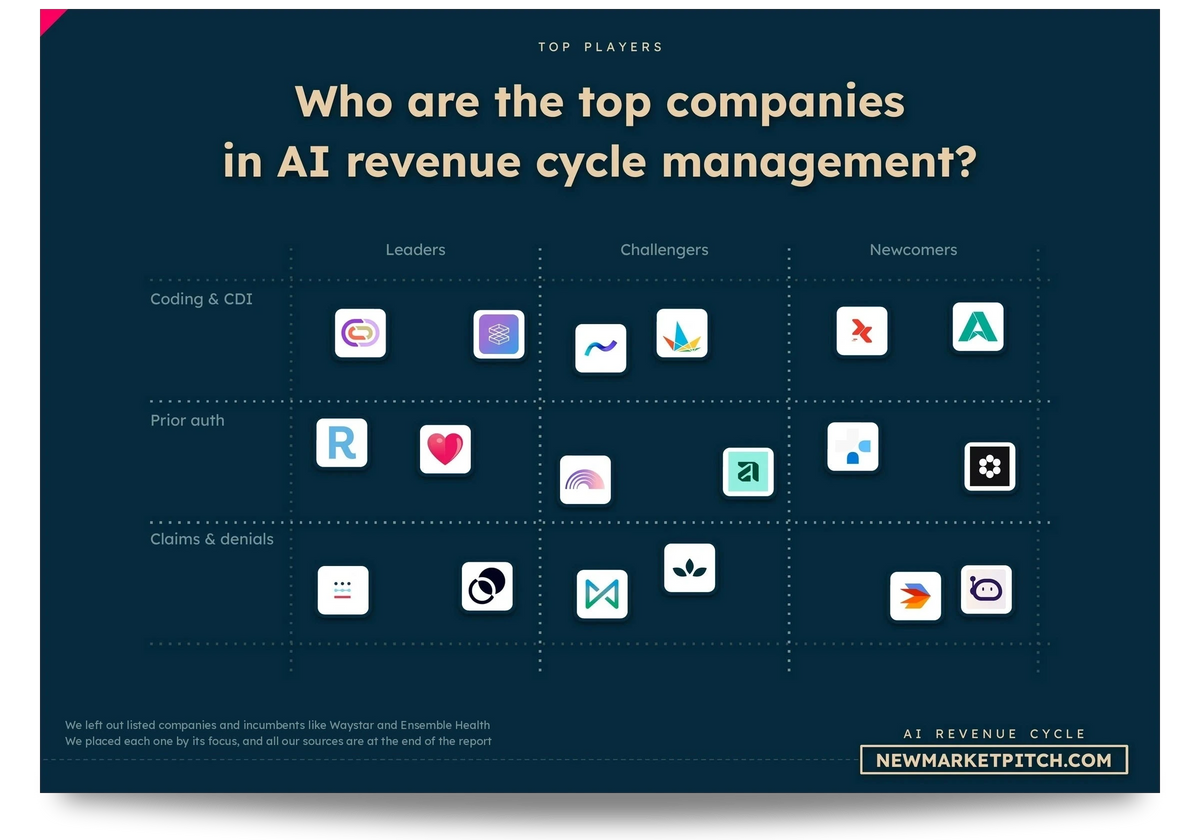
In our research about AI tools for medical billing, we turn what is vague and complex into simple, useful visuals. Market maps like this one show you at a glance where every startup stands.
GenHealth.ai raised $16.5 million in September 2026 to expand its AI agents for healthcare billing and administrative operations.
When was it?
GenHealth.ai announced its latest financing on September 8, 2026.
Who are they?
GenHealth.ai builds AI agents that operate inside healthcare software to verify insurance, manage authorizations, prepare bills and resolve denied claims.
Geographical focus?
GenHealth.ai primarily serves the United States healthcare market, including medical providers and other organizations working with American insurance systems.
Why do we include them in the AI revenue cycle management market?
GenHealth.ai automates billing, eligibility checks and claim denials, although its broader healthcare administration offering makes its revenue-cycle specialization less certain than that of dedicated billing providers.
What is the company stage?
GenHealth.ai is in commercial growth, with deployed AI workflows and a human-supervised operating model that supports complex healthcare billing tasks.
How much did they raise?
GenHealth.ai raised $16.5 million, bringing its total disclosed funding to $30 million.
What round is it?
GenHealth.ai completed a Series A led by Flare Capital Partners, with participation from Craft Ventures, Obvious Ventures, Eniac Ventures, InHealth Ventures, Epsilon Health Investors and ARTIS.
Why did they raise?
GenHealth.ai raised the funding to deploy more AI agents into existing healthcare systems and automate repetitive insurance, billing and claims-management work.
Arintra raised $25 million in August 2026 to expand its autonomous medical coding and healthcare revenue assurance platform.
When was it?
Arintra publicly announced its Series B financing on August 26, 2026.
Who are they?
Arintra develops AI software that assigns billing codes to medical records, identifies missing documentation and helps hospitals capture the correct reimbursement for patient care.
Geographical focus?
Arintra primarily serves hospitals and health systems in the United States, where its platform supports multiple clinical specialties and care settings.
Why do we include them in the AI revenue cycle management market?
Arintra directly automates medical coding, documentation improvement and revenue assurance, addressing the processes that determine whether healthcare providers receive accurate insurance payments.
What is the company stage?
Arintra is in its growth stage, with enterprise health system customers and autonomous coding capabilities covering more than 23 clinical specialties.
How much did they raise?
Arintra raised $25 million in new funding, bringing its total announced capital raised to $51 million.
What round is it?
Arintra completed a Series B led by Define Ventures, alongside Peak XV Partners, Endeavor Health Ventures, Y Combinator and other existing investors.
Why did they raise?
Arintra raised the capital to serve more hospital systems, expand specialty coverage and automate additional parts of the healthcare reimbursement process.

Your time is limited. In our market report about AI tools for medical billing, we put numbers on each part of the market, so you can see where it makes sense to focus.
Procode AI raised $10 million in July 2026 to expand AI-powered surgical coding and specialty medical billing services.
When was it?
Procode AI formally announced its Series A financing on July 28, 2026, following earlier media coverage.
Who are they?
Procode AI combines automated surgical coding software with medical billing services that help specialist practices turn operative reports into accurate insurance claims.
Geographical focus?
Procode AI focuses on the United States, initially serving plastic surgery and dermatology practices while expanding into other surgical specialties.
Why do we include them in the AI revenue cycle management market?
Procode AI directly handles procedural coding, claim preparation and reimbursement management for surgeons, making medical billing its central commercial activity.
What is the company stage?
Procode AI is in commercial growth, supported by its acquisition of The Auctus Group and an established customer base of surgical practices.
How much did they raise?
Procode AI raised $10 million from a funding round led by Health Velocity Capital.
What round is it?
Procode AI completed a Series A venture financing round with Health Velocity Capital as the disclosed lead investor.
Why did they raise?
Procode AI plans to acquire additional specialty billing businesses, integrate its AI coding technology into their operations and expand into more surgical markets.
Candid Health raised $120 million in July 2026 to scale its autonomous healthcare revenue cycle management platform.
When was it?
Candid Health announced its latest investment round on July 22, 2026.
Who are they?
Candid Health provides software that automates medical billing, insurance claim submissions, payment tracking and other reimbursement workflows for healthcare organizations.
Geographical focus?
Candid Health primarily operates in the United States, serving healthcare providers that need to manage large volumes of insurance claims.
Why do we include them in the AI revenue cycle management market?
Candid Health is a direct revenue-cycle specialist whose platform automates multiple stages of medical billing, from claim submission through payment collection.
What is the company stage?
Candid Health is in late-stage commercial growth, reporting 190% year-over-year growth in annual contracted run-rate revenue during 2025.
How much did they raise?
Candid Health raised $120 million, the largest financing among the twelve selected AI revenue cycle management announcements.
What round is it?
Candid Health completed a Series D led by Sixth Street Growth, with participation from Oak HC/FT, 8VC and Y Combinator.
Why did they raise?
Candid Health raised the funding to accelerate development of its autonomous billing infrastructure and expand its deployment across healthcare providers managing complex reimbursement operations.

In our document detailing everything you need to know about AI revenue cycle management, we always try to gather several sources and make estimates that make sense, so you can work with solid numbers.
InsideDesk secured $12.6 million in July 2026 to accelerate AI-powered dental claims management and insurance collections.
When was it?
InsideDesk announced its growth financing on July 15, 2026.
Who are they?
InsideDesk develops software that helps dental service organizations monitor insurance claims, follow up on unpaid balances and collect reimbursement across multiple practices.
Geographical focus?
InsideDesk is headquartered in Canada and primarily serves dental organizations across North America, especially large groups operating in the United States.
Why do we include them in the AI revenue cycle management market?
InsideDesk specializes in dental revenue-cycle operations, using automation to manage insurance receivables, payment tracking, claims follow-up and collections.
What is the company stage?
InsideDesk is in commercial growth, with established dental service organization customers and a platform designed for multi-location operations.
How much did they raise?
InsideDesk announced $12.6 million in growth financing, including a small venture-debt component whose exact size was not separately disclosed.
What round is it?
InsideDesk secured growth financing led by Pender Ventures, with additional participation from Round13 Capital and Graphite Ventures.
Why did they raise?
InsideDesk raised the capital to improve its AI platform, expand its team and automate more dental insurance payment and collection workflows.
Maia Medical Billing raised $1.2 million in June 2026 to improve AI coding and reimbursement for orthopaedic practices.
When was it?
Maia Medical Billing announced its seed financing on June 16, 2026.
Who are they?
Maia Medical Billing develops AutoCoder, an AI tool that reads orthopaedic patient notes and recommends medical billing codes with explanations for each recommendation.
Geographical focus?
Maia Medical Billing focuses on orthopaedic practices in the United States, where detailed coding requirements can make insurance billing particularly complex.
Why do we include them in the AI revenue cycle management market?
Maia Medical Billing automates specialty medical coding, reimbursement preparation and billing checks, helping orthopaedic providers reduce claim errors and missed payments.
What is the company stage?
Maia Medical Billing is in early commercialization, with a working AI coding product and integrations into electronic health record systems.
How much did they raise?
Maia Medical Billing raised $1.2 million from a combination of institutional investors, physicians and healthcare technology investors.
What round is it?
Maia Medical Billing completed a seed funding round without publicly identifying a single lead investor.
Why did they raise?
Maia Medical Billing plans to expand its engineering team, improve AutoCoder's accuracy and support adoption across more orthopaedic practices.

Our report covering the AI revenue cycle management market gets updated several times a month, so you always get the latest view of where things stand.
Commure raised $70 million in May 2026 at a $7 billion valuation to expand AI-powered healthcare operations.
When was it?
Commure announced its $70 million financing on May 19, 2026.
Who are they?
Commure provides AI software for hospitals and medical practices, including revenue-cycle tools, medical coding automation and clinical administration systems.
Geographical focus?
Commure primarily serves healthcare organizations in the United States and has stated plans to expand its platform into international healthcare markets.
Why do we include them in the AI revenue cycle management market?
Commure's Athelas revenue-cycle operations directly support medical billing and reimbursement, although the wider business also includes clinical and administrative products beyond dedicated revenue cycle management (RCM).
What is the company stage?
Commure is in late-stage commercial growth, with technology deployed across more than 500 healthcare organizations and approximately 3,000 care locations.
How much did they raise?
Commure raised $70 million at a publicly disclosed post-money valuation of $7 billion.
What round is it?
Commure completed a growth financing round led by General Catalyst, with participation from Sequoia Capital, Morgan Stanley and Kirkland & Ellis.
Why did they raise?
Commure plans to expand its AI agents, improve its revenue-cycle and practice management products and serve a larger range of healthcare organizations.
Amperos Health raised $16 million in April 2026 to automate insurance denial management and healthcare revenue recovery.
When was it?
Amperos Health announced its Series A funding round on April 22, 2026.
Who are they?
Amperos Health develops AI agents that investigate rejected insurance claims, prepare appeals and help healthcare providers recover payments they are owed.
Geographical focus?
Amperos Health serves healthcare providers throughout the United States, reporting activity across all 50 states and more than 3,000 clinical locations.
Why do we include them in the AI revenue cycle management market?
Amperos Health directly automates denial management, accounts receivable follow-up and reimbursement recovery, which are central activities in the healthcare revenue cycle.
What is the company stage?
Amperos Health is in commercial growth, with an operating platform that has handled hundreds of thousands of insurance claims for healthcare customers.
How much did they raise?
Amperos Health raised $16 million from Bessemer Venture Partners, Uncork Capital and Neo.
What round is it?
Amperos Health completed a Series A financing round led by Bessemer Venture Partners.
Why did they raise?
Amperos Health raised the funding to scale its autonomous denial management platform, recover more unpaid claims and identify recurring causes of reimbursement problems.

In our research about AI tools for medical billing, we look at what the winners do differently, so you can learn from the best instead of guessing.
Healtheon AI secured a $3 million strategic investment in April 2026 to develop autonomous healthcare revenue-cycle agents.
When was it?
Healtheon AI's strategic investment was publicly reported on April 2, 2026.
Who are they?
Healtheon AI builds specialized AI agents that help healthcare providers verify insurance, assign medical codes, process claims and resolve reimbursement denials.
Geographical focus?
Healtheon AI focuses on healthcare providers and medical billing businesses in the United States, with strategic backing from India-based LatentView Analytics.
Why do we include them in the AI revenue cycle management market?
Healtheon AI directly targets medical coding, insurance eligibility, claims processing and payment recovery with AI agents designed specifically for revenue-cycle teams.
What is the company stage?
Healtheon AI is in early commercial development and strategic expansion, although the scale of independently verified customer deployment remains unclear.
How much did they raise?
Healtheon AI received a $3 million strategic investment from LatentView Analytics.
What round is it?
Healtheon AI received the investment through a Simple Agreement for Future Equity, or SAFE, rather than a conventional named venture funding series.
Why did they raise?
Healtheon AI secured the investment to develop its healthcare billing agents and use LatentView's commercial relationships to expand into larger provider and billing-company operations.
Care.fi raised $5 million in equity in February 2026 to expand its AI-powered hospital claims and reimbursement platform.
When was it?
Care.fi announced its Series A financing on February 11, 2026.
Who are they?
Care.fi develops healthcare financial infrastructure that helps hospitals process insurance claims, manage reimbursement documents and access financing while waiting for payments.
Geographical focus?
Care.fi primarily serves hospitals in India, including those working with public and private insurance programs, with plans to expand into the United States and the Middle East.
Why do we include them in the AI revenue cycle management market?
Care.fi provides AI-enabled claims processing, coding and reimbursement management for hospitals, although its separate working-capital financing business makes its RCM specialization less certain.
What is the company stage?
Care.fi is in commercial growth, operating a healthcare-focused financial infrastructure platform with hospital customers and expanding claims-management capabilities.
How much did they raise?
Care.fi raised $5 million in equity alongside $3 million in debt financing, creating a combined financing package of $8 million.
What round is it?
Care.fi completed a Series A led by July Ventures, with participation from Peak XV Partners, Accion Ventures and Sadev Ventures.
Why did they raise?
Care.fi raised the funding to expand its AI-powered hospital claims platform, improve reimbursement settlement processes and grow its healthcare financial services across additional markets.
Written by the New Market Pitch teamWe track new markets so founders and investors can move faster. About us