Can AI video generators make money with GPU costs so high?
Whether you're building or investing in the AI video generation market, our report covers everything you need to know: the players, the money, and what's coming next.
Summary
Yes, AI video generators can make money despite expensive GPUs, and companies such as HeyGen, Runway and Synthesia have already demonstrated substantial commercial demand. But generating hundreds of millions in revenue and building a profitable AI video business are still two very different achievements.
HeyGen surpassed $200 million in annual recurring revenue in June 2026, while Runway reached an estimated $200 million ARR by August. Synthesia generated $113.2 million in actual 2025 revenue but reported a $69.9 million pre-tax loss, showing how quickly sales can grow without producing company-wide profits.
Synthesia's finances challenge the assumption that GPUs are the main obstacle. Hosting expenses represented 23.1% of its 2025 revenue, and even cutting those costs in half would have saved only $13.1 million against a $69.9 million pre-tax loss. Research, salaries, sales and other operating costs can be just as important.
Published AI video generation prices range from approximately $0.05 to $0.40 per second across the models examined. That translates into $0.50 to $4 for a ten-second clip, before accounting for repeated attempts, editing or other production expenses.
The real economic unit is the usable video, not the generated video. Five attempts to produce one acceptable ten-second clip can cost between $2.50 and $20 at the API rates examined, making prompt accuracy, consistent characters and reliable motion financially valuable features.
GPU utilization can matter as much as rental prices. A company operating reserved hardware at 40% productive utilization effectively pays twice the GPU rental cost per useful computing hour of a comparable operator achieving 80%, assuming similar throughput.
Cheaper models will improve the economics, but lower costs will not automatically become higher profits. Competitors can reduce their own prices, and today's difference between basic and premium model prices does not establish how quickly the cost of generating comparable-quality video is declining.
Enterprise video applications offer a stronger near-term business model because customers pay for repeatable work such as training, localization and marketing. Applications built on external models can also avoid frontier training costs, provided they offer enough workflow functionality to justify their prices.
Usage-based pricing and credit allowances help platforms prevent heavy users from consuming more computing resources than their subscriptions can support. Runway's transition from Unlimited toward the credit-based Max plan illustrates how important consumption controls have become.
The biggest uncertainty remains frontier model development. Runway's approximately $5.3 billion financing valuation represented roughly 26.5 times its later estimated ARR, reflecting expectations of major future growth rather than demonstrated profitability. The most credible path to sustainable margins is to earn enough from each useful video workflow to cover generation, research, customer acquisition and operating costs, even as competitive pricing pressure increases.

Written by the New Market Pitch teamWe track new markets so founders and investors can move faster. About us
Are AI video generators making real money yet?
AI video generators are already bringing in hundreds of millions of dollars, but very few have shown they can turn that revenue into profits.
HeyGen announced that it had passed $200 million in annual recurring revenue in June 2026, doubling its run rate in eight months. Sacra estimates that Runway reached $200 million ARR by August 2026, compared with $96 million at the end of 2025. Synthesia reported $113.2 million in actual revenue for 2025, up 94% from the previous year.
These companies have built substantial businesses in a remarkably short time. Yet the financial picture becomes less impressive when we look at expenses.
Synthesia reported a $69.9 million pre-tax loss for 2025. Its hosting costs reached $26.2 million, increasing 108% year over year, slightly faster than revenue. Hosting alone consumed 23.1% of sales, up from 21.6% in 2024.
Customers are clearly willing to pay for AI-generated video, and demand is growing quickly. But even companies with more than $100 million in annual revenue can remain deeply unprofitable.
The question now is how much of those losses come from expensive computing, how much comes from running and growing the business, and whether either can improve fast enough.
How much does generating an AI video actually cost today?
Generating AI video currently costs anywhere from a few cents to several dozen cents per second at published API prices, depending on the model and quality selected.
Google's Veo 3.1 provides a useful comparison. Its Lite model costs $0.05 per second at 720p, Fast costs $0.10, and Standard costs $0.40 with audio at 720p or 1080p. A ten-second video therefore costs between $0.50 and $4.00.
Runway offers Gen-4 Turbo at $0.05 per second through its API. Kling 2.5 Turbo Pro costs $0.07 per second through fal, while Kling 3.0 Pro with audio costs $0.168.
The gap gets expensive at scale. Generating 1,000 ten-second clips costs $500 at $0.05 per second, compared with $4,000 at $0.40. And that assumes every generation succeeds on the first attempt.
These are commercial API prices rather than the companies' internal GPU expenses. Nevertheless, they show how much businesses currently pay for video generation and how dramatically the bill changes depending on their choice of model.
| Video model | Price per second | Price per 10-second clip |
|---|---|---|
| Runway Gen-4 Turbo | $0.05 | $0.50 |
| Google Veo 3.1 Lite | $0.05 | $0.50 |
| Kling 2.5 Turbo Pro | $0.07 | $0.70 |
| Google Veo 3.1 Fast | $0.10 | $1.00 |
| Kling 3.0 Pro, audio off | $0.112 | $1.12 |
| Kling 3.0 Pro, audio on | $0.168 | $1.68 |
| Google Veo 3.1 Standard | $0.40 | $4.00 |

A good product starts with a real problem. In our report covering the AI video generation market, we show you the ones customers still live with.
Are GPUs really what makes AI video generation so expensive?
GPU costs are a major expense for AI video generators, but poor utilization and repeated generations can make the computing bill considerably worse.
Lambda lists an NVIDIA H100 SXM at approximately $3.99 per GPU-hour in an eight-GPU configuration, while its B200 price is approximately $6.69 per GPU-hour. Silicon Data's H100 rental index stood around $2.83 per GPU-hour for neocloud providers in October 2026.
At $3.99 per hour, continuously renting one H100 for 720 hours would cost approximately $2,873. An eight-GPU configuration would cost roughly $23,000 over the same period, before networking, storage or other infrastructure expenses.
But an H100 rental price tells us surprisingly little about the cost of a finished video. Different models use different amounts of memory and computing time. A GPU sitting idle is also still expensive if capacity has been reserved.
Consider two companies using identical hardware. If one keeps its GPUs busy with paying customers 80% of the time while the other achieves 40% utilization, the second pays twice as much in reserved GPU rental expense for each hour of useful work, assuming comparable throughput.
Generation failures add another layer. A customer might request the same scene several times because the model gets the movement, character or composition wrong.
So when we assess AI video profitability, we need to look at how much customers pay for each successful video compared with the total computing resources used to deliver it. The hourly rental price alone cannot answer that.
How much money do AI video generators lose on failed clips?
Failed AI video generations can turn an apparently cheap service into an expensive one, particularly when customers need many attempts before getting a usable result.
Take a ten-second clip generated at $0.10 per second. One attempt costs $1. If the customer needs five attempts, the generation bill reaches $5 for a single accepted clip.
The effect becomes more pronounced with premium models. Five attempts using Veo 3.1 Standard at $0.40 per second would cost $20 for one accepted ten-second video. At the other end, five Runway Gen-4 Turbo generations would cost $2.50 at the published API rate.
A cheaper model can therefore become more expensive in practice if it struggles to follow instructions. Conversely, a premium model may justify its price if it consistently produces acceptable results with fewer attempts.
We calculated the following examples from published API prices. The number of attempts is hypothetical because providers generally do not disclose comparable rejection rates.
| Model | Cost per 10s attempt | Attempts needed | Total generation cost |
|---|---|---|---|
| Runway Gen-4 Turbo | $0.50 | 2 | $1.00 |
| Runway Gen-4 Turbo | $0.50 | 5 | $2.50 |
| Kling 2.5 Turbo Pro | $0.70 | 3 | $2.10 |
| Kling 2.5 Turbo Pro | $0.70 | 8 | $5.60 |
| Veo 3.1 Fast | $1.00 | 2 | $2.00 |
| Veo 3.1 Fast | $1.00 | 6 | $6.00 |
| Veo 3.1 Standard | $4.00 | 2 | $8.00 |
| Veo 3.1 Standard | $4.00 | 5 | $20.00 |
This makes character consistency, accurate motion and reliable prompt-following financially valuable. A model that requires fewer retries can save customers money even when its advertised price is higher.
For providers, the exposure depends on the billing model. APIs that charge for every attempt pass much of this expense to customers. Subscription products that absorb retries carry more of the risk themselves.

If you build or invest in the AI video generation market, you need to know which business models pay off now and which ones are fading. That's why our report covering it has a whole section on it.
Are AI video generation costs falling fast enough to make startups profitable?
Cheaper AI video generation is becoming more accessible, but we still lack evidence that production costs are falling fast enough to make most video AI startups profitable.
The differences between available models already offer opportunities to save money. Google's Veo Lite costs one-eighth of its Standard tier at the published 720p rates. Runway also offers a cheaper Turbo model alongside more expensive generation options.
However, comparing different quality tiers does not establish how quickly computing costs are falling. A slower, less capable or lower-quality model costing $0.05 per second is not necessarily evidence that the same output previously cost $0.40.
Hardware suppliers are making more ambitious claims. Lambda advertises B200-based instances as delivering up to fifteen times faster inference in certain workloads compared with previous-generation hardware. Those figures do not establish an equivalent improvement for video generation, whose computational requirements differ from those of language models.
There is also an important financial difference between reducing the cost of inference and reducing total expenses. Training new models, employing researchers and maintaining infrastructure can remain expensive even when generating an individual clip becomes cheaper.
For now, the strongest evidence is that AI video companies have more low-cost generation options available to them. We cannot reliably calculate an industry-wide decline in cost per comparable, usable video from the public data.
And even if costs fall sharply, competitors might lower their prices just as quickly.
Can AI video startups make money without developing their own models?
AI video startups that rely on external models have a more straightforward path to profitability because they can avoid much of the expense of training frontier video models.
A company building a video editing, marketing or localization application can purchase generation through APIs instead of developing its own foundational technology.
The economics are easier to manage. If an application purchases a ten-second generation for $0.50, it can incorporate that expense into a subscription, credit package or per-video charge. It can also reserve more expensive models for customers who specifically need higher-quality output.
This gives applications flexibility when new models arrive. A company that uses several providers can move workloads toward whichever offers the most useful combination of price, reliability and quality.
There is a catch: access to the same APIs is available to competitors. Simply charging customers more for an underlying video-generation model is a weak business if users can obtain virtually identical output directly from the original provider.
A stronger approach is to sell something customers need beyond generation. That could include brand templates, automatic editing, approval workflows, multilingual versions, campaign management or integration with advertising platforms.
The business then earns money for helping customers finish a task rather than merely producing seconds of video.
For startups without the capital to compete in frontier AI research, this looks like the more realistic bet. Competition will still be fierce, but survival doesn't depend on repeatedly financing increasingly expensive model-training projects.
If you want more recent data on this point, please see our latest AI video generation market report.

Learning from others' mistakes is the cheapest lesson there is. In our market report about AI video generators, we look at what broke startups before you, so you don't repeat it.
Can unlimited AI video subscriptions ever be profitable?
Unlimited AI video subscriptions are financially risky unless providers restrict expensive generations or rely on most subscribers using considerably less than the theoretical maximum.
Runway's subscription structure shows how companies address this problem. Its Standard plan includes 625 monthly credits, while Max includes 9,500. The advertised annual billing rates are $12 and $76 per month, respectively.
Runway began replacing its Unlimited subscription with Max for new subscribers in 2026. Eligible existing Unlimited subscribers can retain their plans until November 30, 2026. Even the older Unlimited plan uses restrictions on generation modes and access rather than offering unrestricted use of every premium model.
A provider collecting $30 per month from a customer who consumes $5 of computing resources has room to cover other expenses. Another customer paying the same amount but consuming $50 of resources creates a loss before support, development and overhead.
The danger comes from heavy users. Someone generating dozens of videos every day can consume far more compute than a subscriber who creates a few clips per month.
This is especially relevant in video because the difference between basic and premium generation can reach several multiples per second, as shown by published API prices.
Credits, slower queues, fair-use restrictions and separate premium charges help providers manage that exposure. Their widespread use suggests that AI video platforms are taking computing expenses seriously.
The missing evidence is how much their subscribers actually consume. Without distributions of compute cost per paying customer, we cannot determine whether a particular unlimited plan makes money. But offering unrestricted premium generation at a low fixed price would create an obvious financial risk.
Is enterprise AI video more profitable than consumer video generation?
Enterprise AI video currently looks like a stronger business than consumer-focused generation because customers pay for recurring work such as training, localization and marketing, although higher revenue does not automatically mean higher profits.
HeyGen reported adoption across 85% of Fortune 100 companies alongside its latest ARR milestone. Synthesia has also reported serving customers across 90% of Fortune 100 companies.
These products are used for things like employee training, sales communication, product explanations and translations. Companies repeatedly need such content, and AI video can reduce the filming and editing work involved.
A consumer might pay $15 or $20 to experiment with cinematic clips for a month, then cancel. A company translating hundreds of training videos has a clearer reason to keep paying, provided the output is reliable and cheaper than its previous process.
Enterprise video can also create additional revenue opportunities through collaboration, integrations, security requirements and service commitments.
Still, selling to large organizations brings other expenses. Enterprise sales teams, customer support, security reviews and product customization can be costly.
The financial evidence supports a narrower conclusion than simply saying enterprise AI video is profitable. Business-focused providers have demonstrated that customers will pay meaningful recurring amounts. Their long-term margins remain dependent on delivery costs and operating discipline.
What makes enterprise video attractive is that generation can be a relatively small part of the value customers receive. A useful localization or training workflow may remain worth paying for even as the underlying models become cheaper.
If you want more recent data on this point, please see our latest AI video generation market report.

When you build or invest in the AI video generation market, you need clarity, not confusion. In our document detailing everything you need to know about AI video generation, we always try to put numbers on and quantify whatever is usually vague and confusing.
Is Runway's $200 million ARR enough to prove its business works?
Runway's estimated $200 million ARR shows that customers will spend substantial money on advanced AI video generation, but the company still has to prove that its expensive model-development strategy can produce lasting profits.
According to Sacra, Runway's ARR more than doubled from approximately $96 million at the end of 2025 to $200 million by August 2026.
That growth occurred alongside heavy fundraising. Runway announced a $315 million Series E in February 2026, led by General Atlantic, with participation from NVIDIA, Adobe Ventures and other investors. Bloomberg reported a valuation of approximately $5.3 billion.
Using the later ARR estimate, that valuation represents roughly 26.5 times annual recurring revenue, although the two figures come from different points in time.
Investors are clearly betting on much more growth. Runway is also expanding beyond conventional video-generation tools into world models, which could eventually serve industries beyond entertainment and marketing.
That ambition introduces additional expense. Training increasingly capable models requires researchers, computing resources and experiments that may never become successful commercial products.
Runway has not published the detailed cost breakdown needed to calculate how much it earns after inference, model training and other operating expenses.
The company has demonstrated rapid revenue growth. Whether its model-development investments will eventually deliver enough returns to justify their cost is still an open question, particularly as Google and other well-funded competitors improve their own video models.
What do Synthesia's financial results reveal about AI video profitability?
Synthesia's latest reported accounts suggest that GPU-related hosting costs are manageable relative to revenue, but the company still spends far more than it earns.
According to financial results reported by The Times, Synthesia generated $113.2 million in revenue in 2025, compared with $58.3 million in 2024.
Its hosting expenses increased from approximately $12.6 million to $26.2 million over the same period.
We calculate that hosting represented 21.6% of revenue in 2024 and 23.1% in 2025. So despite nearly doubling sales, the company had not yet reduced its hosting burden as a share of revenue.
Still, hosting represented less than a quarter of total sales. After subtracting that particular expense, approximately $87 million of revenue remained to cover other direct costs and operating expenses.
That helps explain why cutting GPU expenses alone cannot solve the company's financial problems.
Synthesia's reported pre-tax loss reached $69.9 million in 2025. Even a hypothetical 50% reduction in hosting expenses would save only $13.1 million annually, assuming revenue and everything else remained unchanged.
As seen above, AI video profitability depends on considerably more than the GPU bill. Staff, research, sales, product development and other operating expenses can account for much of the remaining gap.
Synthesia's accounts are particularly valuable because they provide a concrete example of a video AI company where revenue has reached nine figures and infrastructure expenses are substantial, but still far from being the only obstacle to profitability.

In our report covering the AI video generation market, we look at what the winners do differently, so you can learn from the best instead of guessing.
Can charging per video solve the AI generation profitability problem?
Charging by the second, video or credit can make AI generation easier to monetize because revenue increases when customers consume more computing power.
Google's Veo API, Runway's developer products and fal's model marketplace all use consumption-based pricing.
This avoids one of the biggest problems with fixed subscriptions: a customer generating ten times more content can be charged roughly ten times more, depending on the model and pricing arrangement.
The provider can also differentiate prices according to the underlying cost. Premium generation with audio, higher quality or additional features can carry a higher fee than basic output.
The risk is that customers must pay for unsuccessful attempts as well as finished videos. Someone working on a commercial advertisement might need twenty generations to obtain one satisfactory scene.
Charging for every attempt protects the provider's revenue but can make customers reluctant to experiment. Absorbing those attempts improves the user experience but leaves the platform paying for more compute.
That's why hybrid pricing is attractive. Customers receive a monthly credit allocation and purchase additional capacity when needed, while expensive generations consume more credits.
For AI video companies, this gives a clearer relationship between usage and revenue. It cannot compensate for an underlying selling price that falls below the true cost of providing the service, but it removes much of the exposure created by unrestricted fixed-price plans.
If you want more recent data on this point, please see our latest AI video generation market report.
Will cheap AI video models force everyone to lower their prices?
Basic AI video generation is likely to become cheaper, putting pressure on companies that sell little more than access to a model.
The market already contains products at very different prices. Some providers charge around $0.05 per generated second, while premium services can cost several times more.
Customers will keep paying higher prices when the results justify the difference. A professional advertisement might require accurate character movement, consistent products, precise camera control and reliable audio. A casual social-media clip may need none of those capabilities.
However, those distinctions can shrink as less expensive models improve.
Imagine a provider that charges $0.40 per second and spends $0.30 delivering it. Its contribution before other expenses is $0.10. If computing improvements reduce delivery costs to $0.10 while the provider keeps its original selling price, the contribution reaches $0.30.
But if competition forces its price down to $0.12, the contribution falls to $0.02.
These figures are illustrative, not reported margins. They show how much pricing pressure can change the outcome even when technology becomes dramatically more efficient.
Companies selling interchangeable generation endpoints are particularly exposed. If customers can obtain comparable videos for half the price elsewhere, loyalty may be limited.
Providers with better editing controls, reliable characters, integrated workflows or enterprise contracts have more ways to justify a premium.
Cheaper inference will help AI video companies, but competitors will push some of those savings back to customers through lower prices. Assuming that every reduction in GPU cost becomes additional profit is unrealistic.

Your time is limited. In our research about AI video generators, we put numbers on each part of the market, so you can see where it makes sense to focus.
Can Runway and smaller AI video startups survive competition from Google and Adobe?
Independent AI video companies can survive competition from Google and Adobe, but competing mainly on model quality and generation price is becoming increasingly difficult.
Google distributes Veo through its developer products and AI ecosystem. Adobe integrates video generation into Firefly and its wider creative software offering.
Adobe's Firefly Standard subscription starts at $9.99 per month and includes 2,000 generative credits, advertised as sufficient for up to twenty five-second video generations.
That gives Adobe a distribution advantage. Its customers can try AI video inside software they already use rather than adopting a separate platform.
Google has a similar advantage through its cloud infrastructure, developer relationships and consumer AI products. Both companies can support video generation with revenue from much larger businesses.
Specialized startups consequently need a compelling reason for customers to choose them.
Runway is investing in advanced creative tools and proprietary models. HeyGen concentrates on avatars, translation and business communication. Synthesia emphasizes structured enterprise video production.
Those differences matter because customers may remain loyal to a complete workflow even when the underlying video models become widely available.
The toughest competition will likely affect products offering simple text-to-video generation with limited editing or integration capabilities. Such products face direct pressure from both model developers and established software companies.
A specialist that solves a valuable production problem can still build a business. But a startup whose main advantage is access to a powerful video model may struggle to keep that advantage for long.
If you want more recent data on this point, please see our latest AI video generation market report.
Do AI video generators need millions of paying users to become profitable?
AI video companies can build substantial revenue businesses with relatively few customers if those customers spend enough and the cost of serving them stays under control.
Consider two businesses with the same revenue. A consumer platform charging $15 per month needs 100,000 paying subscribers to generate $18 million annually. An enterprise provider charging $30,000 a year reaches the same revenue with 600 customers.
These examples are illustrative, but they reveal how different the customer requirements can be.
A consumer app may need constant marketing, viral growth and high conversion from free to paying users. An enterprise provider may depend on a smaller number of long-term contracts, although winning those customers often requires expensive sales teams and onboarding.
Customer count also tells us little about computing costs.
A platform with 100,000 subscribers who generate videos every day could face enormous infrastructure expenses. Another with 10,000 customers who use video generation sparingly but pay for valuable business tools might enjoy better unit economics.
The important figures are revenue per paying customer, retention, computing expense per account and the cost of acquiring and supporting customers.
For investors evaluating AI video businesses today, user growth without corresponding revenue and cost data is increasingly unconvincing. A large audience can become a financial burden when each additional generation consumes expensive resources.

In our market report about AI video generators, we always try to gather several sources and make estimates that make sense, so you can work with solid numbers.
Are investors betting on profitable AI video companies or future growth?
Investors are still financing AI video companies at multibillion-dollar valuations, even though the available financial evidence shows that profitability remains far from guaranteed.
The fundraising activity has been substantial. Runway raised $315 million in February 2026, while Synthesia announced a $200 million round in January 2026 at a $4 billion valuation.
These companies represent different bets.
Runway is pursuing increasingly advanced generative video and world models. Its investors are financing technology development that could open new applications beyond conventional content production.
Synthesia focuses on enterprise communication, where its value depends more directly on helping organizations produce training, localization and business videos.
Both approaches can generate recurring revenue, but their spending requirements differ. Frontier-model companies must continuously fund expensive research to remain competitive. Application companies can devote more resources to customers, software features and distribution, especially when they rely partly on externally supplied models.
A high valuation reflects expectations for future revenue, margins and growth. It does not establish that the business currently earns a profit.
Investors appear willing to finance the gap between commercial demand and financial maturity, particularly when they believe the company can become a major platform.
That financial support gives startups time to develop their products. It can also hide weak unit economics if the business needs repeated injections of capital to keep operating.
The crucial test will come when more AI video companies must demonstrate that revenue can fund their expenses without relying on another major fundraising round.
Can AI video generators actually make money with GPU costs so high?
Yes, AI video generators can make money despite expensive GPUs, and the strongest businesses already have enough revenue to show that the market is commercially real. But profitable AI video generation is still much easier to demonstrate at the individual transaction level than across an entire company.
The divide is already visible.
Business-focused AI video platforms have established recurring demand from customers who use generated content for training, localization, marketing and communication. They can charge for complete workflows, which gives them more flexibility than companies selling individual clips.
Developers of frontier video models face a harder financial challenge. They must pay for both serving customers and developing the next generation of models, often while competing with technology companies that have much larger financial resources.
Published API prices show that generation can cost from $0.05 to $0.40 per second across the models examined. At that range, the number of attempts required to produce an acceptable clip can change costs by several multiples. Meanwhile, the available financial accounts demonstrate that hosting expenses are only part of the overall spending required to operate an AI video business.
The best near-term opportunities appear to be companies selling useful, repeatable video workflows while keeping a close watch on generation costs. Subscription limits, metered usage, careful model selection and fewer failed generations all help.
The biggest uncertainty concerns companies developing frontier models. They may eventually benefit from enormous usage volumes and lower computing costs, but they also face constant pressure to spend more on research and lower prices as competitors improve.
Expensive GPUs do not prevent AI video companies from becoming profitable. The more serious challenge is maintaining enough revenue per useful video to cover the full cost of creating, delivering and selling it. Enterprise applications already offer a credible path toward that outcome, while profitability among frontier model developers remains much less certain.
If you want more recent data on this point, please see our latest AI video generation market report.

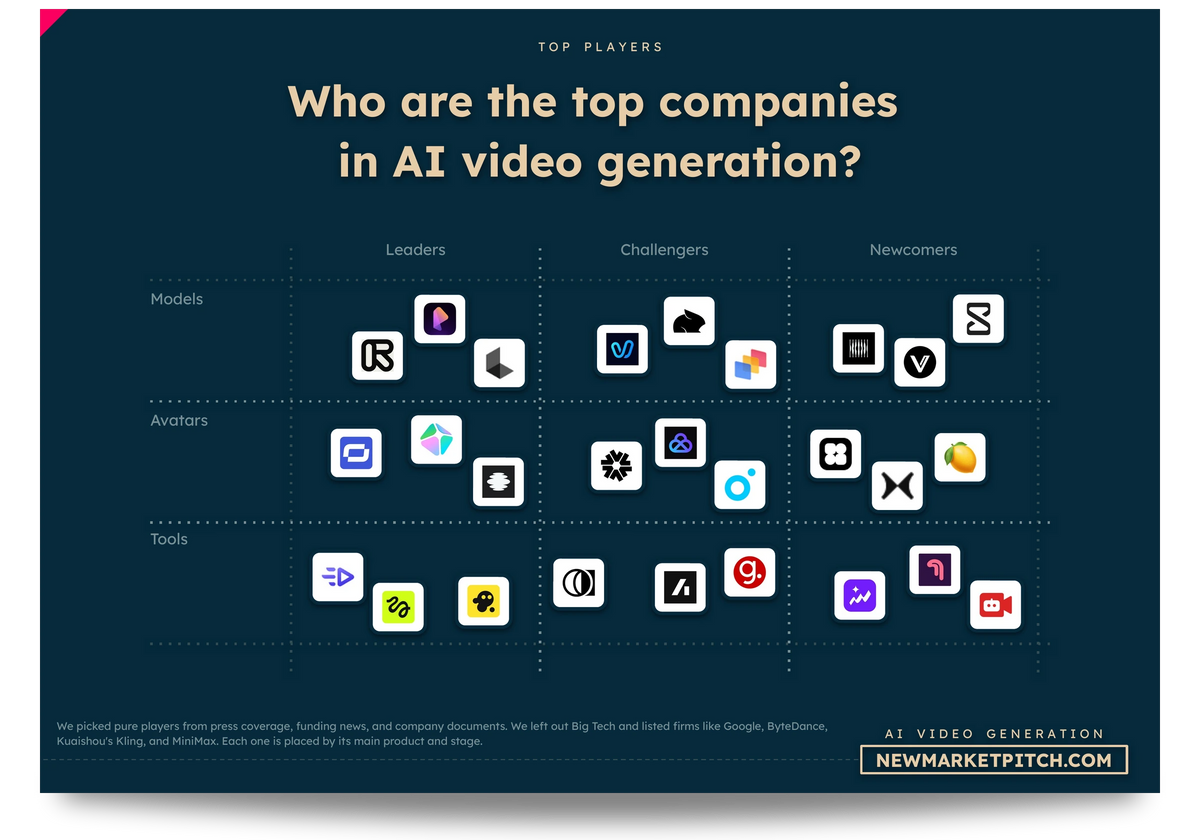
In our document detailing everything you need to know about AI video generation, we turn what is vague and complex into simple, useful visuals. Market maps like this one show you at a glance where every startup stands.
Our methodology
We investigated whether AI video generators can become sustainably profitable with expensive GPU infrastructure. Rather than drawing conclusions from revenue milestones, GPU prices or individual company valuations, we divided the question into nine economic dimensions: commercial traction, generation costs, GPU utilization, model efficiency, pricing, customer consumption, business models, competitive pressure and financing.
For each dimension, we collected recent, attributable evidence, aggregated the most relevant observations and assessed what they showed about the economics of delivering AI-generated video. We then connected the findings across dimensions, examining where growing demand, technical improvements and pricing decisions reinforced each other or exposed financial weaknesses. Our conclusion reflects that combined evidence rather than any one company's performance.
Revenue analysis distinguishes announced annual recurring revenue from recognized annual revenue. HeyGen's and Runway's reported or estimated ARR figures are considered evidence of commercial traction, while Synthesia's financial accounts provide a more direct view of actual sales, hosting expenses and reported losses. Fundraising amounts and valuations are treated as measures of investor expectations and financial backing, never as evidence of operating profits.
For generation economics, we compared published commercial API prices across Google Veo, Runway and Kling models, converting their rates into comparable per-second and ten-second costs. We separately examined GPU rental pricing and utilization because external API charges include more than raw infrastructure costs. The analysis uses the cost per usable video as an important economic measure, accounting for how unsuccessful generations can increase total spending.
Our retry, utilization and contribution-margin scenarios are calculations built from published prices and explicitly stated assumptions, rather than claims about undisclosed company costs. We kept these separate from reported financial performance. We also avoided treating differences between model quality tiers, advertised hardware benchmarks and actual reductions in the cost of comparable-quality video as interchangeable evidence.
We assessed pricing structures through their exposure to customer consumption, including subscriptions, credit allocations, usage-based APIs and constrained unlimited access. We also compared the obligations of frontier-model developers with those of applications using external models, alongside the recurring workflow demand and distribution advantages available in enterprise video. The comparison considers both the ability to capture revenue and the wider expenses required to support that revenue.
Source selection prioritized original company disclosures, financial reporting, official product and infrastructure pricing, and specialist research with identifiable estimates. We used sources for the specific observations they could substantiate and kept company claims, third-party estimates and hypothetical scenarios distinct. This produces a clearer assessment of which AI video business models have credible routes to sustainable margins and where profitability still depends on unproven assumptions.
Key sources for commercial traction and financial performance include HeyGen's $200 million ARR announcement, Sacra's Runway revenue and valuation research, Sacra's analysis of AI video competitors, The Times on Synthesia's 2025 financial results, and Synthesia's Series E announcement.
For generation and infrastructure costs, we used Google's official Gemini API pricing, Runway's developer API pricing, fal's Kling 2.5 Turbo Pro pricing, fal's Kling 3.0 Pro pricing, and Lambda's GPU cloud rates.
Pricing models and competition were examined using Runway's subscription credit documentation, its Unlimited plan restrictions, the transition from Unlimited to Max, Adobe Firefly's subscription plans, and Adobe's integration of external generative models.
For investment activity and strategic positioning, we considered Runway's $315 million Series E announcement, Bloomberg's reporting on Runway's $5.3 billion valuation, and the Financial Times' reporting on Synthesia's financing and valuation.

Our report covering the AI video generation market gets updated several times a month, so you always get the latest view of where things stand.
Written by the New Market Pitch teamWe track new markets so founders and investors can move faster. About us