What are the top AI voice agent startups by total funding raised?
Whether you're building or investing in the AI voice agent market, our report covers everything you need to know: the players, the money, and what's coming next.
Summary
Sierra, Wonderful and Parloa are the top AI voice agent startups by total funding raised, with $1.6 billion, $849 million and $560 million respectively. ASAPP and Decagon complete the top five, with $513 million and $481 million, while the ten largest companies have attracted $5.265 billion combined.
The funding gap between the leaders and the rest of the market is substantial. Sierra's $950 million Series E in May 2026 alone accounts for nearly 60% of its cumulative funding, showing how much capital the largest enterprise AI platforms can now attract.
Enterprise customer service is the biggest investment theme. Sierra, Wonderful, Parloa and Decagon are building agents that can handle customer interactions, access company systems and complete tasks, moving well beyond basic automated telephone answering.
Healthcare has emerged as one of the strongest vertical opportunities. Hippocratic AI has raised $403 million and Assort Health $222 million, with both targeting the large volume of administrative conversations handled by hospitals, medical practices and healthcare providers.
Logistics and insurance are attracting their own specialists. HappyRobot has raised $212 million for operational automation, while Liberate and Salient are applying voice agents to insurance and lending workflows. These businesses have a particularly clear commercial proposition when an automated call can trigger an actual operational action.
Infrastructure is another important investment category. LiveKit has raised $221 million, Vapi $72 million and Daily $62 million, providing developers with the communications technology and tools needed to build and deploy voice agents.
The largest funding rounds are becoming increasingly ambitious. Sierra's $950 million Series E, Wonderful's $550 million Series C and Parloa's $350 million Series D demonstrate that investors are willing to finance companies at a scale previously associated with major enterprise software businesses.
Customer-service automation still has an important limitation: people want access to human support. Gartner found that 87% of surveyed customers wanted the option of speaking to a human agent, even as AI adoption increased. The strongest products will therefore need reliable escalation rather than attempting to automate every conversation.
Geographically, the United States dominates the ranking, but Europe and Israel have produced several major competitors. Wonderful, Parloa and PolyAI have raised $849 million, $560 million and $204 million respectively. Singapore, India and Japan also have growing voice AI businesses, particularly in multilingual customer communications.
The market is getting crowded, especially in generic telephone automation. Sierra, Wonderful and Parloa have the resources to build broad enterprise platforms, while healthcare, logistics, restaurants and insurance offer opportunities for more specialized businesses with deeper industry integrations.
Our view is that the strongest long-term competitors will combine reliable speech technology with proprietary workflows, enterprise integrations and measurable financial returns. The fundraising ranking shows where investors are placing their biggest bets, but customer retention, recurring revenue and the ability to handle real-world conversations will ultimately determine which companies lead the AI voice agents market.

Written by the New Market Pitch teamWe track new markets so founders and investors can move faster. About us

In our report covering the AI voice agent market, you will always find fresh funding data, taken straight from our own verified funding database.
Top startups in the AI voice agents market ranked by total funding raised
Here is an updated table that ranks the top startups in the AI voice agents market based on the total amount of funding they have raised to date.
The table also includes the total number of funding rounds, the date and size of the latest round, the financing type (e.g. Series A, equity financing), key investors, the startup’s current status (active, IPO, acquired, or shut down), and a confidence score based on the data collected (startups with very low data confidence are excluded to make the information more reliable).
If you need to dig deeper and get more detailed data, please check the report covering the AI voice agents market.
| # | Startup | What They Do | Total Raised ($) | Total Rounds | Last Round Date | Last Round Amount ($) | Last Round Type | Key Investors | Current Stage | Confidence | Country |
|---|---|---|---|---|---|---|---|---|---|---|---|
| 1 | Sierra | Enterprise conversational customer service agents | $1.6B | 5 | May 2026 | $950M | Series E | GV, Tiger Global, Benchmark | Active | Strong | United States |
| 2 | Wonderful | Enterprise AI agents and automation | $849M | 5 | September 2026 | $550M | Series C | Insight Partners, Salesforce Ventures, Index Ventures | Active | Strong | Israel |
| 3 | Parloa | Enterprise AI customer service agents | $560M | 5 | January 2026 | $350M | Series D | General Catalyst, EQT Ventures, Altimeter Capital | Active | Full | Germany |
| 4 | ASAPP | Enterprise conversational AI platform | $513M | 5 | August 2023 | $125M | Series D | Undisclosed | Active | Strong | United States |
| 5 | Decagon | AI agents for customer support | $481M | 5 | January 2026 | $250M | Series D | Coatue Management, Index Ventures, Andreessen Horowitz | Active | Full | United States |
| 6 | Hippocratic AI | Healthcare conversational AI agents | $403M | 7 | November 2025 | $126M | Series C | Avenir Growth, CapitalG, General Catalyst | Active | Strong | United States |
| 7 | Assort Health | Healthcare patient-access voice agents | $222M | 5 | June 2026 | $120M | Series C | Menlo Ventures, Lightspeed, Felicis | Active | Strong | United States |
| 8 | LiveKit | Real-time infrastructure for voice AI | $221M | 6 | August 2026 | $40M | Series C Extension | Index Ventures, Salesforce Ventures, Altimeter Capital | Active | Strong | United States |
| 9 | HappyRobot | AI agents for logistics operations | $212M | 4 | August 2026 | $150M | Series C | Prysm Capital, Eurazeo, Andreessen Horowitz | Active | Strong | United States |
| 10 | PolyAI | Enterprise conversational voice customer support | $204M | 6 | December 2025 | $86M | Series D | Georgian, Hedosophia, Khosla Ventures | Active | Strong | United Kingdom |
| 11 | Avoca | AI sales agents for home services | $125M | 4 | April 2026 | Undisclosed | Series B | Meritech Capital, General Catalyst, Kleiner Perkins | Active | Partial | United States |
| 12 | Replicant | Automated contact center voice agents | $112M | 3 | April 2022 | $78M | Series B | Stripes, Salesforce Ventures, Norwest Venture Partners | Active | Full | United States |
| 13 | Bland AI | Enterprise AI phone-call automation | $111M | 4 | June 2026 | $50M | Series C | Dell Technologies Capital, HubSpot Ventures, Emergence Capital | Active | Partial | United States |
| 14 | Omilia | Conversational AI for customer support | $111M | 2 | August 2026 | $67M | Series B | Expedition Growth Capital | Active | Partial | Greece |
| 15 | Yellow.ai | Enterprise conversational AI customer automation | $102M | 3 | August 2021 | $78M | Series C | WestBridge Capital, Salesforce Ventures, Lightspeed Venture Partners | Active | Full | United States |
| 16 | Listen Labs | AI-powered customer research interviews | $96M | 3 | January 2026 | $69M | Series B | Ribbit Capital, Evantic Capital, Sequoia Capital | Active | Strong | United States |
| 17 | Hyro | Healthcare voice and chat automation | $95M | 6 | October 2025 | $45M | Growth Equity | Healthier Capital, Norwest, Define Ventures | Active | Strong | United States |
| 18 | Regal | AI-powered customer engagement and calls | $82M | 3 | October 2024 | $40M | Series B | Emergence Capital, Homebrew | Active | Full | United States |
| 19 | Ellipsis Health | Voice AI for behavioral healthcare | $80M | 4 | June 2025 | $45M | Series A | Salesforce, Khosla Ventures, CVS Health Ventures | Active | Partial | United States |
| 20 | Salient | AI loan servicing and collections | $75M | 2+ | July 2025 | $60M | Series A | Andreessen Horowitz, Matrix Partners, Y Combinator | Active | Partial | United States |
| 21 | Liberate | AI agents automating insurance workflows | $72M | 2 | October 2025 | $50M | Series B | Battery Ventures, Canapi Ventures, Redpoint Ventures | Active | Strong | United States |
| 22 | Vapi | Developer infrastructure for AI voice agents | $72M | 3 | May 2026 | $50M | Series B | Peak XV Partners, M12, Kleiner Perkins | Active | Strong | United States |
| 23 | IVRy | AI business telephone response automation | $69M1 | 4+ | November 2025 | ~$26M | Series D | JIC Venture Growth Investments, Coral Capital, All Star SaaS Fund | Active | Partial | Japan |
| 24 | AI Rudder | Enterprise multilingual voice AI automation | $63M | 4 | March 2022 | $50M | Series B | Tiger Global, Coatue, Cathay Innovation | Active | Strong | Singapore |
| 25 | Daily | Real-time audio and video APIs | $62M | 5 | November 2021 | $40M | Series B | Renegade Partners, Tiger Global, Freestyle Capital | Active | Strong | United States |
| 26 | Giga | Enterprise AI customer support agents | $61M | 1 | November 2025 | $61M | Series A | Redpoint Ventures, Y Combinator, Nexus Venture Partners | Active | Partial | United States |
| 27 | Slang AI | AI phone assistants for hospitality | $60M | 3+ | February 2026 | $28M | Series B | U.S. Venture Partners, Thayer Investment Partners, Homebrew | Active | Partial | United States |
| 28 | Lorikeet | AI agents for complex customer support | $49M | 3 | August 2025 | $35M | Series A | QED Investors, Blackbird Ventures, AirTree Ventures | Active | Full | Australia |
| 29 | WIZ.AI | Multilingual enterprise AI voice agents | $46M2 | 4 | November 2025 | Undisclosed | Series B | SMBC Asia Rising Fund, Beacon Venture Capital, Granite Asia | Active | Partial | Singapore |
| 30 | NuPlay AI | Enterprise voice and chat AI agents | $42M | 2 | August 2025 | $27.5M | Series A | Prosus, Accel, General Catalyst | Active | Partial | India |
| 31 | Voiceflow | Collaborative conversational AI agent development | $40M | 5 | August 2023 | $15M | Series B | OpenView Venture Partners, Felicis Ventures, True Ventures | Active | Strong | Canada |
| 32 | Hi Auto | AI drive-through restaurant ordering | $39M3 | 4 | September 2025 | $11M | Series A | Delek Motors, Goldbell Investments, Vasuki Global Tech Fund | Active | Partial | Israel |
| 33 | Maki | AI recruitment screening and interviewing | $36M | 2 | January 2025 | ~$29M | Series A | Blossom Capital, DST Global, Picus Capital | Active | Full | France |
| 34 | Prosper AI | AI healthcare administration voice agents | $35M | 2 | June 2026 | $30M | Series A | Andreessen Horowitz, Base10 Partners, Emergence Capital | Active | Strong | United States |
| 35 | Acclaim | Enterprise virtual AI workforce | $34M | 1 | July 2025 | $34M | Strategic Equity | Ratmir Timashev, GuruDev Capital | Active | Partial | Cyprus |
| 36 | Kea AI | AI restaurant telephone ordering | $32.9M | 5 | August 2026 | $15.9M | Venture Equity | Streamlined Ventures, Xfund, Heartland Ventures | Active | Partial | United States |
| 37 | Beside | AI receptionist for small businesses | $32M | 3 | November 2025 | $20M | Series A | EQT Ventures, Index Ventures, Stewart Butterfield | Active | Strong | France |
| 38 | Newo | AI receptionists for small businesses | $32M | 4 | February 2026 | $25M | Series A | Ratmir Timashev, Aloniq, Acrobator Ventures | Active | Partial | United States |
| 39 | Phonic | End-to-end speech-to-speech AI voice models | $31.5M | 2 | October 2026 | $28M | Series A | First Round Capital, Lux Capital, Felicis | Active | Full | United States |
| 40 | Coval | Voice AI testing infrastructure | $31M | 2 | June 2026 | $28M | Series A | Norwest, Base10 Partners, Twilio Ventures | Active | Full | United States |
| 41 | GetVocal | Hybrid human-AI customer service agents | $30M | 2 | November 2025 | $26M | Series A | Creandum, Elaia, Speedinvest | Active | Strong | France |
| 42 | Synthflow AI | No-code enterprise AI phone agents | $30M | 3 | June 2025 | $20M | Series A | Accel, Atlantic Labs, Singular | Active | Strong | Germany |
| 43 | Gradient Labs | Financial services AI operations agents | $30M | 3 | June 2026 | $13M | Series A Extension | Octopus Ventures, CommerzVentures, Redpoint Ventures | Active | Strong | United Kingdom |
| 44 | Hello Patient | AI patient communication and scheduling | $29M | 2 | September 2025 | $23M | Series A | Scale Venture Partners, 8VC, Bling Capital | Active | Full | United States |
| 45 | Flip | Automated customer service phone calls | $29M | 3 | January 2026 | $20M | Series A | Undisclosed | Active | Partial | United States |
| 46 | ConverseNow | AI voice ordering for restaurants | $28M | 3 | August 2022 | $10M | Growth Equity | Enlightened Hospitality Investments | Active | Strong | United States |
| 47 | Skit.ai | Voice automation for debt collections | $28M | 3+ | September 2021 | $23M | Series B | WestBridge Capital, Kalaari Capital, Exfinity Venture Partners | Active | Partial | United States |
| 48 | Tucuvi | Clinical AI patient monitoring calls | $27M | 5 | September 2026 | ~$6M | Series A Extension | AXIS | Active | Partial | Spain |
| 49 | Confido Health | Healthcare voice and workflow agents | $26M | 5 | October 2026 | $13M | Series A Extension | Z47, Together Fund, Blume Ventures | Active | Strong | United States |
| 50 | Vocca | AI telephone assistants for healthcare | $25M | 2 | October 2026 | $20M | Series A | Norrsken VC, Heal Capital, Speedinvest | Active | Full | France |
| 51 | Natter | AI-powered enterprise conversation intelligence | $24M | 2 | April 2026 | $23M | Series A | Renegade Partners, Costanoa Ventures, Kindred Capital | Active | Strong | United States |
| 52 | Avaamo | Enterprise conversational AI assistants | $23.5M | 3 | May 2018 | $14M | Series A | Intel Capital, Ericsson Ventures, Mahindra Partners | Active | Strong | United States |
| 53 | Smallest.ai | Real-time speech infrastructure and agents | $21M | 2+ | July 2026 | $13M | Series A | Seligman Ventures, Sierra Ventures, 3one4 Capital | Active | Strong | United States |
| 54 | Sela | AI mortgage sales voice agents | $21M4 | 2 | September 2026 | Undisclosed | Series A | Costanoa, Emergence Capital | Active | Partial | United States |
| 55 | Palona AI | AI sales agents for restaurants | $20M | 2 | August 2026 | $20M | Series A | Ardenwood Ventures, CrimsonOx, Neo | Active | Full | United States |
| 56 | fonio.ai | AI phone assistants for businesses | $20M+ | 2 | June 2026 | $17M | Seed | 20VC | Active | Full | Austria |
| 57 | Alex | AI-powered autonomous recruiting interviews | $20M | 2 | September 2025 | $17M | Series A | Peak XV Partners, Y Combinator, Uncorrelated Ventures | Active | Full | United States |
| 58 | Presto Phoenix | Drive-thru AI voice ordering automation | $20M5 | 2 | September 2026 | $10M | Private Financing | Remus Capital, Metropolitan Partners Group, Link Ventures | Active | Partial | United States |
| 59 | Phonely | AI phone agents for businesses | $19M | 2 | April 2026 | $16M | Series A | Base10 Partners, Y Combinator, Etech | Active | Partial | United States |
| 60 | telli | AI customer-facing communication automation | $19M | 2 | July 2026 | $15M | Seed | redalpine, Cherry Ventures, Y Combinator | Active | Strong | Germany |
| 61 | Toma | AI phone agents for automotive dealerships | $18M | 3 | June 2025 | $17M | Series A | Andreessen Horowitz, Flex Capital, Holman Automotive | Active | Partial | United States |
| 62 | Elyos AI | AI agents for trade businesses | $16M | 3 | January 2026 | $13M | Series A | Blackbird Ventures, Y Combinator, Pi Labs | Active | Strong | United Kingdom |
| 63 | Hostie | AI restaurant guest communications | $16M | 2 | July 2026 | $12M | Series A | Obvious Ventures, Gradient Ventures, Scribble Ventures | Active | Full | United States |
| 64 | Outbound AI | AI automation for healthcare administration | $16M | 1 | June 2023 | $16M | Seed | Madrona Venture Group, SpringRock Ventures, KCRise Fund | Active | Partial | United States |
| 65 | SuperDial | Automates healthcare insurance phone calls | $16M | 3 | June 2025 | $12M | Series A | SignalFire, Slow Ventures, BoxGroup | Active | Partial | United States |
| 66 | Ringg AI | Multilingual enterprise voice agent platform | $15.5M | 3 | August 2026 | $10M | Series A Extension | Peak XV Partners, Capital2B, Arkam Ventures | Active | Full | India |
| 67 | Spara | Conversational AI inbound sales automation | $15M | 2 | September 2025 | $15M | Seed | Radical Ventures, Inspired Capital, XYZ Ventures | Active | Strong | United States |
| 68 | Gnani.ai | Enterprise multilingual voice AI agents | $14M | 3 | March 2026 | $10M | Series B | Aavishkaar Capital, Info Edge Ventures | Active | Partial | India |
| 69 | Simple AI | AI voice agents for sales | $14M | 1 | February 2026 | $14M | Seed | First Harmonic, Y Combinator, Samsung Next | Active | Strong | United States |
| 70 | Attuned Intelligence | Hospital call-center AI agents | $13M | 1 | October 2025 | $13M | Seed | Radical Ventures, Threshold Ventures, FirstMark Capital | Active | Full | United States |
| 71 | Level3 AI | Multilingual AI customer support agents | $13M | 1 | January 2026 | $13M | Seed | Lightspeed Venture Partners, BEENEXT, 500 Global | Active | Strong | Singapore |
| 72 | Parakeet Health | AI-powered patient access and scheduling | $13M | 2 | October 2026 | $10M | Series A | Canvas Ventures, Blank Space Ventures, StoryHouse Ventures | Active | Full | United States |
| 73 | Arc | AI voice ordering and analytics | $11M | 1 | May 2026 | $11M | Seed | Andreessen Horowitz, Adverb Ventures, United Talent Agency | Active | Strong | United States |
| 74 | Vida | Enterprise AI phone agent platform | $10M | 3 | November 2025 | $4M | Series A | Trammell Venture Partners, Timechain | IPO | Strong | United States |
| 75 | Vox AI | Autonomous restaurant voice ordering agents | $10M | 3 | August 2025 | ~$9M | Seed | Headline, True, Simon Capital | Active | Partial | Netherlands |
| 76 | Reecall | AI automation of inbound calls | $8M | 3 | September 2026 | ~$4M | Venture Financing | Founders Future, Evolem, Holnest | Active | Strong | France |
| 77 | HeyDiga | Voice agents for service businesses | $8M | 2 | September 2026 | ~$6M | Seed Extension | 6 Degrees Capital, K Fund, Italian Founders Fund | Active | Full | Spain |
| 78 | Cookiy AI | Agentic voice AI consumer research | $7M | 1 | October 2025 | $7M | Pre-seed | Liquid2 Ventures, Converge, GoAhead Ventures | Active | Full | United States |
| 79 | nocall | Automated outbound AI telephone agents | $7M | 2 | September 2026 | ~$5M | Series A | JAFCO, Archetype Ventures, Coreline Ventures | Active | Partial | Japan |
| 80 | VerbaFlo | Conversational AI for property leasing | $7M | 1 | March 2026 | $7M | Seed | Pi Labs, Haatch, Navigate Ventures | Active | Partial | United Kingdom |
| 81 | Bolna AI | Multilingual enterprise voice-agent platform | $7M | 3 | January 2026 | $6M | Seed | General Catalyst, Y Combinator, Blume Ventures | Active | Strong | India |
| 82 | Miravoice | AI voice interviews and surveys | $6M | 1 | April 2026 | $6M | Seed | Unusual Ventures, Neo, 25madison | Active | Full | United States |
| 83 | VoiceRun | Code-first enterprise voice agent infrastructure | $6M | 1 | January 2026 | $6M | Seed | Flybridge Capital Partners, RRE Ventures, Link Ventures | Active | Full | United States |
| 84 | Leaping AI | AI voice and texting agents | $5M | 1 | August 2025 | $5M | Seed | Nexus Venture Partners, Y Combinator, Paul Graham | Active | Partial | United States |
| 85 | Synthio Labs | Clinical voice AI for pharmaceuticals | $5M | 2 | December 2025 | $5M | Seed | Elevation Capital, 1984 Ventures, Peak XV Partners | Active | Strong | United States |
| 86 | Talkie.ai | Healthcare customer service voice automation | $5M | 3 | October 2024 | $1.3M | Seed Extension | 4growth VC, NCBR Investment Fund, Satus Starter VC | Active | Partial | Poland |
| 87 | Sophiie AI | AI receptionists for service businesses | $5M | 1+ | August 2026 | ~$3M | Seed | Admiralty Capital Group, Archangel Ventures, Antler | Active | Partial | Australia |
| 88 | Retell AI | Developer platform for voice agents | $4.6M | 1 | May 2024 | $4.6M | Seed | Alt Capital, Y Combinator, Carya Venture Partners | Active | Strong | United States |
| 89 | Solda.AI | AI agents automating phone sales | $4M | 1 | April 2025 | ~$4M | Seed | Accel, AltaIR Capital | Active | Strong | Germany |
| 90 | Flair Labs | AI voice sales lead qualification | $4M | 4 | July 2026 | $4M | Seed | Leo Capital, Y Combinator | Active | Partial | United States |
| 91 | Goodcall | AI phone agents for businesses | $4M | 1 | September 2021 | $4M | Seed | Neo, Foothill Ventures, Merus Capital | Active | Full | United States |
| 92 | Hamming AI | AI voice agent testing platform | $4M | 1 | December 2024 | $4M | Seed | Mischief, Y Combinator, AI Grant | Active | Strong | United States |
| 93 | Loman AI | Restaurant AI phone ordering agents | $4M | 2 | August 2025 | $4M | Seed | Next Coast Ventures, TenOneTen Ventures, Antler | Active | Strong | United States |
| 94 | Keplar | AI voice-powered market research interviews | $3M | 1 | September 2025 | $3M | Seed | Kleiner Perkins, SV Angel, South Park Commons | Active | Full | United States |
| 95 | Arrowhead AI | Financial-services voice AI agents | $3M | 2 | January 2026 | $3M | Seed | Stellaris Venture Partners, Kunal Shah, Madhusudanan R | Active | Partial | India |
| 96 | Incept AI | AI restaurant drive-through ordering | $3M | 1 | February 2025 | $3M | Pre-seed | Rally Ventures, 10VC | Active | Full | United States |
| 97 | Revox | Infrastructure for scalable voice agents | $3M | 1 | January 2026 | $3M | Pre-seed | Seedcamp | Active | Full | United States |
- Minimum: excludes undisclosed early equity and bank borrowing.
- The latest Series B amount is disputed.
- Assumes two disputed funding reports are separate equity rounds.
- Total announced, but Seed and Series A amounts are undisclosed.
- Some post-restructuring funding may not be equity.

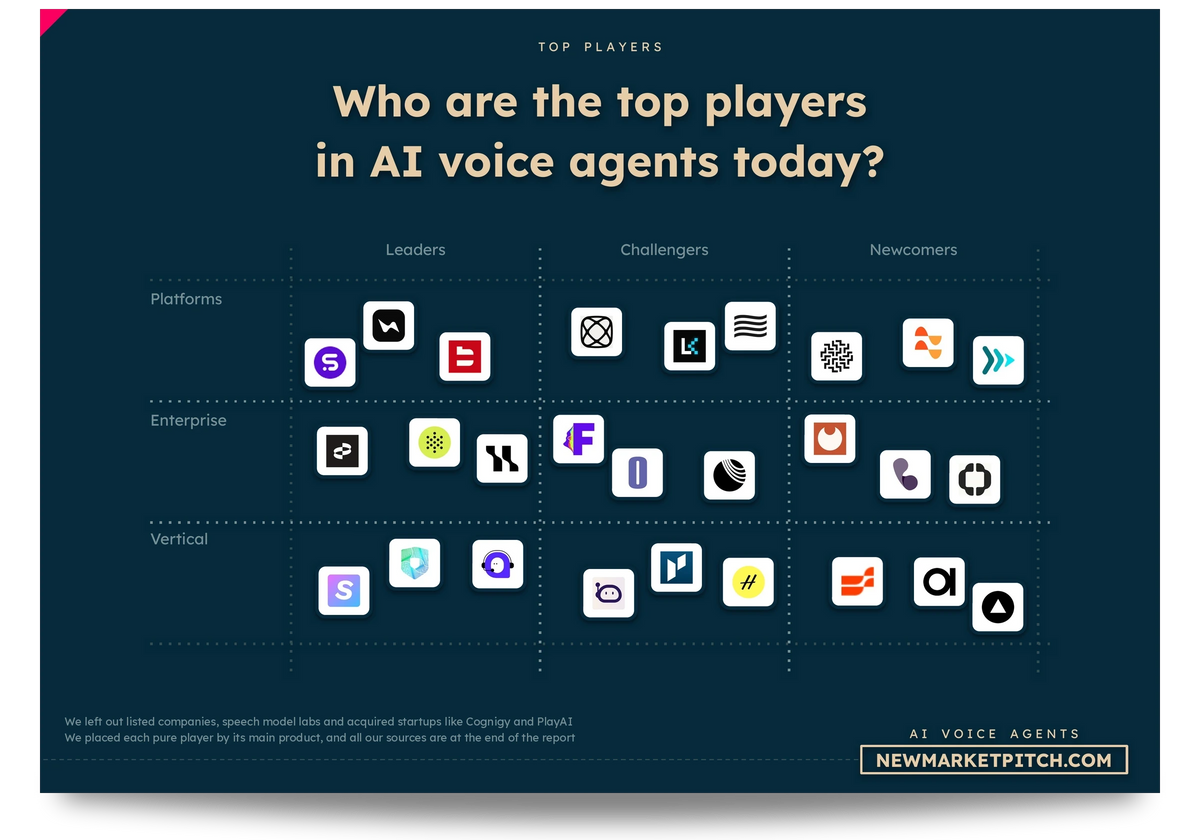
In our research about AI voice agents, we turn what is vague and complex into simple, useful visuals. Market maps like this one show you at a glance where every startup stands.
Why are investors putting so much money into AI voice agents?
Investors are putting billions of dollars into AI voice agents because businesses are starting to use them for real customer interactions, sales calls and administrative work. The shift is particularly visible in enterprise customer service, where companies want AI agents that can resolve requests, access internal systems and complete transactions without requiring an employee to handle every conversation.
Gartner's August 2026 research found that customer-service organizations had increased AI spending by 38%, while their overall budgets had grown by just 2%. The difference is substantial: businesses are redirecting existing budgets toward AI rather than simply increasing technology spending across the board.
The companies attracting the largest investments show where this spending is going. Sierra, Parloa and Decagon are targeting enterprise customer service. Hippocratic AI and Assort Health are automating healthcare interactions, while HappyRobot is applying voice agents to logistics and business operations. LiveKit and Vapi are building the infrastructure behind these applications.
The investment opportunity has consequently expanded beyond telephone answering. Investors are financing companies that want to automate entire workflows, from identifying what a customer needs to completing the action in the relevant business software.
Can AI voice agents actually replace human customer-service workers?
AI voice agents can already handle many repetitive customer-service interactions, but replacing human agents across entire contact centers remains a much harder task. Gartner's August 2026 survey of 3,566 customers found that 50% considered interactions easier when companies used generative AI, yet 87% still wanted access to a human agent.
This combination explains why enterprise adoption is moving forward while customers continue to demand human support. AI can handle routine requests, collect information, schedule appointments and answer account questions. Difficult complaints, unusual situations and sensitive decisions still require escalation.
The companies in this market are taking different approaches. Sierra, Parloa and Decagon are building broader enterprise customer-service agents, while Replicant and Bland AI concentrate more directly on telephone automation. PolyAI is developing enterprise voice agents that can handle complex customer interactions.
Gartner's April 2026 research also found that 85% of surveyed service and support leaders were expanding human-agent responsibilities, despite expectations of AI-related workforce reductions. Only 31% had implemented or were planning AI-driven frontline layoffs through the first quarter of 2027.
The likely outcome is a smaller human workload per customer interaction, with employees increasingly handling exceptions, complex cases and situations where personal judgment is necessary.

Your time is limited. In our market report about AI voice agents, we put numbers on each part of the market, so you can see where it makes sense to focus.
Which AI voice agent startups have raised the most funding?
Sierra, Wonderful and Parloa lead our AI voice agent funding ranking, with $3.009 billion in combined cumulative funding. The top three have attracted considerably more capital than the rest of the market, although several other companies have also raised hundreds of millions of dollars.
Sierra ranks first with $1.6 billion raised across five rounds. Wonderful follows with $849 million across five rounds, and Parloa ranks third with $560 million across five rounds. ASAPP and Decagon complete the top five with $513 million and $481 million respectively.
The concentration becomes even clearer when we aggregate the figures. The top five account for $4.003 billion, while the top ten have raised $5.265 billion. The first three alone represent approximately 57% of the top ten's combined funding.
| Rank | Startup | Total raised | Country |
|---|---|---|---|
| 1 | Sierra | $1.6B | United States |
| 2 | Wonderful | $849M | Israel |
| 3 | Parloa | $560M | Germany |
| 4 | ASAPP | $513M | United States |
| 5 | Decagon | $481M | United States |
| 6 | Hippocratic AI | $403M | United States |
| 7 | Assort Health | $222M | United States |
| 8 | LiveKit | $221M | United States |
| 9 | HappyRobot | $212M | United States |
| 10 | PolyAI | $204M | United Kingdom |
Why has Sierra raised so much money?
Sierra has raised $1.6 billion across five rounds, including a $950 million Series E in May 2026 led by Tiger Global and GV. Its latest financing alone represents approximately 59% of its cumulative funding, making it an unusually important part of the company's fundraising history.
Sierra builds enterprise conversational customer-service agents capable of handling complex interactions and completing tasks through company systems. Its ambition is to become a major platform for businesses that want to automate customer experiences across different industries.
The May financing received considerable attention because Sierra was already reporting substantial commercial growth. TechCrunch reported that the company had reached $150 million in annual recurring revenue in February 2026, following an earlier milestone of $100 million in November 2025. Sierra also said that more than 40% of Fortune 50 companies were customers.
That combination of enterprise adoption, reported revenue growth and a $950 million financing round explains why investors are prepared to commit so much capital. Sierra is also backed by Benchmark, which supported the company from an early stage, alongside Tiger Global and GV.
Its challenge now is to maintain that growth while expanding internationally and defending its position against other enterprise agent platforms. The scale of its financing gives it considerable room to invest in product development and sales.

In our document detailing everything you need to know about AI voice agent, we always try to gather several sources and make estimates that make sense, so you can work with solid numbers.
Is Wonderful becoming a major competitor in enterprise AI agents?
Wonderful is becoming a major enterprise AI competitor, with $849 million raised across five rounds and a $550 million Series C in September 2026. Its latest financing was led by Insight Partners, with participation from Salesforce Ventures and existing investors including Index Ventures.
Wonderful originally focused on enterprise AI agents for customer interactions, including voice, chat and email. Its ambitions have since expanded toward a broader AI operating system that coordinates agents and automates workflows across entire organizations.
The company's September financing came after rapid international expansion. In its announcement, Wonderful said it was operating in more than 35 markets and had grown to 650 employees. Bessemer Venture Partners also reported that the company was serving more than 100 enterprise customers.
Wonderful's position is interesting because it is competing for a broader category of enterprise AI spending than conventional telephone automation. Its platform can potentially expand from customer support into other business departments, increasing the number of workflows it can sell into.
Its $849 million in cumulative funding gives it substantial resources to pursue that strategy, although the company will need to show that its broader platform can deliver consistent results across different industries and countries.
Is Parloa one of Europe's biggest AI voice agent startups?
Parloa has raised $560 million across five rounds, making it one of the largest European enterprise AI agent companies in our ranking. Its January 2026 Series D brought in $350 million, led by General Catalyst, with continued support from EQT Ventures, Altimeter Capital, Durable Capital Partners and Mosaic Ventures.
The financing came just seven months after Parloa's previous Series C. That is a relatively short interval for such a substantial financing progression, suggesting strong investor interest in the company's expansion plans.
Parloa develops AI agents for enterprise customer experience, helping businesses automate customer conversations across voice and other channels. Its platform is designed for large organizations that need agents to work with existing customer-service systems and handle more complicated interactions.
The company announced a $3 billion valuation alongside its Series D. That figure represents the company's valuation, rather than additional funding raised.
Parloa's progress also highlights the growing importance of European enterprise AI companies. Germany has produced a business capable of attracting financing on a scale comparable with much larger American competitors.

Our report covering the AI voice agent market gets updated several times a month, so you always get the latest view of where things stand.
Which AI voice agent startups are attracting the most healthcare funding?
Healthcare is one of the most heavily funded verticals in our ranking, led by Hippocratic AI with $403 million and Assort Health with $222 million. Together, these two companies have raised $625 million, considerably more than most individual specialists in the category.
Hippocratic AI develops conversational agents for healthcare, with a focus on patient-facing interactions and clinically oriented use cases. Its November 2025 Series C raised $126 million, led by Avenir Growth, with participation from CapitalG, General Catalyst and Andreessen Horowitz.
Assort Health focuses on patient access and healthcare administration. Its June 2026 Series C raised $120 million, led by Menlo Ventures, with Lightspeed and Felicis among its investors. The company is developing agents for scheduling, patient intake, referrals and other interactions across the patient journey.
Other companies in the ranking include Hyro with $95 million, Prosper AI with $35 million, Hello Patient with $29 million, Confido Health with $26 million and Parakeet Health with $13 million.
The opportunity is particularly attractive because healthcare providers handle large volumes of administrative telephone interactions. Missed appointments, delayed referrals and unanswered calls can create direct financial costs for hospitals and medical practices.
However, healthcare agents face tougher requirements than ordinary customer-service products. They need to integrate with healthcare systems, handle sensitive information and know when a human professional must take over. That makes successful deployments harder to achieve, but potentially more valuable once established.
Are logistics and insurance becoming important markets for AI voice agents?
Logistics and insurance are becoming important vertical markets because both industries depend on repeated telephone interactions and administrative processes. HappyRobot has raised $212 million, while Liberate has raised $72 million and Salient has raised $75 million.
HappyRobot develops AI agents for logistics operations, including communications between carriers, suppliers and other businesses. Its August 2026 Series C raised $150 million, led by Prysm Capital and co-led by Eurazeo.
Liberate focuses on insurance workflows, where voice agents can automate administrative interactions and help insurers process routine requests. Its October 2025 Series B raised $50 million, with Battery Ventures, Canapi Ventures and Redpoint Ventures among its key investors.
Salient takes a different approach, focusing on loan servicing and collections. Its July 2025 Series A raised $60 million, backed by Andreessen Horowitz, Matrix Partners and Y Combinator.
These companies demonstrate how voice agents can become part of broader business operations. In logistics, an agent may coordinate a delivery or resolve a scheduling issue. In insurance, it may handle a policyholder interaction or administrative follow-up. In lending, it may manage a collection conversation.
The opportunity is particularly interesting when an automated conversation can trigger an actual business action rather than simply provide information.

In our research about AI voice agents, we look at what the winners do differently, so you can learn from the best instead of guessing.
Who are the biggest investors in AI voice agent startups?
General Catalyst, Index Ventures, Andreessen Horowitz and Salesforce Ventures are among the most visible investors across our ranking. Their investments span enterprise customer service, healthcare, developer infrastructure and vertical AI applications.
General Catalyst appears among the key investors in Parloa, Decagon, Hippocratic AI, Avoca and Prosper AI. Index Ventures backs Wonderful, Decagon, LiveKit, Lorikeet and Beside. Andreessen Horowitz has invested in Decagon, HappyRobot, Liberate and Prosper AI, among others.
Salesforce Ventures is another important name, with investments in Wonderful, LiveKit, Replicant and Yellow.ai. Its presence is particularly relevant because enterprise customer-service software is closely connected to the broader CRM and business software ecosystem.
Y Combinator also appears repeatedly, particularly among smaller and developer-focused companies, including Vapi, Retell AI, Leaping AI, Bolna AI and VoiceRun.
| Investor | Examples of ranked startups |
|---|---|
| General Catalyst | Parloa, Decagon, Hippocratic AI, Avoca, Prosper AI |
| Index Ventures | Wonderful, Decagon, LiveKit, Lorikeet, Beside |
| Andreessen Horowitz | Decagon, HappyRobot, Liberate, Prosper AI, Palona AI |
| Salesforce Ventures | Wonderful, LiveKit, Replicant, Yellow.ai |
| Y Combinator | Vapi, Retell AI, Leaping AI, Bolna AI, VoiceRun |
| Kleiner Perkins | Avoca, Vapi, Solda.AI |
| Peak XV Partners | Vapi, Ringg AI, Alex |
| Lightspeed | Assort Health, Yellow.ai, Gnani.ai |
What are the biggest funding rounds in the AI voice agent market?
The largest financing transactions are concentrated among enterprise platforms, with Sierra's $950 million Series E and Wonderful's $550 million Series C standing out. Parloa, Decagon and HappyRobot have also completed particularly large rounds.
The comparison is revealing because these companies are pursuing different business models. Sierra, Wonderful and Parloa are developing enterprise AI agent platforms, Decagon focuses on customer support, and HappyRobot targets operational automation.
| Startup | Latest round | Amount | Date |
|---|---|---|---|
| Sierra | Series E | $950M | May 2026 |
| Wonderful | Series C | $550M | September 2026 |
| Parloa | Series D | $350M | January 2026 |
| Decagon | Series D | $250M | January 2026 |
| HappyRobot | Series C | $150M | August 2026 |
| Hippocratic AI | Series C | $126M | November 2025 |
| Assort Health | Series C | $120M | June 2026 |
| LiveKit | Series C Extension | $40M | August 2026 |
| PolyAI | Series D | $86M | December 2025 |
| Vapi | Series B | $50M | May 2026 |
These transactions also show that major funding rounds are no longer limited to companies selling broad enterprise software. Healthcare specialists and infrastructure providers are attracting substantial capital as well.

In our market report about AI voice agents, we don't want to repeat what boring consulting reports say. Instead, we show you the real and latest market signals that matter.
How many funding rounds have the biggest AI voice agent startups completed?
The largest AI voice agent startups have generally raised money through several financing stages, although some companies have secured substantial capital in just one or two transactions.
Sierra, Wonderful, Parloa, ASAPP and Decagon have each completed five rounds. Hippocratic AI has completed seven, the highest reported number among the ten largest companies. PolyAI and LiveKit have completed six each.
At the other end of the spectrum, Giga has raised $61 million in one Series A, Acclaim has raised $34 million in one strategic equity round and Simple AI has raised $14 million in one seed round.
The difference is worth considering when looking at fundraising trajectories. Hippocratic AI has raised $403 million through seven rounds, while Decagon has raised $481 million through five. Sierra has raised $1.6 billion through five rounds, showing how much larger the individual transactions can become as companies reach later financing stages.
A high round count does not necessarily indicate stronger performance. The amount raised per round, the stage of development and the commercial progress between transactions are more useful ways to understand a company's financing history.
Are older conversational AI companies still competitive with newer voice agent startups?
Older conversational AI companies remain important competitors because they already have experience building enterprise software and integrating with customer-service systems. ASAPP has raised $513 million, Yellow.ai $102 million, Replicant $112 million and Avaamo $23.5 million.
These businesses entered the market before the current wave of generative AI agents and have had more time to develop enterprise relationships and deployment capabilities.
ASAPP, for example, develops conversational AI software for enterprise contact centers. Yellow.ai provides conversational automation across customer interactions, while Replicant focuses on automated contact-center voice agents.
Newer companies such as Sierra, Decagon and Parloa have benefited from advances in large language models and agent orchestration. Their products are designed around more flexible conversations and the ability to complete tasks through business systems.
The competition is increasingly about product execution and enterprise distribution. Older platforms have an installed customer base and operational experience, while newer companies can build around more recent AI architectures. Neither advantage guarantees success, and the established conversational AI companies still have meaningful positions in the market.

Learning from others' mistakes is the cheapest lesson there is. In our document detailing everything you need to know about AI voice agent, we look at what broke startups before you, so you don't repeat it.
Which AI voice agent startups are raising money outside the United States?
The United States dominates our ranking, but Europe, Israel and Asia have produced several heavily funded AI voice agent companies. Wonderful, Parloa and PolyAI are particularly prominent, while Singapore, India and Japan also have a growing group of funded specialists.
In Europe, Parloa has raised $560 million and PolyAI $204 million, while Israel's Wonderful has raised $849 million. Other examples include Maki with $36 million, Beside with $32 million, GetVocal with $30 million and Gradient Labs with $30 million.
Asia has a different funding profile. IVRy has raised $69 million, AI Rudder $63 million, WIZ.AI $46 million, Ringg AI $15.5 million, Gnani.ai $14 million and Bolna AI $7 million.
These companies are addressing markets where language diversity, local telephone infrastructure and regional business processes can create different product requirements. Singapore-based WIZ.AI and AI Rudder, for example, focus on enterprise multilingual voice automation.
The international distribution also shows that the market is not entirely dependent on American enterprise customers. European and Asian companies can build meaningful businesses around local demand and then expand into additional countries.
Are multilingual AI voice agents becoming a major business?
Multilingual voice agents are becoming an important part of the enterprise market because businesses operating across several countries need reliable communication in more than one language. AI Rudder, WIZ.AI, Ringg AI, Gnani.ai and Bolna AI are among the companies targeting this opportunity.
AI Rudder has raised $63 million, while WIZ.AI has raised $46 million. Ringg AI has raised $15.5 million, Gnani.ai $14 million and Bolna AI $7 million.
The commercial opportunity is particularly clear in markets where companies regularly serve customers speaking different languages or dialects. A company operating across Southeast Asia, for example, may need to manage customer interactions in several languages while maintaining consistent service quality.
However, translating speech is only one part of the challenge. Agents must also understand accents, recognize local terminology, handle interruptions and complete tasks through the correct business systems.
The strongest multilingual products will combine language coverage with reliable integrations and the ability to manage complete customer interactions.

If you build or invest in the AI voice agent market, you need to know which business models pay off now and which ones are fading. That's why our report covering it has a whole section on it.
Which AI voice agent startups are targeting restaurants and hospitality?
Restaurants and hospitality businesses are attracting a growing group of specialized voice-agent startups. Slang AI has raised $60 million, Kea AI $32.9 million, ConverseNow $28 million, Palona AI $20 million, Hostie $16 million, Vox AI $10 million and Loman AI $4 million.
These companies focus on different parts of the restaurant experience. Slang AI develops telephone assistants for hospitality businesses, while Palona AI builds sales agents for restaurants. ConverseNow, Kea AI and Loman AI focus more directly on voice ordering.
Hostie targets restaurant guest communications, and Vox AI develops autonomous restaurant ordering agents.
The business case is straightforward. Restaurants frequently miss calls during busy periods, and every unanswered reservation or ordering call can mean lost revenue. AI agents can answer simultaneously, provide information and capture orders without requiring additional telephone staff.
The challenge is making the technology easy enough to deploy across independent restaurants and multi-location operators. Unlike large enterprise contracts, restaurant software often involves smaller individual customers, which places greater importance on onboarding costs and straightforward integrations.
Which AI voice agent startups are building infrastructure rather than selling agents?
Infrastructure companies are attracting significant funding because businesses need tools to build, connect, test and operate voice agents reliably. LiveKit ranks eighth with $221 million raised, Vapi twenty-second with $72 million and Daily twenty-fifth with $62 million.
LiveKit provides real-time communications infrastructure for voice and video applications. Its January 2026 Series C raised $100 million, led by Index Ventures, with Salesforce Ventures, Hanabi Capital, Altimeter Capital and Redpoint Ventures participating. A $40 million Series C extension followed in August 2026.
Vapi offers developer infrastructure for building and deploying AI voice agents. Its May 2026 Series B raised $50 million, led by Peak XV Partners, with participation from M12 and Kleiner Perkins.
Daily provides real-time audio and video APIs, while Coval focuses on testing and evaluating voice AI systems. Coval has raised $31 million, and Hamming AI has raised $4 million.
This segment is particularly interesting because infrastructure providers can benefit from the growth of many different applications. They do not necessarily need to win individual healthcare, restaurant or customer-service contracts themselves.

In our research about AI voice agents, we like to show you the big picture. We know your time is precious, so we make every page quick to read and packed with as much learning as possible per minute.
Are developer-focused AI voice startups worth watching?
Developer-focused voice AI startups are worth watching because they provide the tools that other businesses use to build their own agents. Vapi, Voiceflow, Retell AI and VoiceRun are particularly relevant examples, alongside LiveKit and Daily.
Vapi has raised $72 million, Voiceflow $40 million, VoiceRun $6 million and Retell AI $4.6 million. Their products serve different audiences, ranging from developers building customized telephone agents to teams designing conversational applications.
Vapi's May 2026 Series B announcement highlighted its enterprise traction, including the use of its platform by Amazon, New York Life and Intuit. The company also reported reaching one billion calls.
Retell AI provides a developer platform for voice agents, while VoiceRun offers code-first infrastructure for enterprise voice applications. Voiceflow focuses on collaborative conversational AI development.
These companies benefit from a market where more businesses want to build specialized agents without developing every technical component themselves. Their long-term challenge is maintaining differentiation as speech models, telephony integrations and agent-building tools become easier to access.
Is the AI voice agent market becoming too crowded?
The AI voice agent market is becoming crowded, particularly in generic customer-service and telephone automation products. Dozens of startups are pursuing overlapping use cases, while larger enterprise platforms are expanding into areas that were previously served by specialists.
The competition is visible across several categories. Sierra, Wonderful, Parloa and Decagon target broad enterprise customer-service workflows. Healthcare has Hippocratic AI, Assort Health, Hyro, Prosper AI, Hello Patient, Confido Health and Parakeet Health. Restaurant automation includes Slang AI, Palona AI, ConverseNow, Hostie, Kea AI, Vox AI and Loman AI.
Infrastructure has its own competitive group, including LiveKit, Vapi, Daily, Voiceflow, Coval and Hamming AI.
The number of companies makes it harder for generic products to stand out. Natural-sounding speech is becoming easier to reproduce, and customers can compare several providers offering similar basic functionality.
Companies with deeper integrations, industry knowledge, distribution and proven enterprise deployments have a better chance of defending their positions. The market can support many specialized businesses, but it will be difficult for every generic voice-agent platform to become a large independent company.

When you build or invest in the AI voice agent market, you need clarity, not confusion. In our market report about AI voice agents, we always try to put numbers on and quantify whatever is usually vague and confusing.
How big could the AI voice agent market become?
The AI voice agent market could become a multibillion-dollar industry, although forecasts vary depending on which products and services are included. Grand View Research estimates that the global market was worth approximately $2.5 billion in 2025 and projects it to reach $35.2 billion by 2033.
That forecast implies substantial growth, but it should be treated as an industry projection rather than a guaranteed outcome. The definition of AI voice agents can include different combinations of autonomous telephone agents, voice-based customer support, outbound calling and related infrastructure.
Our ranking illustrates the breadth of the opportunity. The largest companies are pursuing enterprise customer service, while healthcare, logistics, insurance, restaurant ordering and developer infrastructure have attracted their own specialist businesses.
Gartner's August 2026 research provides another indication of where enterprise spending is going. Customer-service AI budgets increased by 38%, and voicebots were among the technologies leaders expected to deliver greater value over the following two years.
The opportunity is substantial, but the projected market size does not tell us which individual companies will capture the revenue. Pricing pressure, customer acquisition costs and competition from established software providers will determine how much of this growth translates into profitable businesses.
Which AI voice agent startups could become major enterprise platforms?
Decagon, Hippocratic AI, Assort Health, HappyRobot, PolyAI and LiveKit are particularly interesting companies beyond the top three because they have meaningful funding and clear positions in different parts of the market.
Decagon has raised $481 million and is developing AI agents for customer support. Hippocratic AI has raised $403 million in healthcare, while Assort Health has raised $222 million with a more focused patient-access proposition.
HappyRobot has raised $212 million and targets logistics operations. PolyAI has raised $204 million and focuses on enterprise voice customer support, while LiveKit has raised $221 million in real-time infrastructure.
Each company has a different route to becoming a larger platform. Decagon can expand across customer-service workflows, Hippocratic AI and Assort Health can deepen their healthcare integrations, HappyRobot can move into adjacent business operations, and LiveKit can benefit from the growth of applications built on its infrastructure.
Their fundraising positions give them considerable resources, but we would pay particular attention to customer retention, deployment volumes and recurring revenue as indicators of which companies are turning investment into durable businesses.

A good product starts with a real problem. In our document detailing everything you need to know about AI voice agent, we show you the ones customers still live with.
Can AI voice agent startups survive when speech technology becomes cheaper?
AI voice agent startups can survive as speech technology becomes cheaper, but generic products will face increasing pressure. The companies with the strongest positions are likely to own valuable workflows, enterprise integrations and customer relationships rather than relying exclusively on the quality of their speech models.
The distinction is visible across the market. Sierra, Wonderful and Parloa are building broad enterprise platforms, while Assort Health, Hippocratic AI and Liberate concentrate on specialized business processes. LiveKit and Vapi provide infrastructure that developers can use across many different applications.
Companies such as Coval and Hamming AI are also addressing an increasingly important problem: testing whether voice agents actually perform reliably in production.
As speech models improve, the technical cost of building an agent may decline. However, companies will still need to manage security, integrations, customer data, compliance, monitoring and human escalation.
This is where specialized businesses can defend their positions. A healthcare agent deeply integrated into patient-access workflows or a logistics agent connected to operational systems has more to offer than a generic telephone assistant that can be recreated using widely available tools.
Which AI voice agent startups have the strongest combination of funding and investors?
Sierra, Wonderful, Parloa, Decagon and Hippocratic AI combine substantial fundraising with backing from some of the most established venture investors in the technology market.
Sierra has raised $1.6 billion, with GV, Tiger Global and Benchmark among its key investors. Wonderful has raised $849 million, backed by Insight Partners, Salesforce Ventures and Index Ventures. Parloa has raised $560 million, with General Catalyst, EQT Ventures and Altimeter Capital among its investors.
Decagon has raised $481 million with Coatue Management, Index Ventures and Andreessen Horowitz. Hippocratic AI has raised $403 million, backed by Avenir Growth, CapitalG and General Catalyst.
The next group also includes strong investor networks. Assort Health has raised $222 million with Menlo Ventures, Lightspeed and Felicis. HappyRobot has raised $212 million with Prysm Capital, Eurazeo and Andreessen Horowitz among its key investors. LiveKit has raised $221 million with Index Ventures, Salesforce Ventures and Altimeter Capital.
| Startup | Total raised | Key investors |
|---|---|---|
| Sierra | $1.6B | GV, Tiger Global, Benchmark |
| Wonderful | $849M | Insight Partners, Salesforce Ventures, Index Ventures |
| Parloa | $560M | General Catalyst, EQT Ventures, Altimeter Capital |
| Decagon | $481M | Coatue Management, Index Ventures, Andreessen Horowitz |
| Hippocratic AI | $403M | Avenir Growth, CapitalG, General Catalyst |
| Assort Health | $222M | Menlo Ventures, Lightspeed, Felicis |
| LiveKit | $221M | Index Ventures, Salesforce Ventures, Altimeter Capital |
| HappyRobot | $212M | Prysm Capital, Eurazeo, Andreessen Horowitz |
Which AI voice agent startups are likely to lead the market?
Sierra, Wonderful and Parloa have the strongest fundraising positions in our ranking, but the future leaders of AI voice agents will probably come from several different parts of the ecosystem. Enterprise platforms have the capital to expand internationally, while vertical specialists and infrastructure providers can build valuable positions around particular workflows.
Sierra's $1.6 billion in funding gives it a substantial financial advantage in enterprise customer service. Wonderful's $849 million supports its ambition to become a broader enterprise AI operating system, while Parloa's $560 million gives it considerable resources to expand its customer-experience platform.
Beyond these three, Decagon and PolyAI are important enterprise customer-service competitors. Hippocratic AI and Assort Health are particularly interesting in healthcare, HappyRobot in logistics and LiveKit in infrastructure.
Our view is that the market will develop around a combination of large enterprise platforms and specialized providers. The companies that succeed will be those that can reliably complete valuable business interactions, integrate deeply into customer systems and demonstrate measurable economic returns.
The fundraising ranking shows where investors have placed their biggest bets. It does not yet establish who will capture the most revenue or build the most profitable businesses. That distinction will become clearer as enterprise deployments mature and customers start comparing the actual cost of automated interactions with the human operations they replace.
Our methodology
We ranked startups in the AI voice agents market by cumulative equity funding raised, focusing on companies whose core business involves AI-powered voice interactions, autonomous agents or the infrastructure used to build and operate them. We included companies that have subsequently been acquired or gone public when their startup-stage financing remained relevant to the ranking.
Funding totals include equity financing and exclude debt, grants and other non-equity funding. We considered individual financing rounds, their announced amounts, dates, financing types and participating investors, giving priority to company announcements, investor disclosures, regulatory filings and reputable financial publications.
Key sources include TechCrunch's reporting on Sierra's $950 million Series E, Wonderful's official Series C announcement, Bessemer Venture Partners' coverage of Wonderful, Parloa's Series D announcement, Decagon's Series D announcement, Hippocratic AI's Series C announcement, Assort Health's Series C announcement, Assort Health's cumulative funding announcement, HappyRobot's financing announcements, PolyAI's Series D announcement, LiveKit's Series C announcement and Vapi's Series B announcement.
For market adoption and customer-service trends, we also used Gartner's research on AI spending in customer service, its survey on customer demand for human-agent access and its research on changing human-agent responsibilities. Gartner's findings on third-party generative AI usage and Grand View Research's AI voice agents market forecast provide additional market context.
When sources disagreed, we prioritized direct company and investor announcements, regulatory information and authoritative financial reporting over secondary database estimates. We also checked subsequent financing announcements to keep cumulative funding figures and the ranking as current as possible.

It's easy to get lost in the details. In our report covering the AI voice agent market, we give you some perspective first, so you see the whole market before you make a move.
Written by the New Market Pitch teamWe track new markets so founders and investors can move faster. About us