What are the top data center startups by revenue today?
Whether you're building or investing in the data center market, our report covers everything you need to know: the players, the money, and what's coming next.
Summary
Aligned Data Centers leads our ranking of data center startups by revenue, with an estimated $1.6 billion in 2025 annual revenue. CtrlS Datacenters follows with INR 15.7 billion (approximately $181 million) in FY2025 operating revenue.
Only six of the 29 companies in our ranking have identifiable financial revenue or turnover figures. The others demonstrate commercial scale through contracted backlog, megawatts of capacity, customer commitments, equipment orders or operating facilities.
The quality of the financial evidence varies considerably. CtrlS has revenue supported by credit-rating analysis, while Aligned, Corintis, DG Matrix and ZutaCore rely on third-party estimates that carry substantially more uncertainty.
Accelsius illustrates why revenue rankings can be misleading in this industry. Its more than $50 million in contracted cooling backlog demonstrates customer demand, but those commitments are not equivalent to $50 million in recognized sales.
The largest infrastructure businesses are increasingly valued for their ability to secure electricity and deliver capacity. Aligned's approximately $40 billion acquisition valuation reflects a platform with 51 campuses and more than 6.4 GW of operational and planned capacity, alongside existing revenue.
Power availability may be a stronger competitive advantage than land ownership. Electricity infrastructure represents an estimated 40–50% of total data center project costs, and developers with secured power can move ahead while competing projects remain stuck.
Cooling suppliers have a different opportunity from traditional operators. With liquid cooling penetration among AI chips expected to reach 53% in 2026, companies such as Corintis, Accelsius, ZutaCore and Submer can grow by selling technology into facilities they do not own.
Gigawatt-scale portfolios need careful interpretation. STACK's more than 8.5 GW of built and developing capacity and Lancium's 4 GW under lease demonstrate substantial infrastructure positioning, but planned, leased and operational megawatts represent very different stages of monetization.
Southeast Asia is becoming a major expansion market. DayOne, AirTrunk, Princeton Digital Group and Digital Edge are developing large regional platforms, while Evolution Data Centres has already sold the first 12 MW phase of its Bangkok TH01 project.
Acquisitions are reshaping the industry. BlackRock-backed investors acquired Aligned, Blackstone acquired AirTrunk, and Trane Technologies bought LiquidStack, showing that institutional buyers want operating facilities as well as specialized technology.
Profitability remains uneven. CtrlS reported INR 206 crore in FY2025 profit after tax, while Iceotope recorded just £838K in turnover and a pre-tax loss of approximately £13.53 million. The next winners will be the companies that turn capacity, contracts and technical advantages into sustainable earnings.

Written by the New Market Pitch teamWe track new markets so founders and investors can move faster. About us

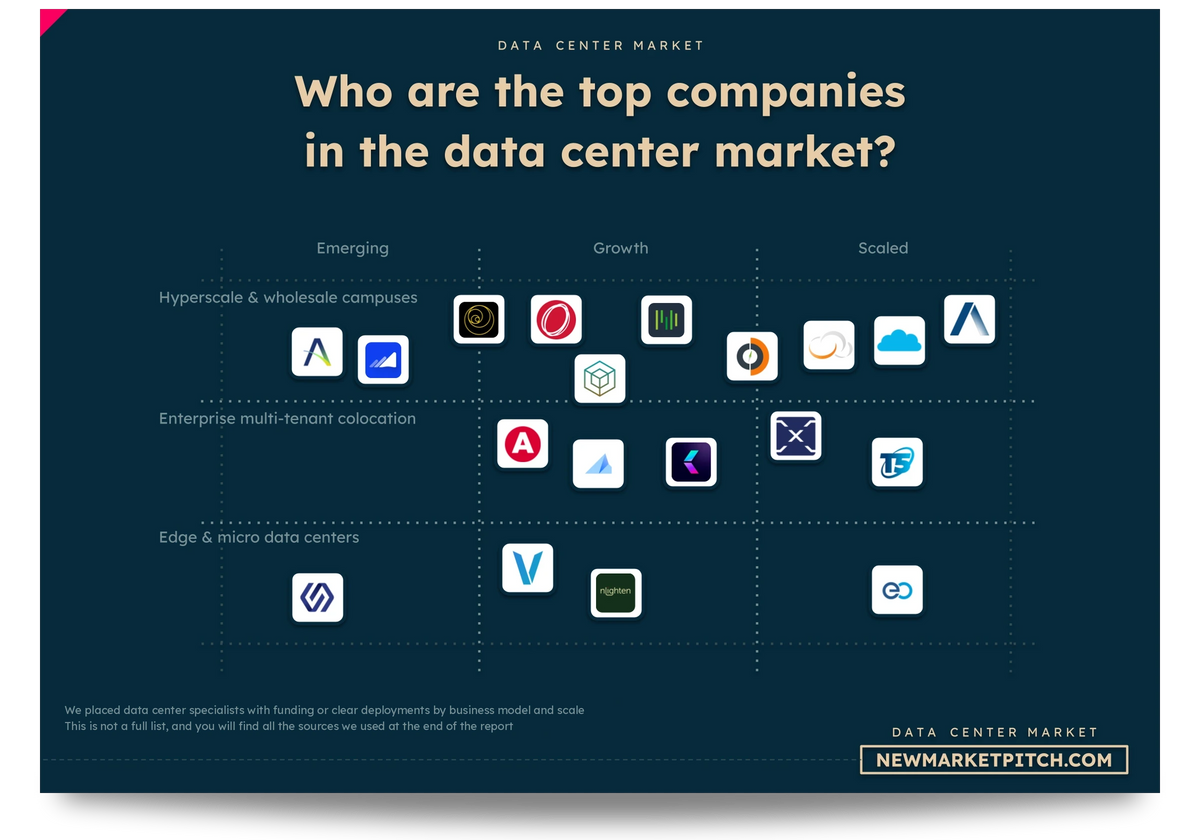
In our report covering the data center market, we turn what is vague and complex into simple, useful visuals. Market maps like this one show you at a glance where every startup stands.
The ranking of top startups in the data center market by revenue
Below is a table ranking the startups of this market by their current revenue scale. You can find our methodology at the end of this page.
If you want a deeper understanding of the market and its current dynamics, get our report on the data center market.
| Ranking | Company | Latest Metric | Metric Type | Freshness | Disclosed When | Source Quality | Confidence | Segment | Why This Ranking | Local Metric | Country |
|---|---|---|---|---|---|---|---|---|---|---|---|
| 1 | Aligned Data Centers | ~$1.6B | Annual Revenue Estimate | Fresh · 10mo | Mar 26, 2026 | Third-Party Estimate | Low | Hyperscale Data Centers | Leads the startups on an estimated ~$1.6B of annual revenue, far above CtrlS Datacenters' ~$181M, though the figure is a third-party estimate rather than filed or company-disclosed revenue. | us | |
| 2 | CtrlS Datacenters | ~$181M | Fiscal-Year Operating Income / Revenue | Aging · 19mo | Sep 30, 2025 | Credible Reported | Medium | Colocation & Hyperscale | Credibly reported FY2025 revenue of ~$181M, well below Aligned Data Centers' ~$1.6B estimate; ranks above Accelsius because it is recognized operator revenue rather than contracted backlog. | INR 15.7B | in |
| 3 | Accelsius | >$50M | Contracted Backlog | Fresh · 7mo | Mar 30, 2026 | Company Disclosed | Medium | Liquid Cooling | FY2025 revenue was only $1.6M, but >$50M of contracted backlog is stronger evidence of current commercial scale; not treated as revenue. | us | |
| 4 | Corintis | ~$100M | Annual Revenue Estimate | Fresh · 10mo | 2026 | Third-Party Estimate | Low | Liquid Cooling | Larger estimated revenue than Accelsius's backlog, but estimate quality is materially weaker, so it is ranked below. | ch | |
| 5 | DG Matrix | ~$100M | Annual Revenue Estimate | Fresh · 10mo | 2026 | Third-Party Estimate | Low | Data Center Power Infrastructure | Useful commercial-scale estimate but no direct revenue disclosure located. | us | |
| 6 | ZutaCore | ~$42.8M | Annual Revenue Estimate | Fresh · 10mo | Sep 10, 2026 | Third-Party Estimate | Low | Liquid Cooling | Current estimate, but conflicting third-party ranges and no company revenue disclosure reduce confidence. | us | |
| 7 | Iceotope | ~$1.11M | Annual Turnover | Fresh · 16mo | 2026 | Filed / Audited | Medium | Liquid Cooling | Filed turnover of ~$1.11M is far below ZutaCore's ~$42.8M estimate above, but as actual revenue it ranks ahead of the capacity-only operators below, starting with Lancium. | £838K | gb |
| 8 | Lancium | 4 GW capacity under lease | Leased Capacity | Very Fresh · 2mo | Aug 24, 2026 | Company Disclosed | Medium | Powered Data Center Campuses | Strongest disclosed commercial capacity signal among revenue-undisclosed operators found. | us | |
| 9 | DayOne Data Centers | >1.5 GW bookings | Booked Capacity | Very Fresh · 4mo | Jun 5, 2026 | Company Disclosed | Medium | Hyperscale Data Centers | Bookings are closer to contracted commercial demand than development-pipeline figures below. | sg | |
| 10 | ST Telemedia Global Data Centres | ~780 MW operational capacity | Operating Capacity | Very Fresh · 1mo | 2026 | Company Disclosed | Medium | Colocation & Hyperscale | Meaningful operating capacity plus a much larger secured/design pipeline; ranks above development-heavy portfolios. | sg | |
| 11 | STACK Infrastructure | >8.5 GW built & under development | Portfolio Capacity | Very Fresh · 1mo | Sep 19, 2026 | Company Disclosed | Low | Hyperscale Data Centers | Enormous portfolio, but the metric blends constructed facilities with projects still under development. | us | |
| 12 | AirTrunk | >3 GW operating & planned | Portfolio Capacity | Very Fresh · 6mo | Apr 20, 2026 | Company Disclosed | Low | Hyperscale Data Centers | Large APAC platform, but operating and planned MW are combined rather than separately monetized. | au | |
| 13 | EdgeCore Digital Infrastructure | >2.27 GW portfolio | Portfolio Capacity | Very Fresh · 1mo | Sep 19, 2026 | Company Disclosed | Low | Hyperscale Data Centers | Very large current portfolio signal, though capacity stages are not fully comparable with DayOne's bookings. | us | |
| 14 | Princeton Digital Group | >1.8 GW portfolio | Portfolio Capacity | Fresh · 7mo | Mar 11, 2026 | Company Disclosed | Low | Hyperscale Data Centers | Large multi-country portfolio, but total portfolio capacity includes different development stages. | sg | |
| 15 | Digital Edge | 31 data centers; >1.8 GW secured IT power | Secured Capacity | Very Fresh · 1mo | 2026 | Company Disclosed | Low | Colocation & Hyperscale | Strong secured-power metric and operating footprint, but neither is revenue. | sg | |
| 16 | Echelon Data Centres | >1.4 GW secured capacity | Secured Capacity | Very Fresh · 1mo | Sep 19, 2026 | Company Disclosed | Low | Hyperscale Data Centers | Significant secured capacity, with roughly 700MW described as in development; monetized portion remains unclear. | ie | |
| 17 | T5 Data Centers | >3 GW managed capacity | Managed Capacity | Very Fresh · 1mo | Sep 19, 2026 | Company Disclosed | Low | Data Center Development & Operations | Large managed footprint, but managed MW may include third-party facilities and is weaker than owned/leased capacity. | us | |
| 18 | Vantage Data Centers | 1.4 GW campus capacity | Campus Capacity | Fresh · 14mo | Aug 19, 2025 | Company Disclosed | Low | Hyperscale Data Centers | The disclosed project alone is enormous, but it is only one campus and includes future construction. | us | |
| 19 | Scala Data Centers | >100 MW operational capacity | Operating & Pipeline Capacity | Very Fresh · 1mo | Sep 19, 2026 | Company Disclosed | Low | Hyperscale Data Centers | At least part of the metric is explicitly operational, making it somewhat stronger than pure pipeline signals. | br | |
| 20 | Submer | >500 MW cooling capacity deployed | Deployed Cooling Capacity | Very Fresh · 1mo | 2026 | Company Disclosed | Low | Liquid Cooling Infrastructure | Deployed rather than merely planned capacity gives this strong physical commercial evidence, though customer revenue is undisclosed. | es | |
| 21 | Yondr Group | >450 MW built capacity | Built Capacity | Very Fresh · 1mo | Sep 19, 2026 | Company Disclosed | Low | Hyperscale Data Centers | Built capacity is more commercially meaningful than a development pipeline, but revenue remains private. | gb | |
| 22 | EdgeConneX | >50 data centers | Operating Footprint | Very Fresh · 1mo | Sep 19, 2026 | Company Disclosed | Low | Edge & Hyperscale Data Centers | Extensive global footprint, but no aggregate MW or current revenue disclosure found. | us | |
| 23 | eStruxture | >16 data centers; >130 MW; >800 customers | Operating Footprint | Very Fresh · 1mo | Sep 19, 2026 | Company Disclosed | Low | Colocation | Multiple operating indicators make the scale credible, but none measures annual revenue. | ca | |
| 24 | Cologix | >45 data centers | Locations | Very Fresh · 1mo | 2026 | Company Disclosed | Low | Colocation & Interconnection | Established footprint, but only individual-facility capacity rather than aggregate commercial scale was disclosed. | us | |
| 25 | LiquidStack | 300 MW CDU order | Order Capacity | Fresh · 9mo | Jan 6, 2026 | Company Disclosed | Low | Liquid Cooling | A real 300MW customer order is commercially stronger than generic deployment claims, but it cannot be converted into revenue. | us | |
| 26 | DataBank | 107 MW capacity (from 60 MW) | Capacity Expansion | Very Fresh · 3mo | Jul 2026 | Company Disclosed | Low | Colocation & Hyperscale | Major operator, but the strongest public current metric found covers only part of its total footprint. | us | |
| 27 | Pure Data Centres | 4 operational sites | Operating Footprint | Very Fresh · 1mo | Sep 19, 2026 | Company Disclosed | Low | Hyperscale Data Centers | Operational evidence exists, but no consolidated capacity/revenue number allows stronger comparison. | gb | |
| 28 | Compass Datacenters | 79 MW operating campus; 360 MW campus nearing completion | Campus Capacity | Very Fresh · 1mo | Sep 19, 2026 | Company Disclosed | Low | Hyperscale Data Centers | Clearly large developer/operator but published facility examples do not form a defensible company-wide commercial total. | us | |
| 29 | Evolution Data Centres | 12 MW capacity sold | Sold Capacity | Very Fresh · 1mo | 2026 | Company Disclosed | Low | Hyperscale Data Centers | The 12MW figure is explicitly sold capacity rather than a speculative pipeline, but current realized scale is still small relative to the operators above. | sg |

Our research about data centers gets updated several times a month, so you always get the latest view of where things stand.
Why are data center startups getting so much attention now?
Data center startups are attracting much more attention because AI investment is creating enormous demand for computing infrastructure, and the companies able to supply it are becoming increasingly valuable.
The scale of investment is already extraordinary. According to the International Energy Agency's 2026 report, the largest technology companies spent more than $400 billion on capital expenditure in 2025, with another 75% increase expected in 2026. Global data center electricity consumption also increased by 17% in 2025, while consumption from AI-focused data centers jumped by 50%.
This is changing the economics of an industry that previously attracted relatively little attention outside specialist infrastructure and technology circles. Hyperscalers need more facilities, more electricity, more sophisticated cooling systems and faster ways to bring computing capacity online.
The opportunity now extends across the entire infrastructure chain. Aligned Data Centers and CtrlS Datacenters are building and operating facilities, while Corintis, ZutaCore and Iceotope develop cooling technologies. DG Matrix is working on the electrical infrastructure needed to support increasingly demanding AI workloads.
Some of these companies are already generating substantial revenue. Others are securing customers and building the capacity that could generate revenue over the coming years.
What do data center startups actually sell?
Data center startups mainly sell physical computing infrastructure, access to electricity and facilities, or specialized equipment needed to keep increasingly powerful servers running.
The first category consists of data center developers and operators. Aligned Data Centers, CtrlS Datacenters, DayOne Data Centers and AirTrunk develop or operate facilities that customers use to host servers and computing infrastructure. Their business models typically involve long-term customer contracts and recurring payments for capacity, power and associated services.
The second category includes cooling technology suppliers. Corintis, Accelsius, ZutaCore, Iceotope, Submer and LiquidStack address the growing difficulty of removing heat from high-density computing systems. Their products range from direct-to-chip cooling to immersion cooling and other specialized thermal-management solutions.
The third category covers electricity and power infrastructure. DG Matrix develops solid-state transformer technology and power-management systems, while Lancium focuses on securing powered sites and developing infrastructure for large computing facilities.
These businesses have very different economics. An operator can earn recurring income from a facility for many years, whereas an equipment supplier generally earns money when its technology is purchased, installed or licensed.
Technology suppliers can therefore grow without owning enormous physical assets. Hyperscale operators, on the other hand, need billions of dollars to finance their expansion.

In our market report about data centers, we look at what the winners do differently, so you can learn from the best instead of guessing.
Which data center startups make the most money right now?
Aligned Data Centers ranks first in our startup ranking, followed by CtrlS Datacenters. Accelsius holds the third position based on contracted backlog, while the remaining companies cover cooling, power infrastructure and hyperscale development.
There is an important difference between the figures. Six companies have a financial revenue or turnover figure, while the others are ranked using quantified commercial indicators such as contracted backlog, operational capacity, bookings, deployed infrastructure and customer footprints.
The ordering is therefore a ranking of financial and commercial scale, rather than a strict revenue leaderboard across all 29 companies.
| Rank | Company | Revenue or commercial figure | Metric and period |
|---|---|---|---|
| 1 | Aligned Data Centers | ~$1.6B | Annual Revenue Estimate, 2025 |
| 2 | CtrlS Datacenters | INR 15.7B | Fiscal-Year Operating Income / Revenue, FY2025 |
| 3 | Accelsius | >$50M | Contracted Backlog, Q1 2026 |
| 4 | Corintis | ~$100M | Annual Revenue Estimate, 2025 |
| 5 | DG Matrix | ~$100M | Annual Revenue Estimate, 2025 |
| 6 | ZutaCore | ~$42.8M | Annual Revenue Estimate, 2025 |
| 7 | Iceotope | £838K | Annual Turnover, FY2025 |
| 8 | Lancium | 4 GW capacity under lease | Leased Capacity, Aug 2026 |
| 9 | DayOne Data Centers | >1.5 GW bookings | Booked Capacity, Jun 2026 |
| 10 | ST Telemedia Global Data Centres | ~780 MW operational capacity | Operating Capacity, 2026 |
| 11 | STACK Infrastructure | >8.5 GW built & under development | Portfolio Capacity, Sep 2026 |
| 12 | AirTrunk | >3 GW operating & planned | Portfolio Capacity, Apr 2026 |
| 13 | EdgeCore Digital Infrastructure | >2.27 GW portfolio | Portfolio Capacity, Sep 2026 |
| 14 | Princeton Digital Group | >1.8 GW portfolio | Portfolio Capacity, Mar 2026 |
| 15 | Digital Edge | 31 data centers; >1.8 GW secured IT power | Secured Capacity, Sep 2026 |
| 16 | Echelon Data Centres | >1.4 GW secured capacity | Secured Capacity, Sep 2026 |
| 17 | T5 Data Centers | >3 GW managed capacity | Managed Capacity, Sep 2026 |
| 18 | Vantage Data Centers | 1.4 GW campus capacity | Campus Capacity, Aug 2025 onward |
| 19 | Scala Data Centers | >100 MW operational capacity | Operating & Pipeline Capacity, Sep 2026 |
| 20 | Submer | >500 MW cooling capacity deployed | Deployed Cooling Capacity, Sep 2026 |
| 21 | Yondr Group | >450 MW built capacity | Built Capacity, Sep 2026 |
| 22 | EdgeConneX | >50 data centers | Operating Footprint, Sep 2026 |
| 23 | eStruxture | >16 data centers; >130 MW; >800 customers | Operating Footprint, Sep 2026 |
| 24 | Cologix | >45 data centers | Locations, Sep 2026 |
| 25 | LiquidStack | 300 MW CDU order | Order Capacity, Jan 2026 |
| 26 | DataBank | 107 MW capacity (from 60 MW) | Capacity Expansion, 2026 |
| 27 | Pure Data Centres | 4 operational sites | Operating Footprint, Sep 2026 |
| 28 | Compass Datacenters | 79 MW operating campus; 360 MW campus nearing completion | Campus Capacity, Sep 2026 |
| 29 | Evolution Data Centres | 12 MW capacity sold | Sold Capacity, Sep 2026 |
The first seven positions deserve particular attention. Aligned has an estimated ~$1.6B in annual revenue, while CtrlS has a more directly supported FY2025 operating revenue figure. Accelsius' >$50M represents contracted backlog, and Corintis, DG Matrix and ZutaCore rely on third-party revenue estimates.
Those differences also mean that Accelsius' third-place position should not be interpreted as third-highest annual revenue. Its backlog is a different financial measure, even though the company has significant commercial traction.
The remaining companies demonstrate how much infrastructure is being developed. A gigawatt under development, however, cannot be compared directly with annual sales.
How much revenue does Aligned Data Centers make?
Aligned Data Centers has an estimated ~$1.6B in annual revenue for 2025, placing the company first in our startup ranking.
The company develops large-scale data center campuses for hyperscalers and other major computing customers. Its business is particularly well positioned for the current AI investment cycle because it can deliver the facilities and infrastructure required for increasingly demanding workloads.
The scale of the platform became even clearer when its acquisition by the Artificial Intelligence Infrastructure Partnership, MGX and BlackRock's Global Infrastructure Partners was completed in July 2026. The transaction valued Aligned at approximately $40 billion in enterprise value.
According to the acquisition announcement, Aligned's portfolio spans 51 campuses and more than 6.4 GW of operational and planned capacity.
That's a substantial infrastructure business by any measure. Its existing operations and enormous development portfolio help explain why the company attracted such significant institutional interest.
One qualification is important: the ~$1.6B revenue figure comes from CB Insights and is an estimate, rather than an audited company disclosure. The acquisition value is independently confirmed by the acquiring consortium, but it should never be confused with annual revenue.
Aligned is now part of the AIP, MGX and GIP ownership consortium, following the completed transaction.

In our document detailing everything you need to know about data center, you will always find fresh funding data, taken straight from our own verified funding database.
Is CtrlS Datacenters already a $100M-plus business?
Yes. CtrlS Datacenters generated approximately INR 15.7B in FY2025 operating revenue, equivalent to around $181M, making it the second-ranked startup in our analysis.
The company's business is built around colocation and managed data center infrastructure. It offers customers space, power, connectivity and associated services for their computing equipment.
Its commercial position is particularly interesting because the company already has meaningful operating revenue and is expanding its infrastructure to serve much larger customers.
According to CRISIL's FY2026 rating rationale, CtrlS increased its revenue-generating capacity from 121 MW in FY2025 to approximately 150 MW in FY2026. The rating agency projected operating revenue of INR 1,935 crore in FY2026, compared with INR 1,563 crore in FY2025.
The longer-term expansion is even more ambitious. ICRA's May 2026 analysis described plans to increase operational data center capacity to approximately 950–1,000 MW by FY2029, with all of the major incremental capacity pre-leased to a hyperscaler.
That combination of existing revenue, operating facilities and pre-leased expansion makes CtrlS particularly interesting. The company still needs substantial capital expenditure to deliver its plans, but much of the proposed growth is backed by actual customer commitments.
Is Accelsius already making $50M from data center cooling?
No. Accelsius has more than $50M in contracted backlog, according to its Q1 2026 investor materials, but that amount represents commercial commitments rather than recognized revenue.
The company develops two-phase, direct-to-chip liquid cooling technology through its NeuCool platform. Its products are designed to remove heat from increasingly powerful AI processors and high-density server racks.
The >$50M figure is especially interesting because the bookings are tied to greenfield data center deployments. Customers are committing to the technology while designing new infrastructure, rather than simply testing cooling systems in existing facilities.
Accelsius' publicly listed parent, Innventure, also projected that the business would exit 2026 with approximately $100M in annual revenue run-rate and achieve positive operating cash flow.
Those were forward-looking targets, rather than achieved financial results. We therefore retain the >$50M contracted backlog figure in the ranking.
Accelsius has attracted serious customer commitments. The next test is how much of that backlog becomes recognized revenue, and how quickly.

Learning from others' mistakes is the cheapest lesson there is. In our report covering the data center market, we look at what broke startups before you, so you don't repeat it.
How much revenue do Corintis, DG Matrix and ZutaCore make?
The available 2025 revenue estimates put Corintis and DG Matrix at approximately $100M each, while ZutaCore is estimated at ~$42.8M.
All three companies operate in specialized infrastructure markets benefiting from the increasing complexity of AI data centers.
Corintis develops advanced liquid-cooling technology, including microfluidic cooling solutions designed to remove heat directly from high-performance computing hardware. Its estimated ~$100M in annual revenue suggests substantial commercial scale, although the figure has not been independently confirmed through audited financial statements.
DG Matrix focuses on electrical infrastructure. Its Interport platform uses solid-state transformer technology to manage power conversion and distribution. In September 2026, the company announced a commercial agreement to deploy its technology alongside a vanadium redox flow battery system to power a live high-performance computing cluster.
The company has also continued developing its technology for AI factories. Its October 2026 announcement introduced Interport 360 SST and Interport OS, a modular power solution designed around the NVIDIA MGX architecture.
ZutaCore develops direct-to-chip, waterless liquid-cooling technology. Its estimated 2025 revenue of ~$42.8M comes from GetLatka, which explicitly identifies the figure as an estimate rather than a company-confirmed disclosure.
These companies could become substantial equipment suppliers without owning the data centers themselves. However, the estimates are less reliable than filed financial results, so the apparent scale still deserves caution.
Which data center startups actually report revenue?
Only six companies in our ranking have a financial revenue or turnover figure, and the difference in disclosure quality is substantial.
Aligned Data Centers, Corintis, DG Matrix and ZutaCore rely on third-party revenue estimates. CtrlS has a credible FY2025 operating revenue figure supported by credit-rating analysis, while Iceotope has filed company accounts showing £838K in FY2025 turnover.
Accelsius occupies a different position. Its >$50M figure represents contracted backlog, which demonstrates customer commitments rather than sales already recognized.
The distinction becomes important when comparing businesses at different stages. An operator with established facilities can report recurring income, whereas a technology supplier may disclose a large order without revealing how much revenue has actually been recognized.
Private infrastructure businesses also have less incentive to publish detailed financial statements than listed companies. Investors may have access to their accounts, but the information available publicly is often incomplete.
As a result, we have a relatively small group of companies with identifiable financial figures and a much larger group whose commercial scale is visible through infrastructure and customer commitments.

In our research about data centers, we always try to gather several sources and make estimates that make sense, so you can work with solid numbers.
Can we trust private data center startup revenue estimates?
Private data center startup revenue estimates are useful, but their reliability varies considerably. They should be treated as estimates unless the underlying company has confirmed the numbers.
Aligned, Corintis and DG Matrix have revenue figures associated with CB Insights, while ZutaCore's figure comes from GetLatka.
Private-company estimates can be based on different combinations of financial disclosures, company information, employee numbers, commercial activity and proprietary models. The underlying methodology is not always transparent.
Compare those figures with CtrlS and Iceotope. CtrlS has operating revenue supported by credit-rating analysis, while Iceotope's turnover appears in filed company accounts.
Those are stronger foundations for financial analysis than a third-party estimate, even when the estimated figure is more recent or larger.
We also pay attention to the reporting perimeter. An estimate may refer to a consolidated business, a particular subsidiary or a product segment. That can change the apparent size of a company significantly.
Estimates are still useful for identifying companies that may have reached meaningful scale. They simply do not deserve the same confidence as direct financial disclosures.
Are the biggest data center startups operators or technology suppliers?
The companies with the clearest infrastructure scale are primarily operators and developers, while specialist suppliers are finding opportunities in the equipment and engineering problems created by AI.
Among the six companies with financial revenue or turnover figures, Aligned Data Centers and CtrlS Datacenters are infrastructure operators. Corintis, DG Matrix, ZutaCore and Iceotope are technology-focused businesses.
These represent two very different routes to commercial scale.
Operators need to finance facilities, secure electricity and attract customers willing to sign long-term contracts. Their revenue can become recurring once a data center reaches a sufficient level of occupancy.
Technology suppliers can sell cooling systems, power equipment and engineering solutions across multiple infrastructure projects without financing every building themselves.
The trade-off is that suppliers depend on customer procurement cycles and successful qualification of their technology. A promising engineering solution can take years to become a standard component in a major customer's infrastructure.
For now, the largest physical platforms belong to operators. But cooling and power suppliers have a chance to expand across many of those platforms at once, which could make their growth much less capital-intensive.

If you build or invest in the data center market, you need to know which business models pay off now and which ones are fading. That's why our market report about data centers has a whole section on it.
Is AI making data centers harder and more expensive to build?
Yes. AI is making data centers considerably more expensive and technically demanding, particularly because of the power and cooling requirements of modern computing equipment.
Colliers' 2026 Data Center Marketplace Report estimates that construction costs increased by 47% year over year in 2025. The report also estimates that power infrastructure accounts for 40–50% of total project costs.
That's a huge increase for an industry that already requires large amounts of upfront investment.
The difficulty is also visible in the electricity requirements of AI hardware. TrendForce estimates that liquid cooling penetration among AI chips will rise from approximately 33% in 2025 to 53% in 2026 and approach 60% in 2027.
The increasing density of computing equipment means developers must plan electrical distribution and thermal management much more carefully.
This creates direct opportunities for companies such as Corintis, Accelsius, ZutaCore, Iceotope and Submer. Their technologies address problems that become more demanding with each new generation of AI infrastructure.
For developers, the challenge is delivering more computing power without letting construction costs, electricity consumption and operating risks spiral out of control.
Is electricity the biggest bottleneck for data center startups right now?
Yes. Access to reliable electricity is one of the biggest constraints on data center development, and companies that secure power early have a clear commercial advantage.
Colliers identifies power availability and delivery certainty as the main factors influencing data center site selection, valuation and project feasibility.
The financial implications are substantial. The report identifies utility deposits of $25M–$75M or more as increasingly common, while power infrastructure can account for 40–50% of total project costs.
The International Energy Agency's 2026 outlook also highlights bottlenecks across the energy and data center supply chains, even as investment and project pipelines continue to grow.
This helps explain Lancium's commercial positioning. The company reports 4 GW of capacity under lease and a development pipeline exceeding 15 GW of powered land.
DG Matrix is approaching the same problem from the equipment side, developing solid-state transformer systems intended to make power conversion and distribution more flexible.
Securing land without electricity is increasingly risky. A site may look attractive on paper, but it cannot generate meaningful data center revenue until the power infrastructure is actually ready.

In our document detailing everything you need to know about data center, we don't want to repeat what boring consulting reports say. Instead, we show you the real and latest market signals that matter.
Can data center startups turn gigawatts of capacity into revenue?
Yes, but companies must move through several stages before capacity becomes recurring revenue: securing electricity, obtaining customer commitments, completing construction and bringing facilities into operation.
The ranking shows just how different those stages can be.
Lancium reports 4 GW of capacity under lease, while DayOne Data Centers has secured more than 1.5 GW in bookings. Both demonstrate meaningful commercial demand, though neither figure represents recognized revenue.
ST Telemedia Global Data Centres reports approximately 780 MW of operational capacity, offering a clearer view of infrastructure already in service.
STACK Infrastructure reports more than 8.5 GW of built and under-development capacity, while AirTrunk reports more than 3 GW of operating and planned capacity.
EdgeCore Digital Infrastructure has a portfolio exceeding 2.27 GW, Princeton Digital Group reports more than 1.8 GW, Digital Edge has 31 data centers and more than 1.8 GW of secured IT power, and Echelon Data Centres reports more than 1.4 GW of secured capacity.
Further down the ranking, T5 Data Centers reports more than 3 GW of managed capacity, Vantage Data Centers has a 1.4 GW campus project, Scala Data Centers reports more than 100 MW of operational capacity, and Submer has deployed more than 500 MW of liquid-cooled infrastructure.
Yondr Group reports more than 450 MW of built capacity, while EdgeConneX operates more than 50 data centers. eStruxture reports more than 16 facilities, over 130 MW and more than 800 customers, and Cologix operates more than 45 data centers.
LiquidStack has a 300 MW CDU order, DataBank reports capacity expansion to 107 MW from 60 MW, Pure Data Centres has four operational sites, Compass Datacenters has a 79 MW operating campus alongside a 360 MW campus nearing completion, and Evolution Data Centres has sold 12 MW of capacity.
These numbers are impressive, but they need context. A planned gigawatt and a fully occupied gigawatt are economically very different assets. What ultimately counts is how quickly developers turn customer commitments into operating facilities that generate payments.
Is liquid cooling becoming a big business in AI data centers?
Yes. Liquid cooling is becoming a major part of AI data center infrastructure, and adoption figures show demand moving well beyond experimental deployments.
TrendForce estimates that liquid cooling penetration among AI chips will increase from approximately 33% in 2025 to 53% in 2026, approaching 60% in 2027.
Google offers another interesting example. More than 80% of its AI servers already use liquid cooling, according to TrendForce's figures.
The technology is becoming increasingly important because high-density AI servers generate substantially more heat than traditional computing equipment. Air cooling alone becomes harder to use as rack power requirements rise.
Several startups in our ranking are positioned to benefit.
Corintis develops microfluidic cooling technology, while Accelsius focuses on two-phase direct-to-chip cooling. ZutaCore develops waterless direct-to-chip solutions, and Iceotope specializes in precision liquid cooling at the chassis level.
Submer has already deployed more than 500 MW of liquid-cooled infrastructure, while LiquidStack announced a 300 MW coolant distribution unit order from a major US data center operator.
There is room for multiple technologies because direct-to-chip cooling, immersion cooling and other approaches solve different engineering problems. The larger opportunity is that liquid cooling is becoming part of mainstream AI infrastructure design.

In our report covering the data center market, we like to show you the big picture. We know your time is precious, so we make every page quick to read and packed with as much learning as possible per minute.
Are power infrastructure startups the real winners of the data center boom?
Power infrastructure startups are among the most interesting beneficiaries of the data center boom because electricity availability increasingly determines which projects can actually be built.
DG Matrix illustrates the opportunity from the equipment side. Its solid-state transformer technology is designed to convert and distribute electricity more flexibly, particularly for high-density AI infrastructure.
In October 2026, DG Matrix introduced its Interport 360 SST and Interport OS technologies for modular data centers and AI factories based on NVIDIA MGX.
Lancium offers a different business model. Its 4 GW of leased capacity demonstrates the commercial value of securing electricity and powered land before a data center is operational.
DataBank also illustrates the importance of physical infrastructure expansion, reporting an increase in capacity from 60 MW to 107 MW.
The opportunity is substantial, but power infrastructure suppliers face long customer qualification cycles and demanding reliability requirements. Their products must perform consistently under real operating conditions before they become standard components in major deployments.
Electricity infrastructure looks set to capture a growing share of AI data center spending. Whether individual startups can translate that demand into strong margins is another question.
Is Southeast Asia becoming a major data center hub?
Yes. Southeast Asia is becoming an increasingly important data center region, with developers expanding across Singapore, Malaysia, Indonesia and Thailand to serve growing cloud and AI demand.
The expansion is visible among several companies in our ranking.
DayOne Data Centers has secured more than 1.5 GW of bookings across Asia-Pacific and Europe. Its June 2026 financing announcement also identified Singapore, Malaysia, Indonesia, Thailand, Japan and other international markets as priorities for expansion.
Princeton Digital Group reports a portfolio exceeding 1.8 GW across Asia-Pacific. The company has expanded across eight markets and continues investing in large hyperscale campuses.
AirTrunk is another major regional platform, with more than 3 GW of operating and planned capacity across Asia-Pacific.
Digital Edge and ST Telemedia Global Data Centres also have significant regional infrastructure businesses.
Evolution Data Centres offers a particularly interesting example in Thailand. Its Bangkok TH01 project has a first 12 MW phase that has been sold, with another 40 MW planned for the next phase. The company also identifies a separate 200 MW TH02 project in its development plans.
There are still major differences between countries in electricity availability, permitting and land access. Singapore remains an important regional hub, while Malaysia and Thailand are attracting new development as infrastructure expands beyond the most established locations.
The customer commitments are already there. The financial returns will depend on how quickly these regional projects become operational.

A good product starts with a real problem. In our report covering the data center market, we show you the ones customers still live with.
Why are big investors buying data center startups?
Large infrastructure investors are buying data center startups because established platforms offer immediate access to land, customers, operating facilities and electricity-related development opportunities.
Aligned Data Centers provides the clearest example. The company was acquired by a consortium involving AIP, MGX and BlackRock's Global Infrastructure Partners in a transaction with an enterprise value of approximately $40 billion.
AirTrunk is another major example. Blackstone and CPP Investments completed their A$24 billion acquisition in December 2024, taking ownership of a large hyperscale platform across Asia-Pacific.
The trend extends beyond operators. Trane Technologies completed its acquisition of LiquidStack in March 2026, adding specialized liquid-cooling technology to its wider data center thermal-management business.
These three acquisitions show that buyers are interested in different parts of the infrastructure chain. Aligned and AirTrunk offer exposure to large-scale facilities, while LiquidStack gives Trane access to specialized cooling technology.
Buying an established platform can be much faster than building a new business. Investors gain experienced engineering teams, customer relationships, operating assets and projects that can expand using institutional financing.
There's also a bigger shift happening: successful data center startups are increasingly becoming part of large infrastructure and industrial groups, rather than remaining independent technology companies indefinitely.
Is Aligned Data Centers really worth $40 billion?
Aligned Data Centers' approximately $40 billion acquisition value is exceptionally high relative to its estimated ~$1.6B annual revenue, implying an indicative enterprise-value-to-revenue ratio of roughly 25 times.
This calculation uses the acquisition enterprise value divided by the 2025 revenue estimate. It is not a directly reported valuation multiple, and the revenue estimate has lower confidence than audited financial statements.
The size of Aligned's infrastructure platform helps explain the price. Its portfolio spans 51 campuses and more than 6.4 GW of operational and planned capacity.
Investors acquired both an existing operating business and the opportunity to develop considerably more capacity for hyperscale customers.
The economics of a data center platform differ from those of a conventional software company. Large facilities require substantial initial investment, but once operational and occupied, they can generate long-term contractual income.
Still, 25 times estimated annual revenue is an aggressive headline multiple. Much of the valuation depends on future development, customer demand and the company's ability to turn planned capacity into profitable operations.
We should not apply Aligned's valuation to every private data center developer. A business with a large pipeline but little operational capacity has a very different financial profile.
The acquisition demonstrates how highly investors currently value established hyperscale infrastructure platforms. It doesn't mean every company holding a few gigawatts of planned capacity is worth tens of billions of dollars.

When you build or invest in the data center market, you need clarity, not confusion. In our document detailing everything you need to know about data center, we always try to put numbers on and quantify whatever is usually vague and confusing.
Are data center startups profitable yet?
Some data center startups are already profitable, but the available financial evidence shows sharp differences between established infrastructure operators and technology suppliers.
CtrlS provides a strong example. CRISIL's FY2026 rating rationale reports FY2025 profit after tax of INR 206 crore and a PAT margin of 13.2%.
That demonstrates that an operating data center business can generate meaningful profits while continuing to expand its facilities.
Iceotope presents a very different financial picture. Its filed FY2025 group accounts show turnover of £838K and a pre-tax loss of approximately £13.53M.
The contrast is striking. CtrlS has an established operating business generating substantial revenue and positive earnings, while Iceotope is spending heavily on technology development despite much smaller turnover.
The majority of companies in our ranking do not publish enough financial information to establish whether they are profitable.
Large capacity portfolios, significant customer commitments and successful acquisitions do not automatically mean a company generates positive cash flow.
For infrastructure businesses, profitability ultimately depends on construction costs, financing, electricity expenses, customer occupancy and the speed at which new facilities begin generating revenue.
Could the data center boom slow before startups monetize their pipelines?
Yes. Some data center projects will be delayed or cancelled, even while demand for AI infrastructure remains strong.
The International Energy Agency's 2026 analysis warns that not every announced data center project will be completed. Electricity supply, infrastructure equipment, financing and construction capacity can all limit the pace of expansion.
However, current demand remains very strong. CBRE's North American Data Center Trends report for the first half of 2026 found that 7,481 MW of capacity was under construction across the eight primary markets, an increase of 24.8% year over year.
More than 80% of that capacity was already pre-leased, compared with 74.3% a year earlier. Customers are committing to future facilities well before they become operational.
The biggest risk is execution. Developers must secure electricity, complete construction and install equipment on time, often while dealing with rising costs and lengthy utility connection schedules.
Companies with operating facilities and existing customers are generally better positioned than developers relying heavily on future projects. Aligned and CtrlS have identifiable revenue figures, while companies such as Lancium and STACK demonstrate substantial capacity commitments that still need to translate into financial results.
The long-term demand outlook remains strong, but the next stage of the industry will reward delivery. Companies that fail to secure power, financing and customers could end up with expensive development pipelines that take years longer than expected to generate revenue.
In our report covering the data center market, we turn what is vague and complex into simple, useful visuals. Market maps like this one show you at a glance where every startup stands.
Final verdict: What are the top data center startups by revenue today?
Aligned Data Centers is the top-ranked data center startup in our analysis, with an estimated ~$1.6B in annual revenue for 2025. CtrlS Datacenters follows with approximately INR 15.7B in FY2025 operating revenue, equivalent to around $181M.
Corintis, DG Matrix, ZutaCore and Iceotope complete the group of six companies with identifiable financial revenue or turnover figures. Accelsius also appears near the top of our commercial-scale ranking, but its >$50M figure represents contracted backlog, not recognized revenue.
That distinction is essential. Most other companies demonstrate their size through operational megawatts, leased capacity, bookings, deployed cooling systems and development portfolios rather than published sales figures.
The AI investment cycle is creating opportunities well beyond traditional data center ownership. Cooling, power distribution and electricity access are becoming major commercial markets in their own right.
Aligned currently leads on estimated annual revenue, while CtrlS offers particularly convincing evidence of operating financial scale and profitability. The cooling and power suppliers could grow quickly too, but several still need to convert orders and early commercial traction into consistent revenue.
And across the wider industry, the biggest test is straightforward: which companies can turn enormous infrastructure commitments into operational capacity, recurring revenue and sustainable profits?
Our methodology
We ranked 29 data center startups using the strongest available evidence of their current financial and commercial scale, as of November 2026. The analysis covers data center operators, hyperscale developers, liquid-cooling technology suppliers and power infrastructure businesses. We prioritized annual revenue wherever credible figures were available, then used contracted backlog, bookings, operating capacity, secured power, equipment orders and customer footprints for companies without financial disclosures.
We apply a consistent startup definition: companies founded in 2000 or later that have never been publicly listed or were first listed within the previous five years, and that operate independently rather than as divisions of established groups. Companies acquired within the previous three years remain eligible and are identified with their acquiring groups. This includes businesses such as Aligned Data Centers, AirTrunk and LiquidStack, whose acquisitions are relevant to understanding the sector's consolidation.
Our financial comparisons distinguish company-reported revenue, figures supported by financial filings or credit-rating agencies, and third-party revenue estimates. CtrlS Datacenters' FY2025 operating revenue is supported by CRISIL's rating analysis, while Iceotope's turnover comes from its Companies House accounts. Aligned, Corintis and DG Matrix use CB Insights estimates, while ZutaCore uses a GetLatka estimate. We treat these estimates as lower-confidence figures rather than audited financial results.
We also separate recognized revenue from contracted backlog, bookings, revenue run-rate targets and physical capacity. Accelsius' >$50M backlog reflects customer commitments, while its projected $100M exit run-rate for 2026 is forward-looking. Similarly, gigawatts of operating, leased, managed, planned or secured capacity are retained in their original categories. These indicators help compare commercial development, but they cannot be converted directly into annual revenue. The overall ranking is therefore a mixed financial-and-commercial-scale ranking, with each metric clearly identified.
Our source selection prioritizes company announcements, official financial filings, investor presentations, credit-rating reports and established industry publications. We use the International Energy Agency for AI-related electricity demand, Colliers for construction costs and power constraints, CBRE for North American development and pre-leasing activity, and TrendForce for liquid-cooling adoption. Acquisition announcements and company portfolio updates support ownership, capacity and expansion figures. We preserve the original reporting periods and avoid treating development plans or forward-looking estimates as achieved results.
Key sources include CB Insights on Aligned Data Centers, Abu Dhabi Media Office on Aligned's acquisition, CRISIL Ratings on CtrlS financial performance, Innventure's Accelsius investor presentation, CB Insights on Corintis, CB Insights on DG Matrix, GetLatka on ZutaCore, Companies House on Iceotope, the International Energy Agency's Energy and AI report, Colliers' 2026 Data Center Marketplace Report, CBRE's North American Data Center Trends H1 2026, and TrendForce on liquid cooling adoption.
Additional company-level sources include Lancium's leased-capacity announcement, DayOne Data Centers' financing and bookings update, STACK Infrastructure, Princeton Digital Group, Scala Data Centers, Submer, LiquidStack's 300 MW order announcement, Trane Technologies on its LiquidStack acquisition, AirTrunk's acquisition announcement, Evolution Data Centres' regional portfolio, and Vantage Data Centers' Frontier campus announcement.
Our research about data centers gets updated several times a month, so you always get the latest view of where things stand.
Written by the New Market Pitch teamWe track new markets so founders and investors can move faster. About us