Which defense AI startups are winning real military adoption?
Building a startup or looking for your next investment in defense AI? Our report gives you the full picture.
Summary
Anduril is clearly winning real military adoption among defense AI startups today, with Shield AI the strongest challenger in autonomy and Vannevar Labs, Skydio, Teal Drones, Helsing, Saronic and Scale AI forming the next group of companies with genuinely operational traction.
The useful dividing line is not contract value or funding. Production orders, fielding to real units, combat use, repeat purchases and integration into enduring military systems tell us far more than a large contract ceiling or a successful exercise.
Anduril stands apart because its adoption now stretches across several military layers at once: Army command-and-control architecture, counter-drone systems and autonomous combat aircraft. Very few private defense companies have moved this far into both software and hardware programs.
Shield AI has built the strongest alternative autonomy position. Hivemind has progressed from competitive selection to flight integration and production work on the Air Force's Collaborative Combat Aircraft program, while V-BAT gives the company operational experience that pure software competitors do not have.
Vannevar Labs is one of the more important quiet winners. Its software has spread across military, intelligence and allied organizations over several years, and repeated production activity suggests users are building workflows around it rather than treating it as a one-off experiment.
Skydio and Teal show why smaller procurement programs can still be strong adoption evidence. Their drones are being produced for the Army and fielded into formations, which is more meaningful than a much larger ceiling attached to technology that remains stuck in testing.
Helsing has the messiest but also one of the most serious battlefield records. Thousands of strike drones ordered for Ukraine have exposed the systems to electronic warfare, operational adaptation and real failure modes, giving Helsing evidence that controlled demonstrations cannot reproduce.
Saronic has just crossed an important threshold. The Navy's decision to buy 10 medium unmanned surface vessels after at-sea competition moves the company from promising supplier to production winner, even though it still lacks the operational history of the leaders.
Scale AI and Applied Intuition show that the defense AI prize is not limited to weapons. Enterprise AI, planning tools, simulation, validation and autonomy-development infrastructure can become deeply embedded even when the supplier's name never appears on the vehicle or aircraft.
The next fight is increasingly over reusable software layers underneath military systems. Militaries want the benefits of startup technology without becoming locked into one supplier, but the deeper companies like Anduril, Shield AI and Vannevar enter core architectures and daily workflows, the harder that independence will be to preserve.

Written by the New Market Pitch teamWe track new markets so founders and investors can move faster. About us

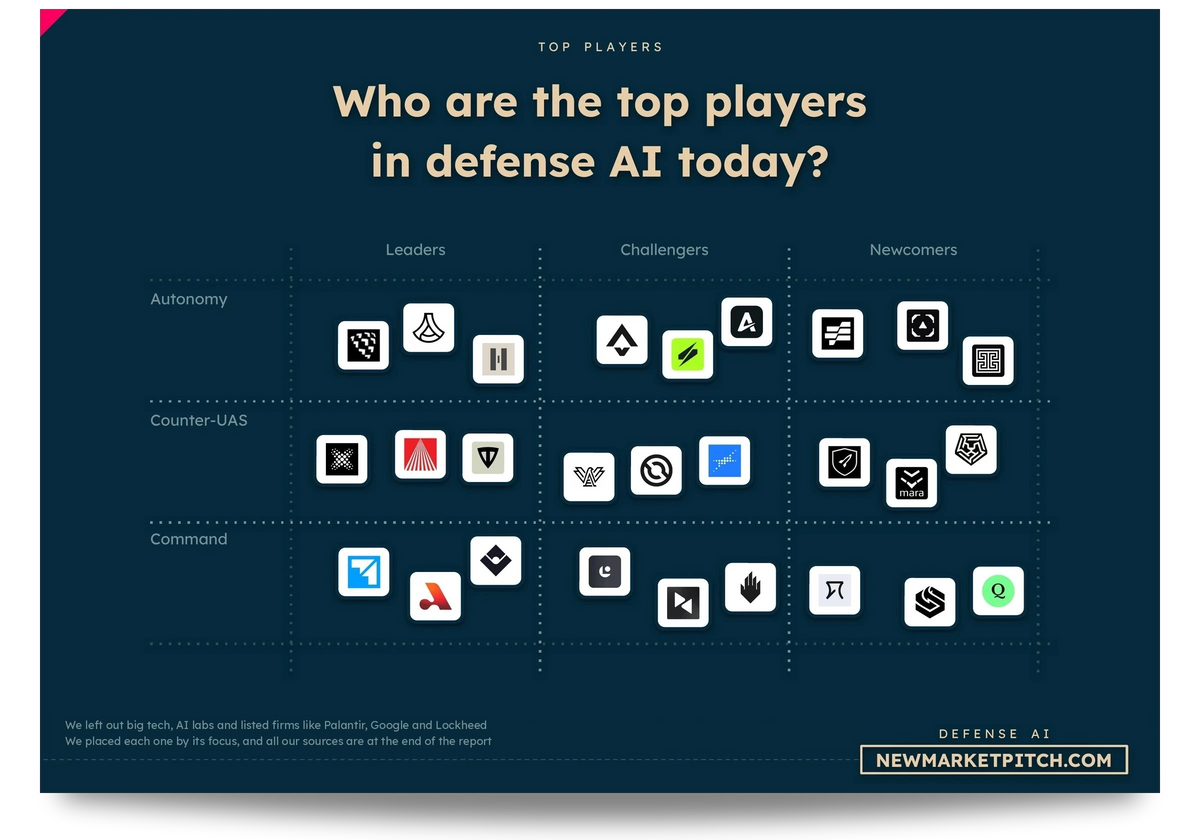
In our report covering the defense AI market, we turn what is vague and complex into simple, useful visuals. Market maps like this one show you at a glance where every startup stands.
What counts as real military adoption for a defense AI startup?
Real military adoption starts when armed forces move from testing a defense AI startup to buying its technology for operational units, repeated missions or enduring military programs.
That sounds obvious, but defense tech makes the distinction unusually important. A startup can announce a $500 million contract ceiling without receiving anything close to $500 million in actual orders. Another can appear in several military exercises and still never make it into production. Meanwhile, a smaller award can tell us far more when it equips a brigade, enters a production program or keeps receiving follow-on orders after troops have used the product.
For this article, we therefore give the most weight to production contracts, fielding to real units, combat use, repeat procurement and integration into military systems that are expected to remain in service. Prototype awards and exercises still count, but much less.
That immediately narrows the field. Anduril, Shield AI, Vannevar Labs, Skydio, Teal Drones, Helsing and now Saronic have all crossed meaningful adoption thresholds. Applied Intuition and several ground-autonomy companies are moving closer. Many other well-funded defense AI startups are still proving that military interest will turn into recurring purchases.
| Evidence | What it tells us | How much weight we give it |
|---|---|---|
| Venture funding | Investors expect future demand | Very little |
| Military partnership | A customer wants to explore the technology | Very little |
| Exercise or demonstration | The product can operate in a military setting | Some |
| Paid prototype | The military will fund further testing | Moderate |
| Competitive program selection | The product survived a meaningful evaluation | High |
| Production order | The military intends to buy deployable systems | Very high |
| Fielding to units | Soldiers, sailors or airmen are receiving the product | Very high |
| Combat use | The product is being tested against a real enemy | Extremely high |
| Repeat orders | The first deployment created enough value to buy again | Extremely high |
| Integration into core military architecture | Other capabilities begin depending on the product | Strongest |
Why are defense AI startups suddenly getting much more real military adoption?
Defense AI adoption is accelerating because the military problem has changed: cheap drones, electronic warfare and faster targeting cycles now create operational needs that traditional procurement often moves too slowly to solve.
Ukraine has made that gap impossible to ignore. Drone designs, countermeasures and communications systems can change within months. A platform that works during one part of the war may struggle after the enemy adapts. Militaries therefore need companies that can update software and hardware much faster than the normal multiyear procurement cycle.
We can see the response inside the U.S. military. The Army is putting new drones and autonomous systems directly into Transformation in Contact units. The Air Force has separated Collaborative Combat Aircraft mission-autonomy software from the aircraft itself so that software suppliers can compete independently. The Pentagon's Autonomy Factory is trying to create a common pipeline for developing and testing autonomous systems rather than rebuilding one for every program.
A few years ago, much of defense AI consisted of prototypes and exercises. Today the harder question is finally answerable: which technologies are actually being produced, fielded and bought again?

Our research about AI for defense gets updated several times a month, so you always get the latest view of where things stand.
Is Anduril clearly winning defense AI adoption right now?
Yes. Anduril currently has the strongest overall military adoption of any private defense AI company because it is moving into several major operational layers at the same time.
The newest evidence comes from U.S. Army command and control. The Army recently expanded its Next-Generation Command and Control work from division-scale experimentation toward operational fielding, beginning with I Corps. Anduril received an initial $162.8 million base award, while options could take the five-year contract to $1.8 billion.
The dollar figure gets attention, but the transition is more important. Lattice is being used as the distributed data layer connecting applications, AI models, sensors, vehicles and other battlefield systems. That puts Anduril much deeper inside Army operations than selling a stand-alone drone would.
Its counter-drone business is already further along. The Pentagon previously awarded Anduril roughly $250 million for more than 500 Roadrunner-M interceptors and Pulsar electronic-warfare systems. The Army has also selected Anduril for next-generation counter-UAS fire control.
Then there is the Air Force. Anduril's Fury became the YFQ-44A Collaborative Combat Aircraft and has advanced through increasingly serious flight and weapons testing. The aircraft is still on the road toward operational fleet service, so we should give it less weight than fielded Army systems. Even so, Anduril now has credible positions in command software, air defense and autonomous aviation.
No other startup currently matches that breadth. Anduril has reached the stage where the question is less about whether the military will adopt its technology and more about how much of the military stack the company can successfully support at once.
If you want more recent data on this point, please see our latest defense AI market report.
Is Shield AI's Hivemind finally becoming real military software?
Yes. Shield AI's Hivemind has now moved beyond experimental autonomy and into production work for one of the U.S. Air Force's most important autonomous-aircraft programs.
The Air Force first selected Shield AI as a mission-autonomy provider for Collaborative Combat Aircraft. Hivemind then flew Anduril's YFQ-44A, completing the required test points for its early mission-autonomy campaign. More recently, the Air Force awarded Shield AI a production contract to implement Hivemind for the CCA program.
That sequence is much stronger than a successful demo. Shield AI went from competitive selection to aircraft integration, flight testing and then production.
The structure of the program could become even more important than the first contract. The Air Force uses a government-owned autonomy architecture that lets it separate the AI pilot from the aircraft. Shield AI can therefore sell Hivemind as a layer that potentially moves between platforms rather than as software permanently tied to one drone.
Recent testing has also become more demanding. Shield AI says Hivemind has now controlled the YFQ-44A across multiple sorties and has been used during a combat-employment exercise in which an Air Force pilot directed two beyond-visual-range engagements through mission autonomy.
Shield AI still trails Anduril in the breadth of military adoption. But for AI piloting specifically, it is currently one of the strongest companies in the market.

In our market report about AI for defense, we look at what the winners do differently, so you can learn from the best instead of guessing.
Is Shield AI's V-BAT actually being used on real missions?
Yes. V-BAT gives Shield AI something many autonomy startups still lack: an aircraft with real operational use alongside its newer AI software programs.
Shield AI says Ukrainian operators have used V-BAT for hundreds of targeting missions in areas where GPS and communications are heavily disrupted. Those claims come from the company and operators rather than a complete public military dataset, so we should avoid pretending we know the exact fleet-wide success rate. Still, operating repeatedly in a heavily jammed war zone is a much stronger test than flying on a controlled range.
V-BAT is also building a procurement record outside Ukraine. The U.S. Coast Guard completed an operational evaluation of the aircraft for intelligence, surveillance and reconnaissance work, while the U.S. Navy has included Shield AI among suppliers that can compete for ISR service orders.
The combination is what gives Shield AI an edge here. Ukraine gives V-BAT battlefield exposure, U.S. government evaluations add institutional validation, and Hivemind gives the company a route to sell the autonomy underneath aircraft as a separate product.
That puts Shield AI ahead of startups that have excellent AI software but little operational hardware, as well as drone makers whose autonomy remains tied to one airframe.
Is Vannevar Labs more embedded in the military than people realize?
Yes. Vannevar Labs is currently one of the most deeply adopted pure-software defense AI startups, even though its work generates far fewer dramatic images than autonomous aircraft or ships.
The best evidence is the history of the Defense Innovation Unit's Real-Time Information and Effects program. Vannevar began working on the effort in 2021 and eventually moved into a production agreement with a ceiling of $99 million.
The program had already spread widely before that transition. DIU said the production user group included 14 organizations across military services, intelligence organizations and Five Eyes partners. Earlier prototyping had supported missions in places including the Indo-Pacific, where Vannevar's software combined public and commercial information to help military teams understand adversary behavior.
The follow-on activity has continued. Federal award records show additional Air Force funding in 2026, while separate Office of the Secretary of Defense production orders appeared during the year. Vannevar also expanded its work with SMX to deploy mission-specific AI agents into combatant commands and selected federal agencies.
That repetition matters more than the headline size of the original contract. Vannevar keeps turning one military use case into another, which is exactly what adoption looks like for software that sits inside intelligence and operational workflows.
If you want more recent data on this point, please see our latest defense AI market report.

In our document detailing everything you need to know about defense AI, you will always find fresh funding data, taken straight from our own verified funding database.
Are Skydio and Teal Drones actually being fielded by the U.S. Army?
Yes. Skydio and Teal Drones are already supplying small drones through an Army program that has moved well beyond experimentation.
The Army's Short Range Reconnaissance program is the clearest evidence. Its first tranche began fielding in 2022 and eventually reached more than 16 brigades. The second tranche then selected Teal's Black Widow and Skydio's X10D as production systems.
Skydio's X10D began initial fielding through an urgent operational requirement before the Army issued another procurement directive under SRR Tranche 2. Teal entered second-tranche production with Black Widow. Both systems are designed to give platoon-level units their own reconnaissance, surveillance and target-acquisition capability.
That scale may look small beside an autonomous fighter or unmanned ship, but adoption works differently here. A reconnaissance drone carried by soldiers and used repeatedly during normal unit operations is already part of the force. There is no need to wait for some distant future program to decide whether the product is useful.
The harder test comes next. Small-drone technology changes so quickly that winning one tranche does not guarantee the next. Skydio and Teal have won real Army adoption for now; they still have to keep winning as the Army refreshes the category.
Is Helsing really winning military adoption in Ukraine?
Yes, although Helsing's adoption is messier than its huge order numbers suggest because Ukraine has exposed both the strength and weaknesses of its systems.
Helsing first announced an order for 4,000 HF-1 strike drones for Ukraine and then another 6,000 HX-2 systems. Very few Western defense AI startups have had the opportunity to put autonomous or AI-assisted weapons into a high-intensity war at that scale.
Combat use then produced a much less polished story. German and Ukrainian reporting described early HX-2 problems involving launches, communications and system configuration. Some follow-on procurement was reportedly held back while those problems were examined.
Later trials and battlefield accounts were more encouraging. U.S. soldiers evaluating HX-2 during Project Flytrap reported 15 direct hits and two near misses across 17 engagements. Ukrainian users have also described continued operational employment after changes to the system.
We should be cautious with every percentage in this category because none gives us a complete fleet-wide picture. What we can say with confidence is that Helsing has already reached a stage most defense AI startups have not: thousands of systems have faced real electronic warfare, real enemy adaptation and real consequences when the product fails.
Helsing therefore belongs among the military-adoption winners today, although its battlefield record is less consistently proven than its procurement volume first suggests.
If you want more recent data on this point, please see our latest defense AI market report.

Learning from others' mistakes is the cheapest lesson there is. In our report covering the defense AI market, we look at what broke startups before you, so you don't repeat it.
Has Saronic now moved from Navy testing into real military adoption?
Yes. Saronic has just crossed the line from promising Navy supplier to genuine production winner, which changes its position substantially.
Earlier in the year, the Navy selected Saronic and six other companies for at-sea testing under its Medium Unmanned Surface Vessel marketplace. At that point, calling Saronic a military-adoption leader would have been premature. It was still competing for the production step.
That production decision has now arrived. After completing Phase I at-sea testing, the Navy awarded production agreements to Saronic, HII and Galliano Marine Services. Each company is set to provide 10 medium unmanned surface vessels, for 30 vessels in total. The Navy said the average procurement cost is around $40 million per vessel, with first deliveries planned before the end of fiscal 2027.
This is a major upgrade in the evidence around Saronic. The company is no longer relying mainly on venture funding, factory expansion or the potential value of its larger Marauder vessel. It has survived a Navy competition and received a ten-vessel production award.
Saronic still lacks the operational history of Anduril's fielded systems or the combat exposure of Helsing. But today it belongs in the adoption group rather than the waiting room.
Is Applied Intuition becoming important military autonomy infrastructure?
Applied Intuition is becoming a serious Pentagon autonomy supplier, although we still have less evidence of frontline dependence than we do for Anduril, Shield AI or the fielded drone companies.
The company's position comes from a different part of the stack. Applied Intuition received a production contract worth up to $171.1 million after Defense Innovation Unit work on autonomy software and development infrastructure. The Pentagon later selected the company to provide technology underpinning its Autonomy Factory.
The idea is straightforward. Autonomous military vehicles need huge amounts of simulation, test data, validation and software iteration. If each aircraft, truck or robot builds that pipeline separately, deployment slows down. Applied Intuition is trying to provide shared infrastructure that programs can use to develop and update autonomy faster.
A company supplying that development pipeline can spread across many platforms even when its name never appears on the vehicle itself.
For now, however, we can see Pentagon-level adoption more clearly than battlefield dependence. Applied Intuition is already a real military supplier, but it has not yet accumulated the operational proof that would put it in the very top group.

Your time is limited. In our research about AI for defense, we put numbers on each part of the market, so you can see where it makes sense to focus.
Are Forterra and the Army's ground-autonomy startups actually getting anywhere?
Forterra and other ground-autonomy startups are getting closer to real Army use, but the category still trails drones and military software by a wide margin.
The Army selected Forterra, Overland AI and Scout AI for unmanned-system autonomy agreements that put commercial driving technology onto Infantry Support Vehicles for soldier evaluation. These are real Army programs, but they remain closer to prototype evaluation than large-scale fielding.
More recently, the Army picked Forterra and Overland AI again for its Infantry Last Tactical Mile initiative. The program aims to use autonomous systems for jobs such as resupply, casualty evacuation and communications support close to combat units. An operational assessment with an Army unit is planned before a production decision.
Forterra has also worked on autonomous breaching and engineering missions, which gives it exposure to tasks where removing soldiers from vehicles has obvious value.
The Army keeps coming back to the same companies for harder missions, which is encouraging. Still, thousands of autonomous ground vehicles are not rolling through Army formations today. Forterra is one of the companies closest to changing that, but this remains an emerging adoption story rather than a mature one.
Is Scale AI becoming a major Pentagon AI supplier?
Yes. Scale AI has become a major Pentagon AI supplier, especially in data, planning and enterprise AI, even though it sits in a different category from defense-native companies building weapons and autonomous vehicles.
Project Thunderforge is the clearest example. Scale leads the Pentagon effort to bring AI agents and decision-support tools into military planning, working with organizations including U.S. Indo-Pacific Command and European Command.
The company also received major Army work involving data operations, AI models, testing and engineering. More recently, its Pentagon enterprise AI agreement increased from a potential $100 million to $500 million after demand reportedly exceeded the original ceiling. According to Scale, Defense Department organizations were using the agreement for areas including computer vision, generative-AI decision support and data operations.
We should still read that $500 million carefully. It is a maximum potential value, not proof that the Pentagon has already spent half a billion dollars with Scale.
The more convincing evidence is that the agreement had to be expanded because additional Pentagon organizations wanted to use it. That puts Scale among the strongest current suppliers of general AI infrastructure to the U.S. military, even if it is less useful as a direct comparison with Anduril or Shield AI.

In our market report about AI for defense, we always try to gather several sources and make estimates that make sense, so you can work with solid numbers.
Which defense AI startups have the strongest military adoption right now?
Anduril is clearly first today, while Shield AI, Vannevar Labs, Skydio, Teal, Helsing, Saronic and Scale AI make up a second group with very different kinds of military adoption.
Anduril has the broadest footprint and is moving into increasingly central military architecture. Shield AI has both an operational aircraft business and production-stage AI-pilot software. Vannevar has built unusually deep software use across defense organizations. Skydio and Teal have physical products reaching Army formations. Helsing has battlefield volume that almost nobody else in Western defense tech can match. Saronic has now earned a real Navy production order after at-sea competition. Scale has become a major enterprise AI supplier.
Applied Intuition sits just below that group because the Pentagon is adopting its autonomy-development infrastructure before we can clearly see how widely deployed systems depend on it. Forterra is further back because Army ground autonomy is still moving through operational assessment rather than broad production.
The ranking is deliberately based on adoption rather than valuation. A company can raise billions of dollars and still sit below a much smaller supplier if the military is only testing its product.
| Company | Best evidence of adoption | Where it stands now |
|---|---|---|
| Anduril | Army NGC2 fielding, counter-UAS production, YFQ-44A program | Clear overall leader |
| Shield AI | Hivemind CCA production work plus V-BAT operational use | Strong autonomy leader |
| Vannevar Labs | Production transition and repeated use across defense organizations | Deep software adoption |
| Skydio | X10D Army SRR production and fielding | Real tactical adoption |
| Teal Drones | Black Widow Army SRR production | Real tactical adoption |
| Helsing | Thousands of strike drones ordered for Ukraine and combat use | Large but uneven battlefield adoption |
| Saronic | Navy production award for 10 medium unmanned surface vessels | Newly established production winner |
| Scale AI | Thunderforge and expanded Pentagon enterprise AI vehicle | Strong enterprise adoption |
| Applied Intuition | Autonomy Factory and major production software work | Strong infrastructure position |
| Forterra | Repeated Army autonomy selections and upcoming unit assessment | Promising, still pre-scale |
If you want more recent data on this point, please see our latest defense AI market report.
Is the real defense AI prize becoming the software underneath the weapons?
Yes. The most valuable defense AI companies are increasingly trying to control reusable software layers that can spread across many military systems rather than depending on one aircraft, drone or vehicle.
Anduril shows what this can look like at the command layer. Its latest Army work puts Lattice inside the data architecture connecting applications, sensors, AI models and vehicles. If that architecture keeps spreading, Anduril can gain from military adoption even when somebody else builds the physical system.
Shield AI is attacking the autonomy layer. The Air Force's CCA architecture allows Hivemind to be evaluated separately from the aircraft, which gives Shield AI a possible route from one autonomous aircraft into many.
Applied Intuition sits another step underneath them. Its Pentagon role focuses on the software infrastructure used to simulate, test and update autonomous systems.
Those layers can reinforce one another. A future military system might use Applied Intuition's tools during development, Shield AI's software to control a vehicle and Anduril's software to connect that vehicle with commanders and other weapons.
The most interesting defense AI competition now goes beyond who builds the best drone. Companies that become reusable software inside many different platforms could end up much harder to replace.

If you build or invest in the defense AI market, you need to know which business models pay off now and which ones are fading. That's why our report covering it has a whole section on it.
Are militaries already becoming dependent on defense AI startups?
Military dependence on defense AI startups has started in specific missions, but it has not spread evenly across the force yet.
Vannevar is a good example of quiet dependence. Its software has expanded across multiple military and intelligence organizations over several years, and new orders continue to appear. Once analysts and operational teams build daily workflows around software like this, replacing it becomes harder than the original contract size suggests.
Small drones create another form of dependence. Army units that get used to platoon-level aerial reconnaissance are unlikely to decide that they no longer need the capability. The supplier can change from one procurement tranche to another, but the operational requirement remains.
Anduril is approaching the most important form of dependence. As seen above, the Army is now moving its NGC2 data architecture toward corps-level operational fielding. The more applications, sensors and units connect through that architecture, the greater the switching cost becomes.
The Pentagon clearly understands this risk. Its CCA autonomy approach deliberately keeps the underlying architecture government-owned so that software providers can be swapped. Similar modularity appears across newer programs.
The military wants startup technology without handing one startup permanent control of the stack. Whether that remains possible once a few software platforms become deeply embedded is one of the biggest questions for the next stage of defense AI.
So which defense AI startups are really winning military adoption?
Anduril is the strongest defense AI adoption winner today, Shield AI is the closest challenger in autonomy, and Vannevar Labs, Skydio, Teal Drones, Helsing, Saronic and Scale AI have all built enough real military use to separate themselves from the much larger group of companies still living mostly on prototypes and future promise.
Anduril stands alone because its adoption now reaches command software, air defense and autonomous aircraft. The Army's move toward operational NGC2 fielding strengthens a position that was already backed by production hardware programs.
Shield AI has built the strongest alternative autonomy story. Hivemind has reached CCA production work, while V-BAT gives the company operational experience that pure software companies do not have.
Vannevar deserves more attention than its public profile suggests. Its adoption has spread gradually across defense organizations, and repeated production orders make the story stronger than one spectacular headline contract would.
Skydio and Teal show what straightforward military adoption looks like: the Army selected their drones, moved them into production and is putting them into formations. Helsing's story is rougher because combat exposed real problems, but thousands of systems facing a real enemy provide evidence that controlled demonstrations simply cannot reproduce.
Saronic is the company whose position has changed most lately. The Navy's decision to buy 10 medium unmanned surface vessels after at-sea testing moves the company into production and makes its military traction much harder to dismiss as investor enthusiasm.
Applied Intuition and Forterra are the two companies closest to moving higher. Applied Intuition already has important Pentagon infrastructure work, while Forterra keeps returning in Army ground-autonomy programs. They need broader operational dependence before we put them in the same group as the current leaders.
The field is much narrower than the defense-tech boom makes it look. Plenty of startups can show us a Pentagon contract, an exercise or a large funding round. Far fewer can show repeated procurement, real units using the product, combat exposure or a place inside an enduring military architecture. Those are the companies we would call the real winners now.
If you want more recent data on this point, please see our latest defense AI market report.
Our methodology
This analysis asks which defense AI startups have accumulated the strongest evidence of real military adoption. We separate military interest from actual adoption by looking at where each company sits in the progression from demonstration and paid prototype to competitive program selection, production, fielding, combat use, repeat procurement and integration into enduring military systems.
We do not rank companies by funding, valuation or the largest announced contract ceiling. A ceiling shows how much a customer may spend, not how much has actually been ordered. We give more weight to funded production, deployment to real units, operational use and follow-on procurement, especially when those signals appear repeatedly rather than in a single announcement.
Because defense AI covers very different products, we do not compare companies with one numerical metric. Tactical drones, mission-autonomy software, command-and-control platforms, maritime systems, enterprise AI and autonomy-development infrastructure all scale differently. We compare the maturity, persistence and operational depth of the adoption evidence within each company's role.
Combat use receives especially high weight because it exposes systems to electronic warfare, enemy adaptation, unreliable communications and real operational consequences. We still treat company-reported battlefield figures cautiously when a complete independent military dataset is not public, and we avoid turning one trial or one performance percentage into a fleet-wide conclusion.
For U.S. procurement and fielding, we prioritized official material from the U.S. Army, U.S. Air Force, U.S. Navy, U.S. Coast Guard, Defense Innovation Unit and federal award records. Company disclosures from Anduril, Shield AI, Helsing and Scale AI were used where they added operational detail or program context not available in the government material.
Key sources used for this analysis include: the U.S. Army on Short Range Reconnaissance Tranche 2 production and fielding, the U.S. Army on Skydio X10D and Teal Black Widow fielding, the U.S. Navy on Saronic's medium unmanned surface vessel production award, Defense Innovation Unit on Vannevar Labs' Real-Time Information and Effects production transition, USAspending on additional 2026 funding to Vannevar Labs, the U.S. Air Force on production-stage Collaborative Combat Aircraft and mission-autonomy contracts, and the U.S. Air Force on its government-owned CCA autonomy architecture.
Additional key sources include: Shield AI on its Hivemind production contract, Shield AI on Hivemind flight testing aboard the YFQ-44A, the U.S. Coast Guard on V-BAT operational testing, Shield AI on V-BAT sorties in Ukraine, Anduril on the Army's NGC2 expansion toward operational fielding, the U.S. Army on the NGC2 architecture, and Anduril on Roadrunner-M and Pulsar production.
We also used Helsing on the additional 6,000 HX-2 order for Ukraine, Helsing on deployment activity in Ukraine, Defense Innovation Unit on Applied Intuition's autonomy-development and validation infrastructure, the U.S. Army on Forterra, Overland AI and Scout AI autonomy agreements, the U.S. Army on Infantry Last Tactical Mile selections, and Scale AI on the expansion of its Pentagon enterprise AI agreement.

In our report covering the defense AI market, we don't want to repeat what boring consulting reports say. Instead, we show you the real and latest market signals that matter.
Written by the New Market Pitch teamWe track new markets so founders and investors can move faster. About us