What are the most valuable defense AI startups?
Whether you're building or investing in the defense AI market, our report covers everything you need to know: the players, the money, and what's coming next.
Summary
Anduril Industries is the most valuable defense AI startup, valued at $61.0B, ahead of Helsing at $18.0B and Shield AI at $12.7B. Saronic Technologies, Quantum Systems and TEKEVER lead the next group, with valuations ranging from approximately $6 billion to $10 billion.
Defense technology investment has accelerated dramatically. Venture investment reached $49.1 billion in 2025, up 81% from $27.2 billion in 2024, as investors responded to growing military demand for autonomous systems, battlefield software and drone technology.
Anduril has established a considerable lead because it combines military software with physical equipment. Its portfolio spans autonomous aircraft, surveillance systems, interceptors and command software, while its reported $2.2 billion in 2025 revenue gives it a commercial scale that few private defense AI companies can match.
The market is becoming much broader than autonomous drones. Counter-drone systems, military logistics software, autonomous ships, orbital defense and ground robotics are all attracting billion-dollar valuations. Onebrief, Allen Control Systems and True Anomaly illustrate how specialized companies can become extremely valuable without building conventional military aircraft.
There are 19 startups in our ranking valued at $1 billion or more. Anduril alone is valued at $61 billion, more than three times the next company, highlighting just how concentrated the very top of the market has become.
Europe is emerging as a serious competitor to the United States. Helsing, Quantum Systems and TEKEVER have secured enormous financing rounds, while Germany has become an especially important center for defense technology investment. Still, no European startup comes close to Anduril's valuation.
Military drone manufacturers have some of the strongest growth opportunities because armies need large quantities of affordable autonomous aircraft, often with frequent upgrades. But manufacturing is expensive, battlefield technology changes quickly, and today's successful product can become outdated surprisingly fast.
Counter-drone technology could become another major winner. Protecting military installations from inexpensive drones requires increasingly sophisticated layered defenses, creating opportunities for companies developing interceptors, autonomous weapon stations, electronic warfare and laser systems.
Military software businesses offer a different investment proposition. Companies such as Onebrief, Vannevar Labs and DEFCON AI can potentially expand without building factories, but their success depends on winning long-term military contracts and becoming deeply integrated into everyday operations.
The biggest concern is the gap between valuations and demonstrated financial performance. Anduril's valuation represents approximately 28 times its reported 2025 revenue, while many other startups disclose little about sales or profitability. Large funding rounds and contract ceilings don't automatically translate into sustainable businesses.
Our conclusion is that defense AI is becoming a major industrial market, with genuine long-term demand behind it. Anduril, Shield AI and Helsing have established strong positions, but the next generation of winners could emerge from counter-drone defense, autonomous maritime systems and military software. The real test will be whether these companies can turn impressive technology and investor enthusiasm into profitable, repeatable production.

Written by the New Market Pitch teamWe track new markets so founders and investors can move faster. About us

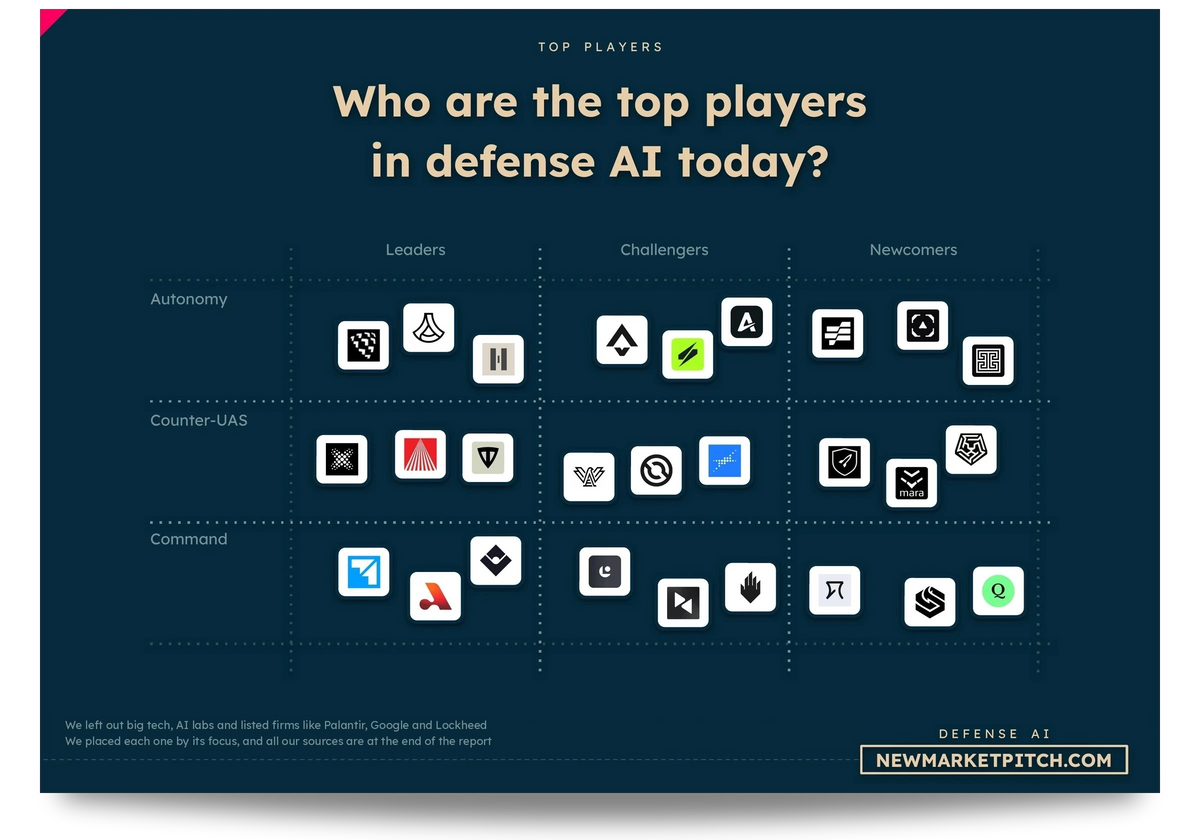
In our report covering the defense AI market, we turn what is vague and complex into simple, useful visuals. Market maps like this one show you at a glance where every startup stands.
Top startups in the defense AI market ranked by valuation
Here is an updated table that ranks the top startups in the defense AI market based on their latest reported or estimated valuations.
If you need to dig deeper and get more detailed data, please check our report covering the defense AI market.
| # | Startup | Valuation | Confidence | Valuation basis | Last round | Total funding |
|---|---|---|---|---|---|---|
| 1 | AndurilAI-powered autonomous defense systems | $61.0Bas of May 2026 | Full | Announced private round valuation | $5.0BSeries H · May 2026 | $11.3Bvalued at 5.4× this |
| 2 | HelsingAI-powered autonomous defense systems | $18.0Bas of Jul 2026 | Full | Announced private round valuation | $1.8BSeries E · Jul 2026 | $3.3B+valued at 5.4× this |
| 3 | Shield AIAutonomous military aircraft and AI | $12.7Bas of Mar 2026 | Partial | Announced private round valuation | $2.0BSeries G + preferred equity · Mar 2026 | $3.1Bvalued at 4.1× this |
| 4 | SaronicAutonomous military surface vessels | $9.25Bas of Mar 2026 | Strong | Implied valuation from raise | $1.8BSeries D · Mar 2026 | $2.6Bvalued at 3.6× this |
| 5 | Quantum SystemsAI-enabled military reconnaissance drones | $8.0Bas of Jul 2026 | Strong | Implied valuation from raise | $1.2BSeries D · Jul 2026 | $1.6B+valued at 5.0× this |
| 6 | TEKEVERAutonomous aerial surveillance systems | $6.4Bas of Sep 2026 | Strong | Implied valuation from raise | ~$580MSeries D · Sep 2026 | $677M+valued at 9.5× this |
| 7 | STARK DefenceAutonomous strike drones and munitions | $3.65Bas of Jun 2026 | Strong | Implied valuation from raise | ~$570MGrowth equity · Jun 2026 | $662M+valued at 5.5× this |
| 8 | Cambridge AerospaceAI-enabled missile and drone interceptors | $3.4Bas of Aug 2026 | Strong | Implied valuation from raise | $300MSeries C · Aug 2026 | $636Mvalued at 5.3× this |
| 9 | OnebriefAI-powered military planning software | $3.11Bas of Jul 2026 | Strong | Implied valuation from raise | $151MSeries E · Jul 2026 | $270Mvalued at 11.5× this |
| 10 | Neros TechnologiesAutonomous combat and interceptor drones | $2.5Bas of Aug 2026 | Full | Announced private round valuation | $52MLate VC · Sep 2026 | $371Mvalued at 6.7× this |
| 11 | True AnomalyAutonomous orbital defense spacecraft | $2.2Bas of Apr 2026 | Strong | Implied valuation from raise | $600MSeries D · Apr 2026 | ~$970Mvalued at 2.3× this |
| 12 | Allen Control SystemsAutonomous counter-drone weapon stations | $2.2Bas of Jun 2026 | Strong | Implied valuation from raise | $200MSeries B · Jun 2026 | $242Mvalued at 9.1× this |
| 13 | Vannevar LabsAI-powered military intelligence software | $1.0B–$1.8Bas of Oct 2026 | Partial | Comparables-based estimate | $75MSeries B · Jan 2023 | $92Mvalued at 15.3× this |
| 14 | Harmattan AIAutonomous aircraft and defense systems | $1.4Bas of Jan 2026 | Strong | Implied valuation from raise | $200MSeries B · Jan 2026 | $242Mvalued at 5.8× this |
| 15 | ForterraAutonomous military ground vehicles | $1.0B–$1.4Bas of Oct 2026 | Partial | Comparables-based estimate | ~$188MSeries C · Nov 2025 | $540M+valued at 2.2× this |
| 16 | Kela TechnologiesMilitary integration platform | $1.0B–$1.4Bas of Oct 2026 | Partial | Comparables-based estimate | $200MSeries B · May 2026 | $300Mvalued at 4.0× this |
| 17 | TwentyAI-powered offensive cyber warfare | $1.1B–$1.3B | Strong | Implied valuation from raise | $30MSeries B extension · Jul 2026 | $168Mvalued at 7.1× this |
| 18 | Kraken Technology GroupAutonomous maritime defense vessels | $1.0Bas of Jul 2026 | Strong | Implied valuation from raise | $175MSeries B · Jul 2026 | $175Mvalued at 5.7× this |
| 19 | UFORCEAutonomous Ukrainian defense systems | $1.0B+as of Mar 2026 | Partial | Active raise valuationEstimated | $50MSeed · Mar 2026 | $50Mvalued at 20.0× this |
| 20 | HavocAICollaborative autonomous maritime systems | $500M–$833Mas of May 2026 | Strong | Implied valuation from raise | $100MSeries A · May 2026 | $196Mvalued at 3.4× this |
| 21 | Scout AIFoundation models for military autonomy | $500M–$833Mas of Apr 2026 | Partial | Implied valuation from raise | $100MSeries A · Apr 2026 | $115Mvalued at 5.8× this |
| 22 | Dominion DynamicsArctic surveillance and autonomous systems | $500M–$833Mas of Jun 2026 | Strong | Implied valuation from raise | $100MSeries A · Jun 2026 | $115M+valued at 5.8× this |
| 23 | Overland AIOff-road autonomous military vehicles | $480M–$850Mas of Oct 2026 | Partial | Comparables-based estimate | $100MSeries B · Feb 2026 | $122Mvalued at 5.5× this |
| 24 | AuterionAutonomous drone operating systems | $600M+as of Sep 2025 | Partial | Announced private round valuation | UndisclosedStrategic equity investment · Nov 2025 | $181M+valued at 3.3× this |
| 25 | Heaviside IndustriesAutonomous precision munitions | $600Mas of Aug 2026 | Strong | Implied valuation from raise | $60MSeries B · Aug 2026 | $88Mvalued at 6.8× this |
| 26 | NestAISovereign defense AI and autonomy | $450M–$690Mas of Oct 2026 | Partial | Comparables-based estimate | ~$115MStrategic / Series A · Nov 2025 | $115Mvalued at 5.0× this |
| 27 | DEFCON AIMilitary logistics planning software | $300M–$550M | Partial | Comparables-based estimate | $44MSeed · Aug 2024 | $44Mvalued at 9.7× this |
| 28 | Alta AresIntegrated AI air defense | $260M–$550Mas of Oct 2026 | Partial | Comparables-based estimate | ~$57MSeries A · Jun 2026 | $59Mvalued at 6.8× this |
| 29 | Vatn SystemsAutonomous underwater military vehicles | $300M–$500Mas of Dec 2025 | Strong | Implied valuation from raise | $60MSeries A · Dec 2025 | $73M+valued at 5.5× this |
| 30 | Gallatin AIAI-powered military logistics software | $250M–$420M | Partial | Implied valuation from raise | $50MSeries A · Oct 2026 | $70Mvalued at 4.8× this |
| 31 | ARX RoboticsAutonomous military ground robotics | $245M–$408Mas of Dec 2025 | Strong | Implied valuation from raise | $13MSeries A extension · Jul 2025 | $56Mvalued at 5.8× this |
| 32 | TurbineOneTactical edge AI software | $250M–$370Mas of Oct 2026 | Partial | Comparables-based estimate | $36MSeries B · May 2025 | $57Mvalued at 5.4× this |
| 33 | PicogridDefense systems integration software | $225M–$375Mas of May 2026 | Strong | Implied valuation from raise | $45MSeries A · May 2026 | $57M+valued at 5.3× this |
| 34 | Blue Water AutonomyAutonomous naval surface vessels | $200M–$360Mas of Oct 2026 | Partial | Comparables-based estimate | $50MSeries A · Aug 2025 | $64Mvalued at 4.4× this |
| 35 | Terra IndustriesAutonomous infrastructure protection systems | $208M–$347Mas of Aug 2026 | Strong | Implied valuation from raise | $18MSeed extension · Aug 2026 | $52Mvalued at 5.4× this |
| 36 | Aurelius SystemsAutonomous laser counter-drone systems | $200M–$333Mas of Aug 2026 | Partial | Implied valuation from raise | $40MSeries A · Aug 2026 | $50Mvalued at 5.3× this |
| 37 | Rune TechnologiesAI-powered military logistics planning | $200M–$330M | Partial | Implied valuation from raise | $24MSeries A · Jul 2025 | $30Mvalued at 8.8× this |
| 38 | NODA AIAutonomous military mission orchestration | $190M–$320M | Partial | Comparables-based estimate | $25MSeries A · Feb 2026 | $25M+valued at 10.2× this |
| 39 | Comand AIAI-native military command software | $185M–$310Mas of Jun 2026 | Strong | Implied valuation from raise | ~$37MSeries A · Jun 2026 | $49Mvalued at 5.1× this |
| 40 | TYTAN TechnologiesAI-powered counter-drone interceptors | $175M–$292Mas of Feb 2026 | Strong | Implied valuation from raise | $35MSeries A · Feb 2026 | $52Mvalued at 4.5× this |
| 41 | Swarm AeroAutonomous military aircraft | $175M–$292Mas of Mar 2026 | Strong | Implied valuation from raise | $35MSeries A · Mar 2026 | $59Mvalued at 4.0× this |
| 42 | Smack TechnologiesMilitary decision intelligence software | $120M–$280Mas of Oct 2026 | Partial | Comparables-based estimate | $61MSeries B · Aug 2026 | $93Mvalued at 2.2× this |
| 43 | Reveal TechnologyBattlefield intelligence and mapping | $100M–$280Mas of Oct 2026 | Partial | Comparables-based estimate | $4.6MVenture · Jul 2026 | $41M+valued at 4.6× this |
| 44 | DarkhiveAutonomous tactical drones and software | $95M–$270Mas of Oct 2026 | Partial | Comparables-based estimate | $30MSeries B · May 2026 | $55Mvalued at 3.3× this |
| 45 | Watchtower LabsAI-powered military logistics software | $140M–$210M | Strong | Implied valuation from raise | $35MSeed · Oct 2026 | $35Mvalued at 5.0× this |
| 46 | AgonSynthetic battlefield training software | $110M–$200M | Partial | Implied valuation from raise | $23MSeed · Jul 2026 | $30Mvalued at 5.2× this |
| 47 | CX2AI-enabled electronic warfare systems | $115M–$190M | Partial | Comparables-based estimate | $31MSeries A · May 2025 | $46Mvalued at 3.3× this |
| 48 | Distributed SpectrumAI-powered electronic warfare sensing | $90M–$190Mas of Oct 2026 | Partial | Comparables-based estimate | $25MSeries A · Mar 2025 | $25M+valued at 5.6× this |
| 49 | Buntar AerospaceAutonomous reconnaissance drones and software | $80M–$180Mas of Oct 2026 | Partial | Comparables-based estimate | $16MSeries A · Oct 2026 | $28M+valued at 4.7× this |
| 50 | AdargaAI-powered defense intelligence analysis | $80M–$160Mas of Oct 2026 | Partial | Comparables-based estimate | ~$9MEarly VC · Jul 2025 | $37Mvalued at 3.2× this |
| 51 | AITANSovereign autonomous defense robotics | $60M–$180Mas of Oct 2026 | Partial | Comparables-based estimate | $41MSeries A · Sep 2026 | $41Mvalued at 2.9× this |
| 52 | Project QOpen-source military integration platform | $85M–$146Mas of Jul 2026 | Strong | Implied valuation from raise | ~$18MSeries A · Jul 2026 | $26M+valued at 4.4× this |
| 53 | ArkeusAI-powered hyperspectral sensing systems | $83M–$139Mas of May 2026 | Strong | Implied valuation from raise | ~$18MSeries A · May 2026 | $20Mvalued at 5.5× this |
| 54 | LINE5Autonomous military drone swarming software | $65M–$115M | Low | Comparables-based estimate | $20MSeed · May 2025 | $20Mvalued at 4.5× this |
| 55 | Delian Alliance IndustriesAutonomous defense surveillance systems | $50M–$130Mas of Oct 2026 | Partial | Comparables-based estimate | $14MSeries A · Jul 2025 | $20M+valued at 4.5× this |
| 56 | Six RoboticsCoordinated autonomous drone swarm software | $60M–$117Mas of Jun 2026 | Strong | Implied valuation from raise | ~$14MSeed · Jun 2026 | $14Mvalued at 6.4× this |
| 57 | Aeon IndustrialAutonomous tactical defense systems | $55M–$115M | Low | Comparables-based estimate | UndisclosedSeed · Mar 2025 | $17Mvalued at 5.0× this |
| 58 | Modern IntelligenceAI-powered battlefield sensor intelligence | $65M–$105M | Partial | Implied valuation from raise | UndisclosedGrowth equity · May 2024 | $5Mvalued at 17.0× this |
| 59 | Tycho.AIGPS-denied autonomous navigation technology | $50M–$83Mas of Oct 2025 | Strong | Implied valuation from raise | $8MVenture financing · May 2026 | $20Mvalued at 3.3× this |
| 60 | AronditeAI orchestration for defense robotics | $40M–$67Mas of May 2025 | Strong | Implied valuation from raise | $10MSeed · May 2025 | $12Mvalued at 4.4× this |
| 61 | Askari DefenseAutonomous kinetic drone interception | $36M–$60Mas of Jun 2026 | Strong | Implied valuation from raise | $9MSeed · Jun 2026 | $11Mvalued at 4.6× this |
No startups match this search.

Our research about AI for defense gets updated several times a month, so you always get the latest view of where things stand.
Why are defense AI startup valuations rising so fast?
Defense AI startups are attracting far more money because autonomous weapons, military drones and battlefield software are becoming real purchasing priorities for Western militaries.
According to PitchBook data published by Defense News in January 2026, venture investment in defense technology reached $49.1 billion in 2025, up from $27.2 billion in 2024. That's an 81% increase in one year. The figures include dual-use businesses, but the trend is unmistakable: investors are putting much more money into technology designed for military use.
There are two main reasons for this change. First, the war in Ukraine has shown how important drones, electronic warfare and fast battlefield decision-making have become. Second, military budgets are increasing. NATO members agreed in June 2025 to spend 5% of GDP on defense and related security requirements by 2035, including at least 3.5% on core defense needs.
We can already see what this means for startups. Anduril Industries, valued at $61.0B, is building autonomous military systems and the software connecting them. Helsing, valued at $18.0B, has moved beyond battlefield AI software into manufacturing strike drones and interceptors. Quantum Systems, valued at $8.0B, raised $1.2 billion in July 2026 to expand its autonomous systems business.
Defense AI companies can now raise the kind of money needed to build factories, acquire other businesses and compete for major military programs. A few years ago, many were mainly trying to prove their technology worked. Today, the better-established ones are trying to produce and deliver it at scale. That's a much bigger financial commitment.
Which defense AI startups are worth the most today?
Anduril Industries is currently the highest-valued defense AI startup, at $61.0B, followed by Helsing at $18.0B and Shield AI at $12.7B.
Anduril's position is especially striking. At $61.0B, the company is worth more than three times Helsing's valuation and nearly five times Shield AI's. Investors are effectively treating Anduril as a potential major defense contractor rather than simply an AI software company.
Its business covers surveillance systems, autonomous aircraft, interceptors and Lattice, the software platform connecting sensors and military equipment. In March 2026, the US Army awarded Anduril a 10-year enterprise contract with a maximum potential value of $20 billion. The ceiling isn't guaranteed spending, but the agreement creates a purchasing framework that could support significant future revenue.
Shield AI takes a somewhat different approach with its Hivemind autonomy software and V-BAT aircraft. Helsing combines AI software with increasingly ambitious military hardware programs, including its HX-2 strike drone.
Beyond these three, the next large valuations belong to Saronic Technologies at $9.25B, Quantum Systems at $8.0B and TEKEVER at $6.4B. Their products cover autonomous ships, reconnaissance drones and military surveillance aircraft.
The leading valuations are increasingly concentrated around businesses that control important military software and can also deliver physical systems in large numbers. That combination is proving particularly attractive to investors.

In our market report about AI for defense, we look at what the winners do differently, so you can learn from the best instead of guessing.
Is Anduril really worth so much more than Shield AI and Helsing?
Anduril's enormous valuation premium over Shield AI and Helsing has some commercial justification, although investors are already counting on several more years of exceptional growth.
The strongest argument comes from revenue. Reuters reported in May 2026 that Anduril had more than doubled its revenue to $2.2 billion in 2025. That compares with approximately $1 billion in 2024, making Anduril one of the few major private defense AI companies with a publicly reported multibillion-dollar annual revenue figure.
The company also has a broad product portfolio. Its technology can be used for base protection, battlefield intelligence, command systems, autonomous aircraft and other military applications. That gives Anduril more ways to win contracts than a company focused on a single type of drone.
Shield AI, valued at $12.7B, is trying to make Hivemind a widely used autonomy system across different aircraft. Its June 2026 acquisition of Aechelon Technology added simulation capabilities that could help train and test autonomous pilots. Helsing, at $18.0B, has expanded into drone production and reported thousands of HX-2 systems deployed to Ukraine during 2026.
Both are serious businesses with substantial technological capabilities. However, we don't have equally transparent revenue figures for Shield AI and Helsing, so we cannot demonstrate that Anduril deserves its entire valuation premium based on current sales.
For now, Anduril has the clearest evidence of commercial scale. Its valuation still leaves little room for disappointing growth, especially given the heavy investment required to manufacture military equipment. A few slower contract cycles could make that premium difficult to defend.
How many defense AI startups are worth more than $1 billion?
In our ranking, 19 defense AI startups are currently valued at $1 billion or more, including Kraken Technology Group at $1.0B.
That means approximately 31% of the 61 companies in our ranking are valued at $1 billion or more.
The billion-dollar group is quite diverse. Neros Technologies, valued at $2.5B, builds autonomous combat and interceptor drones. True Anomaly at $2.2B works on orbital defense spacecraft. Allen Control Systems at $2.2B specializes in counter-drone weapon stations, while Onebrief at $3.11B develops military planning software.
These businesses sell very different products, which suggests billion-dollar valuations are no longer reserved for one particular form of military AI.
The other 42 companies have valuation ranges entirely below $1 billion. Many are still developing their first major production programs or expanding beyond early customers.
| Valuation threshold | Number of startups | Share of ranking |
|---|---|---|
| $50B or more at the lower bound | 1 | 1.6% |
| $10B or more at the lower bound | 3 | 4.9% |
| $5B or more at the lower bound | 6 | 9.8% |
| $2B or more at the lower bound | 12 | 19.7% |
| $1B or more at the lower bound | 19 | 31.1% |
| Entire valuation range below $1B | 42 | 68.9% |

In our document detailing everything you need to know about defense AI, you will always find fresh funding data, taken straight from our own verified funding database.
Is Anduril becoming too dominant in the defense AI startup market?
Anduril dominates defense AI startup valuations, but its financial lead doesn't mean it controls the whole market for autonomous military technology.
Its valuation partly reflects the breadth of its operations, which cover software, surveillance systems, drones, interceptors and other military equipment. Few independent startups can currently compete across so many categories.
Still, military customers don't buy every autonomous system from one company. The US Army's Next Generation Command and Control program illustrates this. In October 2026, the Army announced approximately $93.6 million in initial one-year software awards to a group of suppliers that included Onebrief and Rune Technologies, alongside established companies. Anduril and other technology providers are involved in the broader program.
This approach gives military customers access to different software tools rather than forcing them to rely entirely on one supplier.
The same applies to hardware. Saronic Technologies focuses on autonomous surface vessels, Neros Technologies develops combat drones, and True Anomaly works on orbital defense systems. Their products solve quite different problems.
Anduril may ultimately become the largest independent supplier across multiple categories. However, defense procurement is too fragmented, politically sensitive and technically specialized for its valuation lead to prove market-wide dominance.
Is Europe catching up with the US in defense AI?
Europe is catching up quickly in defense AI funding, although the United States still has a substantial lead in the largest startup valuations.
According to Dealroom's October 2026 State of Defence Tech report, European defense startups had already raised $7.4 billion during the year, with funding projected to reach $10.5 billion by year-end. Defense technology had grown to 11.1% of European venture capital investment, compared with less than 1% before 2021.
The growth is concentrated around a few major companies. Germany's Helsing raised $1.8 billion in July 2026 at an $18 billion valuation. Quantum Systems announced a $1.2 billion Series D the same month, and Portugal's TEKEVER announced the first close of a $580 million financing in September.
These companies are gaining access to the kind of financing previously associated mainly with American defense startups.
European governments are also supporting domestic suppliers because they want greater control over military technology and manufacturing. Quantum Systems secured a separate €150 million financing package in February 2026 backed by the European Investment Bank and German commercial banks.
But the difference at the top remains large. Anduril's $61.0B valuation is still far beyond any European defense AI startup. Europe is becoming a serious competitor, particularly in drones and sovereign military systems, but it has some distance left to cover.

Learning from others' mistakes is the cheapest lesson there is. In our report covering the defense AI market, we look at what broke startups before you, so you don't repeat it.
Why does Germany have so many valuable defense AI startups?
Germany has become Europe's most important defense AI startup hub because its military spending plans, engineering capabilities and growing pool of investors are coming together.
Dealroom's October 2026 research identified Germany as Europe's leading country for defense startup venture funding during the year. Munich has become particularly important, helped by the presence of Helsing, Quantum Systems and other defense technology companies.
The business models are also becoming more varied. Helsing, valued at $18.0B, combines AI software with autonomous strike systems. Quantum Systems at $8.0B develops reconnaissance drones and other autonomous platforms. STARK at $3.65B focuses on strike drones and munitions.
Smaller German companies are tackling different military problems. ARX Robotics at $245M–$408M develops ground vehicles, while TYTAN Technologies at $175M–$292M works on counter-drone interception.
There's an industrial advantage here. Germany already has established aerospace, automotive and precision manufacturing supply chains, and autonomous military systems need many of the same engineering and production skills.
The concentration of venture funding remains a weakness, however. A handful of very large rounds account for much of the growth. Germany's next challenge is turning this wave of investment into a broader group of companies that can repeatedly deliver military equipment, rather than relying on a few exceptionally successful fundraising stories.
Why are military drone startups getting such high valuations?
Military drone startups are receiving high valuations because armies increasingly need large quantities of autonomous aircraft, and replacing those aircraft creates a potentially recurring business.
Ukraine has made this demand much more visible. Small reconnaissance drones, strike drones and electronic warfare systems have become central to battlefield operations. Equipment also needs frequent upgrades because countermeasures evolve quickly.
The scale of procurement is already substantial. In February 2025, Helsing announced plans to manufacture 6,000 additional HX-2 strike drones for Ukraine, following an earlier order of 4,000 HF-1 drones. By July 2026, the company said thousands of HX-2 units had been deployed during the year.
Different drone manufacturers are targeting different needs. Shield AI develops autonomous military aircraft, Quantum Systems focuses heavily on reconnaissance, TEKEVER works on longer-range surveillance, and STARK develops autonomous strike systems.
But military drone manufacturing could eventually become a tough business. Customers want cheaper systems, faster production and frequent redesigns. A manufacturer that makes an excellent drone today may have to change it substantially within a year as battlefield threats evolve.
The companies most likely to justify high valuations are those that can keep improving their software while producing reliable equipment at competitive prices. Strong demand alone won't protect their margins.

Your time is limited. In our research about AI for defense, we put numbers on each part of the market, so you can see where it makes sense to focus.
Are autonomous military ships the next big defense AI opportunity?
Autonomous military ships are becoming a major investment theme, and Saronic Technologies is making one of the biggest bets on the sector.
Saronic, valued at $9.25B, wants to build autonomous vessels at industrial scale. Its planned Port Alpha facility could eventually include more than four million square feet of enclosed production space, with a target capacity of up to 20 ships per year by 2035.
Those figures describe future capacity, but they show how far the company's ambitions extend beyond developing autonomous navigation software.
The broader market includes Kraken Technology Group at $1.0B, HavocAI at $500M–$833M and Blue Water Autonomy at $200M–$360M. Vatn Systems at $300M–$500M approaches the problem underwater, developing autonomous military vehicles for submerged operations.
The appeal for navies is straightforward. Autonomous ships could carry out surveillance, patrols and other missions without placing large crews at risk. They could also help distribute military capabilities across more vessels instead of concentrating everything on expensive warships.
However, reliable maritime operations are demanding. Ships need to survive harsh conditions, maintain communications and operate for extended periods with limited maintenance.
We're confident maritime autonomy will attract more military spending. It's much less clear how quickly these companies can turn their prototypes and factories into dependable fleet-scale businesses. Building 20 ships a year is a very different challenge from demonstrating that one autonomous vessel works.
Can defense AI software startups become as valuable as drone manufacturers?
Defense AI software companies can become multibillion-dollar businesses, but the biggest current valuations belong to companies that combine software with autonomous hardware.
Onebrief, valued at $3.11B, is an important example. Its software helps military organizations plan operations and coordinate decisions. In January 2026, the company announced a $200 million Series D financing and the acquisition of Battle Road Digital, a military wargaming software developer.
The October 2026 US Army software awards also included Onebrief and Rune Technologies, showing that specialized startups can win places in major military technology programs without manufacturing aircraft or ships.
Vannevar Labs at $1.0B–$1.8B focuses on military intelligence. Kela Technologies at $1.0B–$1.4B develops military integration software, while Twenty at $1.1B–$1.3B works on offensive cyber capabilities.
Software businesses have an obvious economic attraction: once developed, their products can often be sold to additional customers without building new factories. Yet military software still involves expensive security reviews, integration work and long procurement cycles.
The deciding factor will be how deeply these products become embedded in everyday military operations. A tool used continuously by thousands of personnel could become a very attractive recurring business. A system bought mainly for occasional exercises will have a harder time supporting a multibillion-dollar valuation.

In our market report about AI for defense, we always try to gather several sources and make estimates that make sense, so you can work with solid numbers.
Are defense AI startups actually making enough revenue to justify their valuations?
Defense AI startup revenues are beginning to reach serious levels, but the financial evidence still falls short of justifying every major valuation.
Anduril offers one of the clearest benchmarks. Reuters reported $2.2 billion in 2025 revenue, more than double the previous year's figure. Using its $61.0B valuation, that represents approximately 28 times reported historical annual revenue.
That's a demanding valuation even for a fast-growing technology business. Investors are expecting Anduril to deliver several more years of major expansion, increasingly large government contracts and eventually attractive margins.
Other companies have disclosed major financing rounds but much less information about annual sales. Helsing's $1.8 billion Series E and Quantum Systems' $1.2 billion Series D provide strong evidence of investor confidence, but neither financing amount tells us how much recurring revenue the company generates.
There is also an important difference between contracts and sales. Anduril's US Army enterprise agreement allows purchases of up to $20 billion over ten years. The Army explicitly stated that the ceiling represents maximum potential value rather than money already obligated.
For manufacturers, we also need to know production costs, delivery schedules and how much cash is needed to fulfill orders. A business can grow revenue very quickly while still consuming substantial capital.
Our assessment is that some leading defense AI valuations are credible as long-term growth bets. They are considerably harder to defend using current revenue alone.
Are investors putting too much money into defense AI?
Some defense AI startups are receiving more money than their current businesses can justify, although the sector's unusually high manufacturing costs explain part of the fundraising boom.
Building a military software product might require tens of millions of dollars. Building factories for autonomous ships, drones or interceptors can require hundreds of millions or even billions. The two businesses shouldn't be judged by identical funding standards.
Quantum Systems' financing is a useful example. Alongside its $1.2 billion Series D, it secured €150 million in European institutional and bank financing. The company is combining different sources of capital to support industrial growth.
Forterra offers another example. Its $238 million Series C, announced in 2025, combined equity and debt to expand autonomous military vehicle technology and deployment capacity. In July 2026, Forterra said it had delivered 105 autonomous Lancer vehicles to Ukraine in less than six months under a US government program.
That is a more useful operating milestone than a fundraising announcement alone. It gives us evidence that manufacturing, logistics and deployment are working beyond the prototype stage.
Still, large funding rounds create pressure to grow quickly. Companies may spend heavily on facilities and hiring before receiving enough confirmed orders to use that capacity.
The greatest risk lies with startups building expensive infrastructure around optimistic procurement forecasts. Their technology may be good, yet investors could still lose money if production demand arrives later than expected.

If you build or invest in the defense AI market, you need to know which business models pay off now and which ones are fading. That's why our report covering it has a whole section on it.
Are counter-drone defense startups becoming the next big winners?
Counter-drone startups have one of the clearest commercial opportunities in defense AI because militaries are spending heavily to protect installations and expensive equipment from relatively cheap drones.
The Congressional Budget Office estimated in July 2026 that a comprehensive layered defense system for a representative military installation could cost approximately $74 million to install, plus $5 million annually for maintenance and support.
The CBO also calculated that protecting 100 comparable installations could cost about $7.4 billion upfront and $500 million a year to operate. These are modeled costs rather than approved procurement budgets, but they show how substantial the market could become.
The opportunities extend across several technologies. Allen Control Systems at $2.2B develops autonomous weapon stations. Cambridge Aerospace at $3.4B focuses on AI-enabled interceptors. Alta Ares at $260M–$550M develops integrated air defense systems.
Aurelius Systems at $200M–$333M works on laser systems, TYTAN Technologies at $175M–$292M develops interceptors, and Askari Defense at $36M–$60M focuses on kinetic interception.
There is a particularly important economic problem here. If destroying a cheap drone requires an expensive missile, defense becomes difficult to sustain against repeated attacks. That gives companies selling lower-cost interception, electronic warfare or reusable defense technologies a strong reason to exist.
Competition will be intense, and customers will compare actual interception costs rather than just technical specifications. The companies that make protection cheaper and more reliable have a particularly attractive opportunity.
Which defense AI startups could become the next unicorns?
HavocAI, Scout AI, Overland AI and several military software companies are credible candidates for future billion-dollar valuations, although their paths to growth look very different.
HavocAI, valued at $500M–$833M, develops collaborative autonomous maritime systems. A major fleet deployment could strengthen its commercial position, especially if navies start purchasing smaller autonomous vessels in meaningful quantities.
Scout AI at $500M–$833M works on foundation models for military autonomy. Its opportunity is potentially broader than one physical platform because software that can reliably control different systems may find customers across several military programs.
Overland AI, valued at $480M–$850M, focuses on off-road autonomous vehicles. Military operations frequently involve roads, terrain and conditions that conventional civilian autonomous driving systems aren't designed to handle.
Software companies offer other possibilities. DEFCON AI at $300M–$550M develops military logistics planning software, while Gallatin AI at $250M–$420M and Rune Technologies at $200M–$330M target related operational problems.
We think the next major valuation increases will be more convincing when they follow repeat production orders, expanding customer deployments or substantial recurring software contracts.
| Startup | Main opportunity | What would strengthen its case |
|---|---|---|
| HavocAI | Autonomous maritime fleets | Repeat fleet-scale purchases |
| Scout AI | Military autonomy models | Adoption across different platforms |
| Overland AI | Autonomous ground vehicles | Larger production programs |
| DEFCON AI | Military logistics planning | Repeat agency-wide deployments |
| Gallatin AI | AI-powered logistics | Expansion into major military programs |
| Rune Technologies | Logistics and planning software | Broader recurring software contracts |
| Blue Water Autonomy | Autonomous naval vessels | Reliable production and fleet orders |
| ARX Robotics | Military ground robotics | Repeat international procurement |

In our report covering the defense AI market, we don't want to repeat what boring consulting reports say. Instead, we show you the real and latest market signals that matter.
Could Ukrainian defense AI startups become global leaders?
Ukrainian defense AI startups have a real technological advantage from battlefield experience, but turning that experience into large international businesses will be difficult.
Ukraine's military has been using drones, electronic warfare and autonomous systems intensively since Russia's full-scale invasion in 2022. Companies can receive feedback from real operations and make changes much faster than developers working entirely through conventional military testing programs.
Uforce, valued at more than $1.0B and now headquartered in the United Kingdom, is a major example of the investor interest surrounding defense technology shaped by Ukraine's battlefield experience. Buntar Aerospace at $80M–$180M develops reconnaissance drones and software.
The opportunity is especially strong in technologies that need constant adaptation, such as navigation under electronic interference, autonomous reconnaissance and low-cost strike systems.
However, international success depends on more than battlefield performance. Ukrainian startups need stable manufacturing, access to foreign customers, export approvals and capital that can support operations beyond wartime domestic demand.
There's another complication: a system developed for Ukraine's battlefield conditions won't necessarily work unchanged for every NATO military. Different doctrine, terrain, communications systems and procurement requirements can make international sales harder.
Ukraine could become an important exporter of defense technology and expertise. Whether it produces several globally dominant companies will depend on how successfully that expertise becomes repeatable products for foreign militaries.
Can defense AI startups really compete with Lockheed Martin and other defense giants?
Defense AI startups can already compete with traditional contractors for selected military programs, and some are winning a place alongside them in major procurement projects.
In September 2026, the US Army selected Anduril, Lockheed Martin, RTX, Castelion and Mach Industries for separate prototype agreements under its Precision Strike Missile Increment 4 program. That is a concrete example of newer companies entering competitions traditionally associated with established defense manufacturers.
The Army's Next Generation Command and Control program offers another example. Anduril has worked on the software architecture, while multiple companies contribute applications and other capabilities.
The competitive advantages are different. Established contractors have decades of manufacturing experience, large workforces, extensive supply chains and long-standing government relationships. Startups can sometimes develop software and smaller autonomous systems faster, with fewer legacy design constraints.
Defense AI companies are particularly well placed in areas where technology changes quickly. Drone software, autonomous navigation and battlefield data processing are all fields where regular upgrades can matter as much as the original hardware.
But replacing a major defense contractor entirely would require an enormous expansion in engineering, manufacturing, maintenance and program management capabilities.
We expect startups to take a growing share of particular defense budgets and become important partners in larger military programs. Some could eventually turn into defense giants themselves, but that process will take years.

In our research about AI for defense, we like to show you the big picture. We know your time is precious, so we make every page quick to read and packed with as much learning as possible per minute.
What could make defense AI startup valuations crash?
Defense AI valuations could fall sharply if governments delay orders, military systems underperform or startups discover they can't manufacture equipment profitably at scale.
Procurement is probably the biggest near-term risk. Governments can announce ambitious defense plans while individual purchasing programs move slowly. Contract ceilings and prototype awards also don't guarantee large production orders.
Manufacturing creates another risk. Companies producing drones, interceptors and autonomous ships need reliable components, trained employees and facilities capable of meeting military requirements. Higher costs or delayed deliveries can quickly weaken their business plans.
Battlefield technology can also become obsolete unusually fast. Advances in electronic warfare, detection systems and countermeasures may force companies to redesign products that were successful only months earlier.
The financial consequences would differ across companies. Software developers may be able to reduce spending more easily than businesses committed to factories, inventory and equipment production.
A valuation correction also wouldn't necessarily mean that demand for defense AI had disappeared. Investors could simply become less willing to pay very high multiples for future revenue.
Our biggest concern is the gap between what some valuations assume companies will eventually deliver and what they have already proved they can manufacture, sell and support.
Are defense AI startup valuations actually justified today?
Defense AI startup valuations are partly justified, but the biggest prices already assume years of successful growth, large government contracts and much greater manufacturing scale.
The evidence for a strong market is convincing. Venture funding has increased sharply, NATO countries are raising defense spending, and militaries are buying autonomous systems and AI software for real operational needs.
Anduril at $61.0B has the strongest combination of reported revenue, product breadth and access to major military programs. Helsing at $18.0B and Shield AI at $12.7B have built important positions in military autonomy, while Saronic Technologies, Quantum Systems and TEKEVER are pursuing substantial markets for autonomous hardware.
However, many private defense AI companies disclose too little revenue or profitability information for us to establish whether their valuations reflect current financial performance. Funding rounds, large contract ceilings and impressive technology demonstrations can make a company look more mature than its actual business.
The strongest opportunities now appear to be autonomous systems that armies repeatedly purchase, counter-drone technologies that reduce defense costs, and military software that becomes indispensable to daily operations.
Our final judgment is that defense AI is becoming a genuinely large and strategically important market, but investors have already priced in much of its potential. Some of today's leading startups will probably grow into major defense suppliers. Others may build useful technology without ever generating enough profit to justify their valuations.
The next few years should make that difference much easier to see, as companies move from raising money and winning early contracts to delivering equipment at scale.
Our methodology
This analysis examines the most valuable private companies in the defense AI market and assesses whether their valuations are supported by financing activity, commercial progress, military procurement and the economics of autonomous defense systems. We focus on independent startups developing military AI, autonomous platforms, battlefield software and closely related technologies.
Recent completed financing rounds provide the clearest valuation anchors. Where a recent round does not establish a current value, we estimate a range using funding history, revenue and ARR where disclosed, commercial progress, contract activity, comparable companies and market conditions. A disclosed financing valuation represents the price investors agreed at that time, while our estimated current ranges account for subsequent developments. This is why some current estimates differ from previously announced round valuations.
We also distinguish between funding, contracts and actual revenue. A large financing round does not demonstrate commercial profitability, while a government contract ceiling or prototype agreement does not mean that the full amount has been spent. Manufacturing capacity, production deliveries, customer adoption and recurring software revenue are considered alongside headline financing figures.
For companies with disclosed financial results, we consider revenue multiples, growth rates and the capital required to deliver military equipment. For earlier-stage businesses, we place greater weight on technology development, military customers, production programs and the potential to expand into additional defense applications. Valuation ranges are wider where the business is harder to assess.
A company can appear in this ranking even when its total funding is undisclosed: its position depends on its valuation, not on the capital it has raised.
Key sources include Defense News and PitchBook's defense technology investment figures, Dealroom's State of Defence Tech 2026 report, and Reuters reporting on Anduril's financing and revenue.
We also use official company announcements from Shield AI, Helsing, Quantum Systems, TEKEVER, Saronic Technologies, Onebrief and Forterra.
Military procurement and policy information comes from official US Army announcements on Anduril's enterprise agreement, Army software procurement awards, and Precision Strike Missile prototype selections. We also consulted the Congressional Budget Office's counter-drone defense analysis and NATO's defense spending commitments.
Our objective is to compare companies on a consistent basis while recognizing that a military software developer, a drone manufacturer and an autonomous shipbuilder have very different financial requirements. We prioritize recent financing activity and commercial performance, while using ranges rather than false precision when estimating current private-market values.
Written by the New Market Pitch teamWe track new markets so founders and investors can move faster. About us