New AI labs: which startup is ahead?


Every funding round, every investor, and what the labs promised in return, in one document. Have a look ↓
Summary
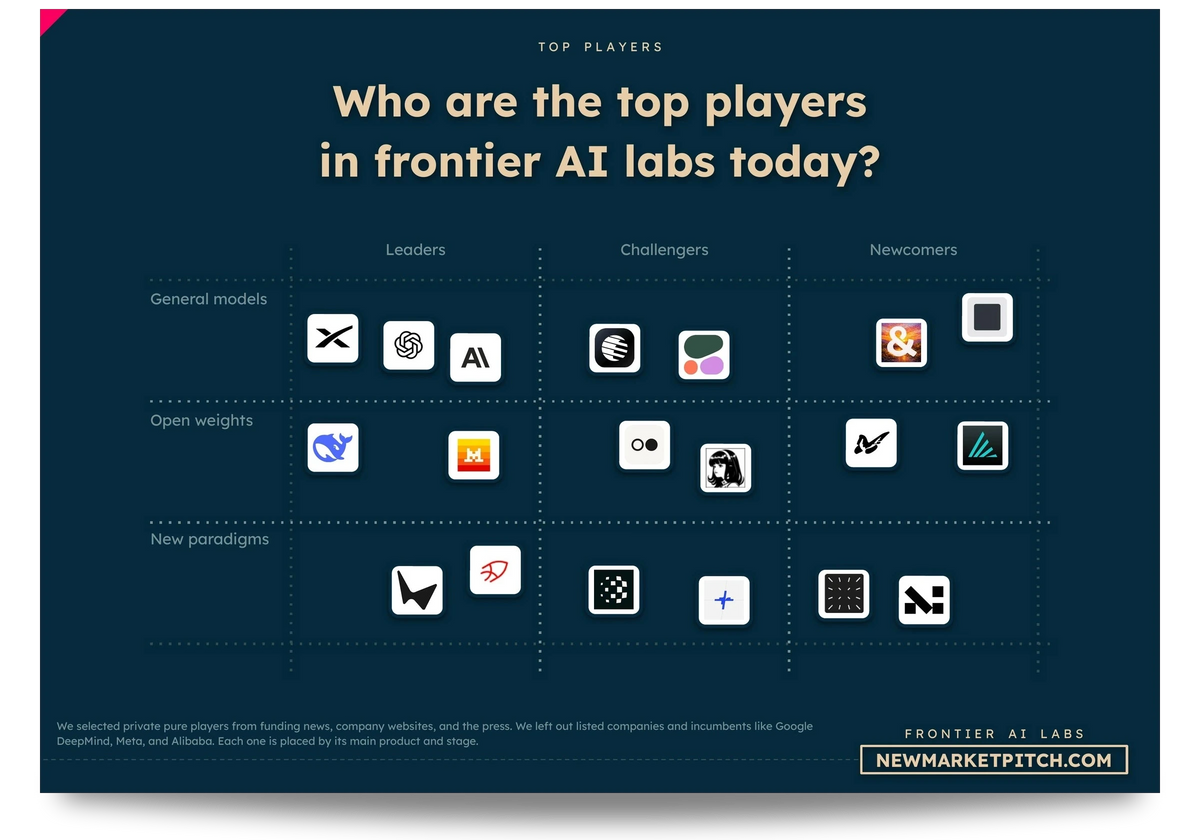
Moonshot AI is currently ahead among the newer independent frontier AI labs. Its Kimi models have come closest to matching established leaders such as OpenAI and Anthropic, while Reflection AI is the strongest emerging Western open-weight challenger in this comparison and Thinking Machines has a promising business in model customization.
Moonshot's advantage is measurable. Kimi K3 scored approximately 50.1 on the Artificial Analysis Agentic Index, compared with 54.0 for GPT-5.6 Sol and 55.3 for Claude Opus 5. That puts it within striking distance of models developed by considerably more established American companies.
The Chinese labs have another advantage that money cannot immediately buy: experience. Moonshot, DeepSeek and Z.ai have repeatedly trained and improved powerful models, while Reflection and Thinking Machines are still establishing their first major foundation-model families. Money cannot buy experience quickly, so we weigh who the likely future winners are, not only who has funding, in our frontier AI labs report.
Reflection has nevertheless made an impressive technical start. Its 501-billion-parameter Beam model activates only about 23 billion parameters per token, potentially making it more economical to run than some larger competitors. But on Terminal-Bench 2.1, Beam scored 80.1% against more than 88% for three leading Chinese alternatives.
Reflection's open-weight strategy could become more important than its initial benchmark ranking. Beam is available under Apache 2.0, and the company has announced more than 40 partners and integrations. The unresolved question is whether this distribution network can turn a credible model into substantial developer adoption and paying customers.
Thinking Machines presents the opposite case: its model is less competitive, but its commercial product may be more developed. Inkling scored just 63.8% on Terminal-Bench 2.1, well behind Beam, yet its Tinker training platform reportedly helped the business exceed a $100 million annual revenue run rate by September 2026.
The financing numbers reveal how aggressively investors are pricing future possibilities. Reflection's April round implied a $27.5 billion post-money valuation, Moonshot reportedly reached $35 billion following a subsequent July financing, and Thinking Machines was exploring a valuation of at least $40 billion despite much more limited evidence of frontier-model leadership.
Large financing rounds also create large obligations. Reflection announced computing arrangements with headline values reaching approximately $7.3 billion, although those commitments are not equivalent to immediate spending. Securing enough computing power is becoming a prerequisite for serious competition, but it does nothing by itself to guarantee superior research.
Safe Superintelligence is the biggest unknown. Ilya Sutskever's reputation and the company's ambition have attracted enormous attention, but without a publicly evaluated model, there is no credible basis for ranking its technical progress above the labs already releasing competitive systems.
The established giants still have a major advantage beyond intelligence benchmarks: distribution. Moonshot may be approaching frontier-level model performance, but OpenAI, Anthropic and Google have deeper customer relationships, established developer ecosystems and much larger commercial operations. Moonshot leads the newcomers on demonstrated technical progress; the broader business race remains open.

Written by the New Market Pitch teamWe track new markets so founders and investors can move faster. About us
Why are new AI labs suddenly raising billions of dollars?
New AI labs are raising billions because investors believe small teams of top AI researchers could build the next serious competitor to OpenAI, Anthropic or Google.
The amounts are remarkable, especially for companies that are still young. Thinking Machines Lab, founded by former OpenAI CTO Mira Murati, raised approximately $2 billion in 2025 at a $12 billion post-money valuation. Reflection AI, founded by former Google DeepMind researchers Misha Laskin and Ioannis Antonoglou, secured $2.5 billion in April 2026 at a $25 billion pre-money valuation. Chinese startup Moonshot AI raised approximately $2 billion in May 2026 at a reported $20 billion valuation.
Together, those three financing rounds brought in roughly $6.5 billion. Moonshot subsequently secured another reported $3.5 billion financing in July at a valuation of approximately $35 billion, making the total capital involved even more extraordinary. These sums could finance several major AI training programs, although the actual cost of developing frontier models varies enormously between companies. Sums like $35 billion invite the question of what these labs are worth, which we size up in our report on frontier AI labs.
The interesting part is how differently these startups are using their money. Thinking Machines is building customizable AI and training tools. Reflection wants to become a major supplier of open-weight foundation models. Moonshot is directly competing with OpenAI and Anthropic on model intelligence.
We also have more evidence to judge them than we did a year ago. Thinking Machines released Inkling, Reflection introduced Beam, and Moonshot continued developing its Kimi models. Investors are still betting heavily on the future, but we can finally compare some of the results.
Which new AI lab is actually ahead right now?
Moonshot AI currently has the strongest claim to leadership among newer independent labs developing general-purpose AI models. Reflection AI looks like the most ambitious emerging Western open-weight challenger, while Thinking Machines has taken a different route through customizable models.
The distinction comes down to what these companies have actually achieved.
Moonshot has released models that compete relatively closely with the best systems from established AI companies. Reflection has trained a large foundation model and made its weights available for outside developers. Thinking Machines has produced a large model of its own while building Tinker, a platform that lets customers train and adapt AI models for specific jobs.
Funding, benchmark results and commercial traction measure different things, and the distinction is particularly important when comparing startups pursuing such different strategies.
For this comparison, we give the greatest weight to demonstrated model intelligence, followed by the ability to improve models repeatedly and turn research into products people use. That gives Moonshot the lead today, although the commercial picture is less settled.
Is Moonshot AI already competing with OpenAI and Anthropic?
Moonshot AI is now genuinely competitive with leading AI companies on several demanding model evaluations, making it the strongest technical contender among the newer independent labs we examined.
Its Kimi K3 model reached approximately 50.1 points on the Artificial Analysis Agentic Index, compared with 55.3 for Anthropic's Claude Opus 5 and 54.0 for OpenAI's GPT-5.6 Sol. Moonshot was therefore only 5.2 points behind Claude and 3.9 behind OpenAI on this particular evaluation.
Those gaps are meaningful, but relatively small considering the resources and head start of the established American labs.
Kimi also performs strongly on coding, reasoning and tasks that require AI systems to use tools. Businesses increasingly want models that can complete work across several steps rather than simply generate convincing text, making these evaluations particularly relevant.
Moonshot's progress is more convincing when we look at its history. The company has developed successive generations of Kimi instead of relying on one impressive model announcement. Its researchers have shown they can repeat and improve the training process.
The company also secured approximately $2 billion in funding at a reported $20 billion valuation in May 2026. Bloomberg subsequently reported another $3.5 billion financing in July at a valuation of approximately $35 billion, giving Moonshot substantial resources for further development.
Still, strong model performance does not tell us how much money Moonshot makes or how widely businesses use Kimi. Its technical lead is much easier to establish than its commercial lead.


This is just a preview page. Don’t worry if a number looks old: the report gets refreshed, and you’ll always get the latest version.
Has Reflection AI caught up with China's best AI models?
Reflection AI has become a serious open-weight AI competitor, but its Beam model still trails the strongest Chinese alternatives on several major benchmarks.
Reflection introduced Beam in October 2026 with 501 billion total parameters, approximately 23 billion of which are active for each token. The company reported training it on 23.8 trillion tokens and using more than 100 million reinforcement-learning rollouts.
The results show that Reflection can train a powerful foundation model. On Terminal-Bench 2.1, Beam achieved 80.1%, compared with 88.3% for Moonshot's Kimi K3, 88.2% for Z.ai's GLM-5.3 and 90.6% for DeepSeek V4.1 Flash. Beam's 80.1% trails three Chinese models on Terminal-Bench, so we check who leads on benchmarks and who only claims it in our frontier AI labs market report.
An eight-to-ten-point gap is substantial on a demanding benchmark, especially when the competing models are already performing at a high level.
Beam looks better against older systems. On SWE-Bench Pro v1, it scored 65.5%, compared with 62.1% for GLM-5.2. On MCP Atlas, Beam reached 78.7% against 77.8% for the same Chinese model.
Reflection's first large open-weight release can beat some established competitors on particular tasks. The problem is that newer Chinese models have already pushed performance considerably further.
These comparisons come from Reflection's own published evaluations rather than a fully independent assessment under identical testing conditions. They are useful for understanding the competitive gap, but should not be treated as definitive rankings.
| Benchmark | Reflection Beam | Moonshot Kimi K3 | Z.ai GLM-5.3 | DeepSeek V4.1 Flash |
|---|---|---|---|---|
| Terminal-Bench 2.1 | 80.1 | 88.3 | 88.2 | 90.6 |
| DeepSWE v1.1 | 44.4 | 68.0 | 61.0 | 74.2 |
| SWE-Bench Pro v2-Hard | 77.2 | 88.2 | 84.3 | Not reported |
| SWE Atlas Codebase QnA | 34.6 | 68.0 | 61.0 | Not reported |
| MCP Atlas | 78.7 | 82.3 | 84.2 | Not reported |
| GPQA Diamond | 90.5 | 93.5 | 91.7 | 90.9 |
| Humanity's Last Exam, no tools | 36.2 | 46.9 | 42.3 | 39.1 |
Could Reflection AI beat larger models by being cheaper to run?
Reflection AI may have found a way to deliver competitive reasoning performance with much less computing power, although its biggest efficiency claims still need independent testing.
Beam uses a mixture-of-experts architecture, meaning only part of the model is active when generating each token. Its 501 billion parameters sound enormous, but approximately 23 billion are active per token.
GLM-5.2, by comparison, activates approximately 40 billion parameters. Beam therefore uses about 42.5% fewer active parameters per token.
Reflection also reports that Beam can approach the reasoning performance of larger open models while using three to four times less inference computation on certain difficult tasks.
If those improvements hold up in production, they could give Reflection an advantage when serving customers who generate large amounts of AI output. Running a model costs money every time customers use it, so even modest efficiency gains can add up.
There are limits to the comparison. A model with fewer active parameters can still require substantial memory, and actual costs depend on hardware, batching, output length and how efficiently the model is served.
Reflection has clearly made efficiency a serious part of its technical strategy. The claimed three-to-fourfold improvement, however, should not be confused with a verified three-to-fourfold reduction in every customer's bill.

Has Reflection AI delivered a model developers can actually use?
Reflection AI has now released a downloadable open-weight foundation model, giving outside developers a way to test and deploy Beam themselves.
On October 16, 2026, Reflection released Beam's weights on Hugging Face under the Apache 2.0 license. The release also included technical documentation and deployment resources.
That license gives developers considerable freedom to use, modify and distribute the model. For companies that want to run AI on their own infrastructure, this can be more attractive than relying entirely on a proprietary API.
Reflection also announced more than 40 partners and integrations involving cloud infrastructure, deployment services and development tools.
The combination gives Beam several routes to reach customers. Developers can work directly with the model, infrastructure providers can offer managed deployments, and businesses can adapt it for internal applications.
But we still lack evidence showing how many organizations have adopted Beam for production work, how frequently they use it or how much revenue it generates.
For Reflection, the next big challenge is getting developers to choose Beam over models that are already widely used. The company has made access relatively easy. Whether developers actually switch is another matter.
Is Thinking Machines Lab living up to the hype around Mira Murati?
Thinking Machines Lab has made real technical progress under Mira Murati, but its released model has yet to establish the company as a frontier AI leader.
Murati previously served as OpenAI's chief technology officer and helped oversee the development of products including ChatGPT. Thinking Machines attracted researchers from leading AI organizations and raised approximately $2 billion in its 2025 seed round.
That created enormous expectations before the startup had released a major product.
In July 2026, Thinking Machines introduced Inkling, a mixture-of-experts model with approximately 975 billion total parameters and 41 billion active parameters. According to the company, the model was trained on 45 trillion tokens covering several modalities.
Inkling is larger in total parameters than Reflection's Beam, which has 501 billion. Yet model size has not translated into better performance on the benchmarks the two companies have reported.
On Terminal-Bench 2.1, Inkling scored 63.8 against Beam's 80.1. On SWE-Bench Pro v2-Hard, Inkling reached 56.9 compared with 77.2 for Beam.
These are considerable differences. They're also a reminder of how misleading founder reputation can be when judging a young AI startup.
Thinking Machines has demonstrated the ability to train a very large model. Based on the available comparisons, however, it remains behind Reflection and Moonshot on several demanding coding and agentic tasks.
Could Thinking Machines win by helping businesses build their own AI?
Thinking Machines has a credible opportunity to become a major AI company through Tinker, even if Inkling never becomes the world's strongest general-purpose model.
Tinker lets developers and businesses work on model training and customization without managing all the underlying infrastructure themselves. It was introduced in October 2025 and has since expanded through additional capabilities and broader availability.
The demand is easy to understand. A financial institution may need models trained for its internal processes, while a software company might want an AI agent that understands its codebase. In both cases, adapting an existing model can be more practical than building a massive foundation model from scratch. Companies wanting models trained on their own processes are a real opening; we look at where the biggest opportunities are in our frontier AI labs report.
Thinking Machines has published research involving specialized financial judgments and text-to-SQL tasks, showing how training models for particular domains can improve their usefulness.
There is also an encouraging commercial result. TechCrunch reported in September 2026 that Thinking Machines had exceeded a $100 million annual revenue run rate, citing a person familiar with the company's finances.
At that pace, the business would be generating more than approximately $8.3 million in monthly revenue if the annualized figure reflected a representative month. We should distinguish that reported run rate from audited annual sales, but it is still a meaningful indicator for such a young company.
Tinker also creates a different relationship with customers than a conventional AI chatbot. Companies that build important internal workflows around training infrastructure may continue paying as their models become more sophisticated.
This makes Thinking Machines particularly interesting commercially. Its ability to build frontier models is still being tested, but its training platform already provides a clearer reason for some businesses to pay.

This is a preview page. Spotted an outdated number? That’s normal here. The report you get is always the freshest version.
Is Safe Superintelligence falling behind without a public AI model?
Safe Superintelligence remains one of the most interesting AI research startups, but we currently have too little public evidence to place it ahead of Moonshot, Reflection or Thinking Machines.
The company was founded by Ilya Sutskever, Daniel Gross and Daniel Levy. Sutskever, OpenAI's former chief scientist, has a long history of important contributions to modern AI research.
Safe Superintelligence has deliberately focused on developing highly capable and safe AI rather than regularly releasing commercial products. That makes its strategy very different from Moonshot's successive Kimi models or Thinking Machines' work on Tinker.
The absence of a publicly evaluated model creates a straightforward problem: we cannot compare its actual capabilities with the systems competitors have released.
Its researchers may be making major breakthroughs behind closed doors. Investors may also have reasons to believe the company will succeed. Neither possibility gives outside observers a reliable measure of its current position.
For a startup whose ambitions are as large as Safe Superintelligence's, the first public demonstration of a competitive model would substantially change the conversation. Until then, its leadership remains a bet on future research.
Are Chinese AI labs developing better models than American startups?
Chinese independent AI labs currently have a clear advantage over most newly funded American startups in demonstrated high-end model development. Moonshot, DeepSeek and Z.ai have repeatedly released competitive models, while Reflection and Thinking Machines are still building out their first major foundation-model families.
The difference becomes obvious when we compare their development histories.
DeepSeek drew international attention with DeepSeek V3 and R1 before continuing to release newer systems. Moonshot developed several generations of Kimi, reaching K3. Z.ai likewise advanced its GLM family through GLM-5.3.
Across these companies, we see repeated cycles of training, testing and improving models. That experience is valuable because the difficult part of frontier AI research is consistently producing better results as systems become larger and more complicated.
The latest benchmark comparisons reinforce the pattern. On Terminal-Bench 2.1, Reflection's Beam scored 80.1, while Kimi K3, GLM-5.3 and DeepSeek V4.1 Flash all exceeded 88.
Reflection has made an impressive start, particularly for its first major foundation-model release. But Chinese competitors have had more opportunities to refine their training methods and improve their products through successive generations.
The implication is uncomfortable for investors who assume that raising billions of dollars guarantees a fast path to the frontier. The American newcomers have attracted extraordinary capital, yet Chinese labs currently have stronger public evidence of repeatable model development.
Does raising more money make an AI startup better?
The funding race has produced no reliable relationship between the biggest financing rounds and the strongest AI models. Moonshot currently has better general-model results than several similarly financed Western startups.
Reflection raised $2.5 billion in April 2026, while Thinking Machines secured approximately $2 billion in its original seed round. Moonshot also raised approximately $2 billion in May 2026, followed by another reported $3.5 billion financing in July.
Despite the enormous amounts involved, their technical results differ considerably. Moonshot is much closer to established frontier-model leaders on independent evaluations, while Reflection's Beam and Thinking Machines' Inkling remain further behind.
Funding still matters enormously because frontier-model research requires expensive computing infrastructure and specialized engineering teams.
But the money is spent differently. One lab may allocate more resources to pretraining, another to reinforcement learning, and another to infrastructure or model customization. Two companies with identical financing can end up pursuing very different research programs.
Reflection illustrates how expensive the competition has become. In June 2026, the company announced a computing agreement with SpaceX worth up to $6.3 billion. Nebius subsequently announced a separate agreement involving approximately $1 billion in AI capacity.
The combined headline value reaches $7.3 billion, although these are not necessarily immediate expenditures. Such agreements can cover multiyear services, future capacity and conditional commitments.
Reflection's willingness to secure that much infrastructure suggests a very ambitious training roadmap. It also raises the pressure to develop models that attract paying customers.
Capital helps labs compete for the frontier. Research execution determines how far they actually get.
Preview only. Some numbers may have changed since we made this page, but your report will be up to date.
Are new AI labs making enough revenue to justify their valuations?
The commercial performance disclosed by new AI labs is still far too limited to support many of their multibillion-dollar valuations through revenue alone.
Thinking Machines offers one of the few concrete reported figures. According to TechCrunch's September 2026 reporting, the company had exceeded a $100 million annual revenue run rate. A $100 million run rate is one of the few concrete revenue figures here, and we compare which business models are winning in our frontier AI labs report.
That is impressive for a young startup, but small relative to the valuations being discussed. Reports indicated that Thinking Machines explored financing at a valuation of at least $40 billion.
If the company were valued at $40 billion with exactly $100 million in annualized revenue, the multiple would be 400 times revenue. Its reported run rate was above that threshold, so the actual multiple would be lower. Without a precise revenue figure, we cannot calculate it reliably.
Reflection's valuation offers another example. Its $2.5 billion April financing was completed at a $25 billion pre-money valuation, implying approximately $27.5 billion post-money.
That compares with a reported valuation of around $8 billion in October 2025. In roughly six months, the company's headline pre-money valuation more than tripled, even though its first major open-weight foundation model had yet to reach the public.
Moonshot's financing history provides an interesting contrast. Its May 2026 round valued it at approximately $20 billion, below Reflection's implied post-money valuation. But Bloomberg reported a subsequent July financing at around $35 billion, putting Moonshot above Reflection's April valuation. Moonshot also has more established public evidence of competitive general-model performance.
These valuations reveal just how much investors are paying for the possibility of future leadership.
We should also acknowledge a limitation: Reflection and Moonshot do not disclose enough comparable revenue information to calculate reliable valuation-to-sales multiples. The figures we have cannot establish which business has the strongest revenue base.
| AI lab | Reported valuation | Financing context | What we can establish |
|---|---|---|---|
| Moonshot AI | $35B | July 2026 reported financing | Latest reported valuation, backed by strong public model results |
| Reflection AI | $27.5B implied post-money | April 2026 completed financing | Rapid valuation growth |
| Thinking Machines | $12B post-money | 2025 completed seed round | Large initial investor backing |
| Thinking Machines | At least $40B proposed | September 2026 financing discussions | Investor expectations, not a completed valuation |
| Moonshot AI | $20B | May 2026 reported financing | Earlier valuation, superseded by July reporting |
| Prime Intellect | Around $1B | July 2026 Series A | Smaller-scale training infrastructure business |
| Arcee AI | More than $1B | September 2026 Series B | Investor interest in specialized open models |
| Reflection AI | Around $8B | October 2025 earlier financing | Baseline for its subsequent valuation increase |
Could smaller AI labs like Arcee and Prime Intellect beat the billion-dollar giants?
Smaller AI labs such as Arcee AI and Prime Intellect could build valuable businesses without matching the spending of Moonshot, Reflection or Thinking Machines.
Prime Intellect raised $130 million in July 2026, bringing its reported total funding above $150 million. Its products focus on the infrastructure and software developers need to train and improve AI models.
Arcee AI, meanwhile, announced a Series B financing in September 2026 at a valuation above $1 billion. Its Trinity model family is part of a broader effort to offer open-weight systems that businesses can customize and deploy.
These companies are pursuing opportunities that do not always require training the world's largest model.
For example, an enterprise may care more about being able to run a specialized AI system privately than about gaining a few extra points on a general reasoning benchmark. Another business may need cheap, reliable inference for millions of routine requests.
Smaller labs can compete on those requirements through lower costs, simpler deployment or better support for particular tasks.
Open-weight distribution also helps. Reflection released Beam under Apache 2.0, while Moonshot and DeepSeek have used downloadable models to reach developers who prefer running AI on their own infrastructure.
The trade-off is that open-weight models can be used without generating direct payments to their creators. Companies must find ways to earn money through managed hosting, training tools, enterprise services or premium products.
Arcee and Prime Intellect are unlikely to outperform the largest frontier labs across every benchmark in the immediate future. But they may have a much simpler route to building sustainable businesses.

This is just a preview page. Don’t worry if a number looks old: the report gets refreshed, and you’ll always get the latest version.
Can new AI labs seriously threaten OpenAI, Anthropic and Google?
New AI labs can already challenge OpenAI, Anthropic and Google in selected areas, but none of the newcomers examined has matched the established leaders across both model quality and commercial scale.
Moonshot provides the clearest technical example. Its Kimi K3 model came within a few points of Claude Opus 5 and GPT-5.6 Sol on the Artificial Analysis Agentic Index.
That is a meaningful result. A startup capable of producing models in the same general performance range gives customers more options and puts pressure on established providers.
But building a competitive model is only one part of the challenge.
OpenAI, Anthropic and Google already have distribution through consumer applications, developer APIs and enterprise products. They have relationships with businesses that may spend years integrating AI into internal systems.
Google also benefits from its existing cloud and software businesses. OpenAI and Anthropic have built substantial developer ecosystems around their models and tools.
The competition keeps moving, too. Google introduced Gemini 4 Argon and Meta released Muse Wonder Full in October 2026, adding further pressure on independent model developers.
A startup that catches up with today's leading model could find itself behind again after another training cycle.
Moonshot has shown that the technical gap can become surprisingly small. We have much less evidence that any of these new labs can match the established companies' customer relationships, infrastructure and ability to distribute products worldwide.
Which new AI lab has the best chance of winning over the next few years?
Moonshot AI has the best demonstrated starting position for future frontier-model competition, while Reflection and Thinking Machines have credible opportunities to win different parts of the AI market.
Moonshot has two advantages that are especially difficult to reproduce quickly: strong general-purpose models and experience improving them across successive generations. Strong models and experience across generations are hard to copy; we weigh the likely future winners in our report on who's ahead in frontier AI labs.
Reflection has made substantial progress in a shorter period. The company has released a competitive open-weight model, attracted major financing and secured large computing arrangements. Its future depends on whether it can close the remaining performance gap while building a large community of developers and paying customers.
Thinking Machines has made a different strategic choice. Tinker gives the company a way to sell training and customization services even when customers prefer foundation models developed elsewhere.
That could become a valuable position as companies develop increasingly specialized AI systems.
Safe Superintelligence remains harder to assess. Ilya Sutskever's research record makes the company worth watching, but its current progress is mostly hidden from public view.
The next major tests will be straightforward. Moonshot must keep producing models that challenge the frontier. Reflection must show that Beam can attract real usage and that subsequent models can compete with the best alternatives. Thinking Machines must turn its early reported revenue into a larger, durable business while improving its models.
The companies that succeed at those tasks will have a much stronger claim to leadership than companies relying mainly on financing announcements.

So which new AI lab is actually winning today?
Moonshot AI is currently winning the race among newer independent frontier-model startups, based on the strongest public evidence of model performance and repeated technical progress.
Its Kimi models compete relatively closely with OpenAI and Anthropic on demanding evaluations, and the company has demonstrated that it can keep improving its systems across generations.
Reflection AI comes next in our comparison of the newer Western contenders. Beam is a serious technical achievement, and the company's infrastructure commitments show how aggressively it intends to compete. But its performance remains behind several leading Chinese models, while commercial adoption is still difficult to measure.
Thinking Machines has a potentially more attractive position in AI customization. Its Tinker platform offers a clear commercial product, supported by a reported annual revenue run rate exceeding $100 million. Its Inkling model, however, has not established equivalent technical leadership.
Safe Superintelligence could eventually change the rankings, but its research remains too private for a fair performance comparison.
Moonshot leads on demonstrated frontier-model capabilities. Reflection is making the strongest visible attempt among the newer Western labs in this comparison to build an independent open-weight competitor. Thinking Machines may have the most distinctive approach to selling model customization.
If we had to choose one startup that is ahead right now, we would choose Moonshot AI. The strongest evidence comes from what its models can already do, rather than how much investors believe the company might eventually be worth.
Our methodology
This analysis compares which newer independent AI labs are making the strongest progress toward competing with established frontier-model developers. We examine Moonshot AI, Reflection AI, Thinking Machines Lab, Safe Superintelligence, and smaller companies including Arcee AI and Prime Intellect, using technical capabilities, research execution, model development consistency, infrastructure commitments, commercial traction and financing as separate dimensions.
We give the greatest weight to demonstrated model intelligence and repeated technical progress. Funding and founder reputation are treated as supporting context rather than proof of leadership. We distinguish companies developing general-purpose foundation models from those focused primarily on training infrastructure, customization or specialized applications, since those businesses do not necessarily compete for the same customers.
For model performance, we use published evaluations of Kimi K3, Reflection Beam, Thinking Machines Inkling and competing Chinese and American models. The Artificial Analysis Agentic Index provides an independent comparison of selected frontier systems. Other benchmark figures, including Terminal-Bench 2.1, DeepSWE, SWE-Bench Pro, MCP Atlas, GPQA Diamond and Humanity's Last Exam, come partly from company-published evaluations. We treat those results as informative comparisons while recognizing that evaluation configurations and testing conditions may differ.
Our assessment of technical execution considers whether a company has produced multiple improving model generations, released usable weights or APIs, and demonstrated substantial training capability. For efficiency, we compare model architecture, active parameter counts and reported inference-compute requirements, without assuming that lower active parameter counts translate directly into proportional customer cost savings.
Commercial traction is assessed separately from model quality. We consider Tinker's product development and reported revenue run rate, Beam's Apache 2.0 release and deployment partnerships, and the public availability of Moonshot's Kimi models. Reported annualized revenue is not treated as audited annual sales, and announced partnerships are not counted as evidence of production adoption without supporting usage or revenue information.
For valuations, we distinguish completed financings, implied post-money valuations, reported subsequent rounds and proposed transactions. Reflection's $25 billion April 2026 pre-money valuation implies approximately $27.5 billion post-money after its $2.5 billion raise. Moonshot's approximately $20 billion May valuation is retained as a historical financing reference, while Bloomberg's subsequent July reporting of a roughly $35 billion valuation is used for the more recent comparison. Thinking Machines' proposed $40 billion-plus valuation is treated as a financing discussion rather than an established transaction value.
Infrastructure commitments are evaluated using their reported headline amounts and contractual context, rather than treating every announced dollar as immediate capital expenditure. We also avoid assigning technical rankings to companies such as Safe Superintelligence when public model evaluations are unavailable.
We prioritized original company announcements, model documentation, independent evaluation providers and established financial reporting. Key technical sources include Reflection AI's Beam technical announcement, its open-weight release documentation, Thinking Machines' Inkling announcement, the Inkling model card, Moonshot AI's Kimi K3 announcement, Artificial Analysis' Kimi K3 evaluation, and DeepSeek's model transparency documentation.
For product development and commercialization, we used Thinking Machines' Tinker launch, its one-year product update, research on financial-domain model customization, research on task-specific reinforcement learning, AWS documentation on Beam deployment, and Safe Superintelligence's official company statement.
Key financial sources include Bloomberg's May reporting on Moonshot's financing, Bloomberg's July reporting on Moonshot's subsequent valuation, TechCrunch on Thinking Machines' revenue and financing discussions, Prime Intellect's Series A announcement, and Arcee AI's Series B announcement.
Written by the New Market Pitch teamWe track new markets so founders and investors can move faster. About us