How big is the military drones market really?
Whether you're building or investing in the military drones market, our report covers everything you need to know: the players, the money, and what's coming next.
Summary
The military drones market is about $20 billion to $30 billion a year today, with roughly $25 billion as the best single estimate for the core UAV market.
The headline number depends heavily on where the boundary is drawn. A narrow procurement view can land near the mid-teens, while broader studies reach above $50 billion by pulling in more payloads, software, mission systems, support and adjacent autonomous platforms.
Unit volumes are now a terrible guide to market value. Ukraine can consume drones by the hundreds of thousands, while one high-end MQ-9B program with only a few dozen aircraft can still be worth several billion dollars.
Ukraine has changed the economics of the low-cost end of the market. FPV and one-way systems increasingly behave like ammunition: they are bought, lost, replaced and redesigned continuously, which means falling unit prices can coexist with rising total spending.
High-end UAVs still capture an outsized share of revenue. Baykar generated $2.5 billion in 2025, and large General Atomics programs show how quickly aircraft, sensors, ground stations, weapons, training and sustainment turn a small fleet into a multibillion-dollar package.
The United States remains the biggest structural market because it combines procurement with unusually deep R&D spending. Ukraine is the more intense battlefield market, but U.S. budgets cover a much wider stack of surveillance aircraft, tactical drones, launched effects, autonomy and future combat aircraft.
Europe is no longer a marginal buyer. Rapidly rising equipment budgets, national drone programs and Ukraine-related procurement are pushing unmanned systems into mainstream force planning rather than leaving them as experimental projects.
Loitering munitions are the main boundary problem. They look and operate like drones for much of the mission, so excluding them entirely understates drone warfare, but including all missiles would make the category meaningless.
Collaborative Combat Aircraft should stay adjacent for now. They are unmanned aircraft, but economically they are starting to look like combat jets, and adding future fighter-like fleets to the current drone market would inflate today's number too early.
The wider opportunity is already much larger than UAV sales alone. Counter-drone systems, resilient communications, autonomy software, targeting infrastructure and other battlefield systems create a broader autonomous-warfare economy, but they should not be folded into the core military-drone number.
A realistic growth range is roughly 9% to 15% annually for the next several years. That would take a $25 billion core market to around $40 billion to $50 billion in five years without relying on the most aggressive published forecasts.

Written by the New Market Pitch teamWe track new markets so founders and investors can move faster. About us

In our report covering the military drone market, we always try to gather several sources and make estimates that make sense, so you can work with solid numbers.
Why is the military drone market so hard to size right now?
The military drone market is unusually hard to size today because a $500 FPV quadcopter, a multimillion-dollar MQ-9B and a one-way attack drone can all end up inside the same market estimate.
That used to matter less. Military UAV spending was concentrated in relatively expensive reconnaissance and strike aircraft bought in fleets of tens or hundreds. Ukraine has changed the shape of demand by using drones more like consumable weapons.
Ukraine's Ministry of Defence says the country went from procuring drones in the thousands in 2023 to more than 1.5 million in 2024. It then delivered more than three million FPV drones to its armed forces during 2025. Britain now estimates that Ukraine uses roughly 200,000 drones a month.
At the other end of the market, Canada is spending C$2.49 billion on a remotely piloted aircraft program built around only 11 aircraft. India agreed to buy 31 MQ-9B aircraft in a package worth roughly $4 billion. Baykar generated $2.5 billion of revenue in 2025 despite selling vastly fewer aircraft than Ukraine consumes in a year.
Those numbers describe very different businesses. Unit volumes tell us little on their own, while a revenue estimate can move sharply depending on whether researchers include sensors, control stations, loitering munitions or autonomous combat aircraft.
What should we actually count as a military drone?
For a useful military drone market estimate, we should count unmanned aircraft bought for military use together with the equipment needed to operate them, while keeping ground robots, unmanned ships and counter-drone weapons outside the core number.
A Reaper clearly belongs. So does a Bayraktar TB2, a military reconnaissance quadcopter and an FPV attack drone.
Ground stations, dedicated datalinks and mission payloads should also count when they are sold as part of the UAV system. Otherwise we would compare bare-airframe prices with complete procurement programs and call them the same thing.
Loitering munitions need a little more care. AeroVironment's Switchblade, for example, behaves like a drone during much of its mission but destroys itself when it attacks. Defense budgets can classify these systems as munitions rather than aircraft. We therefore include them when discussing the broader drone-warfare market while keeping the narrower UAV estimate separate.
Collaborative Combat Aircraft sit further out. The U.S. Air Force's YFQ-42A and YFQ-44A are unmanned aircraft, but economically they are starting to resemble combat jets. Adding large future CCA fleets to today's ordinary drone market would blur two very different procurement categories.
Counter-drone systems belong outside the number altogether. Radar, electronic warfare, guns, interceptor missiles and interceptor drones create a huge business around military drones, but they represent spending to defeat drones rather than spending on the drones themselves.
For the rest of this analysis, we therefore use two practical numbers: the core military UAV market and a broader drone-warfare market that also captures loitering munitions and more of the mission stack.

In our research about military drones, we don't want to repeat what boring consulting reports say. Instead, we show you the real and latest market signals that matter.
Why do military drone market estimates range from $14 billion to more than $50 billion?
Military drone market estimates differ by tens of billions of dollars because researchers are often counting different things under almost identical labels.
The U.S. International Trade Administration, using Teal Group research, gives one of the clearest procurement benchmarks. Teal estimated global military UAS procurement at about $14 billion in 2024, rising to $23.1 billion by 2033.
Fortune Business Insights currently estimates a $22.49 billion military drone market in 2026.
MarketsandMarkets is already at $34.85 billion for the same year and forecasts $109.22 billion by 2031. Its definition reaches beyond bare aircraft into payloads, integrated systems and other parts of the military-drone stack.
Grand View Research goes further again, putting the 2026 market at $54.2 billion.
A gap from $14 billion to $54 billion is far too large to dismiss as normal analyst disagreement. The definitions are doing most of the work.
Grand View, for example, profiles companies such as RTX, Lockheed Martin, Boeing, BAE Systems and Thales alongside dedicated drone manufacturers. Once revenue attributed to mission systems, electronics and broader defense activities gets pulled into a drone-market model, the number rises quickly.
Averaging these estimates would therefore give us a neat-looking figure built from incompatible measurements.
| Source | Reference year | Market estimate | What the number best represents |
|---|---|---|---|
| Teal Group / U.S. ITA | 2024 | $14B | Military UAS procurement |
| Fortune Business Insights | 2025 | $19.8B | Military drones |
| Fortune Business Insights | 2026 | $22.5B | Military drones |
| MarketsandMarkets | 2026 | $34.9B | Broad military-drone systems |
| Grand View Research | 2025 | $47.4B | Broad military-drone revenue |
| Grand View Research | 2026 | $54.2B | Broad military-drone revenue |
| Teal Group / U.S. ITA | 2033 | $23.1B | Military UAS procurement forecast |
So how big is the core military drone market today?
The core military drone market is probably worth about $20 billion to $30 billion a year today, and roughly $25 billion is the best single number we can defend.
The $14 billion Teal procurement estimate gives us a useful lower anchor, but it refers to 2024 and predates another sharp step-up in European, Ukrainian and small-drone procurement.
Fortune's recently updated work lands at $22.49 billion for 2026, which sits close to where the observable evidence takes us.
The manufacturers give us another check. Baykar alone generated $2.5 billion of revenue in 2025, with $2.2 billion coming from exports. General Atomics continues to win large MQ-9 family programs. AeroVironment has built a sizeable business around small UAS and loitering munitions. Elbit, IAI, Northrop Grumman, Teledyne FLIR and a growing group of smaller suppliers add several more layers of military UAV revenue.
Ukraine then pushes the lower end upward. Its Defence Procurement Agency says it signed UAH 333.6 billion of drone contracts in the first half of 2026, twice the value contracted during the same period a year earlier. FPV drones accounted for the largest share.
We should not simply convert that entire Ukrainian contract number into dollars and add it to every commercial market estimate. Contract periods differ, some equipment may sit near the edge of our definition, and foreign financing can show up elsewhere in defense statistics.
Even with those caveats, today's procurement activity makes a global core market below roughly $20 billion increasingly difficult to believe. At the other end, a $50 billion-plus pure UAV market is hard to reconcile with visible procurement and dedicated manufacturer revenues unless the definition absorbs much more software, electronics, sustainment and adjacent autonomous systems.
Our working range therefore stays at $20 billion to $30 billion, with about $25 billion as the center.
If you want more recent data on this point, please see our latest military drones market report.

In our market report about military drones, we like to show you the big picture. We know your time is precious, so we make every page quick to read and packed with as much learning as possible per minute.
Has Ukraine become big enough to reshape the global military drone market?
Ukraine is now large enough to change global military drone economics on its own, especially in FPV and other expendable systems.
The change happened within only a few years. Ukraine's Ministry of Defence says state bodies procured more than 1.5 million drones in 2024. By the end of 2025, the armed forces had received more than three million FPV drones alone.
The latest contract data goes further. Ukraine's Defence Procurement Agency signed UAH 333.6 billion of drone contracts during the first half of 2026, twice the level from the first half of 2025.
Ukraine has also changed how drones are purchased. Through the DOT-Chain Defence marketplace, military units can choose equipment directly from approved suppliers. The Defence Procurement Agency says in-stock equipment ordered through the system currently reaches units in nine days on average.
Foreign funding shows how large this procurement machine has become. Britain has committed to provide 150,000 Ukrainian-produced drones by the end of 2026. European governments are also channeling billions of euros into Ukrainian defense production and procurement.
Ukraine has effectively created a market where demand is measured in monthly consumption, models can become obsolete within months and manufacturers receive battlefield feedback almost immediately.
| Ukraine drone indicator | Scale |
|---|---|
| State-procured drones in 2024 | More than 1.5M |
| FPV drones delivered in 2025 | More than 3M |
| 2025 domestic FPV production capacity previously cited by MoD | About 4.5M |
| 2025 Ukrainian MoD drone budget announced at start of year | More than UAH 110B |
| First-half 2026 drone contracts | UAH 333.6B |
| Increase in first-half contracts vs. prior year | 2× |
| UK-funded Ukrainian-produced drones planned for 2026 | 150,000 |
| Typical delivery time for in-stock DOT-Chain orders | 9 days |
Do millions of cheap FPV drones generate more money than expensive military UAVs?
No. FPV drones dominate military drone volumes today, but high-end UAV programs can still generate the same amount of money with only a few dozen aircraft.
Canada's remotely piloted aircraft program is a good example. The government is spending C$2.49 billion for 11 aircraft, six ground-control stations, a control center, hangars, weapons, training and initial sustainment.
India's MQ-9B acquisition goes even further. The package covers 31 aircraft and associated equipment for roughly $4 billion.
At $3,000 each, one million FPV drones represent $3 billion. Even at that enormous unit volume, the revenue sits in the same order of magnitude as one large MQ-9B program.
The comparison becomes even more striking because high-end UAVs bring a large support ecosystem with them. Satellite communications, EO/IR sensors, radar, weapons integration, training, maintenance and ground infrastructure can be worth as much as the aircraft themselves.
FPVs have their own supporting stack, but their economics still rely much more heavily on volume.
Cheap aircraft dominate the count. Expensive UAV systems continue to capture an outsized share of the dollars.

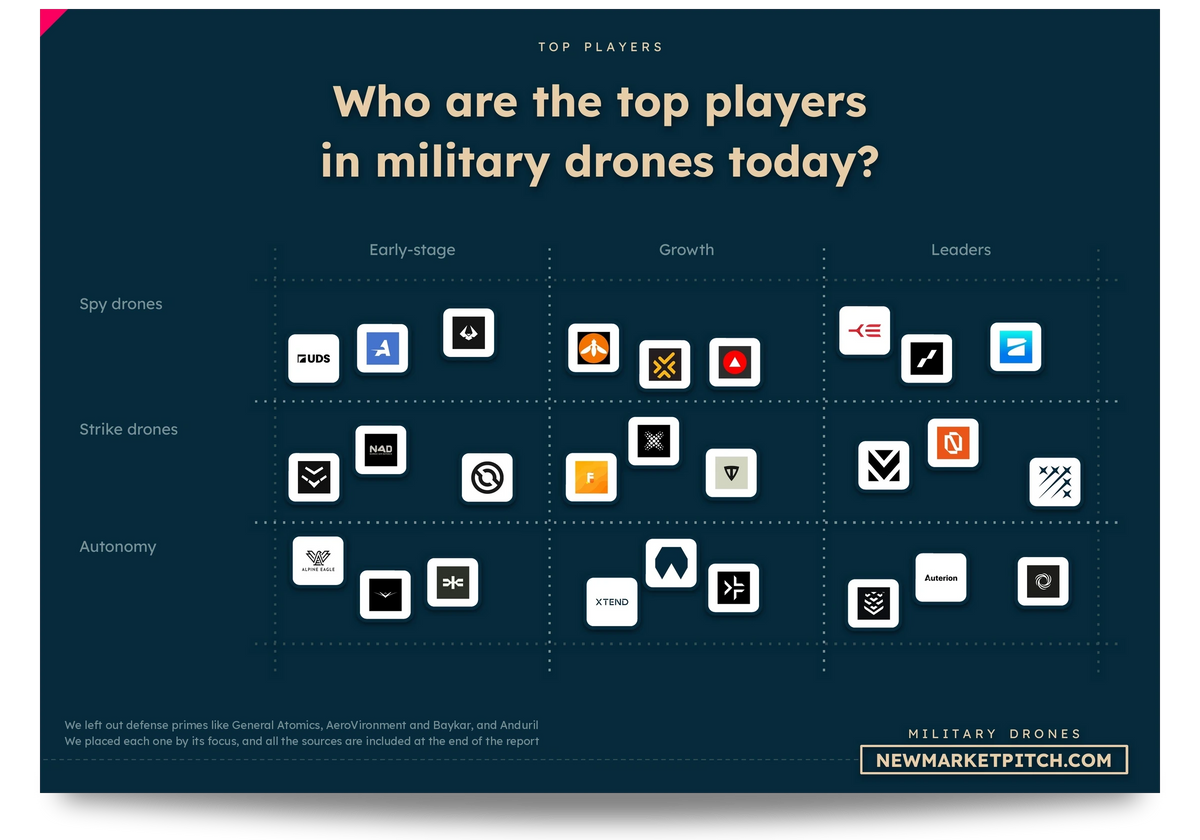
In our document detailing everything you need to know about military drone, we turn what is vague and complex into simple, useful visuals. Market maps like this one show you at a glance where every startup stands.
Are military drones becoming more like ammunition, and does that make falling prices less important?
The expendable side of the military drone market increasingly behaves like an ammunition business, which is why falling unit prices do not necessarily reduce the size of the market.
Ukraine currently uses roughly 200,000 drones a month according to the British government. A military operating at that tempo cannot think about FPVs in the same way it thinks about a Reaper fleet.
Russia shows the same pattern at longer range. Shahed/Geran-type attack drones and decoys are launched in the thousands during high-intensity periods. Once a system is designed for one-way use, the relevant economic question becomes how many can be manufactured, launched and replaced every month.
Production capacity, monthly usage, losses and replenishment time therefore matter much more than installed fleet size.
The pricing effect follows from that. If a drone falls from $5,000 to $2,500 while annual purchases increase fivefold, spending still rises strongly.
Ukraine already demonstrates this behavior. Lower-cost FPVs made it possible to distribute precision attack and reconnaissance capability much deeper into military units, creating uses that would never have justified an expensive aircraft.
The Pentagon is now pursuing the same logic deliberately through mass purchases of inexpensive expendable systems.
Large UAV fleets still behave like conventional aircraft programs. The cheapest attack drones increasingly move through defense budgets like ammunition.
If you want more recent data on this point, please see our latest military drones market report.
Are expensive military drones still where most of the value sits?
Expensive military UAVs still capture a very large share of industry revenue, and export demand is keeping that part of the market healthy.
Baykar gives us an unusually clean view because drones make up most of its business. The Turkish company generated $2.5 billion in revenue in 2025, including $2.2 billion from exports. International customers therefore produced 88% of its revenue.
That export dependence has persisted for years rather than appearing after one large contract.
General Atomics shows the same phenomenon higher up the price curve. India, Canada, Poland and other allied governments have bought or selected MQ-9 variants, often in packages worth hundreds of millions or billions of dollars.
The economics become especially powerful when suppliers move customers up the product range. Baykar initially became famous internationally through the TB2, while the much larger Akıncı now supports bigger deals and Kızılelma pushes the company toward fighter-like unmanned aircraft.
This part of the market also has unusually wide geographic reach for advanced military aviation. Poland, Romania, Albania, Kuwait, Saudi Arabia and many other countries have bought Turkish UAVs without needing the infrastructure required for a modern fighter fleet.
FPVs are changing warfare faster, but high-value UAVs remain crucial to the revenue pool.

Our report covering the military drone market gets updated several times a month, so you always get the latest view of where things stand.
Is the United States still the biggest military drone market?
The United States remains the biggest structural military UAV market, even though Ukraine currently buys and consumes far more drones in some low-cost categories.
Teal Group estimates that the United States accounts for about 59% of global military UAS procurement and 81% of military UAV research spending.
The American market also looks different from Ukraine's. U.S. spending includes large surveillance aircraft, classified systems, advanced autonomy, launched effects, small tactical drones and future Collaborative Combat Aircraft.
The Pentagon's FY2026 budget made that breadth unusually visible. Defense officials identified $13.4 billion for autonomy and autonomous systems, including $9.4 billion for unmanned and remotely operated aerial vehicles. The Navy alone accounted for $5.3 billion across unmanned systems, while the Army had more than $1.1 billion tied to relevant capabilities such as reconnaissance drones and launched effects.
At the unit level, the Army is pushing drones deeper into ordinary formations. Pentagon leadership has directed the service to field unmanned systems and air- or ground-launched effects in every division, while Army exercises have already placed more than 200 drones inside a single brigade combat team.
Ukraine may remain the world's most intense drone battlefield, but the United States still has the deeper long-term pool of procurement and R&D money.
Is Europe finally spending serious money on military drones?
Europe is now spending serious money on military drones, and the shift has moved well beyond small trials and Ukraine-only aid packages.
According to the European Defence Agency, EU defense spending reached €418 billion in 2025, up 20% in one year, and is projected to reach €454 billion in 2026. Equipment procurement alone hit €115 billion in 2025.
Drones now compete inside a much larger equipment budget than they did only a few years ago.
Britain offers one of the clearest national examples. Its Defence Investment Plan allocates more than £5 billion over four years to drones and autonomous systems. The program covers strike drones, surveillance systems, autonomous maritime platforms, expendable systems and work on autonomous combat aircraft.
The UK has separately committed £650 million for inexpensive expendable autonomous systems, including drones and unmanned ground vehicles.
NATO procurement is moving as well. At its latest summit, the alliance said its procurement agency had awarded a surveillance-drone contract worth hundreds of millions of dollars, while allied militaries committed to train five times as many drone operators by the end of 2027.
Europe remains fragmented across national procurement systems and domestic industrial policies, but military drones have clearly moved into mainstream force planning.

In our research about military drones, you will always find fresh funding data, taken straight from our own verified funding database.
Does Russia's hidden procurement mean the real military drone market is larger than published estimates?
Yes. Russia and other opaque state-controlled markets probably make global military drone activity larger than commercial revenue studies can measure cleanly.
Russia has built a very large drone-production base since the invasion of Ukraine, covering FPV systems, reconnaissance UAVs and long-range Geran/Shahed-type aircraft.
The battlefield output is visible even when contract values are not. Russia can launch thousands of long-range attack drones and decoys in a month while also supplying frontline units with large numbers of smaller UAVs.
Turning that production into a reliable dollar market value is much harder. Russian defense procurement is opaque, many contracts are classified, state support can distort prices and some production occurs inside vertically integrated defense structures.
China presents a similar problem for military systems that are neither publicly tendered nor reported through transparent corporate accounts.
Published market reports therefore have a built-in bias toward countries where procurement and company revenues are easier to observe. Our $20 billion to $30 billion estimate is a defensible economic market range based on visible activity, while total global production is probably somewhat larger.
If you want more recent data on this point, please see our latest military drones market report.
Should loitering munitions count as military drones, and how much value sits outside the airframe?
Loitering munitions should count in the broader military drone market, while sensors, software, ground stations and support explain why complete drone programs are worth far more than the aircraft alone.
AeroVironment's Switchblade shows the classification problem clearly. It can launch, search an area, transmit video, receive operator commands and then attack a selected target. Those are familiar UAV functions, even though the aircraft is consumed when it strikes.
Leaving every loitering munition outside the market would therefore understate how militaries use unmanned aviation today. At the same time, conventional cruise missiles should stay outside the category even when they use autonomous navigation.
The economic boundary is equally important.
Canada's C$2.49 billion remotely piloted aircraft acquisition covers 11 aircraft but also six ground-control stations, a new control center, hangars, initial weapons, training, information systems and initial sustainment.
A simple calculation of C$2.49 billion divided by 11 aircraft would therefore produce a meaningless "drone price."
At the smaller end, drones operating in Ukraine increasingly depend on electronic-warfare resistance, alternative navigation when GPS fails, machine vision and secure communications. The airframe may become cheaper while electronics and software take a larger share of system value.
For our broader estimate, we include loitering munitions and equipment sold as part of the UAV system. General battlefield networks, cloud infrastructure and conventional missiles remain outside.

In our market report about military drones, we look at what the winners do differently, so you can learn from the best instead of guessing.
Will autonomous fighter drones suddenly make the military drone market much bigger?
Autonomous combat aircraft could add tens of billions of dollars to unmanned aviation over time, but they are still too early to treat as a major part of today's military drone market.
The U.S. Air Force's Collaborative Combat Aircraft program is the most important example.
General Atomics' YFQ-42A flew in 2025, while Anduril is developing the competing YFQ-44A. The Pentagon describes CCA as uncrewed aircraft designed to add combat mass alongside crewed fighters.
The economics are moving much closer to tactical aviation than ordinary drones. These aircraft need advanced propulsion, sensors, autonomy, secure communications, weapons integration and the performance to operate in contested airspace.
The FY2026 U.S. budget included about $804 million for CCA-related development and procurement. Britain has since allocated £300 million to Collaborative Combat Aircraft development as part of its wider Defence Investment Plan.
Baykar's Kızılelma points in the same direction outside NATO's main fighter programs.
Once militaries buy autonomous combat aircraft in fleets of hundreds or thousands, even single-digit-million-dollar unit costs would create a very large new market. More capable versions could cost considerably more.
For now, CCA belongs next to the military-drone market rather than fully inside our core estimate.
Is counter-drone spending already as big as military drone spending, and is the wider opportunity much larger?
Counter-drone spending is becoming comparable to the military drone market itself, and the wider autonomous-warfare economy is already much larger than UAV sales alone.
NATO recently committed more than $40 billion to counter-drone capabilities over five years.
That works out to more than $8 billion a year if spending were distributed evenly, before adding major national programs outside that initiative.
Britain's Defence Investment Plan separately allocates £790 million over four years to improve protection against air, drone and missile threats, including radars, sensors and counter-drone systems.
The economics can become uncomfortable for defenders. A cheap one-way attack drone can force a military to deploy radar, electronic warfare, guns, interceptor drones or expensive missiles. The defensive system can cost many times more than the incoming aircraft.
The wider spending stack goes beyond defense against drones. Britain is also investing more than £5 billion in drones and autonomous systems and nearly £2 billion in a Digital Targeting Web.
A drone manufacturer may sell the aircraft while other companies provide sensors, resilient communications, autonomy software, targeting infrastructure or systems designed to destroy enemy UAVs.
All of that belongs to the same strategic shift, but we keep counter-UAS and general battlefield infrastructure outside the core military-drone number to avoid inflating it.
| Spending area | Current or announced scale | Included in core military drone market? |
|---|---|---|
| Teal global military UAS procurement benchmark | $14B in 2024 | Yes |
| U.S. FY2026 unmanned and remotely operated aerial vehicles | $9.4B | Yes, though scope is broader than simple procurement |
| UK drones and autonomous systems plan | £5B+ over four years | Partly |
| Ukraine first-half 2026 drone contracts | UAH 333.6B | Yes, subject to category boundaries |
| NATO counter-drone investment | $40B+ over five years | No |
| UK air/drone/missile defense investment | £790M over four years | No |
| U.S. CCA FY2026 funding | About $804M | Adjacent / emerging |
| UK CCA development funding | £300M | Adjacent / emerging |
If you want more recent data on this point, please see our latest military drones market report.

If you build or invest in the military drone market, you need to know which business models pay off now and which ones are fading. That's why our report covering it has a whole section on it.
Are military drones replacing fighters, artillery and missiles?
Military drones are taking over specific missions from conventional weapons, but overall defense budgets show that armed forces are adding drones much faster than they are removing fighters, artillery or missiles.
Ukraine offers the harshest real-world test. Its forces use huge numbers of FPV drones for reconnaissance and strike, yet artillery ammunition, air-defense missiles, long-range weapons and crewed aircraft remain critical.
The same pattern appears in Western budgets.
Britain is committing more than £5 billion to drones and autonomous systems while also spending £11 billion on munitions and weapons and £8.6 billion through its Global Combat Air Programme.
The U.S. Air Force is developing Collaborative Combat Aircraft while continuing to fund F-35s, the F-47, bombers and conventional munitions.
At the tactical level, substitution is very real. A cheap quadcopter can perform reconnaissance that once required a larger UAV or exposed soldiers. An FPV attack drone can destroy a vehicle that might otherwise have required artillery or an antitank missile.
Those savings often create more missions instead of simply lowering budgets. A platoon that previously had little aerial reconnaissance can now launch its own drones, while commanders can attack targets that would have been too minor to justify an expensive missile.
How fast can the military drone market realistically grow from here?
The military drone market can probably keep growing at a low-double-digit annual rate for several years, while forecasts above 20% a year require much more aggressive assumptions.
Fortune Business Insights expects the market to grow from $22.49 billion in 2026 to $52.31 billion in 2034, equivalent to about 11% annually.
Grand View Research starts from a much larger base but expects slower growth, from $54.2 billion in 2026 to $98.2 billion in 2033, around 9% annually.
MarketsandMarkets is far more bullish. It sees the market jumping from $34.85 billion in 2026 to $109.22 billion in 2031, a 25.7% annual growth rate.
Our evidence fits the 9% to 15% range much better.
Ukraine has proved that military drone demand can rise extremely quickly during war. European defense budgets are climbing. U.S. forces are pushing unmanned systems deeper into ordinary units. Cheap expendable drones are opening new procurement categories, while autonomous combat aircraft can add another high-value layer later.
There are still limits. Defense budgets have competing priorities, FPV technology becomes obsolete quickly, electronic warfare can destroy the usefulness of a system within months, and today's Ukrainian consumption rate comes from an exceptionally intense war.
A $25 billion market growing at 10% reaches roughly $40 billion after five years. At 15%, it passes $50 billion.
| Market forecast | Starting point | End point | Implied annual growth |
|---|---|---|---|
| Fortune Business Insights | $22.5B in 2026 | $52.3B in 2034 | 11.1% |
| Grand View Research | $54.2B in 2026 | $98.2B in 2033 | 8.9% |
| MarketsandMarkets | $34.9B in 2026 | $109.2B in 2031 | 25.7% |
| Our conservative case | ~$25B today | ~$40B in five years | ~10% |
| Our stronger-growth case | ~$25B today | ~$50B in five years | ~15% |

When you build or invest in the military drone market, you need clarity, not confusion. In our report covering the military drone market, we always try to put numbers on and quantify whatever is usually vague and confusing.
How big is the military drones market really?
The military drone market is about $20 billion to $30 billion a year today, with roughly $25 billion as the most credible single estimate; the broader drone-warfare market is already closer to $30 billion to $40 billion once loitering munitions and more of the mission stack are included.
Several different pieces of evidence now point into that range.
Teal Group's $14 billion procurement estimate gives us a solid 2024 baseline. Fortune's current $22.49 billion estimate sits close to the observable market two years later. Dedicated UAV manufacturers are already generating billions of dollars in annual revenue. Ukraine alone has reached drone procurement volumes and contract values that would have looked extraordinary only a few years ago.
The upper boundary is also becoming clearer. A $50 billion-plus number can be reached, but only by using a wider definition that pulls in substantial amounts of sensors, mission systems, software, support or adjacent autonomous platforms.
The composition of this roughly $25 billion market is changing faster than its headline size suggests. Armed forces now consume FPV and one-way attack drones in quantities measured in hundreds of thousands or millions, while countries still sign multibillion-dollar programs for fleets containing only a few dozen sophisticated UAVs. Autonomous fighter-like aircraft are beginning to form another category above them.
Our conclusion is fairly firm: roughly $25 billion captures the core military drone business better today, while $30 billion to $40 billion is a reasonable range for the wider drone-warfare layer. The much larger numbers belong to the broader autonomous-war ecosystem forming around it.
If you want more recent data on this point, please see our latest military drones market report.
Our methodology
This analysis estimates the size of the military drone market by separating the question into the areas that most directly change the answer: market definitions, procurement spending, manufacturer revenue, unit volumes, system economics, geographic demand, battlefield consumption, adjacent categories and forward procurement plans.
We do not average published market estimates when they are measuring different things. Instead, we use them as boundary markers and then test those top-down figures against bottom-up evidence from government procurement programs, defense budgets, manufacturer results and operational demand.
Our core market includes military unmanned aircraft and the equipment directly required to operate them, including ground stations, dedicated datalinks and mission payloads when they are sold as part of the UAV system. Ground robots, unmanned ships, counter-drone systems and general battlefield infrastructure stay outside the core number.
Loitering munitions are included in the broader drone-warfare layer because systems such as Switchblade perform many UAV functions before attacking, but they are kept separate from the narrower UAV estimate. Conventional cruise missiles remain outside. Collaborative Combat Aircraft are treated as adjacent because their economics are already moving toward combat aviation rather than ordinary drone procurement.
We use procurement programs to understand what governments are actually committing, but we avoid treating complete program values as airframe prices. Canada's RPAS program and India's MQ-9B acquisition both include equipment, infrastructure, training, weapons and support that make the program value much larger than the aircraft alone.
Ukraine is treated as an unusually important bottom-up check because it shows what mass drone consumption looks like when demand is measured in monthly usage rather than fleet size. We use Ukrainian procurement, delivery and production figures to test whether older global market estimates still look plausible, without simply adding every announced contract value to commercial market reports.
Manufacturer revenue provides another check on the lower bound. Baykar's 2025 revenue and export results, together with large General Atomics programs and the activity of AeroVironment, Elbit, IAI, Northrop Grumman, Teledyne FLIR and other suppliers, help show how much revenue is already flowing through the UAV industry.
Russia, China and classified programs are handled more cautiously because public contract values are incomplete. We use visible production, operational activity and official spending signals to test the plausibility of the market range rather than assigning unsupported dollar estimates to opaque procurement.
The growth range is built the same way. We compare published forecasts with current U.S. and European budgets, Ukrainian procurement momentum, the shift toward expendable systems and the emerging Collaborative Combat Aircraft pipeline, then use the range where those independent pieces of evidence converge.
Key sources include the U.S. International Trade Administration's UAS overview and Teal Group benchmarks, Ukraine's Ministry of Defence on FPV procurement and production capacity, Ukraine's 2025 defense results, Ukraine's first-half 2026 drone contract data, the UK government's drone investment plan, Canada's RPAS procurement page, the U.S. DSCA notice for India's MQ-9B package, Baykar's 2025 revenue and export results, the U.S. FY2026 defense budget briefing, European Defence Agency spending data, NATO's counter-drone investment announcement, the U.S. Air Force on CCA designations, Fortune Business Insights, MarketsandMarkets, and Grand View Research.

A good product starts with a real problem. In our research about military drones, we show you the ones customers still live with.
Written by the New Market Pitch teamWe track new markets so founders and investors can move faster. About us