Who are the top investors in neoclouds?
Whether you're building or investing in the neocloud market, our report covers everything you need to know: the players, the money, and what's coming next.
Summary
NVIDIA is the most active neocloud investor, appearing in 23 equity rounds. AMD Ventures follows with 6 and Dell Technologies Capital with 5. Yet the company that joins the most deals is rarely the one leading them.
NVIDIA was named as lead in 1 round, compared with 4 for AMD Ventures. That gap says a lot about how these investors work. NVIDIA wants a broad network of AI clouds; other investors are more often responsible for putting individual financings together.
Equipment makers have become hard to ignore. Cisco Investments, Intel Capital, Supermicro and Lenovo Capital also feature among the active backers. These companies sell or support the hardware that independent AI clouds need, so investing can go hand in hand with commercial relationships.
But conventional venture firms still lead important deals. Sequoia Capital was named as lead in every neocloud round we found involving it. Andreessen Horowitz, Kindred Ventures, Spark Capital and IVP have taken similarly focused positions in selected companies.
The companies they choose are different, too. Crusoe and Nscale build large AI computing operations, while fal, Fireworks AI and Baseten help developers run models. An investor backing both sorts of business is exposed to very different costs and customers.
Recent activity makes the lead even bigger: NVIDIA joined 14 neocloud rounds this year, against 7 last year. Intel Capital and Dell Technologies Capital have also joined new financings, while Salesforce Ventures has no recorded participation this year.
At seed stage, nobody has pulled away: RTP Global, FUSE VC and Y Combinator are tied on 2 rounds each. By Series D and later, NVIDIA is the most frequent participant, appearing in 7 rounds. The investor names change as a cloud company grows.
Large deals can look different again. Atreides Management, Mubadala Capital and Valor Equity Partners co-led Crusoe's $3.9B financing. That was the whole round, not the amount any single firm invested.
Some investors keep meeting in the same syndicates. NVIDIA and Supermicro joined 3 rounds together, as did NVIDIA and Dell Technologies Capital. That shows how closely investing and hardware sales go together, though it doesn't prove that any equity deal led to a supply contract.
So there is a clear winner if we mean the most rounds joined: NVIDIA. For leading rounds, backing brand-new companies or organizing giant financings, the answer changes. Those distinctions are essential to understanding who funds neoclouds today.

Written by the New Market Pitch teamWe track new markets so founders and investors can move faster. About us

In our report covering the neocloud market, you will always find fresh funding data, taken straight from our own verified funding database.
Which VCs invest the most in neocloud right now?
NVIDIA is the most active neocloud investor right now, with 23 rounds joined, ahead of AMD Ventures with 6 and Dell Technologies Capital with 5.
NVIDIA is a corporate investor, not a traditional venture capital firm. It was named as lead in 1 round; AMD Ventures led 4 and Dell Technologies Capital led 1. The difference is striking. NVIDIA has backed Crusoe, Fireworks AI, fal, Nscale and Lambda, spanning large GPU operators and the services that run AI models for developers. AMD Ventures' portfolio includes Cerebras Systems, TensorWave and Vultr, giving it a different set of hardware and cloud relationships.
Look at what NVIDIA is building outside its investment portfolio. Its DGX Cloud Lepton marketplace connects developers to capacity offered by independent providers, including some of the clouds it has backed. AMD also names AI cloud as an area for venture investment. We see a race to support cloud ecosystems here, not evidence that the most frequent investor wrote the biggest checks or set the terms of every deal.
The table below ranks the 20 most active neocloud investors by the number of equity rounds they joined, with the rounds they led, their main stages, the startups they backed and the biggest round they joined.
If you want to go more into detail and get more data to understand what investors are betting on now, please check our neocloud report.
| # | Investor | Rounds | Led | Main stages | Neocloud startups backed | Biggest round joined | Latest round |
|---|---|---|---|---|---|---|---|
| 1 | NVIDIA ▲ | 23 | 1Mostly follows (led 5% of the 22 rounds with a known lead) |
Series D+ 7Series B 5 | Crusoe, Fireworks AI, fal, Nscale, Lambda + 10 more | $3.9BCrusoe · 2026 | Nov 2026 |
| 2 | AMD Ventures ▲ | 6 | 4Usually leads (67% of its rounds) |
Series A 2Series B 2 | Cerebras Systems, Fireworks AI, Vultr, TensorWave, Featherless.ai | $1.0BCerebras Systems · 2026 | Jun 2026 |
| 3 | Dell Technologies Capital ▲ | 5 | 1Mostly follows (led 20% of its rounds) |
Series A 2Seed 1 | Nscale, Prime Intellect, RunPod, Hyperbolic | $2.0BNscale · 2026 | Oct 2026 |
| 4 | Sequoia Capital | 4 | 4Named as lead in every round found | Series D+ 2Series A 1 | Fireworks AI, fal, Mithril | $350Mfal · 2026 | Apr 2026 |
| 5 | Cisco Investments | 4 | 1Mostly follows (led 25% of its rounds) |
Series A 1Series C 1 | Groq, Lightning AI, Starcloud | $750MGroq · 2025 | Aug 2026 |
| 6 | Intel Capital ▲ | 4 | 1Mostly follows (led 25% of its rounds) |
Series D+ 2Seed 1 | SambaNova Systems, Prime Intellect, RunPod | $1.0BSambaNova Systems · 2026 | Jul 2026 |
| 7 | Supermicro ▲ | 4 | 0Never led | Series B 2Series D+ 2 | Crusoe, Lambda, Verda, DeepInfra | $1.4BCrusoe · 2025 | Sep 2026 |
| 8 | Atreides Management ▲ | 3 | 3Named as lead in every round found | Series D+ 3 | Crusoe, Cerebras Systems, Fireworks AI | $3.9BCrusoe · 2026 | Sep 2026 |
| 9 | Andreessen Horowitz | 3 | 3Named as lead in every round found | Seed 1Series A 1 | fal, Gimlet Labs, Volta | $300MGimlet Labs · 2026 | Sep 2026 |
| 10 | Disruptive ▲ | 3 | 3Named as lead in every round found | Growth 2Series A 1 | Groq | $750MGroq · 2025 | Aug 2026 |
| 11 | Coatue | 3 | 3Named as lead in every round found | Series C 1Growth 1 | Firmus, CoreWeave | $2.0BFirmus · 2026 | Aug 2026 |
| 12 | Spark Capital | 3 | 3Named as lead in every round found | Series B 1Series C 1 | Baseten | $1.5BBaseten · 2026 | Jun 2026 |
| 13 | Kindred Ventures | 3 | 3Named as lead in every round found | Series A 3 | fal, Hydra Host, Parasail | $100MHydra Host · 2026 | Jun 2026 |
| 14 | IVP | 3 | 3Named as lead in every round found | Series B 1Series C 1 | Baseten | $300MBaseten · 2026 | Jan 2026 |
| 15 | General Catalyst ▲ | 3 | 2Usually leads (67% of its rounds) |
Series A 1Series B 1 | Modal, Together AI, Hyperbolic | $355MModal · 2026 | Oct 2026 |
| 16 | RTP Global ▼ | 3 | 1Leads half its rounds (lead known for 2 of 3 rounds) |
Seed 2Series A 1 | Nava, Kluisz.ai | $22MKluisz.ai · 2026 | Apr 2026 |
| 17 | Salesforce Ventures | 3 | 1Mostly follows (led 33% of its rounds) |
Series A 1Series B 1 | fal, Together AI | $305MTogether AI · 2025 | Jul 2025 |
| 18 | Lenovo Capital | 3 | 0Never led | Series A 2Series C 1 | Nscale, Infinigence AI | $2.0BNscale · 2026 | Mar 2026 |
| 19 | Mubadala Capital | 2 | 2Named as lead in every round found | Series D+ 2 | Crusoe | $3.9BCrusoe · 2026 | Sep 2026 |
| 20 | Valor Equity Partners | 2 | 2Named as lead in every round found | Series D+ 2 | Crusoe | $3.9BCrusoe · 2026 | Sep 2026 |
No investors match this search.
Data from January 2024 through 12 November 2026, which is enough to show who is active today and who has been for years. Rounds: equity rounds in which the investor is named. Led: rounds it led or co-led. ▲ more rounds in 2026 so far than its 2025 pace, ▼ fewer.

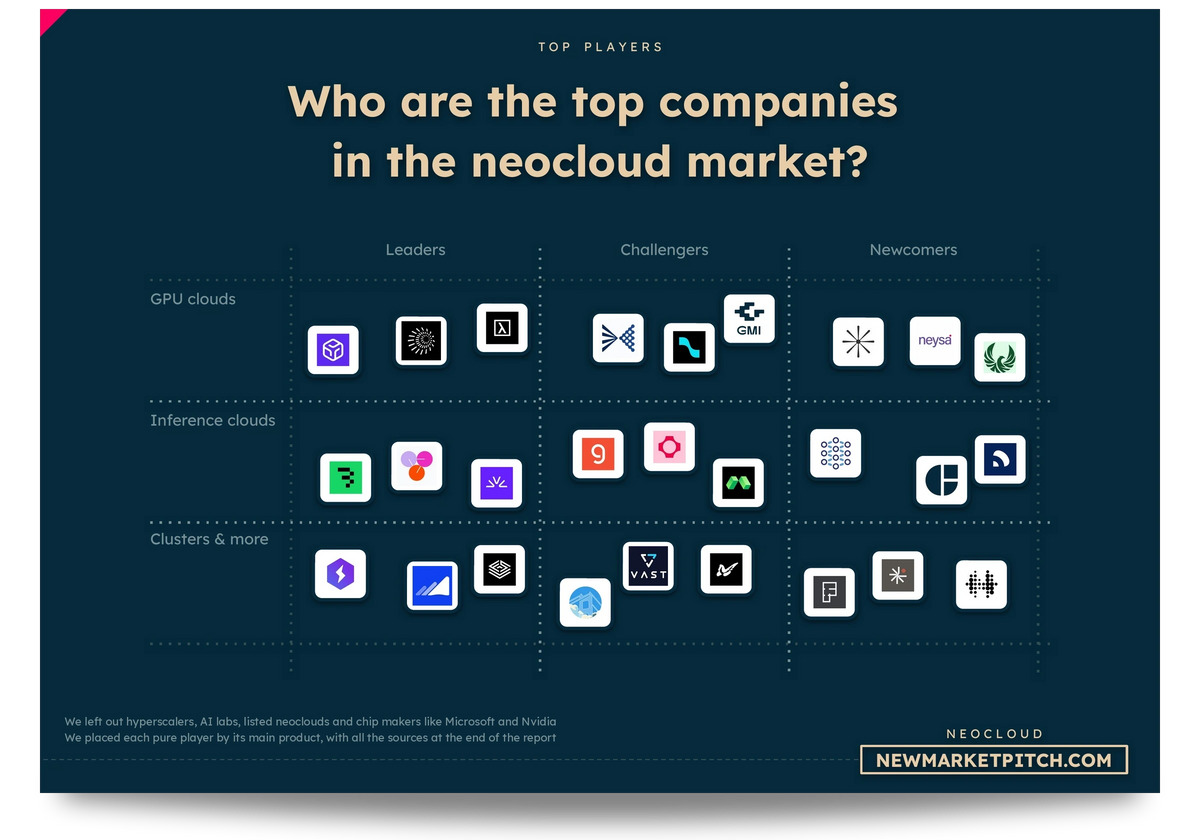
In our research about neoclouds, we turn what is vague and complex into simple, useful visuals. Market maps like this one show you at a glance where every startup stands.
Does NVIDIA back neoclouds like a normal VC?
NVIDIA invests in neocloud companies more often than any other backer, but its business interests go well beyond venture returns.
The chipmaker supplies technology that cloud operators buy, deploy and rent to customers. Its neocloud portfolio includes providers selling dedicated computing capacity and providers selling managed inference. NVIDIA announced DGX Cloud Lepton in May 2025 as a way to give developers access to GPUs through multiple cloud partners. Crusoe later described a broader relationship with NVIDIA covering infrastructure design and model execution. Those connections give NVIDIA reasons to stay close to operators even when it does not lead their funding rounds.
NVIDIA's wide participation should not be read as control over these startups. An equity investment says nothing by itself about hardware allocations, supplier exclusivity or who paid the largest share of a round. We can say the company has built an unusually wide neocloud network. We cannot say that every operator in it follows NVIDIA's commercial decisions.
Can AMD Ventures catch NVIDIA in neocloud investing?
AMD Ventures is a serious neocloud backer, but it is still far behind NVIDIA in the number of rounds joined.
Its more distinctive record is as a lead investor. AMD Ventures has been named as lead in 4 of the 6 rounds it joined. It backs Cerebras Systems, Fireworks AI, Vultr, TensorWave and Featherless.ai. AMD's public venture portfolio describes TensorWave as a cloud built around AMD Instinct accelerators, and AMD's 2026 announcement with Cerebras described work on fast AI inference. These relationships give developers more options beyond the dominant GPU ecosystem.
Dell Technologies Capital belongs in the conversation for a different reason. Its investments include Nscale, Prime Intellect, RunPod and Hyperbolic, companies that must turn computing equipment into a service customers can actually use. Nscale named Dell and NVIDIA among the backers of its large Series C. Neither company needs to match NVIDIA's deal count to influence how AI clouds buy systems or deploy computing capacity. But on the question of who participates in the most neocloud rounds today, NVIDIA remains well ahead.
Are chip and server makers taking over neocloud investing?
Chip and server suppliers have a big presence in neocloud rounds, although financial investors still lead many of the deals.
NVIDIA, AMD Ventures, Dell Technologies Capital, Cisco Investments, Intel Capital, Supermicro and Lenovo Capital all appear among the active corporate backers. Their interest is easy to understand. A cloud provider needs chips, servers, networking and reliable delivery before it can sell a useful computing service. NVIDIA's 2026 AI factory announcements also name Dell Technologies, Lenovo and Supermicro as system partners. An investment may strengthen an existing commercial relationship or help a supplier understand a new kind of customer.
But participation and leadership are different jobs. Supermicro joined 4 rounds without being named as lead. Sequoia Capital and investment firms such as Atreides Management have repeatedly taken the lead role in selected financings. There is plenty of room for hardware suppliers and specialist financiers in the same deal. The first may know how to build the system; the second may be more willing to negotiate the terms and carry the financial risk.
The table below shows how often selected hardware-linked investors joined and led neocloud rounds.
| Investor | Rounds joined | Lead record |
|---|---|---|
| NVIDIA | 23 | Mostly follows |
| AMD Ventures | 6 | Usually leads |
| Dell Technologies Capital | 5 | Mostly follows |
| Cisco Investments | 4 | Mostly follows |
| Intel Capital | 4 | Mostly follows |
| Supermicro | 4 | Never led |
| Lenovo Capital | 3 | Never led |

Your time is limited. In our market report about neoclouds, we put numbers on each part of the market, so you can see where it makes sense to focus.
Why does Sequoia Capital keep leading neocloud rounds?
Sequoia Capital has taken a focused lead-investor role in neoclouds rather than trying to appear in every funding deal.
Sequoia Capital joined 4 rounds and was named as lead in every round we found. Its backed companies include Fireworks AI, fal and Mithril. Fireworks announced a Sequoia-led financing in July 2024, while fal has drawn Sequoia into a business built around fast inference for generative media. Both sell a service to developers who need models to run in production, rather than offering only a large block of raw computing power.
NVIDIA also appears in the financing histories of Fireworks AI and fal, but the two investors are playing different roles. Sequoia has repeatedly taken responsibility for leading particular rounds. NVIDIA has built links across many different providers. We cannot tell from those facts which firm will earn a better return, and a lead designation does not reveal its exact check. What we can see is Sequoia repeatedly choosing to lead companies close to the developer-facing side of AI cloud.
Is Andreessen Horowitz still funding neocloud startups?
Andreessen Horowitz remains active in neocloud investing, especially where better inference software can make expensive computing hardware work harder.
The firm joined 3 rounds and was named as lead in every round we found, backing fal, Gimlet Labs and Volta. In September 2026, it led Gimlet Labs' Series B. The startup described a service that spreads inference work across different kinds of chips instead of forcing developers to build around one processor. Andreessen Horowitz's investment essay made the case for using scarce computing capacity more efficiently.
General Catalyst offers another approach to the same problem. It backs Modal, Together AI and Hyperbolic and was named as lead in 2 of the 3 rounds it joined. Modal's May 2026 financing announcement described infrastructure for inference and AI agents that can expand or shrink with demand. These firms are betting on the software and services needed to make models useful, even though their portfolios are not identical. Andreessen Horowitz matters because it leads specific bets, not because it joins the most neocloud deals.
Who actually leads neocloud funding rounds?
Sequoia Capital and AMD Ventures lead the most neocloud rounds, with 4 each, while NVIDIA usually follows.
Sequoia Capital and AMD Ventures were each named as lead in 4 rounds. Atreides Management, Andreessen Horowitz, Disruptive, Coatue, Spark Capital and Kindred Ventures each led 3 of 3. There's no single winner here, and that's worth knowing. They choose different businesses and take the lead at different moments.
Atreides Management co-led Crusoe's major infrastructure financing, while Andreessen Horowitz led Gimlet Labs' cloud investment. Kindred Ventures has written about supporting fal early, before later investors arrived. Those are different commitments: financing physical AI factories, building a multi-chip inference service and helping a young developer platform get started. A strong lead record tells us who publicly organizes transactions, not who contributes the most money across the market.
The table below shows selected investors repeatedly named as leads in neocloud equity rounds.
| Investor | Rounds joined | Rounds led |
|---|---|---|
| Sequoia Capital | 4 | 4 |
| Atreides Management | 3 | 3 |
| Andreessen Horowitz | 3 | 3 |
| Disruptive | 3 | 3 |
| Coatue | 3 | 3 |
| Spark Capital | 3 | 3 |
| Kindred Ventures | 3 | 3 |
Which neocloud investors are still investing this year?
NVIDIA remains the busiest neocloud investor this year, joining 14 rounds, compared with 7 last year.
Its latest recorded financing involves fal. The other active names include AMD Ventures, Dell Technologies Capital and Intel Capital, each with 3 rounds this year. Across the market, we counted 54 equity rounds this year and 40 last year. Of the 20 most active neocloud investors, 19 joined a round this year, and only Salesforce Ventures has not. This is still a live market for new investors and returning backers.
NVIDIA's recent AI factory partnerships also show why it has stayed involved: independent clouds are important outlets for high-end computing systems. A partnership announcement alone does not prove an equity investment, so we only count the financing rounds in which an investor was actually named. This distinction also keeps an old portfolio relationship from being mistaken for current investing activity.
The table below shows, year by year, how many rounds 12 of the most active neocloud investors joined, so it is easy to see who is still investing and who has slowed down.
If you want to go more into detail and see which investors are still writing checks and which have slowed down, please check our neocloud report.
| Investor | 2024 | 2025 | 2026* | Total |
|---|---|---|---|---|
| NVIDIA | 2 | 7 | 14 | 23 |
| AMD Ventures | 2 | 1 | 3 | 6 |
| Dell Technologies Capital | 1 | 1 | 3 | 5 |
| Intel Capital | 1 | 3 | 4 | |
| Supermicro | 2 | 2 | 4 | |
| Atreides Management | 1 | 2 | 3 | |
| Andreessen Horowitz | 1 | 2 | 3 | |
| Disruptive | 1 | 2 | 3 | |
| Coatue | 1 | 2 | 3 | |
| Kindred Ventures | 1 | 2 | 3 | |
| General Catalyst | 1 | 2 | 3 | |
| Sequoia Capital | 2 | 1 | 1 | 4 |
* 2026: January to 12 November. Darker cells mean more rounds that year. Data from January 2024 through 12 November 2026.

In our document detailing everything you need to know about neocloud, we always try to gather several sources and make estimates that make sense, so you can work with solid numbers.
Has Salesforce Ventures gone quiet on neocloud startups?
Salesforce Ventures has no recorded neocloud equity participation this year, unlike several other major corporate backers.
Salesforce Ventures' last recorded neocloud round was fal, in July 2025. Earlier, it backed both fal and Together AI, businesses that help customers run models rather than manage conventional cloud infrastructure. Together AI's February 2025 funding announcement named Salesforce Ventures alongside General Catalyst, NVIDIA and other investors. The firm was clearly part of this market before its recent pause.
A lack of new announced deals does not mean Salesforce Ventures sold its positions or formally stopped looking at AI clouds. Existing investors can work with a company without appearing in every subsequent round. The practical distinction for founders is simpler: NVIDIA, AMD Ventures and Intel Capital have joined neocloud financings this year; Salesforce Ventures has not appeared in one. That makes it a less visible source of fresh neocloud equity for now.
Is Intel Capital making a comeback in neocloud investing?
Intel Capital is much more visible in neocloud funding this year, with 3 rounds after none recorded last year.
Its portfolio in this market includes SambaNova Systems, Prime Intellect and RunPod. That is an unusual combination: SambaNova offers enterprise AI computing built around its own accelerator system, while the others help customers reach AI compute capacity. The mix shows Intel Capital exploring several ways businesses might buy and run AI processing, rather than backing only one kind of cloud.
Still, Intel Capital has been named as lead in just 1 of the 4 rounds it joined. It is taking part more often, but that does not yet make it the main deal organizer. Dell Technologies Capital has also joined new rounds, and Supermicro remains present in later-stage syndicates. We see renewed interest from companies connected to the hardware supply chain, not proof that any one alternative chip platform has won the cloud market.
Are neocloud investors abandoning GPU rentals for inference?
Neocloud investors are funding inference services alongside GPU rental companies, so the market is broadening rather than switching sides.
Sequoia Capital has backed Fireworks AI and fal; Andreessen Horowitz backs fal and Gimlet Labs; General Catalyst backs Modal and Together AI. Those companies sell ways to run models, often without requiring customers to deal directly with servers. At the other end of the market, Crusoe and Nscale are still raising capital to build and operate large computing facilities. Both kinds of business need funding, but they solve different problems for buyers.
The overlap is growing. Modal's May 2026 announcement described infrastructure for inference and agent workloads, while Together AI later announced a project with IBM and NVIDIA to expand enterprise inference capacity. Reporting by The Information in 2026 described inference companies considering ownership of more hardware instead of relying entirely on outside clouds. That creates an interesting investment question: can a service that makes compute easy to buy keep its cost advantage when it must finance machines itself? The answer is not settled, and a deal in inference does not mean investors have turned against GPU operators.
Which neocloud investors back seed rounds, and which back growth rounds?
RTP Global, FUSE VC and Y Combinator are tied for the most neocloud seed rounds, with 2 each; NVIDIA leads Series D and later participation with 7 rounds.
Seed is the busiest classified stage, with 36 of the 127 rounds whose stage we know. Series C and later account for 40 rounds. NVIDIA leads the recorded Series A, Series B, Series C and growth categories as well, but the seed lead is shared. These numbers show how the investor group changes as a cloud company moves from proving a service to financing more equipment and customers.
The businesses make the difference easy to see. Kindred Ventures supported fal early, when the question was whether developers wanted a new way to run generative-media models. Crusoe's more recent financings involve large institutions and suppliers as it expands AI computing facilities. A seed investor may have experience testing a product before it has many customers; a later backer may be comfortable with expensive infrastructure and long deployment schedules. Neither stage count tells us how much any individual investor contributed.
The table below shows, for 12 of the most active neocloud investors, how many rounds they joined at each stage, from seed to growth.
If you want to go more into detail and see where each investor places its bets, from seed to growth, please check our neocloud report.
| Investor | Seed | Series A | Series B | Series C | Series D+ | Growth |
|---|---|---|---|---|---|---|
| NVIDIA | · | 4 | 5 | 3 | 7 | 3 |
| AMD Ventures | · | 2 | 2 | · | 1 | 1 |
| Dell Technologies Capital | 1 | 2 | 1 | 1 | · | · |
| Sequoia Capital | · | 1 | 1 | · | 2 | · |
| Cisco Investments | · | 1 | · | 1 | 1 | 1 |
| Intel Capital | 1 | 1 | · | · | 2 | · |
| Supermicro | · | · | 2 | · | 2 | · |
| Atreides Management | · | · | · | · | 3 | · |
| Andreessen Horowitz | 1 | 1 | 1 | · | · | · |
| Disruptive | · | 1 | · | · | · | 2 |
| Coatue | · | · | · | 1 | · | 1 |
| Spark Capital | · | · | 1 | 1 | 1 | · |
Most active at each stage, among all neocloud investors: Seed, RTP Global, FUSE VC and Y Combinator · Series A, NVIDIA · Series B, NVIDIA · Series C, NVIDIA · Series D+, NVIDIA · Growth, NVIDIA. Bigger dots mean more rounds. Data from January 2024 through 12 November 2026.
Who funds neocloud startups before they own any GPUs?
Seed funds and startup programs fund neocloud startups before they own a GPU fleet, while NVIDIA usually arrives later.
An early product might connect customers with available accelerators, schedule jobs across hardware providers or let developers run a model without managing machines. That can help a founder prove demand before taking on the full cost of a data center. It also explains why early neocloud backers include seed funds and startup programs rather than only chip suppliers. NVIDIA has not joined a single neocloud seed round, despite its overall lead in the market.
There is no guarantee that early investors disappear when the company grows. Kindred Ventures has described backing fal from an early stage; later financings brought in Sequoia Capital and NVIDIA as the service scaled. Baseten has also returned to institutional investors as demand for its inference platform grew. Founders may keep backers who understand the product while adding firms that can support much bigger operations. For young neoclouds, a working service and real customer demand can come before owning a warehouse of GPUs.

Our report covering the neocloud market gets updated several times a month, so you always get the latest view of where things stand.
Who is willing to lead Crusoe's giant funding rounds?
Crusoe's biggest recent neocloud equity deal was co-led by Atreides Management, Mubadala Capital and Valor Equity Partners, with NVIDIA among the participants.
The $3.9B financing was announced in September 2026. Crusoe said it would support a business stretching from power and data center development to computing services sold through Crusoe Cloud. Mubadala Capital and Valor Equity Partners had also co-led an earlier financing, so their involvement was not a one-time introduction. These are investors comfortable backing a business where new capacity takes time to build and future customer demand matters enormously.
Crusoe also reported large contracted customer commitments in its announcement. The contracts help explain why financial firms would consider such a large transaction, but they should not be confused with cash already received. Nor should the round amount be confused with any single investor's contribution. NVIDIA joining lots of neocloud rounds is a different thing from the co-leads choosing to put together one giant round. If a founder wants to know who can actually lead an infrastructure-sized round, the Crusoe syndicate gives a clearer answer than a simple count of investments.
Do Nscale and Crusoe attract the same investors?
Nscale and Crusoe share NVIDIA as an investor, but the lead investors in their major neocloud financings differ.
Nscale's investor group includes Dell Technologies Capital and Lenovo Capital alongside NVIDIA. Crusoe's includes Supermicro as well as Atreides Management, Mubadala Capital and Valor Equity Partners. In March 2026, Nscale announced a $2.0B Series C led by Aker ASA and 8090 Industries. The company described its business as a full-stack cloud spanning GPU computing, networking, data services and facilities. Crusoe's September financing had financial firms as its named co-leads and emphasized its power-to-compute model.
Both companies need equipment, energy, customers and funds for expansion. That is why they can attract both industrial investors and financial firms. Still, sharing a hardware partner does not make their businesses or funding terms interchangeable. We know who was named in the rounds; we do not know each investor's precise check, contractual rights or purchasing agreements. The comparison shows the breadth of funding needed to build AI clouds, and how different groups can form around similar infrastructure problems.
Why do VCs keep backing Baseten's inference cloud?
Baseten keeps attracting venture investors because it sells a practical service: running AI models reliably for companies that do not want to manage the underlying machines.
IVP and Spark Capital appear among the investors backing its later financings. Baseten's January 2026 announcement named IVP and CapitalG as leads and described the need for low-latency, secure model execution. Its June announcement then named Spark Capital among the leads of a further round. Both announcements put the focus on developers and companies deploying models in production. Those are customers who care whether an AI request finishes quickly and consistently, not which particular rack of servers processed it.
The attraction comes with a real cost problem. Baseten still needs access to sufficient compute, good model optimization and predictable performance, even when the customer sees only a software interface. The Information has reported that some inference providers are considering their own hardware to secure capacity. That could give them more control, but also tie up much more money. Investors backing Baseten are making a bet on a lasting customer service and its ability to run efficiently, not simply on another round of GPU demand.
Who is backing Groq's inference cloud?
Disruptive is the main backer of Groq in the neocloud market, and it was named as lead in all 3 rounds it joined.
Disruptive has put all its recorded neocloud investing into Groq, rather than spreading it across different cloud operators. Groq's June 2026 announcement said Disruptive and Infinitum led a new financing to expand its inference cloud. Groq also described operating data centers across several regions and serving developers who need fast model execution. Its approach uses specialized inference technology and a cloud service, which makes it different from a provider selling general GPU rental instances.
A concentrated position can show strong conviction without making Disruptive the market's busiest investor. Compare the focused Groq relationship with the different operators backed by NVIDIA or AMD Ventures. Those wider portfolios offer exposure to several ways of selling AI computing. Disruptive is making a more specific bet on how inference could be delivered at scale. The quality of that bet depends on Groq's execution, pricing and customer adoption, none of which can be settled by counting how many rounds its investors led.

In our research about neoclouds, we look at what the winners do differently, so you can learn from the best instead of guessing.
Is debt replacing venture capital in neoclouds?
Debt is becoming important for building neocloud infrastructure, but equity investors still have a separate job funding the companies behind it.
Buying GPUs and building computing facilities can require far more money than a normal software startup needs. An operator may borrow against equipment or contracts while also selling equity to investors that take ownership risk. NVIDIA's August 2026 announcement named Apollo, BlackRock, Blackstone, Brookfield, Goldman Sachs and KKR as partners in initiatives to finance AI compute infrastructure. A lender financing hardware is not automatically a shareholder in the cloud company using it.
For that reason, a list of equity investors cannot tell us who supplied every dollar needed to build the neocloud market. Debt and project finance may pay for machines and sites, while an equity syndicate pays to grow the operator and takes more of the upside and downside. Our ranking counts private funding rounds in equity only and excludes debt, IPOs and later public offerings. That makes it useful for identifying venture and strategic backers, but not for measuring the full financing of AI data centers.
Which neocloud investors most often invest together?
NVIDIA and Supermicro, and Dell Technologies Capital and NVIDIA, are tied as the most frequent neocloud co-investment pairs, with 3 rounds together each.
NVIDIA and Supermicro appeared together in financings for Crusoe, Lambda and DeepInfra. Dell Technologies Capital and NVIDIA appeared together in rounds involving Nscale and Prime Intellect. Other recurring pairs include Cisco Investments with NVIDIA in Lightning AI and Starcloud, and NVIDIA with Sequoia Capital in Fireworks AI and fal. The connections are not limited to one cloud or one kind of compute service.
There is an obvious commercial explanation for some of the overlap. NVIDIA supplies accelerators, while Dell Technologies and Supermicro build systems that cloud operators use. NVIDIA's AI factory announcements include these companies among its partners. That is evidence of an ecosystem with both commercial and investment relationships, but not proof that the firms coordinate votes, share deal terms or require each other as suppliers. We count investors named in the same equity round. We do not know how much each put in or whether one investment caused a hardware purchase.
The table below lists the pairs of neocloud investors named together in at least two equity rounds, with the startups they backed together.
If you want to go more into detail and see which investor networks back the same startups, please check our neocloud report.
| Investor pair | Rounds together | Startups backed together |
|---|---|---|
| NVIDIA + SupermicroCrusoe, Lambda, DeepInfra | 3 | Crusoe, Lambda, DeepInfra |
| Dell Technologies Capital + NVIDIANscale, Prime Intellect | 3 | Nscale, Prime Intellect |
| Cisco Investments + NVIDIALightning AI, Starcloud | 2 | Lightning AI, Starcloud |
| NVIDIA + Sequoia CapitalFireworks AI, fal | 2 | Fireworks AI, fal |
| Atreides Management + NVIDIACrusoe, Fireworks AI | 2 | Crusoe, Fireworks AI |
| NVIDIA + PegatronLambda, Together AI | 2 | Lambda, Together AI |
| Dell Technologies Capital + Intel CapitalPrime Intellect, RunPod | 2 | Prime Intellect, RunPod |
| RTP Global + Unicorn India VenturesNava, Kluisz.ai | 2 | Nava, Kluisz.ai |
Pairs of investors named in the same equity round. Data from January 2024 through 12 November 2026.
So, who are the biggest investors in neocloud startups today?
NVIDIA is the most active neocloud investor today, while the lead-investor picture is shared among AMD Ventures, traditional VCs and financial firms.
The answer depends on what a founder needs. NVIDIA has a wide set of cloud relationships and the clearest record for joining deals. AMD Ventures is much more frequently named as a lead in the rounds it enters. Sequoia Capital, Andreessen Horowitz and Kindred Ventures have chosen specific developer-facing businesses. For very large physical infrastructure, firms such as Atreides Management, Mubadala Capital and Valor Equity Partners have been willing to lead.
For young neoclouds, seed investors and startup programs remain relevant even before a company owns much hardware. As providers grow, they may need help financing data centers, arranging equipment and selling reliable model execution. The financing team can change with those needs. We would not call an investor the best merely because it shows up often: frequency, deal leadership and useful commercial connections are different strengths.
The table below shows what we found.
| Question | Answer | |---|---| | Why does NVIDIA appear in so many deals? | NVIDIA has the widest set of neocloud investment relationships. NVIDIA has backed 15 different neocloud startups. The reach also supports its broader cloud hardware ecosystem. | | Does appearing frequently mean leading a round? | Frequent participation does not always mean setting financing terms. NVIDIA was named as lead in 1 round. Other investors are more active as transaction leaders. | | Is AMD building a competing AI cloud network? | AMD Ventures supports providers using different accelerator approaches. TensorWave and Cerebras Systems are among its investments. Those bets could give developers more hardware choices. | | Can server makers influence which clouds grow? | Dell Technologies Capital has backed several cloud operators. Nscale, RunPod and Hyperbolic are among its investees. These relationships connect system suppliers with emerging customers. | | Are traditional VCs still willing to lead? | Sequoia Capital has repeatedly led important neocloud startup financings. Its portfolio includes Fireworks AI, fal and Mithril. Focused venture leadership still matters alongside frequent corporate participation. | | Has corporate interest faded in recent months? | Intel Capital has become more visible in neocloud rounds. Intel Capital joined 3 this year after none last year. Several other hardware-linked investors have also stayed involved recently. | | Can cloud startups raise before buying hardware? | Early neocloud products can connect users to existing computers. Seed backers include RTP Global, FUSE VC and Y Combinator. A useful service can come before major equipment ownership. | | Who can organize huge AI infrastructure financings? | Atreides Management co-led Crusoe's giant $3.9B equity round. Mubadala Capital and Valor Equity Partners have also co-led. Those institutions can back expansion that needs substantial physical infrastructure. | | Do big GPU clouds share the same backers? | Nscale and Crusoe both count NVIDIA as an investor. Their major equity financings attracted different lead investor groups. Similar infrastructure needs can still produce different investor syndicates. | | Are funds supporting model execution or hardware? | Neocloud investors now back both inference services and capacity operators. Baseten and fal serve developers running AI models. Crusoe and Nscale also build large computing infrastructure. | | Are supplier alliances visible in equity rounds? | NVIDIA often appears alongside server and networking partners. Supermicro and Dell Technologies Capital recur as co-investors. But shared equity rounds do not prove exclusive supply contracts. |

In our market report about neoclouds, we don't want to repeat what boring consulting reports say. Instead, we show you the real and latest market signals that matter.
Our methodology
Our data runs through November 12, 2026. We systematically tracked neocloud equity rounds deal by deal from January 2024 through that date, a window long enough to distinguish recent investors from historical names. We define neoclouds as specialist commercial providers of AI-optimized compute, including rented GPUs and other accelerators, dedicated training clusters, managed inference and genuinely delivered compute marketplaces. Every company counted meets our startup definition, including recently listed companies where eligible; we retain credible border cases rather than excluding them simply because their operations also involve data centers, chips or AI software.
We count each equity round an investor joined and separately the rounds it was announced as leading, never an investor's personal dollar contribution, which is rarely disclosed. IPOs and offerings after listing are excluded because they are not private rounds a venture investor joins. We merge duplicate reports of the same round, reconcile variant investor names using company announcements and reputable reporting, and exclude vague attributions such as 'existing investors' or 'angel investors.' The current-year column begins in March, once at least three months of data exist. Announcements name lead investors more reliably than smaller participants, so rounds that an investor joined without leading are undercounted and lead rates are an upper bound.
Rounds confirmed by a company announcement, a press article or a regulatory filing are counted in full. Where no article exists, a round is counted only when at least two recognised databases agree on its date (within one month) and amount (within 5%), and it is marked as low confidence; a round found in a single database stays in the company's history but is left out of totals. For companies that have raised more than $100M, every round counted is backed by an article.
We do not rely on investor lists from Crunchbase, PitchBook or similar commercial services alone. Those lists can mix debt and grants with equity or attach investors who were not publicly named in a particular financing. We counted 143 equity rounds, of which 135 named at least one investor, leaving some financings invisible to investor-specific rankings. Consequently, every named investor's participation count should be understood as a documented floor, not a complete private ledger.
Our investor tables do not have the same total as a deal tracker because the units differ. A round appears once in a company-level deal count but once for every publicly identified investor that joined it in an investor participation analysis. Rounds without named participants still belong in the financing history but do not produce investor rows. Stage comparisons use only the 127 rounds for which a stage is known, avoiding invented classifications for undisclosed cases.
A frequent objection is that a celebrated specialist or a fund associated with an enormous project should rank above a broad corporate investor. We intentionally rank announced equity-round participation, not brand recognition, aggregate capital mobilized, debt arranged, ownership percentage or infrastructure contract value. A fund can lead a consequential deal yet appear in fewer rounds, and an equipment supplier can appear repeatedly without leading. Those distinctions are the point of the analysis, rather than a defect we try to hide.
Key sources include AMD Ventures' investment areas, including AI cloud, and its portfolio positioning, AMD Ventures' named AI cloud and inference portfolio companies, AMD and Cerebras' 2026 inference partnership, NVIDIA's GPU marketplace and participating cloud providers, Crusoe's technical and infrastructure collaboration with NVIDIA, Crusoe's September 2026 equity round, named co-leads and business expansion, Crusoe's preceding equity financing and recurring lead investors, Nscale's equity financing, named leads and strategic participants, Sequoia's early financing role at Fireworks AI, NVIDIA DSX AI factory partners, including Dell, Lenovo and Supermicro, fal's earlier round and new investors, fal's subsequent funding, lead investors and commercial context, Kindred Ventures' description of its early fal investment, Gimlet Labs' multi-silicon cloud financing and lead investor, Andreessen Horowitz's published rationale for backing inference infrastructure, Modal's investor syndicate and AI cloud products, Baseten's IVP-led financing and inference thesis, Baseten's later financing and investor involvement, Together AI's investor syndicate and open-model cloud service, Together AI's enterprise inference capacity partnership, Groq's company-led account of Disruptive's financing role, NVIDIA's infrastructure financing platforms and institutional partners, and Reporting on inference providers' move toward owned compute hardware.

Learning from others' mistakes is the cheapest lesson there is. In our document detailing everything you need to know about neocloud, we look at what broke startups before you, so you don't repeat it.
Written by the New Market Pitch teamWe track new markets so founders and investors can move faster. About us