What are the top smart glasses startups by total funding raised?
Whether you're building or investing in the smart glasses market, our report covers everything you need to know: the players, the money, and what's coming next.
Summary
Rokid, XREAL, Sesame, VITURE and Even Realities are the top smart glasses startups by total funding raised, with a combined $1.565 billion or more. Rokid leads with $480 million, followed by XREAL at $418 million, Sesame at $308 million, VITURE at $200 million or more and Even Realities at $159 million.
The market is growing quickly, but commercial success remains heavily concentrated. Omdia estimated that 8.7 million AI glasses were shipped worldwide in 2025, with Meta accounting for 7.4 million units and an extraordinary 85.2% market share. Independent startups still have a considerable gap to close.
Funding is concentrated among a handful of manufacturers. The five largest companies account for approximately 74% of the funding across the 29 startups in our ranking, suggesting that investors are backing a relatively small group of companies with the resources to compete at scale.
China has become a particularly important center of smart glasses investment. Rokid, XREAL, INMO and several smaller manufacturers benefit from an established electronics supply chain, local investment funds and a rapidly growing domestic market. Chinese smart-glasses sales reached 909,000 units in the first half of 2026, up 85.5% year over year.
Some of the largest recent financing rounds have gone to companies with established products. Even Realities raised $150 million in July 2026, INMO secured approximately $141 million in September, and XREAL and VITURE each attracted another $100 million.
Two distinct product strategies are attracting most of the attention. Rokid, Sesame and Even Realities are exploring AI-assisted eyewear and conversational interfaces, while XREAL and VITURE focus more heavily on virtual displays, entertainment and productivity.
The distinction is becoming less clear as manufacturers combine AI assistants, cameras, translation and displays in the same products. Investors are effectively financing several layers of a new computing platform, from optical components and hardware to operating systems and AI applications.
Industrial and accessibility-focused startups are developing smaller but more specialized opportunities. RealWear and LLVision target enterprise customers, while Legato, XanderGlasses and Eyedaptic are building products around hearing assistance and low vision. These businesses do not need to compete directly with mass-market consumer brands.
The investor landscape is equally diverse. Tencent, Meituan, Sequoia Capital, Spark Capital and Legend Capital are among the notable venture investors, while Chinese regional investment funds are helping finance domestic hardware development and manufacturing capabilities.
Meta's dominance makes the consumer market particularly difficult for independent startups. Companies such as Rokid, XREAL, VITURE and Even Realities need a clear reason for consumers to choose their products, whether that is better displays, more useful AI, discreet design or specialized functionality.
Our view is that the next winners will be determined by everyday usage rather than fundraising totals. Comfort, battery life, optical quality, software reliability and distribution will ultimately matter more than another large financing announcement. The opportunity is real, but building glasses that people actually want to wear all day remains the hard part.

Written by the New Market Pitch teamWe track new markets so founders and investors can move faster. About us

In our report covering the smart glasses market, you will always find fresh funding data, taken straight from our own verified funding database.
Top startups in the smart glasses market ranked by total funding raised
Here is an updated table that ranks the top startups in the smart glasses market based on the total amount of funding they have raised to date.
The table also includes the total number of funding rounds, the date and size of the latest round, the financing type (e.g. Series A, equity financing), key investors, the startup's current status (active, IPO, acquired, or shut down), and a confidence score based on the data collected (we excluded startups with very low data confidence, to make sure everything is reliable).
If you need to dig deeper and get more detailed data, please check our report covering the smart glasses market.
| # | Startup | What They Do | Total Raised ($) | Total Rounds | Last Round Date | Last Round Amount ($) | Last Round Type | Key Investors | Current Stage | Confidence | Country |
|---|---|---|---|---|---|---|---|---|---|---|---|
| 1 | Rokid | AI and AR smart glasses | $480M | 13 | May 2026 | Undisclosed | Strategic Equity | Awinic | Active | Partial | China |
| 2 | XREAL | Consumer augmented reality display glasses | $418M1 | 12+ | January 2026 | $100M1 | Series D Extension | Undisclosed | Active | Partial | China |
| 3 | Sesame | Conversational AI and wearable assistants | $308M | 4 | October 2025 | $2M | Series B-1 | Sequoia Capital, Spark Capital | Active | Strong | United States |
| 4 | VITURE | XR entertainment and productivity glasses | $200M+2 | 5+ | February 2026 | $100M | Series B Extension | Legend Capital, Bertelsmann | Active | Partial | United States |
| 5 | Even Realities | Minimalist AI display smart glasses | $159M | 3 | July 2026 | $150M | Pre-Series B | Meituan, Tencent | Active | Strong | China |
| 6 | INMO | Consumer all-in-one AR smart glasses | $140M+3 | 8 | September 2026 | ~$141M | Series C+ | Sichuan Zhenxing Fund, Jing'an Capital, Shibei Hi-Tech | Active | Partial | China |
| 7 | RealWear | Industrial hands-free wearable computers | $107M | 6 | July 2026 | ~$8M | Equity Offering | Undisclosed | Active | Partial | United States |
| 8 | LLVision | Enterprise AR glasses and software | ~$96M4 | 15 | September 2026 | ~$42M | Series C+ | Beijing Information Industry Development Fund, Beijing New Materials Industry Investment Fund, Beijing Xianglong Asset Management | Active | Partial | China |
| 9 | Guangli Technology | AR glasses and waveguide displays | ~$30M | 5 | March 2026 | ~$14M | Pre-Series B | Hangzhou Hi-Tech Financial Investment Group | Active | Partial | China |
| 10 | MAD Gaze | Affordable augmented reality smart eyewear | ~$30M | 2 | February 2020 | ~$19M | Series A | DNS Capital, Black30 Ventures | Active | Partial | China |
| 11 | Tilt Five | Holographic tabletop gaming glasses | ~$23M | 3+ | November 2024 | ~$14M | Series B | Undisclosed | Active | Partial | United States |
| 12 | Weiguang Electronic Technology | Modular AI augmented reality eyewear | ~$21M | 2 | October 2026 | ~$14M | Series A | Liangxi Technology City Innovation Investment, Hongtai Fund | Active | Partial | China |
| 13 | Mira | Enterprise augmented reality headsets | $17M5 | 5+ | December 2021 | $6M | Series A | Blue Bear Capital, Monozukuri Ventures | Acquired | Partial | United States |
| 14 | Legato | AI-powered hearing-assistance glasses | $12M | 1 | August 2026 | $12M | Early VC | Neotribe Ventures, Listen Ventures, Village Global | Active | Strong | United States |
| 15 | LAWK | AI-powered AR eyewear | ~$8M | 4 | April 2025 | ~$3M | Series B | Hefei Baohe Venture Capital, Meorient | Active | Partial | China |
| 16 | Mentra | Open-source smart glasses operating system | $8M | 1 | July 2025 | $8M | Seed | Y Combinator, Toyota Ventures, Hartmann Capital | Active | Full | United States |
| 17 | Brilliant Labs | Open-source AR and AI wearables | ~$6M | 4 | February 2024 | Undisclosed | Angel | John Hanke | Active | Partial | Singapore |
| 18 | ENGO Eyewear | Sports AR performance glasses | ~$6M | 1 | July 2026 | ~$6M | Seed | Ventech, Odyssée Venture, Bpifrance Amorçage Industriel | Active | Strong | France |
| 19 | INAIR | AI spatial computing and AR glasses | ~$6M | 4 | April 2026 | ~$3M | Series A-II | Legend Capital, Hillhouse Capital, Honghui Fund | Active | Partial | China |
| 20 | Iristick | Industrial AR smart glasses | ~$5M | 3 | February 2023 | ~$4M | Late VC | Saffelberg Investments | Active | Strong | Belgium |
| 21 | Everysight | AR cycling smart glasses | $5M | 1 | October 2014 | $5M | Series A | Meir Shamir, XT Venture Capital, Saban Ventures | Active | Strong | Israel |
| 22 | Shoujing Technology | Enterprise AR hardware and solutions | ~$4M | 2 | March 2026 | ~$4M | Series A | Daoming Optics | Active | Partial | China |
| 23 | XanderGlasses | Real-time captions for hearing accessibility | ~$3M | 3 | September 2025 | Undisclosed | Seed Follow-on | Triangle Tweener Fund | Active | Strong | United States |
| 24 | Gyges Labs (Halliday) | AI wearables and near-eye displays | ~$3M | 2 | November 2025 | Undisclosed | Pre-Series A | Granite Asia, Brilliant Phoenix Capital Management | Active | Partial | China |
| 25 | Eyedaptic | Low-vision AR assistive glasses | ~$2M | 4 | March 2023 | ~$700K | Equity Crowdfunding | StartEngine | Active | Strong | United States |
| 26 | SUPERHEXA | Consumer smart glasses and wearables | ~$2M | 4+ | March 2022 | ~$2M | Strategic Equity | Tencent | Active | Partial | China |
| 27 | Kura Technologies | Advanced AR smart glasses | ~$2M | 6 | August 2023 | Undisclosed | Seed | Unpopular Ventures | Active | Partial | United States |
| 28 | Lighthouse Tech | Assistive obstacle-detection smart eyewear | ~$550K | 1 | May 2024 | ~$550K | Seed | KAPSLY Ventures | Active | Partial | Switzerland |
| 29 | Biel Glasses | Low-vision mobility smart glasses | ~$300K | 2 | September 2020 | ~$220K | Angel / Seed | BHV Partners, Wavecontrol | Active | Partial | Spain |
- January 2026 round disputed; another account gives about $385M in total.
- Minimum: earlier rounds add undisclosed capital.
- Total includes rounds with undisclosed amounts.
- Published totals differ; several rounds lack disclosed amounts.
- Conservative subtotal; overlapping past rounds prevent a definitive lifetime total.

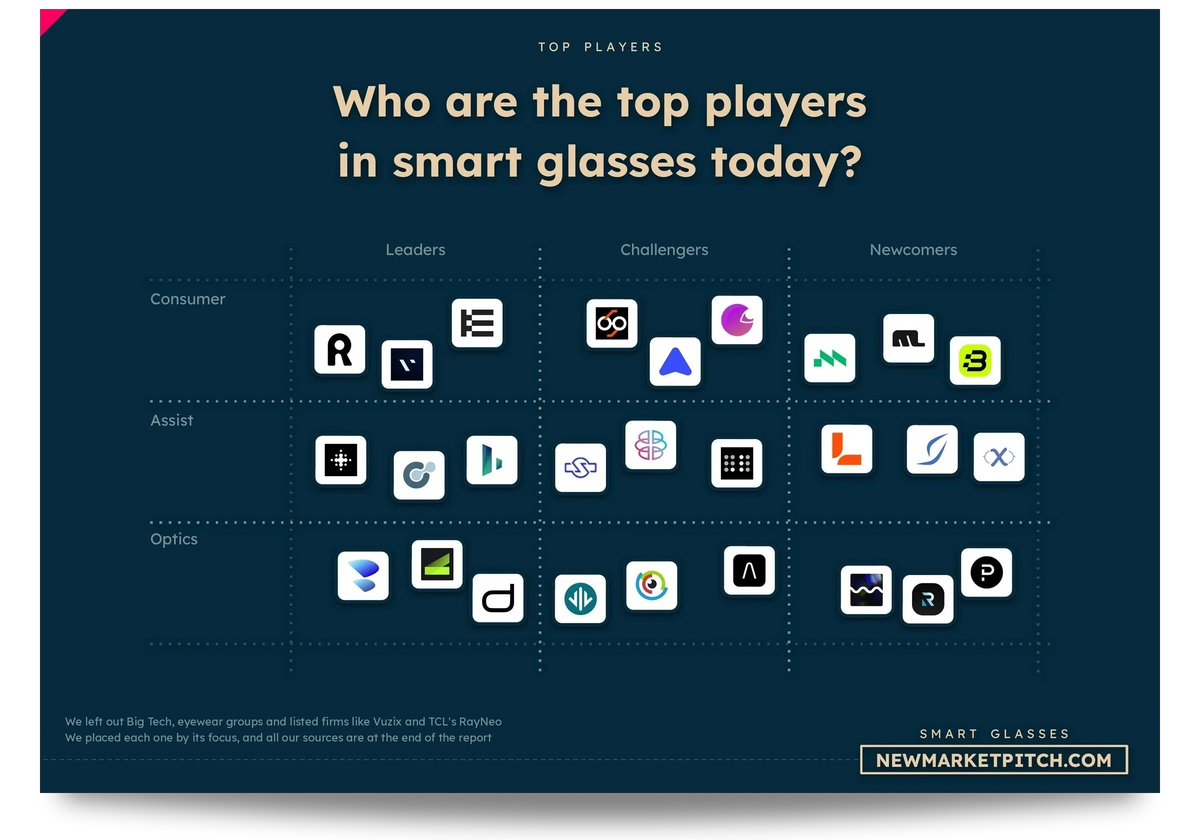
In our research about smart glasses, we turn what is vague and complex into simple, useful visuals. Market maps like this one show you at a glance where every startup stands.
Are smart glasses finally becoming a big business?
Smart glasses are growing quickly, and investors are putting hundreds of millions of dollars into companies trying to turn eyewear into the next computing platform. The category has moved beyond experimental AR headsets, with products now combining AI assistants, cameras, translation, audio and miniature displays.
Omdia estimated that global AI-glasses shipments reached 8.7 million units in 2025, up 322% year over year. Meta accounted for 7.4 million units, giving it an 85.2% share of that market. Chinese manufacturers, including Rokid, are also gaining ground as local demand and international distribution expand.
The product mix is changing too. Some manufacturers are developing conventional-looking glasses with voice assistants and cameras, while others are investing in waveguides, near-eye displays and spatial computing. This creates several different investment opportunities under the same smart-glasses label.
For startups, the opportunity is enormous if eyewear becomes a device people use throughout the day. But the companies developing the technology still have to solve battery life, comfort, optical quality, software and manufacturing costs.
Which smart glasses startups have raised the most money?
Rokid, XREAL, Sesame, VITURE and Even Realities are the five largest-funded startups in our ranking, with a combined $1.565 billion or more in reported cumulative funding.
Rokid leads with $480 million across 13 rounds, followed by XREAL with $418 million across 12 or more rounds. Sesame has raised $308 million, VITURE $200 million or more and Even Realities $159 million.
The top three alone account for approximately $1.206 billion, or 57% of the total funding across the 29 companies. Expanding the comparison to the top five brings that share to approximately 74%.
This is a highly concentrated funding landscape. A relatively small group of companies has attracted most of the capital, while the remaining startups are developing more specialized products or competing in narrower markets.
The top five also have different business models. Rokid combines AI with AR eyewear, XREAL and VITURE concentrate on visual computing, Sesame is building around conversational AI, and Even Realities focuses on lightweight display glasses.
| Rank | Startup | Total raised |
|---|---|---|
| 1 | Rokid | $480M |
| 2 | XREAL | $418M |
| 3 | Sesame | $308M |
| 4 | VITURE | $200M+ |
| 5 | Even Realities | $159M |
| 6 | INMO | $140M+ |
| 7 | RealWear | $107M |
| 8 | LLVision | ~$96M |
| 9 | Guangli Technology | ~$30M |
| 10 | MAD Gaze | ~$30M |

Your time is limited. In our market report about smart glasses, we put numbers on each part of the market, so you can see where it makes sense to focus.
Why have Rokid and XREAL raised so much funding?
Rokid and XREAL have raised so much money because both companies have spent years developing the hardware and technology needed to make augmented-reality eyewear commercially viable. Their products also address two important consumer needs: AI assistance and portable visual displays.
Rokid has accumulated $480 million through 13 rounds. Its latest recorded financing was a strategic equity investment from Awinic in May 2026, although the amount was undisclosed. Awinic's announcement described a partnership covering chip development, joint research and product implementation, giving the relationship an industrial dimension beyond a conventional financial investment.
XREAL has raised $418 million across 12 or more rounds. Its January 2026 Series D extension brought in $100 million, with the investors remaining undisclosed.
XREAL has also strengthened its relationship with Google. In January 2026, the companies announced an extension of their strategic partnership, naming XREAL a lead hardware partner for Android XR. Project Aura is intended to bring Google's operating system to optical-see-through glasses.
The two companies are solving related but different problems. Rokid is pushing AI-assisted eyewear, while XREAL is positioning itself around visual computing and the broader Android XR ecosystem.
Is Sesame really becoming a major smart glasses competitor?
Sesame is becoming an interesting smart-glasses competitor because it is approaching the market from the AI side rather than from traditional eyewear manufacturing.
The company has raised $308 million across four rounds, with Sequoia Capital and Spark Capital among its key investors. Its October 2025 Series B-1 financing was recorded at $2 million, although the larger Series B financing forms a substantial part of its fundraising history.
Sesame's core technology is its conversational AI assistant. The company is developing a wearable experience in which users can interact with an AI companion through natural speech rather than repeatedly opening applications on a smartphone.
This is a different proposition from XREAL's display-first products or VITURE's portable screens. Sesame wants to make AI interaction feel like an ordinary conversation, with eyewear providing a more immediate interface.
The big question is whether its software experience can justify buying another device. Sesame has attracted substantial funding before fully establishing its eyewear business, so commercial execution will be particularly important.

In our document detailing everything you need to know about smart glasses, we always try to gather several sources and make estimates that make sense, so you can work with solid numbers.
Why did INMO attract such a large investment?
INMO has attracted substantial capital because it is developing consumer AR and AI eyewear in one of the world's most active smart-glasses manufacturing markets.
The company has raised at least $140 million across eight rounds. Its latest recorded financing was an approximately $141 million Series C+ round in September 2026, involving Sichuan Zhenxing Fund, Jing'an Capital and Shibei Hi-Tech.
INMO is pursuing all-in-one AR glasses and consumer AI eyewear, giving it exposure to several growing parts of the market. Its products are designed to combine visual information, AI assistance and conventional eyewear rather than requiring users to wear a bulky headset.
The scale of the latest financing is particularly notable. At approximately $141 million, it represents a substantial capital commitment to a company still competing in a market where consumer adoption and the economics of everyday AR remain works in progress.
China's electronics supply chain and domestic technology investment ecosystem give INMO important advantages, although international distribution and software quality will still determine how far the company can expand.
Why is VITURE attracting so much investor attention?
VITURE has attracted investor attention because it has built a recognizable position in consumer XR glasses, particularly among people who want a large virtual screen without carrying a conventional monitor.
The company has raised $200 million across five or more rounds. Its February 2026 Series B extension brought in another $100 million, following a $100 million financing in September 2025. Legend Capital led the latest round, with Bertelsmann among the investors identified in the financing history.
VITURE's products focus on entertainment, gaming and productivity. Its Luma range and The Beast demonstrate its ambition to move beyond basic wearable displays toward more advanced XR experiences.
The company also benefits from an existing consumer use case: people already understand the value of having a large screen for watching films, playing games or working while travelling.
Its challenge is to make the experience sufficiently comfortable and reliable for regular use. A virtual screen may be impressive during a demonstration, but consumers need good image quality, straightforward connectivity and reasonable battery life.

Our report covering the smart glasses market gets updated several times a month, so you always get the latest view of where things stand.
Which smart glasses startups have received the biggest recent funding rounds?
Even Realities, INMO, XREAL and VITURE have attracted some of the largest individual financing commitments among the companies in our ranking.
Even Realities raised $150 million in its July 2026 pre-Series B round, led by Meituan and Tencent. The transaction valued the company at $1 billion, according to TechCrunch. That valuation should be kept separate from its cumulative funding of $159 million.
INMO's September 2026 Series C+ financing was approximately $141 million. XREAL and VITURE each raised $100 million in their latest recorded rounds.
LLVision also completed a substantial financing round in September 2026, raising more than RMB 300 million, according to China National Radio. Its investors included Beijing Information Industry Development Fund, Beijing New Materials Industry Investment Fund and Beijing Xianglong Asset Management.
These transactions show that substantial capital is still available for companies with established hardware development capabilities, particularly in China and the consumer eyewear segment.
| Startup | Latest round | Amount |
|---|---|---|
| Even Realities | Pre-Series B | $150M |
| INMO | Series C+ | ~$141M |
| XREAL | Series D Extension | $100M |
| VITURE | Series B Extension | $100M |
| LLVision | Series C+ | ~$42M |
| Guangli Technology | Pre-Series B | ~$14M |
| Weiguang Electronic Technology | Series A | ~$14M |
| RealWear | Equity Offering | ~$8M |
Who are the biggest investors in smart glasses startups?
Tencent, Meituan, Sequoia Capital, Spark Capital and Legend Capital are among the most notable investors associated with the companies in our ranking.
Tencent has backed both Even Realities and SUPERHEXA, giving it exposure to different approaches to wearable computing. Its participation in Even Realities' $150 million financing alongside Meituan is particularly significant.
Sequoia Capital and Spark Capital are important backers of Sesame, whose strategy is centered on conversational AI. Legend Capital has invested in VITURE and INAIR, providing exposure to consumer display glasses and spatial computing.
Toyota Ventures, Y Combinator and Hartmann Capital are among the investors associated with Mentra. Neotribe Ventures, Listen Ventures and Village Global backed Legato's $12 million financing.
Chinese regional and industrial investment funds are also important. INMO and LLVision have attracted capital from funds linked to local technology and industrial development initiatives.
The investor mix tells us something about the market. Technology companies want to participate in the next computing interface, traditional venture capital firms are backing new hardware and AI platforms, and industrial investors are supporting optical components and domestic manufacturing.

In our research about smart glasses, we look at what the winners do differently, so you can learn from the best instead of guessing.
Why are Chinese smart glasses startups attracting so much funding?
Chinese smart glasses startups are attracting so much funding because they can draw on a strong electronics manufacturing base, established optical suppliers and investors interested in developing domestic AI hardware.
The concentration in our ranking is striking. Rokid, XREAL, INMO and Even Realities are all China-based companies occupying the top six positions, alongside a broader group of Chinese manufacturers developing specialized eyewear and optical technologies.
The domestic market is growing quickly as well. According to research firm RUNTO, Chinese smart-glasses sales reached 909,000 units in H1 2026, increasing 85.5% year over year. Sales value increased 98.7% to RMB 1.88 billion.
The growth is attracting manufacturers from several parts of the electronics industry. Companies are competing to develop cameras, optical displays, AI interfaces and lightweight wearable devices, while local investment funds are supporting the development of the supply chain.
However, strong manufacturing capabilities do not guarantee international success. Chinese startups still need to build recognizable brands, develop reliable software and establish distribution networks outside their home market.
Are AI smart glasses or AR display glasses attracting more funding?
Both categories are attracting substantial investment, but the largest fundraising stories in our ranking span both AI-assisted eyewear and display-based AR products.
On the AI side, Rokid, Sesame, Even Realities and Legato illustrate different approaches. Rokid combines AI with AR experience, Sesame focuses on conversational interaction, Even Realities integrates information displays into conventional-looking eyewear, and Legato is developing hearing-assistance glasses.
On the display side, XREAL, INMO, VITURE, Guangli Technology and Kura Technologies are relevant examples. Their work covers wearable screens, waveguides, near-eye displays and more advanced AR experiences.
These categories also overlap. Rokid and INMO cannot be classified exclusively as AI or display companies, because their product strategies combine both.
The funding distribution suggests that investors are interested in the entire smart-glasses technology stack. Some want to finance consumer brands, others are backing optical technology, and some are investing in the AI software that could eventually make eyewear useful throughout the day.

In our market report about smart glasses, we don't want to repeat what boring consulting reports say. Instead, we show you the real and latest market signals that matter.
Can smart glasses replace smartphones?
Smart glasses are unlikely to replace smartphones completely in the near future, but they could take over several everyday activities that currently require people to look at their phones.
Voice assistants, translation, navigation prompts, notifications, audio and hands-free information are all natural applications for eyewear. Rokid, Sesame, INMO and Even Realities are developing products around these types of interactions.
Display companies such as XREAL and VITURE are approaching the opportunity differently, giving users access to large virtual screens for entertainment and productivity.
The smartphone still has major advantages, including a larger display, more powerful processing, mature applications and flexible input methods. Battery capacity and limited computing resources also make it difficult to reproduce a smartphone experience in ordinary glasses.
The more realistic opportunity is that smart glasses become another everyday computing device, handling tasks where a hands-free interface is more convenient. That alone could create a substantial market without requiring consumers to abandon their phones.
Which startups are building the most advanced AR smart glasses?
XREAL, INMO, VITURE, Rokid and Even Realities are among the most important companies developing advanced AR eyewear in our ranking, although their technical approaches differ considerably.
XREAL and VITURE concentrate on wearable displays that create large virtual screens. Their products are particularly relevant for gaming, entertainment and productivity.
INMO is developing all-in-one AR glasses that combine displays with AI capabilities. Rokid has experience in optical systems and AR software, while Even Realities is developing a more discreet visual interface designed for everyday use.
Guangli Technology is another interesting company because it focuses on AR glasses and waveguide displays. Waveguides are particularly important for making optical displays thinner and more suitable for conventional eyewear.
The engineering challenge remains considerable. Manufacturers need to balance brightness, field of view, image quality, weight and battery consumption. Improving one characteristic can make another more difficult to optimize.
This is why optical technology remains an important investment area even as AI receives much of the consumer attention.

Learning from others' mistakes is the cheapest lesson there is. In our document detailing everything you need to know about smart glasses, we look at what broke startups before you, so you don't repeat it.
Are industrial smart glasses startups attracting less investment?
Industrial smart glasses startups generally attract smaller financing rounds than the leading consumer brands, although they are targeting businesses with very different purchasing needs.
RealWear has raised $107 million through six rounds. Its products are designed for industrial workers who need hands-free access to instructions, information and remote assistance.
LLVision has raised approximately $96 million across 15 rounds, focusing on enterprise AR glasses and software. Iristick has raised approximately $5 million and also specializes in industrial eyewear.
These products can be useful in manufacturing, maintenance, logistics and field service. A technician can receive instructions or communicate with a remote expert without putting down their tools.
The economics are different from consumer eyewear. An industrial customer may purchase devices for an entire workforce, provided that the technology reduces downtime or makes specific tasks easier.
The market is smaller than general consumer electronics, but specialized products can build lasting customer relationships when they solve measurable operational problems.
Which smart glasses startups are working on accessibility?
Legato, XanderGlasses, Eyedaptic, Lighthouse Tech and Biel Glasses are developing smart eyewear for people with specific hearing or vision needs.
Legato has raised $12 million in one early VC round, with backing from Neotribe Ventures, Listen Ventures and Village Global. Its glasses integrate hearing-assistance technology into the arms of conventional-looking frames.
XanderGlasses has raised approximately $3 million across three rounds and focuses on real-time captions for people with hearing difficulties.
Eyedaptic has raised approximately $2 million through four rounds, developing AR glasses for people with low vision. Lighthouse Tech has raised approximately $550,000 for obstacle-detection eyewear, while Biel Glasses has raised approximately $300,000 for low-vision mobility products.
These companies have relatively modest funding compared with the largest consumer manufacturers, but their products address clear problems. They also show how smart eyewear can offer practical benefits beyond entertainment and general-purpose AI.
Legato is particularly interesting because it brings together two established product categories, prescription eyewear and hearing assistance, in one device.

If you build or invest in the smart glasses market, you need to know which business models pay off now and which ones are fading. That's why our report covering it has a whole section on it.
Which smart glasses startups are developing sports and fitness products?
ENGO Eyewear and Everysight are the two most directly sports-focused startups in our ranking.
ENGO Eyewear has raised approximately $6 million in one seed round, backed by Ventech, Odyssée Venture and Bpifrance Amorçage Industriel. Its glasses are designed to display performance information for athletes.
Everysight has raised $5 million in one Series A round, with investors including Meir Shamir, XT Venture Capital and Saban Ventures. It develops AR cycling glasses that display useful information while riders are moving.
The appeal is straightforward. Athletes already use GPS watches, cycling computers and fitness applications to monitor their performance. Displaying information directly in their field of view can make those devices more convenient to use.
Sports eyewear also has an established customer base, making it easier to explain the value of connected glasses than it might be for a completely unfamiliar consumer product.
The challenge for these companies is to demonstrate that the additional technology improves the sporting experience enough to justify the price.
Are open-source smart glasses startups worth watching?
Mentra and Brilliant Labs are particularly interesting because they are trying to make smart glasses more accessible to developers and less dependent on individual hardware manufacturers.
Mentra has raised $8 million in one seed round, backed by Y Combinator, Toyota Ventures and Hartmann Capital. Its MentraOS platform is designed to provide an operating system and application ecosystem for compatible smart glasses.
This is a different approach from companies that build proprietary software exclusively for their own devices. Mentra wants developers to be able to create applications that work across multiple hardware platforms.
Brilliant Labs has raised approximately $6 million across four rounds and is developing open-source AR and AI wearables.
The opportunity is to make smart glasses more useful through applications created by third-party developers. But the challenge is getting enough manufacturers, developers and users onto the same platform.
Mentra's decision to develop its own hardware alongside its operating system also shows how difficult it can be to build an ecosystem without a physical reference product.

In our research about smart glasses, we like to show you the big picture. We know your time is precious, so we make every page quick to read and packed with as much learning as possible per minute.
Why are smaller smart glasses startups still attracting investors?
Smaller smart glasses startups are attracting investment because some of the most interesting opportunities are concentrated in specialized products rather than general-purpose eyewear.
Tilt Five has raised approximately $23 million through three or more rounds. It develops holographic tabletop gaming glasses, targeting a specific gaming audience.
Kura Technologies has raised approximately $2 million across six rounds and focuses on advanced AR glasses. Shoujing Technology has raised approximately $4 million through two rounds, developing enterprise AR hardware and solutions.
Gyges Labs, associated with Halliday, has raised approximately $3 million across two rounds and is developing AI wearables and near-eye displays.
These companies operate in smaller markets than the major consumer manufacturers, but they can still build valuable businesses if they solve specific technical or customer problems.
For investors, the attraction may be proprietary optical technology, specialist applications or the possibility of becoming an important supplier to larger manufacturers.
Is the smart glasses market becoming too crowded?
The smart glasses market is becoming crowded, particularly in consumer AI eyewear and wearable displays. Several startups are now targeting similar customers with products that combine cameras, voice assistants, translation and visual information.
The competitive pressure is especially clear when we compare the companies in our ranking with Meta's Ray-Ban smart glasses business. According to Omdia, Meta shipped 7.4 million AI glasses in 2025, giving it 85.2% of the global market.
That scale is difficult for independent startups to match. Meta benefits from established distribution, brand recognition, an existing AI platform and its relationship with EssilorLuxottica.
The smaller companies therefore need a clearer reason for consumers to choose their products. XREAL and VITURE focus on visual displays, Even Realities emphasizes discreet information, Rokid offers a combination of AI and AR, and Sesame is building around conversational AI.
Specialists such as Legato and RealWear have a different advantage because their products address more specific needs.
We expect competition to become tougher as major technology companies expand their product ranges. Startups with a clear product identity and a strong software experience will have a better chance of surviving than manufacturers selling broadly similar hardware.

When you build or invest in the smart glasses market, you need clarity, not confusion. In our market report about smart glasses, we always try to put numbers on and quantify whatever is usually vague and confusing.
Which smart glasses startups have the strongest international ambitions?
Rokid, XREAL, VITURE, INMO and MAD Gaze are among the consumer-oriented companies in our ranking with international ambitions.
Rokid has been expanding the international availability of its AI glasses, while XREAL has built relationships with international technology partners and consumer electronics distributors.
VITURE is also expanding outside China, using its XR display products to target consumers interested in gaming and portable entertainment. INMO is developing a broader consumer product range, while MAD Gaze has a longer history in international AR eyewear.
The challenge is that international expansion involves more than shipping hardware. Smart glasses depend on language support, prescription compatibility, software integration, privacy compliance and local customer service.
Companies must also compete with brands that already have established distribution relationships and much larger marketing budgets.
For now, the strongest international opportunities appear to belong to companies whose products can be understood and used without requiring consumers to learn an entirely new way of interacting with technology.
Are smart glasses startups too dependent on external AI providers?
Many smart glasses startups depend on external AI models, cloud computing and connected smartphones, creating potential problems around cost, reliability and control over the user experience.
Rokid has pursued compatibility with several AI services, giving users more flexibility in choosing their preferred assistant. Sesame is taking a different route by developing its own conversational AI technology.
INMO and Even Realities are integrating AI features into their eyewear products, while Mentra is building a software platform that allows developers to create applications for compatible devices.
The main technical constraint is power consumption. Running advanced AI models directly on lightweight glasses is difficult, so companies often rely on a connected smartphone or remote cloud processing.
That creates dependencies on internet connectivity, third-party services and external model providers. Companies must also deal with the privacy implications of microphones, cameras and AI systems that can capture conversations or images.
The startups that manage to make these interactions reliable, discreet and useful without draining the battery will have a meaningful advantage.

A good product starts with a real problem. In our document detailing everything you need to know about smart glasses, we show you the ones customers still live with.
Can all these smart glasses startups become profitable?
No, the current funding environment does not mean that all 29 startups in our ranking can become profitable businesses. Several are developing expensive hardware, competing in overlapping product categories or targeting markets that are still relatively small.
Consumer manufacturers such as Rokid, XREAL, INMO and VITURE need sufficient sales volumes to cover product development, manufacturing, distribution and customer support.
Even Realities has a different challenge because its premium eyewear proposition requires customers to accept a relatively high price for a new type of wearable interface.
Industrial companies such as RealWear and Iristick can focus on enterprise customers, where contracts may be more predictable but sales cycles can be longer.
Specialists such as Legato, Eyedaptic and ENGO Eyewear can concentrate on particular customer groups, potentially avoiding direct competition with the largest consumer brands.
We would therefore look at product adoption, repeat purchases, margins and customer retention before treating fundraising totals as evidence of a successful business.
Which smart glasses startups are worth watching most closely?
Rokid, XREAL, INMO, VITURE and Even Realities deserve particular attention because they combine substantial funding with recognizable products and exposure to the largest parts of the smart-glasses market.
Rokid is interesting because it combines AI and AR, while XREAL has established a strong position in wearable displays and the Android XR ecosystem. INMO has attracted substantial investment in China, and VITURE has demonstrated that consumers are willing to pay for portable visual-computing products.
Even Realities deserves attention for its alternative approach to everyday eyewear, particularly its focus on discreet displays and a less camera-dependent experience.
Sesame is another company worth watching because conversational AI could become a major reason people adopt smart glasses. Its ability to translate substantial AI investment into a successful hardware product remains to be demonstrated.
Outside the main consumer market, Mentra, RealWear, LLVision and Legato are interesting for their software, industrial and accessibility strategies.
The companies we would watch most closely are therefore not necessarily those with the largest funding totals. We would pay particular attention to the businesses that can turn their technology into products people actually use regularly.

In our report covering the smart glasses market, we try to remove everything that could confuse you, especially if you're investing or building in this market.
Which smart glasses startups have raised the most money, and who is winning?
Rokid tops our funding ranking, followed by XREAL, Sesame, VITURE and Even Realities. However, fundraising leadership and commercial leadership are two different things, and none of these funding figures alone proves that a company is winning the market.
Rokid leads through its combination of AI and AR eyewear. XREAL is developing wearable displays and spatial computing, Sesame is betting on conversational AI, INMO is expanding its consumer AR portfolio, and VITURE is targeting portable visual computing.
Even Realities is another important competitor after its $150 million financing, while RealWear and LLVision represent the enterprise market. Smaller companies such as Mentra, Legato and Brilliant Labs are exploring software and specialized applications.
The bigger picture is that smart glasses are becoming a serious hardware and software investment category, but the market is still far from settled. Meta has demonstrated the potential for mass-market adoption, while independent startups are experimenting with different products and business models.
We believe the next winners will be the companies that combine comfortable hardware, useful software, reliable AI and strong distribution. Raising hundreds of millions of dollars gives them the resources to compete, but getting consumers and businesses to wear their products every day will ultimately decide who builds a lasting business.
Our methodology
We rank smart-glasses startups by the total amount of equity funding they have raised, focusing on companies whose core business is smart glasses, AR eyewear or closely related wearable technology. Established technology groups and divisions of larger companies are excluded, while startups that have subsequently been acquired or gone public remain eligible.
We compare cumulative funding, financing rounds, latest round dates and participating investors. The ranking includes equity financing and excludes debt, grants and other non-equity funding. Where a financing amount has not been publicly disclosed, we do not treat it as a confirmed amount raised.
For market developments, we draw on Omdia's global AI-glasses shipment estimates, IDC's smart-glasses market analysis and RUNTO's Chinese sales figures reported by IT Home. These sources provide context on market growth, shipment volumes and the competitive position of major manufacturers.
For financing and investor information, we prioritize company and investor announcements, regulatory information and established financial and industry publications. Key sources include Awinic's announcement of its strategic investment in Rokid, Bloomberg's reporting on XREAL's financing, Google and XREAL's Android XR partnership announcement, and VITURE's financing announcement.
Other important financing sources include TechCrunch's reporting on Even Realities' $150 million financing, China National Radio's coverage of LLVision's Series C+ round, Legato's $12 million financing announcement, Y Combinator's Mentra company profile and RealWear's corporate announcements.
For market size and adoption, we also refer to Omdia's analysis of global AI-glasses shipments, IDC's smart-glasses market analysis and IT Home's reporting on RUNTO's H1 2026 Chinese smart-glasses sales figures.
The objective is to provide a comparable view of the companies attracting the most capital, while also examining the investors, technologies and commercial opportunities shaping the smart glasses market.
Written by the New Market Pitch teamWe track new markets so founders and investors can move faster. About us