What are the top solid-state battery startups by revenue?
Whether you're building or investing in the solid-state battery market, our report covers everything you need to know: the players, the money, and what's coming next.
Summary
QingTao Energy is the number one solid-state battery startup by revenue, with $118M of battery revenue in 2025, from audited accounts in its Hong Kong listing application. Solid Power is second with $17.9M of FY2025 fiscal-year revenue, and ProLogium is third with $2.9M of FY2025 fiscal-year revenue. All three reported sales, but they earned that money in different ways.
QingTao already sells hybrid solid-state batteries into energy storage and vehicles. We rank only that battery segment, CNY 829M, and leave out the automation equipment that lifts its group revenue to about CNY 943M. Solid Power gets much of its income from developing technology with partners. ProLogium makes cells and provides technical services, although sales remain small beside its factory plans.
QingTao's lead makes more sense when we look at the products. Its Hong Kong listing application shows that stationary energy storage brings in more revenue than vehicle batteries. Customers are buying hybrid products while the company's fully solid-state designs move through pilot production.
Those customers have yet to make QingTao profitable. Its filing reports losses even as shipments increased, a reminder that selling industrial batteries and making money on every sale are two different achievements.
Solid Power has found a way to get paid before its cells reach a production car. SK On pays for technology and pilot-line work, while BMW and Samsung SDI are testing the company's materials in automotive programs. Commercial contracts exist, though high-volume electrolyte supply is still ahead.
ProLogium has a working factory in Taiwan, which makes its modest sales particularly striking. Its disclosures describe limited battery orders and technical-service work. Much of the plant's activity still goes toward testing processes and preparing for bigger customers.
Factorial Energy offers another contrast. Its first recorded commercial receipts came from drone cells, while the Mercedes-Benz and Stellantis vehicles that made headlines remain test programs. A working prototype can open doors without generating mass-production sales.
WeLion New Energy has supplied a large storage project, and INX Technology reports cumulative cell shipments. Those achievements show that products are leaving factories, but neither company has published a comparable annual revenue number for this ranking.
Smaller batteries tell a similar story. ITEN makes solid-state cells for electronics, while Ampcera has attracted paying customers for electrolyte materials. Manufacturing milestones and customer counts can be impressive without telling us what a company earned in a year.
For now, QingTao Energy has the clearest lead in reported annual sales. The bigger question for the rest of the solid-state battery industry is how quickly prototypes, specialty orders and paid engineering projects can turn into regular, profitable production.

Written by the New Market Pitch teamWe track new markets so founders and investors can move faster. About us

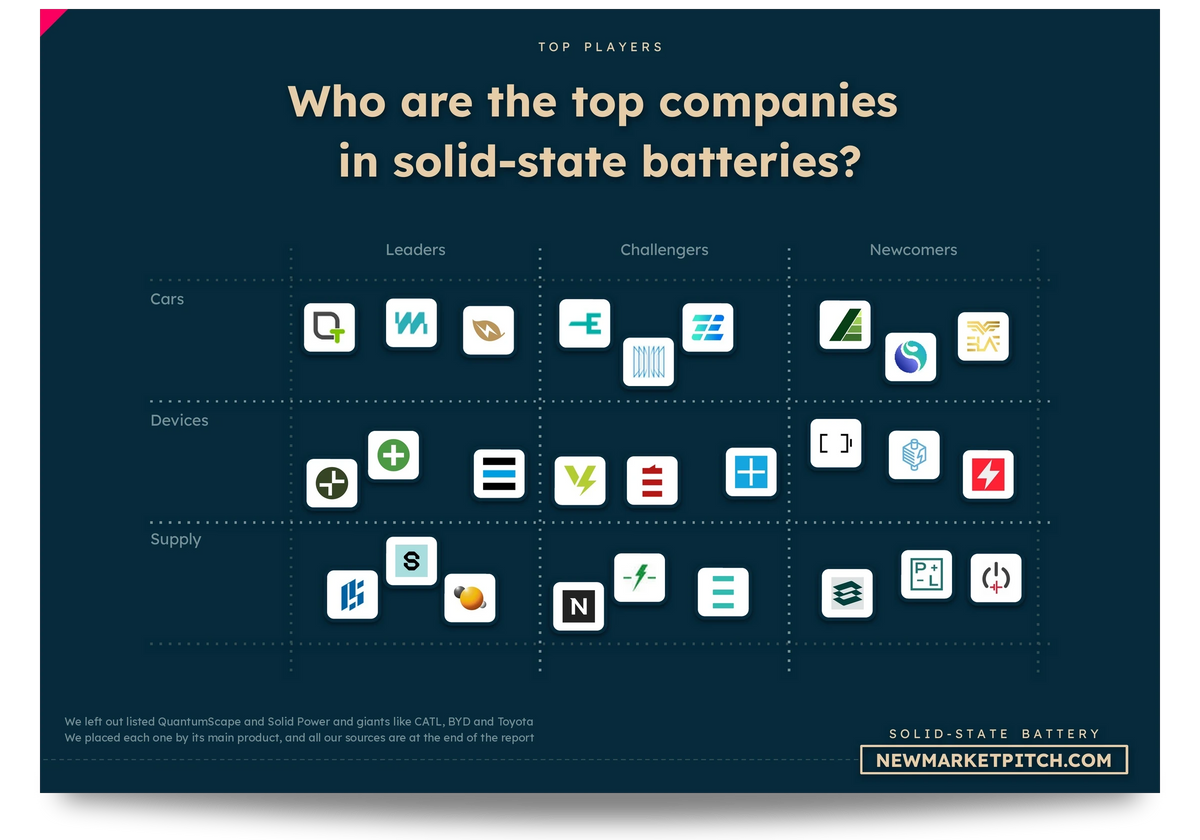
In our report covering the solid-state battery market, we turn what is vague and complex into simple, useful visuals. Market maps like this one show you at a glance where every startup stands.
The ranking of top startups in the solid-state battery market by revenue
Below is a table ranking the startups of this market by their current revenue scale. You can find our methodology at the end of this page.
If you want a deeper understanding of the market and its current dynamics, get our report on the solid-state battery market.
| Ranking | Company | Latest Metric | Metric Type | Freshness | Disclosed When | Source Quality | Confidence | Segment | Why This Ranking | Local Metric | Country |
|---|---|---|---|---|---|---|---|---|---|---|---|
| 1 | QingTao Energy | $118M | Segment Revenue | Fresh · 11mo | Apr 8, 2026 | Filed / Audited | Medium | Hybrid Solid-State Cell Developers | Audited accounts in its listing filing show $118M (CNY 829M) of 2025 battery segment revenue, fresh as of December 2025. Only batteries are ranked, so confidence is Medium, and automation equipment sales are left out. | CNY 829M | cn |
| 2 | Solid Power | $17.9M | Fiscal-Year Revenue | Fresh · 11mo | Feb 24, 2026 | Filed / Audited | High | Sulfide Electrolytes | Its SEC filing records $17.9M of FY2025 fiscal-year revenue, fresh as of December 2025 and excluding grants. Much came from development collaboration, not mass-market cell supply. | us | |
| 3 | ProLogium | $2.9M | Fiscal-Year Revenue | Fresh · 11mo | Sep 10, 2026 | Filed / Audited | High | All-Solid-State Cell Developers | An SEC filing records $2.9M of FY2025 fiscal-year revenue, fresh as of December 2025. Sales came from limited battery and technical-service programs, not volume EV orders. | tw | |
| NR | ITEN | ~$281K | Fiscal-Year Revenue | Aging · 23mo | 2025 | Filed / Audited | Medium | All-Solid-State Cell Developers | French statutory accounts show ~$281K of FY2024 fiscal-year revenue, now aging. Its annual sales fall below the threshold for a ranked position. | EUR 270K | fr |
| NR | Solid Ionics | ~$3K | Fiscal-Year Revenue | Aging · 23mo | 2024 | Third-Party Estimate | Low | Sulfide Electrolytes | An automated company-data source estimates ~$3K of FY2024 fiscal-year revenue. The aging, low-confidence third-party estimate does not qualify for a rank. | KRW 4.28M | kr |
| NR | Factorial Energy | $26K | Quarterly Revenue | Very Fresh · 2mo | Nov 10, 2026 | Filed / Audited | Medium | Hybrid Solid-State Cell Developers | An SEC filing reports $26K of Q3 2026 quarterly revenue, very fresh but not an annual measure. An isolated quarter is not annualized or ranked. | us | |
| NR | INX Technology | >10M units | Units Sold | Very Fresh · 4mo | Jul 2026 | Company Disclosed | Medium | All-Solid-State Cell Developers | The company reports >10M units shipped cumulatively through July 2026. The recent unit count is not recognized revenue, so it has no revenue rank. | cn | |
| NR | WeLion New Energy | 200 MWh | Other Scale Signal | Aging · 29mo | Jul 5, 2024 | Credible Reported | Medium | Hybrid Solid-State Cell Developers | The press reported a 200 MWh project commissioned in June 2024. That aging grid-installation signal measures capacity, not revenue, so it receives no rank. | cn | |
| NR | Ampcera | 200 paying customers | Paying Customers | Historical · 35mo | 2023 | Company Disclosed | Medium | Sulfide Electrolytes | The company disclosed 200 paying customers by December 2023. This historical count signals buyer interest but not fiscal-year revenue, so it remains unranked. | us |

Our research about solid-state batteries gets updated several times a month, so you always get the latest view of where things stand.
Are solid-state battery startups actually making sales yet?
Yes. Solid-state battery startups already have paying customers, although many are selling hybrid batteries, engineering work or specialty cells rather than batteries for mass-produced electric cars.
QingTao Energy's FY2025 accounts describe deliveries for stationary storage and vehicles. Its sales also include some automation equipment. Solid Power's SEC filing records money from collaborative engineering and electrolyte-related work, while ProLogium reports product orders and technical services for a relatively small customer base. All three generate recognized revenue, but their businesses look nothing alike.
Early battery revenue often comes from small paid tests or specialty products. An automaker can pay for engineering without buying a production cell, while a niche customer can place an order long before anyone signs a vehicle contract. Both transactions bring in money, but they tell us different things about future demand.
What is missing across much of the industry is a stream of repeat orders at industrial scale. A supplier can invoice an automaker for tests, sell sample materials or ship an early batch without winning the contract to equip a production vehicle. Our figures establish that solid-state specialists can make sales today. They also show how far most companies still have to go before those sales become a large, regular business.
Is China ahead in solid-state battery sales today?
China currently leads disclosed annual solid-state battery sales through QingTao Energy, while America's Solid Power earns far less, mainly from development and electrolyte work.
QingTao Energy's batteries brought in $118M in 2025, according to the audited accounts in its listing filing. QingTao's Hong Kong listing application describes battery deployments across more than 30 vehicle models, including models associated with IM, MG and Foton. The company also sells batteries for stationary storage, which has become a bigger source of sales than vehicles.
Solid Power has genuine American revenue, largely tied to partners developing future battery products. Factorial Energy has just started reporting commercial drone-cell sales, and Ampcera has disclosed paying customers without a comparable annual revenue figure. Those businesses are making progress, but they are selling into different markets and at different stages.
We would not call China the winner of every solid-state battery technology race on that evidence. QingTao's advantage comes mainly from products customers can buy now, including hybrid cells, rather than from a finished all-solid-state battery in mass-market vehicles. Other Chinese companies, including WeLion New Energy and INX Technology, have disclosed deployments or shipments but no usable annual revenue figure. The result is clear on sales, not on which chemistry will eventually dominate.

In our market report about solid-state batteries, we look at what the winners do differently, so you can learn from the best instead of guessing.
Is QingTao Energy selling fully solid-state batteries already?
Not at commercial scale. QingTao Energy earns most of its solid-state battery sales from solid-liquid hybrid products, with fully solid-state cells still in pilot production.
The company's Hong Kong listing application puts stationary storage at 62.8% of its 2025 sales and traction batteries at 25.1%. Automation equipment and other activities make up the rest. That split helps explain how QingTao became the highest earner in our solid-state battery comparison: storage projects already buy its products, even before a fully solid-state car battery reaches large-scale production.
QingTao says its all-solid-state pilot production began in 2025 and points to a prototype vehicle from March 2026. Both are meaningful steps. Neither establishes that its current revenue comes mainly from that newer chemistry. The hybrid batteries used today have different manufacturing requirements and a more immediate customer base.
The key fact is what buyers are actually purchasing. Battery companies can build a business with transitional designs while working toward more demanding all-solid-state cells. QingTao has done that, but its published product mix does not support the claim that fully solid-state vehicle batteries are already a mainstream commercial product.
Is QingTao Energy profitable from its batteries yet?
No. QingTao Energy is the top solid-state battery startup by revenue, but its 2025 accounts still show a gross loss on sales and a net loss.
Its Hong Kong listing application describes higher battery shipments alongside lower average selling prices. The company also faced costs from expanding production and improving its processes. That combination is hard on a manufacturer: selling more units helps only if the factory can produce them cheaply enough.
Consider what happens when a battery maker wins an early storage or vehicle program. Customers may demand lower prices as orders rise, while new production lines still suffer from scrap, downtime and expensive materials. A larger order book does not fix those problems automatically. QingTao's results show why its sales lead should be taken seriously without treating it as proof of a healthy margin.
Solid Power gets paid for engineering and electrolyte work, and ProLogium is still trying to fill its plant with regular orders. Those are different businesses, so their losses and sales cannot be read as if every company were running an identical battery factory. QingTao has crossed an important commercial threshold. Making those shipments consistently profitable is the next one.

In our document detailing everything you need to know about solid-state battery, you will always find fresh funding data, taken straight from our own verified funding database.
Does Solid Power actually sell solid-state battery cells?
Not at mass-market scale. Solid Power earns revenue from solid-state battery development and electrolyte work, while routine sales of finished cells for production cars have yet to arrive.
Solid Power reported $17.9M of FY2025 fiscal-year revenue in its SEC Form 10-K. Much of the business came from collaboration agreements, especially with SK On. The filing keeps grant income separate, which matters because some results headlines combine grants with revenue. We use the revenue line, not the larger combined amount.
The company is testing cells, improving sulfide electrolyte and helping established manufacturers learn how to use the material. Its own cell production mainly supports engineering and partner trials. A battery supplier can get paid for those services years before automakers buy enough cells to equip thousands of cars.
BMW has tested Solid Power cells in an i7, and Samsung SDI has agreed to evaluate the company's electrolyte in a joint development program. Those relationships show that big manufacturers take the technology seriously. They have not yet produced a public record of recurring, high-volume cell purchases. For now, development work remains the clearest explanation for Solid Power's recognized sales.
Is SK On really paying Solid Power for battery technology?
Yes. SK On has signed paid agreements with Solid Power covering solid-state battery know-how, production-line installation and electrolyte purchases.
Solid Power's 2025 SEC filing describes a research-and-development license with $20 million in milestone payments scheduled across 2024 through 2027. A separate installation agreement includes an estimated $22 million tied to project work. These are agreed contract amounts, not figures we add to fiscal-year revenue or assume have already been collected.
SK On must also buy at least eight metric tons of electrolyte through 2030. The initial material supports testing and validation of a pilot production line in South Korea. That purchase obligation goes further than an announcement that two companies plan to collaborate: it creates a specific customer commitment. The quantity is still far below what a full-scale battery factory would consume.
Solid Power reported factory acceptance testing for the SK On line in 2025, followed by work toward site acceptance and further electrolyte manufacturing capability. SK On is paying to build and test an industrial route to solid-state cells. Whether that becomes a large stream of material orders depends on qualification and factory performance, which the contracts alone cannot guarantee.

Learning from others' mistakes is the cheapest lesson there is. In our report covering the solid-state battery market, we look at what broke startups before you, so you don't repeat it.
Has BMW started buying Solid Power batteries for production cars?
No. BMW has tested Solid Power's all-solid-state cells in a vehicle, but it has not started selling mass-produced cars powered by those batteries.
BMW announced in May 2025 that large-format Solid Power cells were being tested inside a BMW i7. That was a serious engineering step: the battery had moved from laboratory equipment into an electric sedan, where engineers could examine how it behaved as part of a complete vehicle. The i7 remained a test car rather than a retail model fitted with a new production battery.
In October 2025, BMW announced that Samsung SDI was joining the development effort. Solid Power supplies sulfide electrolyte for the program, Samsung SDI works on cells, and BMW handles vehicle integration. Each company has a clear technical job, but a development agreement says little about future purchasing volumes.
Solid Power also has paid work connected to BMW, according to its filing. That provides a commercial relationship today, without establishing a long-term vehicle-cell supply program. We would look for recurring orders for qualified electrolyte or cells tied to a vehicle that customers can buy. Until then, BMW's i7 is strong evidence of technical progress, not high-volume battery sales.
How much revenue does ProLogium actually make?
ProLogium recorded $2.9M of FY2025 fiscal-year revenue, despite already operating a solid-state battery factory in Taiwan.
The company's SEC registration filing describes orders for battery products and technical services, with sales coming from a limited customer base. Some existing cells are used in automotive audio systems. That is a much smaller commercial market than supplying the main traction battery for a car, even if the underlying chemistry could eventually serve both.
ProLogium's Taoke factory in Taoyuan has published capacity of 0.5 GWh. Capacity describes what equipment might make under the right conditions. It does not tell us how many cells passed qualification, shipped to customers or generated recognized sales. That gap is why a real factory can coexist with relatively small revenue.
The company still uses production equipment for testing, cell development and improvements to its manufacturing process. Those jobs are necessary for a new battery design, but they do not produce the same income as a recurring automotive supply contract. ProLogium has moved beyond a laboratory project. Its financial filing shows that large customer orders have not caught up with its industrial ambitions.

Your time is limited. In our research about solid-state batteries, we put numbers on each part of the market, so you can see where it makes sense to focus.
Why did ProLogium's revenue fall after opening a factory?
Sales at ProLogium declined because its solid-state battery factory is still making small customer batches and test cells instead of supplying large production contracts.
Its SEC filing reports lower FY2025 sales than FY2024 sales. The company describes a narrow customer base, development projects and a plant still heavily used for qualification and process work. Underused equipment also creates costs that weigh on gross margins.
Automotive customers rarely move from a successful test cell straight to a large order. They want repeatable performance, safety results, reliable yields and certainty about long-term supply. While those tests are underway, the supplier keeps paying operators, technicians and maintenance bills. A factory can become more capable at the same time its current sales disappoint.
QingTao has already found customers for hybrid batteries in storage and vehicles. ProLogium's own plans are centered on converting advanced cells into dependable manufacturing and bigger contracts. Its decline says more about the slow path from battery qualification to repeat orders than about the size of the building. Until vehicle customers commit to volume purchases, the factory remains ahead of the revenue it can produce.
Will ProLogium's French factory bring in sales soon?
No. ProLogium's planned solid-state battery plant in Dunkirk is still under construction, with commercial operations targeted for the end of 2029.
ProLogium already operates its Taoke facility in Taiwan. Dunkirk is the next manufacturing project, with a much longer path before its equipment produces cells that paying customers accept. The company's own updates and SEC materials describe the French site as a future operation rather than an existing sales channel.
A battery plant needs more than a completed building. Its equipment must produce consistent cells, automotive customers must finish qualification, and signed orders must become deliveries that the company can recognize as revenue. A delay at any of those stages can push sales well beyond the first construction milestone.
The French investment may eventually make it easier to serve European carmakers, but it cannot explain what ProLogium earned from its current Taiwan business. Its published revenue comes from existing battery products and technical services. For now, Dunkirk belongs in the company's industrial plans rather than in any claim about money it already makes.

In our market report about solid-state batteries, we always try to gather several sources and make estimates that make sense, so you can work with solid numbers.
How much solid-state battery revenue has Factorial Energy made?
Factorial Energy reported $26K of quarterly revenue in Q3 2026 from its first commercial drone-cell sales, rather than a full year of solid-state vehicle battery business.
Its SEC Form 10-Q records the transaction and describes a company still in the development stage. That is an important change from showing test vehicles and laboratory results: Factorial has started selling a product. But a short period with an initial order cannot be turned into an annual sales figure, so we show it without a revenue rank.
Drones offer a more immediate use for high-energy battery cells than passenger cars. Customers in aviation, robotics and other specialized applications may accept a higher price if the battery helps them reduce weight or improve performance. Vehicle manufacturers, by contrast, need years of testing and manufacturing checks before ordering battery packs in large volumes.
Factorial also became publicly listed in June 2026. Its financial disclosures make the difference between first commercial sales and a mature manufacturing business easier to see. The drone transaction proves that a buyer paid for cells. We still need longer reporting periods and repeat customers to judge Factorial's annual revenue scale.
Are Mercedes-Benz and Stellantis buying Factorial batteries yet?
Not for mass-produced cars. Mercedes-Benz and Stellantis have tested Factorial Energy solid-state cells in development vehicles, but neither program establishes routine purchases for retail vehicles.
Mercedes-Benz tested Factorial cells in a modified EQS that completed a 1,205 km drive from Stuttgart to Malmo in August 2025. The demonstration offered a concrete look at the technology's possible driving range. Factorial's registration materials nevertheless describe future commercial supply as dependent on separate agreements and development milestones.
Stellantis announced in June 2026 that it had integrated Factorial cells into a Dodge Charger Daytona development vehicle and begun road testing. That program checks whether the batteries work safely and reliably under real vehicle conditions. It leaves unanswered how many packs Stellantis might buy and when any production model might use them.
Factorial's first recorded revenue instead came from drone cells. We can credit the automakers for getting the technology into working cars and the drone customer for producing a paid sale. Confusing those two kinds of progress would make the business look more mature than its filings show. Regular vehicle purchases remain a future step.

If you build or invest in the solid-state battery market, you need to know which business models pay off now and which ones are fading. That's why our report covering it has a whole section on it.
Why isn't QuantumScape among the top battery startups by revenue?
QuantumScape falls outside this solid-state battery startup ranking because it went public in 2020, beyond the five-year listing window we use for startups.
That rule matters because QuantumScape is one of the best-known companies developing solid-state lithium-metal batteries. It works on cell technology and manufacturing processes, and its progress attracts attention from automakers and investors. But this comparison covers independent growth companies founded since 2000, including public listings only within the last five years.
QuantumScape's September 2026 SEC filing also says its planned principal operations had not yet begun and it had not earned revenue from its principal business activities. So even leaving the startup definition aside, there is no established stream of battery-product sales to put beside the reported annual revenue of QingTao, Solid Power or ProLogium.
Solid Power listed in 2021 and Factorial Energy in June 2026, placing them inside the listing window used here. Their eligibility says nothing about whose cells work best. It simply keeps the term "startup" consistent instead of changing it whenever a famous public company enters the conversation.
Is WeLion New Energy already selling semi-solid batteries?
Yes. WeLion New Energy has supplied semi-solid-state batteries for real energy-storage and vehicle applications, although it has not disclosed a comparable annual revenue figure.
WeLion supplied cells for a 200 MWh energy-storage project connected in Zhejiang in June 2024. Its company materials identify a mass-produced 280 Ah semi-solid cell used in the project. WeLion also describes shipments to NIO and other customers. Those examples are enough to establish that its battery technology has reached real-world installations.
The difficulty is knowing what WeLion actually earned. A grid project's energy capacity belongs to the finished installation. The developer, cell maker, system integrator and contractor may all receive different payments, and the public project announcement does not reveal WeLion's recognized sales for the year.
We keep the deployment as evidence of commercial activity, without treating it as a revenue number or comparing it with annual accounts from other startups. WeLion might have a much larger business than the published project alone suggests. Its disclosed project scale cannot tell us that. The distinction is important for a market in which factory output often receives more attention than the income it produces.

In our report covering the solid-state battery market, we don't want to repeat what boring consulting reports say. Instead, we show you the real and latest market signals that matter.
Does shipping millions of solid-state cells mean big revenue?
No. INX Technology's solid-state battery deliveries show that it can manufacture products, but cumulative shipments do not reveal what the company earns in a year.
INX Technology says it shipped >10M units cumulatively through July 2026. Its product range includes cells for electronics, drones, robots and power tools. Those applications use batteries of widely varying sizes and prices. A million tiny electronics cells can represent a smaller business than a much smaller number of large vehicle cells.
The company's history describes a pilot line in 2023, product deliveries beginning in 2024 and a full production line in 2025. That sequence is more convincing than one isolated prototype. It shows a manufacturer steadily expanding what it can make and deliver.
What we still need for a revenue comparison is the amount customers paid in a defined period. We would also need to know how much of the cumulative total represents commercial sales rather than evaluation shipments. INX has reached a meaningful manufacturing stage, but the shipment figure belongs beside other production milestones, not in a ranking of annual revenue.
Can solid-state electrolyte suppliers make money before cars launch?
Yes. Solid-state electrolyte suppliers can earn money from pilot materials, technical services and licensing long before electric-car factories buy their products in bulk.
Solid Power demonstrates the route clearly. Its industry partnerships pay for development and material testing, while customers prepare production processes that may eventually require recurring electrolyte purchases. In 2026, Solid Power said its MOBIUS continuous process was designed for approximately 75 metric tons of annual electrolyte capacity once commissioned. The new equipment could support larger orders, but capacity itself brings in no sales.
Ampcera takes another route. It says it reached 200 paying customers by December 2023 for its solid-state electrolyte materials. That shows buyers exist, but a company can count a small paid sample and a major industrial customer in the same customer total. We cannot infer a fiscal-year revenue figure from the number of accounts.
South Korea's Solid Ionics also develops sulfide electrolytes. Its available ~$3K of FY2024 fiscal-year revenue is an automated third-party estimate, rather than a company disclosure, so it remains unranked. Across these businesses, the pattern is straightforward: paid samples and engineering projects come first; regular material orders depend on factories qualifying the product and using it repeatedly.

In our research about solid-state batteries, we like to show you the big picture. We know your time is precious, so we make every page quick to read and packed with as much learning as possible per minute.
Are tiny solid-state batteries already making money in Europe?
France's ITEN already sells solid-state microbatteries for electronics, although its reported annual revenue remains below the level of the ranked battery businesses.
ITEN's French statutory accounts record ~$281K of FY2024 fiscal-year revenue. That is a real annual figure, but it is below $1M, so ITEN is shown without a rank. Its accounts also include service revenue, so that figure should not be mistaken for sales of finished microbatteries alone.
ITEN announced in September 2026 that it had manufactured its one-millionth solid-state battery. It also introduced a 1,500 microampere-hour surface-mount cell in the Powency family. These cells are aimed at connected sensors, tracking devices and compact electronic equipment, where standard circuit-board assembly and small physical size matter more than driving range.
The production milestone came after the financial year used for its revenue figure. Manufactured cells also are not automatically sold cells. ITEN has an operating product business in a market far removed from electric vehicles, but the later manufacturing achievement does not tell us how much the company earned from customers in the meantime.
Do solid-state battery milestones tell us who earns the most?
No. Factory shipments, grid projects and paying-customer counts show that solid-state batteries are reaching buyers, but those measures cannot identify the startups with the most annual revenue.
The difference becomes clear when we look at six other companies. Factorial Energy has reported a single quarter of revenue from an actual commercial transaction. ITEN has annual accounts for a small electronics-cell business, while Solid Ionics has only an automated estimate. INX Technology reports lifetime shipments, WeLion New Energy reports installed storage capacity, and Ampcera reports how many customers have paid for materials.
Each figure answers a different question. A quarterly sale covers only a few months; cumulative shipments may cover years; a factory or storage-project capacity measures energy rather than money. We show all these signals because they help explain where the market is moving. We do not mix them into a single revenue comparison.
The table below shows six disclosed figures that measure different kinds of commercial progress.
| Company | Figure | Measure | Period |
|---|---|---|---|
| ITEN | ~$281K | Fiscal-Year Revenue | FY2024 |
| Solid Ionics | ~$3K | Fiscal-Year Revenue | FY2024 |
| Factorial Energy | $26K | Quarterly Revenue | Q3 2026 |
| INX Technology | >10M units | Units Sold | Jul 2026 |
| WeLion New Energy | 200 MWh | Other Scale Signal | Jun 2024 |
| Ampcera | 200 paying customers | Paying Customers | Dec 2023 |

When you build or invest in the solid-state battery market, you need clarity, not confusion. In our market report about solid-state batteries, we always try to put numbers on and quantify whatever is usually vague and confusing.
Will solid-state battery prototypes turn into steady sales soon?
Solid-state battery prototypes are not close to generating steady mass-market car sales, even though specialty products already bring in paid orders.
The biggest obstacles are practical. Automotive cells must perform consistently after repeated charging, meet safety requirements and survive manufacturing without high scrap rates. Carmakers also need suppliers that can deliver thousands of identical packs on schedule. A successful test vehicle answers important engineering questions, but it does not settle any of those purchasing decisions.
The early deals tell us where steady demand might start. A developer can first sell pilot materials, a specialist can fill a narrow application, and an established manufacturer can qualify a new chemistry without promising a mass-market launch. Each route still needs a second order, followed by another, before the business can depend on it.
The businesses that turn prototypes into regular sales will need more than an impressive laboratory result. They need factories that make cells consistently, buyers willing to order again and selling prices that cover the cost of production. Hybrid batteries, specialty cells and electrolyte materials are already opening those routes. Mass-market all-solid-state vehicle batteries have more work ahead.
So, which solid-state battery startups make the most money today?
QingTao Energy is the number one solid-state battery startup by revenue today, with $118M of 2025 battery sales, followed by Solid Power and ProLogium on their reported annual figures.
QingTao already sells hybrid batteries to storage and vehicle customers. Solid Power gets paid for engineering, licensing and electrolyte work. ProLogium has a working factory and some customer sales, but its broader automotive business is still being built. Those differences explain the revenue order more clearly than any prototype or production-capacity announcement.
The next race is about repeat purchases and factory costs. Some companies can document a first paid transaction, others a shipment milestone or an operating plant. We keep those milestones in view without turning them into annual revenue figures the companies have not reported. For now, QingTao's existing customers give it the strongest documented sales position among the startups in this market.
The table below shows what we found.
| Question | Answer |
|---|---|
| Why did China's hybrid battery sales take off? | QingTao already sells batteries for storage and vehicles. Its products reached more than 30 vehicle models. Existing uses brought sales before fully solid cells reached mass production. |
| Are electric cars driving most solid-state battery revenue? | No, storage already plays a larger role at QingTao. Stationary batteries supplied 62.8% of its 2025 sales. That mix makes the lead easier to understand. |
| Does selling more solid-state batteries guarantee profit? | No, battery manufacturing costs can swallow growing sales. QingTao's 2025 accounts still reported a gross loss. More shipments need to cover their own production costs. |
| Can battery makers get paid before cars launch? | Yes, development deals already bring money into solid-state batteries. SK On's research license carries $20 million in milestones. Those payments do not mean production cars are ready. |
| Will bigger electrolyte factories automatically raise sales? | No, extra production capacity has to find buyers. Solid Power targets approximately 75 metric tons of annual capacity. Qualified materials still need customers placing regular orders before revenue grows. |
| Does a working factory prove strong battery demand? | Not while equipment is mainly making test cells. ProLogium's Taiwan plant has 0.5 GWh of published capacity. Actual deliveries remain the clearer measure of customer demand. |
| Will the French battery factory earn money immediately? | No, ProLogium's Dunkirk site is still being built. Commercial operations are targeted for the end of 2029. Construction progress cannot be counted as current sales. |
| Have road tests made solid-state car sales routine? | No, those cars still belong to development programs. A Factorial-equipped Mercedes-Benz traveled 1,205 km in testing. A recurring vehicle order would be stronger sales evidence. |
| Has Factorial started selling batteries yet? | Yes, but only a first batch of drone cells so far. Factorial booked $26K of quarterly revenue in Q3 2026. Its car programs with Mercedes-Benz and Stellantis are still only tests. |
| Could tiny batteries become a paying European business? | Yes, ITEN has a commercial product for electronics. It announced its one-millionth manufactured cell in September 2026. That output milestone alone cannot establish annual sales. |

A good product starts with a real problem. In our document detailing everything you need to know about solid-state battery, we show you the ones customers still live with.
Our methodology
Our data runs through November 14, 2026. We then reviewed this article and updated its answers on November 17, 2026, the date shown under the title. We define the solid-state battery market as independent businesses centered on cells with solid-electrolyte architecture, genuine semi-solid hybrids, dedicated solid electrolytes and processes, and miniature solid-state batteries. We include credible businesses near those boundaries instead of excluding them arbitrarily. Every company considered is an independent startup founded in 2000 or later and funded by founders, investors or grants, including recent listings within five years and recent acquisitions within three years; established groups remain outside the startup ranking even where their battery businesses are larger. This ranking considers each eligible company's whole history of disclosed revenue evidence, rather than only a recent funding window.
We reviewed corporate releases, investor materials, annual accounts, stock-exchange applications, regulatory filings and reputable news reporting across the past ten years. Companies describe commercial activity through fiscal-year revenue, annualized recurring revenue, run-rates, short periods, shipments, bookings, contracts and customers. We preserve each original measure and never convert bookings, cumulative deliveries, GMV, forecasts, customer counts or project capacity into recognized revenue. We also never calculate revenue from users, cell prices or shipments.
We choose one representative figure for each company, giving preference to information from the last 18 months, then to filings and company disclosures over credible reporting, analyst work and automated company-data estimates. For comparable evidence, full-year revenue takes priority over ARR or a run-rate, which are then preferred to partial-period or segment figures; usable partial and segment figures are treated as minimums rather than complete annual businesses. Companies are ordered by the selected figure. We use the geometric midpoint to place an eligible range without letting its high end dominate, and the lower bound of an eligible minimum. Non-revenue measures, figures older than 36 months and isolated non-comparable quarterly observations receive no rank. We also show sub-$1M businesses separately so very small filings do not create misleading positions beside scaled annual operations.
We label freshness as Very Fresh, Fresh, Aging or Historical according to the months elapsed since the end of the reported period. High confidence means a recent, exact full-year number filed or disclosed by the company; Medium covers ARR, run-rates, partial periods, minimums, press figures or figures 18 to 30 months old; Low covers estimates, wide ranges and older figures. We convert non-dollar amounts using European Central Bank reference rates at the period end while retaining original-currency values. A single analyst or automated estimate remains unranked; two independent, consistent estimates may be ranked with Low confidence, while conflicting estimates remain an unranked range. A company figure with no stated period can be ranked with Low confidence, unlike an undated estimate. Unsegmented revenue from a company operating more widely than this market is shown without a rank, and forecasts are never ranked.
We do not pretend that revenue always measures the same stage of industrial maturity. A developer may recognize engineering fees before material supply begins, and a manufacturer can sell hybrid cells before its all-solid-state chemistry is ready for wider adoption. We keep the reported metric type and period attached to every figure and never add mixed measures together, so a skeptical reader can distinguish repeatable battery sales from annualized expectations or isolated commercial tests. This is also why a famous, well-funded developer with a test car or a factory can appear without a revenue rank.
Finally, when a results announcement presents revenue together with grants or another income category, we use the separately identified revenue line in the underlying filing. We do not replace historical revenue with subsequent announcements about installed capacity, vehicle performance or prospective customer agreements. A startup moves into a credible revenue position through evidence of recognized sales, not through an estimate of what its technology might earn once production expands.
Key sources include QingTao Energy's Hong Kong application proof: FY2025 sales, product mix, shipments, losses, and manufacturing status, QingTao Energy's listing, customer deployments, hybrid products, and profitability context, Solid Power's FY2025 revenue, grants, SK On agreements, electrolyte and customer relationships, Solid Power's results release and distinction between sales revenue and grant income, Solid Power's late-2026 progress supplying electrolytes and expanding customers, MOBIUS commissioning and planned continuous electrolyte capacity, BMW's May 2025 i7 solid-state battery test with Solid Power, BMW, Samsung SDI and Solid Power's electrolyte and cell evaluation arrangement, ProLogium's FY2025 sales, customer concentration, underused capacity, and qualification stage, ProLogium's Taoke manufacturing capacity and operating site, ProLogium's Dunkirk construction and commercial-operation target, Factorial Energy's Q3 2026 drone-cell revenue and development-stage financial disclosures, Factorial's Mercedes-Benz testing and conditional commercial-supply discussion, Factorial's 2026 Dodge Charger Daytona development program with Stellantis, QuantumScape's listing history and disclosure about revenue from principal operations, WeLion's Longquan semi-solid-state energy-storage project and cell details, WeLion's battery products, customer applications and production history, INX Technology's cumulative cell delivery statement and manufacturing timeline, Ampcera's customer milestone and electrolyte pilot-production history, ITEN's company-filed FY2024 statutory financial statements and revenue composition, ITEN's September 2026 microbattery manufacturing milestone and electronics products, and Factorial's announcement of its first recognized commercial revenue.

In our report covering the solid-state battery market, we try to remove everything that could confuse you, especially if you're investing or building in this market.
Written by the New Market Pitch teamWe track new markets so founders and investors can move faster. About us