What are the top space launch services startups by total funding raised?
Whether you're building or investing in the space launch services market, our report covers everything you need to know: the players, the money, and what's coming next.
Summary
Stoke Space leads the space launch services startup funding ranking with $2.3 billion raised, followed by Relativity Space at $1.36 billion and China's i-Space at more than $1 billion. Space Pioneer, Galactic Energy, Isar Aerospace, Astra Space, LandSpace, PLD Space and Space Epoch complete the top 10.
The funding gap between the leaders and the rest of the industry is substantial. The three largest companies have attracted about $4.7 billion combined, while the next group ranges from $450 million to $900 million per company.
Across all 45 startups, cumulative funding reaches approximately $11.4 billion. The top 10 account for $8.9 billion, leaving a relatively small share for the other 35 companies. Stoke Space alone has raised almost as much as those 35 companies combined.
China has developed an especially strong commercial rocket financing ecosystem. Its 12 ranked companies have raised approximately $4.97 billion, slightly ahead of the $4.55 billion accumulated by eight American companies. Government-linked investment institutions and regional industrial funds play an important role in the Chinese market.
The largest funding transactions are becoming increasingly ambitious. Stoke Space's $1 billion Series E, Deep Blue Aerospace's $280 million financing and Isar Aerospace's $314 million Series D show how much capital investors are willing to commit to companies approaching industrial-scale rocket development.
Funding frequency tells a different story. PLD Space has completed 13 rounds, Space Pioneer 12 and i-Space and Deep Blue Aerospace 10 each. Stoke Space has raised considerably more money through just seven rounds, illustrating the difference between frequent fundraising and securing exceptionally large investments.
Government-backed investors are becoming important alongside traditional venture capital. The National Reconstruction Fund has supported Australia's Gilmour Space and Southern Launch, while European and Chinese institutions are helping finance domestic rocket manufacturing and launch infrastructure.
Europe's strongest competitors are Isar Aerospace and PLD Space, with $736 million and $450 million raised respectively. India is further behind financially, but Skyroot Aerospace has already demonstrated an important technical milestone with its successful Vikram-1 orbital launch.
Reusable rockets are attracting substantial investment, particularly in China and the United States. Stoke Space is pursuing full recovery of both rocket stages, while Relativity Space, Space Pioneer, Deep Blue Aerospace, LandSpace and Space Epoch are developing different combinations of reusable hardware, methane propulsion and advanced manufacturing.
Reaching orbit remains a major dividing line. Skyroot Aerospace and Isar Aerospace have demonstrated important launch capabilities, but establishing a reliable commercial service requires repeated successful missions, sufficient launch frequency and competitive operating costs. Astra Space's acquisition after raising hundreds of millions of dollars is a reminder that fundraising alone guarantees very little.
SpaceX remains the difficult competitor to beat, particularly on price. Its rideshare programme starts at $350,000 for 50 kilograms to sun-synchronous orbit, putting enormous pressure on dedicated small-launch providers to offer better scheduling, orbital flexibility or specialised payload services.
Our conclusion is that Stoke Space currently leads the financial race, China has built an impressive group of privately financed challengers, and the United States retains a substantial operational advantage in the wider launch industry. The next winners will be the companies that turn their financing into reliable, repeatable launches and sustainable customer relationships.
For a broader look at the space launch services market, including its leading companies and competitive landscape, see our dedicated market report.

Written by the New Market Pitch teamWe track new markets so founders and investors can move faster. About us

In our report covering the space launch services market, you will always find fresh funding data, taken straight from our own verified funding database.
Top startups in the space launch services market ranked by total funding raised
Here is an updated table that ranks the top startups in the space launch services market based on the total amount of funding they have raised to date.
The table also includes the total number of funding rounds, the date and size of the latest round, the financing type (e.g. Series A, equity financing), key investors, the startup’s current status (active, IPO, acquired, or shut down), and a confidence score based on the data collected (we excluded startups with very low data confidence, to make sure everything is reliable).
If you need to dig deeper and get more detailed data, please check our report covering the space launch services market.
| # | Startup | What They Do | Total Raised ($) | Total Rounds | Last Round Date | Last Round Amount ($) | Last Round Type | Key Investors | Current Stage | Confidence | Country |
|---|---|---|---|---|---|---|---|---|---|---|---|
| 1 | Stoke Space | Develops fully reusable orbital rockets | $2.3B | 7 | September 2026 | $1.0B | Series E | Point72 Ventures, Spark Capital, General Innovation | Active | Strong | United States |
| 2 | Relativity Space | Develops reusable 3D-printed orbital rockets | $1.36B1 | 8 | February 2026 | Undisclosed | Venture Equity | Fidelity Investments, Tiger Global, Bond | Active | Partial | United States |
| 3 | i-Space | Develops reusable commercial orbital rockets | $1B+ | 10 | August 2026 | ~$140M | Series E | Cowin Capital, Jingming Capital, Chengdu Advanced Capital | Active | Partial | China |
| 4 | Space Pioneer | Develops reusable liquid-fueled launch rockets | $900M+2 | 12 | July 2026 | ~$28M | Strategic Equity | Hengdian Capital | Active | Partial | China |
| 5 | Galactic Energy | Provides reusable orbital rocket launches | $760M | 8 | July 2026 | Undisclosed | Series D+ | Beijing Commercial Aerospace Fund, CCB International, Sichuan Industrial Promotion | Active | Partial | China |
| 6 | Isar Aerospace | Builds orbital rockets for satellites | $736M | 7 | June 2026 | $314M | Series D | HV Capital, Lakestar, Island Green Capital | Active | Strong | Germany |
| 7 | Astra Space | Develops satellite launch and propulsion | $591M | 7 | February 2024 | $4M | Post-IPO Equity | Canaan, Innovation Endeavors, Airbus Ventures | Acquired | Partial | United States |
| 8 | LandSpace | Builds methane-powered orbital launch vehicles | $460M | 8 | December 2024 | $123M | Series D | National Manufacturing Transformation Fund, Sequoia China | Active | Strong | China |
| 9 | PLD Space | Develops reusable MIURA launch vehicles | $450M | 13 | September 2026 | $125M | Series C Extension | Mitsubishi Electric, COFIDES, Endeavor Catalyst | Active | Partial | Spain |
| 10 | Space Epoch | Develops reusable methane-fueled launch vehicles | $342M+3 | 7 | September 2026 | ~$343M3 | Series B++ | IDG Capital, Chaos Investment, Hangzhou Capital | Active | Partial | China |
| 11 | CAS Space | Develops commercial orbital launch services | $303M | 9 | December 2024 | $117M | Strategic Investment | China National Manufacturing Transformation Fund | Active | Partial | China |
| 12 | Orienspace | Develops commercial heavy-lift launch vehicles | $283M | 7 | September 2026 | Undisclosed | Growth Equity | Shanghai STVC, Vertex Capital, Shandong New Growth Drivers Fund | Active | Partial | China |
| 13 | Deep Blue Aerospace | Develops reusable commercial rocket launchers | $280M+ | 10 | September 2026 | $280M | Series B6/B7 | Wuxi High-tech Zone Investment, Addor Capital, Oceanpine Capital | Active | Partial | China |
| 14 | Gilmour Space Technologies | Develops Australian rockets and satellites | $246M+ | 6 | January 2026 | $145M | Series E | National Reconstruction Fund, Hostplus, Future Fund | Active | Strong | Australia |
| 15 | SpinLaunch | Develops kinetic satellite launch systems | $196M+ | 7 | August 2025 | $30M | Series C | ATW Partners, John Doerr, Airbus Ventures | Active | Partial | United States |
| 16 | Skyroot Aerospace | Builds small satellite orbital rockets | $167M | 8 | July 2026 | ~$1M | Angel | Mukesh Bansal, GIC, Playbook Partners | Active | Strong | India |
| 17 | Interstellar Technologies | Develops Japanese rockets and satellite infrastructure | $158M | 9 | January 2026 | $96M | Series F | Woven by Toyota, SBI Group, SPARX | Active | Partial | Japan |
| 18 | Yushi Space | Develops reusable stainless-steel orbital rockets | $140M+4 | 5 | May 2026 | ~$70M | Series A | Gaorong Ventures, Kunlun Capital, C&D Emerging Investment | Active | Partial | China |
| 19 | Cosmoleap | Develops reusable liquid-fuel rockets | $84M | 3 | April 2026 | $70M | Series A | Qianhai Ark Capital, Houji Capital, Puhua Capital | Active | Partial | China |
| 20 | Agnikul Cosmos | Develops 3D-printed orbital launch vehicles | $81M | 8 | March 2026 | $3M | Series C Extension | Celesta Capital, Rocketship.vc, Mayfield India | Active | Strong | India |
| 21 | INNOSPACE | Develops hybrid-propulsion small launch vehicles | $81M | 7 | November 2025 | $34M | Follow-on Equity Offering | Korea Investment Partners, Kolon Investment, FuturePlay | IPO | Partial | South Korea |
| 22 | HyImpulse | Develops hybrid-propulsion suborbital rockets | $80M | 5 | September 2026 | $58M | Series A Extension | JOIN Capital, Ace Capital Partners, Bayern Kapital | Active | Strong | Germany |
| 23 | Perigee Aerospace | Develops reusable small satellite launchers | $45M+ | 6 | May 2024 | $10M | Series D | DT&Investment, Enlight Ventures, Evergreen Investment Partners | Active | Partial | South Korea |
| 24 | Unastella | Develops crewed and satellite launchers | $44M | 4 | June 2026 | $24M | Series B | Altos Ventures, Korea Development Bank, Strong Ventures | Active | Strong | South Korea |
| 25 | Latitude | Develops dedicated small satellite rockets | $41M | 3 | January 2024 | $30M | Series B | Crédit Mutuel Innovation, Expansion, Bpifrance | Active | Strong | France |
| 26 | Phantom Space | Manufactures orbital rockets and spacecraft | $37M+ | 6 | December 2025 | Undisclosed | Series B | Balerion Space Ventures, KOLH Capital, Reaser Family Office | Active | Partial | United States |
| 27 | Xinghuo Space | Develops electric-pump liquid launch rockets | ~$35M | 4 | June 2026 | Undisclosed | Pre-Series A Extension | Cathay Capital | Active | Partial | China |
| 28 | HyPrSpace | Develops hybrid-propulsion orbital launch vehicles | $33M | 5 | November 2025 | $23M | Series A | Bpifrance, Red River West, Expansion Ventures | Active | Strong | France |
| 29 | Innovative Space Carrier | Develops reusable space transportation systems | $30M | 4 | March 2026 | $22M | Series A | Incubate Fund, B Dash Ventures, Angel Bridge | Active | Full | Japan |
| 30 | Radian Aerospace | Develops reusable orbital spaceplanes | $28M | 1 | January 2022 | $28M | Seed | Fine Structure Ventures, EXOR, The Venture Collective | Active | Partial | United States |
| 31 | EtherealX | Develops fully reusable medium-lift launch vehicles | $26M | 4 | January 2026 | $21M | Series A | TDK Ventures, BIG Capital, Accel | Active | Strong | India |
| 32 | Maritime Launch Services | Develops Canadian commercial launch spaceports | $17M | 3 | November 2025 | $7M | Post-IPO Equity | MDA Space, PowerOne Capital Markets | IPO | Partial | Canada |
| 33 | Southern Launch | Operates spaceports and launch ranges | ~$17M | 2 | June 2026 | ~$17M | Series A | National Reconstruction Fund, Brindabella & Company, Nicholas Moore | Active | Partial | Australia |
| 34 | AstroX | Develops balloon-assisted orbital rocket launches | $16M | 1 | February 2026 | $16M | Series A | One Capital, Inclusion Japan, Angel Investors | Active | Strong | Japan |
| 35 | Z-TRAK Space | Develops reusable small satellite launchers | ~$15M | 1 | October 2026 | ~$15M | Private Financing | Undisclosed | Active | Low | China |
| 36 | Space Walker | Develops reusable winged spaceplanes | ~$12M5 | 4 | April 2024 | Undisclosed | Strategic Equity | Kowa | Active | Partial | Japan |
| 37 | PD Aerospace | Develops reusable suborbital tourism spaceplanes | $11M | 6 | January 2022 | Undisclosed | Venture | Toyota Tsusho, H.I.S., All Nippon Airways | Active | Partial | Japan |
| 38 | Reaction Dynamics | Develops hybrid-propulsion small satellite rockets | $10M+ | 4 | June 2025 | $10M | Series A | Front Row Ventures, Creative Destruction Lab | Active | Partial | Canada |
| 39 | EXOS Aerospace | Develops reusable suborbital rocket systems | $7M | 9 | March 2025 | $132K | Equity | Undisclosed | Active | Partial | United States |
| 40 | POLARIS Raumflugzeuge | Develops reusable hypersonic orbital spaceplanes | $6M+ | 5 | June 2025 | $6M | Seed | Capnamic Ventures, E2MC Ventures, Spacewalk VC | Active | Partial | Germany |
| 41 | bluShift Aerospace | Develops biofuel-powered satellite launch vehicles | $5M | 6 | July 2026 | $1M | SAFE | Wefunder Investors | Active | Partial | United States |
| 42 | Canada Rocket Company | Develops sovereign reusable medium-lift rockets | $5M | 1 | January 2026 | $5M | Seed | BDC Capital, Garage Capital, Panache Ventures | Active | Full | Canada |
| 43 | SaxaVord Spaceport | Develops commercial vertical launch infrastructure | $4M | 1 | October 2023 | $4M | Private Equity | Undisclosed | Active | Low | United Kingdom |
| 44 | Opus Aerospace | Develops agile suborbital launch systems | $4M | 2 | February 2026 | $2M | Seed | Sowefund, Fives, Itera Invest | Active | Partial | France |
| 45 | iRocket | Develops autonomous reusable small launch vehicles | $146K+ | 1 | June 2022 | $146K | Seed | Undisclosed | Active | Low | United States |
- Excludes a later $800M investment by its controlling owner.
- Estimate: some Chinese funding announcements may overlap.
- The $343M Series B total covers several closings, not an extra round.
- Minimum: two earlier rounds lack exact amounts.
- Based on a published total, not a full sum of rounds.

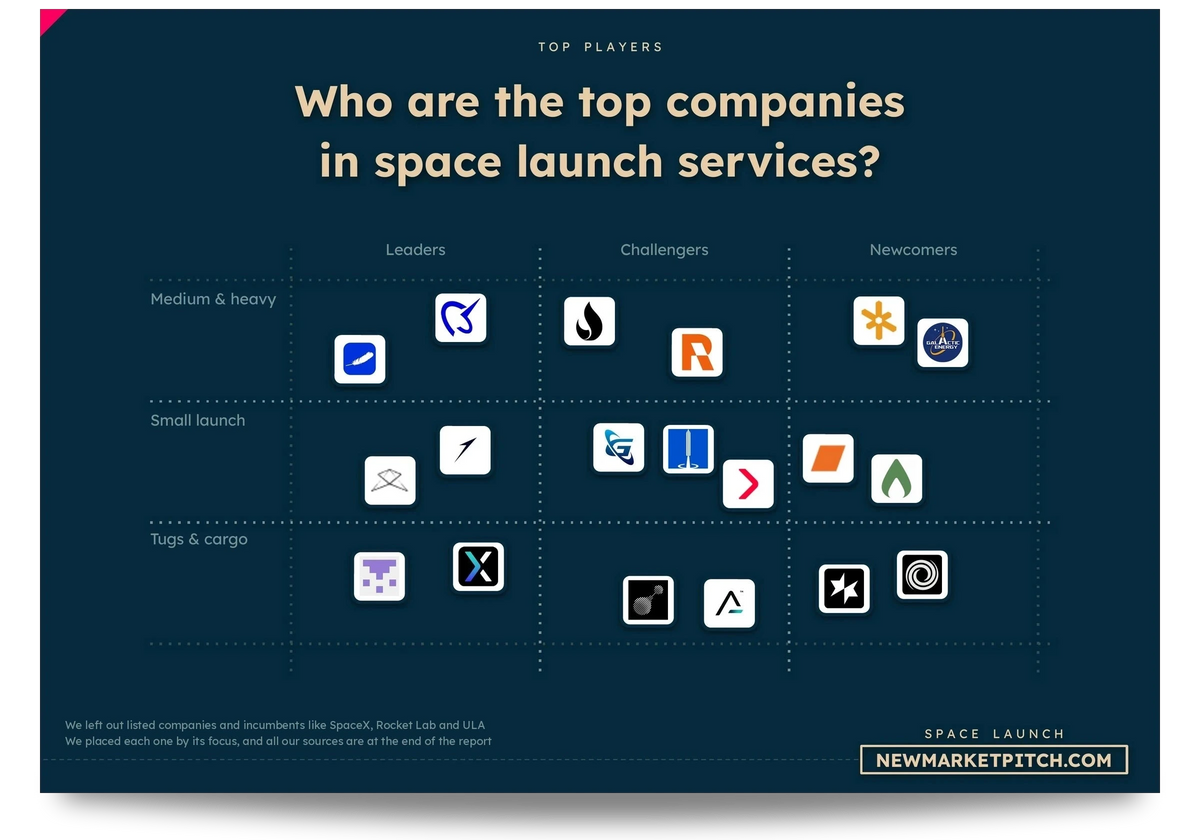
In our research about space launches, we turn what is vague and complex into simple, useful visuals. Market maps like this one show you at a glance where every startup stands.
Which startups have raised the most money in the space launch services market?
Stoke Space, Relativity Space and i-Space have raised the most money among the 45 companies in our space launch services ranking, with $2.3 billion, $1.36 billion and more than $1 billion respectively. Together, they have accumulated about $4.7 billion, giving them a substantial financial head start over the rest of the industry.
Stoke Space has pulled particularly far ahead following its September 2026 $1 billion Series E, co-led by Point72 Ventures and Spark Capital. The company is developing fully reusable orbital rockets. Its latest financing will support the Nova Pathfinder programme, production expansion and development of a larger launch vehicle.
Relativity Space comes second with $1.36 billion. Its financing history includes backing from Fidelity Investments, Tiger Global and Bond. The company has gone through a significant strategic transition, moving from its original Terran 1 programme towards the larger Terran R rocket. Its funding figure excludes a subsequent $800 million controlling-owner investment whose equity structure remains unclear.
China's i-Space completes the top three with more than $1 billion across 10 rounds. Its August 2026 Series E was approximately $140 million, with Cowin Capital, Jingming Capital and Chengdu Advanced Capital among its key investors.
The gap becomes particularly noticeable after these three companies. Space Pioneer has raised at least $900 million, Galactic Energy $760 million and Isar Aerospace $736 million. All three have attracted substantial capital, yet none has reached the $1 billion threshold.
| Startup | Total raised | Rounds |
|---|---|---|
| Stoke Space | $2.3B | 7 |
| Relativity Space | $1.36B | 8 |
| i-Space | $1B+ | 10 |
| Space Pioneer | $900M+ | 12 |
| Galactic Energy | $760M | 8 |
| Isar Aerospace | $736M | 7 |
| Astra Space | $591M | 7 |
| LandSpace | $460M | 8 |
| PLD Space | $450M | 13 |
| Space Epoch | $342M+ | 7 |
How much money have space launch startups raised altogether?
The 45 startups in our ranking have accumulated approximately $11.4 billion in funding. The distribution is heavily skewed towards the largest companies, with the top three alone accounting for about $4.7 billion and the top 10 representing approximately $8.9 billion.
We can divide the industry into three broad financing groups. The first contains Stoke Space, Relativity Space and i-Space, each with at least $1 billion raised. The second includes companies between $450 million and $900 million, such as Space Pioneer, Galactic Energy, Isar Aerospace, Astra Space, LandSpace and PLD Space.
The third group includes the majority of the remaining startups. Space Epoch has raised at least $342 million, CAS Space $303 million, Orienspace $283 million, Deep Blue Aerospace at least $280 million and Gilmour Space Technologies at least $246 million. Below them, several companies have accumulated between $80 million and $200 million.
The contrast is striking: Stoke Space alone has raised almost as much as the bottom 35 companies combined. A handful of ambitious rocket programmes are absorbing a disproportionate amount of the industry's available investment capital.
Developing an orbital rocket requires substantial financing long before a company can establish regular commercial operations. Investors are therefore concentrating large commitments in companies they believe have a realistic chance of reaching industrial scale.

Your time is limited. In our market report about space launches, we put numbers on each part of the market, so you can see where it makes sense to focus.
Which space launch startups have raised more than $500 million?
Eight space launch startups have raised more than $500 million, including four Chinese companies, three American companies and one German company. Together, they represent approximately $7.35 billion in cumulative funding.
Below the three largest companies, Space Pioneer has raised at least $900 million and Galactic Energy and Isar Aerospace more than $700 million each, while Astra Space has accumulated $591 million.
Astra Space deserves particular attention because it has since been acquired. Its $591 million funding history reflects the capital accumulated during its independent development and public-market years. Its take-private transaction closed in July 2024, when an entity formed by its co-founders acquired the remaining publicly held shares for $0.50 each.
The German presence is represented by Isar Aerospace, which raised $314 million in its June 2026 Series D. Its financing supports serial production of its Spectrum rocket and the expansion of its international launch network.
The geographical distribution is interesting. American companies have a particularly strong presence at the top, while Chinese companies have developed several independently financed competitors. Germany's Isar Aerospace is the only European company in this eight-company group.
| Startup | Total raised | Country |
|---|---|---|
| Stoke Space | $2.3B | United States |
| Relativity Space | $1.36B | United States |
| i-Space | $1B+ | China |
| Space Pioneer | $900M+ | China |
| Galactic Energy | $760M | China |
| Isar Aerospace | $736M | Germany |
| Astra Space | $591M | United States |
| LandSpace | $460M | China |
Which space launch startups have raised the largest funding rounds?
Stoke Space's $1 billion Series E is the largest latest funding round in our ranking by a considerable margin. Deep Blue Aerospace, Isar Aerospace and Galactic Energy have also attracted major financing, showing how much capital is now going into orbital launch vehicle development.
Stoke Space announced its billion-dollar financing in September 2026. Point72 Ventures and Spark Capital co-led the round, with General Innovation and several other investors participating. The transaction brought the company's cumulative funding to $2.3 billion.
Deep Blue Aerospace's September 2026 Series B6/B7 financing reached $280 million, with Wuxi High-tech Zone Investment, Addor Capital and Oceanpine Capital among its investors. The company is developing reusable commercial launch vehicles.
Isar Aerospace's June 2026 Series D raised $314 million, while Galactic Energy's September 2025 Series D raised $337 million, before an undisclosed Series D+ in July 2026. Both rounds are particularly substantial for European and Chinese private rocket developers.
PLD Space also attracted $125 million in September 2026 through its Series C extension, with Mitsubishi Electric among the key investors. The additional financing was intended to expand manufacturing and testing capacity for MIURA 5.
These transactions are increasingly focused on the expensive industrial stages of rocket development: manufacturing facilities, testing infrastructure, reusable hardware and the transition towards operational launch services.
| Startup | Latest round | Amount | Date |
|---|---|---|---|
| Stoke Space | Series E | $1.0B | September 2026 |
| Isar Aerospace | Series D | $314M | June 2026 |
| Deep Blue Aerospace | Series B6/B7 | $280M | September 2026 |
| i-Space | Series E | ~$140M | August 2026 |
| PLD Space | Series C Extension | $125M | September 2026 |
| Interstellar Technologies | Series F | $96M | January 2026 |
| Yushi Space | Series A | ~$70M | May 2026 |
| Cosmoleap | Series A | $70M | April 2026 |
| HyImpulse | Series A Extension | $58M | September 2026 |

In our document detailing everything you need to know about space launch services, we always try to gather several sources and make estimates that make sense, so you can work with solid numbers.
Which space launch startups have raised the most funding rounds?
PLD Space has completed 13 funding rounds, the highest number among the 45 companies, followed by Space Pioneer with 12. i-Space and Deep Blue Aerospace have each completed 10 rounds, showing how frequently some rocket developers have returned to investors to finance their programmes.
PLD Space has accumulated $450 million through 13 rounds. Its latest transaction was a $125 million Series C extension in September 2026, bringing additional capital to its MIURA 5 development programme.
Space Pioneer has raised at least $900 million across 12 rounds. Its latest financing was an approximately $28 million strategic equity investment from Hengdian Capital in July 2026.
i-Space has raised more than $1 billion over 10 rounds, while Deep Blue Aerospace has accumulated at least $280 million through the same number of rounds. Both companies illustrate the repeated financing activity taking place in China's commercial rocket industry.
Stoke Space offers an interesting contrast. It has raised $2.3 billion in only seven rounds, suggesting that its fundraising has relied on substantially larger individual transactions.
The difference between PLD Space's 13 rounds and Stoke Space's seven rounds also shows why round count alone tells us relatively little about financial strength. The size of each transaction and the company's total accumulated funding are much more informative.
Who are the biggest investors in space launch startups?
Point72 Ventures, Spark Capital, Fidelity Investments, Tiger Global, Cowin Capital and several government-linked investment institutions stand out among the major investors in the space launch startups in our ranking.
Point72 Ventures and Spark Capital co-led Stoke Space's September 2026 Series E. General Innovation also participated, alongside several other investors. The transaction illustrates the willingness of established venture capital firms to commit unusually large amounts to a single rocket development programme.
Relativity Space has attracted Fidelity Investments, Tiger Global and Bond. These investors helped finance its ambitious approach to rocket manufacturing and launch services.
China has a different mix of investors. Cowin Capital, Jingming Capital and Chengdu Advanced Capital are among i-Space's key investors. Galactic Energy has attracted Beijing Commercial Aerospace Fund, CCB International and Sichuan Industrial Promotion, while Deep Blue Aerospace counts Wuxi High-tech Zone Investment, Addor Capital and Oceanpine Capital.
European companies have attracted a combination of venture capital and industrial investors. Isar Aerospace is backed by HV Capital, Lakestar and Island Green Capital. PLD Space has attracted Mitsubishi Electric, COFIDES and Endeavor Catalyst.
Australia provides another interesting example. Gilmour Space Technologies has received backing from the National Reconstruction Fund, Hostplus and Future Fund. Interstellar Technologies in Japan has attracted Woven by Toyota, SBI Group and SPARX.
The investor mix reveals a growing overlap between traditional venture capital, industrial investment and national strategic financing. Space launch is attracting investors who want exposure to commercial growth as well as countries' efforts to secure independent access to orbit.

Our report covering the space launch services market gets updated several times a month, so you always get the latest view of where things stand.
Are Chinese space launch startups raising more money than American ones?
Chinese space launch startups have raised slightly more combined funding than the American companies in our ranking, with approximately $4.60 billion across 12 companies compared with approximately $4.52 billion across nine American companies.
The Chinese total is led by i-Space, followed by Space Pioneer, Galactic Energy, LandSpace and Space Epoch. Together, these companies represent a substantial financing base for China's commercial rocket industry.
The American group is more concentrated. Stoke Space and Relativity Space account for $3.7 billion, while Astra Space adds another $591 million despite its acquired status.
This difference reflects two distinct financing ecosystems. Chinese commercial rocket developers receive funding from private venture capital, regional investment platforms and institutions connected to industrial development. American companies have attracted major venture capital funds, institutional investors and strategic corporate backing.
The OECD's Space Economy at a Glance 2026 provides important context. The United States accounted for 55% of global orbital launches in 2025, compared with 28% for China. These figures cover national launch activity rather than only the private startups in our ranking.
China has therefore built a remarkably strong financing base for commercial launch development. However, the United States retains a significant operational advantage, particularly through the established launch cadence of its largest providers.
| Country | Ranked startups | Combined funding |
|---|---|---|
| China | 12 | ~$4.60B |
| United States | 9 | ~$4.52B |
Which European space launch startups have raised the most money?
Isar Aerospace and PLD Space are Europe's two largest funded startups in our ranking, with $736 million and $450 million raised respectively. Together, they have accumulated $1.186 billion, substantially more than the other European companies combined.
Germany's Isar Aerospace has attracted $736 million, including a $314 million Series D in June 2026. Its investors include HV Capital, Lakestar and Island Green Capital. The company is developing its Spectrum orbital rocket and expanding serial production.
Spain's PLD Space has raised $450 million over 13 rounds. Its September 2026 Series C extension added $125 million, with Mitsubishi Electric, COFIDES and Endeavor Catalyst among its key investors.
France has three companies in the ranking: Latitude ($41 million), HyPrSpace ($33 million) and Opus Aerospace ($4 million). Germany also has HyImpulse ($80 million) and POLARIS Raumflugzeuge ($6 million).
The difference in financing between Isar Aerospace and the smaller European companies is substantial. Isar alone has raised more than the combined funding of several of its European competitors.
Europe's broader objective is to develop independent access to orbit. This has become increasingly important as European governments and satellite operators seek alternatives to relying on foreign launch providers.
The commercial challenge remains significant. European companies need to demonstrate that their rockets can fly reliably and frequently enough to support customers, while competing with established international launch services.
| Startup | Country | Total raised |
|---|---|---|
| Isar Aerospace | Germany | $736M |
| PLD Space | Spain | $450M |
| HyImpulse | Germany | $80M |
| Latitude | France | $41M |
| HyPrSpace | France | $33M |
| POLARIS Raumflugzeuge | Germany | $6M |
| Opus Aerospace | France | $4M |

In our research about space launches, we look at what the winners do differently, so you can learn from the best instead of guessing.
Are Indian space launch startups attracting serious investment?
Skyroot Aerospace and Agnikul Cosmos have raised $167 million and $81 million respectively, giving India's two leading launch startups a combined $248 million in funding. Their financing is considerably smaller than that of the leading American and Chinese companies, but India has already produced an important commercial launch milestone.
Skyroot Aerospace successfully launched its Vikram-1 rocket into orbit on July 18, 2026. According to the Indian Space Research Organisation, it became the first private Indian company to successfully place a rocket into orbit from Indian soil.
That achievement gives Skyroot a meaningful technical advantage over companies that remain in development. Its investors include Mukesh Bansal, GIC and Playbook Partners.
Agnikul Cosmos has raised $81 million over eight rounds, with Celesta Capital, Rocketship.vc and Mayfield India among its investors. It is developing 3D-printed orbital launch vehicles, offering a different manufacturing approach from Skyroot.
The Indian government's space-sector reforms have also encouraged private investment. The expansion of IN-SPACe and the opening of more space activities to private companies have created a larger domestic ecosystem for rocket manufacturers, satellite developers and supporting businesses.
India still has a considerable financing gap compared with the biggest international competitors. However, Skyroot's orbital achievement shows that funding totals alone do not determine which companies can reach important technical milestones.
Which Japanese space launch startups have raised the most money?
Interstellar Technologies is Japan's largest funded company in the ranking, with $158 million raised, followed by Innovative Space Carrier with $30 million and AstroX with $16 million.
Interstellar Technologies is developing rockets and satellite infrastructure. Its investors include Woven by Toyota, SBI Group and SPARX. Its January 2026 Series F is recorded as $96 million in our ranking.
Innovative Space Carrier has raised $30 million over four rounds, with Incubate Fund, B Dash Ventures and Angel Bridge among its investors. It is developing reusable space transportation systems.
AstroX has raised $16 million in a single Series A, backed by One Capital, Inclusion Japan and angel investors. The company is developing balloon-assisted orbital rocket launch systems.
Japan also has Space Walker, with approximately $12 million raised, and PD Aerospace, with $11 million. Both are developing reusable suborbital spaceplanes.
The country is investing in launch infrastructure as part of a broader effort to strengthen its space industry. Toyota's involvement with Interstellar Technologies is particularly interesting because it brings established industrial manufacturing expertise into the commercial rocket ecosystem.

In our market report about space launches, we don't want to repeat what boring consulting reports say. Instead, we show you the real and latest market signals that matter.
Which Australian space launch startups have raised the most money?
Gilmour Space Technologies leads Australia's space launch startup funding group with $246 million raised, followed by Southern Launch with approximately $17 million. Together, they have accumulated around $263 million.
Gilmour Space raised $145 million in January 2026 through its Series E. The National Reconstruction Fund and Hostplus jointly led the financing, with Future Fund and several other institutional investors participating.
The company is developing Australian rockets and satellites, with its Eris launch vehicle forming an important part of its programme.
Southern Launch has a different business model. It operates spaceports and launch ranges rather than concentrating on manufacturing its own orbital rocket. Its approximately $17 million Series A in June 2026 was backed by the National Reconstruction Fund, Brindabella & Company and Nicholas Moore.
Australia is therefore developing two complementary parts of a domestic launch industry: rocket manufacturing and launch infrastructure.
The challenge for both companies is commercial utilisation. Gilmour Space needs to establish a reliable launch service, while Southern Launch needs enough customer activity to support its facilities over the long term.
Which space launch startups are developing reusable rockets?
Stoke Space, Relativity Space, i-Space, Galactic Energy, Space Pioneer, Deep Blue Aerospace and LandSpace are among the most heavily funded companies pursuing reusable launch technology. Their different approaches show how strongly investors are betting on reducing the cost of repeated access to orbit.
Stoke Space is developing fully reusable orbital rockets, with a strategy focused on recovering both stages. Its approach is particularly ambitious because most other reusable launch programmes initially concentrate on recovering the first stage.
Relativity Space is combining 3D-printed manufacturing with reusable rocket development. The company has shifted its focus towards Terran R, a larger vehicle intended to serve heavier commercial and institutional missions.
Chinese companies are also pursuing reusable systems. Space Pioneer is developing reusable liquid-fuel rockets, while Deep Blue Aerospace is working on reusable commercial launch vehicles. LandSpace is developing methane-powered orbital rockets, and Space Epoch is pursuing reusable methane-fuelled launch vehicles.
The distinction between propulsion and reusability is important. Methane propulsion may offer advantages in engine design and vehicle operations, but the actual economic benefit depends on recovering and reusing rocket hardware successfully.
The industry has already seen substantial progress in reusable launch technology through SpaceX, but replicating that operational model requires much more than a successful landing. Companies must demonstrate reliable recovery, rapid refurbishment and repeated launches at a commercially attractive cost.

Learning from others' mistakes is the cheapest lesson there is. In our document detailing everything you need to know about space launch services, we look at what broke startups before you, so you don't repeat it.
Can small space launch startups compete with SpaceX?
Small space launch startups can compete with SpaceX in specialised missions, but matching its launch prices is extremely difficult. SpaceX's rideshare programme advertises prices starting at $350,000 for 50 kilograms to sun-synchronous orbit, with additional mass priced at $7,000 per kilogram.
That pricing creates a major challenge for companies such as Skyroot Aerospace, Agnikul Cosmos, Latitude, AstroX and HyImpulse. Their dedicated small-launch vehicles need to offer customers advantages beyond simply reaching orbit.
Dedicated launches can provide more control over orbital insertion, scheduling and payload integration. For satellite operators with specialised requirements, those advantages may justify paying more than the price of a rideshare mission.
The market also includes customers that cannot easily wait for a shared launch. Some satellite operators have strict deployment schedules or require a particular orbit to complete their constellation architecture.
Skyroot's successful Vikram-1 orbital launch gives it a stronger starting position in this competition. Agnikul Cosmos is pursuing a different approach through 3D-printed launch vehicles, while European companies such as Latitude are developing dedicated small-satellite rockets.
The biggest challenge remains launch frequency. SpaceX benefits from a high flight cadence that allows it to spread manufacturing and operational costs across many missions. Smaller competitors need enough customers to support their launch infrastructure without pricing themselves out of the market.
Are fully reusable rockets becoming the future of space launch services?
Fully reusable rockets are attracting some of the largest investments in the industry, but the commercial model still needs to be proven across a wider group of companies. Stoke Space is the clearest example of how seriously investors are taking the technology.
Its programme is designed around the recovery and reuse of both rocket stages. Its September 2026 Series E will support the Nova Pathfinder programme and the development of a larger Nova Block 2 vehicle.
Other companies are pursuing different approaches. Relativity Space combines additive manufacturing with reusable rocket development, while Deep Blue Aerospace and Space Pioneer are developing reusable liquid-fuel systems.
LandSpace is concentrating on methane-powered vehicles, and Space Epoch is developing reusable methane-fuelled launchers. These programmes reflect the growing interest in propulsion technologies that may support repeated flights and simpler engine refurbishment.
The economic argument is straightforward. Rocket hardware represents a substantial part of launch costs, so recovering and reusing expensive components could reduce the cost of each subsequent mission.
However, these systems still need to prove that they can be refurbished quickly and operated frequently. A reusable rocket that requires extensive maintenance after every flight may struggle to achieve the economics investors expect.
Fully reusable vehicles could eventually change the market substantially, but partial reusability and expendable rockets will continue to play important roles while the technology develops.

If you build or invest in the space launch services market, you need to know which business models pay off now and which ones are fading. That's why our report covering it has a whole section on it.
Which space launch startups have actually reached orbit?
Skyroot Aerospace, Isar Aerospace and several Chinese launch companies have made important orbital launch progress, although their commercial maturity varies considerably. The distinction between successful orbital insertion and regular commercial service remains essential when comparing these companies.
Skyroot Aerospace achieved a particularly important milestone with Vikram-1 in July 2026. ISRO confirmed that the rocket successfully placed payloads into low Earth orbit, making Skyroot the first private Indian company to accomplish an orbital launch from Indian soil.
Isar Aerospace also reached orbit with its Spectrum rocket on its second flight attempt. The milestone strengthened its position as one of Europe's leading privately financed orbital launch developers.
China has an established group of commercial launch providers. Galactic Energy has developed its Ceres launch vehicle family, while LandSpace has continued developing its Zhuque rockets. These companies have different launch histories and development strategies.
The broader operational landscape remains concentrated. The OECD reports that only 12 countries had demonstrated sovereign orbital launch capability by mid-2026. It also found that the United States and China were the only economies to have successfully recovered orbital-class rocket boosters by that point.
For private launch startups, reaching orbit is a major technical achievement, but customers need more. They want predictable launch schedules, reliable payload delivery and confidence that the provider can support repeated missions.
Does raising hundreds of millions guarantee that a space launch startup will succeed?
No. The history of commercial rocket development shows that even hundreds of millions of dollars cannot guarantee a successful launch business. Astra Space is a particularly clear example of the difference between attracting capital and establishing a sustainable operating model.
Astra Space raised $591 million before completing its take-private transaction in July 2024. The company had struggled to establish a reliable launch service, and its co-founders acquired the remaining publicly held shares for $0.50 each.
Relativity Space offers another example of the risks involved. Its $1.36 billion in cumulative funding reflects years of investment in rocket development and manufacturing technology. The company has since shifted its attention towards Terran R, illustrating how much strategic direction can change during a long development programme.
Stoke Space has accumulated substantial financial resources. However, its first orbital launch remains an important milestone for its fully reusable rocket programme.
Skyroot Aerospace provides an interesting contrast. It has raised $167 million, considerably less than the largest companies, but successfully demonstrated its orbital launch capability with Vikram-1.
These examples show why investors and customers should look beyond cumulative fundraising. Technical milestones, production capacity, reliability, customer demand and cash available for future development all influence a rocket company's chances of survival.

In our research about space launches, we like to show you the big picture. We know your time is precious, so we make every page quick to read and packed with as much learning as possible per minute.
Which space launch startups have gone public or been acquired?
Astra Space is the acquired company in the ranking, while INNOSPACE and Maritime Launch Services are classified as IPO-stage companies. Their different corporate histories show that commercial launch startups can follow very different financing and ownership paths.
Astra Space raised $591 million before its take-private acquisition closed in July 2024. The transaction was led by an entity formed by its co-founders, Chris Kemp and Adam London. Its shares subsequently ceased trading on Nasdaq.
INNOSPACE has raised $81 million and is publicly listed on South Korea's KOSDAQ market. It develops hybrid-propulsion small launch vehicles and has attracted Korea Investment Partners, Kolon Investment and FuturePlay.
Maritime Launch Services has raised $17 million and is developing Spaceport Nova Scotia in Canada. It moved to the Toronto Stock Exchange in November 2026, after receiving final listing approval.
These corporate developments should be considered alongside each company's technical progress. An IPO provides access to public capital markets, while an acquisition changes ownership and corporate control. Neither automatically establishes that a company has achieved a sustainable commercial launch business.
Why are government-backed investors putting money into space launch startups?
Government-backed investors are becoming increasingly important because access to orbit has strategic value for national security, communications, defence and industrial independence. This is particularly visible in China, Australia and Europe.
In China, Galactic Energy has attracted Beijing Commercial Aerospace Fund and Sichuan Industrial Promotion, while i-Space has backing from Chengdu Advanced Capital. Deep Blue Aerospace has also attracted Wuxi High-tech Zone Investment.
Australia's National Reconstruction Fund has invested in Gilmour Space Technologies and Southern Launch. These investments support domestic rocket manufacturing and launch infrastructure.
Europe has a similar strategic objective. Isar Aerospace and PLD Space are developing launch systems that could help European satellite operators access orbit without relying exclusively on foreign launch providers.
Japan is also supporting the development of domestic space infrastructure. Interstellar Technologies has attracted investment from Woven by Toyota, SBI Group and SPARX.
The OECD estimates that government civil-space budgets reached $46.4 billion in 2025, up from $40.5 billion in 2022. Defence demand has also increased. Those figures cover government spending rather than startup equity funding, but they help explain why investors increasingly see launch services as strategic infrastructure.

When you build or invest in the space launch services market, you need clarity, not confusion. In our market report about space launches, we always try to put numbers on and quantify whatever is usually vague and confusing.
Are spaceports becoming an interesting investment opportunity?
Spaceports are attracting investment as countries seek more independent launch capabilities, although their business models depend heavily on the number of rockets and customers using their facilities.
Southern Launch has raised approximately $17 million and operates launch ranges and spaceports in Australia. Its June 2026 Series A was approximately $17 million.
Maritime Launch Services has raised $17 million and is developing Spaceport Nova Scotia in Canada. The company has reached IPO status and is now listed on the Toronto Stock Exchange.
SaxaVord Spaceport has raised $4 million and is developing commercial vertical launch infrastructure in the United Kingdom.
These businesses address a different part of the space launch industry from rocket manufacturers. They provide the locations, facilities and operational services required to launch vehicles.
Isar Aerospace's expansion plans also show how important launch infrastructure has become. Its June 2026 financing supports the development of additional launch capacity, including plans for a Canadian launch site.
However, a spaceport needs regular customers to generate attractive economics. Building a launch facility is only the beginning; the operator must attract rocket companies, secure regulatory approvals and maintain sufficient activity to cover its costs.
Which space launch startups are attracting the most investor attention lately?
Stoke Space, Deep Blue Aerospace, Space Epoch, PLD Space and Gilmour Space Technologies have attracted particularly large financing commitments through their latest funding events. Their transactions show that investors are still prepared to finance substantial rocket development programmes.
Stoke Space's September 2026 Series E is the most striking transaction. It supports the company's fully reusable launch programme and the development of its larger Nova Block 2 vehicle.
Deep Blue Aerospace raised $280 million in September 2026, while Space Epoch announced a new Series B++ financing that brought the capital raised over six months to more than RMB 2.3 billion, equivalent to approximately $343 million.
PLD Space added $125 million through its September 2026 Series C extension. The company is using the capital to expand MIURA 5 manufacturing and testing capacity.
Gilmour Space Technologies raised $145 million in January 2026, with Australia's National Reconstruction Fund and Hostplus jointly leading the Series E.
These transactions have something important in common: investors are financing companies that need to move beyond early rocket development towards production, testing and launch operations.
The next financing milestones will depend heavily on what these companies can demonstrate technically and commercially. Investors will want to see more than successful prototypes; they will want evidence that the companies can deliver reliable launch services at a sustainable cost.

A good product starts with a real problem. In our document detailing everything you need to know about space launch services, we show you the ones customers still live with.
Which space launch startups are best positioned to become major competitors?
Stoke Space, Isar Aerospace, PLD Space, Galactic Energy, LandSpace and Skyroot Aerospace have particularly interesting positions, although their strengths come from very different sources.
Stoke Space has the largest financial resources, with $2.3 billion raised. Its fully reusable rocket strategy gives it substantial long-term potential, provided it can demonstrate reliable operations and commercially attractive turnaround times.
Isar Aerospace has raised $736 million and has reached orbit with its Spectrum rocket. Its focus on serial production and European launch independence gives it an important strategic position.
PLD Space has accumulated $450 million and is developing MIURA 5 for commercial launch services. Its September 2026 funding extension will help it expand manufacturing and testing capacity.
Galactic Energy has raised $760 million, while LandSpace has accumulated $460 million. Both are developing Chinese orbital launch capabilities and benefit from a domestic ecosystem that supports commercial space development.
Skyroot Aerospace has raised $167 million, but its successful Vikram-1 orbital launch gives it a significant technical achievement relative to its funding total.
We would therefore watch these companies for different reasons. Stoke Space has the strongest financial position, Isar Aerospace and PLD Space are important European contenders, Galactic Energy and LandSpace are substantial Chinese competitors, and Skyroot has demonstrated that a smaller-funded company can achieve a major orbital milestone.
What will happen to the space launch services market over the next few years?
The space launch services market should continue growing as satellite constellations expand, governments invest in independent launch capabilities and commercial operators look for more flexible access to orbit. However, only a relatively small group of companies is likely to achieve substantial and recurring launch activity.
The OECD's Space Economy at a Glance 2026 reports that 329 space launches took place in 2025, carrying approximately 4,900 objects into space. More than 14,000 operational satellites were in orbit by the end of that year, with the total approaching 15,000 by mid-2026.
Telecommunications accounted for 82% of satellites launched in 2025, reflecting the expansion of broadband constellations and other space-based connectivity services.
This creates a significant potential market for companies developing larger rockets, dedicated small-satellite launchers and specialised launch infrastructure. Stoke Space and Relativity Space are pursuing larger launch vehicles, while companies such as Skyroot Aerospace, Agnikul Cosmos and Latitude are targeting smaller payloads.
The market will also benefit from governments seeking to reduce dependence on foreign launch providers. China's commercial rocket industry, Europe's efforts to develop independent launch capacity and Australia's investment in domestic infrastructure all reflect this shift.
However, the industry faces a serious consolidation risk. More than 30 small-launcher projects have been announced worldwide over the past decade, according to the OECD, but only a limited number have reached orbit or entered commercial service.
The next few years will reveal which companies can turn their funding into reliable launch capacity. Those that cannot demonstrate technical progress, attract customers and secure additional capital will face increasing pressure as the market matures.

In our report covering the space launch services market, we try to remove everything that could confuse you, especially if you're investing or building in this market.
Which space launch startups have the strongest financial position today?
Stoke Space has the strongest financial position by cumulative funding, with $2.3 billion raised, followed by Relativity Space at $1.36 billion and i-Space at more than $1 billion. However, the ranking also reveals substantial differences between the financing resources available to companies at different stages of development.
The next group includes Space Pioneer (at least $900 million), Galactic Energy ($760 million), Isar Aerospace ($736 million), Astra Space ($591 million), LandSpace ($460 million) and PLD Space ($450 million).
A second group of substantial competitors includes Space Epoch (at least $342 million), CAS Space ($303 million), Orienspace ($283 million), Deep Blue Aerospace (at least $280 million) and Gilmour Space Technologies (at least $246 million).
These funding totals provide a useful indication of how much equity capital investors have committed to each company. They do not, however, reveal how much cash remains available, how quickly companies are spending it or how much additional financing they may need.
Astra Space is a particularly important reminder of this distinction. Despite having raised $591 million, it ultimately became an acquired company after struggling to establish a sustainable independent business.
Stoke Space currently has the largest financial resources in the ranking, but its ability to turn that capital into reliable commercial launches will determine whether its financial advantage becomes a lasting competitive one.
Who is actually winning the space launch startup race?
Stoke Space is winning the fundraising race, China has built the strongest group of privately financed challengers, and the United States retains the clearest operational advantage in the wider launch market.
The funding ranking is unambiguous: Stoke Space has raised $2.3 billion, ahead of Relativity Space ($1.36 billion) and i-Space (more than $1 billion). The top 10 have accumulated approximately $8.9 billion, showing how much capital is concentrated among a small group of companies.
China's 12 ranked startups have raised approximately $4.97 billion, compared with approximately $4.55 billion across the eight American companies. That is a remarkable achievement for China's commercial rocket ecosystem, especially given the number of companies pursuing reusable launch vehicles.
Europe has two particularly important competitors in Isar Aerospace and PLD Space, while Skyroot Aerospace has demonstrated that India can produce a privately developed orbital launcher.
Yet the ultimate winners will be determined by launch performance, reliability, customer demand and the ability to operate repeatedly. A large funding round gives a company more time and resources to develop its technology, but commercial launch services require consistent execution.
Our conclusion is that Stoke Space is the financial leader, while the wider race remains open. The next major shift will come when more of the heavily funded startups move from development programmes to reliable, repeatable commercial launch operations.
In our research about space launches, you will always find fresh funding data, taken straight from our own verified funding database.
Our methodology
We rank space launch startups by the cumulative equity funding they have raised. Our focus is on companies whose core business is directly related to space launch services, including orbital rocket manufacturing, dedicated launch vehicles and commercial launch infrastructure. Large established aerospace groups and divisions of larger companies are excluded, while startups that subsequently went public or were acquired remain eligible because their historical fundraising is still relevant.
We focused on equity financing, excluding debt, grants and other non-equity funding from cumulative totals. We reviewed individual financing rounds, including their dates, amounts, round types and key investors, using company announcements, investor disclosures, regulatory filings, official press releases and reputable financial and aerospace publications. Particular attention was paid to funding extensions, mixed financing structures and transactions where the headline amount might not represent equity raised.
When sources disagreed, we prioritised direct company and investor announcements, regulatory disclosures and authoritative reporting over secondary database figures. Historical rounds remain relevant because the ranking measures cumulative funding, while more recent transactions were checked to keep company financing histories current.
Key sources for this analysis include Stoke Space's September 2026 Series E announcement and Reuters coverage of its $1 billion financing; Isar Aerospace's June 2026 Series D announcement; Galactic Energy's September 2025 Series D announcement; PLD Space's funding announcement and Reuters coverage; Gilmour Space's January 2026 Series E announcement and the National Reconstruction Fund's investment information; Interstellar Technologies' Series F announcement; and Caixin's reporting on Space Epoch's Series B++ financing.
We also used Astra Space's take-private announcement and Nasdaq's merger completion notice to establish its corporate status, ISRO's announcement of Skyroot's orbital launch, INNOSPACE's KOSDAQ listing announcement and Maritime Launch Services' TSX listing information. The OECD's Space Economy at a Glance 2026 provides the broader context on global launch activity, satellite demand and national launch capabilities. SpaceX's official Small Satellite Rideshare programme provides the published pricing used in our comparison of dedicated small-launch vehicles and rideshare services.
Our guiding principle is simple: cumulative funding should reflect capital raised by the companies themselves, while technical milestones, commercial progress and corporate status should be assessed separately. Funding totals are useful for understanding investor commitment, but they should never be confused with available cash, operational maturity or the likelihood of commercial success.
Written by the New Market Pitch teamWe track new markets so founders and investors can move faster. About us