Is the stablecoin payments market as big as it looks?
Whether you're building or investing in the stablecoin payments market, our report covers everything you need to know: the players, the money, and what's coming next.
Summary
The stablecoin payments market is much smaller than its headline transaction volumes suggest. Actual payments are estimated at approximately $390 billion annually, compared with roughly $33 trillion in reported blockchain transfers, and account for just 0.02% of global payment value.
Even Visa's adjusted $10.2 trillion stablecoin volume substantially overstates commercial payments. Exchange deposits, withdrawals, collateral movements and other financial transfers still make up much of the activity that survives its filters.
Businesses are driving the market's growth. B2B stablecoin payments reached approximately $226 billion in annualized volume, representing 58% of identifiable payments, after growing 733% during 2025. The strongest commercial opportunity is international business settlement rather than everyday shopping.
Adoption is remarkably concentrated. Around $245 billion in identified payments originated from Asia, with Singapore, Hong Kong and Japan accounting for nearly all of that regional activity. Global transaction totals conceal how dependent the market remains on particular financial hubs and payment corridors.
Stablecoins can make the transfer of digital dollars extremely cheap, but international payments still need local banking connections, currency conversion and cash-out services. Replacing an expensive settlement step does not automatically eliminate the cost of an entire remittance.
Visa and Mastercard face a more immediate infrastructure transition than a consumer-payment threat. Visa's stablecoin settlement pilot reached a $7 billion annualized run rate, while identifiable consumer-to-business stablecoin payments remained below 0.6% of Visa's 2024 payment volume.
Consumer adoption is developing through familiar payment infrastructure. Stablecoin-linked card spending reached an estimated $4.5 billion in 2025, up 673%, but merchants generally still receive payments through conventional card networks rather than accepting stablecoins directly.
USDT dominates observed payment volume in available provider samples, while USDC is building institutional distribution through financial networks and regulated infrastructure. Neither token's total blockchain transfer volume reliably measures its share of commercial payments.
Payment-processing economics are less impressive than transaction growth. At an effective fee of 0.10% to 0.25%, today's $390 billion payment market would support approximately $390 million to $975 million in annual transaction revenue. Circle, meanwhile, earned roughly 95% of its second-quarter 2026 revenue and reserve income from reserves rather than other activities.
Stripe, Visa, banks and specialist infrastructure providers are likely to share the opportunity. Stablecoin specialists can win difficult corridors and settlement workflows, but established financial platforms have distribution, customer relationships and compliance capabilities that are hard to replicate. Under illustrative annual growth rates of 20% to 60%, payment volume could reach approximately $970 billion to $4.09 trillion within five years. That remains a scenario, not an achieved market.

Written by the New Market Pitch teamWe track new markets so founders and investors can move faster. About us

Your time is limited. In our report covering the stablecoin payments market, we put numbers on each part of the market, so you can see where it makes sense to focus.
Why does the stablecoin payments market suddenly look so big?
The stablecoin payments market is growing fast, but the enormous numbers making headlines mostly describe blockchain transfers rather than people and businesses actually making payments.
Visa's stablecoin dashboard has reported roughly $33 trillion in transfers over a 12-month period, including $10.2 trillion after filtering out certain artificial and automated transactions. Meanwhile, a joint McKinsey and Artemis Analytics study published in February 2026 estimated actual stablecoin payments at an annualized $390 billion, based on activity in December 2025.
The excitement also comes from who is entering the market. Stripe completed its $1.1 billion acquisition of Bridge in February 2025, Visa expanded stablecoin settlement to nine blockchains in April 2026, and the United States passed the GENIUS Act in July 2025, creating a federal framework for payment stablecoins.
These are meaningful developments for an industry that was previously associated mainly with cryptocurrency trading. The problem is that payment adoption, blockchain transaction volume and the value of stablecoins in circulation are regularly presented as though they measure the same business.
How much of stablecoin transaction volume is actually payments?
Only a small fraction of reported stablecoin transaction volume represents identifiable real-world payments. The best available estimate is approximately $390 billion annually, compared with headline blockchain transfers exceeding $30 trillion.
The gap comes from what blockchains record. Moving stablecoins between exchange wallets, transferring collateral, rebalancing reserves and executing automated trading transactions all generate volume. None necessarily represents a customer paying another party for a product or service.
Visa worked with Artemis, Allium Labs and Castle Island Ventures to create an adjusted transaction measure. Its approximately $10.2 trillion figure removes certain artificial activities, but even that includes financial movements unrelated to commercial payments. Visa reported that deposits and withdrawals involving centralized exchanges accounted for 36% of adjusted volume in 2025.
McKinsey and Artemis went further by identifying payment activity. Their $390 billion estimate represented just 0.02% of global payment value. It also excluded some difficult-to-identify private transfers, so we should treat it as an estimate rather than a complete accounting of every payment.
Dividing $390 billion by $33 trillion produces a ratio of roughly 1.2%. The periods and definitions differ, so that is an illustrative comparison rather than an exact payment share. Still, the difference is too large to ignore.
| Measure | Reported value | What it includes |
|---|---|---|
| Gross stablecoin transfers | ~$33T | Recorded blockchain transfers |
| Visa-adjusted volume | ~$10.2T | Transfers after removing selected inorganic activity |
| Exchange deposits and withdrawals | 36% | Share of Visa-adjusted 2025 volume |
| Actual stablecoin payments | ~$390B | Estimated annualized end-user payments |
| B2B payments | ~$226B | Payments between businesses |
| Consumer-to-consumer | ~$77B | Payments between individuals |
| Consumer-to-business | ~$76B | Payments to businesses |
| Business-to-consumer | ~$11B | Business payouts |
| Share of global payments | ~0.02% | Estimated stablecoin payment penetration |
If you want more recent data on this point, please see our latest stablecoin payments market report.

In our research about stablecoin payments, we always try to gather several sources and make estimates that make sense, so you can work with solid numbers.
Are stablecoin payments growing as fast as everyone says?
Real stablecoin payments more than doubled between 2024 and 2025, and business payments grew considerably faster. The acceleration is visible even after removing cryptocurrency trading activity.
McKinsey and Artemis reported approximately $390 billion in annualized payment volume at the end of 2025, more than twice the level a year earlier. Within that total, business-to-business stablecoin payments increased 733% year over year.
The earlier Artemis research helps explain the progression. In February 2025, its sampled payment companies were processing an annualized $72 billion, up 88% from the previous year. By August, monthly volume in its expanded dataset reached $10.2 billion, compared with $6 billion in February.
We cannot combine these figures into one continuous growth series because the studies covered different groups of companies. However, the underlying pattern also appears in commercial disclosures.
Bridge's payment processing volume more than quadrupled during 2025, according to Stripe. BVNK reported $30 billion in annualized payment volume by the end of 2025 and more than $39 billion by September 2026, an increase of at least 30% within nine months.
The growth is substantial, although the available figures still give us a much clearer picture of annual expansion than of consistent quarter-by-quarter market acceleration.
Are businesses already using stablecoins more than consumers?
Businesses now account for most identifiable stablecoin payment value, and their adoption has grown much faster than consumer payments.
McKinsey and Artemis estimated that B2B transfers represented $226 billion of the $390 billion annualized stablecoin payment market, or approximately 58%. Consumer-to-consumer transfers accounted for another $77 billion, while consumer-to-business payments reached $76 billion.
The B2B segment is attractive because international business payments often involve several intermediaries, foreign exchange conversion and limited banking hours. A company paying an overseas supplier has an immediate reason to consider a faster settlement method, particularly when its banking options are expensive.
This explains the focus of providers such as BVNK, Bridge and Circle on business payment infrastructure. These companies help businesses transfer digital dollars, connect with domestic banking systems and convert funds between currencies.
The geographic concentration is also striking. McKinsey and Artemis identified approximately $245 billion in stablecoin payments originating from Asia, compared with $95 billion from North America and $50 billion from Europe. The researchers found that Singapore, Hong Kong and Japan accounted for nearly all identified Asia-originating activity.
That concentration points to strong adoption in particular financial corridors rather than uniform demand worldwide.

In our market report about stablecoin payments, we don't want to repeat what boring consulting reports say. Instead, we show you the real and latest market signals that matter.
Are stablecoins actually replacing banks for international payments?
Stablecoins are taking over some cross-border settlement activity, but banks still control many of the services needed to complete those payments.
The attraction is straightforward. Businesses can move dollar-denominated assets between compatible wallets without waiting for every intermediary in a conventional correspondent banking chain. In certain corridors, that can make settlement faster and reduce the amount of money companies need to keep in foreign accounts.
BVNK offers a useful example. In September 2026, the company disclosed more than $39 billion in annualized payment volume when announcing a partnership with card issuing platform Marqeta. The partnership allows companies to connect stablecoin balances with card-based spending.
Stripe's Bridge acquisition follows a similar commercial direction. Instead of asking businesses to manage wallets and blockchain networks independently, Bridge provides infrastructure that developers can integrate into existing financial products.
However, stablecoins still need banks, local payment networks or licensed financial intermediaries when customers want to deposit ordinary money or receive funds in their domestic currency. Compliance checks and foreign exchange conversion remain necessary.
What is being disrupted most clearly is the movement and settlement of money between financial providers. We have considerably less evidence that companies are abandoning their banking relationships altogether.
If you want more recent data on this point, please see our latest stablecoin payments market report.
Can stablecoins make international remittances much cheaper?
Stablecoins can dramatically reduce the cost of transferring money between digital wallets, but the savings on complete international remittances depend on how recipients access their money.
The World Bank's Remittance Prices Worldwide database reported an average global remittance cost of approximately 6.36% in 2025. Sending $200 at that rate costs around $12.72.
Stablecoin transfers on inexpensive blockchain networks can cost only a few cents. The difference looks compelling until we account for the full process: acquiring stablecoins, converting currencies, transferring the tokens and allowing recipients to spend or withdraw the funds.
In corridors where recipients already use digital dollars, stablecoins can remove several expensive steps. In markets where recipients need physical cash or local bank transfers, exchange services and payout providers can absorb a substantial part of the potential saving.
The commercial advantage is strongest where conventional remittances remain expensive and customers can convert stablecoins cheaply. We still lack consistent global data showing that stablecoins deliver lower all-in costs across most major remittance corridors.

In our document detailing everything you need to know about stablecoin payments, we like to show you the big picture. We know your time is precious, so we make every page quick to read and packed with as much learning as possible per minute.
Are stablecoins becoming a real threat to Visa and Mastercard?
Stablecoins are becoming useful to Visa and Mastercard much faster than they are replacing either company's consumer payment networks.
Visa processed approximately $13.2 trillion in payments during 2024. For comparison, McKinsey and Artemis estimated $76 billion in annualized consumer-to-business stablecoin payments, equivalent to less than 0.6% of that Visa benchmark.
There is also a substantial difference between accepting a card and receiving a blockchain payment. Visa and Mastercard provide authorization, fraud controls, merchant acceptance and dispute processes. Stablecoins primarily offer a way to hold and transfer value.
Visa has been incorporating that capability into its own infrastructure. In April 2026, the company reported that its stablecoin settlement pilot had reached a $7 billion annualized run rate, 50% higher than the previous quarter, while expanding support to nine blockchains.
The pilot allows participating financial institutions to settle certain obligations with stablecoins while consumers continue using familiar card products.
So far, stablecoins are changing how payment networks settle money behind the scenes. They have barely affected the dominance of card networks at the point of sale.
If you want more recent data on this point, please see our latest stablecoin payments market report.
Are people actually spending stablecoins with payment cards?
Stablecoin-linked cards are growing quickly, although most of the spending still reaches merchants through ordinary card networks.
McKinsey and Artemis estimated $4.5 billion in stablecoin-linked card spending during 2025, up 673% from 2024. That implies a previous-year baseline of approximately $582 million and an increase of almost $3.9 billion in one year.
RedotPay provides another view of consumer demand. The company reported more than six million registered users across over 100 markets, more than $10 billion in annualized payment volume and over $150 million in annualized revenue when announcing its $107 million Series B in November 2025.
The $10 billion annualized volume equals approximately $1,667 per registered user, although the company did not disclose how many accounts were actively spending. Its roughly 1.5% revenue-to-volume ratio also includes revenue sources beyond direct processing fees.
The difference between the independent $4.5 billion market estimate and RedotPay's larger self-reported annualized volume shows why definitions matter. The figures use different periods and coverage and cannot simply be added together.
Stablecoin-backed consumer payment products are becoming commercially significant. Direct merchant acceptance of stablecoins remains much less developed.

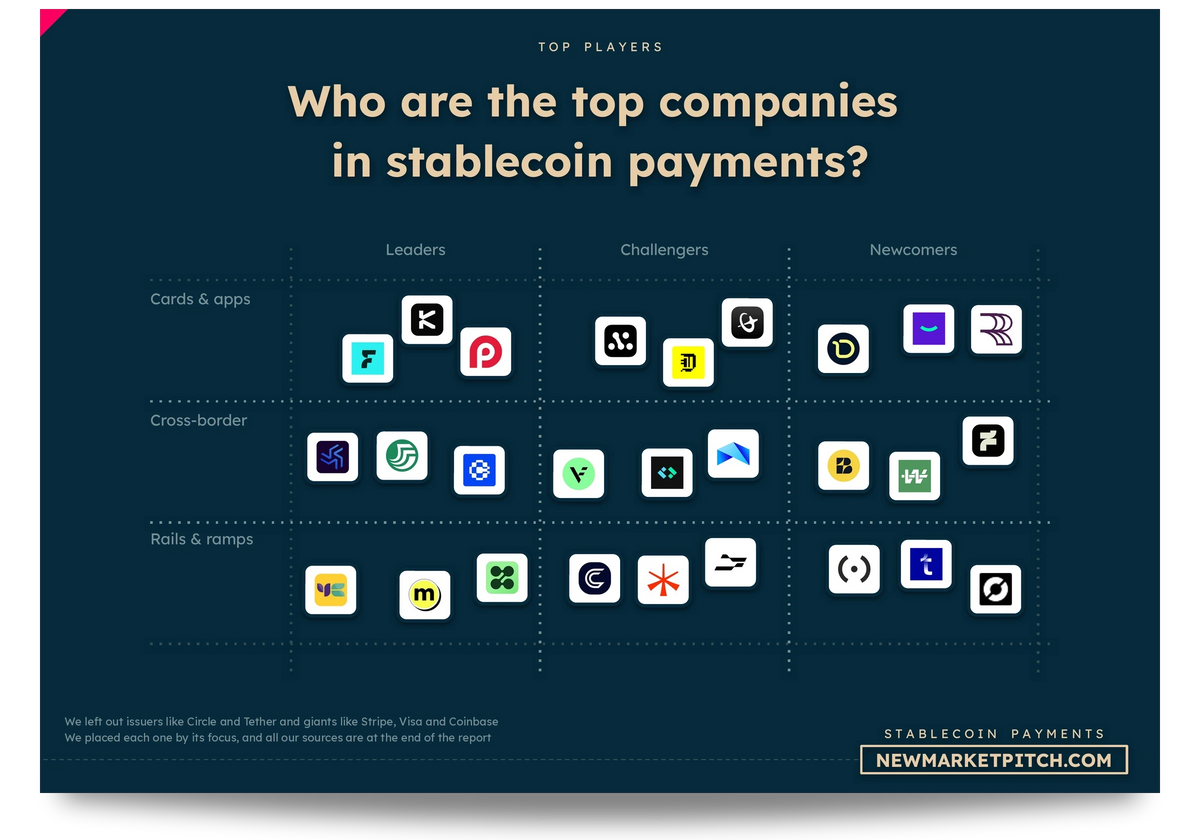
In our report covering the stablecoin payments market, we turn what is vague and complex into simple, useful visuals. Market maps like this one show you at a glance where every startup stands.
Is USDT or USDC winning the stablecoin payments market?
USDT currently has the stronger position in observed stablecoin payment volume, while USDC has become an important choice for regulated institutional infrastructure.
Artemis reported that USDT accounted for approximately 80% of payment volume among companies included in its earlier 2025 research. That dominance reflects the token's liquidity, distribution and established use in international transfers, particularly through the Tron network.
USDC has a different set of advantages. Visa has incorporated it into settlement services, and Circle has developed integrations aimed at financial institutions and businesses.
Circle's second-quarter 2026 results showed $73.3 billion in USDC circulation, up 19% year over year, and $14.8 trillion in quarterly on-chain transactions, up 151%. The transaction figure includes financial movements beyond actual payments, so it cannot tell us how much USDC consumers and businesses spent.
Tether and Circle are also competing over distribution partnerships, liquidity and reserve economics, which extend well beyond payments.
USDT has the stronger evidence of payment usage in the available provider samples. USDC's institutional partnerships could help it gain share, but they have not yet established that it has overtaken USDT in actual payment volume.
How much revenue can the stablecoin payments market generate?
At its currently measured size, the stablecoin payments market could support hundreds of millions to several billion dollars in annual transaction-related revenue, depending on what providers can charge.
Using the approximately $390 billion annualized payment-volume estimate, we calculated revenue under different effective fee assumptions. At 0.10%, the market would generate $390 million. At 0.25%, it would generate $975 million. A much higher 1% fee would produce $3.9 billion.
These are illustrative calculations rather than estimates of revenue already earned. They assume all measured payments are monetized at the same effective rate and exclude separate income from stablecoin reserves.
There is also a strong reason to expect pricing pressure. Businesses transferring large amounts have an incentive to negotiate lower fees, particularly when competing providers offer similar settlement times and currencies.
For example, charging 0.5% on a $1 million transaction generates $5,000. At 0.1%, that falls to $1,000. Companies transferring hundreds of millions annually have strong reasons to compare providers.
The companies with the most attractive economics may therefore combine payments with foreign exchange, liquidity management, account services and software rather than relying exclusively on blockchain transfer fees.
| Effective payment fee | Annual revenue on $390B |
|---|---|
| 0.05% | $195M |
| 0.10% | $390M |
| 0.15% | $585M |
| 0.20% | $780M |
| 0.25% | $975M |
| 0.50% | $1.95B |
| 0.75% | $2.93B |
| 1.00% | $3.90B |

Our research about stablecoin payments gets updated several times a month, so you always get the latest view of where things stand.
Are stablecoin companies making more money from interest than payments?
Stablecoin issuance remains heavily dependent on reserve income, and Circle's latest reported financial results show just how dominant that business can be.
In the second quarter of 2026, Circle generated $701 million in total revenue and reserve income. Of that amount, $668 million came from reserve income and $34 million from other revenue, with minor differences caused by rounding.
Reserve income represented approximately 95% of the quarterly total. Circle earned that money primarily from assets backing USDC, including short-term U.S. government securities.
The company also reported $412 million in distribution, transaction and other costs, leaving $289 million after those costs. This distinction matters because reserve revenue is partly shared with distribution partners rather than retained entirely by the issuer.
Tether operates under similar broad reserve economics, although its asset composition, disclosures and commercial arrangements differ. Visa estimated that Circle and Tether collectively earned more than $7 billion in interest income from their reserves in 2024.
A stablecoin issuer can consequently generate substantial revenue even when the tokens are mostly used for trading, savings or collateral. Its earnings depend heavily on outstanding balances and interest rates.
Stablecoin issuance is already a potentially much larger revenue pool than transaction processing at today's measured payment volumes. The two businesses deserve separate assessments.
Will banks and Stripe take most of the stablecoin payments market?
Banks and established payment companies are well positioned to capture a large share of stablecoin adoption, particularly because they already control customers, compliance and access to local currencies.
Stripe processed $1.9 trillion in business payment volume during 2025, up 34% from the previous year. Its acquisition of Bridge gives it a way to offer stablecoin functionality to existing customers rather than building a customer base from scratch.
Visa is taking a similar approach through its settlement infrastructure. Meanwhile, Marqeta's partnership with BVNK combines a card issuing platform that processed nearly $400 billion in payment volume during 2025 with a specialist stablecoin provider handling more than $39 billion annualized.
These combinations are revealing. A traditional payment company contributes distribution and established merchant relationships, while the stablecoin specialist provides technical infrastructure and access to digital-dollar liquidity.
Smaller startups can still win in difficult payment corridors, underserved markets or specialized treasury workflows. But a generic stablecoin transfer service is relatively easy for a large financial platform to incorporate.
Regulation strengthens the position of established players. The U.S. GENIUS Act and Europe's MiCA framework establish clearer requirements for stablecoin activities, while also increasing the importance of compliance capabilities and regulated financial partnerships. The U.S. framework has phased implementation, so the effect will develop over time.
The likely winners include both traditional payment companies and specialist infrastructure providers. The fiercest competition will be over customer relationships, not the basic act of moving tokens.
If you want more recent data on this point, please see our latest stablecoin payments market report.

In our market report about stablecoin payments, you will always find fresh funding data, taken straight from our own verified funding database.
How much bigger could stablecoin payments become over the next five years?
Stablecoin payments could reach several trillion dollars annually within five years, but that would require sustained growth well above the rate of the broader payments industry.
Starting with the $390 billion annualized baseline, we modeled three possible growth rates. These are scenarios, not forecasts.
At 20% annual growth, payment volume would reach approximately $970 billion after five years. At 40%, it would reach $2.10 trillion. At 60%, it would reach $4.09 trillion.
The more aggressive scenarios are possible mathematically because the market starts from a small base. But maintaining 40% or 60% annual growth becomes much harder as the market adds hundreds of billions in new volume every year.
There is a huge addressable market. McKinsey estimates worldwide B2B payments alone at roughly $1.6 quadrillion annually, while consumer-to-consumer, consumer-to-business and business-to-consumer flows add other large opportunities.
Nevertheless, even $4 trillion in stablecoin payments would represent only about 0.2% of the global payments denominator implied by McKinsey's current market-share estimate, assuming that denominator remained unchanged.
For now, the most credible path to a multitrillion-dollar market runs through business payments and international settlement. Consumer retail payments may become important too, but their measured base remains much smaller.
What would prove stablecoins are becoming a mainstream payment method?
Stablecoins will have a convincing claim to mainstream payment adoption when measurable commercial transactions grow consistently across businesses, consumers and financial institutions, with enough revenue to support the companies providing the infrastructure.
The first test is whether genuine payment growth continues to outpace broader blockchain activity. Visa's adjusted transfer metric grew 63% year over year, while McKinsey and Artemis found that actual payments more than doubled during 2025. The difference is encouraging, although the measures need consistent monitoring across future periods.
The second test is whether adoption spreads geographically. McKinsey and Artemis found that approximately 60% of identified stablecoin payment volume originated from Asia, with activity concentrated in a small number of financial hubs. A broader market would show sustained usage across additional countries and cross-border corridors.
Third, stablecoin settlement must become material within existing financial networks. Visa's $7 billion annualized settlement pilot and Bridge's growing processing volume show progress, but neither establishes widespread commercial adoption.
Finally, payment providers need to show that rising volumes produce durable profits after accounting for compliance, currency conversion, liquidity and distribution costs.
Those are the numbers worth watching. Record-breaking blockchain transfers alone won't tell us whether stablecoins have become a mainstream payment method.

In our document detailing everything you need to know about stablecoin payments, we look at what the winners do differently, so you can learn from the best instead of guessing.
Is the stablecoin payments market as big as it looks?
No. The stablecoin payments market is much smaller than its headline transaction volumes suggest, even though the underlying business is growing very quickly.
The clearest benchmark remains approximately $390 billion in annualized real-world payments, representing just 0.02% of global payment value. That is substantial for a relatively young payment method, but far below the tens of trillions in reported blockchain transfers.
The growth is particularly convincing in B2B payments, where McKinsey and Artemis measured an increase of 733% during 2025. Consumer adoption is progressing too, with stablecoin-linked card spending reaching an estimated $4.5 billion, up 673% year over year.
The economics are more complicated. Circle's financial results show that reserve income still dominates the economics of a major stablecoin issuer. Meanwhile, the revenue available from payment processing depends on how much providers can charge in a market where cheaper settlement is one of the main selling points.
We also see a clear competitive pattern: established payment companies are incorporating stablecoins into their existing products, while specialists such as BVNK and Bridge help connect blockchain settlement with traditional finance.
Our assessment is that stablecoin payments have become a real and fast-growing financial infrastructure business, with the strongest demand coming from cross-border transfers and corporate payments. A multitrillion-dollar payment market is plausible over time, but it has not arrived yet. Current payment volume, revenue generation and global penetration are still far smaller than the industry's most frequently quoted figures suggest.
If you want more recent data on this point, please see our latest stablecoin payments market report.
Our methodology
This analysis examines how large the stablecoin payments market actually is, separating identifiable commercial payments from the much larger volume of blockchain transactions. We assess current payment activity, historical growth, business and consumer adoption, geographic concentration, settlement infrastructure, competitive positioning, revenue economics and five-year market potential.
For each dimension, we identify recent observable developments, aggregate comparable figures, assess what the evidence establishes and draw conclusions from the combined findings. We prioritize original transaction research, payment-network data, company financial disclosures, operational announcements and official regulatory documents over headline market estimates or promotional claims.
Our primary market-sizing benchmark is the approximately $390 billion annualized payment volume estimated by McKinsey and Artemis Analytics from December 2025 activity. We compare it with Visa's approximately $33 trillion gross transfer figure and $10.2 trillion adjusted volume, while keeping their definitions separate. Blockchain transfers, exchange movements, identifiable end-user payments and stablecoin supply measure different economic activities and should not be combined into one market figure.
For payment adoption, we examine B2B, consumer-to-consumer, consumer-to-business and business-to-consumer flows separately. We also compare geographic origin, token usage and stablecoin-linked card spending. Earlier Artemis payment-provider datasets are used to understand the market's development, but changes in sample coverage prevent us from treating every reported observation as part of a single continuous growth series.
We cross-check market-level research against disclosed commercial activity at Stripe, Bridge, BVNK, Visa, Marqeta and RedotPay. Company-reported annualized processing volumes are treated as evidence of individual platform scale rather than interchangeable measurements of the entire market. We distinguish payment processing from card-network settlement and direct stablecoin acceptance.
For revenue economics, we calculate illustrative transaction revenue by applying effective fees of 0.05% to 1.00% to the $390 billion payment baseline. These calculations are potential revenue scenarios, not reported industry earnings. Circle's quarterly disclosures are used separately to assess the importance of reserve income, distribution costs and outstanding stablecoin balances. We do not combine reserve earnings with hypothetical payment-processing revenue.
Our five-year market scenarios compound the current annualized baseline at 20%, 40% and 60% annual growth. The resulting volumes are mathematical scenarios rather than forecasts. We compare them with the wider global payments market to assess potential penetration without assuming that today's growth rates will persist indefinitely.
Regulatory developments are assessed using the enacted U.S. GENIUS Act and the European Union's MiCA framework. We distinguish enacted legislation and implementation requirements from their eventual commercial effects, particularly where implementation is phased or still developing.
Key sources include McKinsey and Artemis on identifiable stablecoin payments, Visa's Onchain Analytics dashboard, Visa's analysis of stablecoin transfer activity, Visa's analytics methodology updates, and Artemis' bottom-up research on stablecoin payment providers.
For commercial adoption and company economics, we use Stripe's 2025 annual update, Stripe's Bridge acquisition announcement, BVNK and Marqeta's partnership announcement, Visa's stablecoin settlement expansion, Circle's second-quarter 2026 financial results, and RedotPay's Series B announcement.
Additional sources include the World Bank's Remittance Prices Worldwide database, the official text of the U.S. GENIUS Act, the European Commission's MiCA regulatory documentation, and the European Commission's May 2026 MiCA review.

If you build or invest in the stablecoin payments market, you need to know which business models pay off now and which ones are fading. That's why our report covering it has a whole section on it.
Written by the New Market Pitch teamWe track new markets so founders and investors can move faster. About us