Surgical robotics: what’s funding like now?
Whether you're building or investing in the surgical robotics market, our report covers everything you need to know: the players, the money, and what's coming next.
Summary
Surgical robotics funding is healthier in 2026 in terms of deal activity, the number of companies attracting investment, and financing consistency. The market recorded 32 deals involving 31 companies over the latest 12 months, compared with 21 deals and 20 companies previously. Whether total capital increased is less certain because most financing amounts were not disclosed precisely.
Funding activity increased 52.4%, and the number of funded companies rose 55.0%. Deals occurred in all 12 months, compared with eight months in the previous period. The expansion reflects more businesses securing investment rather than a handful of established developers raising repeatedly.
The apparent 21.7% decline in funding capital is based on an incomplete sample. Exactly disclosed rounds totaled $378.48 million, down from $483.28 million, but only 12 of 32 current deals had precise amounts. Cornerstone Robotics' approximately $200 million financing was excluded from this subtotal.
Funding below the largest deal sizes held up better. Excluding rounds above $50 million, exactly disclosed capital increased 24.4%, from $103.28 million to $128.48 million. At the same time, the median exact-size round fell 57.0% to $13.23 million, suggesting smaller checks became more prominent among transactions with precise disclosures.
Soft-tissue surgical robotics has become the strongest funding category. Deals jumped from two to 11, increasing its share of the market from 9.5% to 34.4%. Distalmotion's $150 million Series G and Cornerstone's approximately $200 million financing illustrate the substantial capital flowing toward commercially advanced platforms.
The category shift is substantial. Microsurgery declined from eight to six deals, orthopedic robotics dropped from three to none, while interventional and endoscopic robotics both expanded. Investors are financing a broader range of surgical applications, but soft-tissue robots account for the most pronounced increase.
Most financing still goes to companies with previous investment histories. Follow-on rounds represented 84.4% of current deals, even as first financings increased from three to five. Seed deals doubled from three to six, while Series A activity rose only slightly, from eight to nine.
The largest rounds are increasingly connected to commercial deployment. Distalmotion has been expanding DEXTER adoption in US ambulatory surgery centers, while Cornerstone has pursued international regulatory approvals and distribution partnerships. Clinical validation remains critical, but established developers are raising capital to put more systems into use.
China remains the largest individual country by funding deal count, with 12 transactions, up from nine. The United States increased from seven to ten and Europe from two to five. The geographic expansion is broader than a China-only story, even though Asia-Pacific continues to account for more than half of recorded activity.
Strategic investors remain involved, but their share of recorded financing events has barely moved, from 23.8% to 25.0%. Johnson & Johnson Innovation's investment in Distalmotion and Cornerstone's announced Medtronic partnership demonstrate corporate interest without proving a market-wide acceleration in strategic participation.
The strongest conclusion is that surgical robotics has become a more active and commercially developed fundraising market. More companies are getting financed, soft-tissue systems are attracting exceptional attention, and leading developers are advancing toward wider clinical use. The actual change in total invested capital remains unresolved because disclosure is incomplete.

Written by the New Market Pitch teamWe track new markets so founders and investors can move faster. About us

In our report covering the surgical robotics market, you will always find fresh funding data, taken straight from our own verified funding database.
All funding deals in the surgical robotics market over the last 24 months
Below is the table listing all the deals. You can find our methodology at the end of this page.
If you want a deeper understanding of the market and its current dynamics, get our report covering the surgical robotics market.
| Company | Category | Date | Stage | Deal size | What they do | Region | Lead investors | Country | Rank |
|---|---|---|---|---|---|---|---|---|---|
| ZAP Surgical Systems | Interventional Robotics | October 2026 | Series D+ | $36M | Robotic stereotactic brain radiosurgery | North America | Catalio Capital Management | United States | |
| DeepSurgery | Microsurgery Robots | October 2026 | Series B | $14M | Intelligent microsurgery robotic systems | Asia-Pacific | Mifang Capital, Shengshi Investment | China | |
| Abrobo | Interventional Robotics | October 2026 | Series A | $1.4M+ | Develops PANVIS robotic platforms for neurovascular, coronary and peripheral interventional surgery. | Asia-Pacific | Puhe Capital | China | |
| Nami Surgical | Soft-Tissue Surgical Robots | October 2026 | Unknown | ~$4.5M | Ultrasonic surgical tools for robotic surgery | Europe | Scottish National Investment Bank | United Kingdom | |
| Medical Microinstruments | Microsurgery Robots | October 2026 | Series D+ | $125M | Robotic microsurgery and precision instruments | North America | BioStar Capital | United States | |
| Aleph Surgical | Soft-Tissue Surgical Robots | September 2026 | Seed | $7.5M | Autonomous surgical robotics AI | Middle East | Andreessen Horowitz | Israel | |
| Virtual Incision | Soft-Tissue Surgical Robots | September 2026 | Unknown | $4M | Miniaturized abdominal surgical robotic systems | North America | Not disclosed | United States | |
| Qubot Technology | Interventional Robotics | September 2026 | Seed | ~$15M | Magnetic-controlled interventional surgical robots | Asia-Pacific | Noyu Capital | China | |
| Deneb Medical | Spine Surgery Robots | September 2026 | Unknown | ~$17M | Robotic system for endoscopic spine surgery | Europe | Not disclosed | Spain | |
| Lupin Dental | Dental Surgery Robots | August 2026 | Series A | ~$18M | Robotic systems for dental procedures | Europe | Fynveur | France | |
| Andromeda Surgical | Endoluminal & Endoscopic Robots | August 2026 | Series A | $15M | Autonomous robotic surgery platform | North America | Standard Capital | United States | |
| Magnendo | Interventional Robotics | July 2026 | Series A | $18M | Robotic navigation for neurovascular procedures | North America | Penumbra | United States | |
| Endo Tools Therapeutics | Endoluminal & Endoscopic Robots | July 2026 | Series C | $22M | Endoscopic tissue intervention system; precise robotic control unverif | Europe | Capricorn Partners | Belgium | |
| Rosota | Soft-Tissue Surgical Robots | July 2026 | Seed | ~$1.1M | Robotic surgical assistance systems | Asia-Pacific | FuturePlay | South Korea | |
| Biobot Surgical | Interventional Robotics | June 2026 | Series C | ~$16M | Robotic prostate biopsy and treatment | Asia-Pacific | ClavystBio | Singapore | |
| HistoSonics | Interventional Robotics | June 2026 | Unknown | Undisclosed | Noninvasive focused-ultrasound tumor destruction | North America | Not disclosed | United States | |
| Channel Robotics | Endoluminal & Endoscopic Robots | June 2026 | Seed | $2.5M | Robotic systems for minimally invasive surgery | North America | True Ventures | United States | |
| Oculotronics | Microsurgery Robots | June 2026 | Series A | Undisclosed | Robotic retinal microsurgery systems | Asia-Pacific | Yuanhang Capital | China | |
| Petal Surgical | Interventional Robotics | June 2026 | Unknown | Undisclosed | Noninvasive robotic tissue ablation | North America | Blue Pool Capital | United States | |
| ROBO Medical Technology | Orthopedic Surgical Robots | May 2026 | Series B | $1.4M+ | Robotic systems for orthopedic surgery | Asia-Pacific | Tsinghua Innovation Ventures (Shuimu Capital) | China | |
| Virtuoso Surgical | Endoluminal & Endoscopic Robots | May 2026 | Series B | $2.9M | Robotic endoscopic microsurgical instruments | North America | Not disclosed | United States | |
| TIROMU | Microsurgery Robots | April 2026 | Seed | $1.4M+ | Robotic ophthalmic microsurgery and injections | Asia-Pacific | Aibo Hongsheng Fund, Qihang Venture Capital | China | |
| Puncture Robotic | Interventional Robotics | April 2026 | Series B | ~$15M | Robotic precision needle interventions | Asia-Pacific | Not disclosed | China | |
| Levita Magnetics | Soft-Tissue Surgical Robots | April 2026 | Series D+ | $31M | Magnetic-assisted minimally invasive surgical robotics | North America | Not disclosed | United States | |
| XCath | Interventional Robotics | April 2026 | Series C | $30M | Neurovascular endovascular surgical robotics | North America | Crescent Enterprises, Fred Moll | United States | |
| Petal Surgical | Interventional Robotics | March 2026 | Series A | $5M+ | Noninvasive robotic tissue ablation | North America | Not disclosed | United States | |
| Borns Medical Robotics | Soft-Tissue Surgical Robots | March 2026 | Unknown | Undisclosed | Minimally invasive surgical robotics | Asia-Pacific | Not disclosed | China | |
| Qoly | Soft-Tissue Surgical Robots | February 2026 | Series A | ~$12M | Compact robots for laparoscopic surgery | Asia-Pacific | Fast Track Initiative, MedVenture Partners | Japan | |
| Deep Medical | Microsurgery Robots | February 2026 | Series A | Undisclosed | Robotic arms for precision microsurgery procedures | Asia-Pacific | Not disclosed | China | |
| DeepSurgery | Microsurgery Robots | February 2026 | Series A | Undisclosed | Intelligent microsurgery robotic systems | Asia-Pacific | Not disclosed | China | |
| Nami Surgical | Soft-Tissue Surgical Robots | January 2026 | Unknown | $2.6M | Ultrasonic surgical tools for robotic surgery | Europe | Eos Advisory | United Kingdom | |
| Dessight Biomedical | Microsurgery Robots | January 2026 | Series A | Undisclosed | Ophthalmic microsurgery robotic systems | Asia-Pacific | Fortune Capital | China | |
| Dessight Biomedical | Microsurgery Robots | January 2026 | Series A | Undisclosed | Ophthalmic microsurgery robotic systems | Asia-Pacific | Not disclosed | China | |
| Gibbon Medical Technology | Microsurgery Robots | January 2026 | Seed | Undisclosed | Microsurgery robot for tiny vessel suturing | Asia-Pacific | Wuxi Venture Capital | China | |
| Surgerii Robotics | Soft-Tissue Surgical Robots | December 2025 | Series D+ | $100M | Single-port minimally invasive surgical robotics | Asia-Pacific | Loyal Valley Capital | China | |
| Kangji Weijing Medical Robotics | Soft-Tissue Surgical Robots | December 2025 | Series B | Undisclosed | Single-port robotic surgery systems | Asia-Pacific | Not disclosed | China | |
| Würzburg Dynamics | Interventional Robotics | December 2025 | Series B | $17M+ | AI-guided surgical robotics for needle procedures | Asia-Pacific | Guangzhou Jinkong Fund, Tianhe Investment Funds | China | |
| Agloe Medical Technologies | Spine Surgery Robots | December 2025 | Series A | Undisclosed | Robotic systems for minimally invasive surgery | Asia-Pacific | Shunxi Fund, Qiming Venture Partners | China | |
| EndoRobotics | Endoluminal & Endoscopic Robots | December 2025 | Series C | ~$22M | Robotic gastrointestinal endoscopic surgery | Asia-Pacific | Premier Partners | South Korea | |
| Momentis Surgical | Soft-Tissue Surgical Robots | November 2025 | Unknown | $14M | Miniaturized robotic minimally invasive surgery | Middle East | Not disclosed | Israel | |
| Distalmotion | Soft-Tissue Surgical Robots | November 2025 | Series D+ | $150M | Soft-tissue robotic surgery systems | Europe | Revival Healthcare Capital | Switzerland | |
| Cornerstone Robotics | Soft-Tissue Surgical Robots | November 2025 | Series D+ | ~$200M | Multi-port laparoscopic surgical robots | Asia-Pacific | Hong Kong Investment Corporation | Hong Kong | |
| Sovato | Soft-Tissue Surgical Robots | November 2025 | Series B | Undisclosed | Remote robotic surgery connectivity platform | North America | Not disclosed | United States | |
| Surgical Automations | Endoluminal & Endoscopic Robots | October 2025 | Seed | $3.4M | Robotic automation for minimally invasive surgery | North America | Fred Moll, TurboStart | United States | |
| Petal Surgical | Interventional Robotics | October 2025 | Series A | $10M | Noninvasive robotic tissue ablation | North America | K50 Ventures, TSVC | United States | |
| HistoSonics | Interventional Robotics | October 2025 | Series D+ | $250M | Noninvasive focused-ultrasound tumor destruction | North America | New ownership group | United States | |
| Jupiter Endovascular | Interventional Robotics | October 2025 | Series B | $40M+ | Robotic or remotely actuated endovascular catheter platform | North America | Sonder Capital | United States | |
| Panda Surgical | Microsurgery Robots | October 2025 | Seed | $1.3M | Robotic platform for minimally invasive surgery | Europe | Oxford Investment Consultants | United Kingdom | |
| AGIBOT Medtech | Soft-Tissue Surgical Robots | October 2025 | Series B | Undisclosed | Robotic systems for surgery | Asia-Pacific | Mingxi Capital | China | |
| AiM Medical Robotics | Interventional Robotics | September 2025 | Series A | $8.1M | MRI-compatible neurosurgical robotics | North America | IQ Capital, 1540 Ventures | United States | |
| KouTech Medical Technology | Microsurgery Robots | September 2025 | Series B | $28M+ | Microsurgical robotic systems and instruments | Asia-Pacific | Not disclosed | China | |
| Ronovo Surgical | Soft-Tissue Surgical Robots | September 2025 | Series D+ | $67M | Modular laparoscopic surgical robots | Asia-Pacific | Johnson & Johnson Development Corporation (JJDC) | China | |
| Andromeda Surgical | Endoluminal & Endoscopic Robots | September 2025 | Seed | Undisclosed | Autonomous robotic surgery platform | North America | Not disclosed | United States | |
| Borns Medical Robotics | Soft-Tissue Surgical Robots | September 2025 | Unknown | Undisclosed | Minimally invasive surgical robotics | Asia-Pacific | Not disclosed | China | |
| Quantum Surgical | Interventional Robotics | September 2025 | Unknown | Undisclosed | Robotic image-guided tumor ablation | Europe | Not disclosed | France | |
| Riverfield | Soft-Tissue Surgical Robots | August 2025 | Series D+ | Undisclosed | Pneumatic force-feedback surgical robots | Asia-Pacific | Not disclosed | Japan | |
| Swan EndoSurgical | Endoluminal & Endoscopic Robots | July 2025 | Unknown | $65M+ | Robotic system for endoscopic surgery | North America | Not disclosed | United States | |
| EndoQuest Robotics | Endoluminal & Endoscopic Robots | July 2025 | Series D+ | Undisclosed | Flexible incisionless endoluminal surgical robots | North America | Crescent Enterprises, Dr. Fred Moll | United States | |
| Synaptive Medical | Microsurgery Robots | July 2025 | Growth Equity | Undisclosed | Robotic neurosurgical imaging and navigation | North America | Not disclosed | Canada | |
| ForSight Robotics | Microsurgery Robots | June 2025 | Series B | $125M | Robotic ophthalmic and cataract surgery | Middle East | Eclipse | Israel | |
| Dessight Biomedical | Microsurgery Robots | June 2025 | Series A | ~$14M | Ophthalmic microsurgery robotic systems | Asia-Pacific | Panlin Capital | China | |
| Deep Medical | Microsurgery Robots | June 2025 | Seed | Undisclosed | Robotic arms for precision microsurgery procedures | Asia-Pacific | Wondfo Venture Valley | China | |
| DeepSurgery | Microsurgery Robots | June 2025 | Seed | Undisclosed | Intelligent microsurgery robotic systems | Asia-Pacific | Not disclosed | China | |
| Lancet Robotics | Orthopedic Surgical Robots | June 2025 | Series A | ~$2.8M | Robotic orthopedic surgery and navigation | Asia-Pacific | Yuehu Fund | China | |
| Aopeng Medical Technology | Interventional Robotics | April 2025 | Series C | ~$14M | Surgical robots for minimally invasive procedures | Asia-Pacific | Jinan International Medical Center Industrial Development, Jinan Huaiyin Guorong Holdings | China | |
| Biobot Surgical | Interventional Robotics | April 2025 | Growth Equity | $8.5M | Robotic prostate biopsy and treatment | Asia-Pacific | Not disclosed | Singapore | |
| Dessight Biomedical | Microsurgery Robots | April 2025 | Unknown | Undisclosed | Ophthalmic microsurgery robotic systems | Asia-Pacific | Not disclosed | China | |
| iotaMotion | Microsurgery Robots | January 2025 | Series B | $6.4M | Robotic cochlear implant electrode insertion | North America | Not disclosed | United States | |
| TrueHealth Medical | Interventional Robotics | January 2025 | Series B | $28M | Robotic puncture and tumor ablation | Asia-Pacific | Not disclosed | China | |
| Convergence Medical | Orthopedic Surgical Robots | January 2025 | Series A | ~$3.1M | Robotic systems for orthopedic surgery | Asia-Pacific | Avicella Capital | Australia | |
| Robeauté | Microsurgery Robots | January 2025 | Series A | $28M | Microrobots for brain surgery | Europe | Plural, Cherry Ventures, Kindred Ventures | France | |
| Cornerstone Robotics | Soft-Tissue Surgical Robots | January 2025 | Series C | $70M+ | Multi-port laparoscopic surgical robots | Asia-Pacific | EQT | Hong Kong | |
| Zeta Surgical | Interventional Robotics | January 2025 | Series A | $5M | AI-guided neurosurgical navigation and robotics | North America | Not disclosed | United States | |
| Rossum Robotics | Orthopedic Surgical Robots | January 2025 | Series C | Undisclosed | Robotic pelvic fracture reduction systems | Asia-Pacific | Not disclosed | China | |
| Tuodao Medical | Soft-Tissue Surgical Robots | January 2025 | Unknown | Undisclosed | Multi-specialty surgical robotics platforms | Asia-Pacific | Not disclosed | China | |
| Sagebot | Soft-Tissue Surgical Robots | December 2024 | Series A | Undisclosed | Multi-specialty laparoscopic surgical robotic systems | Asia-Pacific | Not disclosed | China | |
| Capstan Medical | Interventional Robotics | December 2024 | Series C | $110M | Robotic heart-valve repair systems | North America | Eclipse | United States | |
| AiM Medical Robotics | Interventional Robotics | December 2024 | Seed | $3.8M | MRI-compatible neurosurgical robotics | North America | Not disclosed | United States | |
| ROEN Surgical | Endoluminal & Endoscopic Robots | December 2024 | Series B | Undisclosed | Robotic endoscopic kidney stone removal | Asia-Pacific | Not disclosed | South Korea | |
| Lancet Robotics | Orthopedic Surgical Robots | November 2024 | Series A | $2.7M+ | Robotic orthopedic surgery and navigation | Asia-Pacific | CICC Capital | China | |
| ZAP Surgical Systems | Interventional Robotics | November 2024 | Series D+ | $78M | Robotic stereotactic brain radiosurgery | North America | Qingdao Baheal Medical | United States | |
| AMIT Medical | Interventional Robotics | November 2024 | Series A | $2.7M+ | Robotic systems for minimally invasive surgery | Asia-Pacific | Qianhai Ark Healthcare Fund | China | |
| Huiyue Medical Technology | Endoluminal & Endoscopic Robots | October 2024 | Seed | $2.7M+ | Robotic catheter system for lung procedures | Asia-Pacific | Hetang Venture Capital | China |

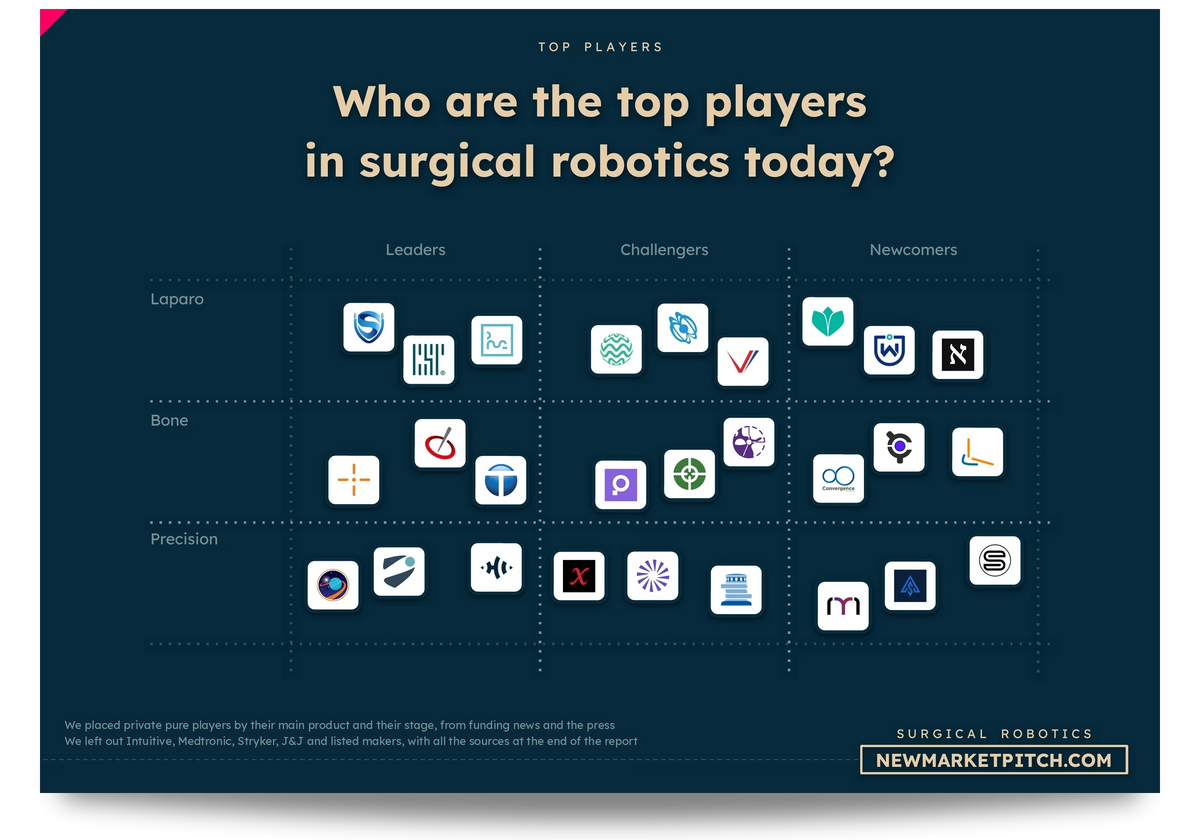
In our research about surgical robots, we turn what is vague and complex into simple, useful visuals. Market maps like this one show you at a glance where every startup stands.
Is the surgical robotics funding market healthier than a year ago?
Surgical robotics funding is in better shape when we look at how many companies are getting financed, although the amount of money actually flowing into the market is harder to pin down.
Over the latest 12-month period, we counted 32 funding deals involving 31 companies, compared with 21 deals and 20 companies in the previous year. That's a 52.4% increase in transactions and a 55.0% increase in funded companies. Financing also happened in every single month, whereas four months had no recorded deals the year before.
The improvement goes beyond a few established companies raising money repeatedly. More businesses are securing financing, and investment activity has become much more regular.
But the capital figures tell a different story. Among rounds with exact disclosed USD amounts, the subtotal fell from $483.28 million to $378.48 million. That comparison excludes most transactions, including Cornerstone Robotics' approximately $200 million financing, because the amounts were either approximate, expressed as lower bounds, or undisclosed.
We're therefore seeing a broader and more active market, with some major companies attracting substantial growth capital. Whether the industry received more money overall remains unresolved.
| Funding metric | Latest 12M | Previous 12M | Change |
|---|---|---|---|
| Funding deals | 32 | 21 | +52.4% |
| Funded companies | 31 | 20 | +55.0% |
| First financings | 5 | 3 | +66.7% |
| Follow-on financings | 27 | 18 | +50.0% |
| Months with funding | 12 | 8 | +50.0% |
| Exact disclosed capital | $378.48M | $483.28M | -21.7% |
| Median exact-size round | $13.23M | $30.74M | -57.0% |
Did surgical robotics funding actually decline in 2026?
The reported decline in surgical robotics investment is misleading because too many funding amounts are missing or approximate to calculate a reliable market-wide total.
Our exact-amount figures show a 21.7% fall in capital, but they cover only 12 of the 32 current financing events and nine of the 21 previous events. The remaining rounds include undisclosed amounts, minimum commitments, and approximate figures.
Cornerstone Robotics makes the problem obvious. In November 2025, the Hong Kong-based company announced an approximately $200 million round to accelerate commercialization and global expansion of its Sentire surgical platform.
Adding that one indicative transaction to the $378.48 million current subtotal would bring the figure to approximately $578.48 million, already above the previous year's exact-amount subtotal. But that wouldn't establish genuine year-over-year growth, since the previous period also contains financing amounts that cannot be measured precisely.
Large surgical robotics investments can involve multiple investors, commitments, and financing stages. With so much incomplete disclosure, the exact-amount subtotals are useful for analyzing the disclosed sample, not for declaring that the entire market contracted.

Your time is limited. In our market report about surgical robots, we put numbers on each part of the market, so you can see where it makes sense to focus.
Would surgical robotics funding still look strong without the biggest deals?
Smaller disclosed surgical robotics financings actually increased, even though the overall exact-amount capital subtotal declined.
When we remove rounds above $50 million, the remaining exact-amount funding rises from $103.28 million to $128.48 million, an increase of 24.4%. Financing below the largest deal sizes held up.
The concentration of money is still striking. Distalmotion's $150 million round alone represents 39.6% of current exact-size capital. The three largest disclosed rounds account for 74.0%, up from 64.8% previously.
Cornerstone's approximately $200 million financing would make the concentration even more pronounced in an indicative calculation, but including it selectively would distort the comparison.
So we have two developments happening together. Smaller recorded financings are contributing more capital within the exact-size sample, while large companies continue to absorb a substantial share of the money we can measure.
| Capital indicator | Latest 12M | Previous 12M | Change |
|---|---|---|---|
| Exact disclosed capital | $378.48M | $483.28M | -21.7% |
| Excluding rounds above $50M | $128.48M | $103.28M | +24.4% |
| Excluding rounds above $100M | $228.48M | $248.28M | -8.0% |
| Largest exact-size round | $150M | $125M | +20.0% |
| Largest round share | 39.6% | 25.9% | +13.7 pp |
| Top three rounds' share | 74.0% | 64.8% | +9.2 pp |
| Top five rounds' share | 86.1% | 85.0% | +1.1 pp |
Are more surgical robotics startups getting funded now?
Yes, surgical robotics funding has reached 11 more companies than in the preceding year.
We counted 31 distinct funded companies in the latest period, compared with 20 previously. Just one company in each period received multiple recorded financings within the same 12 months, so the increase largely comes from additional businesses getting investment.
The monthly numbers make the change even clearer. Average activity rose from 1.75 to 2.67 deals per month, and the median monthly count increased from 1.5 to 2.5.
The current period included transactions involving established developers such as Distalmotion and Cornerstone Robotics, alongside financing for companies including Petal Surgical, Beijing Surgerii, and AGIBOT MedTech.
These businesses are working at different levels of technical and commercial maturity. Their presence in the same financing cycle shows that investment isn't restricted to the best-known platforms.
The regularity is worth emphasizing. Recorded funding appeared throughout the year rather than being concentrated into a few isolated months.

In our document detailing everything you need to know about surgical robotics, we always try to gather several sources and make estimates that make sense, so you can work with solid numbers.
Are investors still funding new surgical robotics startups?
New surgical robotics startups are attracting more first financings, but most investment activity still involves companies that have already raised money.
We identified five first-time financings in the latest 12 months, up from three previously. That's a 66.7% increase, although the numbers are small.
Their share of total financing activity barely changed, moving from 14.3% to 15.6%. Follow-on rounds still represented 84.4% of current transactions.
That preference makes sense given how surgical robots reach the market. A company may need several rounds of funding before completing clinical trials, obtaining regulatory clearances, setting up manufacturing, and developing a credible sales operation.
We also found that Seed financing doubled from three to six deals, while Series A transactions edged up from eight to nine. Investors haven't stopped financing young developers, even as more mature companies pursue much larger commercial opportunities.
For new entrants, the positive change is straightforward: more businesses are getting through the financing process, even though first-time recipients remain a small minority.
Are surgical robotics investors writing smaller checks?
Disclosed surgical robotics rounds have become noticeably smaller, although incomplete reporting prevents us from calling this a market-wide trend.
The median exact-size financing declined from $30.74 million to $13.23 million. That's a substantial 57.0% decrease.
Looking at individual size brackets helps explain the result. Eight of the 12 current exact-size rounds were below $20 million, compared with two of nine previously. We also recorded three current financings below $5 million, versus none in the earlier period.
Meanwhile, the number of exact-size rounds between $50 million and $100 million fell from two to zero.
Smaller investments became more prominent among companies that disclosed precise amounts. That could reflect additional development-stage funding, although round sizes alone cannot establish it.
There's a catch: several Chinese financings were reported using broad descriptions such as tens or hundreds of millions of renminbi. Those transactions cannot be assigned reliably to a precise USD size bracket.
The disclosed median fell sharply. Whether the typical surgical robotics startup actually received a smaller investment remains an open question.
| Deal-size bracket | Latest 12M | Previous 12M | Current share |
|---|---|---|---|
| Under $5M | 3 | 0 | 25.0% |
| $5M to under $20M | 5 | 2 | 41.7% |
| $20M to under $50M | 2 | 3 | 16.7% |
| $50M to under $100M | 0 | 2 | 0% |
| $100M and above | 2 | 2 | 16.7% |
| Total exact-size rounds | 12 | 9 | 100% |
| Rounds below $20M | 8 | 2 | 66.7% |

Our report covering the surgical robotics market gets updated several times a month, so you always get the latest view of where things stand.
Why is soft-tissue surgical robotics attracting so much money?
Soft-tissue surgical robotics is the standout segment of the funding market, with far more financing deals and several companies raising money to expand commercially.
The category went from two deals to 11 in a single year. Its share of all surgical robotics financing events jumped from 9.5% to 34.4%.
Distalmotion is one of the clearest examples. In November 2025, the Swiss company closed a $150 million Series G round led by Revival Healthcare Capital. The money was primarily intended to accelerate US adoption of its DEXTER robotic surgery system, particularly in ambulatory surgery centers.
Cornerstone Robotics followed a similar commercial direction with its approximately $200 million financing. The company's Sentire system had already received regulatory approval in China and entered clinical use, giving it a foundation for international expansion.
Smaller financing events involving Petal Surgical, Beijing Surgerii, and AGIBOT MedTech show that investors are also backing developers at earlier stages of building surgical platforms.
Soft-tissue robotics therefore has both substantial growth-stage recipients and a growing group of younger financed businesses. Its momentum extends well beyond one unusually large transaction.
Is microsurgery losing investors to soft-tissue surgical robots?
Microsurgery has lost ground relative to soft-tissue robotics, but investors are still financing companies developing robots for highly specialized procedures.
Recorded microsurgery deals declined from eight to six, while soft-tissue financing increased sharply. The previous period had also benefited from ForSight Robotics' $125 million Series B round in June 2025.
ForSight is developing ORYOM, a robotic platform intended for cataract surgery and other eye procedures. Its financing was led by Eclipse and supported preparations for first-in-human clinical trials. The company had also achieved ISO 13485 certification and reported that surgeons had completed hundreds of procedures using animal eye models.
Those achievements help explain why a company can attract a nine-figure investment before reaching routine commercial deployment. Robotic ophthalmic surgery requires exceptionally precise instruments, clinical evidence, and regulatory work.
Soft-tissue developers such as Distalmotion are further along in selling systems to healthcare providers, giving their rounds a different commercial purpose.
The shift toward soft-tissue robotics is unmistakable in deal counts. But six microsurgery financings in the latest year hardly suggest that specialized surgical platforms have lost investor support altogether.

In our research about surgical robots, we look at what the winners do differently, so you can learn from the best instead of guessing.
Which surgical robotics categories are losing momentum?
Orthopedic surgical robotics recorded the sharpest decline in financing activity, while several other specialties continued adding deals.
Orthopedic robotics went from three recorded transactions to none. Microsurgery also declined, from eight to six, although it remained one of the larger categories.
Interventional robotics increased from five to seven deals, and endoscopic robotics rose from three to five. Spine surgery and dental robotics also appeared in the current financing records after having no deals in the preceding period.
One or two transactions aren't enough to establish sustained demand in a small specialty. Still, the market is no longer expanding in just one direction: soft-tissue robotics has become the clear leader, while other applications are moving at very different speeds.
| Surgical robotics category | Latest 12M | Previous 12M | Share change |
|---|---|---|---|
| Soft-tissue surgical robots | 11 | 2 | +24.9 pp |
| Microsurgery robots | 6 | 8 | -19.3 pp |
| Interventional robotics | 7 | 5 | -1.9 pp |
| Endoscopic robots | 5 | 3 | +1.3 pp |
| Orthopedic surgical robots | 0 | 3 | -14.3 pp |
| Spine surgery robots | 2 | 0 | +6.3 pp |
| Dental surgery robots | 1 | 0 | +3.1 pp |
Are surgical robotics investors becoming more selective?
We haven't found convincing evidence that surgical robotics investors became more selective over the last year, at least when comparing the stages and ages of companies receiving funding.
Among rounds with a known stage, Seed and Series A accounted for 55.6% of current transactions, almost identical to the previous 55.0%.
The number of Series B deals increased from three to five, while Series D and later financings also rose from three to five. Activity increased among both younger companies and businesses that had already completed several funding rounds.
There is one potential sign of greater maturity. Based on founding information in our research, the approximate median company age at financing increased from four to five years.
But some companies are corporate spin-offs, and a founding year doesn't necessarily tell us when a project began developing its technology. Unknown funding stages also became more common, rising from one to five records.
Investors are backing companies across a fairly wide range of stages. The available figures don't demonstrate a meaningful shift toward stricter financing requirements.

In our market report about surgical robots, we don't want to repeat what boring consulting reports say. Instead, we show you the real and latest market signals that matter.
Do surgical robotics startups need more proof before investors fund them?
Surgical robotics companies raising the biggest rounds often have substantial regulatory, clinical, or commercial achievements behind them. We can see this in several leading transactions, although we cannot prove that investors have raised their requirements compared with a year ago.
Distalmotion's progress before its $150 million financing is a good example. In May 2025, its DEXTER system received FDA clearance for cholecystectomy, followed by clearance for hysterectomy and related procedures in October.
In June 2025, AdventHealth announced the acquisition of multiple DEXTER systems, with initial procedures already completed. The company entered its next financing round with regulatory progress and evidence of real customer adoption.
Cornerstone Robotics had also moved beyond basic development. Its Sentire platform received Chinese regulatory approval in 2024, and the company began clinical evaluation in the United Kingdom in 2025.
In May 2026, Cornerstone announced European CE certification and Singapore regulatory approval. In September, it announced a strategic partnership with Medtronic involving a proposed approximately $700 million strategic investment and distribution rights in selected markets.
We have not added that announced investment to the historical funding totals without establishing its closing status and comparable financing treatment.
The largest recipients can demonstrate meaningful progress toward clinical acceptance and commercial adoption. Whether smaller surgical robotics startups now face a higher funding bar would require a fuller comparison of their milestones before financing.
Are surgical robotics companies finally raising money to sell robots?
Some of the largest recent surgical robotics rounds are focused on selling and deploying systems, especially in the soft-tissue segment.
Distalmotion said its November 2025 financing would primarily support US commercial adoption of DEXTER. Its subsequent announcements show that the expansion is advancing.
In May 2026, the company reported growing adoption across US ambulatory surgery centers. In June, it announced additional FDA clearance for gynecological procedures, followed by clearance for ventral hernia repair in August. Those approvals expanded the procedures for which DEXTER could be used in the United States.
Cornerstone's November 2025 financing also targeted commercialization and technological development. Its later European and Singapore regulatory approvals, alongside the announced Medtronic distribution partnership, supported the company's international rollout plans.
Compare those developments with ForSight Robotics' June 2025 round, where the main next step was preparing first-in-human clinical trials.
The financing needs are very different. Clinical development remains a major reason companies raise money, but commercial rollout has become a central objective for some of the best-funded surgical robotics developers.

Learning from others' mistakes is the cheapest lesson there is. In our document detailing everything you need to know about surgical robotics, we look at what broke startups before you, so you don't repeat it.
Are outpatient surgery centers becoming the next big market for surgical robots?
Outpatient surgery centers are a major commercial target for companies such as Distalmotion, and their operational requirements are influencing how surgical robots are designed and sold.
Traditional robotic surgery systems can require substantial space, expensive equipment, specialist training, and dedicated workflows. Ambulatory surgery centers operate under different financial and practical constraints, especially when handling large volumes of same-day procedures.
Distalmotion built its US expansion strategy around those requirements. DEXTER has a mobile design, an open architecture, and a surgeon console that allows direct access to the patient during procedures.
The commercial progress is increasingly tangible. AdventHealth purchased multiple systems in June 2025, and Distalmotion reported further adoption across ambulatory surgery centers in May 2026.
Its expanding FDA-cleared procedure portfolio also helps the commercial case. A surgery center can make better use of an expensive robotic system when it supports several common procedures rather than one narrow indication.
Distalmotion's January 2026 strategic investment from Johnson & Johnson Innovation adds corporate backing to this approach.
The move toward smaller, flexible systems has already produced installations, regulatory approvals, and substantial financing. The larger question is how widely these systems can be deployed across outpatient facilities.
Are big medical technology companies investing more in surgical robotics?
Large medical technology companies remain active in surgical robotics financing and partnerships, but their recorded share of funding rounds has barely changed.
We identified eight current transactions with explicitly named strategic participation, compared with five previously. Their share of deals moved only from 23.8% to 25.0%.
Current financing records include involvement from companies or investment organizations associated with Sony, Olympus, Penumbra, and Kangji Medical. The previous period included Intuitive Ventures, Brainlab, Johnson & Johnson's venture organization, and Olympus.
Two developments stand out. In January 2026, Johnson & Johnson Innovation invested in Distalmotion to support expansion in ambulatory surgery centers, although the amount wasn't publicly disclosed in the announcement.
In September 2026, Cornerstone Robotics announced its strategic partnership with Medtronic, including a proposed approximately $700 million investment and distribution rights for Sentire in certain markets outside the United States.
The second announcement is especially substantial, but an announced strategic arrangement should not automatically be treated as fully closed funding in a historical financing comparison.
Corporate interest in emerging surgical platforms is evident. What hasn't changed much is the proportion of recorded deals involving named strategic investors, which remains near one-quarter.

If you build or invest in the surgical robotics market, you need to know which business models pay off now and which ones are fading. That's why our report covering it has a whole section on it.
Is China taking over surgical robotics funding?
China remains the largest individual country in our surgical robotics financing records, but the latest year also brought more activity in Europe and the United States.
Chinese companies accounted for 12 current financing events, compared with nine previously. Across Asia-Pacific, deal counts increased from 11 to 17, keeping the region's share just above 53%.
Cornerstone Robotics illustrates the international ambitions of Chinese surgical robotics developers. The Hong Kong-based company has developed Sentire through operations spanning several Chinese cities while pursuing clinical and commercial opportunities abroad.
Its 2026 European and Singapore regulatory approvals, followed by the Medtronic partnership announcement, demonstrate how developers based in China are targeting international healthcare markets.
However, the regional financing picture isn't shifting exclusively toward China.
The United States increased from seven to ten deals, while Europe grew from two to five. European financings included companies in Switzerland, Spain, France, and the United Kingdom, with Distalmotion's $150 million round making a particularly large contribution to recorded capital.
China leads by deal count, but American and European developers are also attracting more investment. Surgical robotics funding is geographically broader than it was a year ago.
Are surgical robotics companies raising follow-on funding faster?
More surgical robotics companies are receiving follow-on investment, but we don't have enough comparable financing histories to establish whether they're raising their next round faster.
Follow-on deals increased from 18 to 27, a 50% rise. That's substantial additional activity among previously financed businesses.
Petal Surgical offers one example of closely spaced fundraising. Our records identify a Series A in October 2025 followed by an extension in March 2026, although the proceeds need to be treated as distinct before drawing strong conclusions about financing frequency.
Cornerstone Robotics announced more than $70 million in financing in January 2025 and approximately $200 million in November of the same year. Some companies can clearly attract substantial additional capital within relatively short periods.
But two examples don't establish what happened to the typical company. A proper funding-velocity comparison would require previous-round dates, confirmation that subsequent transactions were genuinely separate, and comparable intervals between rounds.
Follow-on financing became more common in absolute terms. Faster funding cycles remain unproven.

In our research about surgical robots, we like to show you the big picture. We know your time is precious, so we make every page quick to read and packed with as much learning as possible per minute.
What really changed in surgical robotics funding over the last 12 months?
Surgical robotics funding is healthier in company participation and consistency, while several of the largest deals involve businesses preparing for commercial expansion. The biggest unresolved question is how much total capital actually reached the industry.
More companies are getting funded. The number of funded businesses increased from 20 to 31, and transactions occurred throughout the year. This is the strongest evidence that market activity improved.
Soft-tissue robots are attracting the most attention. Financing increased from two to 11 deals. The category combines substantial growth-stage investment with financing for younger developers, rather than relying on one exceptional transaction.
Existing companies still receive most financing. Follow-ons represented more than four-fifths of current deals. First financings increased, but new entrants remain a relatively small part of recorded investment activity.
The biggest rounds are increasingly tied to commercial progress. Regulatory approvals, clinical evidence, hospital adoption, and distribution partnerships feature prominently among leading recipients. Distalmotion's US expansion and Cornerstone's international strategy are clear examples.
Capital remains heavily concentrated. The three largest exact-size rounds accounted for 74.0% of disclosed capital. The apparent decline in total funding is also highly sensitive to how approximate and undisclosed amounts are handled.
There is no proven shift toward stricter funding requirements. The known-stage distribution stayed broadly stable, and the available records cannot demonstrate faster funding cycles or higher milestone requirements across the whole industry.
If someone looked only at the 21.7% decline in exact disclosed capital, they could conclude that surgical robotics funding weakened. That would miss the increase in funded companies, the more regular deal flow, and major commercialization financings excluded from that calculation.
Our overall assessment is that surgical robotics has become a more active and increasingly commercially developed funding market. More companies are finding investors, while established developers are raising substantial capital to bring robotic systems into routine surgical care.
Our methodology
This analysis compares private-company fundraising in the surgical robotics market across two consecutive, non-overlapping 12-month periods: October 1, 2025 to September 30, 2026, and October 1, 2024 to September 30, 2025. We assessed deal activity, funded companies, financing stages, deal sizes, surgical specialties, geography, investor participation, and the commercial maturity of companies receiving investment.
We used our funding data and checked relevant financing announcements against company disclosures, investor communications, regulatory announcements, and established medical technology reporting.
The research covered 75 identified market records, of which 53 financing events fell within the two comparison periods. We counted individual financing events and distinct funded companies separately, using company identity rather than variations in recorded names. Financing extensions and additional closes were assessed carefully to avoid counting the same proceeds twice.
We focused on qualifying company financing rather than mixing venture investment with grants, debt facilities, public-market transactions, or strategic agreements whose financing structure could not be established. We also distinguished closed equity financings from approximate amounts, minimum commitments, announced agreements, and other financing structures.
For the capital comparison, we used exactly disclosed USD financing amounts. This produced 12 exact-size rounds in the latest period and nine in the preceding one, with subtotals of $378.48 million and $483.28 million respectively. These figures describe the exactly disclosed subsets, not total market investment. Deal counts and company counts cover the broader recorded financing population. We analyzed exceptional records, including Cornerstone Robotics' approximately $200 million financing, separately rather than incorporating indicative amounts into exact capital totals.
We classified funding stages, surgical robotics specialties, founding years, geography, first financings, follow-on activity, and named strategic investor participation using the available records and supporting disclosures. Company age estimates used reported founding information, while missing funding stages remained unknown. We evaluated financing motivations against documented regulatory, clinical, manufacturing, and commercial milestones.
Key sources include Distalmotion's $150 million Series G announcement, its reporting on US ambulatory surgery center adoption, its Johnson & Johnson Innovation investment announcement, Cornerstone Robotics' approximately $200 million financing announcement, Cornerstone's Medtronic partnership announcement, ForSight Robotics' $125 million Series B announcement, and MedTech Dive's independent coverage of Cornerstone's financing.
We aggregated recent financing announcements, company milestones, regulatory developments, and investor participation by period and category before assessing changes in market activity, capital concentration, and commercial maturity. This distinguishes trends supported by multiple financing events from developments specific to individual companies, particularly where incomplete capital disclosure limits market-wide comparisons.

When you build or invest in the surgical robotics market, you need clarity, not confusion. In our market report about surgical robots, we always try to put numbers on and quantify whatever is usually vague and confusing.
Written by the New Market Pitch teamWe track new markets so founders and investors can move faster. About us