What’s the latest funding news in the surgical robotics market? (October 2026)
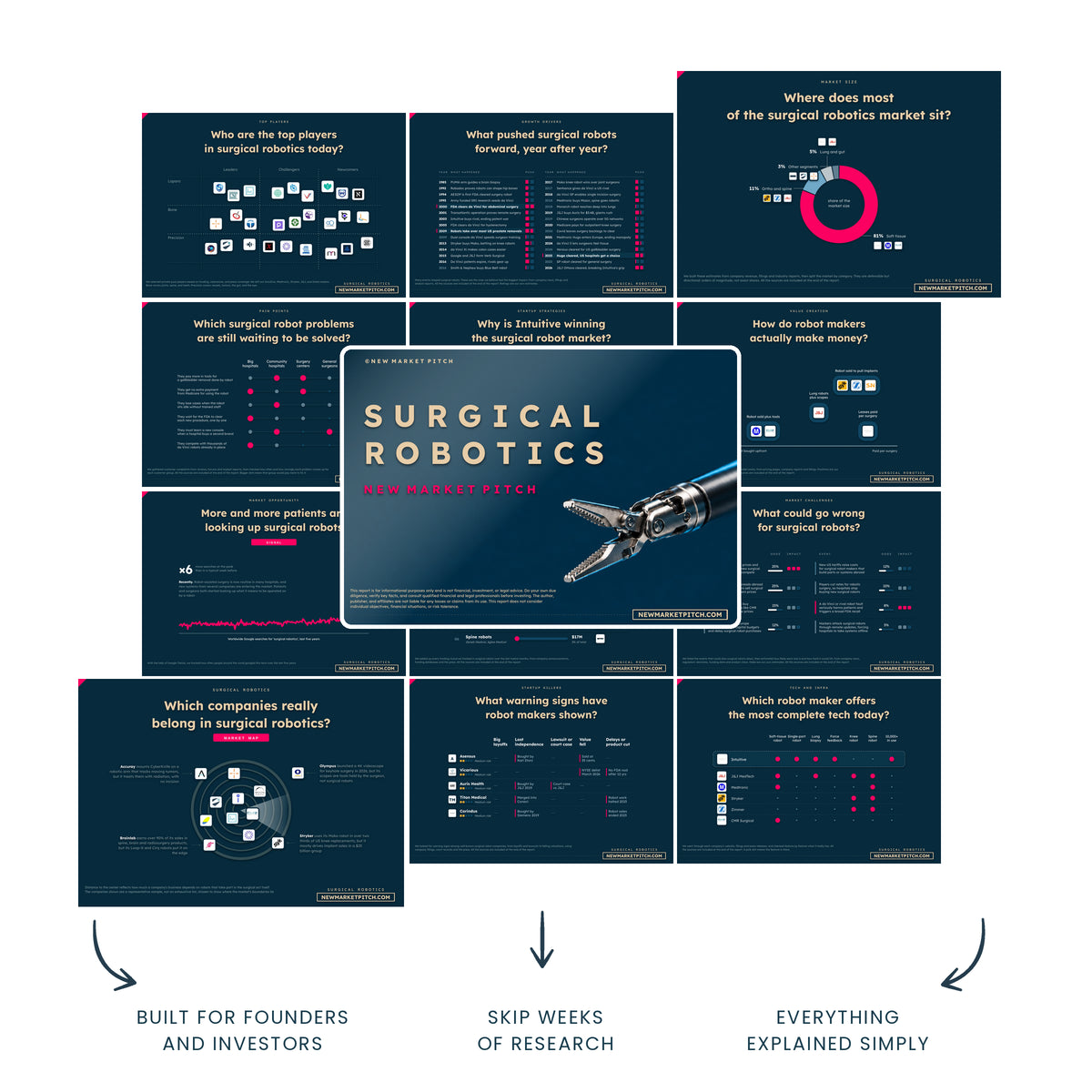
Whether you're building or investing in the surgical robotics market, our report covers everything you need to know: the players, the money, and what's coming next.
Surgical robotics funding in 2026 ranged from early AI-powered prototypes to large partnerships involving established hospital systems.
Across these 12 announced transactions, specialist robots for microsurgery, urology, ophthalmology and vascular procedures attracted investors alongside broader surgical platforms.
The figures below distinguish new venture rounds from strategic investments and flag announcements that are not directly comparable.
And if you want to better understand this new industry, you can download our pitch covering the surgical robotics market.
Insights
- Two strategic partnerships dominate the disclosed dollar value. CMR Surgical and Cornerstone Robotics account for roughly $1.1 billion, or 83% of this 12-deal sample, although their transaction structures are not directly comparable with standard venture rounds.
- The three largest announcements, from Cornerstone Robotics, CMR Surgical and Medical Microinstruments, represent about $1.225 billion of the roughly $1.33 billion total, leaving nine smaller transactions to account for about 8%.
- Surgical robotics investment is splitting between established platforms and procedure-focused challengers. Hospital-ready systems attract expansion capital, while younger companies work on clinical evidence for prostate, retinal, endoscopic and neurovascular procedures.
- Five of the 12 companies are based in mainland China or Hong Kong, including developers of magnetic catheters, waterjet prostate surgery and ophthalmic robots. Geographic breadth is wider than the biggest dollar amounts suggest.
- Only CMR Surgical has a reported valuation in this set, at approximately $4 billion. The other 11 transactions do not disclose valuations, making comparisons based on company value far less reliable than comparisons by stage or clinical specialty.
- AI is entering surgical robotics at very different maturity levels. Aleph Surgical is researching learned autonomous skills, while Andromeda Surgical is testing a surgeon-supervised urology platform and Rosota is building surgical data infrastructure.
- Round labels can hide important differences in capital. Channel Robotics announced $2.5 million in new Seed+ financing, not $4.6 million in a single round, while strategic distribution rights complicate the $700 million Cornerstone transaction.
- Funding milestones do not imply regulatory clearance. Several specialized surgical robot developers still need trials, device registration or commercial approval, so adoption evidence may matter more than the size of an early financing.

Written by the New Market Pitch teamWe track new markets so founders and investors can move faster. About us

In our report covering the surgical robotics market, you will always find fresh funding data, taken straight from our own verified funding database.
Summary table of the latest funding deals in the surgical robotics market as of October 2026
We define the surgical robotics market as robotic systems that assist or carry out surgical procedures.
We include robotic platforms, procedure-specific systems and dedicated instruments or control software for surgery.
We exclude diagnostic-only equipment, rehabilitation robots and conventional surgical instruments without robotic control.
| Name | When | Amount in $ | Round Type | Category |
|---|---|---|---|---|
| CMR Surgical | 12 Oct 2026 | $400M approx. | Strategic preferred equity | Multi-specialty soft-tissue surgery |
| Medical Microinstruments | 8 Oct 2026 | $125M | Series D | Robotic microsurgery & reconstructive surgery |
| Aleph Surgical | 30 Sep 2026 | $7.5M | Pre-seed | Autonomous surgical robots & embodied AI |
| Qubot Technology | 17 Sep 2026 | ≈$13.8M | Pre-A+ | Magnetic neurovascular intervention robots |
| Cornerstone Robotics | 1 Sep 2026 | ≈$700M | Strategic investment & distribution | Multi-specialty robotic-assisted surgery |
| Andromeda Surgical | 3 Aug 2026 | $15M | Series A | AI-assisted urological surgery |
| Zhiyu Medical | Jul 2026 | >$8M | Pre-A++ | Robotic waterjet prostate surgery |
| Rosota | 2 Jul 2026 | ≈$1.1M | Seed | Surgical AI data & future robotic control |
| Channel Robotics | 18 Jun 2026 | $2.5M | Seed+ | Handheld endoscopic surgical robots |
| Oculotronics | 9 Jun 2026 | ≈$13–14M | Series A | Ophthalmic microsurgical robots |
| Puncture Robotic | 3 Apr 2026 | ≈$14.5M | Series B | Image-guided interventional surgery |
| XCath | 12 Mar 2026 | $30M | Series C | Neuroendovascular robotic intervention |
All the latest funding deals in the surgical robotics market as of October 2026
CMR Surgical announced approximately $400 million in strategic financing in October 2026.
When was it?
CMR Surgical announced the financing on 12 October 2026.
Who are they?
CMR Surgical develops Versius and Versius Plus, modular robots that assist surgeons with minimally invasive soft-tissue operations.
Geographical focus?
CMR Surgical serves hospitals internationally and is preparing to expand U.S. adoption through Stryker.
Why do we include them in the surgical robotics market?
CMR Surgical makes dedicated robotic operating-room platforms for hospitals performing minimally invasive surgery.
What is the company stage?
CMR Surgical is in commercial growth, with Versius systems already used in hospitals across several countries.
How much did they raise?
CMR Surgical announced an approximately $400 million preferred-equity investment that remained subject to closing conditions.
What round is it?
CMR Surgical announced a strategic preferred-equity investment from Stryker rather than a numbered venture series.
Why did they raise?
CMR Surgical raised the money to develop its Versius portfolio and accelerate global sales, particularly through Stryker in the United States.
Medical Microinstruments raised $125 million in a Series D in October 2026.
When was it?
Medical Microinstruments announced the financing on 8 October 2026.
Who are they?
Medical Microinstruments builds the Symani system with tiny wristed instruments for joining delicate blood vessels, nerves and lymphatic vessels.
Geographical focus?
Medical Microinstruments serves hospitals in the United States and Europe and is expanding access across selected international markets.
Why do we include them in the surgical robotics market?
Medical Microinstruments develops a dedicated robotic platform for microsurgeons working on structures too small for conventional instruments.
What is the company stage?
Medical Microinstruments is in commercial growth, with about 50 installed systems and 3,500 procedures reported worldwide.
How much did they raise?
Medical Microinstruments announced $125 million in new Series D financing.
What round is it?
Medical Microinstruments announced a Series D led by BioStar Capital, with S3 Ventures and Angelini Ventures among the new investors.
Why did they raise?
Medical Microinstruments raised the money to support hospital adoption, clinical evidence and new robotic instruments and digital surgery functions.

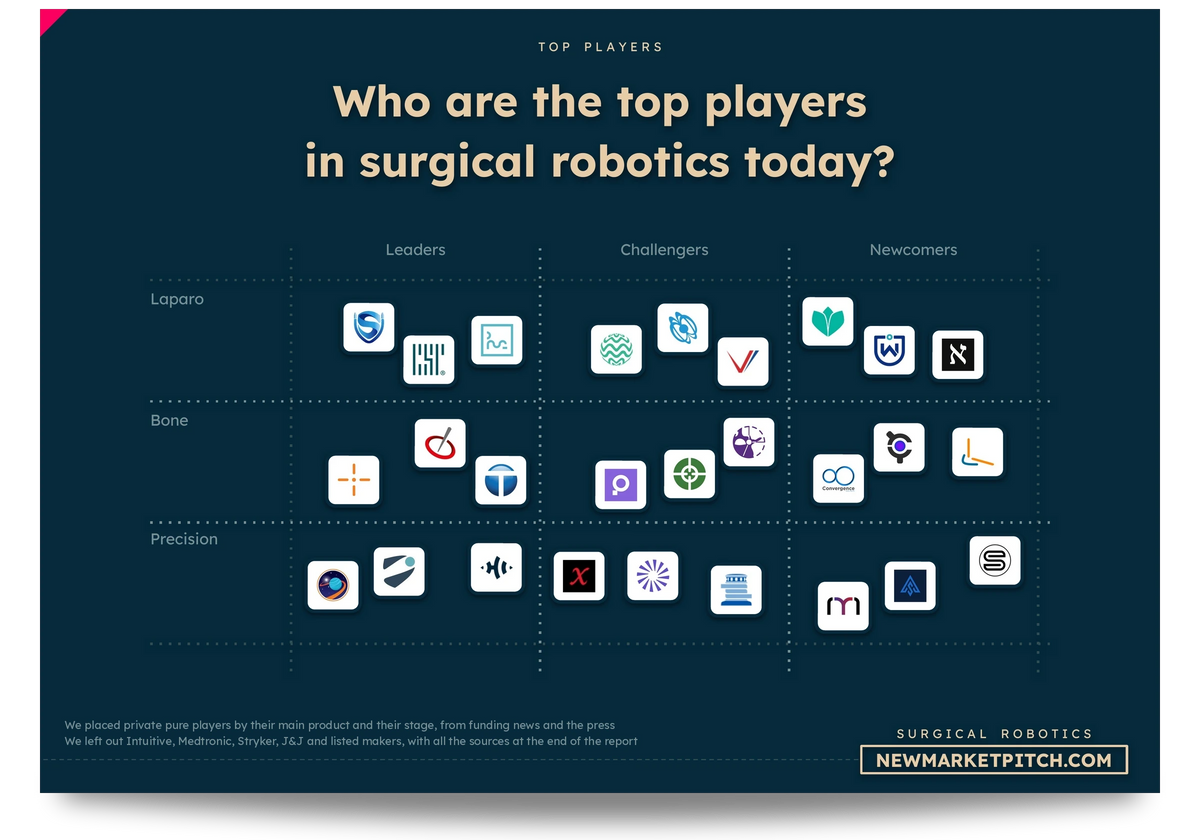
In our research about surgical robots, we turn what is vague and complex into simple, useful visuals. Market maps like this one show you at a glance where every startup stands.
Aleph Surgical raised $7.5 million in pre-seed funding in September 2026.
When was it?
Aleph Surgical announced the financing on 30 September 2026.
Who are they?
Aleph Surgical is building robotic systems that learn surgical movements from demonstrations and aim to perform selected tasks autonomously.
Geographical focus?
Aleph Surgical has not disclosed a verified headquarters or initial commercial region.
Why do we include them in the surgical robotics market?
Aleph Surgical is designing purpose-built surgical robots and AI control models rather than general robotics software.
What is the company stage?
Aleph Surgical is in pre-product research with an early prototype and no verified commercial surgical deployment.
How much did they raise?
Aleph Surgical announced $7.5 million in pre-seed funding.
What round is it?
Aleph Surgical announced a pre-seed led by Andreessen Horowitz with BoxGroup and other early investors participating.
Why did they raise?
Aleph Surgical raised the money to develop robotic hardware and transferable AI models for learning surgical skills.
Qubot Technology secured approximately $13.8 million in September 2026.
When was it?
Qubot Technology announced the financing on 17 September 2026.
Who are they?
Qubot Technology develops a magnetic-control robot that navigates guidewires inside blood vessels for neurovascular interventions.
Geographical focus?
Qubot Technology is focused first on China, with longer-term regulatory ambitions beyond the domestic market.
Why do we include them in the surgical robotics market?
Qubot Technology builds procedure-specific robotic control hardware for minimally invasive endovascular surgery.
What is the company stage?
Qubot Technology is in clinical development and regulatory preparation before broad commercialization.
How much did they raise?
Qubot Technology announced nearly RMB 100 million, or approximately $13.8 million.
What round is it?
Qubot Technology announced a Pre-A+ financing led by Noyu Capital.
Why did they raise?
Qubot Technology raised the money to advance clinical trials, medical-device registration and commercialization of its Maxwell platform.

Your time is limited. In our market report about surgical robots, we put numbers on each part of the market, so you can see where it makes sense to focus.
Cornerstone Robotics announced an approximately $700 million strategic transaction in September 2026.
When was it?
Cornerstone Robotics announced the financing on 1 September 2026.
Who are they?
Cornerstone Robotics develops the Sentire robot for minimally invasive general, gynecological, thoracic and urological surgery.
Geographical focus?
Cornerstone Robotics is based in Hong Kong and targets China, Singapore, Europe and other approved international markets.
Why do we include them in the surgical robotics market?
Cornerstone Robotics supplies a multi-port surgical robotic system to hospitals conducting soft-tissue operations.
What is the company stage?
Cornerstone Robotics is in commercial expansion after receiving approvals in multiple markets.
How much did they raise?
Cornerstone Robotics announced approximately $700 million in a strategic package that also includes distribution rights.
What round is it?
Cornerstone Robotics announced a strategic partnership with Medtronic, not a standard venture round with a disclosed equity-only amount.
Why did they raise?
Cornerstone Robotics raised the money to expand sales of Sentire through Medtronic distribution channels and increase global access to robotic surgery.
Andromeda Surgical raised $15 million in a Series A in August 2026.
When was it?
Andromeda Surgical announced the financing on 3 August 2026.
Who are they?
Andromeda Surgical develops the Beacon robot for prostate procedures using anatomical mapping, tablet controls and surgeon-supervised robotic assistance.
Geographical focus?
Andromeda Surgical is based in the United States and has conducted clinical work internationally, including in Chile.
Why do we include them in the surgical robotics market?
Andromeda Surgical focuses its robotic hardware and surgical-control software on specific urology procedures.
What is the company stage?
Andromeda Surgical is in clinical validation and pre-commercial development, with the product not yet cleared for commercial sale.
How much did they raise?
Andromeda Surgical announced $15 million in Series A financing, bringing announced cumulative funding to about $30 million.
What round is it?
Andromeda Surgical announced a Series A led by Standard Capital.
Why did they raise?
Andromeda Surgical raised the money to continue clinical trials and move its urology-focused Beacon system toward regulated commercial use.

In our document detailing everything you need to know about surgical robotics, we always try to gather several sources and make estimates that make sense, so you can work with solid numbers.
Zhiyu Medical secured more than $8 million in a Pre-A++ round in July 2026.
When was it?
Zhiyu Medical's round was reported by 14 July 2026, but its exact announcement day was not verified.
Who are they?
Zhiyu Medical is developing a computer-controlled waterjet robot that removes excess prostate tissue without thermal cutting.
Geographical focus?
Zhiyu Medical is focused on clinical development and medical-device approval in China.
Why do we include them in the surgical robotics market?
Zhiyu Medical makes a procedure-specific surgical robot intended for urologists treating enlarged prostates.
What is the company stage?
Zhiyu Medical is in clinical development and regulatory review in China.
How much did they raise?
Zhiyu Medical announced more than RMB 60 million, equivalent to over $8 million at the approximate exchange rate used.
What round is it?
Zhiyu Medical announced a Pre-A++ round led by Chende Capital with participation from existing investors.
Why did they raise?
Zhiyu Medical raised the money to fund clinical trials and prepare its waterjet surgical robot for regulatory approval.
Rosota raised approximately $1.1 million in seed funding in July 2026.
When was it?
Rosota announced the financing on 2 July 2026.
Who are they?
Rosota collects surgical video and instrument data to develop AI models for future surgical robot control.
Geographical focus?
Rosota is developing its platform in South Korea while aiming for broader international use.
Why do we include them in the surgical robotics market?
Rosota targets robotic execution of surgical tasks, although its current emphasis remains surgical data infrastructure.
What is the company stage?
Rosota is in seed-stage research and product development without a verified commercially deployed surgical robot.
How much did they raise?
Rosota announced KRW 1.5 billion, approximately $1.1 million.
What round is it?
Rosota announced a seed round led by FuturePlay with Schmidt and ZDVC participating.
Why did they raise?
Rosota raised the money to build its surgical data pipeline and train intelligence systems for future robotic assistance.

Our report covering the surgical robotics market gets updated several times a month, so you always get the latest view of where things stand.
Channel Robotics raised $2.5 million in Seed+ funding in June 2026.
When was it?
Channel Robotics announced the financing on 18 June 2026.
Who are they?
Channel Robotics builds a compact handheld robot that lets physicians precisely move miniature instruments through flexible endoscopes.
Geographical focus?
Channel Robotics is initially focused on U.S. clinics, community hospitals and outpatient surgical centers.
Why do we include them in the surgical robotics market?
Channel Robotics adds robotic manipulation to minimally invasive endoscopic procedures rather than offering general endoscopy software.
What is the company stage?
Channel Robotics is in pre-commercial prototype development and regulatory preparation.
How much did they raise?
Channel Robotics announced $2.5 million in new Seed+ funding, distinct from its $4.6 million cumulative funding.
What round is it?
Channel Robotics announced a Seed+ round led by True Ventures.
Why did they raise?
Channel Robotics raised the money to refine its platform, advance quality systems and prepare regulatory submissions and manufacturing.
Oculotronics raised approximately $13 million to $14 million in June 2026.
When was it?
Oculotronics announced the financing on 9 June 2026.
Who are they?
Oculotronics develops precision surgical robots that help ophthalmologists manipulate fine instruments during retinal and other eye procedures.
Geographical focus?
Oculotronics is based in Guangzhou and is pursuing Chinese approval before wider international expansion.
Why do we include them in the surgical robotics market?
Oculotronics builds dedicated robotic instruments and operating-room systems for delicate eye surgery.
What is the company stage?
Oculotronics is in clinical validation and device registration following a multicenter study.
How much did they raise?
Oculotronics announced nearly RMB 100 million, or approximately $13 million to $14 million.
What round is it?
Oculotronics announced a Series A led by Essential Capital with follow-on participation from Minggui Capital.
Why did they raise?
Oculotronics raised the money to complete product registration, advance robotic capabilities and prepare commercial rollout.

In our research about surgical robots, we look at what the winners do differently, so you can learn from the best instead of guessing.
Puncture Robotic secured approximately $14.5 million in Series B funding in April 2026.
When was it?
Puncture Robotic announced the round on 3 April 2026, with news coverage following on 4 April.
Who are they?
Puncture Robotic develops image-guided robots for instrument placement in minimally invasive interventions and selected surgical procedures.
Geographical focus?
Puncture Robotic is based in China and is expanding its domestic distribution with longer-term international plans.
Why do we include them in the surgical robotics market?
Puncture Robotic designs robotic systems that guide and manipulate tools during therapeutic procedures, alongside other medical applications.
What is the company stage?
Puncture Robotic is in mixed product development, clinical registration and early commercialization across several indications.
How much did they raise?
Puncture Robotic announced about RMB 100 million, or approximately $14.5 million.
What round is it?
Puncture Robotic announced a Series B strategic financing led by an unnamed international AI technology company.
Why did they raise?
Puncture Robotic raised the money to improve its robotic platforms, advance product approvals and expand commercial channels.
XCath raised $30 million in a Series C in March 2026.
When was it?
XCath announced the financing on 12 March 2026.
Who are they?
XCath builds the Iris endovascular robot to help specialists steer devices through brain blood vessels during neurovascular procedures.
Geographical focus?
XCath is based in the United States and is developing applications for international neurovascular care.
Why do we include them in the surgical robotics market?
XCath develops a dedicated interventional robotic platform for brain vessel treatment and potential remote surgery.
What is the company stage?
XCath is in advanced clinical development, with first-in-human robotic procedures reported but commercialization pending.
How much did they raise?
XCath announced $30 million in Series C funding, bringing the company total to approximately $92 million.
What round is it?
XCath announced a Series C co-led by Crescent Enterprises and surgical robotics pioneer Fred Moll.
Why did they raise?
XCath raised the money to advance clinical studies and prepare Iris for commercial neurovascular procedures.
Written by the New Market Pitch teamWe track new markets so founders and investors can move faster. About us