Surgical robotics funding tracker (75 deals)
Whether you're building or investing in the surgical robotics market, our report covers everything you need to know: the players, the money, and what's coming next.
Summary
The surgical robotics funding tracker (75 deals) shows a genuinely well-funded market, with approximately $1.91 billion raised by 65 companies between January 2024 and September 2026. But the money is heavily concentrated: the median disclosed financing is just $14 million, less than half the $28.45 million average.
Just 12 financings strictly above $50 million account for roughly $1.25 billion, leaving approximately $656 million across the rest of the market. Seven rounds of at least $100 million alone captured 47.1% of recorded capital.
The ten largest funded companies received 65.5% of the money. Cornerstone Robotics leads with approximately $270 million across two financings, followed by Distalmotion at $150 million and Medical Microinstruments at $129.6 million.
Smaller rounds dominate deal activity. Forty-five of the 75 transactions were below $20 million, representing 60% of financing announcements but only 19.4% of total capital. Twenty rounds were below $5 million.
Investors have concentrated 86.3% of funding in three surgical specialties: soft-tissue robotics, interventional robotics and microsurgery. Soft-tissue robotics received $683.4 million across 11 companies, while interventional robotics attracted $569.8 million across 17 companies, indicating substantially higher capital concentration among soft-tissue developers.
Brand-new fundraising remains modest relative to established developers. Fourteen first-financing transactions represented approximately 5% of total capital, with a median of $1.84 million compared with $15.5 million for follow-on financings.
The funding ladder gets expensive quickly. Median rounds move from $1.16 million at Seed to $11.72 million at Series A, $50 million at Series C and $72.5 million at Series D+. Only six Series C deals appeared during the entire 33-month period.
Time in development is a major feature of this market. The median company age at financing was four years, rising to 11 years for Series D+ businesses. The largest investors are frequently backing companies that have spent years developing, validating and preparing complex medical systems for commercial use.
Asia-Pacific leads in activity, with 37 deals involving 30 companies, but North America leads in recorded capital with $779.3 million compared with $734.4 million. Europe attracted $267.6 million, more than half of which came from Distalmotion's single $150 million financing.
Strategic investors participated in 17 transactions, and those deals had a higher median financing amount than deals without disclosed strategic participation. The roughly $1.91 billion market total remains indicative because eight deals lack reliable disclosed amounts, but the underlying pattern is clear: early development funding is available to dozens of companies, while nine-figure commitments remain concentrated among a few advanced developers.

Written by the New Market Pitch teamWe track new markets so founders and investors can move faster. About us

In our report covering the surgical robotics market, you will always find fresh funding data, taken straight from our own verified funding database.
Our funding tracker covering the surgical robotics market
Below is the table listing all the deals. You may find our methodology at the end of this page.
And, if you want to gain a deeper understanding of the market and its current dynamics, get our report covering the surgical robotics market.
| Company | Category | Date | Stage | Deal size | What they do | Region | Lead investors | Country | Rank |
|---|---|---|---|---|---|---|---|---|---|
| Aleph Surgical (Aleph Nought) | Soft-Tissue Surgical Robots | September 2026 | Seed | $7.5M | Develops autonomous surgical robots trained through embodied AI to learn and physically execute surgical procedures. | North America | Andreessen Horowitz | United States | |
| Qubot (Shanghai SiboHuiyi Technology Co., Ltd.) | Interventional Robotics | September 2026 | Unknown | ≈$14.9M | Develops an AI-powered magnetic robotic platform for automated guidewire navigation during cerebrovascular interventions. | Asia-Pacific | Noyu Capital | China | |
| Medical Microinstruments, Inc. (MMI) | Microsurgery Robots | September 2026 | Series D+ | ≈$19.6M | Develops the Symani robotic system and articulated microinstruments for microsurgery and supermicrosurgery. | North America | Not disclosed | United States | |
| Deneb Medical, S.L. | Spine Surgery Robots | September 2026 | Unknown | ≈$17.1M | Develops the IZAR robotic spine-surgery platform combining robotic positioning, laser tissue treatment and AI. | Europe | Not disclosed | Spain | |
| Lupin Dental SAS | Dental Surgery Robots | August 2026 | Series A | ≈$17.5M | Develops a supervised robotic system for minimally invasive tooth preparation in aesthetic dental procedures. | Europe | Fynveur | France | |
| Andromeda Surgical | Endoluminal & Endoscopic Robots | August 2026 | Series A | $15M | Develops AI-guided autonomous surgical robots initially targeting transurethral prostate surgery. | North America | Standard Capital | United States | |
| Magnendo Corp. | Interventional Robotics | July 2026 | Series A | $18M | Develops magnetic robotic guidewire navigation systems for neurovascular interventions, including stroke treatment. | North America | Penumbra, Inc. | United States | |
| Rosota | Soft-Tissue Surgical Robots | July 2026 | Seed | ≈$975K | Develops AI-native surgical robotics systems using intraoperative data to enable intelligent robotic assistance during surgery. | Asia-Pacific | FuturePlay | South Korea | |
| Biobot Surgical Pte. Ltd. | Interventional Robotics | June 2026 | Unknown | ≈$15.5M | Develops robotic transperineal needle-guidance systems for targeted prostate biopsy and focal ablation treatment. | Asia-Pacific | ClavystBio | Singapore | |
| Nanoflex Robotics AG | Interventional Robotics | June 2026 | Unknown | ≈$11.3M | Develops magnetically controlled robotic navigation systems for endovascular interventions, including stroke treatment. | Europe | Not disclosed | Switzerland | |
| Channel Robotics, Inc. | Endoluminal & Endoscopic Robots | June 2026 | Seed | $2.5M | Develops handheld, AI-enabled robotic instruments that enhance dexterity and control during flexible endoscopic procedures. | North America | True Ventures | United States | |
| Guangzhou Oculotronics Medical Instrument Co., Ltd. (Weimou Medical; 广州市微眸医疗器械有限公司) | Microsurgery Robots | June 2026 | Series A | ≈$14M | Develops high-precision ophthalmic robots for retinal microsurgery, including robot-assisted subretinal injections. | Asia-Pacific | Essential Capital (Yuanhang Capital) | China | |
| Shenzhen ROBO Medical Technology Co., Ltd. (罗伯医疗) | Endoluminal & Endoscopic Robots | May 2026 | Series B | >$1.4M | Develops robotic systems for gastrointestinal endoscopic surgery, including robotic tissue manipulation during endoscopic resections. | Asia-Pacific | Tsinghua Innovation Ventures (Shuimu Capital) | China | |
| Beijing TiROMU Medical Technology Co., Ltd. (瞳沐医疗) | Microsurgery Robots | April 2026 | Seed | >$1.4M | Develops precision ophthalmic microsurgical robots for retinal injections and other delicate eye procedures. | Asia-Pacific | Aibo Hongsheng Fund; Qihang Venture Capital | China | |
| Pangce Medical | Soft-Tissue Surgical Robots | April 2026 | Series B | ≈$14.5M | Develops HAIRO robotic systems for follicle extraction and implantation during hair-transplant surgery. | Asia-Pacific | Not disclosed | China | |
| Monteris Medical | Interventional Robotics | March 2026 | Series D+ | $28M | Develops and commercializes the NeuroBlate MRI-guided, robotically controlled laser-ablation system for minimally invasive brain surgery. | North America | Not disclosed | United States | |
| XCath | Interventional Robotics | March 2026 | Series C | $30M | Develops robotic endovascular systems for neurovascular interventions, including remotely controlled catheter navigation and thrombectomy. | North America | Crescent Enterprises; Dr. Fred Moll | United States | |
| Petal Surgical | Soft-Tissue Surgical Robots | March 2026 | Series A | Not Disclosed | Develops an incisionless robotic surgery platform combining millisecond-pulse histotripsy, imaging and AI to treat tissue without conventional incisions. | North America | Not disclosed | United States | |
| Qoly Corporation (クオリィ株式会社) | Microsurgery Robots | February 2026 | Series A | $11.5M | Develops precision robotic systems that assist surgeons with microsurgical procedures involving small blood vessels, nerves and other delicate tissues. | Asia-Pacific | Fast Track Initiative; MedVenture Partners | Japan | |
| Nami Surgical | Soft-Tissue Surgical Robots | January 2026 | Unknown | $2.6M | Develops miniaturized ultrasonic scalpels engineered for integration into articulated robotic surgical instruments. | Europe | Eos Advisory | United Kingdom | |
| Dessight | Microsurgery Robots | January 2026 | Series A | Not Disclosed | Develops ophthalmic and other ultra-microsurgical robotic platforms for high-precision surgical manipulation. | Asia-Pacific | Fortune Capital (达晨财智) | China | |
| Gibbon Medical Technology (Wuxi) Co., Ltd. (长臂猿医疗) | Microsurgery Robots | January 2026 | Seed | Not Disclosed | Develops modular robotic systems for precise microsurgical manipulation, dissection, suturing and vascular anastomosis across surgical specialties. | Asia-Pacific | Wuxi Venture Capital (锡创投) | China | |
| Beijing Surgerii Robotics Company Limited (北京术锐机器人股份有限公司) | Soft-Tissue Surgical Robots | December 2025 | Series D+ | $100M | Develops the SHURUI single-port robotic system for minimally invasive laparoscopic surgery. | Asia-Pacific | Loyal Valley Capital | China | |
| Hangzhou Kangji Weijing Medical Robotics Co., Ltd. (杭州康基唯精医疗机器人有限公司) | Soft-Tissue Surgical Robots | December 2025 | Series B | Not Disclosed | Develops robotic platforms and control technologies for minimally invasive laparoscopic surgery. | Asia-Pacific | Not disclosed | China | |
| Würzburg Dynamics (深圳惟德精准医疗科技有限公司) | Interventional Robotics | December 2025 | Series B | >$17M | Develops image-guided robotic systems for percutaneous biopsy, ablation, and other soft-tissue interventions. | Asia-Pacific | Guangzhou Jinkong Fund; Tianhe Investment Funds | China | |
| Agloe Medical Technologies (Suzhou) Co., Ltd. (春风化雨(苏州)智能医疗科技有限公司) | Spine Surgery Robots | December 2025 | Series A | Not Disclosed | Develops a three-arm spine surgery robot integrating visualization, ultrasonic bone cutting, and automated screw placement. | Asia-Pacific | Shunxi Fund; Qiming Venture Partners | China | |
| EndoRobotics Co., Ltd. | Endoluminal & Endoscopic Robots | December 2025 | Series C | ≈$22.1M | Develops the ROBOPERA robotic endoscopic platform and dedicated instruments for gastrointestinal tissue resection and closure. | Asia-Pacific | Premier Partners | South Korea | |
| Distalmotion SA | Soft-Tissue Surgical Robots | November 2025 | Series D+ | $150M | Develops the DEXTER modular robotic surgery system for minimally invasive soft-tissue procedures. | Europe | Revival Healthcare Capital | Switzerland | |
| Cornerstone Robotics (康诺思腾) | Soft-Tissue Surgical Robots | November 2025 | Series D+ | ≈$200M | Develops the Sentire multi-arm robotic platform for minimally invasive laparoscopic surgery. | Asia-Pacific | Hong Kong Investment Corporation | Hong Kong | |
| Surgical Automations | Endoluminal & Endoscopic Robots | October 2025 | Seed | $3.4M | Develops the Vāsuki robotic platform for automated navigation and instrument control during gastrointestinal endoscopic procedures. | North America | Dr. Fred Moll; TurboStart | United States | |
| Petal Surgical | Soft-Tissue Surgical Robots | October 2025 | Series A | $10M | Develops an AI- and robotics-assisted histotripsy platform for incisionless surgical tissue ablation. | North America | K50 Ventures; TSVC | United States | |
| HistoSonics, Inc. | Interventional Robotics | October 2025 | Growth Equity | $250M | Develops robotic-arm-guided noninvasive histotripsy systems for ultrasound-based destruction of tumors and other therapeutic tissue interventions. | North America | Not disclosed | United States | |
| AGIBOT Medtech | Soft-Tissue Surgical Robots | October 2025 | Series B | Not Disclosed | Develops the AGIBOT robotic platform for minimally invasive laparoscopic surgery. | Asia-Pacific | Mingxi Capital | China | |
| AiM Medical Robotics, Inc. | Interventional Robotics | September 2025 | Series A | $8.1M | Develops MRI-compatible surgical robots for image-guided neurosurgical interventions. | North America | IQ Capital; 1540 Ventures | United States | |
| KouTech Medical Technology (Shanghai) Co., Ltd. (昂泰微精) | Microsurgery Robots | September 2025 | Series B | >$28M | Develops high-precision robotic platforms for microsurgery and ophthalmic surgery. | Asia-Pacific | Not disclosed | China | |
| Panda Surgical Limited | Microsurgery Robots | September 2025 | Seed | ≈$1.3M | Develops handheld robotic instruments for minimally invasive brain and spine surgery. | Europe | Oxford Investment Consultants | United Kingdom | |
| Ronovo Surgical | Soft-Tissue Surgical Robots | September 2025 | Series D+ | $67M | Develops the modular Carina robotic platform for laparoscopic soft-tissue surgery. | Asia-Pacific | Johnson & Johnson Development Corporation (JJDC) | China | |
| Swan EndoSurgical, Inc. | Endoluminal & Endoscopic Robots | July 2025 | Unknown | >$65M | Develops endoluminal robotic systems for minimally invasive treatment of gastrointestinal lesions and tumors. | North America | Not disclosed | United States | |
| EndoQuest Robotics, Inc. | Endoluminal & Endoscopic Robots | July 2025 | Series D+ | $30.7M | Develops flexible endoluminal surgical robots for incisionless gastrointestinal procedures. | North America | Crescent Enterprises; Dr. Fred Moll | United States | |
| ForSight Robotics | Microsurgery Robots | June 2025 | Series B | $125M | Develops the ORYOM robotic platform for cataract and other ophthalmic surgical procedures. | Middle East | Eclipse | Israel | |
| Dessight | Microsurgery Robots | June 2025 | Series A | ≈$14M | Develops robotic systems for ophthalmic and ultra-precise microsurgical procedures, including microvascular anastomosis. | Asia-Pacific | Panlin Capital | China | |
| Deep Medical (广州深度医疗器械科技有限公司) | Microsurgery Robots | June 2025 | Seed | Not Disclosed | Develops the FUNZAR dual-arm robotic platform for precision microsurgical procedures. | Asia-Pacific | Wondfo Venture Valley (万孚创谷) | China | |
| Lancet Robotics | Orthopedic Surgical Robots | June 2025 | Series A | Not Disclosed | Develops robotic systems for joint replacement, spine, dental implant, and other robot-assisted surgical procedures. | Asia-Pacific | Yuehu Fund | China | |
| Shanghai Aopeng Medical Technology Co., Ltd. (上海奥朋医疗科技有限公司) | Interventional Robotics | April 2025 | Series C | ≈$14M | Develops the ALLVAS robotic platform for catheter-based coronary, peripheral, and neurovascular interventions. | Asia-Pacific | Jinan International Medical Center Industrial Development Co., Ltd.; Jinan Huaiyin Guorong Holdings Co., Ltd. | China | |
| iotaMotion | Microsurgery Robots | January 2025 | Series B | $6.4M | Develops the iotaSOFT robotic-assisted insertion system for precise cochlear implant electrode placement during ear surgery. | North America | Not disclosed | United States | |
| Convergence Medical | Orthopedic Surgical Robots | January 2025 | Series A | ≈$3.1M | Develops the V01 robotic platform for minimally invasive arthroscopic orthopedic surgery. | Asia-Pacific | Avicella Capital | Australia | |
| Robeauté | Microsurgery Robots | January 2025 | Series A | $28M | Develops miniature robotic systems that navigate brain tissue for minimally invasive neurosurgical biopsy and therapeutic interventions. | Europe | Plural; Cherry Ventures; Kindred Ventures | France | |
| Cornerstone Robotics (康诺思腾) | Soft-Tissue Surgical Robots | January 2025 | Series C | >$70M | Develops robotic-assisted surgical platforms, including the Sentire endoscopic system for minimally invasive soft-tissue surgery. | Asia-Pacific | EQT | Hong Kong | |
| Capstan Medical | Interventional Robotics | December 2024 | Series C | $110M | Develops a robotic catheter-delivery platform and dedicated implants for minimally invasive mitral and tricuspid valve procedures. | North America | Eclipse | United States | |
| Lancet Robotics | Orthopedic Surgical Robots | November 2024 | Series A | >$2.7M | Develops robotic systems for orthopedic joint replacement, with additional platforms for spine, dental and vascular interventions. | Asia-Pacific | CICC Capital | China | |
| ZAP Surgical Systems, Inc. | Interventional Robotics | November 2024 | Series D+ | $78M | Manufactures the ZAP-X robotic stereotactic radiosurgery platform for non-invasive treatment of intracranial tumors and disorders. | North America | Qingdao Baheal Medical Inc. | United States | |
| Beijing AMIT Medical Science and Technology Co., Ltd. (奥达智声) | Interventional Robotics | November 2024 | Series A | >$2.7M | Develops robotic ultrasound-guided percutaneous navigation systems for minimally invasive tumor interventions. | Asia-Pacific | Qianhai Ark Healthcare Fund | China | |
| Suzhou Huiyue Medical Technology Co., Ltd. (慧跃医疗) | Endoluminal & Endoscopic Robots | October 2024 | Seed | >$2.7M | Develops flexible gastrointestinal surgical robots supporting endoscopic submucosal dissection and ERCP interventions. | Asia-Pacific | Hetang Venture Capital | China | |
| Horizon Surgical Systems, Inc. | Microsurgery Robots | October 2024 | Series A | $30M | Develops the Polaris AI-enabled robotic platform for precision ophthalmic microsurgery, initially targeting cataract procedures. | North America | ExSight Ventures; Not disclosed (corporate co-lead) | United States | |
| Mendaera, Inc. | Interventional Robotics | September 2024 | Series B | $73M | Develops a handheld robotic platform combining ultrasound guidance and automated positioning for needle-based interventional procedures. | North America | Threshold Ventures | United States | |
| Pangce Medical | Soft-Tissue Surgical Robots | September 2024 | Unknown | >$2.8M | Develops robotic hair-transplant systems that automate precise follicular extraction and assist implantation procedures. | Asia-Pacific | Not disclosed | China | |
| AGIBOT Medtech | Soft-Tissue Surgical Robots | August 2024 | Series A | >$14M | Develops robotic endoscopic surgical platforms and dedicated instruments for minimally invasive operations across multiple surgical specialties. | Asia-Pacific | Cenova Capital | China | |
| HistoSonics, Inc. | Interventional Robotics | August 2024 | Series D+ | $102M | Develops the robotically positioned Edison Histotripsy System for image-guided, non-invasive destruction of targeted tumors. | North America | Alpha Wave Ventures | United States | |
| Neptune Medical | Endoluminal & Endoscopic Robots | August 2024 | Series D+ | $97M | Develops endoluminal flexible robotic systems for gastrointestinal interventions, following spinout of the separately operated Jupiter Endovascular business. | North America | Not disclosed | United States | |
| NAVIGANTIS Inc. | Interventional Robotics | July 2024 | Series A | $12M | Develops the VASCO robotic platform for neurovascular interventions, including stroke thrombectomy and aneurysm treatment. | North America | Puma Venture Capital | United States | |
| LN Robotics Inc. (엘엔로보틱스) | Interventional Robotics | July 2024 | Series B | ≈$14.5M | Develops the AVIAR robotic system for physician-controlled cardiovascular catheter interventions. | Asia-Pacific | LB Investment | South Korea | |
| F.MED Co., Ltd. (F.MED株式会社) | Microsurgery Robots | July 2024 | Series A | ≈$2.7M | Develops a surgeon-controlled microsurgery robot with precision manipulators for suturing extremely small blood vessels and nerves. | Asia-Pacific | Diamond Medino Capital | Japan | |
| Ronovo Surgical | Soft-Tissue Surgical Robots | June 2024 | Series B | $44M | Develops the Carina modular robotic platform for laparoscopic soft-tissue surgery across multiple specialties. | Asia-Pacific | Guolian Capital; INCE Capital | China | |
| Healinno (Beijing) Medical Technology Co., Ltd. (智愈医疗) | Endoluminal & Endoscopic Robots | May 2024 | Seed | >$8.2M | Develops the metaFlow image-guided autonomous waterjet surgical robot for treating benign prostatic hyperplasia. | Asia-Pacific | Chende Capital | China | |
| SpinEM Robotics SAS | Spine Surgery Robots | April 2024 | Series A | $11M | Develops the Odysseus robotic navigation and surgical-assistance system for spinal procedures. | Europe | Not disclosed | France | |
| Wuxi Yindatong Medical Co., Ltd. (无锡英达通医疗有限公司; Endoways) | Interventional Robotics | March 2024 | Unknown | ≈$2.8M | Develops disposable catheter-based robotic systems for neurovascular and other vascular-intervention procedures. | Asia-Pacific | Not disclosed | China | |
| Agilis Robotics Limited (巧捷力医疗机器人) | Endoluminal & Endoscopic Robots | March 2024 | Series A | $10M | Develops miniaturized flexible dual-arm surgical robots for endoluminal tumor resection. | Asia-Pacific | Not disclosed | Hong Kong | |
| Biobot Surgical Pte. Ltd. | Interventional Robotics | March 2024 | Series B | $18M | Develops the Mona Lisa robotic system for image-guided transperineal prostate biopsy and therapeutic needle procedures. | Asia-Pacific | Tony Tan | Singapore | |
| Medical Microinstruments, Inc. (MMI) | Microsurgery Robots | February 2024 | Series C | $110M | Develops the Symani robotic system and miniature articulated instruments for reconstructive microsurgery. | North America | Fidelity Management & Research Company | United States | |
| Extremis Robotics | Orthopedic Surgical Robots | January 2024 | Seed | ≈$490K | Develops robotic assistance for total ankle replacement and other foot surgeries. | Europe | Not disclosed | France | |
| KAT Robotics SAS | Orthopedic Surgical Robots | January 2024 | Seed | ≈$490K | Develops robotic technology with interactive surgical power-tool control for orthopedic procedures. | Europe | Not disclosed | France | |
| LinkX Robotics | Orthopedic Surgical Robots | January 2024 | Seed | ≈$490K | Develops robotic surgical guidance and planning technology for knee-ligament procedures. | Europe | Not disclosed | France | |
| Ostesys | Orthopedic Surgical Robots | January 2024 | Seed | ≈$490K | Develops robotic assistance, imaging and surgical planning for corrective knee osteotomy. | Europe | Not disclosed | France | |
| SpinEM Robotics SAS | Spine Surgery Robots | January 2024 | Seed | ≈$490K | Develops robotic navigation and vertebra-mounted tracking technology for spinal surgery. | Europe | Not disclosed | France | |
| Zentact Robotics | Endoluminal & Endoscopic Robots | January 2024 | Seed | ≈$490K | Develops telemanipulated robotic instruments for minimally invasive endoscopic ear, nose and throat surgery. | Europe | Not disclosed | France | |
| Neocis, Inc. | Dental Surgery Robots | January 2024 | Series D+ | $20M | Develops Yomi, a robotic guidance system for dental implant surgery. | North America | Not disclosed | United States | |
| LEM Surgical AG | Spine Surgery Robots | January 2024 | Series B | ≈$25.8M | Develops robotic surgical platforms for spine and other hard-tissue procedures. | Europe | Not disclosed | Switzerland |

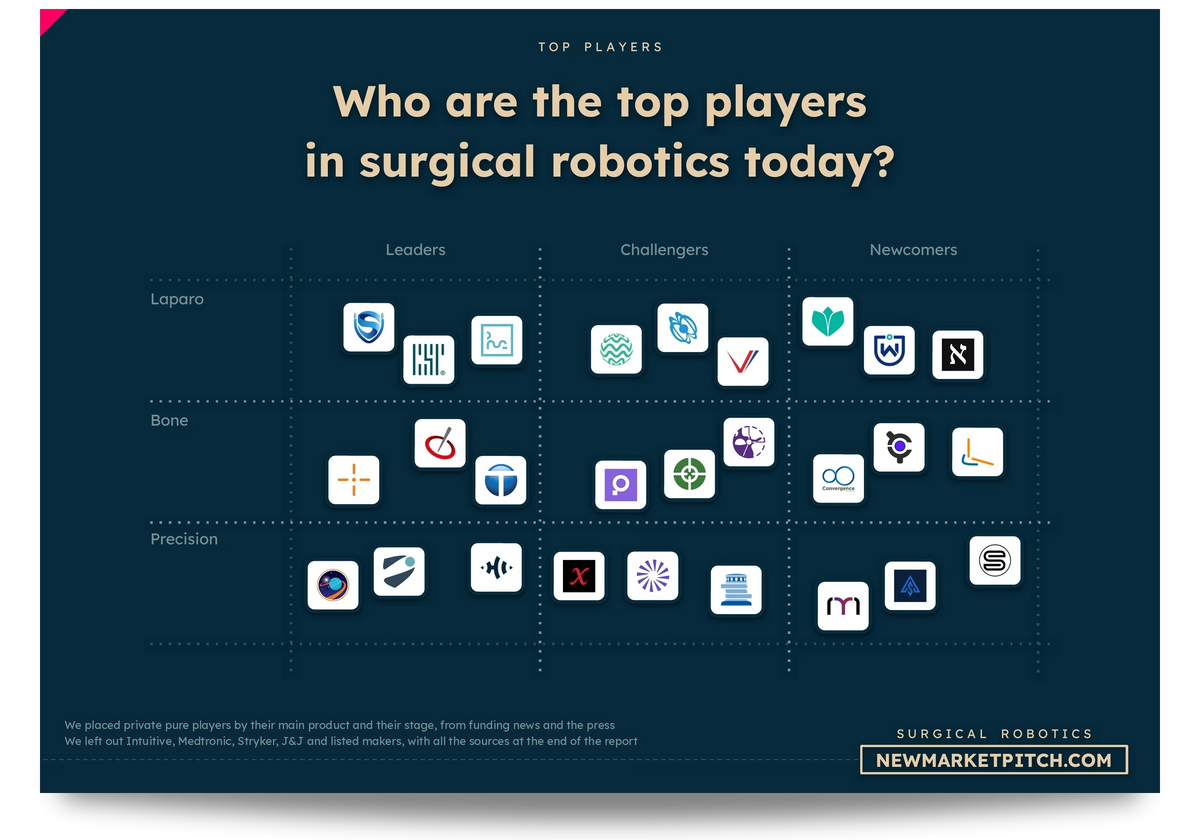
In our research about surgical robots, we turn what is vague and complex into simple, useful visuals. Market maps like this one show you at a glance where every startup stands.
Is surgical robotics really a well-funded market, or are a few giant rounds making it look bigger?
Surgical robotics has attracted about $1.91 billion in funding, but a small group of companies accounts for most of that money. The typical startup is raising considerably less than the headline figures suggest.
We identified 75 financing deals involving 65 companies between January 2024 and September 2026. The median disclosed round was $14 million, while the average reached $28.45 million. That's a pretty big gap.
Cornerstone Robotics closed an approximately $200 million financing in November 2025, Distalmotion secured $150 million that same month, and ForSight Robotics raised $125 million in June 2025. Those three transactions alone account for nearly a quarter of all recorded capital.
Remove the 12 financings strictly above $50 million, and the remaining market represents approximately $656 million. Meanwhile, 45 of the 75 deals were smaller than $20 million.
Surgical robotics certainly attracts serious money. But most of it goes to companies that have already moved well beyond their initial development work. Young startups are competing for much smaller checks.
How many surgical robotics startups are actually getting funded?
The funded surgical robotics market contains 65 identifiable companies in our research, and 55 of them appeared only once during the 33-month period.
Only ten companies raised capital twice, and none appeared three or more times. The 75 financing announcements therefore came from a relatively small group of businesses, with limited repeat fundraising visible within the observation period.
Cornerstone Robotics, Medical Microinstruments and Ronovo Surgical are among the companies that returned for additional funding. All three accumulated substantial capital across their transactions.
But repeat fundraising is not the only route to a large total. Distalmotion and ForSight Robotics each secured a nine-figure financing through a single observed deal.
The 15.4% repeat-fundraising rate also needs some perspective. Developing a surgical robot, completing clinical studies and preparing a commercial launch can take several years. A company might therefore raise once during our observation window and still have a long fundraising history.
For now, the market looks like a relatively small population of funded developers, with only a handful returning to investors frequently enough to appear multiple times.

Your time is limited. In our market report about surgical robots, we put numbers on each part of the market, so you can see where it makes sense to focus.
Which surgical robotics companies have raised the most money?
Cornerstone Robotics leads the surgical robotics funding ranking with approximately $270 million raised across two deals, while the ten largest companies together account for 65.5% of recorded capital.
That puts Cornerstone well ahead of Distalmotion, which raised $150 million, and Medical Microinstruments, which accumulated $129.6 million.
ForSight Robotics follows with $125 million, while Ronovo Surgical, Capstan Medical and HistoSonics each passed the $100 million mark.
These companies are pursuing rather different opportunities. Cornerstone and Ronovo develop robotic systems for minimally invasive surgery, Distalmotion is expanding its DEXTER platform, MMI specializes in microsurgery, and Capstan is developing robotic technology for heart-valve interventions.
What they have in common is the scale of investment needed to bring complex medical systems through development, clinical validation and commercial adoption.
The contrast with the bottom of the market is striking. Twenty-two companies had recorded cumulative funding of $5 million or less, compared with just 11 companies above $50 million.
| Company | Financing deals | Recorded capital |
|---|---|---|
| Cornerstone Robotics | 2 | ≈$270M |
| Distalmotion | 1 | $150M |
| Medical Microinstruments | 2 | $129.6M |
| ForSight Robotics | 1 | $125M |
| Ronovo Surgical | 2 | $111M |
| Capstan Medical | 1 | $110M |
| HistoSonics | 1 | $102M |
| Beijing Surgerii Robotics | 1 | $100M |
| ZAP Surgical Systems | 1 | $78M |
| Mendaera | 1 | $73M |
How much can a normal surgical robotics startup expect to raise?
A typical disclosed surgical robotics financing is around $14 million, although a startup raising its first institutional capital will usually be working with a much smaller amount.
The difference becomes obvious when we break down the transactions.
Twenty deals were below $5 million, and another 25 fell between $5 million and $20 million. Together, those 45 transactions represent 60% of all funding announcements but only 19.4% of the money.
At the opposite end, seven rounds reached at least $100 million and absorbed 47.1% of recorded capital.
We also found that the median Seed financing was only $1.16 million, compared with $11.72 million at Series A and $18 million at Series B.
A founder developing an early surgical robotics prototype should therefore be careful about using companies such as Cornerstone or Distalmotion as fundraising benchmarks. Their financing requirements reflect a much more advanced stage of development.
That's especially true in medical robotics, where getting a device ready for clinical use can require years of engineering, testing and regulatory work before meaningful revenue arrives.
| Round size | Deals | Capital raised | Share of capital |
|---|---|---|---|
| Below $5M | 20 | $36.0M | 1.9% |
| $5M to under $20M | 25 | $333.6M | 17.5% |
| $20M to under $50M | 10 | $286.6M | 15.0% |
| $50M to under $100M | 5 | $353.0M | 18.5% |
| $100M and above | 7 | $897.0M | 47.1% |
| Undisclosed amounts | 8 | Not quantified | N/A |
| Total | 75 | ≈$1,906.3M | 100% |

In our document detailing everything you need to know about surgical robotics, we always try to gather several sources and make estimates that make sense, so you can work with solid numbers.
Which types of surgical robots are getting the most funding?
Soft-tissue surgical robots are attracting the most capital in our dataset, followed by interventional robotics and microsurgery. Together, these three specialties received approximately 86.3% of all recorded funding.
Soft-tissue robotics leads with $683.4 million across 16 deals. Interventional robotics follows at $569.8 million across 18 deals, while microsurgery attracted another $391.9 million.
The company counts reveal an interesting difference. Soft-tissue robotics has 11 funded companies, compared with 17 in interventional robotics. Soft-tissue developers therefore receive a much larger share of capital relative to their number of competitors.
Cornerstone, Distalmotion, Ronovo and Beijing Surgerii help explain the soft-tissue total. Interventional robotics has several substantial fundraisers of its own, including Capstan, HistoSonics, ZAP Surgical Systems and Mendaera.
Microsurgery combines smaller early-stage financings with particularly large investments in MMI and ForSight.
Other specialties look very different. Endoluminal and endoscopic robotics received $161.5 million, spine robotics $54.4 million, dental robotics $37.5 million, and orthopedic surgical robotics just $7.8 million.
The size of a clinical market alone does not determine how much venture money its robotic developers attract. The stage of the companies and the particular technologies being financed play a major role.
| Surgical robotics category | Companies | Deals | Recorded capital |
|---|---|---|---|
| Soft-tissue surgical robots | 11 | 16 | $683.4M |
| Interventional robotics | 17 | 18 | $569.8M |
| Microsurgery robots | 14 | 16 | $391.9M |
| Endoluminal and endoscopic robots | 11 | 11 | $161.5M |
| Spine surgery robots | 4 | 5 | $54.4M |
| Dental surgery robots | 2 | 2 | $37.5M |
| Orthopedic surgical robots | 6 | 7 | $7.8M |
Why are soft-tissue surgical robots raising such enormous amounts?
Soft-tissue surgical robotics attracts unusually large investments because companies such as Cornerstone and Distalmotion are already spending heavily on commercialization, international expansion and adoption in hospitals.
Cornerstone Robotics provides a good example. In November 2025, the company announced the closing of an approximately $200 million financing, with proceeds intended to accelerate commercialization and further develop its technology.
By then, Cornerstone had already developed its Sentire surgical system and obtained regulatory approval in China. The company was working on expanding into international markets, which creates another set of capital requirements beyond the original engineering effort.
Distalmotion is following a similar path with DEXTER. Its $150 million Series G, announced on November 18, 2025, was led by Revival Healthcare Capital and focused primarily on accelerating commercial adoption in the United States.
One particularly interesting detail is Distalmotion's focus on ambulatory surgery centers. These facilities need surgical technology that fits their operating model, which puts pressure on manufacturers to address training, workflow integration and the economics of robotic procedures.
Ronovo Surgical offers another example. Its September 2025 Series D financing included $67 million led by Johnson & Johnson's corporate venture capital organization, alongside a commercial collaboration with Johnson & Johnson MedTech in China.
These companies need money for far more than designing a robot. Manufacturing, clinical evidence, surgeon training, technical support and hospital adoption can each become major expenses as a surgical platform moves toward commercial scale.

Our report covering the surgical robotics market gets updated several times a month, so you always get the latest view of where things stand.
Can microsurgery really support $100 million funding rounds?
Microsurgery has already produced multiple nine-figure financings, even though many of its funded startups are still relatively early in development.
The category attracted approximately $391.9 million across 16 deals. Eleven of those deals were Seed or Series A, which makes ForSight Robotics' $125 million Series B particularly striking.
On June 24, 2025, ForSight announced that Eclipse had led the round to support development of ORYOM, its robotic platform for ophthalmic surgery. The company was preparing first-in-human clinical trials and targeting procedures such as cataract surgery.
That's a substantial investment in a company still facing major clinical and commercialization milestones.
Medical Microinstruments illustrates a different part of the opportunity. In February 2024, MMI raised $110 million in Series C financing to support commercialization of its Symani Surgical System, expand clinical evidence and develop additional capabilities.
The two companies are working on different surgical problems, but both use robotics to address procedures where precision and instrument control are particularly demanding.
Investors are betting that these systems could make difficult procedures easier to perform, broaden access to specialized treatment and increase surgical capacity.
The commercial opportunity could be large, although ForSight's pre-commercial funding and MMI's commercialization financing show that investors are backing companies at very different points along that journey.
Why is orthopedic surgical robotics getting so little startup funding?
Orthopedic surgical robotics received just $7.8 million in our funding research, but that figure reflects a very narrow slice of the orthopedic robotics industry.
We identified seven financings involving six companies. Four were Seed rounds, three were Series A, and none were classified as Series B or later.
Several of these transactions were associated with the French SUROSH initiative, which distributed relatively small financing allocations to specialized surgical robotics businesses in January 2024.
That makes the category's average financing unusually low. It partly reflects the structure of a coordinated early-stage program rather than seven independent venture capital rounds of comparable size.
There is also a broader industry distinction. Orthopedic robotics already includes established medical-device manufacturers and technology businesses that may operate within larger corporate groups. Their investment activity would not necessarily appear in a database focused on qualifying private-company equity rounds.
The finding is still worth noting: we see very little disclosed financing for independent orthopedic robotics startups during this period, and no visible progression into larger later-stage rounds.
Whether that reflects fewer independent opportunities, the strength of incumbents or the way orthopedic robotics companies are financed requires more evidence than these seven deals provide.

In our research about surgical robots, we look at what the winners do differently, so you can learn from the best instead of guessing.
Are investors still funding brand-new surgical robotics startups?
New surgical robotics companies are still finding investors, but first-time financings captured only about 5% of the money raised across the market.
Fourteen of the 75 deals were classified as first financings, involving 14 companies. Together, they represented approximately $96.25 million.
The median was $1.84 million, compared with $15.5 million for follow-on rounds. That's more than eight times as much for a typical subsequent transaction.
One recent example is Aleph Surgical, which announced a $7.5 million pre-seed round led by Andreessen Horowitz in September 2026. The startup is developing autonomous surgical robotics, with the ambition of training systems to perform surgical tasks using demonstrations and physical AI.
Andromeda Surgical represents another emerging direction. Its $15 million Series A, recorded in August 2026, supports work on AI-guided robotic systems initially targeting transurethral prostate surgery.
Meanwhile, new companies in endoluminal procedures and specialized microsurgery are also securing smaller development rounds.
We should be careful about interpreting the financing-status classification too literally, since some recently incorporated businesses inherit older research programs or previously developed intellectual property.
Even with that limitation, the difference is substantial. Investors continue to back new surgical robotics ideas, but 95% of recorded capital went to companies classified as having already raised financing.
How old are surgical robotics startups when investors write big checks?
Surgical robotics companies receiving substantial financing are generally several years old, and the largest later-stage fundraisers tend to have been developing their technology for around a decade.
The median company age at financing was four years, compared with an average of 5.8 years.
We see a fairly steady progression across funding stages. Seed-stage companies had a median age of 2.5 years, Series A companies four years, Series B companies five years and Series C companies seven years.
By Series D+, the median reached 11 years.
The difference also appears when we compare financing sizes. Companies raising more than $50 million had a median age of six years, versus three years among those raising less than $5 million.
The younger end of the market remains substantial. Companies founded in 2021 account for 15 distinct businesses and 18 financing records, making that the most represented founding year in our research.
Medical robotics involves development cycles that can be much longer than those of ordinary software startups. A newly incorporated company may already be based on years of university research, while an older developer may still be working toward broader clinical approval or commercial adoption.
Age does not guarantee a larger round, but the progression across funding stages is remarkably consistent.

In our market report about surgical robots, we don't want to repeat what boring consulting reports say. Instead, we show you the real and latest market signals that matter.
Why do so few surgical robotics startups reach Series C?
Series C is one of the narrowest parts of the surgical robotics funding ladder, with only six observed deals compared with 13 at Series B.
The median financing jumps from $18 million at Series B to $50 million at Series C. By Series D+, it rises again to $72.5 million.
That creates a difficult transition for companies that have secured enough money to build and test their technology but now need much larger amounts to advance clinical programs, manufacturing and commercialization.
Regulatory requirements help explain some of the pressure.
In September 2026, the US Food and Drug Administration published draft guidance on premarket submissions for robotically assisted surgical devices. Its recommendations cover areas such as nonclinical testing, clinical data and labeling, reflecting the scrutiny applied to these systems.
The financial demands are visible in individual companies as well. Mendaera's $73 million Series B in September 2024 was intended to complete robotic technology development, expand AI capabilities and begin clinical introduction. ForSight's $125 million Series B supported a different clinical opportunity but also came before the company's planned first-in-human trials.
Expensive development milestones can arrive well before Series C.
We cannot calculate a genuine Series B-to-C failure rate from these figures because the companies at each stage are not necessarily the same businesses. Some reached later stages before the observation period, and financing labels are not always applied consistently.
Still, six Series C deals across 33 months is a thin market for companies needing tens of millions of dollars to move forward.
| Funding stage | Deals | Recorded capital | Median round |
|---|---|---|---|
| Seed | 16 | $31.0M | $1.16M |
| Series A | 22 | $224.2M | $11.72M |
| Series B | 13 | $367.6M | $18.00M |
| Series C | 6 | $356.1M | $50.00M |
| Series D+ | 10 | $795.3M | $72.50M |
| Unknown stage | 8 | $132.0M | $13.10M |
| Total | 75 | ≈$1,906.3M | $14.00M overall |
Is surgical robotics funding growing steadily?
Surgical robotics funding has been arriving in sudden bursts rather than through a steady stream of equally sized deals.
Across the 33-month period, we recorded an average of 2.27 financings per month, with a median of two.
Monthly recorded capital averaged approximately $57.8 million, but the median was only $32.7 million. A few exceptionally large financing announcements explain much of that difference.
November 2025 was the most extreme example. Cornerstone Robotics and Distalmotion announced financings totaling approximately $350 million. That single month represented 18.4% of the entire period's capital, despite containing only two deals.
January 2024 tells almost the opposite story. Eight transactions were recorded, the highest monthly count, but total funding was approximately $48.7 million. Seven were linked to the same French surgical robotics financing initiative.
We also found four months with no recorded deals.
There is no convincing evidence here of a smooth month-by-month rise in funding. Deal counts and capital totals move quite differently, and one major financing can completely change the appearance of a monthly funding chart.
For anyone tracking this market, the number and maturity of companies obtaining financing are more useful than reacting to every jump in the aggregate dollar figure.

Learning from others' mistakes is the cheapest lesson there is. In our document detailing everything you need to know about surgical robotics, we look at what broke startups before you, so you don't repeat it.
Is China or the United States winning the surgical robotics funding race?
Asia-Pacific leads surgical robotics funding by the number of deals and companies, while North America leads by total dollars invested.
Asia-Pacific generated 37 financing deals involving 30 companies, compared with 22 deals involving 20 companies in North America.
But North American businesses raised approximately $779.3 million, slightly ahead of Asia-Pacific's $734.4 million.
China is particularly active in soft-tissue, microsurgical and interventional robotics. Cornerstone, Ronovo and Beijing Surgerii are among the larger developers contributing to the region's funding position.
North America has a different collection of significant fundraisers. Capstan is developing robotic heart-valve technology, HistoSonics focuses on histotripsy, ZAP Surgical develops stereotactic radiosurgery systems, and Mendaera works on robotic interventional procedures.
Europe received about $267.6 million across 15 deals. Distalmotion's financing alone accounts for roughly 56% of that regional total.
The Middle East has one recorded transaction, ForSight Robotics' $125 million financing in Israel.
Geographic rankings therefore depend on what we measure. Asia-Pacific has more funded businesses, North America attracts larger average deals, and Europe's capital distribution is particularly uneven.
Neither the number of funded companies nor the capital raised tells us which region will ultimately build the most commercially successful surgical robotics industry.
Which investors keep putting money into surgical robotics?
Surgical robotics has surprisingly few recurring lead investors in our dataset, even though some individual venture firms have backed extremely large transactions.
We identified 63 distinct named lead or co-lead investors across the 53 deals with disclosed leadership. Only three appeared on more than one financing.
Eclipse stands out. It led Capstan Medical's $110 million Series C in December 2024 and ForSight Robotics' $125 million Series B in June 2025.
Those two transactions total $235 million, representing approximately 12.3% of all recorded market capital. Of course, that is the combined size of the rounds, not the amount Eclipse invested itself.
Dr. Fred Moll appears in three financing records spanning endoluminal and interventional robotics. Crescent Enterprises appears in two transactions.
The scarcity of repeated leads is interesting because these investors have to understand unusually specialized medical technologies. Evaluating a surgical robotics company involves clinical demand, hardware development, regulatory risk and a potentially lengthy route to commercialization.
Yet funding leadership is spread across venture capital, healthcare specialists, strategic investors and other institutional backers.
There is an important limitation: 22 financing records do not disclose a lead investor. We can identify visible repeat participants, but the evidence is insufficient to rank every investor by its actual equity commitments.

If you build or invest in the surgical robotics market, you need to know which business models pay off now and which ones are fading. That's why our report covering it has a whole section on it.
Are big medical-device companies taking surgical robotics seriously?
Major medical-device companies are already investing in surgical robotics, although strategic participation appears in only 17 of the 75 financing deals we identified.
That represents 22.7% of recorded transactions.
More interestingly, deals with disclosed strategic investors have a median size of $21.05 million, compared with $12 million when no strategic investor is disclosed.
Olympus offers one of the clearest examples. In July 2025, it announced an agreement with Revival Healthcare Capital to establish Swan EndoSurgical, including a combined initial investment commitment of at least $65 million.
The company will develop robotic systems for gastrointestinal procedures, an area closely related to Olympus's existing medical technology business. The agreement also describes the potential for additional milestone-dependent funding.
Johnson & Johnson provides another example through Ronovo Surgical. Its venture organization led Ronovo's $67 million Series D, while Johnson & Johnson MedTech entered a targeted commercial collaboration with the company in China.
Capstan's Series C included Intuitive Ventures, and HistoSonics' $102 million Series D included Johnson & Johnson Innovation among its investors.
These relationships can give startups access to distribution, clinical expertise, complementary devices and established healthcare networks.
The higher median funding amount among strategically backed deals is worth noticing, although it may partly reflect the greater maturity of companies that attract corporate investors.
For the more advanced surgical robotics businesses, an industrial partner can be valuable for reasons that go well beyond the size of its equity investment.
Where does surgical robotics funding still look weak?
The biggest weakness in surgical robotics funding is the small number of companies obtaining large checks after their early development rounds.
As seen above, the Series B-to-C transition is particularly narrow. Several individual specialties also have very limited later-stage representation.
Orthopedic surgical robotics has no recorded Series B or later financing. Endoluminal and endoscopic robotics includes 11 funded companies but only two classified Series C-or-later deals. Spine robotics has five transactions without any recorded Series C or later round.
The limited number of repeat fundraisers adds another constraint. Only ten companies received multiple observed financings, which means we see relatively few businesses raising additional equity within the period.
That said, the gaps should be interpreted within the way surgical robotics companies are financed. Some developers operate inside large medical-device groups, others receive strategic investments, and some need several years between major rounds.
Our research also includes adjacent therapeutic technologies such as HistoSonics' image-guided histotripsy and ZAP's robotically positioned radiosurgery. A definition restricted to physical surgical-instrument manipulation would produce different category totals.
There are also eight deals without reliable disclosed amounts, including some Chinese financings that could materially increase the market's recorded capital if fully reported.
The gap between small development rounds and the much larger commitments needed for advanced clinical development and commercialization remains the clearest weakness in the observed funding market.

In our research about surgical robots, we like to show you the big picture. We know your time is precious, so we make every page quick to read and packed with as much learning as possible per minute.
What should we actually take away from the surgical robotics funding data?
Surgical robotics is a capital-intensive market with a relatively small funded company population. The 65 businesses we identified raised approximately $1.91 billion across 75 deals, but the largest ten companies captured nearly two-thirds of the money. For most startups, fundraising happens on a far smaller scale.
The biggest checks go to companies developing complex surgical platforms or specialized systems with substantial clinical and commercial potential. Soft-tissue robotics, interventional robotics and microsurgery account for most of the recorded investment, supported by major rounds for companies such as Cornerstone, Distalmotion, MMI, ForSight and Capstan.
The funding ladder becomes much harder as companies advance. Early-stage rounds are common, but only a small group of developers secures the tens or hundreds of millions of dollars associated with clinical expansion, manufacturing and commercialization. The limited number of Series C transactions is particularly revealing.
Company age reinforces that pattern. Businesses obtaining the biggest checks tend to have spent years developing their technologies. A median age of 11 years at Series D+ reflects the long journey that medical robotics companies often face before reaching advanced financing stages.
Geographically, Asia-Pacific has the broadest group of funded startups, while North America leads in total capital. Investors are backing multiple surgical specialties across several regions, rather than concentrating entirely on one national ecosystem.
Strategic investors are also playing a meaningful role. Olympus, Johnson & Johnson and Intuitive-linked investment activity shows that established medical-device companies see opportunities in emerging surgical robotics platforms, particularly where they can support development or commercial adoption.
The central question for the market now is how many of these funded developers can turn expensive technology programs into surgical systems that hospitals and clinicians use regularly. Investors have already shown they will finance that transition at considerable scale, but only a relatively small number of companies have reached the point where they can attract those commitments.
Our methodology
This analysis examines surgical robotics equity financing announced between January 1, 2024 and September 30, 2026, inclusive. We analyzed 75 financing transactions involving 65 companies to understand how much capital the market attracts, which companies receive it, how financing varies by surgical specialty and stage, and where investors are concentrating their commitments.
Our research draws on company funding announcements, investor and corporate disclosures, established financial and industry reporting, regulatory publications, and funding databases. We cross-checked financing amounts, announcement dates, funding stages, named investors and company activities where supporting information was available. We focused on private-company equity financings and excluded debt, grants, loans, public offerings and identifiable non-equity financing components from the capital totals.
Each separately qualifying financing was counted once. Duplicate announcements, additional closes, extensions and financing tranches were reviewed to avoid double-counting capital. Company names and legal identities were reconciled where necessary, and funding stages were taken from reported classifications rather than inferred from deal sizes. We classified companies by their principal surgical robotics application, including selected image-guided therapeutic and robotically positioned interventional systems.
All funding statistics refer to transactions within the 33-month observation period rather than lifetime company fundraising. Of the 75 deals, 67 have usable numeric financing amounts and eight have no reliable disclosed figure. The approximately $1.91 billion total combines disclosed amounts, indicative currency conversions and certain lower-bound figures. Average and median financing statistics were calculated using the available numeric data, with unavailable amounts excluded from those calculations.
We analyzed company-level funding concentration, financing-size bands, funding stages, first versus follow-on financings, company founding years, surgical specialties, geographic distribution, monthly activity, named lead investors and disclosed strategic participation. Because the companies observed at different funding stages do not form a single longitudinal cohort, stage counts should not be interpreted as conversion, survival or failure rates. Similarly, investor participation in a financing does not establish the amount individually invested by that participant.
For the main financing events, key sources include Cornerstone Robotics' approximately $200 million financing announcement, Distalmotion's $150 million Series G announcement, Medical Microinstruments' $110 million Series C announcement, ForSight Robotics' $125 million Series B announcement, Capstan Medical's $110 million Series C announcement, HistoSonics' $102 million Series D announcement, Ronovo Surgical's financing and strategic collaboration disclosure, and Mendaera's $73 million Series B announcement.
Additional sources used to assess emerging companies, commercial partnerships and regulatory conditions include Aleph Surgical's pre-seed financing announcement, Olympus' Swan EndoSurgical investment agreement, Distalmotion's Johnson & Johnson strategic investment announcement, Capstan Medical's clinical milestone announcement, the FDA's September 2026 draft guidance on robotically assisted surgical device submissions, and the FDA's guidance on computer-assisted surgical systems.
The figures presented are an indicative snapshot of recorded private equity financing, not an audited estimate of all investment flowing into surgical robotics. The analysis preserves approximate amounts, distinguishes completed investments from prospective commitments, and uses consistent deal-level classifications to keep comparisons between companies, specialties and funding stages meaningful.

When you build or invest in the surgical robotics market, you need clarity, not confusion. In our market report about surgical robots, we always try to put numbers on and quantify whatever is usually vague and confusing.
Written by the New Market Pitch teamWe track new markets so founders and investors can move faster. About us