What are the latest funding trends in warehouse robotics?
Whether you're building or investing in the warehouse robotics market, our report covers everything you need to know: the players, the money, and what's coming next.
Summary
Warehouse robotics funding is accelerating sharply in 2026, with investment spreading across more companies while shifting decisively toward larger, later-stage rounds. Between January 1 and September 29, we recorded 25 deals worth $557.7 million in quantifiable capital, up 108.3% in deal count and 208.6% in disclosed capital from the equivalent period in 2025.
This is a broader funding expansion than the headline numbers initially suggest. The number of funded companies increased from 11 to 20, while the three largest rounds accounted for 49.2% of capital, down from 75.7% in 2025. Investment is becoming less concentrated in a handful of companies.
Two major rounds still shaped the year: Mytra raised $120 million and Sereact secured $110 million. But removing every round above $50 million leaves $327.7 million in 2026 funding, compared with $85.7 million in 2025, a 282.4% increase. The acceleration survives a fairly aggressive outlier test.
The biggest structural change is the move toward mature businesses. Later-stage transactions increased from two to fourteen, representing 56% of all deals versus 16.7% a year earlier. The median disclosed round rose to $13.85 million, while the average reached $27.89 million.
Early-stage investment has not disappeared. Five startups received their first recorded financing in 2026, compared with just one in 2025. Yet approximately 95.5% of quantifiable capital went into follow-on rounds, indicating that newer businesses can still enter the market while established companies capture almost all investment dollars.
Autonomous mobile robots attracted the most financing activity among established categories, with seven deals and $160.2 million raised. Robotic picking and automated storage systems received $137.8 million and $132 million respectively, although their totals were dominated by Sereact and Mytra.
Robotic sorting is the clearest emerging category. It recorded five financing announcements after none in the equivalent periods of 2024 or 2025. Only $42 million could be quantified, however, so the stronger finding is the appearance of new funded companies rather than a proven surge in investment dollars.
Investors are increasingly backing companies with measurable operating progress. Mytra reported a 32% reduction in material-handling labor in early deployments, Sereact passed one billion production picks, and Gather AI reported 250% bookings growth. These are company-reported milestones, but they help explain the larger growth-stage financings.
The funding market is also becoming more international. Asia-Pacific leads by deal count, while North America accounts for the most quantifiable capital. Corporate investors such as Lineage, RyderVentures, Zalando and Prologis Ventures remain involved, although strategic investors' share of transactions has changed little.
By September 29, 2026 had already surpassed the full-year deal counts and disclosed capital totals recorded in both 2024 and 2025. The clearest trend is the rapid expansion of a growth-stage warehouse robotics industry, although undisclosed Asian financings make exact historical capital comparisons less reliable than deal-count comparisons.

Written by the New Market Pitch teamWe track new markets so founders and investors can move faster. About us

In our report covering the warehouse robotics market, you will always find fresh funding data, taken straight from our own verified funding database.
All funding deals in the warehouse robotics market over the last years
Below is the table listing all the deals. You can find our methodology at the end of this page.
If you want a deeper understanding of the market and its current dynamics, get our report covering the warehouse robotics market.
| Company | Category | Date | Stage | Deal size | What they do | Region | Lead investors | Country | Rank |
|---|---|---|---|---|---|---|---|---|---|
| Destro AI | Warehouse Robot Orchestration | September 2026 | Seed | $8M | Develops software that orchestrates heterogeneous warehouse robot fleets and coordinates robotic tasks across fulfillment operations. | North America | Base10 Partners; Bonfire Ventures | United States | |
| Logibot | Warehouse Robot Orchestration | September 2026 | Seed | ≈$1.6M | Provides robot-agnostic software to select, train, deploy and coordinate robots for warehouse logistics tasks. | Europe | BeamBerlin | Belgium | |
| Yincheng Intelligent | Robotic Sorting Systems | September 2026 | Series A | ≈$14M | Develops AI-powered robotic parcel-picking and induction systems for automated sorting centers. | Asia-Pacific | Huamin Investment; Shanghai Semiconductor Industry Investment | China | |
| Vecna Robotics | Autonomous Mobile Robots | September 2026 | Unknown | $31M | Develops autonomous forklifts, pallet-handling robots and coordinated robotic systems for warehouse material movement. | North America | Unless | United States | |
| SENAD | Palletizing & Depalletizing Robots | September 2026 | Series C | ≈$27M | Develops autonomous robotic systems for warehouse loading, unloading, depalletizing and related logistics handling tasks. | Asia-Pacific | Not disclosed | China | |
| Locus Robotics | Autonomous Mobile Robots | September 2026 | Series D+ | $41.6M | Supplies autonomous mobile robots and fleet software for collaborative picking and material movement in fulfillment centers. | North America | Not disclosed | United States | |
| Tiangong Robot / Tegene (天工机器人) | Robotic Sorting Systems | September 2026 | Unknown | Not Disclosed | Manufactures robotic sorting systems for e-commerce warehouses, parcel distribution centers and other logistics facilities. | Asia-Pacific | Chuxin Fund | China | |
| TWINNY | Autonomous Mobile Robots | September 2026 | Growth Equity | ≈$10.4M | Develops autonomous mobile robots for picking assistance, parcel distribution and internal logistics automation. | Asia-Pacific | Not disclosed | South Korea | |
| Corvus Robotics | Autonomous Mobile Robots | August 2026 | Series A | $20M | Builds autonomous indoor inventory-scanning drones and robotic tracking systems for warehouse stock visibility. | North America | Catalyst Investors | United States | |
| UNIT AI | Automated Storage & Retrieval Systems | July 2026 | Seed | $12M | Develops modular robotic storage and retrieval systems for single-item e-commerce fulfillment, inventory management and returns. | North America | Prologis Ventures; Dynamo Ventures; Ground Up Ventures | United States | |
| Sereact | Robotic Picking Systems | July 2026 | Series B | $6M | Develops AI software that enables robots to pick, sort and handle products autonomously in warehouses and fulfillment centers. | Europe | Not disclosed | Germany | |
| SENAD | Palletizing & Depalletizing Robots | June 2026 | Series C | ≈$44.1M | Develops autonomous robotic systems for truck loading, unloading, sorting and depalletizing in warehouse logistics operations. | Asia-Pacific | Not disclosed | China | |
| ULTIROBOTICS | Robotic Sorting Systems | June 2026 | Unknown | Not Disclosed | Develops AI-powered robotic picking and zero-shot sorting systems for warehouse fulfillment operations. | Asia-Pacific | Not disclosed | China | |
| Dexterity | Palletizing & Depalletizing Robots | June 2026 | Series C | $5M | Builds AI-powered robotic systems for autonomous truck unloading, palletizing and warehouse material handling. | North America | Not disclosed | United States | |
| Yincheng Intelligent | Robotic Sorting Systems | May 2026 | Seed | Not Disclosed | Develops intelligent robotic picking and sorting systems for irregular parcels and other items in logistics sorting facilities. | Asia-Pacific | Detong Capital | China | |
| Sereact | Robotic Picking Systems | April 2026 | Series B | $110M | Develops AI-driven robotic picking systems and manipulation software for automated warehouse and fulfillment operations. | Europe | Headline | Germany | |
| ZIKOO Robotics (Jiangsu Zikoo Smart Technology Co., Ltd.) | Automated Storage & Retrieval Systems | April 2026 | Series B | Not Disclosed | Develops autonomous pallet-shuttle robots, robotic high-density storage systems and their dedicated warehouse-control software. | Asia-Pacific | Suzhou Capital Group | China | |
| Smart Robotics | Robotic Picking Systems | April 2026 | Series A | ≈$11.8M | Develops AI-powered robotic item-picking, palletizing and depalletizing systems for warehouse and intralogistics operations. | Europe | Rotterdamse Havendraken; Innovation Industries; Ernij Next | Netherlands | |
| TWINNY | Autonomous Mobile Robots | March 2026 | Series C | ≈$13.7M | Develops autonomous mobile robots for transporting goods and assisting order picking in warehouses and logistics centers. | Asia-Pacific | Ato Investment | South Korea | |
| SENAD | Palletizing & Depalletizing Robots | March 2026 | Growth Equity | >$29M | Develops AI-enabled robots that autonomously load, unload and depalletize goods within logistics and warehouse facilities. | Asia-Pacific | Not disclosed | China | |
| Gather AI | Autonomous Mobile Robots | February 2026 | Series B | $40M | Provides autonomous indoor robotic inventory scanning and monitoring systems for warehouses and fulfillment centers. | North America | Smith Point Capital Management | United States | |
| Nomagic | Robotic Picking Systems | January 2026 | Series B | $10M | Develops AI-powered robotic systems for picking, packing and handling individual items in warehouse fulfillment operations. | Europe | Cogito Capital Partners | Poland | |
| NEOintralogistics | Autonomous Mobile Robots | January 2026 | Seed | ≈$3.5M | Provides autonomous mobile robots that retrieve warehouse inventory bins and bring them to picking stations through a robotics-as-a-service model. | Europe | Amadeus APEX Technology Fund; Cetus Holding | Germany | |
| Unbox Robotics | Robotic Sorting Systems | January 2026 | Series B | $28M | Designs swarm-coordinated robotic systems for high-density parcel sorting and order consolidation in fulfillment facilities. | Asia-Pacific | ICICI Venture; Redstart Labs | India | |
| Mytra | Automated Storage & Retrieval Systems | January 2026 | Series C | $120M | Develops three-dimensional robotic storage and material-movement systems for warehouses and distribution facilities. | North America | Avenir Growth | United States | |
| ZS Robotics | Automated Storage & Retrieval Systems | December 2025 | Series A | Not Disclosed | Develops four-way pallet shuttle robots and integrated control systems for automated high-density warehouse storage and retrieval. | Asia-Pacific | Yinfeng Capital | China | |
| Mujin | Warehouse Robot Orchestration | December 2025 | Series D+ | $134M | Builds MujinOS, a platform controlling warehouse and factory robots for picking, depalletizing, truck unloading, automated storage and fleet orchestration. | Asia-Pacific | NTT Group; Qatar Investment Authority | Japan | |
| Tutor Intelligence | Palletizing & Depalletizing Robots | December 2025 | Series A | $34M | Develops AI-powered robotic systems for palletizing, depalletizing and handling cases in warehouse and distribution workflows. | North America | Union Square Ventures; Fundomo | United States | |
| Dexory | Autonomous Mobile Robots | October 2025 | Series C | $100M | Provides autonomous warehouse-scanning robots and AI software for real-time inventory visibility and warehouse intelligence. | Europe | Eurazeo | United Kingdom | |
| Seegrid | Autonomous Mobile Robots | October 2025 | Series D+ | $25M | Develops autonomous forklifts and mobile robots for pallet handling and internal material transport in warehouses and industrial facilities. | North America | Not disclosed | United States | |
| MagicStore Robotics (苏州魔仓机器人有限公司) | Automated Storage & Retrieval Systems | August 2025 | Unknown | Not Disclosed | Develops robotic pallet shuttles, vertical-handling robots and coordinated automated warehouse storage and retrieval systems. | Asia-Pacific | Waniu Capital | China | |
| Milvus Robotics | Autonomous Mobile Robots | July 2025 | Series A | $1M | Manufactures autonomous mobile robots and fleet-control software for warehouse and internal material transportation. | Europe | TT Ventures GSYF | Turkey | |
| Filics GmbH | Autonomous Mobile Robots | July 2025 | Series A | $15.8M | Develops ultra-flat autonomous mobile robots that lift and transport pallets through warehouses and storage areas. | Europe | Sandwater; F-LOG Ventures | Germany | |
| Milvus Robotics | Autonomous Mobile Robots | May 2025 | Series A | $4.5M | Develops autonomous mobile robots and fleet-management software for material movement in warehouses and industrial facilities. | Europe | TT Ventures GSYF | Turkey | |
| Multiway Robotics (劢微机器人) | Automated Forklifts | April 2025 | Series B | >$13.5M | Develops autonomous forklifts, mobile robots, shuttle systems and dedicated control software for automated material handling and storage. | Asia-Pacific | Puhua Capital | China | |
| Contoro Robotics | Robotic Picking Systems | March 2025 | Series A | $12M | Develops AI-controlled robotic systems for unloading floor-loaded cartons from trailers and shipping containers at warehouses. | North America | Not disclosed | United States | |
| Galam Robotics | Automated Storage & Retrieval Systems | March 2025 | Series A | ≈$10.9M | Develops modular robotic storage and retrieval systems for buffering, sequencing and consolidating orders inside warehouses. | Europe | Supernova Invest; Bpifrance Amorçage Industriel | France | |
| Anyware Robotics | Robotic Picking Systems | March 2025 | Seed | $12M | Develops mobile robotic manipulators that autonomously unload cartons from warehouse trailers and shipping containers. | North America | GFT Ventures | United States | |
| Dexterity | Palletizing & Depalletizing Robots | March 2025 | Series C | $95M | Develops AI-powered robotic manipulation systems for warehouse truck loading, parcel handling and palletizing. | North America | Lightspeed Venture Partners; Sumitomo Corporation | United States | |
| UVIONIX Innovations Inc. | Autonomous Mobile Robots | February 2025 | Seed | $3.5M | Develops autonomous indoor flying robots for warehouse inventory scanning and stock monitoring. | North America | LAUNCHub Ventures; PortfoLion | United States | |
| Sereact | Robotic Picking Systems | January 2025 | Series A | ≈$26M | Develops AI-powered robotic picking and manipulation systems for warehouse order fulfillment and intralogistics. | Europe | Creandum | Germany | |
| ZS Robotics | Automated Storage & Retrieval Systems | January 2025 | Series A | Not Disclosed | Develops four-way pallet shuttle robots and integrated high-density automated warehouse storage and retrieval systems. | Asia-Pacific | 安徽省科创 | China | |
| Deus Robotics | Warehouse Robot Orchestration | December 2024 | Seed | $3M | Develops an AI-powered orchestration platform that integrates and coordinates warehouse robots from different manufacturers. | Europe | u.ventures | Ukraine | |
| Slip Robotics | Autonomous Mobile Robots | December 2024 | Series B | $28M | Develops autonomous mobile platforms that transfer palletized cargo between warehouse loading docks and truck trailers. | North America | DCVC | United States | |
| Pickle Robot | Robotic Picking Systems | November 2024 | Series B | $50M | Develops AI-enabled robotic systems that unload individual cartons from freight trailers at warehouse and distribution-center docks. | North America | Not disclosed | United States | |
| Vecna Robotics | Autonomous Mobile Robots | November 2024 | Unknown | $14.5M | Develops autonomous mobile robots for warehouse pallet transport, case-picking workflows, and material handling. | North America | Not disclosed | United States | |
| Third Wave Automation | Automated Forklifts | October 2024 | Series C | $27M | Develops autonomous high-reach forklifts and fleet-management software for warehouse material handling. | North America | Woven Capital | United States | |
| Deli Smart Warehouse (Suzhou Deli Intelligent Logistics Technology Co., Ltd.; 苏州德力智慧物流科技有限公司) | Automated Storage & Retrieval Systems | October 2024 | Seed | Not Disclosed (Tens Of Millions Of Cny) | Develops robotic shuttle-based automated warehouse storage and retrieval systems with dedicated control software. | Asia-Pacific | Not disclosed | China | |
| Nimble Robotics, Inc. | Robotic Picking Systems | October 2024 | Series C | $106M | Develops AI-powered robotic picking and manipulation systems for autonomous e-commerce fulfillment centers. | North America | FedEx; Cedar Pine | United States | |
| Navflex Inc. | Automated Forklifts | September 2024 | Series A | $3.5M | Develops autonomous robotic forklifts and pallet-handling vehicles for loading and unloading warehouse trailers and containers. | North America | Not disclosed | United States | |
| Quicktron Robotics | Autonomous Mobile Robots | September 2024 | Series D+ | >$100M | Manufactures autonomous mobile robots and associated control systems for warehouse storage, goods-to-person picking and internal material movement. | Asia-Pacific | Golden Oriole Capital; FarGlory Group; Wuxi Liangxi Technology Innovation Fund; Weifang Yuanfei Industrial Fund | China | |
| Seegrid | Autonomous Mobile Robots | September 2024 | Series D+ | $50M | Develops autonomous mobile robots, including tow tractors and lift trucks, for pallet movement in warehouses and industrial facilities. | North America | Giant Eagle Incorporated; G2 Venture Partners | United States | |
| PHINXT Robotics Ltd | Warehouse Robot Orchestration | August 2024 | Seed | ≈$2.5M | Develops decentralized software that coordinates and orchestrates autonomous robots operating inside warehouses. | Europe | Sure Valley Ventures | United Kingdom | |
| Mytra | Automated Storage & Retrieval Systems | July 2024 | Series B | $50M | Develops three-dimensional robotic storage and material-handling systems that autonomously move, store and retrieve warehouse inventory. | North America | Greenoaks | United States | |
| Floatic | Autonomous Mobile Robots | June 2024 | Seed | $3.8M | Develops autonomous mobile robots and coordinating software to automate order picking in e-commerce fulfillment warehouses. | Asia-Pacific | Capstone Partners | South Korea | |
| XSQUARE Technologies Pte. Ltd. | Automated Forklifts | May 2024 | Series A | $7.8M | Develops autonomous forklifts and dedicated robot-orchestration software for warehouse material handling and internal logistics. | Asia-Pacific | Wavemaker Partners | Singapore | |
| Gather AI | Autonomous Mobile Robots | March 2024 | Series A | $17M | Provides autonomous indoor drones and AI software for warehouse inventory scanning and monitoring. | North America | Bain Capital Ventures | United States | |
| Yueshi Robotics | Automated Forklifts | March 2024 | Seed | >$2.8M | Develops autonomous forklifts and robotic automation systems for refrigerated warehouses and cold-chain storage facilities. | Asia-Pacific | Not disclosed | China | |
| Cuebus Co., Ltd. | Automated Storage & Retrieval Systems | February 2024 | Series B | ≈$1.5M | Develops linear-motor-driven robotic storage and retrieval systems for automated warehouses. | Asia-Pacific | Not disclosed | Japan | |
| Yueshi Robotics | Automated Forklifts | January 2024 | Seed | ≈$14M | Develops autonomous forklifts and robotic automation systems for refrigerated warehouses and cold-chain storage facilities. | Asia-Pacific | Beijing Shunchuang Industrial Investment | China | |
| Accio Robotics | Autonomous Mobile Robots | January 2024 | Seed | $1.8M | Develops autonomous mobile robotic systems for warehouse order picking and goods movement. | Asia-Pacific | BIG Capital | India |

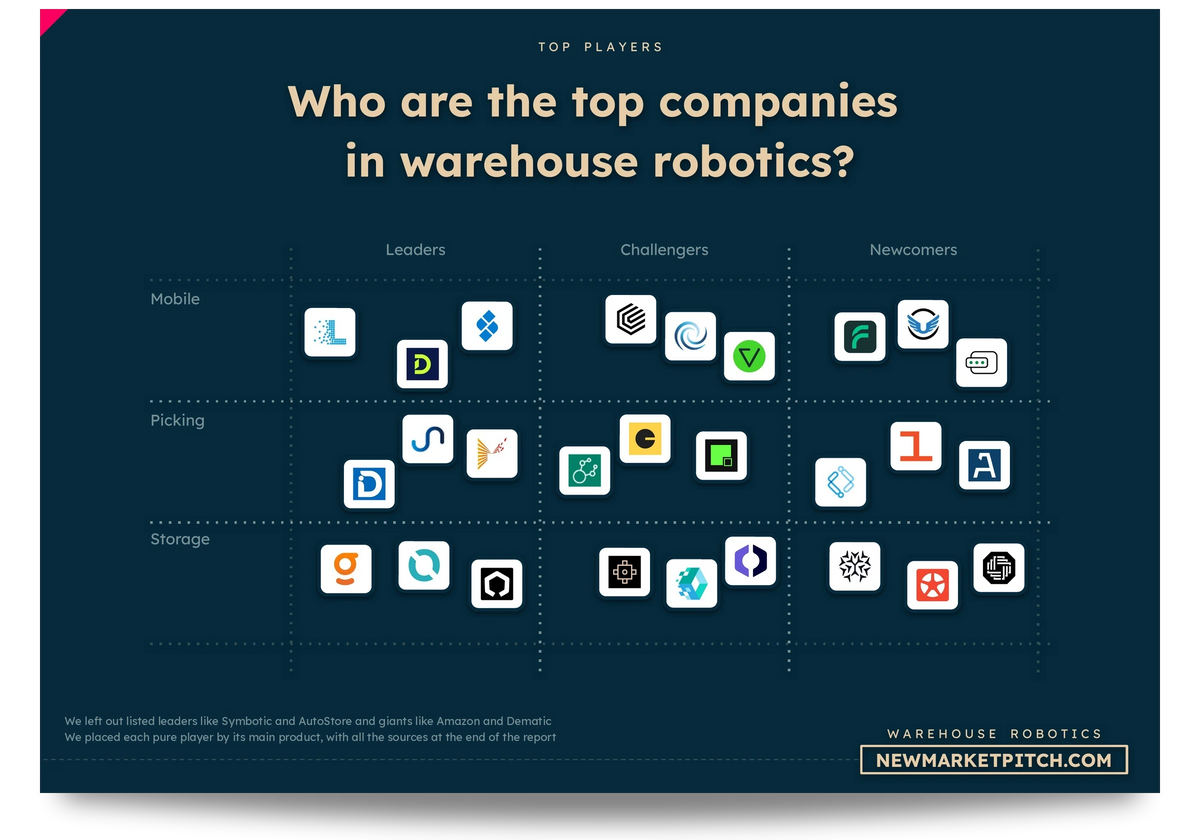
In our research about warehouse robots, we turn what is vague and complex into simple, useful visuals. Market maps like this one show you at a glance where every startup stands.
Is warehouse robotics funding really booming in 2026?
Warehouse robotics funding is growing much faster in 2026, with more than twice as many deals and three times as much disclosed capital as a year earlier.
We counted 25 funding deals worth $557.7 million between January 1 and September 29, compared with 12 deals and $180.7 million during the same period in 2025. That represents 108.3% growth in deal volume and 208.6% growth in quantifiable capital.
The number of funded companies also increased from 11 to 20. The growth extends to more businesses rather than coming entirely from larger checks to the same startups.
The market is also performing well against 2024, when we recorded 14 deals involving 13 companies during the equivalent period. The median round has climbed from $8.95 million in 2024 to $12 million in 2025 and $13.85 million in 2026.
The main qualification concerns funding disclosure. Several Asian transactions have no exact amounts, including a Quicktron Robotics round exceeding $100 million in 2024. Our dollar totals cover quantifiable financings rather than every dollar invested.
| Funding metric | 2024 YTD | 2025 YTD | 2026 YTD | 2026 vs 2025 |
|---|---|---|---|---|
| Funding deals | 14 | 12 | 25 | +108.3% |
| Funded companies | 13 | 11 | 20 | +81.8% |
| Quantifiable capital | $178.1M | $180.7M | $557.7M | +208.6% |
| Capital excluding rounds above $50M | $178.1M | $85.7M | $327.7M | +282.4% |
| Capital excluding rounds above $100M | $178.1M | $180.7M | $327.7M | +81.4% |
| Median quantifiable round | $8.95M | $12M | $13.85M | +15.4% |
| Average quantifiable round | $14.85M | $20.08M | $27.89M | +38.9% |
| Early-stage deal share | 57.1% | 75.0% | 32.0% | −43.0 pp |
| Later-stage deal share | 28.6% | 16.7% | 56.0% | +39.3 pp |
Is warehouse robotics funding growth just two giant deals?
Warehouse robotics funding would still be growing extremely fast without the biggest rounds in 2026. In fact, the increase looks even stronger once we remove them.
Mytra raised $120 million in January, followed by Sereact's $110 million Series B in April. Together, these two financings represented 41.2% of the $557.7 million we recorded.
Mytra develops three-dimensional robotic systems that move and store inventory inside warehouses. Its financing was led by Avenir Growth and followed a year of larger customer deployments.
Sereact develops AI-powered robotic picking technology. Its April round, led by Headline, supported further development of its Cortex platform and expansion into the United States.
Remove these two deals and 2026 still has $327.7 million in quantifiable capital. The equivalent figure in 2025, after excluding rounds above $50 million, was $85.7 million. That's a 282.4% increase.
Concentration has also fallen. The three largest rounds represented 49.2% of quantifiable funding in 2026, compared with 75.7% in 2025. Dexterity's $95 million Series C had accounted for more than half of the previous year's total.
The 2024 comparison requires more caution because Quicktron's financing exceeded $100 million without disclosing a precise figure. Still, the 2025-to-2026 comparison shows that funding has grown well beyond the two headline rounds.

Your time is limited. In our market report about warehouse robots, we put numbers on each part of the market, so you can see where it makes sense to focus.
Are more warehouse robotics startups actually getting funded?
Warehouse robotics investors are backing considerably more companies this year, although some established startups are raising several times within the same period.
We identified 20 funded companies across 25 deals, up from 11 companies across 12 deals in 2025. Four companies completed multiple recorded financings, compared with only one in each earlier comparable period.
Sereact announced a $110 million Series B followed by a $6 million strategic extension involving Zalando. TWINNY recorded approximately $13.7 million in March and another $10.4 million in September. SENAD appeared in three announcements, although we cannot confirm that every reported financing represents entirely independent capital.
There are newer companies entering the market too. Destro AI raised $8 million to develop software that coordinates robots from different manufacturers. UNIT AI secured $12 million for automated warehouse storage and retrieval. Logibot raised approximately $1.6 million for its robot-agnostic deployment and coordination platform.
The new recipients span physical warehouse systems and the software needed to run them. Growth in funded companies is therefore spread across several technologies, rather than being concentrated in one product category.
Are warehouse robotics investors writing bigger checks now?
Warehouse robotics funding rounds are getting larger, especially for companies that already have products deployed with customers.
The median quantifiable round reached $13.85 million this year, up 15.4% from 2025. The average increased much faster, from $20.08 million to $27.89 million, reflecting the greater weight of large financings.
Seven transactions were in the $20 million–$50 million range. Alongside Mytra and Sereact, substantial rounds included Locus Robotics at $41.6 million, Gather AI at $40 million, Vecna Robotics at $31 million and SENAD at approximately $44.13 million.
These companies address different warehouse problems. Locus develops collaborative mobile robots for fulfillment centers, Gather AI uses autonomous systems to monitor inventory, and Vecna builds robotic material-handling solutions.
The changing stage mix helps explain the larger checks. Businesses moving from pilots to bigger installations need hardware, manufacturing capacity, deployment teams and customer support. Those requirements can consume a lot of capital.
The financing records establish that checks are getting bigger. The exact spending plans vary by company and cannot always be reconstructed from the announcements.

In our document detailing everything you need to know about warehouse robotics, we always try to gather several sources and make estimates that make sense, so you can work with solid numbers.
Are warehouse robotics startups finally moving past the early stage?
Warehouse robotics financing has become much more focused on established companies in 2026. More than half of the year's deals were Series B or later, compared with fewer than one in five during 2025.
Later-stage transactions increased from two to fourteen, and Series B and Series C together accounted for eleven financings, up from two in the previous comparable period.
Mytra's $120 million Series C illustrates how far some businesses have progressed. In its January announcement, the company reported signing major enterprise customers, starting production operations at a new customer site and securing a deployment 60 times larger than its previous biggest installation.
Sereact reported over 200 systems operating across Europe and more than one billion production picks when announcing its Series B. Gather AI, meanwhile, raised $40 million to extend its warehouse intelligence technology beyond inventory monitoring into broader logistics operations.
All three were raising money to expand technology already being used in commercial environments.
Early-stage fundraising remains active, but the rapid growth in Series B and C transactions has substantially changed the financing mix.
| Financing stage | 2024 deals | 2025 deals | 2026 deals | 2026 capital |
|---|---|---|---|---|
| Seed | 6 | 2 | 5 | $25.1M |
| Series A | 2 | 7 | 3 | $45.8M |
| Series B | 2 | 1 | 6 | $194.0M |
| Series C | 0 | 1 | 5 | $209.8M |
| Series D+ | 2 | 0 | 1 | $41.6M |
| Growth Equity | 0 | 0 | 2 | $10.4M |
| Unknown | 2 | 1 | 3 | $31.0M |
| Total | 14 | 12 | 25 | $557.7M |
Can new warehouse robotics startups still raise money?
New warehouse robotics startups are still getting funded, and the number of first financings has actually increased in 2026.
We recorded five first-financing transactions, compared with one in 2025 and two in 2024. Their share of all deals rose from 8.3% to 20% over the past year.
Among the newer businesses, Destro AI raised $8 million for warehouse robot orchestration, UNIT AI secured $12 million for automated storage and retrieval, and NEOintralogistics raised approximately $3.52 million to develop its robotics-as-a-service model. Logibot also secured an initial financing for its warehouse robot coordination software.
At the same time, approximately 95.5% of quantifiable capital went to follow-on financings. Mytra, Sereact, Locus Robotics, Gather AI and other previously funded companies received the largest commitments.
So there is still room for newcomers, but most investment dollars are going to companies with an established financing history. First-financing classifications are based on identifiable funding records, which may not capture every earlier transaction.

Our report covering the warehouse robotics market gets updated several times a month, so you always get the latest view of where things stand.
Which warehouse robotics categories are getting the most funding?
Autonomous mobile robots are attracting the broadest combination of warehouse robotics deals and capital in 2026, while robotic picking and storage systems are receiving some of the biggest checks.
Autonomous Mobile Robots recorded seven transactions and $160.2 million in quantifiable financing, compared with four deals and $24.8 million in 2025. Gather AI, Locus Robotics, Vecna Robotics, Corvus Robotics and TWINNY contributed to this activity.
Robotic Picking Systems attracted $137.8 million across four deals. Sereact's $110 million Series B represented almost 80% of that total.
Automated Storage & Retrieval Systems raised $132 million across three deals. Mytra accounted for $120 million, meaning the category's investment jump was almost entirely explained by its Series C.
Robotic Sorting Systems presents a different pattern. Five financing announcements appeared this year, following zero in the equivalent 2024 and 2025 periods. Three of the five financing amounts were unavailable.
The category rankings change depending on whether we measure transactions or dollars. Autonomous mobile robots lead on both dimensions, but picking and storage look much stronger by capital than by the number of funded rounds.
| Warehouse robotics category | 2024 deals | 2025 deals | 2026 deals | 2026 capital |
|---|---|---|---|---|
| Autonomous Mobile Robots | 5 | 4 | 7 | $160.2M |
| Robotic Sorting Systems | 0 | 0 | 5 | $42.0M |
| Palletizing & Depalletizing | 0 | 1 | 4 | $76.1M |
| Robotic Picking Systems | 1 | 3 | 4 | $137.8M |
| Automated Storage & Retrieval | 3 | 3 | 3 | $132.0M |
| Warehouse Robot Orchestration | 1 | 0 | 2 | $9.6M |
| Automated Forklifts | 4 | 1 | 0 | $0M |
Is robotic sorting the next big thing in warehouse robotics?
Robotic sorting is becoming a much more active fundraising category in 2026, although it is too early to call it the biggest opportunity in warehouse robotics.
The category produced five deals during the current period, representing 20% of all warehouse robotics financing activity. Neither 2024 nor 2025 recorded a deal in the same category during the comparable months.
Unbox Robotics raised $28 million in January for its robotic parcel-sorting technology. Yincheng Intelligent recorded an initial round in May and approximately $14 million in Series A funding in September. ULTIROBOTICS and Tiangong Robot/Tegene also appeared among the year's financed companies.
These businesses address parcel movement, sorting and order handling inside logistics facilities. The activity suggests greater investor interest in automating specific warehouse processes beyond conventional mobile transportation and item picking.
But only $42 million could be quantified across the five transactions. With several amounts undisclosed, we have stronger evidence of rising deal activity than of a large increase in capital.

In our research about warehouse robots, we look at what the winners do differently, so you can learn from the best instead of guessing.
Why are investors putting so much money into warehouse robotics now?
Warehouse robotics investors are increasingly funding businesses that can show real deployments, measurable warehouse performance and plans to expand existing customer operations.
Mytra offers a particularly detailed example. In January, it reported that early deployments had reduced material-handling labor by 32% and improved storage density by 34%. It also announced contracts with large enterprise customers and a substantial increase in deployment scale. These are company-reported results, but they give a concrete explanation of the business case behind its financing.
Sereact had reached another important commercial milestone: more than one billion production picks. Its technology focuses on giving robots the intelligence to handle changing products and warehouse conditions without requiring conventional rule-based programming for every object.
Gather AI reported that its bookings had increased by 250% and its operational footprint had doubled before its $40 million Series B. Its customers include logistics and industrial operators using autonomous inventory monitoring technology.
Corvus Robotics also offers evidence of operational adoption. In August, the company announced $20 million in funding and reported more than 300 devices deployed across 26 US states, Canada and Mexico. Its systems analyze warehouse inventory locations and track product movement.
Several major funding recipients can now point to operating results, installed fleets or customer expansion. Investors have more to examine than a prototype or technology demonstration, even if the reported performance figures still need to be distinguished from independently verified results.
Is AI becoming the main reason investors fund warehouse robots?
AI is increasingly important to warehouse robotics funding because it helps robots recognize inventory, handle unfamiliar objects and coordinate operations across different machines.
Sereact is among the clearest examples. Its Cortex platform uses AI to guide robotic manipulation, allowing systems to pick and handle products under changing warehouse conditions. The company's substantial financing reflects investment in an intelligence layer that can be deployed across robotic systems.
Nomagic is working on a related problem. The Polish company raised an additional $10 million in January to develop its Physical AI platform and vision-language-action models. Its robots are designed to pick, pack and manipulate goods inside fulfillment environments.
Gather AI and Corvus Robotics focus more heavily on perception and operational visibility. Their systems use autonomous devices and computer vision to detect inventory discrepancies and monitor warehouse conditions. Corvus has also expanded into tracking pallet movements with equipment-mounted sensors.
Software coordination is another area attracting funding. Destro AI and Logibot develop technology for managing different robotic systems, potentially reducing the difficulties of operating machines from multiple suppliers.
We're seeing AI investment across manipulation, perception and orchestration. Hardware remains central, though: Mytra, Locus Robotics and numerous other funded companies still develop substantial physical systems alongside their software.

In our market report about warehouse robots, we don't want to repeat what boring consulting reports say. Instead, we show you the real and latest market signals that matter.
Are autonomous warehouse robots replacing automated forklifts?
Autonomous mobile robots are attracting far more recorded funding activity than automated forklifts in 2026, although there's no evidence here that warehouses are abandoning forklift automation.
The autonomous mobile category recorded seven deals this year, compared with four in 2025. Automated Forklifts recorded none, following one transaction in 2025 and four in 2024.
The companies involved show why the comparison is complicated.
Locus Robotics builds mobile robots that work alongside warehouse employees to move and pick goods. Gather AI and Corvus Robotics deploy autonomous inventory-scanning drones. Vecna Robotics develops autonomous vehicles for industrial material handling.
Meanwhile, companies such as Multiway Robotics develop autonomous forklifts alongside other mobile robots and warehouse automation equipment.
The categories overlap in practice. Some technologies classified as mobile robotics can perform tasks previously associated with conventional material-handling vehicles.
Our funding records show considerably greater activity in the broader autonomous mobile category. Whether that translates into a permanent shift in equipment demand will depend on customer purchasing and deployment decisions, which financing data cannot establish.
Are Amazon, logistics companies and industrial groups investing more in warehouse robotics?
Corporate investors are continuing to fund warehouse robotics companies, particularly when the technology relates directly to their logistics operations, but their share of all financings has barely changed.
We identified nine deals involving strategic investors in 2026, compared with four during the equivalent period in 2025. Their share increased by only 2.7 percentage points.
Mytra's strategic investors include Lineage, which operates temperature-controlled warehouses, and RyderVentures, the investment arm of logistics and transportation company Ryder.
Sereact received a $6 million strategic investment involving Zalando in July. Zalando operates a substantial e-commerce fulfillment network, making robotic picking a technology with direct operational relevance.
UNIT AI's $12 million financing included Prologis Ventures, while Logibot received backing from BeamBerlin, a startup studio supported by intralogistics equipment manufacturer BEUMER Group.
Chinese warehouse robotics company SENAD has also attracted investors connected with logistics, industrial operations and freight transportation, including Sinotrans and Full Truck Alliance.
Amazon's Industrial Innovation Fund is another established strategic participant in this sector, having invested in businesses such as Contoro Robotics and Filics in earlier periods.
These investments reflect a direct interest from logistics operators and equipment suppliers in warehouse automation. Some investors may eventually become commercial partners, customers or distribution channels, although an equity investment alone doesn't establish a customer deployment.

Learning from others' mistakes is the cheapest lesson there is. In our document detailing everything you need to know about warehouse robotics, we look at what broke startups before you, so you don't repeat it.
Is warehouse robotics funding becoming a global race?
Warehouse robotics fundraising is increasingly international, with Asia-Pacific leading by deal count and North America accounting for the largest share of quantifiable capital.
American companies have secured several of the biggest disclosed financings, including Mytra, Gather AI, Locus Robotics and Vecna Robotics. Their rounds cover warehouse storage, inventory intelligence, collaborative robots and material handling.
Europe has produced important investments too. Germany-based Sereact raised $110 million in April and another $6 million in July. Poland-based Nomagic obtained a $10 million Series B extension, while Belgian startup Logibot raised approximately $1.6 million.
Asia-Pacific shows substantial activity across several categories. SENAD appeared in three financing announcements, South Korea's TWINNY raised money twice, India's Unbox Robotics secured $28 million, and Chinese businesses such as Yincheng Intelligent and ZIKOO Robotics attracted investment in sorting and storage technology.
One difficulty is that funding disclosure differs considerably between regions. Several Asian transactions were announced without an exact dollar amount or were described only as exceeding a particular financing threshold.
Regional deal counts therefore provide a clearer comparison than disclosed capital totals. North America leads our quantifiable investment figures, but that should not automatically be interpreted as an equivalent lead in all capital actually raised.
Is 2026 already the biggest year for warehouse robotics funding?
Warehouse robotics has already recorded more financing deals and more quantifiable capital in 2026 than during either of the two previous full calendar years.
By the September 29 cutoff, we counted 25 transactions, compared with 16 throughout 2025 and 22 throughout 2024.
Quantifiable capital reached $557.7 million in the first nine months of 2026, against $339.7 million for full-year 2025 and $410.1 million for full-year 2024.
The 2024 figures refer to two different periods: $178.1 million in quantifiable funding between January 1 and September 29, 2024, and $410.1 million across the complete 2024 calendar year. The same January–September window is used for all year-over-year growth calculations.
The number of funded companies is also notable. Twenty businesses raised capital during the first nine months of 2026, matching the entire 2024 total and exceeding the fourteen companies funded in 2025.
There is no need to assume anything about fourth-quarter activity. The recorded 2026 deal count has already exceeded both previous annual totals.
The capital comparison is less definitive because some historical transactions had unquantified amounts, particularly the large Quicktron round in 2024. The record in deal activity is clearer than the record in total dollars invested.

If you build or invest in the warehouse robotics market, you need to know which business models pay off now and which ones are fading. That's why our report covering it has a whole section on it.
Are warehouse robotics investors getting more selective?
Warehouse robotics investors seem increasingly willing to write large checks for companies with substantial commercial progress, while smaller startups continue to secure funding for new technologies.
The financing-stage changes support that interpretation. Series B and later deals have become much more common, and major recipients are reporting installed systems, operating customers and plans to expand deployments.
Mytra raised $120 million after reporting major enterprise contracts and a much larger deployment pipeline. Sereact secured $110 million after reaching more than one billion production picks. Gather AI's $40 million round followed strong growth in bookings and its operational footprint.
On the early-stage side, Destro AI, UNIT AI, Logibot and NEOintralogistics show that investors still see opportunities in new warehouse automation products and business models.
But selectivity is difficult to measure directly. We don't have reliable data on rejected funding applications, fundraising durations or changes in valuation expectations. More growth-stage deals do not automatically mean it has become harder for promising early-stage companies to raise capital.
The strongest conclusion is that the largest funding commitments favor businesses with developed technology and commercial operations. Whether investors have become more demanding across the entire market remains less clear.
What is actually changing in warehouse robotics funding?
Warehouse robotics funding is growing across more companies, larger deals and more mature businesses. The strongest change is the combination of wider participation and a sharp increase in Series B and later financing.
The increase goes well beyond two headline transactions. Even after excluding rounds above $50 million, quantifiable capital rose dramatically compared with 2025. The number of funded businesses also increased, giving us two separate measures of the expansion.
The market's maturity is changing just as quickly. Later-stage rounds now account for more than half of transactions, with companies such as Mytra, Sereact and Gather AI reporting meaningful deployment or commercial milestones. Investors are providing larger amounts to businesses already operating in customer environments.
At the category level, autonomous mobile robots are attracting more transactions and substantial capital, while robotic sorting has emerged as a notable source of new activity. Automated storage and robotic picking are also receiving large checks, although their capital totals remain heavily dependent on individual companies.
First financings have increased too, even as follow-on rounds absorb almost all quantifiable investment capital. Young robotics companies are still getting funded, but a much larger share of available capital is flowing toward growth-stage businesses.
The exact magnitude of capital growth across regions and against 2024 deserves more caution. Several large or potentially significant transactions lack precise disclosed amounts. Company deployment claims also require separate assessment before being treated as independently verified commercial performance.
For now, the most convincing finding is that warehouse robotics is attracting more funded companies while producing a larger group of businesses capable of raising substantial growth capital. The next test is how many can turn increasingly large deployments into sustainable operating performance.

In our research about warehouse robots, we like to show you the big picture. We know your time is precious, so we make every page quick to read and packed with as much learning as possible per minute.
Our methodology
This analysis examines global warehouse robotics market financing announced between January 1 and September 29, 2026, compared with the equivalent January 1–September 29 periods in 2025 and 2024. The full calendar years 2024 and 2025 are used separately to assess whether 2026 has already surpassed previous annual funding activity.
We assembled transaction-level financing records using company and investor announcements, regulatory filings, established financial and industry reporting, and other public records. We reviewed recent financing events individually, aggregated the findings across deal counts, funded companies, capital, stages, technology categories, investors and geographies, and compared those results to identify changes supported by multiple measures.
Our market definition covers businesses whose core activities are directly connected to warehouse robotics, including autonomous material movement, robotic picking, sorting, automated storage and retrieval, pallet handling and robot orchestration. Companies operating across multiple applications were assigned one primary category per transaction to avoid counting the same financing in several technology categories.
We focused on qualifying private-company financings meeting a minimum threshold of $300,000. Equity capital was distinguished from debt, grants, loans, public offerings and secondary transactions where the financing structure was identifiable. For packages combining equity and debt, we used the attributable equity component where available. We also reviewed extensions and additional closings to distinguish incremental investment from repeated reporting of the same capital.
Quantifiable capital totals include disclosed amounts and consistently converted US dollar estimates. Undisclosed financing amounts and transactions reported only as exceeding a funding threshold were retained in qualifying deal counts but excluded from calculations requiring precise dollar values. This distinction particularly affects historical and regional comparisons involving Quicktron Robotics, Multiway Robotics and SENAD. The $178.1 million reported for 2024 YTD covers January 1–September 29, while the $410.1 million full-year figure covers January 1–December 31.
Funding stages, first-financing status, strategic investor involvement and commercial milestones were classified using the information available in underlying transaction histories and announcements. We also reviewed concentration by comparing the largest rounds with total quantifiable capital and recalculating funding growth after excluding transactions above $50 million and $100 million. Company-reported deployment and performance metrics were used as commercial context, separately from our own funding calculations.
Key company and investor sources include Mytra's Series C announcement and reported deployment results, Gather AI's Series B announcement, Corvus Robotics' funding and operational update, Nomagic's Series B extension, Sereact's company publications, Amadeus Capital's NEOintralogistics investment announcement, Milvus Robotics' Series A announcement, its subsequent Series A extension, and Dexterity's SEC financing filing.
Additional historical financing references include Mytra's 2024 launch and funding announcement, Supernova Invest on Galam Robotics, Floatic's 2024 financing, Contoro Robotics' Series A, Nimble Robotics' Series C, 1991 Ventures on Deus Robotics, and Multiway Robotics' Series B announcement. These references were used alongside the transaction-level research to distinguish financing events, verify company activities and assess developments across the three comparison periods.

When you build or invest in the warehouse robotics market, you need clarity, not confusion. In our market report about warehouse robots, we always try to put numbers on and quantify whatever is usually vague and confusing.
Written by the New Market Pitch teamWe track new markets so founders and investors can move faster. About us