AI Chip Market Pitch Deck

LAST UPDATED: April 24, 2026

The real map of
the AI chip market

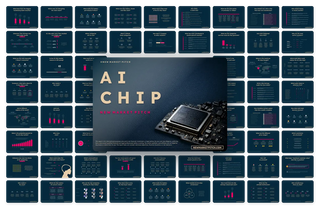
Behind the obvious NVIDIA story are harder questions around CUDA lock-in, design wins, hyperscaler custom silicon, packaging capacity, inference economics, and where new entrants can actually create value. This deck helps builders and investors answer them faster.

What’s inside the deck?

12 tightly built sections for founders and investors trying to understand where the AI chip opportunity is real, what is slowing adoption, and which parts of the market are stronger than they first appear

AI chip market europe asia africa usa world
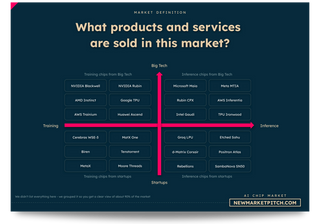
Market Definition

Where does the AI chip market start and stop?

A lot of bad analysis starts with category drift. People lump together NVIDIA GPUs, hyperscaler TPUs, edge AI silicon, inference ASICs, and even parts of the broader AI infrastructure stack, then wonder why the market looks bigger or cleaner than it really is.

We define the market precisely, so the rest of the deck rests on the right foundation.

ai-chip chart
ai-chip chart
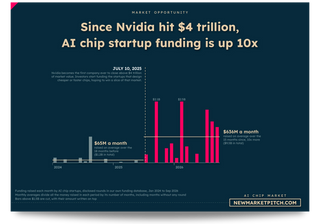
Market Opportunity

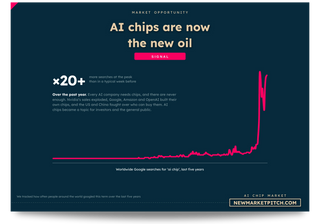
Why this market now?

The easy answer is AI demand. The harder answer is that several forces are moving at once: frontier model training, rising inference volumes, hyperscalers expanding custom silicon programs, and customers looking for better performance per watt and better economics than generic compute can offer.

But this is not a simple growth story. In AI chips, demand alone does not create an opportunity. Software lock-in, packaging capacity, HBM supply, and real design-win velocity still decide who can turn momentum into revenue.

AI chip market cagr growth rate market size
Market Size

What is the real size of the AI chip market?

AI chip market numbers are all over the place because people are often measuring different things: GPUs vs accelerators, training vs inference, merchant silicon vs hyperscaler-designed chips, chip revenue vs broader AI systems revenue, and deployed volume vs projected demand.

We rebuild the estimate from the ground up, make the assumptions visible, and show the logic behind the number, so you can use it without guessing what is hidden underneath.

AI chip market revenue breakdown segments
Pain Points

Where is the pain strong enough to drive adoption?

In AI chips, demand is not just about wanting more compute. It is about having a problem painful enough to justify changing hardware, porting workloads, or betting on a new supplier.

We show where that pressure is strongest across hyperscalers, AI infrastructure players, edge deployments, and vertical use cases, and which buyers care enough about performance, latency, power efficiency, or cost to create real adoption opportunities.

ai-chip tech chart
ai-chip tech chart
Tech & Infra

What is changing in the AI chip stack right now?

Not every breakthrough in AI chips turns into adoption. What matters is which shifts actually improve deployability, economics, and real workload performance.

This section helps you see what is becoming commercially decisive, from packaging and memory bandwidth to compiler maturity, interconnect, and system-level integration, so you can distinguish serious platform moves from technology that still looks better on paper than in production.

AI chip market business models startups
Value Creation

Where does value actually accrue in this market?

In AI chips, technical novelty does not always translate into economic power. This section helps you see where value really concentrates, whether in silicon, software enablement, packaging relationships, full-stack systems, or control of key design wins.

The goal is simple: help you understand which models create durable leverage, and which ones stay capital-intensive without ever owning enough of the stack.

AI chip market challenges
Market Challenges

What could actually break the story?

The upside case in AI chips is easy to repeat. This section helps you see what can stop strong technical stories from turning into adoption, scale, and revenue.

From qualification drag and software friction to export exposure, manufacturing dependencies, and architecture bets that age badly, we focus on the risks that matter early, so you can pressure-test the market before the market does it for you.

AI chip market consumer adoption chart
Growth Drivers

What are the growth drivers?

AI demand is the headline, but it is not enough on its own. This section helps you see which forces are truly carrying the market, from inference economics and hyperscaler customization to tighter efficiency constraints and workload-specific demand.

More importantly, it shows you what still has to line up, across tooling, supply, and customer adoption, so you can tell the difference between growth that looks exciting and growth that is actually investable.

AI chip market fundraising investors
Investor Bets

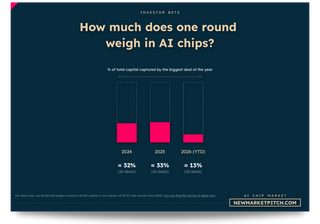
What are investors betting on now?

In AI chips, capital is not just backing performance claims. It is backing teams that look most likely to turn technical advantage into adoption, whether through stronger software, clearer design-win paths, tighter system integration, or a wedge into inference, edge, or hyperscaler demand.

This section helps you see where conviction is concentrating, which theses are gaining momentum, and which kinds of stories investors are treating more cautiously.

AI chip market map top startups
Top Players

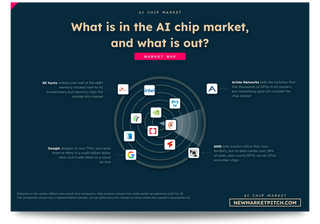
Who are the top startups?

NVIDIA dominates the conversation, but the AI chip market is far larger than one company.

A growing set of challengers and specialists is building across training accelerators, inference chips, edge silicon, photonics, and neuromorphic architectures.

Because the ecosystem is evolving fast, confusion is common, especially around software lock-in, foundry access, and which architectures will win which workloads.

That's why, in this section, we'll share the detailed market grids and ecosystem maps we've built, so you can quickly see what's happening, where the opportunities are, and how the AI chip market is evolving.

AI chip market pain points customers
Startup Killers

What could kill an AI chip startup?

The AI chip market looks like an enormous opportunity, but it's not "tape out and win". Design cycles are long, software ecosystems decide adoption, foundry access is constrained, and NVIDIA's moat is deeper than most founders admit.

So we studied AI chip startups that failed and pulled out the quiet traps: shipping silicon without a mature compiler, chasing benchmarks that don't reflect real workloads, relying on one hyperscaler for the entire revenue plan, or underestimating how long it takes to get from sample to volume production.

After reading this section, you'll have clarity on these non-obvious challenges, so you can spot them early, and avoid them before they slow you down.

AI chip market market share
Startup Strategies

How do you win in this market?

The best AI chip companies do more than tape out strong silicon. They choose the right wedge, reduce adoption friction, align with real customer pain, and build enough of the surrounding stack to make switching feel worth it.

This section helps you see the strategic choices that separate traction from noise.

Questions?

Who is this market pitch actually for?+

This deck is built for builders, investors, and strategic teams who need a sharper read on the AI chip market before they build, back, partner, acquire, or reposition.

It is especially useful if you are trying to understand where a new chip can actually win, where value is likely to accrue across the stack, how the market is shifting between training and inference, and which opportunities are stronger than they first appear.

How many pages are in the deck?+

The deck is around 210+ pages.

That sounds long, but it is built to be fast to use: high signal, visual, tightly structured, and easy to skim when you need answers quickly. The goal is not to give you more pages. It is to give you a much better map of the market.

What do you include in the AI chip market?+

We define the AI chip market as data-center AI accelerators primarily used to run AI workloads, including both training and inference.

That includes GPUs, TPUs, and other AI accelerators / ASICs deployed in servers used to train or serve machine-learning models.

We do not include general-purpose CPUs, networking and memory components, or endpoint / edge chips used in phones, PCs, cars, and IoT devices.

Do you list your sources clearly?+

Yes. All key data points and assumptions are explained and sourced in the deck.

All sources are tier-1: company filings, funding databases, public datasets, expert interviews, industry reports, etc.

Is the data up to date?+

Yes. The deck was last updated on April 24, 2026 with the latest market signals.

Is this a one-time payment?+

Yes. This is a one-time purchase. There is no subscription required to access the deck.

I want to buy several market reports, can I get a discount code?+

Yes. You can use NEWMARKET for 20% off when purchasing two reports, or NEWMARKETMAX for 30% off when purchasing five or more.

I’m interested in a market but I can’t find it here+

If a market you care about is not currently on the list, email us at team@newmarketpitch.com and we may be able to cover it.

I have more questions for you+

No problem. You can reach out directly and we respond within 24 hours.

Get the AI chip market pitch

A lot of people can tell you the AI chip market is growing. Far fewer can help you read where adoption gets blocked, which parts of the stack still have room for new winners, and where the attractive story starts to break. That is what this deck is for.

PRO
$49
One-time payment
  • Market Definition
  • Market Opportunity
  • Market Size
  • Pain Points
  • Tech & Infra
  • Value Creation
  • Market Challenges
  • Growth Drivers
  • Investor Bets
  • Top Players
  • Startup Killers
  • Startup Strategies
PRO+
$79
One-time payment
  • Market Definition
  • Market Opportunity
  • Market Size
  • Pain Points
  • Tech & Infra
  • Value Creation
  • Market Challenges
  • Growth Drivers
  • Investor Bets
  • Top Players
  • Startup Killers
  • Startup Strategies
PRO++
$99
One-time payment
  • Market Definition
  • Market Opportunity
  • Market Size
  • Pain Points
  • Tech & Infra
  • Value Creation
  • Market Challenges
  • Growth Drivers
  • Investor Bets
  • Top Players
  • Startup Killers
  • Startup Strategies
Use code MARKETPITCH for 10% off your order