Get the current state of the alternative protein market
The mission is not enough anymore. Alternative protein now has to win on taste, price, repeat purchase, manufacturing, and whether people actually want the product once the novelty fades. This report gets you up to date on the market.
What’s inside the deck?
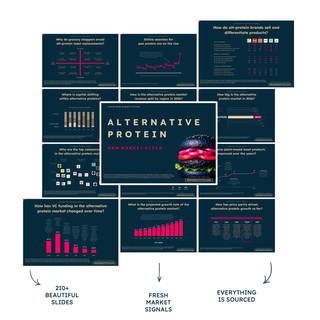
12 sections to help founders and investors understand the alternative protein market with clarity
Market Definition
What is this market about?
Before we start, we'll define the market plainly: what it includes, what it doesn’t, where are the boundaries, mistakes people make when they talk about this market, etc.
That way, the numbers, competitors, and takeaways are all evaluated in the same frame.
It saves you time and makes the rest of the deck easier to trust.
Market Opportunity
Why this market now?
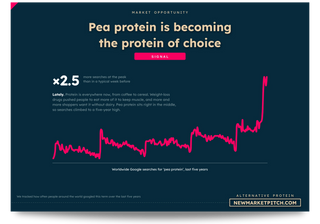
Yes, the plant-based segment is currently in difficulty. However, we have seen couple of bright spots in the alternative protein market (notably fermentation ingredients and cultivated-meat regulatory progress).
Our team has found a lot of interesting signals. Australia approving its first cultivated meat for sale or The EVERY Company raising $55M Series D are some of them.
In this section, we will see why 2026 might still be a good year to build and invest in this market.
Market Size
How big could this market get?
If you’ve tried to look up alternative protein market size and CAGR online, you’ve probably noticed the numbers don’t match. That’s because they often rely on different definitions and opaque methods.
So we built our own numbers. We did a rigorous, first-principles analysis, cross-check it against aggregated third-party sources, and then landed on a single estimate we could stand behind.
In this section, we lay out every assumption, walk through the logic step by step, and show our reasoning so you can see exactly why the numbers make sense.
The goal is simple: give you reliable figures you can quickly sanity-check to answer, “Is this worth anyone’s time?”as an entrepreneur or an investor.
Pain Points
What are the pain points, and for whom?
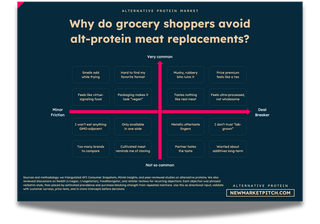
Health-conscious consumers, food manufacturers, retailers, and restaurants all face frustrations that alternative proteins can address.
We walk through who the buyers are and what's pushing them toward new protein sources.
Knowing who wants change and why helps you build or invest in products that win market share.
Tech & Infra
What is the latest tech and infrastructure?
Plant-based formulations, precision fermentation, cultivated meat, novel ingredients ... the alternative protein market covers a lot of ground, and the landscape shifts quickly.
That's why we regularly update this section with what's on shelves, what's in trials, and what's still in R&D. Production platforms, scaling solutions, and the tech enabling new food systems, all in one place.
A current snapshot of a market redefining how we eat.
Value Creation
How is value created and monetized exactly?
CPG sales, foodservice contracts, ingredient supply, co-manufacturing, licensing, and strategic partnerships are just a few of the ways alternative protein companies make money.
We show which business models are working right now, and why certain segments deliver 10x better unit economics than others.
In this section, we want you to understand where margin is real, so you don’t build or invest in a great product that can’t win on cost, scale, or distribution.
Market Challenges
What could slow this market down?
There are obvious forces that can slow the alternative protein market, such as high production costs, scaling challenges, and price gaps versus conventional meat.
But there are also less obvious threats, like taste and repeat-purchase hurdles, regulatory and labeling fights, and retailer delistings if velocity disappoints.
In this section, we map the main hurdles and rate how likely they are, so you get a practical risk briefing before you invest or build.
Growth Drivers
What are the growth drivers in this market?
The alternative protein market really has a lot of potential, but some things need to happen for it to grow faster and reach mass adoption.
Some drivers are easy to see: sustainability concerns, food security, and shifting consumer preferences. But growth also depends on less obvious shifts such as real progress on taste and texture, price parity through scaled manufacturing and lower-cost inputs, stronger distribution in foodservice and retail, and clear regulation and labeling that supports trust, just to name a few.
Before building or investing, you should know what has to be true for adoption to scale.
Investor Bets
What are investors backing right now?
Some investors love the alternative protein market because it can reshape a massive global category, especially when taste, cost, and distribution finally line up.
In this section, we’ll show you where money is flowing and what’s actually getting funded right now. You’ll see which companies are raising, plus what those rounds have in common: the approaches investors keep leaning into, what they’re excited about today, and what they’ve mostly stopped backing. We’ll also flag the newer theses starting to gain traction.
Top Players
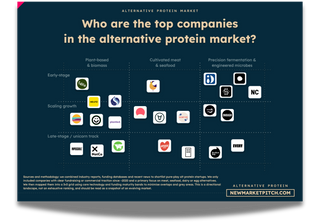
Who are the top startups and companies?
Of course you’ve heard of Beyond Meat and Impossible Foods, but a new wave of promising startups is emerging across the alternative protein market.
They don’t always make headlines. Many are building quietly, outside the spotlight. But they’re worth watching. Some of these companies may become the next breakout winners.
Because the market is still young, confusion is common, especially among founders, investors, and food industry leaders navigating changing consumer demand, unit economics, and regulatory pathways.
That’s why, in this section, we’ll share the detailed market grids and ecosystem maps we’ve built, so you can quickly understand what’s happening, where the opportunities are, and how the alternative protein market is evolving.
Startup Killers
What could kill a startup in this market?
The alternative protein market looks huge, but it’s not a straight-line win: taste expectations are high, cost parity is brutal, scale-up is hard, and distribution is controlled by a few buyers.
So we studied alt-protein startups that failed and pulled out the quiet traps: scaling before yields stabilize, mistaking hype for repeat purchase, or assuming “better for the planet” beats price and convenience.
After reading this section, you’ll have clarity on these non-obvious challenges, so you can spot them early, and avoid them before they slow you down.
Startup Strategies
How do you win in this market?
Impossible, Beyond, UPSIDE Foods, GOOD Meat… alternative protein has its share of headline-grabbing leaders.
So why do some brands earn real repeat purchase while others get stuck as “curiosity products”? The winners tend to nail distribution, taste/price expectations, and a story that feels credible .. especially as the category matures and hype fades.
We’ve mapped the patterns behind the breakouts, and in this section we’ll hand you the cheat codes to build and win in this market.
Questions?
Who is this market report actually for?+
This deck is built for founders, investors, operators, and strategists who need a clearer view of the market before they build, invest, partner, or reposition.
It is especially useful if you are trying to understand where the opportunity is real, how the market is evolving, and what separates the promising segments from the fragile ones.
How many pages are in the deck?+
The deck is around 210+ pages. It is designed to be comprehensive enough to support serious market evaluation, while still being fast to read and easy to use.
We prioritize signal, structure, and visual clarity over unnecessary length.
What do you include in the alternative protein market?+
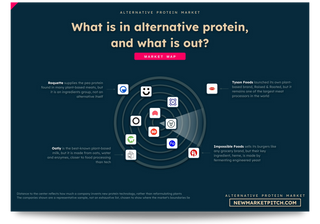
We define the alternative protein market as all modern technologies that provide protein for human food as a substitute for conventional meat, seafood, dairy, and eggs.
We include plant-based meat, seafood, dairy and egg products, fermentation-derived proteins used in such foods, and cultivated (cell-based) meat and seafood.
We exclude generic plant staples like beans, lentils, tofu and wheat gluten sold as ordinary foods, as well as insect, algae and other novel proteins, unless they are clearly positioned as meat, seafood, dairy or egg alternatives.
Do you list your sources clearly?+
Yes. All key data points and assumptions are explained and sourced in the deck.
All sources are tier-1: company filings, funding databases, public datasets, expert interviews, industry reports, etc.
Is the data up to date?+
Yes. The deck was last updated on July 2, 2026 with the latest market signals.
Is this a one-time payment?+
Yes. This is a one-time purchase. There is no subscription required to access the deck.
I want to buy several market reports, can I get a discount code?+
Yes. You can use NEWMARKET for 20% off when purchasing two reports,
or NEWMARKETMAX for 30% off when purchasing five or more.
I’m interested in a market but I can’t find it here+
If a market you care about is not currently on the list,
email us at team@newmarketpitch.com and we may be able to cover it.
The cost of misreading a market is high, especially in a category as nuanced as this one. This deck helps you understand where the market is real, where it is moving, and what matters most before you commit time, capital, or strategy
PRO
$49
One-time payment
✓Market Definition
✓Market Opportunity
✓Market Size
✓Pain Points
✓Tech & Infra
✓Value Creation
✓Market Challenges
✓Growth Drivers
✓Investor Bets
✓Top Players
✓Startup Killers
✓Startup Strategies
PRO+
$79
One-time payment
✓Market Definition
✓Market Opportunity
✓Market Size
✓Pain Points
✓Tech & Infra
✓Value Creation
✓Market Challenges
✓Growth Drivers
✓Investor Bets
✓Top Players
✓Startup Killers
✓Startup Strategies
PRO++
$99
One-time payment
✓Market Definition
✓Market Opportunity
✓Market Size
✓Pain Points
✓Tech & Infra
✓Value Creation
✓Market Challenges
✓Growth Drivers
✓Investor Bets
✓Top Players
✓Startup Killers
✓Startup Strategies
Use code MARKETPITCH for 10% off your order
Choosing a selection results in a full page refresh.