
Get total clarity on the autonomous vehicle market
Hundreds of hours of research and analysis summarized in 100+ beautiful slides. Forget boring reports and "trust us" insights with no methodology behind them. We've made everything fresh, clear, and straightforward.
What is included in the pitch?
The autonomous vehicle market pitch covers 12 topics
Market Definition
What is this market about?
Before we start, we define the market so you know exactly what we’re counting (and what we’re not).
We do this because every data and chart in the deck depends on that very clear definition.
This way, you can read the rest of the deck without constantly wondering what we’re talking about.
Market Opportunity
Why this market now?
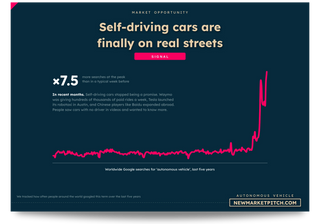
Clearly, the autonomous vehicle market is hot in 2026.
Our team is seeing really strong signals. Real commercial scaling in robotaxis, the UK signaling near-term commercialization or Aurora launching the first commercial driverless trucking service in the U.S. are some of them.
Here, we will tell you why investors and builders are looking at this market now.
Market Size
How big could this market get?
There are tons of autonomous vehicle market size and CAGR numbers online, and they’re all over the place. It’s tough to know what to trust.
That’s why we built our own estimate. We started from scratch with a first-principles model, validated it with aggregated sources, and clearly laid out the assumptions and logic behind it.
This way, you get numbers you can trust, and a fast way to sanity-check whether this market is worth pursuing.
Pain Points
What are the pain points, and for whom?
If the autonomous vehicle market is accelerating, it's because there are critical problems to solve.
Fleet operators, logistics companies, city planners, and everyday commuters all face challenges that self-driving tech can address. In this section, we break down who the buyers are and what's motivating their decisions.
When you see who's struggling and why, you can build or fund AV solutions that meet genuine market needs.
Tech & Infra
What is the latest tech and infrastructure?
If you're tracking the autonomous vehicle market, you know how much changes quarter to quarter. New software stacks, sensor breakthroughs, regulatory updates. It's a lot to keep up with.
This section stays current with what's on the road, what's in pilot programs, and what's still in the lab.
Self-driving systems, HD mapping, fleet operations, and the full infrastructure stack, all covered.
Value Creation
How is value created and monetized exactly?
You need to understand where value is captured in autonomous vehicles (hardware, software, safety validation, or operations) before you build on the wrong layer of the stack.
We will give you clarity on which business models are working right now, and why some segments seem to deliver 10x better unit economics than others.
You will learn how market leaders make money via autonomy-as-a-service, logistics and fleet partnerships, licensing, and high-margin components ... not just by promising a future that keeps getting pushed out.
Market Challenges
What could slow this market down?
You’re probably already aware of the headline frictions in the autonomous vehicle market: safety validation, regulatory uncertainty, expensive sensors and compute, and the like.
The less obvious threats tend to surface later: edge-case failures that trigger backlash, unclear liability and insurance, high operating costs that strain unit economics, to name a few.
In this section, we map the main hurdles and rate how likely they are, so you get a practical risk briefing before you invest or build.
Growth Drivers
What are the growth drivers in this market?
As mentioned earlier, we will give you a realistic growth rate for the autonomous vehicle market. Now we also need to explain why the market would grow. If we do not, the numbers are just guesswork.
Some drivers are easy to see: advances in sensors and AI, demand for safer roads, and interest in lowering logistics and labor costs. But there are also less obvious forces that can accelerate autonomous vehicles, including supportive regulation and liability frameworks, high-quality mapping and infrastructure, fleet-based deployment models that improve unit economics, and consistent performance in real-world edge cases.
Before building or investing, you should know what these forces are, and what needs to happen for them to kick in at scale.
Investor Bets
What are investors betting on now?
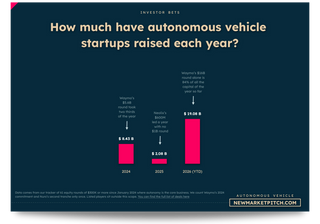
Not every investor is chasing the same thing. In autonomous vehicles, the money is increasingly following clear paths to deployment, whether that’s specific geofenced services, industrial settings, or the enabling tech that makes autonomy safer and cheaper.
In this section, we’ll show you where capital is actually going right now. You’ll see which companies are raising, plus the pattern behind the rounds: the segments investors are leaning into, what they’re passing on, and the newer theses starting to build momentum across software, sensors, and operations.
Use this to stay aligned with what capital is rewarding today.
Top Players
Who are the top startups and companies?
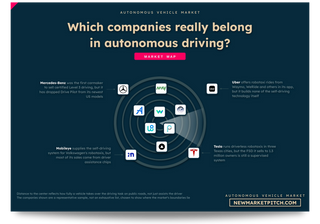
Waymo and Cruise grab headlines, but they represent just one layer of the autonomous vehicle market.
Real progress is happening across the stack: from autonomy software and safety systems to fleet management and infrastructure.
We've built ecosystem maps and market grids to give you a clearer view of what's actually happening and where the whitespace is.
Startup Killers
What could kill a startup in this market?
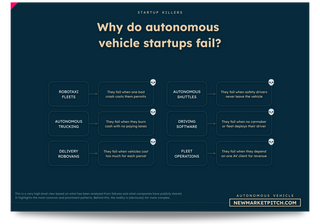
The autonomous vehicle market isn’t a guaranteed goldmine. Many teams underestimate how unforgiving it is: safety requirements, edge cases, high burn, long validation timelines, and dependence on OEMs and regulators, and some crash hard.
So we studied AV startups that failed and pulled out the non-obvious patterns: the quiet traps you don’t see in generic startup advice, like scaling pilots too early, overfitting to demos, ignoring operations and maintenance, or assuming partnerships will convert into real deployments.
The goal: if you’re building, you start ahead. If you’re investing, you avoid teams heading toward the same dead ends.
Startup Strategies
How do you win in this market?
Waymo, Baidu Apollo Go… autonomy finally has a few visible leaders.
Why did they progress from prototypes to real rides at scale while others hit safety, unit economics, or policy walls? What did they do differently in operations, partnerships, and rollout strategy? The winners share some surprisingly consistent patterns.
We’ve broken down what’s working in the field, and in this section we’ll share the cheat codes you can borrow ... without making the same expensive mistakes.
Questions?
How do you define the autonomous vehicle market?
We define the autonomous vehicle market as all cars, vans, buses and trucks designed for public roads that can fully take over the driving task from a human driver in some conditions (SAE Level 3 to Level 5).
We include passenger cars, robo-taxis, shuttles and commercial trucks with Level 3–5 automated driving systems, whether owned by individuals or operated in fleets.
We exclude vehicles with only driver-assistance features (Level 1–2), off-road or industrial robots, and non-road systems such as drones or warehouse robots.
How long is the market pitch?
The market pitch is around 120 pages.
When was it last updated?
It was last updated on
January 18, 2026.
I have more questions
Please contact us and we will reply within 24 hours.
Get the
autonomous vehicle market pitch
If you need a fresh, visual and concise report to understand this market, you're at the right place. Also, when you buy the market pitch, you get full access to our experts, research and internal data.
PRO
$149
One-time payment
✓Market Definition
✓Market Opportunity
✓Market Size
✓Pain Points
✓Tech & Infra
✓Value Creation
✓Market Challenges
✓Growth Drivers
✓Investor Bets
✓Top Players
✓Startup Killers
✓Startup Strategies
PRO+
$179
One-time payment
✓Market Definition
✓Market Opportunity
✓Market Size
✓Pain Points
✓Tech & Infra
✓Value Creation
✓Market Challenges
✓Growth Drivers
✓Investor Bets
✓Top Players
✓Startup Killers
✓Startup Strategies
PRO++
$199
One-time payment
✓Market Definition
✓Market Opportunity
✓Market Size
✓Pain Points
✓Tech & Infra
✓Value Creation
✓Market Challenges
✓Growth Drivers
✓Investor Bets
✓Top Players
✓Startup Killers
✓Startup Strategies
Get 10% off with the discount code MARKETPITCH
Choosing a selection results in a full page refresh.