What is this market about?
Before we start, we define the market so you know exactly what we’re counting (and what we’re not).
We do this because every chart in the deck depends on that definition.
It helps you interpret the data the right way.
Biotech is moving again, but investors are a lot less willing to fund every big scientific promise. This report gets you up to date on the market.

12 sections to help founders and investors understand
the biotechnology market with clarity


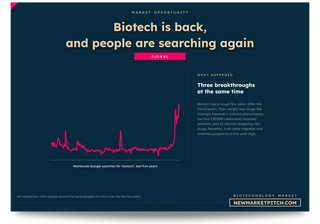
In 2026, the biotech market is stabilizing.
Pfizer acquiring Seagen for $43B and Roche buying Telavant show that big pharma is still paying up for strong assets. At the same time, companies like Xaira Therapeutics raising $1B and multiple oncology startups closing $100M+ rounds prove that late-stage and platform plays can still attract serious capital.
Here, we’ll show you why this mix of active M&A and focused mega-rounds makes biotech attractive for builders and investors right now.


If you’ve tried to look up biotechnology market size and CAGR online, you’ve probably noticed the numbers don’t match. That’s because they often rely on different definitions and opaque methods.
This deck gives you a clear, defensible estimate. We start with first-principles analysis, verify it with aggregated sources, and document every assumption. We also show the reasoning behind the result so you can pressure-test it yourself.
The point is to give you numbers you can trust ... and a fast sanity check on whether this market is worth pursuing.


There are massive problems across the biotechnology space. Pharma companies, healthcare systems, agricultural firms, and industrial manufacturers all face hurdles that biotech breakthroughs can solve.
We walk you through each customer segment and the specific challenges driving their decisions.
When you understand who's struggling and why, you can create or invest in biotech solutions that deliver real value.


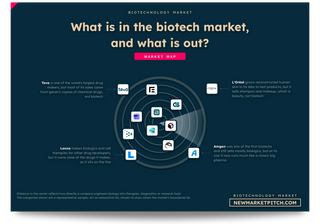
Gene therapies, mRNA platforms, CRISPR tools, biomanufacturing systems, computational biology software: the biotechnology market covers a lot of ground, and the landscape shifts quickly.
That's why we regularly update this section with what's approved, what's in trials, and what's still in R&D. Therapeutic platforms, enabling technologies, and the infrastructure powering modern biology, all in one place.
A current snapshot of a market redefining medicine, agriculture, and manufacturing.


Grants, milestone payments, licensing royalties, CDMO services, product sales, and platform deals are just a few of the ways biotech companies make money.
We break down which business models are working right now, and why some segments deliver 10x better unit economics than others.
Bottom line: you'll understand exactly where value is created (and how it gets captured), so you don't invest in breakthrough science that never finds a commercial path.


There are the risks you've heard of and everyone knows in biotech: long R&D timelines, high failure rates in trials, and heavy capital requirements, among other factors.
But there are other things to keep in mind, like patent cliffs that erode competitive moats, manufacturing scale-up failures, and reimbursement pushback that limits commercial uptake even after approval.
In this section, we map the challenges and how likely they are, so you can plan ahead before you invest or build.


The biotechnology market really has a lot of potential, but some things need to happen for it to grow faster from breakthroughs to scaled commercial impact.
Some drivers are easy to see: advances in genomics and cell engineering, unmet medical need, and strong venture and government funding. But growth also depends on less obvious shifts such as manufacturing scale-up capacity, predictable regulatory timelines, stronger real-world evidence for reimbursement, and partnerships that bridge discovery and commercialization, just to name a few.
Before building or investing, you should know what has to be true for adoption to scale.


In this section, we'll show you where money is flowing in the biotechnology market and what's actually getting funded right now.
You'll see which companies are raising, plus what those rounds have in common: the platforms and therapeutic areas investors keep leaning into, what they're excited about today, and what they've mostly stopped backing. We'll also flag the newer ideas starting to gain traction.
We keep this updated often because biotech moves quickly and investor focus can change with a single data readout.


Moderna and Genentech are not the only names shaping the biotechnology market.
A growing set of startups is advancing new modalities, platform technologies, and novel therapeutic approaches across oncology, rare disease, and beyond.
Because the category is complex, confusion is common, especially around clinical development, manufacturing scale-up, and commercial strategy.
That's why, in this section, we'll share the detailed market grids and ecosystem maps we've built, so you can quickly see what's happening, where the opportunities are, and how the biotech market is evolving.


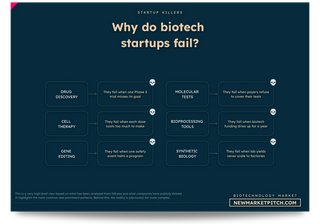
The biotechnology market isn't a guaranteed goldmine. Many founders underestimate how unforgiving it is: long R&D cycles, high failure rates, expensive manufacturing, and a commercial path that depends on partnerships, regulation, and reimbursement.
So we studied biotech startups that failed and pulled out the non-obvious patterns: the quiet traps you don't see in generic startup advice, like chasing too many indications, underestimating CMC complexity, or assuming positive data automatically leads to commercial traction.
This way, if you're building, you start ahead. If you're investing, you avoid teams heading toward the same dead ends.


Moderna, BioNTech, Regeneron… biotech has no shortage of category-defining winners.
Why do they keep compounding while hundreds of promising companies stall between Phase II and commercial launch? The leaders win by pairing platform science with manufacturing discipline, regulatory speed, and commercial infrastructure that's ready before approval.
We've distilled the patterns behind the companies that actually scaled, and in this section we'll share the cheat codes you can use immediately.
This deck is built for founders, investors, operators, and strategists who need a clearer view of the market before they build, invest, partner, or reposition.
It is especially useful if you are trying to understand where the opportunity is real, how the market is evolving, and what separates the promising segments from the fragile ones.
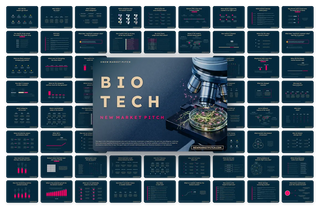
The deck is around 210+ pages. It is designed to be comprehensive enough to support serious market evaluation, while still being fast to read and easy to use.
We prioritize signal, structure, and visual clarity over unnecessary length.
We define the biotechnology market as products and services that apply modern biological science and engineering to create or improve medical and life-science outcomes.
We include biopharma R&D and therapeutics (including biologics, cell/gene therapies, and vaccines), molecular diagnostics, and core life-science research tools and reagents used to generate and analyze biological data.
We exclude routine healthcare delivery, conventional pharmaceuticals and chemicals not enabled by biotechnology, and agriculture/industrial bioapplications unless they are explicitly in scope for the analysis.
Yes. All key data points and assumptions are explained and sourced in the deck.
All sources are tier-1: company filings, funding databases, public datasets, expert interviews, industry reports, etc.
Yes. The deck was last updated on September 5, 2026 with the latest market signals.
Yes. This is a one-time purchase. There is no subscription required to access the deck.
Yes. You can use NEWMARKET for 20% off when purchasing two reports, or NEWMARKETMAX for 30% off when purchasing five or more.
If a market you care about is not currently on the list, email us at team@newmarketpitch.com and we may be able to cover it.
No problem. You can reach out directly and we respond within 24 hours.
The cost of misreading a market is high, especially in a category as nuanced as this one. This deck helps you understand where the market is real, where it is moving, and what matters most before you commit time, capital, or strategy