Circular Economy Pitch Deck

LAST UPDATED: January 18, 2026

Everything that matters about the circular economy

We did the digging, hundreds of hours of it, and put it into 100+ clean slides. Forget boring reports, outdated statistics and confusing information. We've made everything fresh, clear, and straightforward.

What is included in the pitch?

The circular economy pitch covers 12 topics

circular economy europe asia africa usa world
Market Definition

What is this market about?

Before we start, we’ll lay out the market boundaries: what we count, what we don’t, what we see as sub-markets, and what sits adjacent.

We do this because people often mean different things when they talk about this market.

This way, you can read the rest without constantly wondering what we’re counting.

circular-economy chart
Market Opportunity

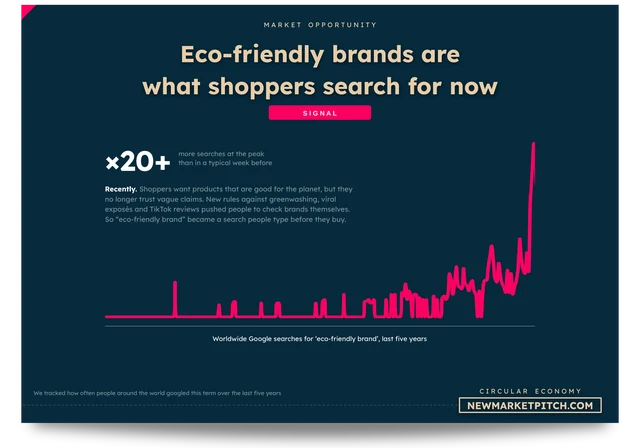
Why this market now?

In 2026, commercial realities and "scale math" are a bit harsh for the circular economy.

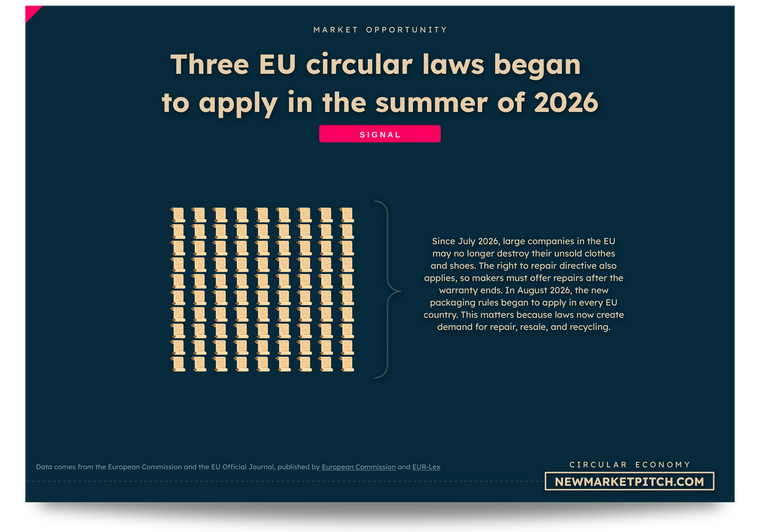
However, we have seen serious momentum in policy and flagship projects. EU packaging rules got real and textiles got a systemic shove.

In this section, we will see how the timing can play in your favor if you want to build or invest in the circular economy.

circular economy cagr growth rate market size
Market Size

How big could this market get?

If you’ve tried to look up circular economy size and CAGR online, you’ve probably noticed the numbers don’t match. That’s because they often rely on different definitions and opaque methods.

We built our own estimate using first-principles analysis, validated with aggregated sources, and we lay out every assumption and step so you can trust the result.

The goal is a quick, reliable sanity check on whether this market is worth pursuing.

circular economy revenue breakdown segments
Pain Points

What are the pain points, and for whom?

There are mounting problems in how we produce and consume. Manufacturers, retailers, waste management companies, and sustainability-focused consumers all face challenges that circular economy solutions can address.

We walk you through each customer segment and the real obstacles they're up against.

Knowing who's feeling the pressure and why helps you create or fund products that make a difference and generate returns.

circular-economy tech chart
Tech & Infra

What is the latest tech and infrastructure?

Let's not underestimate the complexity here: reverse logistics platforms, material tracking systems, resale infrastructure, recycling tech, product lifecycle management. The circular economy runs on serious technology.

We continuously update this section with what's deployed, what's in pilot, and what's being engineered. Covering the full stack from collection to reprocessing to resale.

circular economy business models startups
Value Creation

How is value created and monetized exactly?

Service contracts, resale take rates, recycling fees, materials recovery margins, compliance revenue, and B2B partnerships are just a few of the ways circular economy companies make money.

We break down which business models are working right now, and why some loops seem to deliver 10x better unit economics than others.

You’ll see where the economics truly close, so you don’t build or invest in something “good” that can’t compete on cost and reliability.

circular economy challenges
Market Challenges

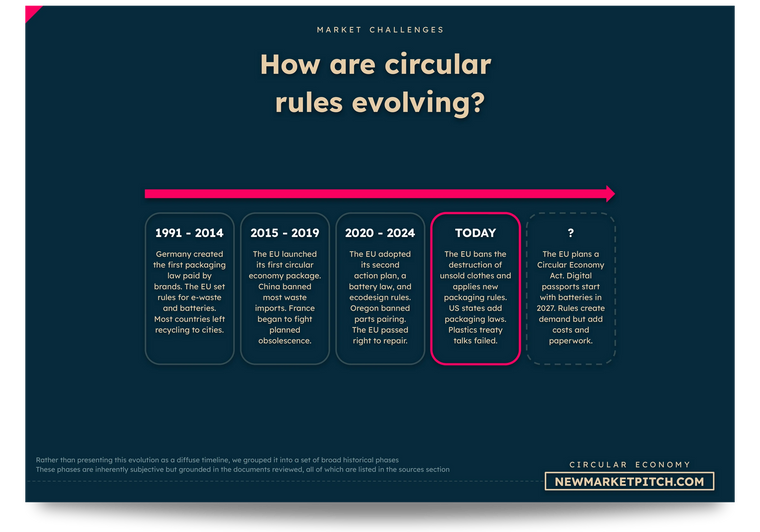
What could slow this market down?

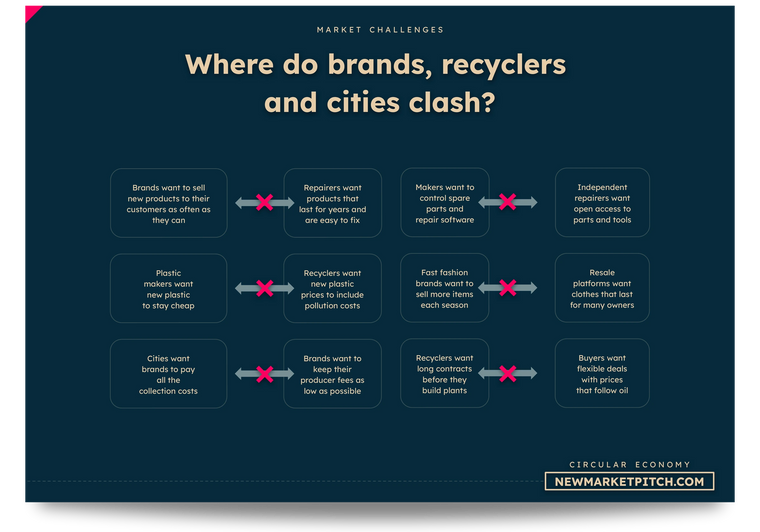
You’re probably already aware of the headline frictions in the circular economy: high collection and sorting costs, uneven infrastructure, and hard unit economics.

The less obvious threats tend to show up later: contamination that breaks recycling streams, commodity price swings that flip incentives, and fragmented standards that block scale.

In this section, we map the main hurdles and rate how likely they are, so you get a practical risk briefing before you invest or build.

circular economy consumer adoption chart
Growth Drivers

What are the growth drivers in this market?

Knowing the growth rate and market size of the circular economy is one thing. But these numbers do not mean much if you do not understand what is actually pushing the market forward, and what has to change for adoption to scale.

Some drivers are easy to see: higher material costs, stronger sustainability targets, and pressure to reduce waste. But the circular economy often hinges on quieter enablers such as better reverse logistics, reliable sorting and tracking, design-for-reuse standards, and incentives that make circular models competitive with linear ones.

Before building or investing, you should know which enablers matter most, and what needs to happen for them to kick in.

circular economy fundraising investors
Investor Bets

What are investors betting on now?

A lot of investors love the circular economy because it’s where sustainability meets margins, especially when waste turns into reliable supply. In this section, we’ll show you where money is flowing and what’s actually getting funded right now.

You’ll see which companies are raising, plus what those rounds have in common: the business models investors keep leaning into, what they’re excited about today, and what they’ve mostly stopped backing. We’ll also flag the newer theses starting to gain traction.

Use this to find the segments with real pull from customers and capital, whether you’re placing investments or designing a business that can scale.

circular economy map top startups
Top Players

Who are the top startups and companies?

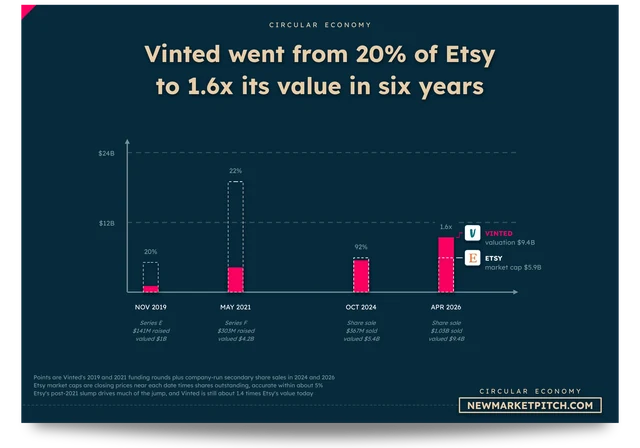
Back Market and Vinted have proven that circular business models can reach unicorn scale, but the circular economy is far larger than resale and refurbishment.

Startups are rethinking everything from material flows and reverse logistics to product design, take-back programs, and waste-to-value systems.

After conversations with entrepreneurs and investors in this space, we've found that confusion is everywhere ... definitions blur, value chains are tangled, and it's hard to know what's working. That's why we put this section together.

Our market grids and ecosystem maps are here to help you cut through the complexity and find where the real opportunities lie.

circular economy pain points customers
Startup Killers

What could kill a startup in this market?

The circular economy isn’t a guaranteed goldmine. A lot of founders underestimate how tough it is: thin margins, messy logistics, volatile pricing, and a real dependence on big incumbents.

So we studied circular-economy startups that failed and pulled out the non-obvious patterns: the quiet traps you don’t see in generic startup advice, like relying on one anchor partner, or scaling ops before the unit economics actually work.

This way, if you’re building, you start ahead. If you’re investing, you can spot the red flags much earlier.

circular economy market share
Startup Strategies

How do you win in this market?

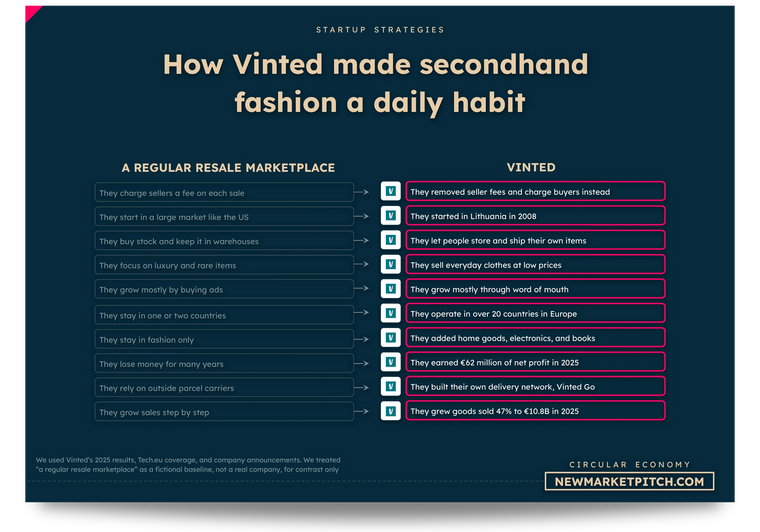
Back Market, Too Good To Go, TerraCycle… the circular economy has its share of modern winners.

How did they scale behavior change, without asking people to be saints? The winners make the circular choice feel obvious: easy flows, clear value (save money, reduce waste), and trust that the system actually works.

We studied what’s driving repeat usage and durable growth here, and this section hands you the cheat codes you can apply right away.

Questions?

How do you define the circular economy?

We define the circular economy market as all activities that keep products and materials in use for longer and return them safely to the economy or nature instead of sending them to waste.

We include circular design, sharing and product-as-a-service models, repair and refurbishment, remanufacturing, high-quality recycling, bio-based and compostable materials, regenerative agriculture, and the digital, logistics, consulting and financial services that enable these loops.

We exclude purely linear “take-make-waste” activities, traditional waste disposal (landfilling and non-recovering incineration), and generic sustainability actions that do not materially change how resources and materials flow through the economy.

How long is the market pitch?
The market pitch is around 120 pages.
When was it last updated?
It was last updated on January 18, 2026.
I have more questions
Please contact us and we will reply within 24 hours.

Get the circular economy pitch

If you need a fresh, visual and concise report to understand this market, you're at the right place. Also, when you buy the market pitch, you get full access to our experts, research and internal data.

PRO
$149
One-time payment
  • Market Definition
  • Market Opportunity
  • Market Size
  • Pain Points
  • Tech & Infra
  • Value Creation
  • Market Challenges
  • Growth Drivers
  • Investor Bets
  • Top Players
  • Startup Killers
  • Startup Strategies
PRO+
$179
One-time payment
  • Market Definition
  • Market Opportunity
  • Market Size
  • Pain Points
  • Tech & Infra
  • Value Creation
  • Market Challenges
  • Growth Drivers
  • Investor Bets
  • Top Players
  • Startup Killers
  • Startup Strategies
PRO++
$199
One-time payment
  • Market Definition
  • Market Opportunity
  • Market Size
  • Pain Points
  • Tech & Infra
  • Value Creation
  • Market Challenges
  • Growth Drivers
  • Investor Bets
  • Top Players
  • Startup Killers
  • Startup Strategies
Get 10% off with the discount code MARKETPITCH