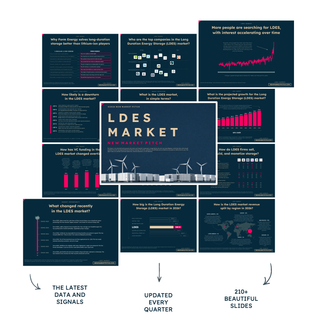
Everyone knows the grid will need storage that lasts longer than a lithium-ion shift. Now, it's about getting utilities, regulators, project financiers, and power markets to pay for that value before the grid is already in trouble. This report will show you what's happening in the market now.
What’s inside the deck?
12 sections to help founders and investors understand the LDES market with clarity
Market Definition
What is this market about?
First, we make the market definition super clear: what’s included, what’s not, what are the adjacent markets, what we consider out of scope, etc.
We do this because people often mean different things when they talk about this market.
This way, you can read the rest of the deck without constantly wondering what we’re talking about.
Market Opportunity
Why this market now?
The long-duration energy storage market is very hot right now.
Over the past year, utilities have signed multi-hour storage contracts at gigawatt scale. In the United States and Europe, new LDES tenders have been launched.
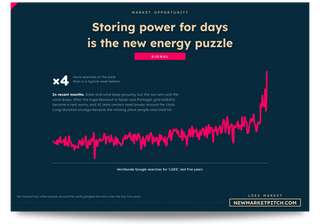
In this section, we will lay out recent quantitative data and policy decisions that show why long-duration energy storage is accelerating in 2026.
Market Size
How big could this market get?
There are tons of LDES market size and CAGR numbers online, and they’re all over the place. It’s tough to know what to trust.
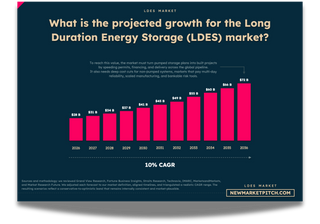
We built our own estimate using first-principles analysis, validated with aggregated sources, and we lay out every assumption and step so you can trust the result.
The goal is a quick, reliable sanity check on whether this market is worth pursuing.
Pain Points
What are the pain points, and for whom?
There are critical problems in how we store and dispatch energy. Utilities, grid operators, renewable developers, and industrial consumers all face challenges that long duration energy storage can solve.
We break down who the stakeholders are and what's driving their decisions.
When you see who's struggling and why, you can create or invest in LDES solutions that capture real market demand.
Tech & Infra
What is the latest tech and infrastructure?
Iron-air batteries, flow chemistries, compressed air, gravity storage, thermal systems, hydrogen pathways: the LDES market covers a lot of ground, and the landscape shifts with every demonstration project.
That's why we regularly update this section with what's deployed, what's in pilot, and what's still in development. Storage technologies, balance-of-plant systems, and the grid integration software enabling long-duration dispatch, all in one place.
A current snapshot of a market the grid increasingly depends on.
Value Creation
How is value created and monetized exactly?
We have noticed it can be hard to see exactly where long duration energy storage captures value (in the technology, the project development, the grid services, or the ongoing operations).
We will make it as clear as possible which business models are working right now, and why some segments deliver 10x better unit economics than others.
Whether you're building or investing, you'll learn what makes the economics bankable, and what stays stuck as a promising pilot without a repeatable revenue path.
Market Challenges
What could slow this market down?
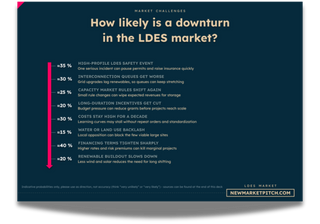
You're probably already aware of the big factors that can slow the LDES market (unproven technologies at scale, high upfront costs, and long permitting timelines, to name a few).
What's easier to miss are risks like revenue uncertainty from evolving market structures, supply chain bottlenecks on critical materials, and utility procurement conservatism that favors incumbents over novel storage.
In this section, we map the main hurdles and rate how likely they are, so you get a practical risk briefing before you invest or build.
Growth Drivers
What are the growth drivers in this market?
Knowing the growth rate and market size of the LDES market is one thing. But these numbers do not mean much if you do not understand what is actually pushing the market forward, and what has to change for storage to deploy at grid scale.
Some drivers are easy to see: more renewables on the grid, reliability mandates, and declining technology costs. But LDES growth often hinges on quieter enablers such as capacity market reforms that value duration, streamlined permitting, bankable long-term offtake contracts, and supply chain maturity for novel chemistries and materials.
Before building or investing, you should know which enablers matter most, and what needs to happen for them to kick in.
Investor Bets
Where are investors placing their bets today?
A lot of investors love the LDES market because it's where grid reliability meets the clean energy transition, especially when projects can secure long-term offtake.
In this section, we'll show you where money is flowing and what's actually getting funded right now. You'll see which companies are raising, plus what those rounds have in common: the technologies and business models investors keep leaning into, what they're excited about today, and what they've mostly stopped backing. We'll also flag the newer theses starting to gain traction.
Use this to find the segments with real pull from utilities and capital, whether you're placing investments or designing a business that can scale.
Top Players
Who are the top startups and companies?
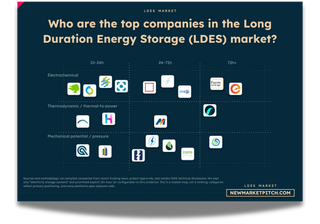
Form Energy and ESS Inc. may have put long duration energy storage on the map, but the market now extends far beyond iron-air and iron flow batteries.
Startups are building across dozens of chemistries and approaches: from compressed air and gravity storage to thermal systems, hydrogen, and novel electrochemical designs.
We've had conversations with many entrepreneurs and investors in this space, and the confusion is widespread, around technology readiness, bankability, and which approaches will actually reach grid scale. That's why we created this section.
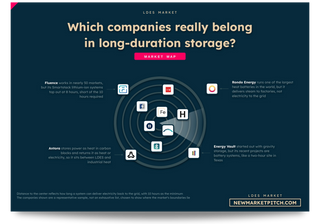
Our grids and ecosystem maps are designed to help you see through the noise and understand where things are really heading.
Startup Killers
What could kill a startup in this market?
The LDES market isn't a guaranteed goldmine. It can be brutally unforgiving: long development cycles, heavy capex, unproven technologies at grid scale, and revenue models that depend on policy and market design.
So we studied LDES startups that failed and pulled out the non-obvious patterns: the quiet traps you don't see in generic startup advice, like treating lab performance as commercial readiness, underestimating supply chain risk for novel chemistries, or building projects without bankable offtake.
This way, if you're building, you start ahead. If you're investing, you can spot the red flags much earlier.
Startup Strategies
How do you win in this market?
Form Energy, ESS Inc., Invinity… long duration energy storage is producing its first visible leaders.
How did they advance from lab curiosities to real grid projects while so many storage chemistries stall at the pilot stage? The winners pair technology readiness with bankable offtake, site development discipline, and supply chain plans that survive scrutiny.
We pulled apart their decisions and this section shares the cheat codes you can reuse fast.
Questions?
Who is this market report actually for?+
This deck is built for founders, investors, operators, and strategists who need a clearer view of the market before they build, invest, partner, or reposition.
It is especially useful if you are trying to understand where the opportunity is real, how the market is evolving, and what separates the promising segments from the fragile ones.
How many pages are in the deck?+
The deck is around 210+ pages. It is designed to be comprehensive enough to support serious market evaluation, while still being fast to read and easy to use.
We prioritize signal, structure, and visual clarity over unnecessary length.
What do you include in the LDES market?+
We define the LDES market as electricity storage systems designed to discharge at rated power for at least 10 hours.
We include grid-connected and behind-the-meter assets whose primary function is shifting electricity over 10+ hours to multi-day timescales (across electrochemical, mechanical, thermal-to-power, and chemical storage technologies).
We exclude short-duration storage (<10h), demand response, and fuel/heat value chains that are not procured and operated as an electricity storage system.
Do you list your sources clearly?+
Yes. All key data points and assumptions are explained and sourced in the deck.
All sources are tier-1: company filings, funding databases, public datasets, expert interviews, industry reports, etc.
Is the data up to date?+
Yes. The deck was last updated on September 2, 2026 with the latest market signals.
Is this a one-time payment?+
Yes. This is a one-time purchase. There is no subscription required to access the deck.
I want to buy several market reports, can I get a discount code?+
Yes. You can use NEWMARKET for 20% off when purchasing two reports,
or NEWMARKETMAX for 30% off when purchasing five or more.
I’m interested in a market but I can’t find it here+
If a market you care about is not currently on the list,
email us at team@newmarketpitch.com and we may be able to cover it.
The cost of misreading a market is high, especially in a category as nuanced as this one. This deck helps you understand where the market is real, where it is moving, and what matters most before you commit time, capital, or strategy
PRO
$49
One-time payment
✓Market Definition
✓Market Opportunity
✓Market Size
✓Pain Points
✓Tech & Infra
✓Value Creation
✓Market Challenges
✓Growth Drivers
✓Investor Bets
✓Top Players
✓Startup Killers
✓Startup Strategies
PRO+
$79
One-time payment
✓Market Definition
✓Market Opportunity
✓Market Size
✓Pain Points
✓Tech & Infra
✓Value Creation
✓Market Challenges
✓Growth Drivers
✓Investor Bets
✓Top Players
✓Startup Killers
✓Startup Strategies
PRO++
$99
One-time payment
✓Market Definition
✓Market Opportunity
✓Market Size
✓Pain Points
✓Tech & Infra
✓Value Creation
✓Market Challenges
✓Growth Drivers
✓Investor Bets
✓Top Players
✓Startup Killers
✓Startup Strategies
Use code MARKETPITCH for 10% off your order
Choosing a selection results in a full page refresh.