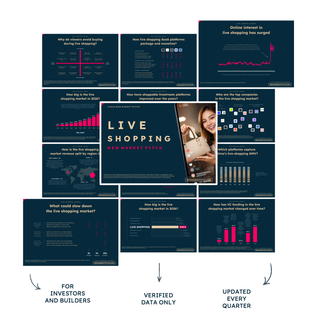
This market looks like commerce, but it behaves a lot like media. The real questions sit around creator trust, conversion quality and whether live shopping can become a durable retail channel instead of a promotional spike. This report gives you the latest reality check on the market.
What’s inside the deck?
12 sections to help founders and investors understand the live shopping market with clarity
Market Definition
What is this market about?
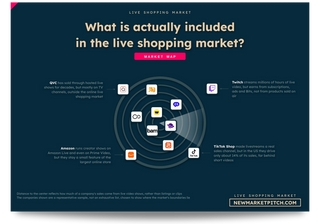
Before we start, we’ll lay out the market boundaries: what we count, what we don’t, what we see as sub-markets, and what sits adjacent.
We do this because every chart in the deck depends on that definition.
It saves you time and makes the rest of the deck easier to trust.
Market Opportunity
Why this market now?
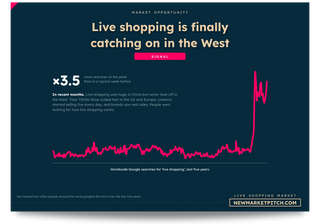
In 2026, the live shopping market is maturing, yes, but it's still hot.
Our team has found a lot of interesting signals. Whatnot raising ~$225M Series F at ~$11.5B valuation or TikTok Shop crossing $500M+ in U.S. sales during Black Friday are some of them.
Here, we will break down why this space is still getting a lot of attention from builders and investors.
Market Size
How big could this market get?
You’ll find a lot of different estimates online for live shopping market size and CAGR … and honestly, it’s hard to trust most of them. Many also use market definitions that don’t match ours.
That’s why we built our own estimate. We started from scratch with a first-principles model, validated it with aggregated sources, and clearly laid out the assumptions and logic behind it.
This way, you get numbers you can trust, and a fast way to sanity-check whether this market is worth pursuing.
Pain Points
What are the pain points, and for whom?
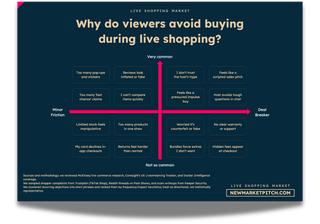
Shoppers, influencers, brands, and e-commerce platforms all face frustrations that live shopping solutions can solve.
We show you who the customers are and what problems they're trying to fix.
When you know who's struggling and why, you can build or invest in solutions that actually sell.
Tech & Infra
What is the latest tech and infrastructure?
Let's not underestimate the tech behind live shopping. Real-time video streaming, instant checkout, inventory sync, creator tools, audience interaction features. There's serious infrastructure powering what looks like a simple livestream.
We keep this section updated with what's live, what's in beta, and what's being built. Platforms, payment systems, engagement tools, and the backend making seamless commerce possible.
This is your refreshed view of a market where content and conversion happen simultaneously.
Value Creation
How is value created and monetized exactly?
Take rates, commissions, seller SaaS, affiliate fees, ads, and fulfillment margins are just a few of the ways live shopping companies make money.
We break down which models are working right now, and why some parts of the stack deliver 10x better unit economics than others.
In this section, you’ll see where monetization actually holds, so you don’t build or invest in a stream that gets views but can’t turn attention into checkout.
Market Challenges
What could slow this market down?
We also need to talk about what could slow the live shopping market: high customer acquisition costs, inconsistent show quality, and logistics/returns friction, among other factors.
Then there are the quieter threats, like trust issues, compliance pitfalls, and platform changes that reduce traffic overnight.
In this section, we map the hurdles and how likely they are, so you can plan ahead before you invest or build.
Growth Drivers
What are the growth drivers in this market?
Knowing the growth rate and market size of the live shopping market is one thing. But these numbers do not mean much if you do not understand what drives conversion and repeat purchases at scale.
Some drivers are easy to see: more time spent on social platforms, influencer-led commerce, and better mobile payments. But growth often depends on less obvious enablers like reliable fulfillment and returns, strong creator incentives, better merchandising and data tools, and trust mechanisms that reduce fraud and disappointment.
Before building or investing, you should know what has to change for these enablers to kick in widely.
Investor Bets
What are investors backing right now?
Not every investor is chasing the same thing. In live shopping, the believers are backing formats that can turn attention into repeat purchases, not just one-off viral spikes.
In this section, we’ll show you where capital is actually going right now. You’ll see which companies are raising, plus the pattern behind the rounds: the models investors are leaning into, what they’re passing on, and the newer theses starting to build momentum across platforms, tooling, and commerce infrastructure.
Use this to stay aligned with what capital is rewarding today.
Top Players
Who are the top startups and companies?
Of course you’ve heard of QVC and Whatnot, but a new wave of promising startups is emerging across the live shopping market.
They don’t always make headlines. Many are building quietly, outside the spotlight. But they’re worth watching. Some of these companies may become the next breakout winners.
Because the market is still young, confusion is common, especially among merchants, creators, and investors trying to understand what drives conversion, retention, and trust in real time.
That’s why, in this section, we’ll share the detailed market grids and ecosystem maps we’ve built, so you can quickly understand what’s happening, where the opportunities are, and how the live shopping market is evolving.
Startup Killers
What could kill a startup in this market?
The live shopping market looks explosive, but it’s not an automatic win: supply is hard to secure, creator/host quality varies, margins get squeezed by incentives, and platforms can change the rules overnight.
So we studied live-shopping startups that failed and pulled out the quiet traps: relying on subsidized discounts to create “traction,” building features before repeatable programming and ops work, or confusing GMV spikes with durable take-rate and retention.
After reading this section, you’ll have clarity on these non-obvious challenges, so you can spot them early, and avoid them before they slow you down.
Startup Strategies
How do you win in this market?
TikTok Shop, Whatnot, Taobao Live… live shopping has its share of clear winners.
So why did they crack the format where so many “QVC-for-the-internet” attempts fizzled out? What did they do differently to blend entertainment, trust, and frictionless checkout? There are a few key patterns worth noticing.
We’ve studied the category leaders, distilled what actually works, and in this section we’ll share the cheat codes you can apply right away.
Questions?
Who is this market report actually for?+
This deck is built for founders, investors, operators, and strategists who need a clearer view of the market before they build, invest, partner, or reposition.
It is especially useful if you are trying to understand where the opportunity is real, how the market is evolving, and what separates the promising segments from the fragile ones.
How many pages are in the deck?+
The deck is around 210+ pages. It is designed to be comprehensive enough to support serious market evaluation, while still being fast to read and easy to use.
We prioritize signal, structure, and visual clarity over unnecessary length.
What do you include in the live shopping market?+
We define the live shopping market as online sales driven by real-time video shows where a host presents products to viewers.
We include live video shows on social platforms, marketplaces, and brand or retailer websites that link directly to products and lead to online purchases during or shortly after the show.
We exclude TV home shopping channels, offline store events, non-video promotions, and purely pre-recorded shoppable videos with no live broadcast.
Do you list your sources clearly?+
Yes. All key data points and assumptions are explained and sourced in the deck.
All sources are tier-1: company filings, funding databases, public datasets, expert interviews, industry reports, etc.
Is the data up to date?+
Yes. The deck was last updated on June 17, 2026 with the latest market signals.
Is this a one-time payment?+
Yes. This is a one-time purchase. There is no subscription required to access the deck.
I want to buy several market reports, can I get a discount code?+
Yes. You can use NEWMARKET for 20% off when purchasing two reports,
or NEWMARKETMAX for 30% off when purchasing five or more.
I’m interested in a market but I can’t find it here+
If a market you care about is not currently on the list,
email us at team@newmarketpitch.com and we may be able to cover it.
The cost of misreading a market is high, especially in a category as nuanced as this one. This deck helps you understand where the market is real, where it is moving, and what matters most before you commit time, capital, or strategy
PRO
$49
One-time payment
✓Market Definition
✓Market Opportunity
✓Market Size
✓Pain Points
✓Tech & Infra
✓Value Creation
✓Market Challenges
✓Growth Drivers
✓Investor Bets
✓Top Players
✓Startup Killers
✓Startup Strategies
PRO+
$79
One-time payment
✓Market Definition
✓Market Opportunity
✓Market Size
✓Pain Points
✓Tech & Infra
✓Value Creation
✓Market Challenges
✓Growth Drivers
✓Investor Bets
✓Top Players
✓Startup Killers
✓Startup Strategies
PRO++
$99
One-time payment
✓Market Definition
✓Market Opportunity
✓Market Size
✓Pain Points
✓Tech & Infra
✓Value Creation
✓Market Challenges
✓Growth Drivers
✓Investor Bets
✓Top Players
✓Startup Killers
✓Startup Strategies
Use code MARKETPITCH for 10% off your order
Choosing a selection results in a full page refresh.