Get an updated reality check on the neurotech market
The obvious story is brain-computer interfaces. The harder one is clinical adoption, neuromodulation economics, regulatory friction, and where durable value is actually forming across the market. This report gives you the latest update on the market.
What’s inside the deck?
12 sections to help founders and investors understand the neurotechnology market with clarity
Market Definition
What is this market about?
First, we make the market definition super clear: what’s included, what’s not, what are the adjacent markets, what we consider out of scope, etc.
We do this because every chart in the deck depends on that definition.
It helps you interpret the data the right way.
Market Opportunity
Why this market now?
Yes, the neurotech market is very hot in 2026.
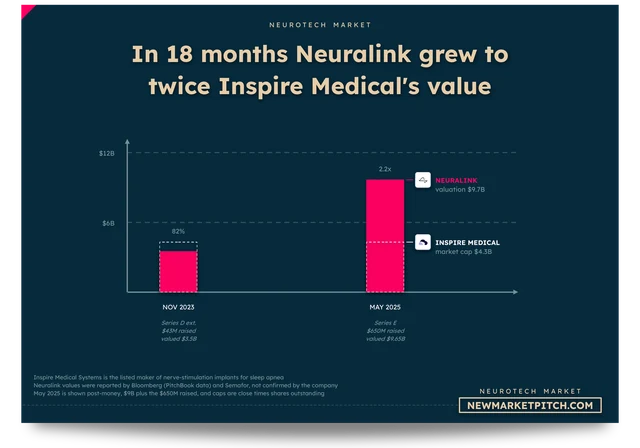
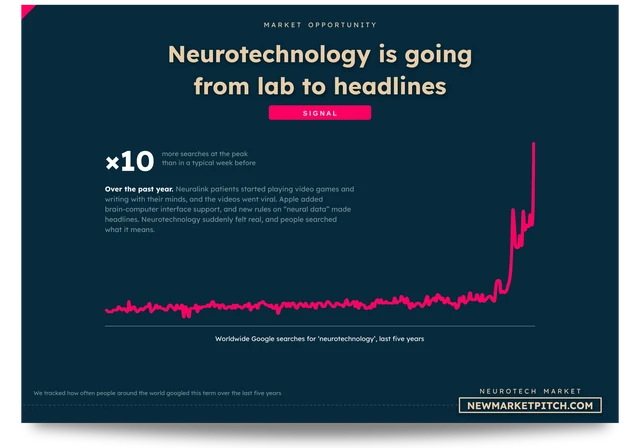
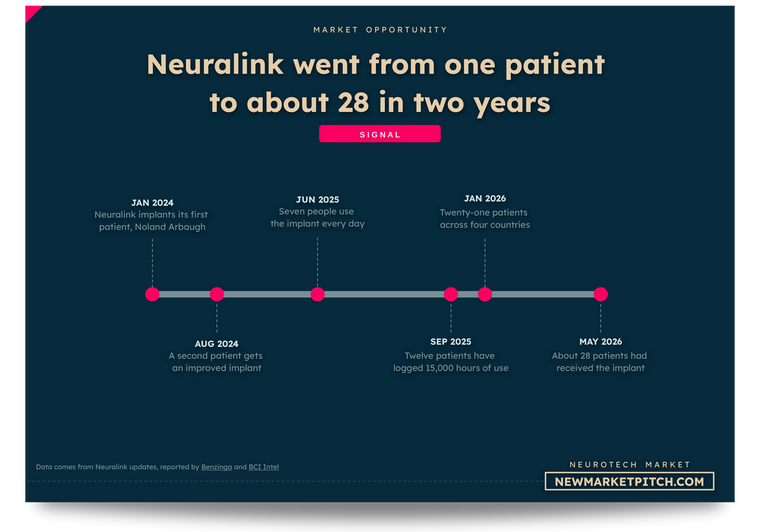
We’re seeing strong signals. Neuralink raising around $650M and scaling human implants, OpenAI backing a brain–computer interface startup, and multiple neurotech companies closing solid Series A and B rounds are some of them.
This is not just lab research anymore. Brain implants are being tested in real patients. Neurostimulation devices are used in chronic care. Non-invasive EEG wearables are entering consumer and workplace settings.
Market forecasts point to steady double-digit growth over the next decade, especially in brain–computer interfaces and AI-powered neuro devices.
In this section, we’ll break down why neurotech is becoming an attractive space for builders and a serious opportunity for investors.
Market Size
How big could this market get?
You’ll find a lot of different estimates online for neurotechnology market size and CAGR … and honestly, it’s hard to trust most of them. Many also use market definitions that don’t match ours.
We built our own estimate using first-principles analysis, validated with aggregated sources, and we lay out every assumption and step so you can trust the result.
The goal is a quick, reliable sanity check on whether this market is worth pursuing.
Pain Points
What are the pain points, and for whom?
There are deep problems across the neurotechnology landscape. Patients with neurological conditions, clinicians, researchers, and defense agencies all face limitations that better brain-computer interfaces and neurodevices can solve.
We show you who the buyers are and what challenges are pushing them toward new solutions.
Knowing these pain points lets you create or fund neurotech products that meet real clinical and commercial demand.
Tech & Infra
What is the latest tech and infrastructure?
Brain-computer interfaces, neurostimulation devices, EEG platforms, neural decoding software: the neurotechnology market is advancing fast, and breakthroughs come frequently.
This section stays updated with what's approved, what's in clinical trials, and what's emerging from labs. Covering invasive and non-invasive devices, brain-data platforms, and the processing infrastructure enabling real-time neural signal analysis.
Your regularly refreshed guide to a market at the frontier of human-machine interaction.
Value Creation
How is value created and monetized exactly?
It can be hard to understand exactly where neurotech captures value (clinical devices, consumer wearables, software platforms, or research tools?).
We will make it as clear as possible which business models are working right now, and why some segments deliver 10x better unit economics than others.
Whether you're building or investing, you'll see what separates reimbursable, sticky products from impressive science that never finds a payer.
Market Challenges
What could slow this market down?
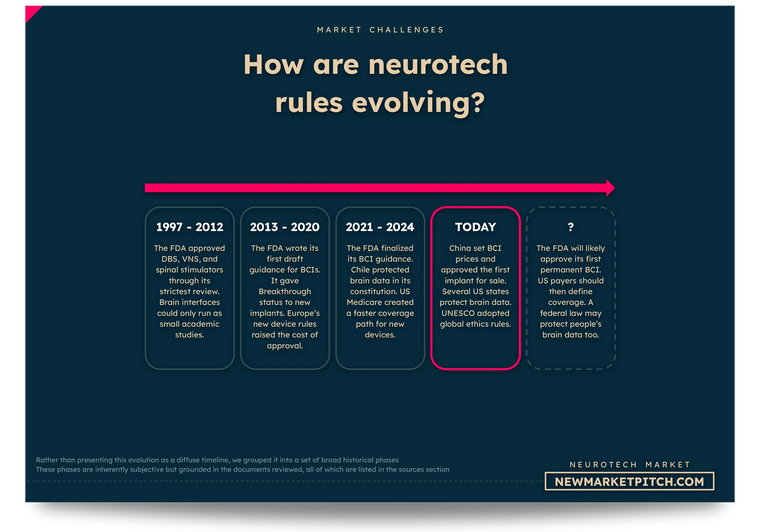
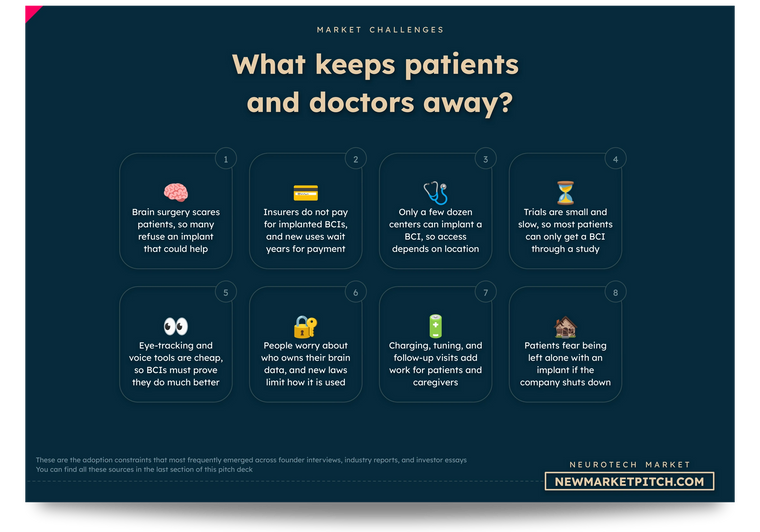
There are the risks you've heard of and everyone knows in neurotechnology: long regulatory timelines, complex clinical validation, and limited reimbursement pathways, among other factors.
But there are other things to keep in mind, like ethical backlash around brain data, patient recruitment challenges for trials, and consumer skepticism that keeps adoption niche.
In this section, we map the challenges and how likely they are, so you can plan ahead before you invest or build.
Growth Drivers
What are the growth drivers in this market?
The neurotechnology market really has a lot of potential, but some things need to happen for it to grow faster beyond early clinical use cases.
Some drivers are easy to see: rising neurological disease burden, better brain imaging, and growing interest in brain-computer interfaces. But growth also depends on less obvious shifts such as miniaturized and less invasive devices, clearer regulatory pathways, reimbursement models that support neurotech, and consumer trust in brain data privacy, just to name a few.
Before building or investing, you should know what has to be true for adoption to scale.
Investor Bets
What are investors betting on now?
In this section, we'll show you where money is flowing in the neurotechnology market and what's actually getting funded right now.
You'll see which companies are raising, plus what those rounds have in common: the modalities and applications investors keep leaning into, what they're excited about today, and what they've mostly stopped backing. We'll also flag the newer ideas starting to gain traction.
We keep this updated often because neurotech moves fast and investor priorities can shift with a single clinical milestone.
Top Players
Who are the top startups and companies?
Neuralink and Synchron have captured attention, but neurotechnology runs much deeper than a few well-funded BCI companies.
Startups are building across the full stack: from non-invasive sensing and neurostimulation to brain-data platforms, clinical software, and consumer neurotech.
We've talked with entrepreneurs and investors here, and confusion is widespread: around regulatory pathways, clinical evidence, and where to place bets. That's why we built this section.
Our market grids and ecosystem maps help you see what's emerging and where the real opportunities lie.
Startup Killers
What could kill a startup in this market?
The neurotechnology market looks like the future, but it's not an automatic win: clinical timelines are long, regulatory pathways are unclear, the science is complex, and the buyer landscape is fragmented.
So we studied neurotech startups that failed and pulled out the quiet traps: building impressive hardware without a reimbursement path, targeting too many indications at once, or confusing research interest with commercial demand.
After reading this section, you'll have clarity on these non-obvious challenges, so you can spot them early, and avoid them before they slow you down.
Startup Strategies
How do you win in this market?
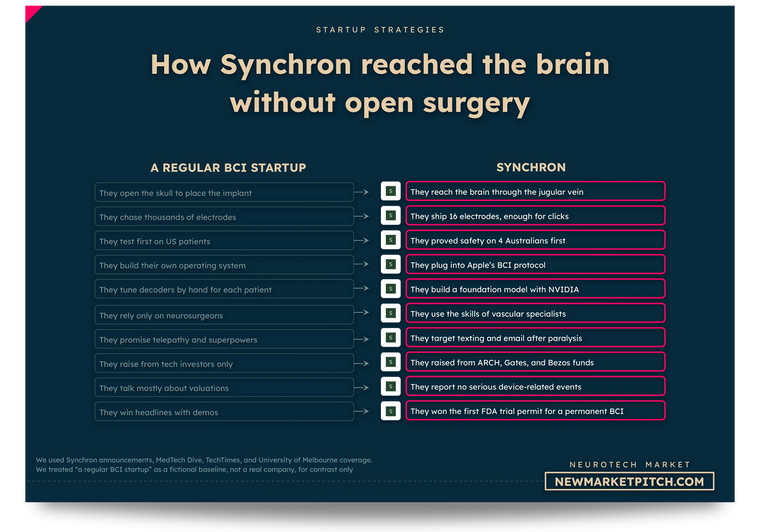
Neuralink, Synchron, Blackrock Neurotech… neurotechnology has a small set of companies generating real momentum.
How did they push forward while so many neurotech ventures stall between lab and clinic? The winners move on parallel tracks: clinical rigor, regulatory strategy, and a manufacturing path that doesn't depend on breakthroughs at every step.
We pulled apart their decisions and this section shares the cheat codes you can reuse fast.
Questions?
Who is this market report actually for?+
This deck is built for founders, investors, operators, and strategists who need a clearer view of the market before they build, invest, partner, or reposition.
It is especially useful if you are trying to understand where the opportunity is real, how the market is evolving, and what separates the promising segments from the fragile ones.
How many pages are in the deck?+
The deck is around 210+ pages. It is designed to be comprehensive enough to support serious market evaluation, while still being fast to read and easy to use.
We prioritize signal, structure, and visual clarity over unnecessary length.
What do you include in the neurotechnology market?+
We define the neurotechnology market as products that directly measure, stimulate, or computationally interface with the human nervous system for clinical or validated functional outcomes.
We include neurodevices and their enabling software such as BCIs, neuromodulation systems, and neurodiagnostic/monitoring tools (e.g., EEG and related analytics).
We exclude pharmaceuticals, general-purpose imaging infrastructure not purpose-built for neuro, and standalone wellness or mental-health apps that do not directly capture or act on nervous-system signals.
Do you list your sources clearly?+
Yes. All key data points and assumptions are explained and sourced in the deck.
All sources are tier-1: company filings, funding databases, public datasets, expert interviews, industry reports, etc.
Is the data up to date?+
Yes. The deck was last updated on June 4, 2026 with the latest market signals.
Is this a one-time payment?+
Yes. This is a one-time purchase. There is no subscription required to access the deck.
I want to buy several market reports, can I get a discount code?+
Yes. You can use NEWMARKET for 20% off when purchasing two reports,
or NEWMARKETMAX for 30% off when purchasing five or more.
I’m interested in a market but I can’t find it here+
If a market you care about is not currently on the list,
email us at team@newmarketpitch.com and we may be able to cover it.
The cost of misreading a market is high, especially in a category as nuanced as this one. This deck helps you understand where the market is real, where it is moving, and what matters most before you commit time, capital, or strategy
PRO
$49
One-time payment
✓Market Definition
✓Market Opportunity
✓Market Size
✓Pain Points
✓Tech & Infra
✓Value Creation
✓Market Challenges
✓Growth Drivers
✓Investor Bets
✓Top Players
✓Startup Killers
✓Startup Strategies
PRO+
$79
One-time payment
✓Market Definition
✓Market Opportunity
✓Market Size
✓Pain Points
✓Tech & Infra
✓Value Creation
✓Market Challenges
✓Growth Drivers
✓Investor Bets
✓Top Players
✓Startup Killers
✓Startup Strategies
PRO++
$99
One-time payment
✓Market Definition
✓Market Opportunity
✓Market Size
✓Pain Points
✓Tech & Infra
✓Value Creation
✓Market Challenges
✓Growth Drivers
✓Investor Bets
✓Top Players
✓Startup Killers
✓Startup Strategies
Use code MARKETPITCH for 10% off your order
Choosing a selection results in a full page refresh.