LAST UPDATED: October 9, 2026

Here's what's happening in physical AI today

Robotaxis now carry paying riders, and humanoids are starting to work real shifts. The open questions are about data, safety, the cost of each unit, and who captures the value: the body, the brain, or the fleet. This report gives you a clear view of the whole market right now.

  • 196+ slides
  • 12 sections
  • verified data only
physical AI market report cover

What’s inside the deck?

12 sections to help founders and investors understand the physical AI market with clarity

physical AI market europe asia africa usa world
Market Definition

What is this market about?

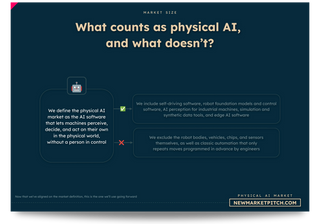
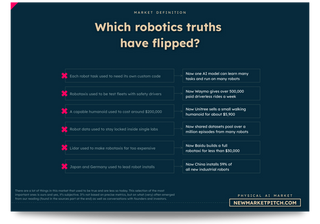
We start by drawing the market clearly: what counts as physical AI, what doesn't, and which markets touch it.

A robot that learns new tasks, an autonomous vehicle, and the AI models or software behind them can all belong here. A chatbot or a factory arm repeating a fixed program does not. That difference shapes the numbers we show.

So you can read the charts without second-guessing the scope.

physical AI market chart
Market Opportunity

Why this market now?

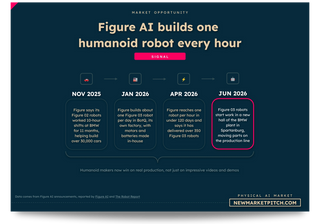
Physical AI is heating up fast right now, from machines doing real work to AI models that help them learn new tasks.

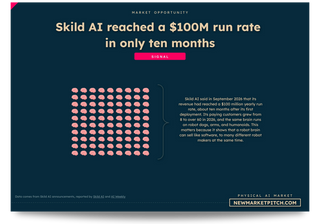
We've found a lot of interesting signals. Uber and Nvidia set a goal of 100,000 robotaxis on Uber's network, starting in 2027. And Skild AI raised $1.4B at a valuation above $14B for its robot AI models. The two moves show interest in both the machines and the AI behind them.

In this section, we look at the numbers behind this shift, from driverless rides and humanoid shipments to the new robot models that reach the market every few months.

physical AI market cagr growth rate market size
Market Size

How big could this market get?

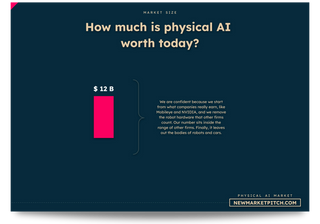
Physical AI market size estimates online range from a few billion to tens of billions of dollars. Some count intelligent robots and autonomous vehicles. Others count only the AI software that makes them work. Those are very different markets to put a number on.

For market sizing, this deck focuses on the AI software layer, not the full value of robots and vehicles. We use first principles to estimate the models and software that help machines perceive, decide and act. We check our result against other sources and show the assumptions. The rest of the report covers the wider physical AI market, including the machines themselves.

Then we look at growth and explain why an estimate for the AI software layer can be lower than forecasts that include whole robots and vehicles.

physical AI market revenue breakdown segments
Pain Points

What are the pain points, and for whom?

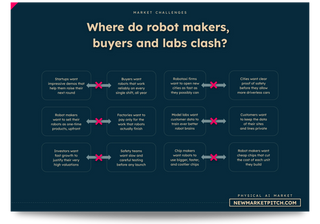
Robots can do more than ever, but the people who buy them still hit the same walls: too little data, clumsy hands, short batteries and permits that take months.

Ride platforms, car makers, warehouse operators, defense forces, hospitals, robot makers and safety regulators all have different problems. We go through six types of physical AI companies and rank which pains matter most for each buyer.

That's how you tell which problems buyers will pay to fix and which ones they only talk about at conferences.

physical AI market tech chart
Tech & Infra

What is the latest tech and infrastructure?

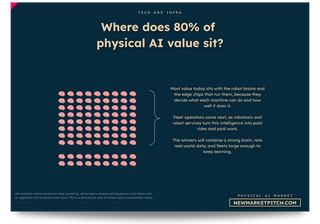
A robot needs more than a smart model. Better sensors, onboard computing and simulation are helping AI work in the physical world.

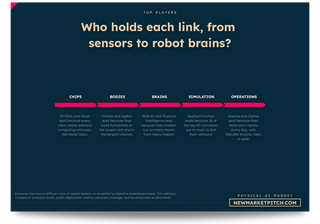
We map the stack, from sensors and edge chips to robot bodies, robot brains, data, simulation and fleet operations. We rank which layers carry the most weight and show which bottlenecks could be solved, and roughly when.

We also look at the bold bets, like home robots, dark factories and driverless trucks, and the companies chasing them.

physical AI market business models startups
Value Creation

How is value created and monetized exactly?

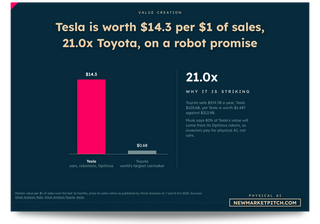
Paid rides, robots rented by the month, fees per delivery, licenses per robot, data sold by the hour: physical AI companies get paid in very different ways.

We compare these models on who pays, what each unit costs to run, and how remote operators, integration work and hardware prices weigh on margins. Renting out a robot for the work it does and selling it upfront are two very different businesses.

We'll also look at what is getting cheaper, from lidar to basic robot arms, and how companies hope to make money: machines doing paid work, AI models, and the data used to train them.

physical AI market challenges
Market Challenges

What could slow this market down?

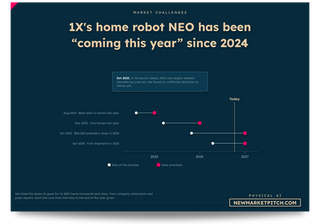
You probably know the obvious brakes: robots that still cost more than the work they replace, safety rules that aren't finished, and permits won city by city.

Less visible risks matter too. Chinese makers push prices down fast. Big tech releases robot models for free. And a serious crash could bring tighter rules and slow deployments far beyond one city.

Here, we go through the scenarios that could hurt physical AI, give each one a likelihood, and explain how deep the damage would go.

physical AI market growth drivers chart
Growth Drivers

What are the growth drivers in this market?

A growth rate means little until you know what drives it. So here, we explain why physical AI would grow, and what could speed it up.

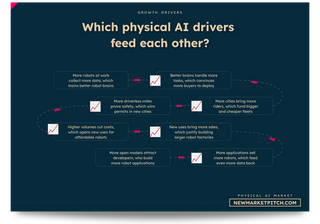
Some drivers are easy to spot: labor shortages in factories, warehouses and trucking, falling prices for sensors and chips, and defense budgets that now buy drones in huge numbers. Others are less obvious, like ride platforms that bring demand to each new robotaxi fleet, or robot brains that learn from demos instead of months of code. Several of these drivers feed each other over time.

Before building or investing, you should know what makes a machine worth deploying by the thousand, not just by the dozen.

physical AI market fundraising investors
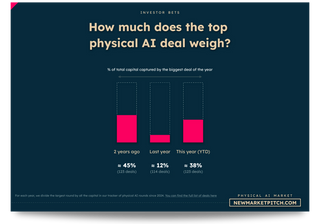
Investor Bets

What are investors backing right now?

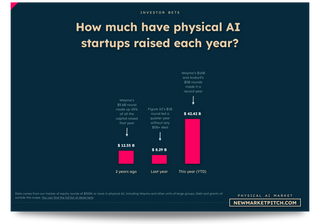
Money in physical AI is concentrated in a few very large rounds. Here, we show where it goes, and which kinds of companies investors now trust with that much capital.

We'll compare funding for robotaxis, defense drones, humanoids and the software that helps them work. We'll also look at the proof investors want, from real deployments to paying customers.

You'll see what the latest rounds say about where investors expect physical AI to make money, from robotaxis and warehouse machines to AI models, simulation and control software.

physical AI market market map top startups
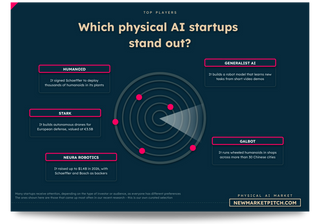
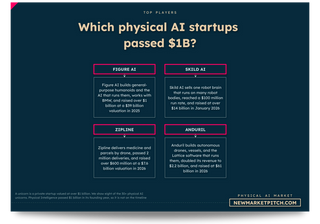
Top Players

Who are the top startups and companies?

Waymo and Physical Intelligence get most of the attention, but physical AI also flies, sails, digs and sorts parcels.

Some of the most interesting players never post a viral robot video. They turn old excavators into autonomous machines, build simulators that test robots before any hardware exists, or rent robots out by the task. They are worth a closer look.

They're hard to spot because physical AI isn't one industry. A drone maker for the army, a robot brain sold to many makers and a robotaxi fleet have different buyers, rules and timelines.

This section brings together our market grids and ecosystem maps, so you can place each company and spot where new players are emerging.

physical AI market startup failures
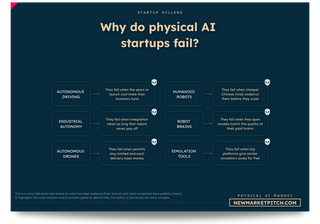
Startup Killers

What could kill a startup in this market?

Good AI doesn't guarantee a working business. Hardware costs, long deployments and permits can still sink a physical AI startup.

So we studied why physical AI startups fail. Self-driving teams run out of money before launch. Industrial robots take so long to install that they never pay off. Delivery drones lose money on each drop. Humanoid makers get undercut by cheaper Chinese rivals, and paid robot brains get matched by free open models.

If you're building, you'll see why the time to launch, the cost of each unit and the permit plan matter as much as the model. If you're investing, you'll know what to check about runway, hardware costs, and competition from cheaper or free alternatives.

physical AI market winners market share
Startup Strategies

How do you win in this market?

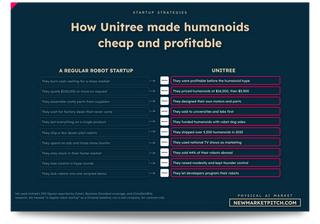
Applied Intuition, Zipline, Quantum Systems… a few physical AI companies already do real, paid work at scale.

Applied Intuition built software for self-driving teams. Zipline delivered medical supplies by drone in Rwanda before expanding to US suburbs. Quantum Systems focused on defense drones. We'll separate commercial progress from business models that still need proof.

We'll show how the leading teams picked a first use where the need was urgent, proved their safety, and got paid for work done before chasing the big vision.

Questions?

Who is this market report actually for?+

This deck is for founders, investors, robot and car makers, logistics and industrial operators, defense teams and strategists looking at physical AI.

It's useful if you're choosing between robotaxis, robot brains, humanoids or drones, deciding whether to sell machines or the work they do, or trying to understand buyers, safety rules, funding, competition and risks across the whole market.

How many pages are in the deck?+

The deck is around 196+ pages. It is designed to be comprehensive enough to support serious market evaluation, while still being fast to read and easy to use.

We prioritize signal, structure, and visual clarity over unnecessary length.

What do you include in the physical AI market?+

We define the physical AI market as AI systems that perceive, reason about and act in the physical world.

We include intelligent robots, autonomous vehicles and specialized models, simulation and control software enabling physical action.

We exclude software-only agents, passive analytics and conventional automation without meaningful AI-based perception or decision-making.

Do you list your sources clearly?+

Yes. All key data points and assumptions are explained and sourced in the deck.

All sources are tier-1: company filings, funding databases, public datasets, expert interviews, industry reports, etc.

Is the data up to date?+

Yes. The deck was last updated on October 9, 2026 with the latest market signals.

Is this a one-time payment?+

Yes. This is a one-time purchase. There is no subscription required to access the deck.

I want to buy several market reports, can I get a discount code?+

Yes. You can use NEWMARKET for 20% off when purchasing two reports, or NEWMARKETMAX for 30% off when purchasing five or more.

I’m interested in a market but I can’t find it here+

If a market you care about is not currently on the list, email us at team@newmarketpitch.com and we may be able to cover it.

I have more questions for you+

No problem. You can reach out directly and we respond within 24 hours.

LAST UPDATED: October 9, 2026

Want to know what's really going on in the physical AI market?

Physical AI has to deal with things software never meets: gravity, weather, batteries and city permits. This deck maps the whole physical AI market: size, buyers, technology, business models, funding, key players, risks and the next opportunities.

PRO
$49
One-time payment
  • ✓ Market Definition
  • ✓ Market Opportunity
  • ✓ Market Size
  • ✓ Pain Points
  • ✓ Tech & Infra
  • ✓ Value Creation
  • ✓ Market Challenges
  • ✓ Growth Drivers
  • ✓ Investor Bets
  • ✓ Top Players
  • ✓ Startup Killers
  • ✓ Startup Strategies
PRO+
$79
One-time payment
  • ✓ Market Definition
  • ✓ Market Opportunity
  • ✓ Market Size
  • ✓ Pain Points
  • ✓ Tech & Infra
  • ✓ Value Creation
  • ✓ Market Challenges
  • ✓ Growth Drivers
  • ✓ Investor Bets
  • ✓ Top Players
  • ✓ Startup Killers
  • ✓ Startup Strategies
PRO++
$99
One-time payment
  • ✓ Market Definition
  • ✓ Market Opportunity
  • ✓ Market Size
  • ✓ Pain Points
  • ✓ Tech & Infra
  • ✓ Value Creation
  • ✓ Market Challenges
  • ✓ Growth Drivers
  • ✓ Investor Bets
  • ✓ Top Players
  • ✓ Startup Killers
  • ✓ Startup Strategies
Use code MARKETPITCH for 10% off your order