Everything you need to know about the regenerative agriculture market
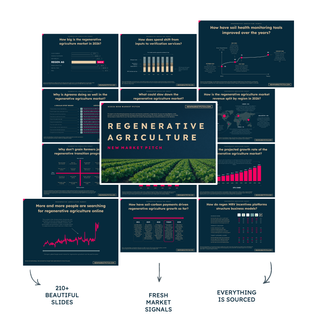
All the research and analysis done for you, summed up in 100+ sharp slides. Forget expensive old reports with opinions dressed up as research. We've made everything solid, clear and straightforward.
What is included in the pitch?
The regenerative agriculture market pitch covers 12 topics
Market Definition
What is this market about?
First thing first, we define the market in plain words ... what it covers, what it doesn’t, how we split it up, and what we’re not counting.
We do this because every chart in the deck depends on that definition.
It saves you time and makes the rest of the deck easier to trust.
Market Opportunity
Why this market now?
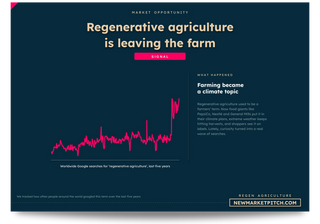
In 2026, regenerative agriculture is maturing, but it’s still hot in pockets.
Our team is seeing strong signals. PepsiCo expanding its regenerative ambition to 10M acres by 2030, the "STEP up for Agriculture" coalition launch, or higher-integrity carbon standards (e.g., ICVCM approving the first CCP-aligned sustainable agriculture methodologies and Verra verification milestones) are some of them.
Here, we will show you why regenerative agriculture remains an attractive space for builders and investors.
Market Size
How big could this market get?
You’ll find a lot of different estimates online for regenerative agriculture market size and CAGR … and honestly, it’s hard to trust most of them. Many also use market definitions that don’t match ours.
So we built our own numbers. We did a rigorous, first-principles analysis, cross-check it against aggregated third-party sources, and then landed on a single estimate we could stand behind.
In this section, we lay out every assumption, walk through the logic step by step, and show our reasoning so you can see exactly why the numbers make sense.
The goal is simple: give you reliable figures you can quickly sanity-check to answer, “Is this worth anyone’s time?”as an entrepreneur or an investor.
Pain Points
What are the pain points, and for whom?
There are serious problems in how we grow food. Farmers, food brands, investors, and environmentally conscious consumers all face challenges that regenerative practices can address.
We break down who the stakeholders are and what's driving their decisions.
When you see who's struggling and why, you can create or invest in solutions that restore land and generate real value.
Tech & Infra
What is the latest tech and infrastructure?
If you're interested in regenerative agriculture, you're watching a market in full growth mode: new practices, new tools, new business models emerging as sustainability takes center stage.
We keep this section fresh with what's already in the field, what's being piloted, and what's coming next.
Soil health tech, carbon measurement platforms, precision tools, and sustainable inputs all included.
Value Creation
How is value created and monetized exactly?
Yes, you need to understand where regenerative agriculture creates value (yield, input reduction, soil performance, and incentives) and who writes the check (farmers, brands, or carbon buyers).
We will give you clarity on which business models are working right now, and why some segments deliver 10x better unit economics than others.
You will see which revenue paths are proving out (from agronomy services and input products to supply-chain premiums and verified credits) and how to avoid models that look good on impact but fail on payback.
Market Challenges
What could slow this market down?
There are the risks you’ve heard of and everyone knows: weather volatility, slim farm margins, and slow adoption cycles, among other factors.
But there are other things to keep in mind, like measurement and verification challenges, unclear incentives across the value chain, and inconsistent demand from buyers.
In this section, we map the hurdles and how likely they are, so you can plan ahead before you invest or build.
Growth Drivers
What are the growth drivers in this market?
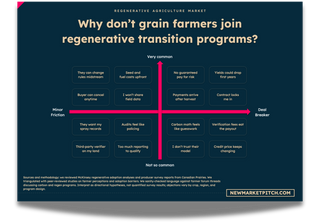
Growth rate numbers do not mean anything for the regenerative agriculture market if you do not understand what motivates farmers to switch and what makes the transition financially viable.
Some drivers are easy to see: soil degradation, input cost volatility, and demand for cleaner supply chains. But scale depends on less obvious enablers like credible measurement and verification, transitional financing during yield risk, agronomy support, and buyer contracts that pay for outcomes.
Before building or investing, you should know what needs to happen for growth to speed up.
Investor Bets
What are investors betting on now?
What investors were backing a year ago isn’t always what gets funded today. In regenerative agriculture, funding is concentrating around approaches that can prove measurable outcomes on real farms and hold up across different crops, climates, and seasons.
In this section, we’ll show you where capital is actually going right now. You’ll see which companies are raising, plus the pattern behind the rounds: the models investors are leaning into, what they’re actively avoiding, and the newer theses starting to build momentum across inputs, measurement, and supply chains.
Use this to stay aligned with what capital is rewarding today.
Top Players
Who are the top startups and companies?
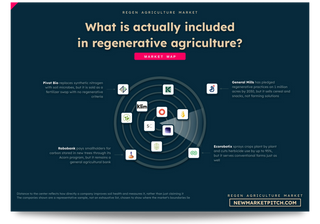
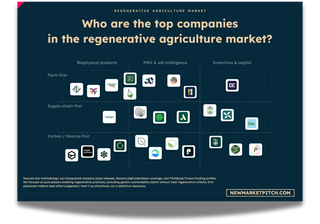
Indigo Ag and Pivot Bio may have put regenerative agriculture on the map, but the market now extends far beyond microbial seed treatments and nitrogen fixation.
Startups are building across the full value chain: from soil health and carbon measurement to farmer incentives, supply chain traceability, and outcome-based financing.
We've had conversations with many entrepreneurs and investors in this space, and the confusion is widespread, around verification standards, farmer economics, and what actually scales. That's why we created this section.
Our grids and ecosystem maps are designed to help you see through the noise and understand where things are really heading.
Startup Killers
What could kill a startup in this market?
Regenerative agriculture isn’t a guaranteed goldmine. Many founders underestimate how unforgiving it is: seasonal timelines, fragmented buyers, measurement challenges, and incentives that don’t always align, and some crash hard.
So we studied regenerative ag startups that failed and pulled out the non-obvious patterns: the quiet traps you don’t see in generic startup advice, like relying on shaky MRV, underestimating farmer adoption, mispricing risk, or building supply-chain stories without durable demand.
This way, if you’re building, you start ahead. If you’re investing, you avoid teams heading toward the same dead ends.
Startup Strategies
How do you win in this market?
Indigo Ag, Regrow, Soil Capital… regenerative agriculture has its share of category leaders.
So why did they gain adoption where many “sustainable ag” ideas stall out? How did they translate soil health into measurable outcomes, incentives that farmers accept, and reporting that buyers can trust? The winners follow a few core principles.
We’ve analyzed what’s actually driving adoption in the field, and in this section we’ll share the cheat codes you can use to build (and sell) with less friction.
Questions?
How do you define the regenerative agriculture market?
We define the regenerative agriculture market as the set of farming activities and supporting solutions that intentionally improve soil health, biodiversity and water while producing food, feed, fibre or biomass.
We include farms that apply core regenerative practices at scale, plus the specialised inputs, advisory services, digital tools and finance mechanisms that directly enable those practices and measure their outcomes.
We exclude generic sustainable or organic farming with no clear regenerative criteria, conventional inputs used without regenerative intent, and downstream consumer products whose only link to regeneration is a marketing claim.
How long is the market pitch?
The market pitch is around 120 pages.
When was it last updated?
It was last updated on
January 20, 2026.
I have more questions
Please contact us and we will reply within 24 hours.
Get the
regenerative agriculture market pitch
If you need a fresh, visual and concise report to understand this market, you're at the right place. Also, when you buy the market pitch, you get full access to our experts, research and internal data.
PRO
$149
One-time payment
✓Market Definition
✓Market Opportunity
✓Market Size
✓Pain Points
✓Tech & Infra
✓Value Creation
✓Market Challenges
✓Growth Drivers
✓Investor Bets
✓Top Players
✓Startup Killers
✓Startup Strategies
PRO+
$179
One-time payment
✓Market Definition
✓Market Opportunity
✓Market Size
✓Pain Points
✓Tech & Infra
✓Value Creation
✓Market Challenges
✓Growth Drivers
✓Investor Bets
✓Top Players
✓Startup Killers
✓Startup Strategies
PRO++
$199
One-time payment
✓Market Definition
✓Market Opportunity
✓Market Size
✓Pain Points
✓Tech & Infra
✓Value Creation
✓Market Challenges
✓Growth Drivers
✓Investor Bets
✓Top Players
✓Startup Killers
✓Startup Strategies
Get 10% off with the discount code MARKETPITCH
Choosing a selection results in a full page refresh.