What are the most valuable AgriTech startups?
Everything we know about the AgriTech market, in one place. Get our report whether you build or invest.
Summary
Inari and Halter are the most valuable AgriTech startups in our current ranking, both sitting around the $2 billion mark, with only a small group of companies still clearly above $1 billion.
The market thins out very quickly. Oishii, Pivot Bio and Zhongxin Breeding make up the rest of the clear unicorn group, while Ecorobotix is the main borderline case because its estimated range crosses $1 billion without firmly clearing it.
The top of AgriTech is unusually diverse. Gene-edited seeds, livestock collars, premium indoor strawberries, microbial nitrogen and pig genetics all appear in the first five positions, which makes it hard to argue that one startup model has won the sector. A sector this varied makes what counts as agritech a real question, and we draw that line in our agritech market report.
What has changed is the type of business investors are still willing to fund aggressively. Genetics, biological inputs, precision spraying, robotics and livestock technology now hold much of the upper end because they can be tied to yield, labor, fertilizer, chemical use or genetic productivity.
Halter is the cleanest recent valuation benchmark: a completed $220 million Series E at $2 billion, backed by more than 2,000 farmers and ranchers and one million collars sold. That is much firmer evidence than carrying forward an old venture-round valuation.
Oishii is the notable exception to the vertical-farming crash. Its premium crop strategy and fresh $150 million financing put it in a very different position from Bowery, Plenty, AppHarvest and Infarm, although the capital intensity problem has not disappeared.
Farm robotics is also pricing above most pure farm software. Ecorobotix and Carbon Robotics sit well ahead of many farm-management and analytics platforms because their products attack measurable costs such as herbicides, labor and field operations.
Biological inputs have become one of the deepest clusters in the market. Pivot Bio leads, but Vestaron, Sound Agriculture, Aphea.Bio, Micropep, Kula Bio and others show that investors still see large value in replacing or reducing conventional farm inputs.
Old funding totals are a poor shortcut for current value. Indigo Ag, Plenty, Bowery and AppHarvest show that a startup can absorb enormous amounts of capital and later be worth less than investors put in, while focused businesses such as TARGAN, Blue River Technology and Bear Flag Robotics produced much stronger exit values relative to funding.
The broader funding market is recovering selectively rather than returning to the old boom. AgFunder recorded about $9 billion of upstream agrifoodtech funding in 2025, up 7%, even as upstream deal count fell 12%, meaning more money went into fewer companies.
The current AgriTech market rewards hard-to-copy science, measurable farm economics and real commercial adoption. Big vision still helps, but it no longer carries a weak operating model very far.

Written by the New Market Pitch teamWe track new markets so founders and investors can move faster. About us

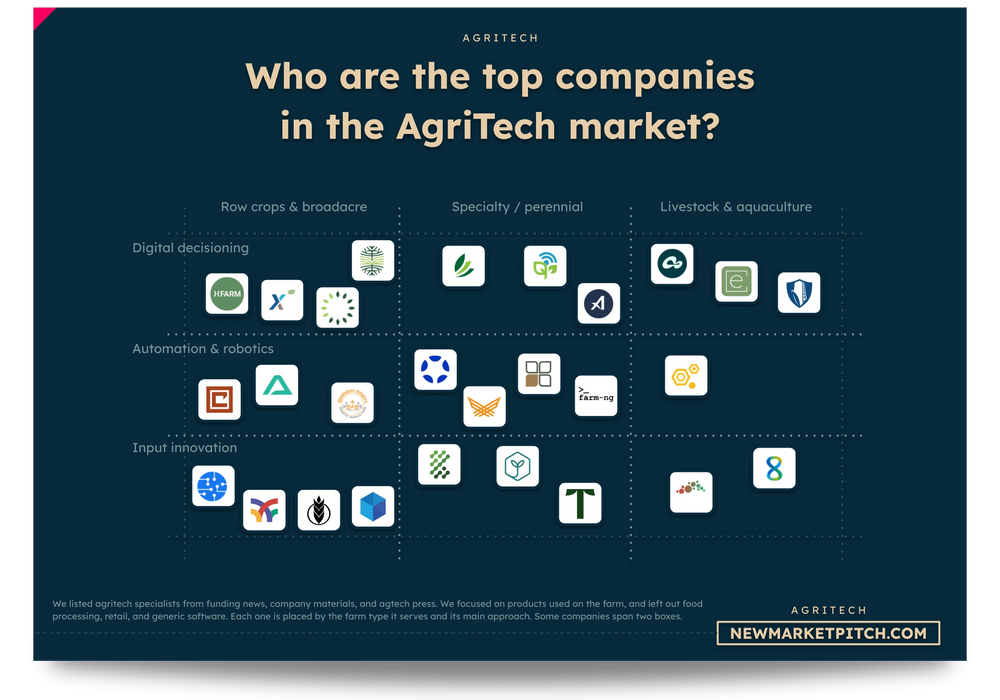
In our report covering the agritech market, we turn what is vague and complex into simple, useful visuals. Market maps like this one show you at a glance where every startup stands.
Top startups in the AgriTech market ranked by valuation
Here is an updated table that ranks the top startups in the AgriTech market based on their latest reported or estimated valuations.
If you need to dig deeper and get more detailed data, please check our report covering the AgriTech market.
| # | Startup Name | What They Do | Current Valuation ($) | Valuation Confidence Level | Valuation Type | Evidence Status | Total Funding ($) | Funding Confidence Level |
|---|---|---|---|---|---|---|---|---|
| 1 | Inari | AI-designed gene-edited crop seeds | $2.0B–$2.4B | Strong Confidence | Announced Private Round Valuation | Estimated | $771M | Strong Confidence |
| 2 | Halter | Virtual fencing and cattle management | $2.0B | Full Confidence | Announced Private Round Valuation | Observed | $434M | Full Confidence |
| 3 | Oishii | Indoor premium strawberry farming | $1.5B–$1.7B | Strong Confidence | Announced Private Round Valuation | Observed | $551M | Strong Confidence |
| 4 | Pivot Bio | Microbial nitrogen fertilizer alternatives | $1.3B–$1.9B | Partial Confidence | Proxy-Based Estimate | Estimated | $617M | Strong Confidence |
| 5 | Zhongxin Breeding | Genomic pig breeding and genetics | $1.3B–$1.7B | Strong Confidence | Announced Private Round Valuation | Estimated | $327M | Strong Confidence |
| 6 | Ecorobotix | AI precision crop spraying | $700M–$1.3B | Partial Confidence | Implied Valuation from Raise | Implied | $276M | Strong Confidence |
| 7 | Gotham Greens | Hydroponic greenhouse produce network | $650M–$950M | Low Confidence | Comparables-Based Estimate | Estimated | $443M | Strong Confidence |
| 8 | Scigene (SCIGene) | Genomic pig breeding technologies | $720M–$850M | Strong Confidence | Announced Private Round Valuation | Estimated | $230M | Strong Confidence |
| 9 | DeHaat | End-to-end farmer commerce platform | $650M–$750M | Strong Confidence | Revenue or ARR Multiple Estimate | Estimated | $251M | Strong Confidence |
| 10 | TARGAN | Automates poultry hatchery operations | $650M | Full Confidence | Acquisition Value | Observed | $51M+ | Partial Confidence |
| 11 | Indigo Ag | Agricultural sustainability and carbon programs | $500M–$750M | Partial Confidence | Announced Private Round Valuation | Estimated | $1.4B | Strong Confidence |
| 12 | GrowUp Farms | Vertically farms branded leafy greens | $500M–$650M | Partial Confidence | Comparables-Based Estimate | Estimated | $185M | Partial Confidence |
| 13 | Carbon Robotics | AI laser weed-control robots | $540M–$590M | Strong Confidence | Announced Private Round Valuation | Observed | $214M | Strong Confidence |
| 14 | Innovafeed | Insect protein and agricultural ingredients | $450M–$650M | Strong Confidence | Implied Valuation from Raise | Implied | $541M | Strong Confidence |
| 15 | Farmers Business Network | Farmer marketplace, data and finance | $400M–$650M | Partial Confidence | Implied Valuation from Raise | Implied | $944M | Strong Confidence |
| 16 | BrightFarms | Local hydroponic greenhouse greens | $350M–$650M | Low Confidence | Acquisition Value | Estimated | $211M | Strong Confidence |
| 17 | Vestaron | Peptide-based biological crop protection | $410M–$550M | Strong Confidence | Announced Private Round Valuation | Estimated | $302M | Strong Confidence |
| 18 | Sound Agriculture | Biological crop nutrition products | $350M–$600M | Partial Confidence | Announced Private Round Valuation | Estimated | $195M | Strong Confidence |
| 19 | Pairwise | Gene-edited crops and plant breeding | $425M–$500M | Strong Confidence | Announced Private Round Valuation | Estimated | $155M | Strong Confidence |
| 20 | Aphea.Bio | Microbial crop protection and biostimulants | $310M–$460M | Strong Confidence | Comparables-Based Estimate | Estimated | $109M | Strong Confidence |
| 21 | Bestzyme Bioengineering | Industrial and feed enzymes | $330M–$430M | Strong Confidence | Revenue or ARR Multiple Estimate | Estimated | $35M | Strong Confidence |
| 22 | Absolute Foods | Bioscience and precision farming platform | $300M–$450M | Partial Confidence | Comparables-Based Estimate | Estimated | $112M | Strong Confidence |
| 23 | xFarm Technologies | Digital farm-management software platform | $300M–$450M | Partial Confidence | Implied Valuation from Raise | Implied | $60M | Partial Confidence |
| 24 | EarthOptics | Soil sensing and intelligence | $280M–$450M | Strong Confidence | Implied Valuation from Raise | Implied | $131M | Strong Confidence |
| 25 | Loam Bio | Microbial soil carbon sequestration | $290M–$440M | Strong Confidence | Comparables-Based Estimate | Estimated | $110M | Strong Confidence |
| 26 | ProducePay | Fresh-produce financing and marketplace | $300M–$400M | Partial Confidence | Implied Valuation from Raise | Estimated | $557M+ | Partial Confidence |
| 27 | Beewise | AI-powered autonomous robotic beehives | $280M–$400M | Partial Confidence | Announced Private Round Valuation | Estimated | $165M | Strong Confidence |
| 28 | Micropep Technologies | Micropeptide biological crop protection | $250M–$400M | Strong Confidence | Implied Valuation from Raise | Implied | $64M | Strong Confidence |
| 29 | Pure Harvest Smart Farms | Climate-controlled desert greenhouse farming | $250M–$400M | Low Confidence | Comparables-Based Estimate | Estimated | $333M | Strong Confidence |
| 30 | Nofence | GPS virtual fencing for livestock | $240M–$400M | Partial Confidence | Implied Valuation from Raise | Implied | $60M | Strong Confidence |
| 31 | Victory Farms | Vertically integrated African tilapia farming | $250M–$375M | Partial Confidence | Comparables-Based Estimate | Estimated | $55M | Strong Confidence |
| 32 | Blue River Technology | AI precision herbicide application | $305M | Full Confidence | Acquisition Value | Observed | $31M | Full Confidence |
| 33 | GoodLeaf Farms | Canadian vertical leafy-greens farming | $250M–$350M | Strong Confidence | Revenue or ARR Multiple Estimate | Estimated | $222M | Strong Confidence |
| 34 | Prospera Technologies | AI computer vision for farms | $300M | Full Confidence | Acquisition Value | Observed | $22M | Full Confidence |
| 35 | AgroSpheres | Biological crop-protection delivery technology | $230M–$360M | Partial Confidence | Implied Valuation from Raise | Implied | $42M | Strong Confidence |
| 36 | Plenty | Vertical indoor strawberry farming | $250M–$340M | Partial Confidence | Announced Private Round Valuation | Estimated | $941M | Strong Confidence |
| 37 | AgroStar | Farmer inputs, advisory and commerce | $250M–$310M | Strong Confidence | Announced Private Round Valuation | Estimated | $199M | Strong Confidence |
| 38 | Bio-Engine | Serum-free cell culture media | $220M–$300M | Partial Confidence | Announced Private Round Valuation | Estimated | $94M | Strong Confidence |
| 39 | Bear Flag Robotics | Autonomous tractor retrofit technology | $250M | Full Confidence | Acquisition Value | Observed | $13M | Full Confidence |
| 40 | Bluewhite | Autonomous retrofit systems for tractors | $200M–$300M | Partial Confidence | Acquisition Value | Estimated | $86M | Strong Confidence |
| 41 | Calysta | Fermentation-based sustainable animal protein | $180M–$300M | Low Confidence | Comparables-Based Estimate | Estimated | $178M | Strong Confidence |
| 42 | CropX | Digital agronomy and farm intelligence | $180M–$280M | Partial Confidence | Implied Valuation from Raise | Estimated | $64M | Strong Confidence |
| 43 | Kula Bio | Biological nitrogen fertilizer | $220M–$240M | Strong Confidence | Announced Private Round Valuation | Observed | $87M | Strong Confidence |
| 44 | Agtonomy | Autonomous software for agricultural equipment | $200M–$250M | Strong Confidence | Announced Private Round Valuation | Estimated | $69M | Strong Confidence |
| 45 | Phagos | Veterinary bacteriophage therapies | $160M–$240M | Strong Confidence | Implied Valuation from Raise | Implied | $35M | Strong Confidence |
| 46 | TerViva | Pongamia crops for food fuels | $150M–$250M | Partial Confidence | Comparables-Based Estimate | Estimated | $103M | Strong Confidence |
| 47 | Ceres AI | Aerial crop analytics and intelligence | $140M–$220M | Partial Confidence | Comparables-Based Estimate | Estimated | $48M | Strong Confidence |
| 48 | Techcoop | Agricultural trade and supply-chain platform | $140M–$220M | Partial Confidence | Implied Valuation from Raise | Implied | $75M | Strong Confidence |
| 49 | BiomEdit | Microbiome products for animal health | $130M–$210M | Partial Confidence | Implied Valuation from Raise | Implied | $62M | Strong Confidence |
| 50 | Verdant Robotics | Precision robotic spraying and weeding | $140M–$200M | Partial Confidence | Comparables-Based Estimate | Estimated | $58M | Strong Confidence |
| 51 | iUNU | AI monitoring for commercial greenhouses | $125M–$200M | Partial Confidence | Implied Valuation from Raise | Implied | $80M | Strong Confidence |
| 52 | ArkeaBio | Vaccines reducing livestock methane emissions | $130M–$190M | Partial Confidence | Implied Valuation from Raise | Implied | $46M | Strong Confidence |
| 53 | GreenLight Biosciences | RNA-based biological crop protection | $120M–$200M | Partial Confidence | Implied Valuation from Raise | Estimated | $287M | Strong Confidence |
| 54 | AeroFarms | Indoor vertical microgreens farming | $100M–$180M | Low Confidence | Acquisition Value | Estimated | $257M+ | Partial Confidence |
| 55 | BioConsortia | Microbial crop inputs and biocontrol | $100M–$180M | Partial Confidence | Implied Valuation from Raise | Implied | $100M+ | Partial Confidence |
| 56 | Greenlabs | Digital farming and produce marketplace | $100M–$180M | Low Confidence | Proxy-Based Estimate | Estimated | $208M+ | Partial Confidence |
| 57 | nextProtein | Produces insect protein ingredients | $100M–$160M | Partial Confidence | Implied Valuation from Raise | Implied | $33M | Strong Confidence |
| 58 | Agreena | Regenerative farming carbon platform | $100M–$150M | Partial Confidence | Comparables-Based Estimate | Estimated | $82M | Strong Confidence |
| 59 | Arable | Crop sensing and irrigation intelligence | $115M–$135M | Strong Confidence | Comparables-Based Estimate | Estimated | $67M | Strong Confidence |
| 60 | Burro | Autonomous outdoor material-moving robots | $100M–$150M | Partial Confidence | Comparables-Based Estimate | Estimated | $54M | Strong Confidence |
| 61 | Protix | Insect protein and animal feed | $90M–$160M | Partial Confidence | Revenue or ARR Multiple Estimate | Estimated | $127M | Strong Confidence |
| 62 | Cibus | Gene-edited agricultural crop traits | $122M | Full Confidence | Public Market Cap | Observed | $228M | Strong Confidence |
| 63 | AppHarvest | Large-scale controlled-environment farms | $110M–$125M | Partial Confidence | Acquisition Value | Observed | $700M+ | Partial Confidence |
| 64 | AgriWebb | Livestock management software platform | $90M–$140M | Low Confidence | Acquisition Value | Estimated | $51M | Strong Confidence |
| 65 | Phytech | Plant sensors for irrigation management | $90M–$140M | Low Confidence | Comparables-Based Estimate | Estimated | $35M | Strong Confidence |
| 66 | Biome Makers | Soil microbiome intelligence platform | $80M–$130M | Partial Confidence | Comparables-Based Estimate | Estimated | $23M | Strong Confidence |
| 67 | Joyn Bio | Engineered microbes for sustainable farming | $100M–$108M | Strong Confidence | Acquisition Value | Observed | $100M | Strong Confidence |
| 68 | BeeHero | Precision pollination monitoring platform | $50M–$150M | Low Confidence | Proxy-Based Estimate | Estimated | $65M | Strong Confidence |
| 69 | Cropin | Enterprise AI agriculture cloud | $80M–$120M | Partial Confidence | Revenue or ARR Multiple Estimate | Estimated | $44M | Strong Confidence |
| 70 | Taranis | AI-powered aerial crop intelligence | $80M–$105M | Partial Confidence | Comparables-Based Estimate | Estimated | $100M | Full Confidence |
| 71 | Nutrition Technologies | Produces insect feed and fertilizer | $60M–$110M | Low Confidence | Comparables-Based Estimate | Estimated | $34M | Strong Confidence |
| 72 | Enterra Feed | Produces insect-based animal-feed ingredients | $60M–$100M | Low Confidence | Proxy-Based Estimate | Estimated | $10M+ | Partial Confidence |
| 73 | Monarch Tractor | Electric autonomous farm tractors | $50M–$110M | Low Confidence | Acquisition Value | Estimated | $242M | Strong Confidence |
| 74 | Sentera | Drone-based precision crop imaging | $60M–$100M | Low Confidence | Acquisition Value | Estimated | $50M | Strong Confidence |
| 75 | String Bio | Methane fermentation for biological products | $60M–$100M | Partial Confidence | Revenue or ARR Multiple Estimate | Estimated | $20M | Strong Confidence |
| 76 | eFishery | Aquaculture technology and farmer services | $40M–$120M | Low Confidence | Proxy-Based Estimate | Estimated | $591M | Strong Confidence |
| 77 | Sabanto | Autonomous tractor retrofit technology | $60M–$90M | Partial Confidence | Comparables-Based Estimate | Estimated | $17M | Strong Confidence |
| 78 | Robotics Plus | Automated agricultural machinery and robotics | $61M | Strong Confidence | Acquisition Value | Observed | $10M | Strong Confidence |
| 79 | Aquaconnect | Digital aquaculture commerce platform | $45M–$75M | Low Confidence | Comparables-Based Estimate | Estimated | $33M | Strong Confidence |
| 80 | Beta Hatch | Mealworm protein and fertilizer | $40M–$80M | Low Confidence | Comparables-Based Estimate | Estimated | $26M | Strong Confidence |
| 81 | Stellapps | Digital dairy supply-chain technology | $45M–$65M | Partial Confidence | Revenue or ARR Multiple Estimate | Estimated | $60M | Strong Confidence |
| 82 | Naïo Technologies | Autonomous electric agricultural robots | $35M–$55M | Partial Confidence | Implied Valuation from Raise | Implied | $65M | Strong Confidence |
| 83 | Connecterra | AI analytics for dairy farms | $30M–$50M | Low Confidence | Comparables-Based Estimate | Estimated | $18M | Strong Confidence |
| 84 | Symbrosia | Seaweed additives reducing cattle methane | $32M–$40M | Strong Confidence | Announced Private Round Valuation | Observed | $15M | Partial Confidence |
| 85 | farm-ng | Modular autonomous electric farm robots | $25M–$45M | Low Confidence | Acquisition Value | Estimated | $10M | Strong Confidence |
| 86 | FarmWise | AI-powered precision weeding robots | $20M–$40M | Low Confidence | Acquisition Value | Estimated | $96M | Strong Confidence |
| 87 | NovoNutrients | Ferments industrial gases into protein | $18M–$35M | Low Confidence | Acquisition Value | Estimated | $23M | Strong Confidence |
| 88 | Trace Genomics | Soil DNA diagnostic testing | $15M–$35M | Low Confidence | Acquisition Value | Estimated | $48M | Strong Confidence |
| 89 | Agronutris | Industrial insect protein production | $15M–$25M | Partial Confidence | Implied Valuation from Raise | Implied | $116M | Strong Confidence |
| 90 | Atarraya | Modular indoor shrimp farming systems | $12M–$25M | Low Confidence | Proxy-Based Estimate | Estimated | $10M+ | Partial Confidence |
| 91 | AgBiome | Agricultural microbial discovery platform | $17M–$19M | Strong Confidence | Acquisition Value | Observed | $237M | Strong Confidence |
| 92 | Benson Hill | Genomics-driven specialty crop genetics | $12M–$20M | Partial Confidence | Acquisition Value | Estimated | $277M | Strong Confidence |
| 93 | Lavie Bio | Microbial agricultural biological products | $15M | Full Confidence | Acquisition Value | Observed | $37M | Strong Confidence |
| 94 | Iron Ox | Robotic greenhouse farming systems | $0M–$20M | Low Confidence | Proxy-Based Estimate | Estimated | $100M | Strong Confidence |
| 95 | Farmers Edge | Digital agronomy and farm analytics | $9M | Strong Confidence | Acquisition Value | Observed | $56M | Strong Confidence |
| 96 | Infarm | Modular urban vertical farms | $0M–$10M | Low Confidence | Proxy-Based Estimate | Estimated | $602M | Strong Confidence |
| 97 | Bowery Farming | Automated indoor vertical farms | $0M–$5M | Low Confidence | Proxy-Based Estimate | Estimated | $725M | Strong Confidence |
| 98 | Future Crops | Soil-based indoor vertical farming | $0M–$5M | Partial Confidence | Proxy-Based Estimate | Estimated | $30M | Strong Confidence |
| 99 | Ynsect | Insect protein and fertilizer | $0M–$5M | Strong Confidence | Proxy-Based Estimate | Estimated | $590M | Strong Confidence |
| 100 | Small Robot Company | Per-plant autonomous farming robots | $0M–$1M | Strong Confidence | Proxy-Based Estimate | Estimated | $11M | Strong Confidence |

Our research about farm technology gets updated several times a month, so you always get the latest view of where things stand.
How many AgriTech unicorns are left today?
We count five clear AgriTech unicorns today, with Ecorobotix sitting just outside that group because its estimated range crosses $1 billion without firmly clearing it.
Inari, Halter, Oishii, Pivot Bio and Zhongxin Breeding all have current ranges that stay above $1 billion. Ecorobotix spans roughly $700 million to $1.3 billion, so calling it a unicorn depends on where the company's actual value falls inside that range.
That is a much smaller club than historical AgriTech unicorn lists suggest. Bowery Farming was once valued at $2.3 billion before shutting down. Plenty reached roughly $1.9 billion before filing for bankruptcy protection. eFishery reached $1.4 billion before an investigation found that its reported financial performance had been massively overstated. Unicorns that later shut down or overstated their numbers tend to share a few traits, which we look at in our report on agritech.
The difference between “has ever been a unicorn” and “is still plausibly worth $1 billion” is especially important in AgriTech. Several of the category's most famous billion-dollar valuations did not survive the shift from cheap venture capital to harder questions about revenue, margins and capital efficiency.
Is Inari actually worth more than Halter?
Inari is probably worth slightly more than Halter today, but Halter's $2 billion valuation is much easier to defend because investors explicitly priced it in a recent completed round.
Inari raised $144 million in early 2025, bringing cumulative equity funding above $720 million. The company said the new capital would support commercialization of its soybean, corn and wheat technologies. Our current estimate of roughly $2.0 billion to $2.4 billion also reflects the company's continued progress after that financing.
Halter gives us a much harder number. Its latest $220 million Series E was completed at a $2 billion valuation. That round followed an earlier financing around the $1 billion level, so Halter effectively doubled its headline valuation between major rounds.
The gap is small enough that first versus second place should not be treated as settled. Inari has the slightly higher estimated ceiling. Halter has the stronger current transaction evidence.
Why is Halter suddenly worth $2 billion?
Halter reached a $2 billion AgriTech valuation because virtual fencing has turned into a large commercial product rather than staying a clever livestock experiment.
The company says more than 2,000 farmers and ranchers now use Halter and that one million of its solar-powered collars have been sold. Its latest $220 million Series E was led by Founders Fund, with Blackbird, DCVC, Bond, Bessemer and several other existing investors participating.
The valuation also doubled from roughly $1 billion between major rounds. That sort of re-rating is unusual in the current AgriTech market, where plenty of former stars have moved the other way.
Halter has one advantage investors can understand quickly: the product goes after costs farmers already have. Ranchers spend money and time moving animals, checking cattle, managing pasture and organizing labor. A connected collar that can reduce some of that work has a direct economic comparison against existing farm expenses.
Expansion adds another layer. Halter has moved beyond New Zealand into Australia and the United States and is now targeting additional international markets. For a farm technology company, proving that the same product can work across several large livestock regions is a much stronger test than piling up pilot projects in one home market.

In our market report about farm technology, we look at what the winners do differently, so you can learn from the best instead of guessing.
Why is Inari worth more than $2 billion before becoming a huge seed company?
Inari can support a valuation above $2 billion because successful seed technology can scale across huge acreage without requiring Inari to build thousands of farms or sell expensive machinery to every farmer.
Inari combines predictive design with multiplex gene editing and is working mainly on major crops such as soybeans, corn and wheat. The company's latest $144 million financing took cumulative equity raised above $720 million, and Inari has described its model as deliberately asset-light, with the goal of supplying innovation to seed companies rather than building a complete parallel seed-distribution system.
That structure helps explain the valuation. Improving a crop trait by even a few percentage points can create a lot of economic value once the trait reaches millions of acres. The underlying product can also be reproduced through seed multiplication instead of requiring another factory or greenhouse every time output grows. Asset-light licensing is one of the business models we check for margins in our report covering the agritech market.
There is plenty left to prove. Agricultural biotechnology takes years to commercialize, regulatory pathways can slow expansion, and good trial results do not guarantee broad farmer adoption.
Still, Inari has something investors usually pay for: proprietary technology aimed at very large existing markets, with a scaling model that should require less physical capital than indoor farming or farm-machinery manufacturing.
Is Oishii really surviving the vertical-farming crash?
Oishii is currently the biggest exception to the vertical-farming collapse, and its latest $150 million financing makes that position harder to dismiss as an old valuation artifact.
Oishii announced the first close of a $150 million Series C in 2026. Its Japanese operation said the financing took cumulative funding there to roughly ¥52.5 billion. The company is using the capital to expand production, automation and its indoor Smart Farm model.
The crop choice helps. Oishii focused on premium strawberries rather than building huge facilities around low-priced leafy greens. Strawberries can support much higher revenue per kilogram, giving the company more room to absorb electricity, labor, depreciation and automation costs.
That does not magically solve indoor farming's economics. Oishii still has to show that premium pricing and better automation can eventually produce attractive returns on the enormous amount of capital needed to build these farms.
But compared with Bowery, Plenty, AppHarvest, Infarm and several other former vertical-farming stars, Oishii is in a completely different position right now: it is still raising large rounds and adding capacity while several peers have shut down or restructured.

In our document detailing everything you need to know about agritech, you will always find fresh funding data, taken straight from our own verified funding database.
Did the vertical-farming boom basically collapse?
Yes. The vertical-farming boom collapsed financially, even though controlled-environment farming itself is still alive.
Bowery Farming raised more than $700 million and reached a $2.3 billion valuation before ceasing operations. Plenty had raised close to $1 billion and was last known to be worth around $1.9 billion before entering Chapter 11. AeroFarms filed for bankruptcy protection in 2023, while AppHarvest entered Chapter 11 after raising more than $700 million.
The common problem was brutal capital intensity. Large indoor farms require expensive buildings, lighting, climate control, growing systems, automation and energy before they sell the first crop from a new site. Expanding revenue therefore required another large investment in physical infrastructure.
That model looked much more attractive when venture investors were comfortable funding years of aggressive expansion. Once capital became expensive and profitability mattered more, weak unit economics became difficult to hide.
Oishii shows that indoor farming can still attract capital when the crop, pricing and operating model are different enough. Gotham Greens has also held far more value than the failed vertical-farming companies. The easy assumption that almost any automated indoor farm deserved a technology-company valuation, however, is gone.
| Company | Earlier valuation or position | Current situation in our dataset |
|---|---|---|
| Bowery Farming | $2.3B | $0M–$5M |
| Plenty | ~$1.9B | $250M–$340M estimated |
| AppHarvest | ~$1B public-market launch | $110M–$125M acquisition value |
| AeroFarms | Major VC/SPAC-backed grower | $100M–$180M |
| Infarm | Former unicorn | $0M–$10M |
| Future Crops | Heavily funded indoor grower | $0M–$5M |
| Oishii | Premium indoor farming | $1.5B–$1.7B |
| Gotham Greens | Greenhouse network | $650M–$950M |
What kind of AgriTech startup gets the highest valuation today?
The highest AgriTech valuations currently cluster around genetics, biological inputs, livestock technology and precision automation, with only a few controlled-environment farms breaking into the same group.
Look at the first six companies. Inari and Zhongxin Breeding are genetics businesses. Pivot Bio works on microbial nitrogen. Halter combines connected hardware and livestock software. Ecorobotix sells precision spraying. Oishii is the only indoor grower in that top group.
The pattern continues further down. Carbon Robotics is around $540 million to $590 million. Vestaron sits around $410 million to $550 million. Pairwise is around $425 million to $500 million. EarthOptics, Loam Bio and Micropep all sit in the several-hundred-million-dollar range.
These businesses tend to have one thing in common: their products can be connected fairly directly to yield, labor, chemical use, fertilizer use or genetic productivity.
Recent venture data points in the same direction. AgFunder says upstream agrifoodtech companies attracted about $9 billion in 2025, up 7% from the year before even though the number of deals fell 12%. Investors are still putting serious money into agricultural technology, but fewer companies are getting a larger share of it.
| AgriTech theme | Examples near the top | Highest current valuation |
|---|---|---|
| Seed genetics | Inari, Pairwise | $2.0B–$2.4B |
| Livestock technology | Halter, Zhongxin, SCIGene | $2.0B |
| Biological inputs | Pivot Bio, Vestaron, Sound Agriculture | $1.3B–$1.9B |
| Precision robotics | Ecorobotix, Carbon Robotics | $700M–$1.3B |
| Indoor/CEA | Oishii, Gotham Greens | $1.5B–$1.7B |
| Farmer commerce | DeHaat, FBN | $650M–$750M |
| Farm software/data | xFarm, CropX, Ceres AI | $300M–$450M |
| Insect protein | Innovafeed, Protix, Agronutris | $450M–$650M |

Learning from others' mistakes is the cheapest lesson there is. In our report covering the agritech market, we look at what broke startups before you, so you don't repeat it.
Are farm robots worth more than farm software now?
The strongest farm-robotics companies are currently worth more than most pure farm-software startups, especially when the machine can save labor or reduce expensive inputs.
Ecorobotix is estimated at $700 million to $1.3 billion and Carbon Robotics at roughly $540 million to $590 million. Carbon Robotics now says it generates more than $100 million in annual revenue and sells into 15 countries, which gives its valuation a much stronger operating base than a typical early robotics startup.
Most farm-management software businesses sit lower. xFarm Technologies is around $300 million to $450 million, CropX around $180 million to $280 million, Cropin around $80 million to $120 million and AgriWebb around $90 million to $140 million. Which farm problems growers will actually pay to solve, with a robot or with software, is what we study in our agritech market report.
Farmers can often calculate the payback on precision machinery fairly quickly. Carbon Robotics attacks weed-control labor and herbicide use with its LaserWeeder. Ecorobotix says its plant-by-plant spraying can reduce crop-protection product use by as much as 95%.
Hardware has risks that software companies can avoid. Manufacturing is expensive, servicing equipment across large territories is difficult, and a product can work technically without selling in enough volume to support the company.
Monarch Tractor is the obvious warning. The electric autonomous tractor startup raised more than $200 million but struggled to commercialize its platform, cut staff, shifted toward licensing and ultimately had its technology acquired by Caterpillar.
Are biological crop startups becoming one of AgriTech's biggest categories?
Yes. Biological fertilizers and crop-protection technologies now form one of the deepest high-value clusters in AgriTech.
Pivot Bio leads the group at roughly $1.3 billion to $1.9 billion. Vestaron is around $410 million to $550 million, Sound Agriculture around $350 million to $600 million, Aphea.Bio around $310 million to $460 million, Micropep around $250 million to $400 million and Kula Bio roughly $220 million to $240 million.
These companies are not all betting on the same science. Pivot Bio works with microbes that supply nitrogen. Vestaron develops peptide-based crop protection. Micropep works with micropeptides. GreenLight Biosciences uses RNA technologies. Loam Bio focuses on soil microbes. Microbes, peptides and RNA are different bets, and we sort what works today from what is still on paper in our agritech market report.
The commercial promise is pretty straightforward: replace or reduce expensive conventional agricultural inputs without asking the farmer to rebuild the farm.
Pivot Bio shows the scale investors think could be available. Its 2021 Series D raised $430 million, taking total equity funding above $600 million. At the time, the company described synthetic nitrogen for corn, wheat and rice as a roughly $60 billion annual market.
A biological product does not have to capture a huge share of that market to build a meaningful company. That is one reason this part of AgriTech continues to attract valuations that farm software often struggles to reach.

In our research about farm technology, we always try to gather several sources and make estimates that make sense, so you can work with solid numbers.
Why is Pivot Bio still worth around $1.5 billion?
Pivot Bio remains one of AgriTech's most valuable biological-input companies because it is attacking a huge recurring farm expense and has already moved beyond laboratory-stage technology.
The company raised $430 million in its Series D and said its products had been used on more than one million acres by 2021. Pivot Bio also reported tripling revenue that year as it rolled out its second-generation product for corn.
Those figures are old enough that we would not simply carry the old private valuation forward untouched. They do, however, establish that Pivot Bio reached real commercial scale before many agricultural-biological startups did.
The size of the nitrogen market keeps the upside large. Synthetic nitrogen is purchased every growing season, so replacing even part of it creates recurring demand rather than a one-time equipment sale.
Our current $1.3 billion to $1.9 billion range reflects both sides of the story: Pivot Bio still owns a potentially valuable biological platform with meaningful commercial history, while the valuation has to account for today's tougher private-market conditions rather than automatically preserving a venture-boom price.
Is DeHaat one of the biggest AgriTech businesses even though it is not a unicorn?
Yes. DeHaat is already one of the largest operating AgriTech companies in India, and its scale shows why revenue size and startup valuation can tell very different stories.
Our dataset puts DeHaat around $650 million to $750 million. The company connects farmers with agricultural inputs, advice, financing and produce markets, giving it a much more transaction-heavy business than seed-biotech or robotics startups.
Recent reporting put DeHaat's annual revenue above ₹3,000 crore. That level of activity is enormous compared with many venture-backed agricultural technology companies.
Yet DeHaat is still valued below companies such as Inari or Pivot Bio that may generate much less current revenue. Investors usually give marketplace and commerce revenue lower multiples because much of the money passing through the business ultimately goes to suppliers, logistics providers or other participants.
A valuation ranking cannot double as a ranking of the largest operating companies. DeHaat can be commercially larger than a biotech startup while still carrying a much lower equity valuation.
Does raising more money make an AgriTech startup more valuable?
No. AgriTech has some of the clearest examples of startups raising hundreds of millions of dollars and ending up worth less than the capital investors put into them.
Indigo Ag has raised roughly $1.4 billion in our dataset but is currently estimated around $500 million to $750 million. Plenty raised close to $1 billion before entering bankruptcy. Bowery raised more than $700 million before shutting down. AppHarvest also raised more than $700 million before Chapter 11.
TARGAN shows the opposite outcome. The poultry-automation company raised only a fraction of those amounts before Merck acquired it for approximately $650 million.
John Deere's acquisitions tell a similar story. Deere acquired Blue River Technology for roughly $300 million after the startup had raised only around $31 million. Bear Flag Robotics produced another strong exit relative to its prior venture funding.
Cumulative funding is a dangerous shortcut for estimating valuation. Funding measures how much capital investors supplied over time. Current valuation reflects what the business or its equity is worth now. In AgriTech, those numbers can end up hundreds of millions of dollars apart.
| Company | Funding in dataset | Current or exit value | Value relative to funding |
|---|---|---|---|
| TARGAN | $51M+ | $650M | >12x |
| Bear Flag Robotics | $13M | ~$250M deal headline | ~19x |
| Blue River Technology | $31M | ~$300M | ~10x |
| Halter | $434M | $2.0B | ~4.6x |
| Inari | $771M | $2.0B–$2.4B | ~2.6–3.1x |
| Indigo Ag | $1.4B | $500M–$750M | <1x |
| AppHarvest | $700M+ | $110M–$125M | far below 1x |
| Bowery Farming | $725M | $0M–$5M | effectively zero |

If you build or invest in the agritech market, you need to know which business models pay off now and which ones are fading. That's why our report covering it has a whole section on it.
What do AgriTech acquisitions tell us about what buyers will actually pay for?
The clearest AgriTech acquisitions show that big agricultural companies will pay hundreds of millions of dollars for focused technology when they can plug it into an existing product and distribution network.
Merck's TARGAN deal is the freshest example. Merck bought the poultry-automation company for approximately $650 million. TARGAN's WingScan system automates poultry gender identification, and its technology also includes precision spray systems for vaccines. Strategic buyers paying real money for poultry automation say something about where agritech investors put their money, which we trace in our report on agritech.
John Deere made similar bets earlier in precision agriculture. Deere acquired Blue River Technology to add computer vision and machine learning to agricultural equipment, while Bear Flag Robotics brought autonomous tractor technology into Deere's broader machinery platform.
These companies did not need to build global distribution from scratch after the acquisition. Merck already sells into animal health and poultry production. Deere already has dealers, machinery customers, financing and service operations around the world.
That strategic fit can make a relatively narrow startup worth much more to an incumbent than the startup could justify from standalone revenue alone.
Which AgriTech startups have gained or lost the most value lately?
Halter has produced the clearest recent valuation gain among major AgriTech startups, while vertical farming, eFishery and Monarch Tractor show how quickly previous valuations can disappear.
Halter moved from roughly $1 billion to $2 billion between major financing rounds. Oishii also strengthened its position by raising another $150 million while most vertical-farming peers were struggling. Ecorobotix raised $105 million in a Series D after a $45 million Series C, giving it $150 million across those two rounds and enough capital to commit another $50 million to US assembly.
On the other side, Bowery went from a $2.3 billion valuation to shutting down. Plenty fell from roughly $1.9 billion into bankruptcy. Monarch Tractor raised more than $200 million before its technology ended up with Caterpillar.
eFishery is even more extreme because its collapse was tied to financial reporting rather than farm economics. The Indonesian aquaculture startup had reached a $1.4 billion valuation. An investigation later alleged that more than three quarters of the revenue it reported for the first nine months of 2024 was fabricated. FTI Consulting subsequently took over management while the business was reviewed.
These very different outcomes are why old AgriTech unicorn lists age badly. A valuation from several years ago can say almost nothing about what the company is worth now.

In our document detailing everything you need to know about agritech, we don't want to repeat what boring consulting reports say. Instead, we show you the real and latest market signals that matter.
Is AI actually making AgriTech startups more valuable?
AI can support a high AgriTech valuation today, but investors seem to pay much more when the AI controls a valuable physical process rather than simply analyzing farm data.
Ecorobotix uses computer vision to identify individual plants and spray at plant level. Carbon Robotics identifies weeds and destroys them with lasers. Halter uses software, sensors and connected collars to influence livestock movement. Ceres AI and Taranis analyze crop imagery, while iUNU focuses on greenhouse monitoring.
The valuation spread is huge. Ecorobotix can plausibly approach $1 billion and Carbon Robotics sits above $500 million, while many agricultural analytics platforms remain closer to the $100 million to $200 million range.
Carbon Robotics is especially useful here because the company now reports more than $100 million in annual revenue. That gives investors something much more concrete than an AI narrative: a physical product using AI that farmers are already buying at significant scale.
The valuable part is usually the job the technology performs. Weed control, precision spraying, livestock management and farm automation create obvious economic comparisons against labor, chemicals and existing machinery.
Calling a product “AI-powered” adds very little on its own now.
Are the most valuable AgriTech startups mostly American?
The United States has the largest concentration of highly valued AgriTech startups, but the current top tier is surprisingly international.
Inari, Pivot Bio, Oishii, Carbon Robotics, Indigo Ag and Gotham Greens are based in the United States. That gives the US a strong presence across seeds, biologicals, robotics and controlled-environment agriculture.
Halter came out of New Zealand and has expanded across Australia and the United States. Ecorobotix is Swiss. DeHaat is Indian. Innovafeed is French. Beewise originated in Israel. Zhongxin Breeding and SCIGene give China two unusually valuable companies in pig genetics.
That geographic mix reflects agriculture itself. Farming conditions are local in a way that cloud software is not. Herd sizes, crop types, labor costs, regulation, weather, farm ownership and distribution systems vary dramatically by country.
A company can therefore build a very large agricultural business by solving a problem that is especially painful in one region and then moving into markets with similar farm economics. Halter's path through New Zealand, Australia and cattle-producing regions of the United States is a good example.
Is AgriTech venture funding finally recovering?
AgriTech funding has stopped collapsing, but the market has not returned to the loose-money boom that produced many of the sector's old unicorn valuations.
AgFunder recorded $16.2 billion of global agrifoodtech funding in 2025, only 3% below the previous year. The more relevant number for this ranking is upstream funding: technologies closer to farms, production and biological systems attracted roughly $9 billion, up 7%. Funding totals and deal counts are signals we follow every quarter in our market report about agritech.
Deal count moved the other way, falling 12% upstream. More capital went into fewer companies.
That matches what we see in the valuation ranking. Halter can raise $220 million. Oishii can raise $150 million. Ecorobotix can collect $105 million in a Series D. Meanwhile, plenty of smaller companies are still struggling to finance expansion or preserve their previous valuation.
The comparison with the bottom of the downturn is useful. Agrifoodtech funding had fallen to about $15.6 billion in 2023, down 49% year over year according to AgFunder, while overall venture funding fell much less.
These days, the market looks selective rather than frozen. Investors will still write very large checks, but the company usually needs real commercial traction, hard science, defensible technology or a convincing path to farm-level savings.

In our report covering the agritech market, we like to show you the big picture. We know your time is precious, so we make every page quick to read and packed with as much learning as possible per minute.
What does the AgriTech valuation ranking tell us about the market now?
AgriTech can still create billion-dollar startups, but the current winners look very different from many of the companies investors were chasing during the last venture boom.
Only five companies in our ranking sit clearly above $1 billion today. Inari and Halter lead at roughly $2 billion. Oishii, Pivot Bio and Zhongxin Breeding make up the rest of the clear unicorn group, while Ecorobotix sits on the edge.
The ranking gets thin quickly after that. Roughly $650 million is enough for the top ten. Around $300 million gets a company close to the top 30. A startup worth about $200 million already belongs around the global top 50 in our dataset.
What investors are rewarding has changed as well. Genetics, biological inputs, precision spraying, agricultural robotics and livestock technology occupy much of the upper ranking. These products usually attack costs farmers can already measure or create intellectual property that could spread across very large agricultural markets.
The most capital-intensive failures sit at the other end of the story. Bowery, Plenty, AppHarvest and Infarm show what happened when investors treated physical farming infrastructure as if it could scale like software. Monarch Tractor shows that impressive machinery still has to survive manufacturing and commercialization. eFishery shows why reported growth means little if the underlying financial data cannot be trusted.
AgFunder's latest funding data fits that picture. Upstream investment is rising again even while fewer deals get funded. Capital has returned, but it is concentrating.
Our final judgment is clear: AgriTech is no longer a market where a big vision and a large funding round are enough to sustain a huge valuation. The companies worth the most today usually have hard-to-copy science, measurable farm economics, meaningful commercial adoption or some combination of the three.
Our methodology
This analysis estimates the most defensible current valuations for companies in the AgriTech market rather than simply repeating the last valuation ever reported. We focus on businesses whose core activity is agricultural technology, farm production systems or closely related inputs and automation.
We separate three kinds of evidence. Observed valuations come from completed financing rounds, current public-market values or disclosed acquisition prices. Implied valuations are inferred from financing terms when part of the transaction is known. Estimated valuations rely more heavily on revenue, operating metrics, comparable companies, transactions and current market conditions.
Recent completed financings generally receive the most weight for private companies. Age matters: a round from the last year can still be a strong anchor, while older figures need more support from subsequent operating progress, later funding, restructuring, shutdowns or changes in the financing environment.
We do not mechanically mark old valuations up or down. When a company needs an updated estimate, we look at commercialization, revenue or ARR where available, customers, acreage, machines sold, geographic expansion, later funding and comparable transactions. Softer operating indicators can support an estimate, but they do not override better financial evidence.
Funding raised is not treated as a proxy for valuation. AgriTech has several prominent cases where companies raised hundreds of millions of dollars and later shut down, restructured or ended up worth less than the capital invested. Acquisition values are used when a disclosed transaction gives a cleaner market price than an old private round.
For capital-intensive businesses such as indoor farming and agricultural machinery, we pay particular attention to physical expansion requirements and the gap between revenue growth and the capital needed to produce that growth. For biology and genetics companies, we give more weight to intellectual property, commercialization progress and the size of the existing farm input or seed market they can address.
Key sources include Inari's financing announcement, Halter's $220 million Series E announcement, Oishii's Series C announcement, Pivot Bio's Series D release, Ecorobotix's financing announcement, Carbon Robotics' operating disclosures, Merck's SEC filing on TARGAN, and AgFunder's 2026 Global AgriFoodTech Investment Report.
We also use transaction and failure evidence to avoid carrying old unicorn valuations forward uncritically, including TechCrunch on Bowery Farming, TechCrunch on Plenty's bankruptcy, Bloomberg on Monarch Tractor, and reporting on eFishery's financial misconduct investigation and subsequent management takeover.
Point estimates are used when the evidence supports a precise number. Wider ranges are used when more inference is required. The ranking therefore reflects our best current valuation estimate, not a claim that every private company could transact today at the exact midpoint of its range.

When you build or invest in the agritech market, you need clarity, not confusion. In our research about farm technology, we always try to put numbers on and quantify whatever is usually vague and confusing.
Written by the New Market Pitch teamWe track new markets so founders and investors can move faster. About us