
Data Center Funding: A Quarter-by-Quarter Analysis
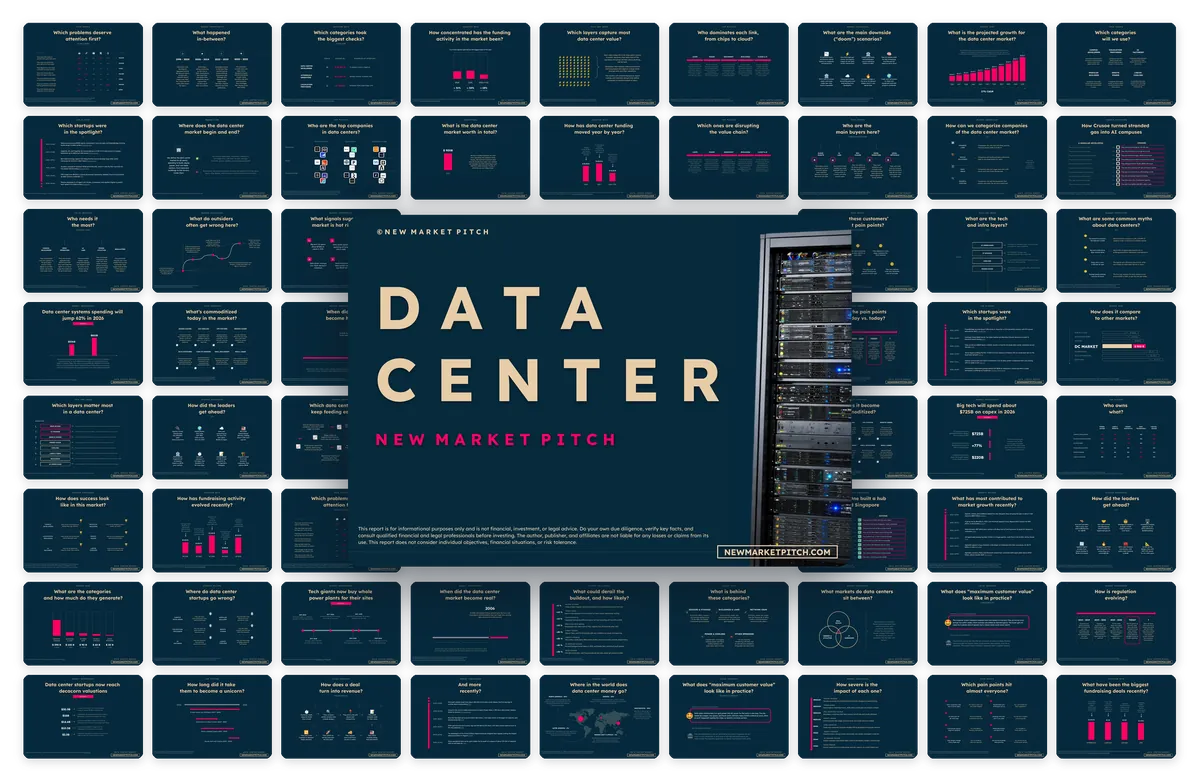
Whether you're building or investing in the data center market, our report covers everything you need to know: the players, the money, and what's coming next.
Summary
Data centers are still attracting huge amounts of capital, but not in a steady upward trend. Funding is arriving in bursts, with billion-dollar platform rounds driving quarterly totals far more than changes in deal count.
Across Q2 2025 to Q2 2026, quarterly deal count stayed in a narrow band of six to nine financings while measured capital swung from about $1 billion to more than $5 billion. That tells us the market is active, but extremely sensitive to a handful of outsized transactions. Capital swinging between $1 billion and $5 billion a quarter is why we show how much money went in, quarter by quarter, in our data center market report.
The biggest shift is not that more companies are getting funded. It is that follow-on financings now dominate the market. After a formation-heavy Q2 2025, previously funded companies accounted for at least two-thirds of deals in every quarter that followed.
Large rounds remain structurally dominant. Financings above $50 million represented more than 92% of quarterly capital throughout the period, even when smaller-round activity improved underneath the headline.
Q1 2026 looked like a boom because DayOne, Nxtra and other large platforms raised enormous checks. But capital from rounds of $50 million or less actually fell to $35.9 million, one of the weakest readings in the period.
Q2 2026 then looked like a crash in the headline total, yet the smaller end of the market strengthened. Funding from rounds of $50 million or less more than doubled to $74.8 million while power-and-cooling companies accounted for five of seven deals.
Power and cooling is the clearest company-level funding trend right now. It generated steady activity for four quarters and then expanded sharply in Q2 2026, with funding spread across liquid cooling, power electronics, private power networks and behind-the-meter systems.
That category momentum lines up with a real infrastructure problem. Data center electricity demand is rising quickly, while grid connections, transformers, turbines, permitting and heat removal are becoming practical limits on how fast AI capacity can be built.
APAC has become a major destination for large operator financings, with Princeton Digital Group, DayOne, Vantage, Nxtra and CtrlS all contributing to the shift. India stands out because large commitments appeared in consecutive quarters rather than as a single isolated deal.
Strategic investors are not taking over the market, but they are becoming more targeted. Industrial companies such as Johnson Controls, Mitsubishi Electric, Carrier, Samsung, TDK and JLL are increasingly backing technologies that sit close to their existing power, cooling, building or infrastructure businesses.
The best way to read data center funding today is to separate breadth from scale. Deal count, company type, financing status and category mix tell us whether the market is actually broadening; headline capital mostly tells us whether one or two giant platforms happened to raise money that quarter.

Written by the New Market Pitch teamWe track new markets so founders and investors can move faster. About us

In our report covering the data center market, you will always find fresh funding data, taken straight from our own verified funding database.
All funding deals in the data center market over the last years
Below is the table listing all the deals. You can find our methodology at the end of this page.
If you want a deeper understanding of the market and its current dynamics, get our data center market report.
| Company | Category | Date | Stage | Deal size | What they do | Region | Lead investors | Country |
|---|---|---|---|---|---|---|---|---|
| TAR | Power Cooling Infrastructure | September 2026 | Series A | $120M | Builds and operates modular off-grid power-generation and battery systems for gigawatt-scale AI data centers. | North America | Spark Capital | United States |
| Fluidstack | Hyperscale Operators | September 2026 | Growth Equity | $1.5B | Builds and operates high-density AI data centers, leasing powered facility capacity to customers that supply the compute hardware. | North America | Jane Street | United States |
| Lancium | Data Center Developers | August 2026 | Growth Equity | $2B | Develops, owns and operates gigawatt-scale AI data-center campuses integrating powered land, grid connections and behind-the-meter generation and storage. | North America | Not disclosed | United States |
| AVK Power Solutions | Power Cooling Infrastructure | August 2026 | Unknown | >$1B | Designs, installs, owns, operates and maintains mission-critical power systems and behind-the-meter energy infrastructure for data centers. | Europe | Not disclosed | United Kingdom |
| StratGrid Inc. | Data Center Developers | July 2026 | Unknown | $1.8M | Develops behind-the-meter natural-gas-powered data-center campuses in Alberta. | North America | Not disclosed | Canada |
| Cardinal Data Power, Inc. | Data Center Developers | July 2026 | Series A | ≈$70M | Develops behind-the-meter, gigawatt-scale powered data-center campuses for AI and HPC tenants. | North America | Hood River Capital Management | United States |
| KuhlTherm Private Limited | Power Cooling Infrastructure | July 2026 | Seed | $1.1M | Develops direct-to-chip, rear-door and CDU liquid-cooling systems for high-density AI data centers. | Asia-Pacific | Arkam Ventures | India |
| Raxio Group | Colocation Providers | July 2026 | Series B | $30M | Operates carrier-neutral colocation data centers across African markets. | Europe | Not disclosed | Netherlands |
| Wafr Technologies Ltd. | Power Cooling Infrastructure | July 2026 | Unknown | ≈$70.5M | Develops facility-level thermal-storage and cooling infrastructure for high-density AI data centers. | North America | Not disclosed | Canada |
| Ionic Digital Inc. | Data Center Owners | June 2026 | Growth Equity | $400M | Owns and develops powered data-center sites leased to HPC and AI infrastructure customers. | North America | Attestor; Oaktree Capital Management; Sachem Head Capital Management | United States |
| CtrlS Datacenters Ltd. | Colocation Providers | June 2026 | Growth Equity | ≈$423M | Operates colocation, hyperscale and edge data centers across India and develops AI-ready hyperscale campuses. | Asia-Pacific | Not disclosed | India |
| Aston Power | Power Cooling Infrastructure | June 2026 | Series A | $20M | Develops integrated private power networks spanning generation, transmission, firming and delivery for data-center loads. | North America | Building Ventures; TDK Ventures | United States |
| TAR | Power Cooling Infrastructure | June 2026 | Seed | $27M | Builds modular behind-the-meter power systems combining renewables, batteries and backup generation for data-center loads. | North America | Not disclosed | United States |
| ZutaCore | Power Cooling Infrastructure | June 2026 | Series C | $100M | Develops waterless direct-to-chip two-phase liquid-cooling systems for high-density data centers. | North America | Mitsubishi Electric; Carrier Ventures; Samsung Ventures | United States |
| Iceotope Group | Power Cooling Infrastructure | May 2026 | Series B | $26M | Develops and licenses precision liquid-cooling architecture for data centers, AI and edge infrastructure. | Europe | Two Seas Capital; Barclays Climate Ventures | United Kingdom |
| Enaxiom | Power Cooling Infrastructure | May 2026 | Seed | $1.8M | Develops HydroCool, a data-center heat-rejection cooling system designed to reduce energy use and recover usable water. | Asia-Pacific | Epic Angels | Australia |
| EPG | Modular Data Centers | March 2026 | Series B | >$100M | Designs and manufactures prefabricated modular data-center systems integrating facility power, cooling and IT-space infrastructure. | Asia-Pacific | Decarbonization Partners; Alibaba Cloud | Singapore |
| Starcloud | Data Center Developers | March 2026 | Series A | $170M | Develops orbital data-center satellites integrating power and thermal infrastructure for commercial AI and computing workloads. | North America | Benchmark; EQT Ventures | United States |
| Nxtra Data Limited | Colocation Providers | March 2026 | Growth Equity | $1B | Operates a nationwide network of core and edge data centers in India providing physical colocation capacity to enterprises, hyperscalers and government customers. | Asia-Pacific | Alpha Wave Global; Carlyle | India |
| Claros, Inc. | Power Cooling Infrastructure | March 2026 | Seed | $30M | Develops chip-to-grid power-delivery hardware for AI data centers, including integrated voltage regulation and DC-native facility power distribution. | North America | General Catalyst; Red Cell Partners | United States |
| DG Matrix | Power Cooling Infrastructure | February 2026 | Series A | $60M | Builds multi-port solid-state transformers that consolidate and route electrical power for high-density AI data centers. | North America | Engine Ventures | United States |
| MegaCool Technologies | Power Cooling Infrastructure | February 2026 | Seed | $5.9M | Builds direct-to-chip liquid-cooling cold plates and thermal-management hardware for high-density AI data centers. | Europe | Vsquared Ventures | Belgium |
| EPG | Modular Data Centers | January 2026 | Series B | ≈$100M | Designs and manufactures prefabricated modular data center systems integrating power, IT and cooling infrastructure. | Asia-Pacific | Forebright; Silicon Peak | Singapore |
| Accelsius | Power Cooling Infrastructure | January 2026 | Series B | $65M | Develops two-phase direct-to-chip liquid-cooling systems for high-density AI and HPC data centers. | North America | Johnson Controls | United States |
| Global Technical Realty | Data Center Developers | January 2026 | Growth Equity | ≈$1.9B | Develops and operates built-to-suit hyperscale data centers for cloud, AI and large enterprise customers across Europe. | Europe | Not disclosed | United Kingdom |
| DayOne Data Centers | Hyperscale Operators | January 2026 | Series C | >$2B | Develops and operates hyperscale data center campuses for cloud, AI and enterprise customers across Asia-Pacific and Europe. | Asia-Pacific | Coatue | Singapore |
| Bolt Data & Energy, Inc. | Data Center Developers | December 2025 | Series A | $50M | Develops large-scale AI data center campuses integrating land, power generation, and supporting infrastructure. | North America | Not disclosed | United States |
| Corintis | Power Cooling Infrastructure | December 2025 | Series A | $25M | Develops microfluidic direct-to-chip liquid-cooling systems for high-density AI and HPC data centers. | Europe | Applied Digital | Switzerland |
| HyperVault AI Data Center Limited | Data Center Developers | November 2025 | Growth Equity | $2B | Develops, owns and will operate AI-ready hyperscale data centers in India, including liquid-cooled high-density capacity. | Asia-Pacific | Not disclosed | India |
| CENTRA Digital Interconnect | Colocation Providers | October 2025 | Growth Equity | $230M | Builds and operates carrier-neutral interconnection data centers providing colocation, power and connectivity in U.S. markets. | North America | Columbia Capital | United States |
| Accelsius | Power Cooling Infrastructure | October 2025 | Series B | $25M | Develops two-phase direct-to-chip liquid-cooling systems for data-center and edge operators. | North America | Johnson Controls | United States |
| Corintis | Power Cooling Infrastructure | September 2025 | Series A | $24M | Develops microfluidic direct-to-chip liquid-cooling systems and cold plates for high-power chips deployed in data centers. | Europe | BlueYard Capital | Switzerland |
| Vantage Data Centers | Hyperscale Operators | September 2025 | Growth Equity | $1.6B | Develops and operates large hyperscale data-center campuses providing powered and cooled capacity to cloud, AI and enterprise customers. | North America | GIC affiliate; Abu Dhabi Investment Authority subsidiary | United States |
| Asperitas | Power Cooling Infrastructure | September 2025 | Unknown | Not Disclosed | Develops immersion-cooling and thermal-management systems for data centers, including integrated modular cooling solutions. | Europe | STECON GROUP GLOBAL PRIVATE LIMITED; Invest-NL | Netherlands |
| Fermi America | Power Cooling Infrastructure | August 2025 | Series C | $100M | Develops an integrated behind-the-meter private power grid and hyperscale AI data center campus in Amarillo, Texas. | North America | Macquarie Group | United States |
| Evolution Data Centres | Data Center Developers | August 2025 | Growth Equity | $325M | Develops, owns, and operates hyperscale-ready data center campuses across emerging Southeast Asian markets. | Asia-Pacific | Not disclosed | Singapore |
| Princeton Digital Group | Hyperscale Operators | July 2025 | Growth Equity | $1.3B | Develops and operates hyperscale data centers across Asia-Pacific, providing physical capacity, power and cooling for hyperscalers and enterprises. | Asia-Pacific | Stonepeak | Singapore |

In our research about data centers, we turn what is vague and complex into simple, useful visuals. Market maps like this one show you at a glance where every startup stands.
Is data center funding actually growing right now?
As of now, data center funding is moving in bursts rather than climbing steadily from one quarter to the next.
From Q2 2025 through Q2 2026, we counted 7, 6, 6, 9 and 7 financings per quarter. Capital moved much more violently: $3.87 billion, $3.35 billion, $2.40 billion, at least $5.37 billion and then $998 million under our quarter-assignment methodology.
That gap between deals and dollars is the first thing to understand about this market. Q1 2026 more than doubled the previous quarter's funding even though only three additional deals closed. The following quarter, the reported capital total fell sharply while deal count slipped from nine to seven.
The smaller end of the market has been just as uneven. Capital from rounds of $50 million or less moved from $40.5 million in Q2 2025 to $24 million in Q3, jumped to $140 million in Q4, dropped to $35.9 million in Q1 2026 and recovered to $74.8 million in Q2.
There is plenty of money around, but the amount deployed in any given quarter depends heavily on whether one or two infrastructure platforms happen to raise a very large round.
| Quarter | Deals | Capital | Median round | Largest financing |
|---|---|---|---|---|
| Q2 2025 | 7 | $3.869bn | $500m | Montera, $1.5bn |
| Q3 2025 | 6 | $3.349bn | $325m | Vantage, $1.6bn |
| Q4 2025 | 6 | $2.400bn | $45m | HyperVault, $2.03bn |
| Q1 2026 | 9 | ≥$5.366bn | $100m | DayOne, >$2bn |
| Q2 2026 | 7 | $997.8m | $27m | CtrlS, ≈$423m |
Was Q1 2026 really a data center funding boom?
Q1 2026 was a huge quarter for big data center checks, while the smaller-round market actually got weaker.
Reported funding reached at least $5.37 billion, up 124% from Q4 2025, and deal count rose from six to nine. DayOne announced more than $2 billion in Series C financing, Nxtra raised $1 billion, and Starcloud added a $170 million Series A.
Those few transactions explain most of the jump. Seven of the nine rounds were above $50 million, and they represented roughly 99% of the quarter's capital. A few giant rounds explained most of that quarter, so we watch where the biggest rounds are going in our report on data centers.
Meanwhile, funding from rounds of $50 million or less fell from $140 million in Q4 to only $35.9 million. The headline number makes the quarter look much broader than it was.
What Q1 really showed was how much institutional capital is available for platforms that can already deploy hundreds of millions of dollars into campuses, power, land and capacity. It said much less about whether fundraising suddenly became easier for the average young data center company.
Did data center funding really crash in Q2 2026?
The apparent Q2 2026 data center funding crash is much less dramatic once we look below the headline total and account for the way DayOne's Series C was announced.
Our quarter-level calculation falls from at least $5.37 billion in Q1 to $997.8 million in Q2, an 81% decline, while the number of deals moves from nine to seven. At the smaller end, the direction is reversed: funding from rounds of $50 million or less more than doubles from $35.9 million to $74.8 million.
There is also an important timing issue around DayOne. The company first announced definitive agreements for more than $2 billion of Series C financing in January 2026. It then announced that the same Series C had reached a $4.5 billion final close in June.
We do not mechanically add another $2.5 billion to Q2 because the January figure was disclosed only as “over $2 billion,” and the June announcement describes the final size of the same Series C. Assigning an exact incremental Q2 amount would create precision that the public disclosures do not support.
So the 81% drop is useful for comparing financings we can cleanly assign to each quarter, but it is a weaker measure of how much capital actually became available to the sector during Q2. The cleaner shift is in the mix: Q1 was dominated by giant platform rounds, while Q2 had much more activity in power and cooling.

In our market report about data centers, we always try to gather several sources and make estimates that make sense, so you can work with solid numbers.
Are more data center companies getting funded, or are a few winners taking most of the money?
Data center funding is still extremely concentrated, and we are not seeing a steady increase in the number of companies benefiting from it.
The number of unique companies funded each quarter moved from seven to six, five, eight and seven. Q1 2026 produced the broadest quarter in our period, but even then the top three financings absorbed roughly 91% of the capital.
Q4 2025 was the clearest example. HyperVault's $2.03 billion financing represented about 85% of the entire quarter. In Q3, Vantage and Princeton Digital Group together raised $2.9 billion. In Q2 2025, Montera and PowerBridge alone accounted for $2.5 billion.
The pattern survives across all five quarters. Rounds above $50 million generated between roughly 92% and 99% of quarterly funding every time.
That makes deal count much more useful than total dollars when we want to know whether investor interest is spreading. Capital can jump by billions because one infrastructure platform raises money while the rest of the market barely changes.
| Quarter | Unique companies | Largest deal share | Top three share | Capital from >$50m rounds |
|---|---|---|---|---|
| Q2 2025 | 7 | 38.8% | 86.0% | 99.0% |
| Q3 2025 | 6 | 47.8% | 96.3% | 99.3% |
| Q4 2025 | 5 | 84.6% | 96.3% | 94.2% |
| Q1 2026 | 8 | 37.3% | ≈91.3% | ≈99.3% |
| Q2 2026 | 7 | 42.4% | 92.5% | 92.5% |
Are new data center startups disappearing from the funding mix?
New data center startups are still getting funded, but most deals now go to companies that have already raised before.
The break happened after Q2 2025. Five of that quarter's seven financings were first financings, giving new entrants a 71% share of deals. The share fell to zero in Q3 and then stayed between 11% and 33% over the next three quarters. First financings dropping from 71% of deals to zero in a quarter is a sharp change, and we look back over the past year in our report covering data centers.
Q2 2025 was unusual because several new platforms arrived with very large commitments. Stonepeak launched Montera with $1.5 billion of committed equity. PowerBridge was formed with an equity commitment of up to $1 billion. That is startup formation, but on an infrastructure scale that looks nothing like a normal venture seed cycle.
From Q3 onward, previously funded companies took over the flow. Vantage and Princeton Digital Group drove Q3. Accelsius, Corintis and CENTRA were among the follow-on financings in Q4. Q1 2026 had eight follow-ons out of nine deals, and Q2 had six out of seven.
Young companies have not vanished. TAR's $27 million seed financing is a good recent example. The broader shift is that today's funding market spends much more of its time scaling companies that are already inside the capital ecosystem.
Are data center investors moving away from early-stage companies?
Early-stage data center deals are still happening regularly, but the biggest checks increasingly go to older companies and mature infrastructure platforms.
Early-stage deals represented 43% of Q2 2025 activity, dropped to 17% in Q3, then recovered to 33%, 44% and 43% over the following quarters. There is no continuous retreat from early-stage investing in that sequence.
The dollar mix is different. Growth Equity accounted for roughly 53% of Q1 2026 capital and about 82% of Q2, despite only two Growth Equity deals in each quarter. A $1 billion financing for Nxtra or a roughly $423 million financing for CtrlS naturally outweighs several Seed and Series A rounds combined.
Company age points the same way. The median funded company was around one year old in Q2 2025, then roughly six years in Q3, three in Q4 and four in both 2026 quarters. By Q2 2026, companies receiving follow-on financing had a median age of around seven years.
The market has split. Early-stage infrastructure technology still produces plenty of deals, while most of the dollars flow toward companies that already own assets, customers, capacity or technology that is ready to scale.

Our document detailing everything you need to know about data center gets updated several times a month, so you always get the latest view of where things stand.
Is power and cooling now the hottest part of data center funding?
Power and cooling is currently the clearest area of real deal momentum in data center funding.
The category produced three financings in each quarter from Q2 2025 through Q1 2026, then jumped to five of the seven deals in Q2 2026. Aston Power, Enaxiom, Iceotope, TAR and ZutaCore all raised during the quarter.
That breadth is more convincing than a category total inflated by one giant transaction. ZutaCore raised $100 million, Iceotope raised $26 million, Aston Power raised $20 million and TAR raised $27 million. Different investors are backing different parts of the physical stack.
The capital share is still modest beside the enormous checks going into data center operators. Power and cooling represented 17.5% of Q2 funding even though it accounted for 71% of the deals. A large share of new company-level investment activity is happening here, while the really big dollars still go into owning and expanding data center capacity.
| Quarter | Power/cooling deals | Deal share | Capital | Capital share |
|---|---|---|---|---|
| Q2 2025 | 3 | 43% | $540m | 14.0% |
| Q3 2025 | 3 | 50% | $124m | 3.7% |
| Q4 2025 | 3 | 50% | $90m | 3.8% |
| Q1 2026 | 3 | 33% | $95.9m | 1.8% |
| Q2 2026 | 5 | 71% | $174.8m | 17.5% |
Why are investors putting so much money into data center power and cooling now?
Investors are piling into data center power and cooling because electricity delivery and heat removal have become practical limits on how fast new AI capacity can come online.
The latest IEA work makes the pressure easy to see. Global data center electricity consumption grew 17% in 2025, while electricity use from AI-focused facilities grew even faster. The IEA currently expects overall data center electricity demand to roughly double between 2025 and 2030.
The constraints are already showing up before 2030. The IEA points to grid connections, transformers, gas turbines, equipment supply chains and permitting as bottlenecks. Those are exactly the problems several funded companies are trying to solve. Grid and transformer bottlenecks are what several funded companies try to solve, so we map where the biggest opportunities are in our data center market report.
DG Matrix raised $60 million for solid-state transformer technology. Aston Power raised $20 million around private power networks for data center loads. TAR is building modular behind-the-meter power systems. On the thermal side, Iceotope raised $26 million and ZutaCore raised $100 million for liquid-cooling technologies designed around much denser AI hardware.
Strategic investors make the pattern even clearer. Johnson Controls invested in Accelsius and described high-density AI cooling as a front-line challenge. ZutaCore's latest round brought in Mitsubishi Electric, Carrier and Samsung. Aston Power attracted TDK Ventures and JLL Spark.
These companies are tackling different technical problems, but the commercial logic is converging fast: building more compute is becoming a power-and-thermal infrastructure problem as much as a server problem.

In our report covering the data center market, we look at what the winners do differently, so you can learn from the best instead of guessing.
Are giant data center developers still attracting money?
Large data center developers can still raise enormous amounts, but their quarterly funding is so lumpy that a quiet quarter tells us very little about long-term investor interest.
Q2 2025 was dominated by developer financings. Montera launched with a $1.5 billion Stonepeak equity commitment, and PowerBridge came to market with up to $1 billion of equity behind it. Developers represented roughly 86% of the quarter's capital.
The category then almost disappeared in Q3 before returning forcefully in Q4, when HyperVault's $2.03 billion financing pushed developers back above 85% of quarterly capital. Q1 2026 again contained more than $2 billion of developer funding.
Then Q2 produced no developer financing in our qualifying set.
That sequence is mostly about the timing of individual platform launches and capital raises. These businesses need unusually large amounts of money, so one transaction can create an entire quarter's apparent category trend.
Colocation looks somewhat steadier. CENTRA raised $230 million in Q4, Nxtra raised $1 billion in Q1, and CtrlS followed with a large equity financing in Q2. Three consecutive quarters still make a small sample, but the repetition is worth watching because those rounds are funding operators with existing infrastructure rather than newly formed development platforms.
Is Asia becoming the center of data center funding?
Asia-Pacific has become a major destination for large data center checks, although North America still produces plenty of deals and a few billion-dollar rounds can heavily distort regional shares.
APAC represented around 49% of Q3 2025 capital, roughly 85% in Q4 and close to 60% in Q1 2026. Princeton Digital Group, HyperVault and DayOne were major reasons why. Asia-Pacific's capital share swung from 49% to 85% to 60%; we follow how much money went in, quarter by quarter, in our data centers report.
Vantage's $1.6 billion financing is another useful example. The company said the money would support its APAC platform and the acquisition of a hyperscale campus in Johor, Malaysia. Princeton Digital Group's $1.3 billion preferred-equity financing was likewise aimed at continued expansion across Asia-Pacific.
India is the more interesting recent development because the pattern carried across two quarters and two separate companies. Airtel announced a $1 billion investment in Nxtra to expand its Indian data center network. CtrlS then announced an INR 4,000 crore company-level investment from CPP Investments, alongside a separate joint venture for hyperscale campuses.
That gives India more weight than a one-deal geographic spike. We now have repeated large equity commitments attached directly to capacity expansion.
North America still accounted for four of seven Q2 2026 deals. The current picture has two major capital centers: North America continues to generate a broad flow of infrastructure companies, while APAC increasingly produces some of the largest operator financings.

In our research about data centers, we don't want to repeat what boring consulting reports say. Instead, we show you the real and latest market signals that matter.
Are corporate investors taking over data center funding?
Corporate investors are not taking over data center funding, but they are showing up with much more purpose around power, cooling and technologies close to their existing businesses.
Strategic participation by deal count moved from roughly 0% in Q2 2025 to 33% in Q3, peaked at 83% in Q4, then fell to 44% in Q1 2026 and 29% in Q2. The Q4 peak clearly did not turn into a straight-line increase.
Where those investors are appearing is more interesting.
Johnson Controls invested in Accelsius, whose two-phase direct-to-chip system sits directly beside Johnson Controls' existing cooling and building-infrastructure business. Applied Digital led a $25 million round in Corintis, linking a data center operator with chip-cooling technology. ZutaCore attracted Mitsubishi Electric, Carrier and Samsung. TDK Ventures and JLL Spark invested in Aston Power.
The lead-investor picture remains much more fragmented. We found roughly thirteen unique disclosed leads in Q1 2026 and eleven in Q2, with no single investor repeatedly controlling enough separate deals to define the market.
Part of that apparent broadening comes from better disclosure: only 43% of Q2 2025 deals had a disclosed lead, compared with much stronger coverage later in the period. Even allowing for that, the investor base looks diverse.
The more interesting trend is specialization. Industrial groups are making targeted bets where they already understand the customer, the hardware or the infrastructure bottleneck.
Which data center funding trends look real now, and which ones still look like noise?
The most durable changes in data center funding are the shift toward follow-on financings, the continued dominance of very large rounds and the growing breadth of power-and-cooling deals.
The follow-on shift has lasted long enough to take seriously. After the formation-heavy Q2 2025 quarter, previously funded companies represented between two-thirds and all deals in every subsequent quarter.
Large-round dependence is even more established. More than 92% of quarterly capital came from rounds above $50 million throughout the period. The company absorbing the big check changes, but the overall funding structure barely does.
Power and cooling now has the strongest category momentum by deal count. The category stayed active for several quarters before expanding sharply in Q2 2026, and fresh external evidence around grid capacity, transformers, power density and cooling gives us a clear reason for that interest.
India also looks more convincing than a temporary geographic spike after large Nxtra and CtrlS financings arrived in consecutive quarters.
A few other apparent trends deserve more caution. Strategic-investor participation peaked and then fell. Developer funding swings wildly with individual billion-dollar deals. Q1 2026's record total was heavily skewed toward large financings, and the Q2 headline decline is complicated by the final closing of DayOne's Series C.
The cleanest way to read this market right now is to watch who gets funded, what they build and whether the pattern survives another quarter. The headline total can change by several billion dollars without the underlying funding market changing nearly as much.

Learning from others' mistakes is the cheapest lesson there is. In our market report about data centers, we look at what broke startups before you, so you don't repeat it.
What is the funding trend actually telling us?
Data center funding has stayed active throughout the period, but the market has become much more focused on scaling companies that already have a credible route to deployment. The unusually formation-heavy Q2 2025 quarter has not repeated.
At the same time, early-stage funding remains alive. Young companies continue to raise around power electronics, energy systems, cooling and other infrastructure technologies. Mature operators absorb the largest checks, which explains why later-stage capital dominates dollars without dominating every deal.
Power and cooling currently has the clearest underlying momentum. Several unrelated companies are raising at once, investors are backing different technical approaches, and the financing wave lines up with real constraints reported by data center operators, equipment companies and the IEA.
Large data center platforms can still raise extraordinary amounts. That is why headline funding will probably remain volatile: one DayOne-, HyperVault- or Vantage-sized transaction can add billions of dollars to a quarter.
APAC is now an important part of that large-platform funding market, and India has become particularly visible through Nxtra and CtrlS. North America still generates a broad share of the company-level activity, especially around the infrastructure layer.
Corporate investors are becoming more selective rather than universally more active. The most interesting strategic checks increasingly connect industrial incumbents with technologies they may eventually supply, integrate or rely on themselves.
For anyone tracking this market today, quarterly funding totals should therefore be treated as the starting point rather than the conclusion. Deal breadth, financing status, category mix and the size distribution of rounds tell us far more about what is actually changing.

If you build or invest in the data center market, you need to know which business models pay off now and which ones are fading. That's why our document detailing everything you need to know about data center has a whole section on it.
Our methodology
This analysis covers private-company equity financings in data center infrastructure announced from April 1, 2025 through June 30, 2026. We use the quarter-by-quarter dataset to compare deal count, disclosed capital, round size, financing stage, company age, prior financing status, investor participation and category mix.
We applied a strict market-definition test. Data center infrastructure had to be the company's overwhelming core business at the time of financing, or the financed product had to be directly focused on the physical data center stack. Borderline companies were excluded rather than stretched into the dataset.
Only qualifying private-company equity financings were included. We excluded debt, grants, loans, public offerings, unconverted convertible instruments, SAFEs and financings where the equity component could not be isolated reliably.
Duplicate reports of the same round were consolidated. Extensions, additional closes and tranches were reviewed individually to determine whether they represented genuinely new capital or another disclosure of the same financing.
We recorded stages, investors, previous financing status, company age and deal amounts only when public evidence supported them. We did not infer stages from check size, assume an investor was the lead because its name appeared prominently, estimate undisclosed rounds or turn approximate amounts into artificial precision.
Accelsius is a good example of that treatment. SEC filings show approximately $25 million closing on October 2, 2025 and another approximately $40 million closing on December 29, 2025. The later $65 million announcement described the aggregate Series B, so we did not count it again as a new Q1 2026 financing.
DayOne required a different treatment. The company announced definitive agreements for more than $2 billion in January 2026 and later disclosed a $4.5 billion final Series C close in June. Because the initial amount was expressed only as “over $2 billion” and the June disclosure referred to the final size of the same round, we did not assign an invented exact incremental amount to Q2.
After building the dataset, we ran a separate completeness and quality-control pass focused on missed deals, date boundaries, equity eligibility, company fit, duplicated announcements and aggregate round totals that could otherwise be counted twice.
Key sources included company and investor announcements, regulatory filings, government records, established funding databases, and reputable financial and industry media. We gave particular weight to first-party disclosures and SEC filings for the largest or most unusual financings.
Key sources used in this analysis include: the International Energy Agency on 2025 data center electricity demand and infrastructure bottlenecks, the IEA's 2025–2030 energy-and-AI outlook, DayOne on the initial Series C announcement, DayOne on the $4.5 billion final close, Bharti Airtel on Nxtra's $1 billion financing, CtrlS on CPP Investments' commitment, Vantage on its $1.6 billion APAC financing, Stonepeak on Princeton Digital Group, Stonepeak on Montera, Johnson Controls on Accelsius, the SEC filing for Accelsius' October 2025 closing, the SEC filing covering the additional December 2025 closing, ZutaCore on its $100 million Series C, Iceotope on its $26 million Series B, Aston Power on its $20 million financing, Applied Digital on Corintis, and CENTRA on its $230 million growth investment.

In our report covering the data center market, we like to show you the big picture. We know your time is precious, so we make every page quick to read and packed with as much learning as possible per minute.
Written by the New Market Pitch teamWe track new markets so founders and investors can move faster. About us