
What are the most valuable data center startups?
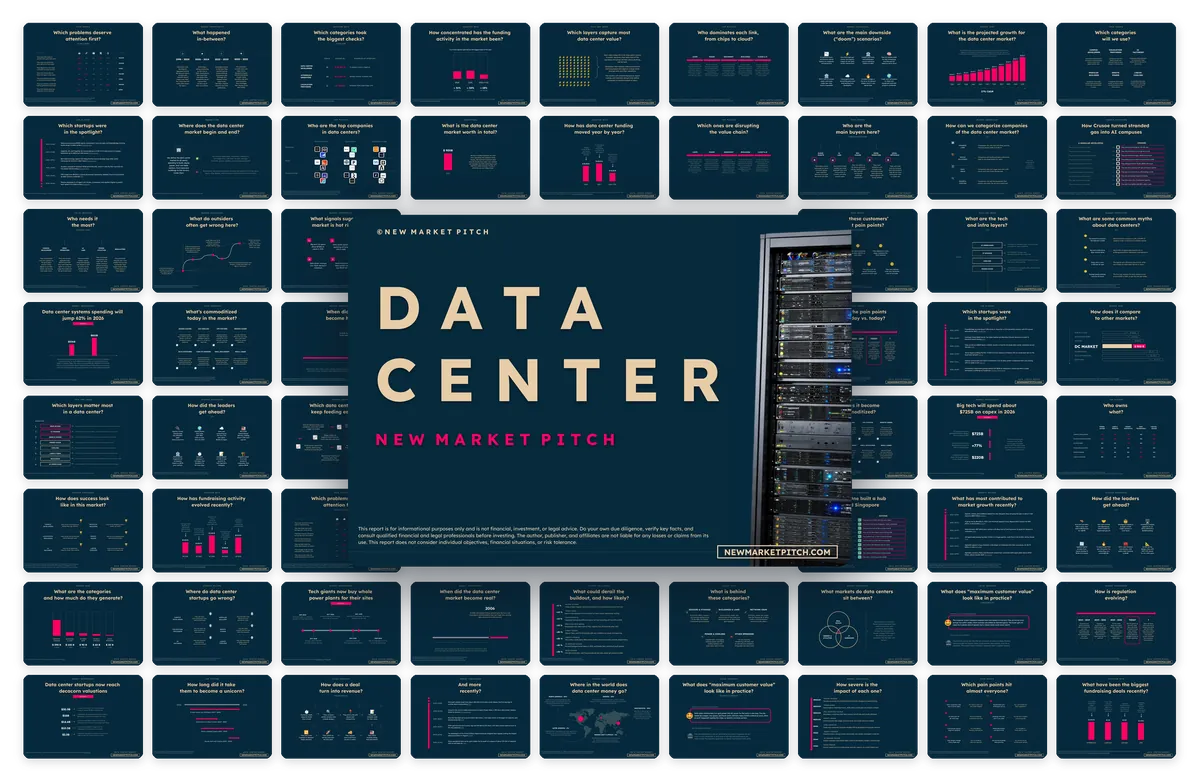
Whether you're building or investing in the data center market, our report covers everything you need to know: the players, the money, and what's coming next.
Summary
Aligned Data Centers is currently the clearest valuation leader in the data center market at about $40 billion, with STACK Infrastructure estimated at $30–40 billion, Crusoe at $30.9 billion, and CyrusOne around $22–28 billion.
The top end is no longer a small club. Using the lower bound of every range in the dataset, 12 companies clear $10 billion and 27 clear $5 billion, which makes this a much deeper market than a typical infrastructure niche. With a dozen companies above $10 billion, we line up who the top companies are today in our data center market report.
Not all of those valuation figures are equally solid. Aligned’s $40 billion comes from a completed acquisition, Crusoe’s $30.9 billion from a priced private round, while companies such as STACK, CyrusOne and EdgeConneX still rely more heavily on estimates.
AI has changed what buyers prize most. The scarce asset is increasingly not the building itself, but deliverable power, grid access, construction readiness and the ability to bring hundreds of megawatts online fast.
Crusoe is the unusual case near the top because investors are valuing more than real estate and power infrastructure. Its model also reaches into GPU capacity, cloud services and managed inference, which gives it a different revenue profile from a conventional colocation operator.
Asia has become a major part of the valuation story. AirTrunk, DayOne, CDC Data Centres and ST Telemedia Global Data Centres all sit near the top, while India is producing large platforms such as CtrlS and Yotta with multi-gigawatt ambitions.
Europe has plenty of multibillion-dollar operators, but it still has fewer companies in the $15 billion-plus band. The Nordics stand out because power availability, renewable energy and cooler climates can support high-density AI infrastructure.
Headline megawatts can be misleading. One operating, contracted megawatt is worth far more than one attached to undeveloped land or a grid connection that may not arrive for years, so pipeline size alone is a poor valuation shortcut.
The demand data still support high asset prices for now: North American primary-market vacancy is around 1.4%, more than 80% of construction is already preleased, and supply has kept growing without creating a large pool of empty capacity.
The bigger risk sits in financing and customer concentration. AI campuses require billions in construction, power and equipment, often against a small number of very large tenants, so even a healthy overall market can still produce bad projects.
The ranking therefore says more than “AI is booming.” The companies attracting the highest valuations are the ones that have already secured power, customers, land, financing and execution capacity at scale, and, in a few cases, layered higher-value compute revenue on top.

Written by the New Market Pitch teamWe track new markets so founders and investors can move faster. About us

In our report covering the data center market, we turn what is vague and complex into simple, useful visuals. Market maps like this one show you at a glance where every startup stands.
Top startups in the data center market ranked by valuation
Here is an updated table that ranks the top startups in the data center market based on their latest reported or estimated valuations.
If you need to dig deeper and get more detailed data, please check our report on data center funding, valuations and who's ahead.
| # | Startup Name | What They Do | Current Valuation ($) | Valuation Confidence Level | Valuation Type | Evidence Status | Total Funding ($) | Funding Confidence Level |
|---|---|---|---|---|---|---|---|---|
| 1 | Aligned Data Centers | Hyperscale and AI data centers | $40.0B | Full Confidence | Acquisition Value | Observed | ~$18.4B | Partial Confidence |
| 2 | STACK Infrastructure | Global hyperscale data center platform | $30.0B–$40.0B | Partial Confidence | Proxy-Based Estimate | Estimated | $10.8B | Strong Confidence |
| 3 | Crusoe | Vertically integrated AI infrastructure | $30.9B | Full Confidence | Announced Private Round Valuation | Observed | ~$8.4B | Partial Confidence |
| 4 | CyrusOne | Global hyperscale data center operator | $22.0B–$28.0B | Partial Confidence | Comparables-Based Estimate | Estimated | $9.85B | Strong Confidence |
| 5 | EdgeConneX | Global hyperscale and edge campuses | $18.0B–$24.0B | Partial Confidence | Comparables-Based Estimate | Estimated | $7.46B | Strong Confidence |
| 6 | Vantage Data Centers | Global hyperscale data center campuses | $18.0B–$24.0B | Partial Confidence | Comparables-Based Estimate | Estimated | $25.8B | Strong Confidence |
| 7 | AirTrunk | APAC hyperscale data center campuses | $16.1B–$22.0B | Partial Confidence | Acquisition Value | Estimated | ~$15.6B | Partial Confidence |
| 8 | DayOne | APAC-European hyperscale data centers | $16.0B–$20.0B | Strong Confidence | IPO or Listing Range Valuation | Estimated | $6.4B equity | Strong Confidence |
| 9 | CDC Data Centres | Australasian hyperscale sovereign data centers | $12.4B–$14.0B | Strong Confidence | Comparables-Based Estimate | Observed | ≥$355M disclosed equity | Partial Confidence |
| 10 | Switch | U.S. hyperscale data center campuses | $11.0B | Full Confidence | Acquisition Value | Observed | N/D | Low Confidence |
| 11 | ST Telemedia Global Data Centres | Global colocation and hyperscale infrastructure | $10.9B | Full Confidence | Acquisition Value | Observed | $1.3B | Strong Confidence |
| 12 | QTS Data Centers | Hyperscale and enterprise data centers | $10.0B | Full Confidence | Acquisition Value | Observed | N/D | Low Confidence |
| 13 | EDGNEX Data Centres | Global hyperscale data center developer | $7.0B–$11.0B | Low Confidence | Comparables-Based Estimate | Estimated | Not disclosed | Low Confidence |
| 14 | Colt Data Centre Services | Global hyperscale colocation infrastructure | $7.0B–$10.0B | Partial Confidence | Comparables-Based Estimate | Estimated | Not disclosed | Low Confidence |
| 15 | DataBank | Edge colocation and interconnection platform | $7.0B–$9.0B | Strong Confidence | Revenue or ARR Multiple Estimate | Estimated | $3.86B | Strong Confidence |
| 16 | Compass Datacenters | Hyperscale build-to-suit data centers | $6.0B–$8.0B | Partial Confidence | Comparables-Based Estimate | Estimated | ~$279M | Partial Confidence |
| 17 | Pure Data Centres | European hyperscale AI data centers | $6.0B–$8.0B | Partial Confidence | Proxy-Based Estimate | Estimated | ≥$4.2B disclosed recent financing | Partial Confidence |
| 18 | VIRTUS Data Centres | UK-European hyperscale colocation operator | $5.5B–$8.0B | Partial Confidence | Comparables-Based Estimate | Estimated | $81M | Strong Confidence |
| 19 | Global Switch | Large-scale international colocation campuses | $6.0B–$7.0B | Partial Confidence | Active Raise Valuation | Implied | Not disclosed | Low Confidence |
| 20 | EdgeCore Digital Infrastructure | US hyperscale data center campuses | $5.5B–$7.0B | Partial Confidence | Comparables-Based Estimate | Estimated | $5.9B+ announced capital | Partial Confidence |
| 21 | NEXTDC | Australian hyperscale data centers | $6.2B | Full Confidence | Public Market Cap | Observed | Not disclosed | Low Confidence |
| 22 | Khazna Data Centers | Middle Eastern hyperscale data centers | $5.5B–$6.5B | Strong Confidence | Announced Private Round Valuation | Estimated | Not disclosed | Low Confidence |
| 23 | Princeton Digital Group | Asian hyperscale data center platform | $5.0B–$7.0B | Partial Confidence | Comparables-Based Estimate | Estimated | $3.4B | Strong Confidence |
| 24 | Yondr Group | Global hyperscale data center developer | $5.0B–$7.0B | Partial Confidence | Comparables-Based Estimate | Estimated | $100M | Strong Confidence |
| 25 | DATA4 | European hyperscale data center platform | $5.0B–$6.5B | Partial Confidence | Comparables-Based Estimate | Estimated | $6.82B | Strong Confidence |
| 26 | Green Mountain | Nordic low-carbon hyperscale data centers | $5.2B–$5.8B | Strong Confidence | Active Raise Valuation | Implied | Not disclosed | Low Confidence |
| 27 | Global Technical Realty | European hyperscale build-to-suit campuses | $5.0B–$6.0B | Strong Confidence | Implied Valuation from Raise | Implied | $1.9B | Strong Confidence |
| 28 | T5 Data Centers | Develops and operates U.S. data centers | $4.5B–$6.5B | Partial Confidence | Proxy-Based Estimate | Estimated | $123M | Strong Confidence |
| 29 | CtrlS Datacenters | Indian hyperscale data center operator | $5.3B | Full Confidence | Announced Private Round Valuation | Implied | ≈$1.0B committed | Partial Confidence |
| 30 | Cologix | North American interconnected data centers | $4.5B–$6.0B | Partial Confidence | Comparables-Based Estimate | Estimated | ~$2.9B | Partial Confidence |
| 31 | CloudHQ | Global hyperscale data center campuses | $4.0B–$6.0B | Low Confidence | Comparables-Based Estimate | Estimated | ≥$1.4B disclosed debt | Partial Confidence |
| 32 | Ascenty | Latin American hyperscale colocation | $4.0B–$6.0B | Low Confidence | Comparables-Based Estimate | Estimated | ~$1.4B | Partial Confidence |
| 33 | AdaniConneX | Indian hyperscale green data centers | $4.0B–$6.0B | Partial Confidence | Comparables-Based Estimate | Estimated | $1.09B | Strong Confidence |
| 34 | Echelon Data Centres | European hyperscale data center campuses | $4.5B–$5.2B | Strong Confidence | Comparables-Based Estimate | Estimated | $3.82B | Strong Confidence |
| 35 | Sabey Data Centers | U.S. colocation data center campuses | $4.0B–$5.5B | Partial Confidence | Comparables-Based Estimate | Estimated | N/D | Low Confidence |
| 36 | Bridge Data Centres | Asian hyperscale data center platform | $4.5B–$5.0B | Strong Confidence | Comparables-Based Estimate | Estimated | $2.8B | Strong Confidence |
| 37 | Flexential | US colocation and cloud infrastructure | $4.0B–$5.0B | Partial Confidence | Revenue or ARR Multiple Estimate | Estimated | $2.67B | Strong Confidence |
| 38 | Ark Data Centres | UK hyperscale and government infrastructure | $4.0B–$4.8B | Partial Confidence | Active Raise Valuation | Estimated | ≥$500M disclosed debt | Partial Confidence |
| 39 | Serverfarm | Develops hyperscale data center campuses | $3.5B–$5.0B | Partial Confidence | Comparables-Based Estimate | Estimated | $3.9B | Strong Confidence |
| 40 | atNorth | Nordic high-density sustainable data centers | $4.0B | Full Confidence | Acquisition Value | Observed | Not publicly consolidated | Low Confidence |
| 41 | Digital Edge DC | Pan-Asian hyperscale data center platform | $3.5B–$4.5B | Partial Confidence | Comparables-Based Estimate | Estimated | $1.6B+ recent capital | Partial Confidence |
| 42 | Teraco Data Environments | African carrier-neutral data centers | $4.0B | Full Confidence | Acquisition Value | Implied | N/D | Low Confidence |
| 43 | Yotta Infrastructure | Indian AI cloud infrastructure | $4.0B | Full Confidence | Announced Private Round Valuation | Observed | $325M | Strong Confidence |
| 44 | Stream Data Centers | U.S. hyperscale campus developer | $3.0B–$4.5B | Partial Confidence | Comparables-Based Estimate | Estimated | N/D | Low Confidence |
| 45 | DC BLOX | Southeastern US hyperscale infrastructure | $3.0B–$4.0B | Partial Confidence | Comparables-Based Estimate | Estimated | $2.50B | Strong Confidence |
| 46 | maincubes | German hyperscale data centers | $3.0B–$4.0B | Partial Confidence | Proxy-Based Estimate | Estimated | $2.1B+ | Partial Confidence |
| 47 | AtlasEdge Data Centres | European edge and regional data centers | $2.8B–$3.8B | Partial Confidence | Comparables-Based Estimate | Estimated | ~$1.7B | Partial Confidence |
| 48 | Chindata Group | Asian hyperscale data center platform | $3.0B–$3.5B | Partial Confidence | Acquisition Value | Estimated | ~$570M | Partial Confidence |
| 49 | PowerHouse Data Centers | Develops hyperscale powered-shell campuses | $2.5B–$4.0B | Low Confidence | Proxy-Based Estimate | Estimated | N/D | Low Confidence |
| 50 | Start Campus | Portuguese gigascale AI data campus | $2.5B–$4.0B | Partial Confidence | Proxy-Based Estimate | Estimated | N/D | Low Confidence |
| 51 | Prime Data Centers | Global hyperscale data center developer | $2.5B–$4.0B | Low Confidence | Proxy-Based Estimate | Estimated | $200M | Strong Confidence |
| 52 | Nxtra by Airtel | Indian hyperscale data centers | $2.9B–$3.2B | Strong Confidence | Active Raise Valuation | Observed | $1.0B active raise | Partial Confidence |
| 53 | Edged Energy | Waterless AI-ready data center campuses | $2.5B–$3.5B | Low Confidence | Comparables-Based Estimate | Estimated | $2.0B+ 2026 financing | Partial Confidence |
| 54 | TierPoint | US enterprise colocation and cloud | $2.5B–$3.5B | Partial Confidence | Comparables-Based Estimate | Estimated | $820M | Strong Confidence |
| 55 | Novva Data Centers | Western US hyperscale campuses | $2.3B–$3.2B | Partial Confidence | Proxy-Based Estimate | Estimated | $355M | Strong Confidence |
| 56 | Omnia | Brazilian hyperscale AI infrastructure | $2.0B–$3.5B | Low Confidence | Proxy-Based Estimate | Estimated | Not disclosed | Low Confidence |
| 57 | Corscale Data Centers | US hyperscale data center development | $2.0B–$3.0B | Low Confidence | Proxy-Based Estimate | Estimated | ≥$975M project debt | Partial Confidence |
| 58 | Netrality Data Centers | US interconnected colocation facilities | $2.0B–$3.0B | Strong Confidence | Acquisition Value | Estimated | $425M | Strong Confidence |
| 59 | Scala Data Centers | Latin American hyperscale data centers | $2.0B–$3.0B | Partial Confidence | Comparables-Based Estimate | Estimated | $594M | Strong Confidence |
| 60 | EcoDataCenter | Nordic sustainable AI data centers | $2.0B–$2.8B | Partial Confidence | Comparables-Based Estimate | Estimated | $773M | Strong Confidence |
| 61 | NorthC Datacenters | Northwest European regional colocation | $2.1B–$2.5B | Strong Confidence | Acquisition Value | Estimated | Not disclosed | Low Confidence |
| 62 | OneAsia | Asian data centers and cloud | $1.8B–$2.7B | Low Confidence | Comparables-Based Estimate | Estimated | Not disclosed | Low Confidence |
| 63 | Green Datacenter | Swiss hyperscale and enterprise facilities | $2.2B | Full Confidence | Acquisition Value | Observed | Not disclosed | Low Confidence |
| 64 | Bulk Infrastructure | Nordic sustainable hyperscale infrastructure | $1.9B–$2.4B | Partial Confidence | Active Raise Valuation | Estimated | ~$1.1B | Partial Confidence |
| 65 | BDx Data Centers | Asian hyperscale colocation platform | $1.7B–$2.2B | Partial Confidence | Active Raise Valuation | Estimated | ≥$475M identified financing | Partial Confidence |
| 66 | AIMS Data Centre | Southeast Asian carrier-neutral data centers | $1.7B–$2.1B | Partial Confidence | Active Raise Valuation | Estimated | ~$438M | Partial Confidence |
| 67 | eStruxture | Canadian carrier-neutral data center network | $1.6B–$2.2B | Strong Confidence | Comparables-Based Estimate | Estimated | $1.65B | Strong Confidence |
| 68 | Verne Global | Nordic renewable-powered data centers | $1.5B–$2.3B | Partial Confidence | Comparables-Based Estimate | Estimated | $125M | Strong Confidence |
| 69 | Empyrion Digital | Asian green hyperscale data centers | $1.5B–$2.1B | Partial Confidence | Implied Valuation from Raise | Implied | $828M equity commitment | Partial Confidence |
| 70 | nLighten | Pan-European edge data centers | $1.4B–$1.9B | Partial Confidence | Comparables-Based Estimate | Estimated | Not disclosed | Low Confidence |
| 71 | CleanArc Data Centers | Renewable-focused hyperscale data centers | $1.3B–$2.0B | Partial Confidence | Implied Valuation from Raise | Implied | ~$300M equity commitments | Partial Confidence |
| 72 | OData | Latin American hyperscale data centers | $1.3B–$1.8B | Low Confidence | Comparables-Based Estimate | Estimated | Not disclosed | Low Confidence |
| 73 | Elea Digital | Brazilian sustainable data center network | $1.2B–$1.8B | Low Confidence | Comparables-Based Estimate | Estimated | Not disclosed | Low Confidence |
| 74 | DCI Data Centers | APAC hyperscale data center operator | $1.0B–$1.6B | Low Confidence | Comparables-Based Estimate | Estimated | Not disclosed | Low Confidence |
| 75 | Africa Data Centres | Pan-African carrier-neutral data centers | $1.0B–$1.5B | Low Confidence | Comparables-Based Estimate | Estimated | ~$109M | Partial Confidence |
| 76 | Nabiax | Spanish hyperscale data centers | $1.0B–$1.2B | Strong Confidence | Acquisition Value | Estimated | Not disclosed | Low Confidence |
| 77 | AQ Compute | Sustainable European hyperscale data centers | $800M–$1.3B | Low Confidence | Comparables-Based Estimate | Estimated | Undisclosed | Low Confidence |
| 78 | Kao Data | UK AI-ready data centers | $900M–$1.0B | Strong Confidence | Revenue or ARR Multiple Estimate | Estimated | $478M | Strong Confidence |
| 79 | Digital Halo | Asian AI-ready data center developer | $600M–$900M | Low Confidence | Proxy-Based Estimate | Estimated | $447M+ committed/financed | Partial Confidence |
| 80 | MedOne | Israeli secure data centers | $650M–$850M | Partial Confidence | Comparables-Based Estimate | Estimated | Not disclosed | Low Confidence |
| 81 | Penta Infra | European regional colocation data centers | $600M–$900M | Low Confidence | Comparables-Based Estimate | Estimated | N/D | Low Confidence |
| 82 | 365 Data Centers | US regional colocation and networks | $600M–$900M | Low Confidence | Proxy-Based Estimate | Estimated | $111M | Strong Confidence |
| 83 | Chayora | Chinese hyperscale data center campuses | $500M–$900M | Low Confidence | Comparables-Based Estimate | Estimated | ~$137M | Partial Confidence |
| 84 | KIO Networks | Latin American colocation platform | $500M–$750M | Partial Confidence | Comparables-Based Estimate | Estimated | $50M+ | Partial Confidence |
| 85 | Hyperco | Nordic hyperscale data center developer | $450M–$700M | Low Confidence | Comparables-Based Estimate | Estimated | Not disclosed | Low Confidence |
| 86 | MEEZA | Qatari data centers and cloud | $563M | Full Confidence | Public Market Cap | Observed | Not disclosed | Low Confidence |
| 87 | H5 Data Centers | US regional colocation and interconnection | $400M–$700M | Low Confidence | Proxy-Based Estimate | Estimated | Not disclosed | Low Confidence |
| 88 | IXcellerate | Russian carrier-neutral data centers | $350M–$550M | Low Confidence | Comparables-Based Estimate | Estimated | $205M | Strong Confidence |
| 89 | DartPoints | Regional US edge data centers | $350M–$500M | Partial Confidence | Comparables-Based Estimate | Estimated | $5.5M disclosed | Strong Confidence |
| 90 | Web Werks Data Centers | Indian carrier-neutral data centers | $300M–$450M | Partial Confidence | Acquisition Value | Estimated | ~$142M direct IRM investment | Partial Confidence |
| 91 | Skybox Datacenters | Develops wholesale hyperscale data centers | $250M–$450M | Low Confidence | Proxy-Based Estimate | Estimated | N/D | Low Confidence |
| 92 | IXAfrica Data Centre | Kenyan hyperscale colocation campus | $250M–$400M | Partial Confidence | Comparables-Based Estimate | Estimated | $50M | Strong Confidence |
| 93 | Evocative | Colocation network and cloud infrastructure | $250M–$400M | Low Confidence | Proxy-Based Estimate | Estimated | $62.5M+ | Partial Confidence |
| 94 | Raxio Group | African carrier-neutral data centers | $200M–$375M | Partial Confidence | Implied Valuation from Raise | Implied | $334M | Strong Confidence |
| 95 | Wingu.Africa | East African carrier-neutral data centers | $180M–$300M | Partial Confidence | Comparables-Based Estimate | Estimated | $60M | Strong Confidence |
| 96 | SpaceDC | Southeast Asian data center developer | $150M–$300M | Low Confidence | Proxy-Based Estimate | Estimated | N/D | Low Confidence |
| 97 | Infinaxis Data Centre Holdings | Southeast Asian data center platform | $150M–$250M | Low Confidence | Proxy-Based Estimate | Estimated | Not disclosed | Low Confidence |
| 98 | Proximity Data Centres | UK regional edge data centers | $125M–$160M | Partial Confidence | Acquisition Value | Estimated | N/D | Low Confidence |
| 99 | PAIX Data Centres | Pan-African carrier-neutral colocation | $70M–$100M | Partial Confidence | Comparables-Based Estimate | Estimated | $30M+ | Partial Confidence |
| 100 | Digital Fortress | Pacific Northwest colocation provider | $15M–$30M | Low Confidence | Proxy-Based Estimate | Estimated | ~$12M disclosed | Partial Confidence |
The biggest data center companies are now worth $20 billion to $40 billion, with Aligned Data Centers at roughly $40 billion, STACK Infrastructure estimated at $30–40 billion, Crusoe at $30.9 billion, and CyrusOne around $22–28 billion.
That upper tier has become much larger than it was only a few years ago. Using the conservative lower end of every range in our dataset, 12 companies are worth at least $10 billion and 27 are worth at least $5 billion.
Aligned gives us the cleanest benchmark. Its acquisition recently closed at an enterprise value of about $40 billion. The company has 51 campuses and more than 6.4 GW of operating and planned capacity.
Crusoe reached almost the same tier through a completely different route. Its latest $3.9 billion private round valued the company at $30.9 billion post-money. Crusoe now reports more than 6 GW of gross contracted capacity and over $140 billion of contracted value across its infrastructure platform.
At the top, the split is pretty clear. Companies such as Aligned, AirTrunk and atNorth are being priced as enormous infrastructure platforms, while Crusoe is also getting credit for the AI compute and software layers sitting on top of its physical infrastructure.
| Rank | Company | Current valuation | Main valuation basis |
|---|---|---|---|
| 1 | Aligned Data Centers | $40.0B | Acquisition |
| 2 | STACK Infrastructure | $30.0B–$40.0B | Estimated |
| 3 | Crusoe | $30.9B | Private funding round |
| 4 | CyrusOne | $22.0B–$28.0B | Estimated |
| 5 | EdgeConneX | $18.0B–$24.0B | Estimated |
| 6 | Vantage Data Centers | $18.0B–$24.0B | Estimated |
| 7 | AirTrunk | $16.1B–$22.0B | Acquisition-linked |
| 8 | DayOne | $16.0B–$20.0B | IPO-related estimate |
| 9 | CDC Data Centres | $12.4B–$14.0B | Estimated |
| 10 | Switch | $11.0B | Acquisition |

Our research about data centers gets updated several times a month, so you always get the latest view of where things stand.
Is Aligned Data Centers really worth $40 billion?
Yes. Aligned Data Centers has a real $40 billion transaction behind its valuation, which makes it one of the strongest numbers anywhere in this ranking.
The acquisition by the AI Infrastructure Partnership, MGX and BlackRock's Global Infrastructure Partners has now closed at an enterprise value of approximately $40 billion. That gives Aligned a much firmer benchmark than companies valued from financing discussions, revenue multiples or comparable transactions.
There is serious physical scale behind the price. Aligned says its portfolio covers 51 campuses and more than 6.4 GW of operating and planned capacity.
Still, dividing $40 billion by 6.4 GW and calling the result a valuation multiple would be too simplistic. Some capacity is already operating, some is contracted, and some still sits in the development pipeline. Those stages carry very different values.
The better comparison is AirTrunk. When Blackstone agreed to acquire AirTrunk, the company had grown from five sites and 450 MW of capacity in 2020 to 11 sites and more than 1.8 GW. That transaction implied an enterprise value above A$24 billion. Aligned later pushed the sector benchmark much higher.
Investors are effectively paying for years of work that has already been done: land assembled, power secured, campuses designed, customer relationships built and financing channels proven.
How did Crusoe become a $30.9 billion company so fast?
Crusoe reached a $30.9 billion valuation because the business expanded far beyond its early energy-and-compute model and became one of the clearest pure plays on AI infrastructure.
The valuation trajectory is extreme. Crusoe's Series D valued the company at $2.8 billion in late 2024. Its latest Series F values it at $30.9 billion. That is roughly an elevenfold increase in less than two years.
Crusoe's operating profile changed quickly at the same time. The company now reports more than $140 billion of total contracted value, more than 6 GW of gross contracted capacity, around 1 GW already delivered and operational, and more than $100 million of contracted annual recurring revenue from managed inference.
Those figures explain why Crusoe can trade at a very different valuation from a conventional colocation operator. The company touches energy, data center construction, GPU infrastructure, cloud computing and managed AI inference.
Investors are pricing more than the buildings it controls. They are also pricing the chance that Crusoe can earn higher-value compute revenue on the same underlying power infrastructure.

In our market report about data centers, we look at what the winners do differently, so you can learn from the best instead of guessing.
Is AI really driving data center valuations now?
Yes. AI is currently the biggest force behind the jump in data center valuations, especially for operators that can deliver large blocks of power quickly.
The clearest evidence comes from the physical market. CBRE found that primary data center supply in North America grew 33.7% year over year in the first half of 2026, yet vacancy still fell to 1.4%. More than 80% of capacity under construction was already preleased. Vacancy falling to 1.4% despite 33.7% more supply is a shift; we cover what changed in the last 12 months in our data centers report.
Supply is expanding at an extraordinary pace and customers are still absorbing almost everything developers can deliver.
JLL found an even more dramatic demand figure using its broader methodology: North American data center absorption reached 25 GW in the first half of 2026, twice the level a year earlier and five times the level two years earlier.
The companies at the top of our ranking fit that pattern. Aligned targets cloud and AI workloads. Crusoe builds what it calls AI factories. Yotta is deploying more than 20,000 Nvidia Blackwell Ultra GPUs. atNorth specializes in high-density infrastructure for AI and high-performance computing. Vantage, EdgeConneX, DayOne and CtrlS are all developing much larger campuses than traditional enterprise data centers required.
Cloud computing still accounts for a huge amount of demand, but AI has changed what buyers are willing to pay for a large, power-secured campus.
How many data center unicorns are there?
At least 76 companies in our 100-company dataset are worth $1 billion or more when we use the lower end of every valuation range.
That is a remarkably deep billion-dollar market. We do not need optimistic midpoint assumptions to get there: more than three quarters of the companies already clear the threshold on a conservative basis.
The number would rise slightly if we used midpoints. AQ Compute, for example, sits at $800 million to $1.3 billion, while Kao Data is estimated at $900 million to $1 billion.
The term “unicorn” is a little awkward here because many companies have moved well beyond a normal startup profile. Switch, QTS and CyrusOne are mature infrastructure businesses. NEXTDC and MEEZA are publicly listed. Aligned has just changed hands in a $40 billion acquisition.
Still, the count says something useful about the depth of the market. This category has dozens of billion-dollar platforms rather than a small handful of giants surrounded by tiny operators.
Which data center companies are worth more than $10 billion?
Twelve data center companies in our ranking have valuations of at least $10 billion on a conservative basis, with several more able to cross that level at the upper end of their ranges.
North America dominates the group through Aligned, STACK, Crusoe, CyrusOne, EdgeConneX, Vantage, Switch and QTS. Asia-Pacific contributes AirTrunk and CDC Data Centres, while DayOne has grown into a global platform with a heavy Asian footprint. ST Telemedia Global Data Centres recently received an implied enterprise value of about $10.9 billion.
The jump between the bottom and top of this group is large. QTS sits at roughly $10 billion in our dataset, while Aligned is worth about four times as much.
A $10 billion data center company is now clearly part of the industry's top tier, yet the biggest platforms are already moving toward $30 billion and $40 billion.
| Company | Current valuation |
|---|---|
| Aligned Data Centers | $40.0B |
| STACK Infrastructure | $30.0B–$40.0B |
| Crusoe | $30.9B |
| CyrusOne | $22.0B–$28.0B |
| EdgeConneX | $18.0B–$24.0B |
| Vantage Data Centers | $18.0B–$24.0B |
| AirTrunk | $16.1B–$22.0B |
| DayOne | $16.0B–$20.0B |
| CDC Data Centres | $12.4B–$14.0B |
| Switch | $11.0B |
| ST Telemedia Global Data Centres | $10.9B |
| QTS Data Centers | $10.0B |

In our document detailing everything you need to know about data center, you will always find fresh funding data, taken straight from our own verified funding database.
Why are investors paying so much for data centers today?
Investors are paying much more for data centers because usable power has become scarce, construction costs have exploded and large AI customers want capacity faster than developers can deliver it.
JLL estimates that average global shell-and-core construction costs rose from about $7.7 million per MW in 2020 to $10.7 million in 2025 and could reach around $11.3 million per MW in 2026.
The tenant's technology equipment can cost even more. JLL says an AI fit-out can reach roughly $25 million per MW. A 100 MW AI facility can therefore involve several billion dollars of combined property and computing investment. A 100 MW AI facility can cost several billion dollars; we look at which investors are making the biggest bets in our data centers report.
Power has become even more important than the building cost. JLL now calls speed to power the main criterion in data center site selection. CBRE likewise says power availability and infrastructure delivery timelines are among the biggest factors shaping leasing and pricing.
An existing platform with grid access can command a huge premium because a buyer may save years compared with assembling equivalent power positions from scratch.
The industry is increasingly pricing time, power access and execution together.
Is AirTrunk still one of the world's most valuable data center companies?
Yes. AirTrunk remains one of the most valuable private data center platforms in the world, even after newer deals pushed the absolute valuation ceiling higher.
Its expansion was unusually fast. Macquarie and PSP Investments backed AirTrunk when the company had five data centers and roughly 450 MW of capacity. By the time Blackstone's consortium agreed to acquire it, AirTrunk had 11 sites across Australia, Singapore, Hong Kong, Japan and Malaysia and more than 1.8 GW across the portfolio.
The transaction implied an enterprise value above A$24 billion. AirTrunk also had more than 800 MW already committed to customers and land capable of supporting more than another gigawatt.
Investors had seen that the company could repeat its model across several countries rather than simply build one large campus.
Aligned and Crusoe have since established even larger valuation benchmarks, but AirTrunk remains one of the clearest examples of a regional data center company turning into a global-scale infrastructure asset.
Why are Asian data center companies getting so valuable?
Asian data center companies are getting more valuable because the region is combining fast cloud growth, AI investment, sovereign-data demand and severe power constraints in several major cities.
Our ranking shows how broad that trend has become. AirTrunk, DayOne, CDC Data Centres, ST Telemedia Global Data Centres, CtrlS, Princeton Digital Group, Bridge Data Centres, Digital Edge and Yotta all sit high in the table.
ST Telemedia Global Data Centres recently gave us a useful transaction benchmark. A KKR-led consortium with Singtel agreed to acquire the remaining stake in the company at an implied enterprise value of about S$13.8 billion, or approximately $10.9 billion. STT GDC operates across major markets in Asia-Pacific, the UK and Europe.
AirTrunk provides an even bigger reference point with its A$24 billion-plus transaction.
The projects themselves are also getting much larger. CBRE says new developments in Asia-Pacific increasingly exceed 100 MW, while operators are moving into places such as Johor, Batam and India where large-scale power can still be assembled.
Singapore, Tokyo and Hong Kong remain important, but the next generation of Asian capacity is increasingly being built around nearby markets that offer more land and electricity.

Learning from others' mistakes is the cheapest lesson there is. In our report covering the data center market, we look at what broke startups before you, so you don't repeat it.
Is India becoming a major data center market?
Yes. India is now producing multibillion-dollar data center companies and AI infrastructure projects large enough to matter globally.
CtrlS gives us the clearest current valuation benchmark. CPP Investments recently committed up to ₹7,000 crore to the company and a related hyperscale joint venture. CtrlS disclosed a pre-money valuation of ₹44,824 crore, equivalent to roughly C$6.6 billion.
The operating plan is ambitious as well. CtrlS says it is working toward more than 4 GW of AI-ready infrastructure.
Yotta is approaching the market from the compute side. The company announced more than 20,000 liquid-cooled Nvidia Blackwell Ultra GPUs, representing over $2 billion of investment. It also disclosed a four-year Nvidia engagement worth more than $1 billion. Yotta says its Greater Noida campus can scale to 250 MW and its Navi Mumbai campus to 2 GW.
AdaniConneX and Nxtra by Airtel add two more large platforms to the Indian market.
Pension funds, telecom groups, infrastructure conglomerates and AI-cloud operators are all building capacity at the same time. That is a long way from an early speculative market.
Are European data center companies catching up with the US and Asia?
Europe has built a deep group of multibillion-dollar data center companies, but the continent still has fewer platforms in the $15 billion-plus tier.
Our estimates place Colt DCS around $7–10 billion, Pure Data Centres around $6–8 billion, VIRTUS around $5.5–8 billion, DATA4 around $5–6.5 billion and Global Technical Realty around $5–6 billion.
atNorth gives us a much firmer reference point. CPP Investments and Equinix recently completed its acquisition at a $4 billion enterprise value. The company has eight operating data centers across the Nordics and more than 1.5 GW of secured power according to Partners Group.
atNorth has also kept growing during the transaction process. Partners Group says contracted EBITDA doubled since the end of 2025 and increased fourteenfold during its four years of ownership.
Its new Norwegian campus shows where European growth is moving. The project is designed to start at 120 MW and eventually reach 350 MW, with power availability dependent on new grid infrastructure.
Europe can produce valuable data center companies, particularly in the Nordics where renewable power and cooler climates help high-density computing. The biggest US and Asian platforms still command much higher absolute valuations today. The biggest US and Asian platforms still command much higher values, and we look at who is ahead, and who is falling behind, in our report covering data centers.
Does having more megawatts automatically make a data center company worth more?
No. Data center valuations depend heavily on how usable, contracted and close to operation those megawatts really are.
Aligned has more than 6.4 GW of operating and planned capacity and is worth about $40 billion. Crusoe reports more than 6 GW of gross contracted capacity and carries a $30.9 billion valuation. AirTrunk had more than 1.8 GW across its portfolio around the time of its A$24 billion-plus transaction.
Those numbers look comparable until we examine what sits underneath them.
A megawatt running today under a long-term contract with a hyperscaler is worth far more than a megawatt attached to undeveloped land where power may arrive years later. Grid connection, construction status, customer commitments and financing all change the economics.
atNorth illustrates the timing issue well. Its planned Norwegian site can eventually reach 350 MW, but power availability is projected for 2028 and depends on new substations. The future capacity is valuable because atNorth controls the site and development path, although it cannot be treated like 350 MW of operating capacity today.
A large parcel of land has limited value for AI infrastructure when a developer cannot secure hundreds of megawatts. A less obvious location with credible grid access can be far more attractive.
So we pay much more attention to deliverable megawatts than headline pipeline numbers.

In our research about data centers, we always try to gather several sources and make estimates that make sense, so you can work with solid numbers.
Is there enough real demand to support today's data center valuations?
Yes, for now. Current vacancy, leasing and preleasing numbers show that customers are absorbing data center capacity extremely quickly.
CBRE reported primary-market vacancy of only 1.4% in North America even after supply grew 33.7% year over year. Developers had 7,481 MW under construction, and 80.4% of that capacity had already been preleased.
Less than 1,500 MW of future capacity remained available across the primary markets covered by CBRE, equivalent to roughly six months of demand at the current absorption rate.
Pricing is moving in the same direction. CBRE found higher asking rents across every major deployment size, including an 8.3% increase for 3-to-10-MW deployments.
Company data also show real commitments behind the boom. Crusoe reports more than $140 billion of contracted value. AirTrunk had more than 800 MW committed to customers around its sale. Partners Group says atNorth's contracted EBITDA has doubled since the end of 2025.
None of those figures guarantee that every proposed AI campus will make money. They do show that today's valuation boom is happening in a market where available capacity remains unusually scarce.
| Current demand indicator | Latest figure |
|---|---|
| North American primary-market vacancy | 1.4% |
| Primary-market supply growth | +33.7% YoY |
| Capacity under construction | 7,481 MW |
| Construction already preleased | 80.4% |
| Future capacity still available | <1,500 MW |
| Global vacancy across 16 major markets | 6.7% |
| Global supply growth | +25% YoY |
| JLL North American H1 absorption | 25 GW |
Are we building too many AI data centers?
Probably not yet. The current numbers still point to a shortage of deliverable capacity, although the risk of overbuilding individual projects is becoming much more serious.
The distinction between announced capacity and usable capacity is crucial. A project can appear in a multi-gigawatt development pipeline years before its transformers, transmission lines, permits and financing are ready.
McKinsey recently looked directly at the risk of overbuilding power infrastructure for AI data centers in the United States. Its conclusion was that the greater near-term risk may still be underbuilding, even if compute demand eventually lands below the most aggressive forecasts.
The current market data support that view. Global supply across 16 major markets grew 25% year over year according to CBRE, while vacancy still fell from 8.3% to 6.7%. In North America's primary markets, vacancy is much tighter at 1.4%.
The risk gets more interesting at the company level. Some developers are making enormous capital commitments against a small number of AI customers. A change in model efficiency, chip economics or customer financing could hurt individual campuses even while the overall data center market stays healthy.
There is real risk of bad projects and overextended financing. We do not yet see evidence of a broad market flooded with empty AI data centers.

If you build or invest in the data center market, you need to know which business models pay off now and which ones are fading. That's why our market report about data centers has a whole section on it.
Why are data center companies raising so much money?
Data center companies are raising billions because modern AI campuses are simply too expensive to finance like normal startups.
JLL's construction estimates make the scale easy to understand. At roughly $11.3 million per MW for shell-and-core construction, a 500 MW development implies about $5.65 billion of building cost before the tenant installs its AI equipment. Building a single campus can cost billions, so we trace who has raised the most, and from whom, in our data centers market report.
An AI technology fit-out can cost up to another $25 million per MW. At that level, 500 MW of compute equipment would represent another $12.5 billion.
This is why the funding figures in our ranking sometimes look larger than the companies' own valuations. Data center financing frequently includes project debt, construction loans, joint-venture capital and money tied to individual campuses. It cannot be read like a normal venture-capital total.
atNorth gives us a recent example. The $4 billion acquisition was accompanied by a $4.1 billion financing package designed to fund the transaction and the company's continued expansion.
The financing structures around AI infrastructure are also getting more complicated. The Financial Times recently reported that large technology companies are using special-purpose vehicles and residual-value guarantees to support hundreds of billions of dollars of data center and chip financing.
That adds another risk: data center valuations increasingly depend on access to cheap, deep and patient capital.
Which kinds of data center companies get the highest valuations?
Large hyperscale platforms with secured power currently command the highest data center valuations, while companies that also sell AI compute can push even higher.
Aligned, STACK, CyrusOne, EdgeConneX, Vantage, AirTrunk and DayOne all fit the first group. Their advantage is the ability to deliver very large campuses to hyperscalers and AI customers.
Crusoe adds another layer. It builds the data centers, participates in energy infrastructure, operates GPU capacity and sells cloud and managed inference services. That gives the company more ways to earn revenue from each block of power it controls.
Yotta is moving in a similar direction in India by combining hyperscale facilities with enormous GPU deployments.
Regional colocation companies generally appear further down the ranking. A network of smaller enterprise facilities can still be a strong business, but it cannot absorb a 100 MW or 200 MW AI requirement as easily as a multi-campus hyperscale developer.
The scale gap is huge. Aligned's $40 billion enterprise value is around 40 times the midpoint of a $900 million-to-$1 billion company such as Kao Data and hundreds of times larger than some regional operators near the bottom of our ranking.
Right now, the premium goes to companies that can turn scarce power into very large, repeatable customer deployments.

In our document detailing everything you need to know about data center, we don't want to repeat what boring consulting reports say. Instead, we show you the real and latest market signals that matter.
Can you really compare a $40 billion acquisition with a $30.9 billion startup valuation?
Yes, but only as a broad measure of company value. A $40 billion enterprise value and a $30.9 billion post-money equity valuation are different financial measurements.
Aligned's approximately $40 billion acquisition figure is enterprise value. It reflects the value of the operating business while taking the capital structure into account.
Crusoe's $30.9 billion figure is the post-money equity valuation from its latest private financing round.
ST Telemedia Global Data Centres gives us another enterprise-value example. Its recent transaction implied a value of about $10.9 billion including leverage and capital expenditure for committed projects.
Public companies add another measurement. NEXTDC and MEEZA are represented by market capitalization, which values the publicly traded equity and changes with the share price.
These figures still belong in the same ranking because someone searching for the world's most valuable data center companies wants the best current economic reference available for each business.
The differences become important when companies sit very close together. We should not pretend a $10.9 billion enterprise value and a $10 billion historical acquisition price are precise enough to settle which underlying business is intrinsically worth more. A gap such as $40 billion versus $3 billion is much more meaningful.
Is DayOne really worth $20 billion?
DayOne could reach a $20 billion valuation, but the number is currently a proposed IPO benchmark rather than a completed transaction.
Bloomberg reported earlier this year that DayOne was considering a US listing at a valuation as high as $20 billion. That would represent a major increase from the roughly $10 billion level associated with previous private financing. A listing target at double the last private value shows how fast numbers move; we compare what each company is worth, then and now, in our data centers report.
The operating footprint has expanded enough to make the target plausible. DayOne has developed a large presence across Singapore, Johor, Batam, Tokyo and Hong Kong while also moving into Europe.
Even so, an IPO target tells us what a company and its advisers hope the public market may accept. Crusoe's $30.9 billion round and Aligned's $40 billion acquisition give us firmer evidence because investors have already committed capital at those values.
That is why our ranking uses a $16–20 billion range for DayOne rather than presenting $20 billion as a confirmed point valuation.
Which data center valuations have risen the fastest?
Crusoe has produced the most dramatic confirmed valuation increase in our ranking, jumping from $2.8 billion in late 2024 to $30.9 billion today.
That is more than a tenfold increase in less than two years.
AirTrunk followed a slower infrastructure path. Between 2020 and its sale, capacity expanded from roughly 450 MW across five sites to more than 1.8 GW across 11 sites. The company ultimately reached an enterprise value above A$24 billion.
atNorth gives us another useful growth case. Partners Group says contracted EBITDA increased fourteenfold during its ownership and doubled again since the end of 2025. The company has now been acquired at a $4 billion enterprise value.
DayOne could become the next big step-up if public investors eventually accept a valuation approaching its reported $20 billion target.
The biggest increases have come from companies whose operating scale genuinely changed through larger power portfolios, new geographies, major customer commitments or new AI-compute revenue.

In our report covering the data center market, we like to show you the big picture. We know your time is precious, so we make every page quick to read and packed with as much learning as possible per minute.
What could make data center valuations fall?
Data center valuations could fall hard if AI customers stop absorbing capacity at today's pace while developers remain locked into huge power, construction and debt commitments.
Customer concentration is one of the biggest risks. A large AI campus can depend on one tenant signing a very long lease. That works extremely well while the tenant keeps expanding, but it creates a painful problem if the customer cuts spending or runs into financing trouble.
Debt is another pressure point. The sector now requires enormous borrowing, and lenders are starting to price more of that risk explicitly. Recent Financial Times reporting has shown higher borrowing costs and investor caution around several large AI data center financings.
Technology can also move faster than the buildings. More efficient chips or models could reduce the amount of infrastructure required for a given amount of AI output. Older campuses may need expensive upgrades to support higher rack densities and new cooling systems.
Power and local politics add another layer. JLL recently found a large gap between public support for national AI leadership and support for building data centers locally. Grid delays, water concerns, noise complaints and permitting disputes can push projects years behind schedule.
These risks are especially dangerous when a company has a huge speculative pipeline but limited contracted demand. The strongest operators today tend to have customers attached to capacity before construction finishes.
What does the data center valuation ranking tell us about the market today?
The data center market has moved into a new valuation era: the best-positioned platforms are now $20 billion, $30 billion and even $40 billion businesses because AI has made large blocks of deliverable power extraordinarily valuable.
Our ranking captures the scale of that shift. Aligned recently closed at about $40 billion. Crusoe reached $30.9 billion after being valued at $2.8 billion less than two years earlier. AirTrunk established another major benchmark above A$24 billion. ST Telemedia Global Data Centres recently received an implied enterprise value around $10.9 billion, while atNorth changed hands at $4 billion.
The underlying market still supports those valuations today. North American primary-market vacancy is around 1.4%, more than 80% of construction is already preleased, and global vacancy keeps falling despite fast supply growth.
The market is also becoming much more divided. Regional colocation companies can still build good businesses, but investors are paying a very different price for operators that can secure hundreds of megawatts, sign hyperscale customers and repeat that process across multiple regions.
AI has accelerated that divide.
For now, the upper end of the ranking reflects a genuine change in the economics of data center infrastructure. The bigger uncertainty sits further ahead: whether today's enormous AI commitments eventually produce enough revenue to support all the debt, power contracts and campuses now being built.
Our methodology
This analysis estimates the most defensible current valuation for companies in the data center market rather than simply repeating the last number ever reported. We focus on businesses whose activity is genuinely centered on data centers, hyperscale infrastructure or closely related AI infrastructure, while excluding broader companies where data centers are only a small side business.
We give the most weight to completed acquisitions, priced private funding rounds, public-market values and clearly disclosed transaction benchmarks. When those are unavailable, we use ranges based on financing evidence, operating scale, contracted capacity, customer commitments, power pipelines and comparable transactions.
Valuation type matters. Enterprise value, post-money equity valuation and public market capitalization are not identical measures, so we use them as the best available economic reference for each company rather than pretending they are perfectly interchangeable. Point estimates are reserved for stronger evidence; ranges widen as the evidence becomes more inferential.
Older valuation anchors are updated only when newer operating or financial evidence justifies it. We look at changes in revenue, financing, geography, capacity, customer base and market conditions rather than applying automatic percentage increases or decreases.
Key sources include Aligned Data Centers on its approximately $40 billion acquisition, Crusoe on its $30.9 billion Series F valuation and operating metrics, Macquarie on the AirTrunk sale, ST Telemedia on STT GDC's S$13.8 billion enterprise value, atNorth on its $4 billion acquisition, CtrlS on CPP Investments' commitment and disclosed pre-money valuation, Yotta on its Blackwell Ultra deployment, Bloomberg on DayOne's reported IPO valuation target, CBRE on North American vacancy, construction and preleasing, JLL on construction costs and speed to power, and McKinsey on the risk of overbuilding AI power infrastructure.

When you build or invest in the data center market, you need clarity, not confusion. In our research about data centers, we always try to put numbers on and quantify whatever is usually vague and confusing.
Written by the New Market Pitch teamWe track new markets so founders and investors can move faster. About us