What is the latest update in the data center market?
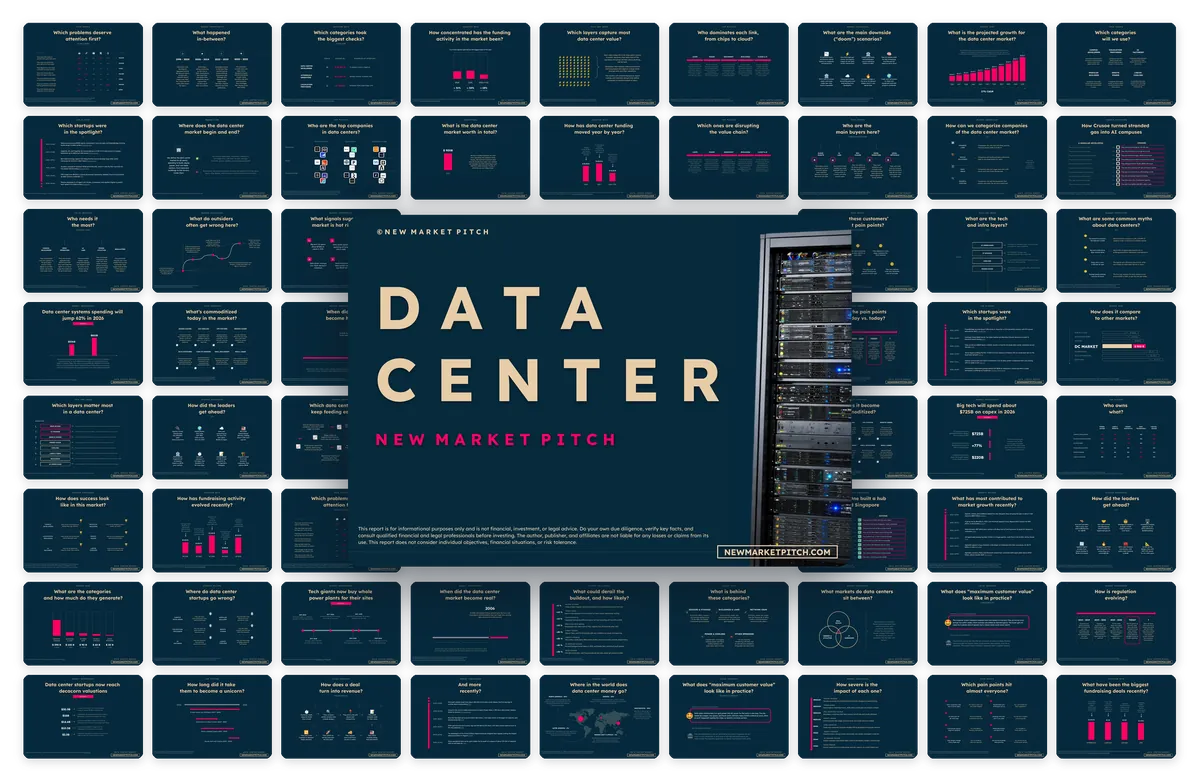
Whether you're building or investing in the data center market, our report covers everything you need to know: the players, the money, and what's coming next.
This is our October 2026 update on the data center market, and we constantly refresh this blog post as new information comes in.
Demand for data center capacity stayed exceptionally strong, but power shortages, permitting fights and nervous debt investors made it harder to deliver new capacity on time.
Below you will find the most important updates, financial results, and market signals from July through October 2026.
And if you want to better understand this new industry, you can get our data center market report.
Insights
- US data center vacancy fell to a record 1.4% across eight primary markets in H1 2026, and 80.4% of the 7,481 MW under construction was already preleased, according to CBRE.
- Crusoe raised $3.9 billion in the initial closing of its Series F at a $30.9 billion post-money valuation, the largest equity round in the market since July.
- Texas halted new data center permits on September 21, 2026 until ERCOT finishes auditing projects asking for grid connections, the strongest political brake on the market so far.
- PJM's July 2026 capacity auction cleared at its $325/MW-day price cap and still came up 6,831 MW short of its reliability target, turning power scarcity into a hard number.
- Hyperscalers keep raising spending: Alphabet now expects $195–205 billion of 2026 capex, Amazon about $220 billion and Meta $130–145 billion (forecasts that also include servers and networking).
- Equinix and CPP Investments completed their roughly $4 billion acquisition of atNorth on September 2, 2026, the largest completed data center acquisition of the period.
- Amazon and Google both signed 20-year nuclear power agreements with Constellation, covering 690 MW and 890 MW of planned extra output, showing that firm power is now part of hyperscaler strategy.
- Goldman Sachs counted 86 data center projects cancelled or heavily delayed between January and October 2026, 76 of them linked to local opposition.
- Digital Realty raised rents by 25.4% on renewed leases in Q2 2026 and held about $1.9 billion of signed-but-not-started annual rent, proof that scarcity is turning into pricing power.
- Bonds linked to big AI data center projects traded below par in October 2026, and some CoreWeave debt yielded around 15%, a sign that cheap capital is no longer guaranteed.

Written by the New Market Pitch teamWe track new markets so founders and investors can move faster. About us

In our report covering the data center market, we always try to gather several sources and make estimates that make sense, so you can work with solid numbers.
Summary table of the most important updates in the data center market
We define the data center market as the market for delivering and operating physical data center capacity (space, power, and cooling) used to host computing equipment.
We include colocation providers and hyperscale facilities (owned or leased) and the facility infrastructure required to power and cool IT loads.
We exclude the IT equipment and software inside the facility (servers/GPUs, storage, networking, and cloud services revenue).
| News | Category | Date | Source |
|---|---|---|---|
| Texas ordered a halt to new data center permits pending an ERCOT grid audit | Regulations & Policies | September 21, 2026 | Texas Governor's Office |
| Equinix and CPP Investments completed the $4B acquisition of atNorth | M&A | September 2, 2026 | Equinix |
| Crusoe raised $3.9B in a Series F at a $30.9B valuation | Fundraisings | September 17, 2026 | Crusoe |
| SoftBank completed its roughly $3.1B acquisition of DigitalBridge | M&A | September 30, 2026 | DigitalBridge |
| Nscale announced $3.36B of pre-IPO convertible financing | Fundraisings | September 25, 2026 | Nscale |
| Vertiv agreed to buy UtilityInnovation Group for $1.45B to move into on-site power | M&A | September 2, 2026 | Vertiv |
| CBRE said US data center vacancy hit a record low of 1.4% | Market Research | August 27, 2026 | CBRE |
| PJM's capacity auction hit its price cap and fell 6,831 MW short | Regulations & Policies | July 14, 2026 | PJM |
| Alphabet raised its 2026 capex forecast to $195–205B | Financial results | July 22, 2026 | Alphabet |
| Digital Realty posted $1.9B quarterly revenue, up 29%, and a $1.9B signed backlog | Financial results | July 23, 2026 | Digital Realty |
| Equinix posted $2.63B quarterly revenue and raised its 2026 outlook | Financial results | July 29, 2026 | Equinix |
| Amazon signed a 20-year, 690 MW nuclear power deal with Constellation | Partnerships | September 30, 2026 | Constellation |
| Google and Constellation agreed on 890 MW of extra nuclear output | Partnerships | October 6, 2026 | Constellation |
| Google announced about €13B of new investment in Finland for 2027–2028 | Market expansions | September 9, 2026 |
How is the data center market doing now?
How do we define the data center market?
We define the data center market as the market for delivering and operating physical data center capacity (space, power, and cooling) used to host computing equipment.
We include colocation providers and hyperscale facilities (owned or leased) and the facility infrastructure required to power and cool IT loads.
We exclude the IT equipment and software inside the facility (servers/GPUs, storage, networking, and cloud services revenue).
This is also the definition we use in our data center market report.
How big is the data center market in 2026?
The data center market is worth approximately $150 billion in 2026, with a range of $120 billion to $180 billion depending on how much hyperscalers are spending on their own facilities.
This is not a random guess, if you want to know how we have come up with this estimate, you can read our data center market size analysis here.
To put that number in perspective, the data center market is roughly the same size as the global pharmaceutical contract manufacturing market ($140 billion) or the global semiconductor equipment market ($130 billion).
The data center market scores 65 out of 100 on maturity (still evolving fast because of AI), 85 out of 100 on competitive intensity (everyone is fighting for power and permits), and 70 out of 100 on fragmentation (a few giants plus hundreds of regional players).

In our research about data centers, we don't want to repeat what boring consulting reports say. Instead, we show you the real and latest market signals that matter.
How fast will the data center market grow in the future?
The data center market is expected to grow at about 12% per year, driven by AI-related power demand, continued hyperscale expansion, and persistent capacity shortages.
At that pace, the data center market should reach approximately $236 billion by 2030 and roughly $466 billion by 2036, which would make it more than three times its current size.
For comparison, that 2036 figure would put the data center market on par with today's global commercial aviation industry, making it one of the largest infrastructure sectors in the world.
Recent signals back this up. Dell'Oro reported that spending on physical data center infrastructure (power and cooling equipment) grew 27% year over year to $14 billion in Q2 2026, and Goldman Sachs forecast in October 2026 that global data center power demand could rise about 170% between 2025 and 2030.
The real limit on growth is delivery: CBRE counted 7,481 MW under construction in the eight primary US markets in H1 2026, but much of it depends on grid connections that can take years.
What does current funding activity look like in the data center market?
Our team, who continually updates our data center market report, is keeping a close eye on the market and tracking key signals.
One of those signals is fundraising activity across startups. Each month, we refresh this page with a list of startups of the data center market that have raised funding, and we also publish a quarterly analysis here.
Is funding momentum accelerating or cooling in the data center market these days?
Funding momentum is still accelerating in size: since July 2026, Crusoe raised $3.9 billion in a Series F and Nscale announced $3.36 billion of pre-IPO convertible notes, both bigger than DayOne's $2 billion+ round in Q1 2026.
Debt is growing even faster. Aligned Data Centers completed a $1.18 billion securitization in July, Nscale arranged about $3.05 billion of term loans in August, and Lambda raised $1 billion of secured financing in October.
But investors are getting more selective. By mid-October, the Financial Times reported that bonds linked to big AI data center projects were trading below par and some CoreWeave debt yielded around 15%, which is a warning sign, not a default.
Which categories and business models are attracting capital in the data center market?
These categories and business models of the data center market are receiving important fundraising currently:
- Vertically integrated AI infrastructure platforms attract the biggest equity checks, as shown by Crusoe's $3.9 billion Series F, backed by more than 6 GW of contracted capacity (about 1 GW operational).
- Neoclouds with large contract books are raising both equity-like and debt capital, with Nscale's $3.36 billion pre-IPO financing announced alongside $103 billion of total contracted value (contract value, not revenue earned).
- Stabilized facilities leased to strong customers are being financed through securitization, like Aligned Data Centers' $1.18 billion ABS deal, about 30% larger than first targeted.
The common thread across all these deals is clear: in 2026, capital in the data center market flows to whoever controls power, signed customers, and the ability to deliver capacity fast.

In our market report about data centers, we like to show you the big picture. We know your time is precious, so we make every page quick to read and packed with as much learning as possible per minute.
Who's writing the most checks in the data center market?
These investors are being very active when it comes to fundraising in the data center market:
- Atreides, Mubadala Capital and Valor were among the investors in Crusoe's $3.9 billion Series F, which valued the company at $30.9 billion.
- SoftBank completed its roughly $3.1 billion acquisition of DigitalBridge, buying one of the largest digital infrastructure asset managers.
- CPP Investments now owns about 51% of atNorth after closing the $4 billion deal with Equinix, which holds about 34%.
- NVIDIA teamed up with Apollo, BlackRock, Blackstone, Brookfield, Goldman Sachs and KKR with the aim of mobilizing more than $500 billion for AI infrastructure, an ambition rather than capital already deployed.
The biggest checks since July came from sovereign funds, pension funds and large infrastructure investors, confirming that institutional capital still sees data centers as long-duration strategic assets.
Any big acquisitions or IPOs in the last three months in the data center market?
These are the big acquisitions and IPOs that happened recently in the data center market:
- Equinix and CPP Investments completed the acquisition of atNorth for about $4 billion on September 2, 2026, adding eight operating Nordic facilities (the separate $4.1 billion financing package is not part of the price).
- SoftBank completed its acquisition of DigitalBridge for about $3.1 billion on September 30, 2026.
- Vertiv agreed to acquire UtilityInnovation Group for about $1.45 billion upfront plus up to $1.15 billion in earnouts, a deal not yet closed.
- Eaton agreed to buy electrical supplier COL Group (€810 million, closing expected Q1 2027) and CBRE announced the purchase of fit-out specialist Onnec Group for about $1 billion.
There were no data center IPOs in the period. Talks around a $20–25 billion deal for Stack Infrastructure were reported in September but not confirmed, so the biggest money is going to platforms and suppliers that help solve the power problem.
How are companies in the data center market performing overall?
We are watching this market everyday, because we need to constantly update our report. Here is a couple of things we have noticed.
Are there any standout success metrics or financial results in the data center market?
Yes, several data center operators posted impressive numbers in Q2 2026:
- Digital Realty reported $1.9 billion in quarterly revenue, up 29% year over year, with a $1.9 billion backlog of signed-but-not-started rent ($1.4 billion at its share) and raised 2026 revenue guidance to $6.85–6.95 billion.
- Equinix posted $2.63 billion in quarterly revenue, up about 16% year over year, with annualized gross bookings up 23% and a raised 2026 outlook.
- CoreWeave more than doubled quarterly revenue to $2.58 billion and reported a $104 billion contracted backlog, but also a $626 million quarterly net loss and about $35 billion of debt.
- NEXTDC reached 740.1 MW of contracted utilization, up 202%, while only 175 MW was billing, which shows how long signed demand takes to become revenue.
Record backlogs across the largest data center operators confirm that demand is real and signed, but turning that backlog into profits depends on building on time.

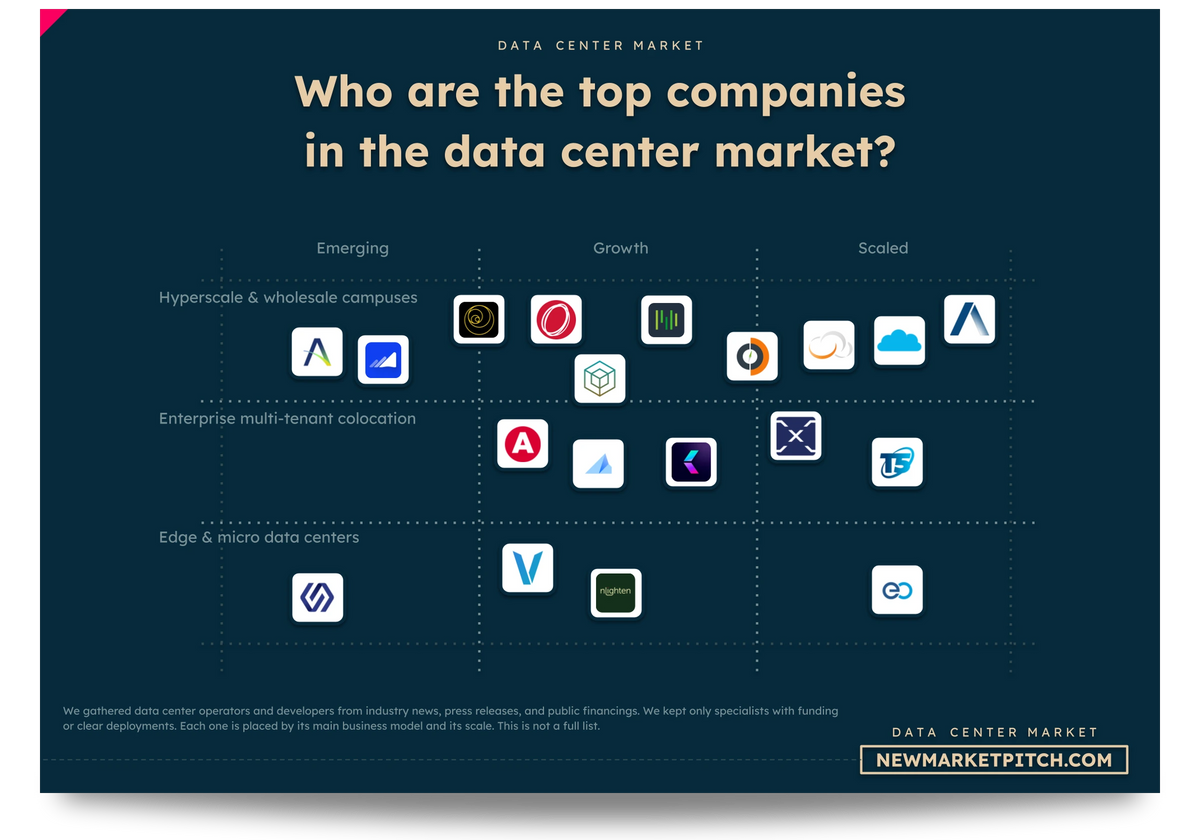
In our document detailing everything you need to know about data center, we turn what is vague and complex into simple, useful visuals. Market maps like this one show you at a glance where every startup stands.
Have there been any major partnerships in the data center market?
Yes, two standout power partnerships were announced since July:
- Amazon signed a 20-year agreement with Constellation covering 690 MW at the Calvert Cliffs nuclear plant, including a planned 190 MW uprate expected in 2030–2032.
- Google and Constellation agreed on a 20-year deal enabling 890 MW of extra output from upgrades to 11 existing nuclear units, with the first uprate expected in 2028.
These partnerships show that hyperscalers are no longer waiting for the grid and are locking in firm, long-term power years before they need it.
Have there been any notable technology or infrastructure breakthroughs in the data center market?
The main shift since July is that liquid cooling is becoming a standard design requirement for new AI facilities rather than a niche option.
- Schneider Electric launched a Motivair coolant distribution unit rated at about 3.5 MW in September 2026, designed to cool entire high-density AI halls.
- Dell'Oro reported that thermal management sales grew more than 40% year over year in Q2 2026, driven by direct liquid cooling.
AI designs now involve racks of 100 kW or more, against roughly 3–10 kW in many traditional air-cooled rooms, which is why cooling has to be rethought at the scale of the whole building.
Have any companies restructured or shifted pricing or business model in the data center market?
Yes, prices kept rising and some suppliers changed their business model to sell power, not just equipment.
- CBRE reported US asking rents up 8.3% for 3–10 MW deployments in H1 2026, and up 19% in New York Tri-State for 10+ MW requirements, against only 1.5% in Northern Virginia.
- Vertiv moved into behind-the-meter power with its UtilityInnovation Group deal, adding microgrid controls, on-site generation and storage to its cooling and electrical business.
The flip side appeared in October 2026, when Microsoft reportedly pulled out of a 50 MW lease at Nscale's UK site because grid power would not arrive before 2030, a reminder that late power can cost a signed customer.
Are there any other notable wins or successes in the data center market?
Beyond the financial results already mentioned, these additional wins stood out since July 2026:
- Digital Realty won a provisional 50 MW allocation in Singapore, one of the hardest markets to enter, with only 2% vacancy in Q1 2026.
- Google announced about €13 billion of new investment in Finland for 2027–2028, a future commitment rather than capacity already built.
- HUMAIN and DataVolt have about 100 MW under construction in NEOM, Saudi Arabia, as the first part of a planned 360 MW phase, with first capacity expected in 2028.
The biggest wins this period went to operators who secured scarce power and permits in new geographies before competitors could.
How much are hyperscalers spending on data centers in 2026?
Hyperscalers are still raising their 2026 spending plans, and none of the largest cut its forecast this summer.
- Alphabet raised its 2026 capex forecast to $195–205 billion in July, against $91.4 billion actually spent in 2025.
- Amazon expects about $220 billion of 2026 investment, against $128.3 billion of cash capex in 2025 (its figure also includes warehouses).
- Meta forecast $130–145 billion for 2026, and Microsoft expects about $175 billion for calendar 2026, lower than before mainly because of a change in how it counts data center leases.
These budgets include servers, chips and networking, so they are not data center construction spending alone, and each company measures capex differently, so they should not be added up.
What is the overall sentiment in the data center market right now?
Are there any notable recent opinion pieces, thought leadership about the data center market?
Yes, the big debate since July is whether the AI data center boom is turning into a bubble.
- Goldman Sachs argued that the AI buildout is a system of bottlenecks, with about five years from grid application to operation in the US and 86 projects cancelled or heavily delayed in 2026.
- The Financial Times highlighted stress in AI infrastructure debt, with project bonds trading below their issue price.
Our reading: there is no glut of operating capacity today, with US vacancy at 1.4%, but some developers may be overpromising or overborrowing for facilities that do not exist yet.

Our report covering the data center market gets updated several times a month, so you always get the latest view of where things stand.
Are there any interesting and recent market research reports about the data center market?
Yes, three important research reports shaped the data center market conversation since July:
- CBRE's North America H1 2026 report showed 10,903 MW of operating inventory in eight primary markets, up 33.7%, with 1.4% vacancy and just 0.2% in Northern Virginia.
- JLL said US data center demand exceeded expectations in H1 2026, counting about 66 GW under construction, 95% precommitted, using a much wider coverage than CBRE, so the two figures should not be compared.
- Dell'Oro reported that physical data center infrastructure revenue grew 27% to $14 billion in Q2 2026, and named permitting delays, not cancellations, as the main near-term constraint.
All three reports point to the same conclusion: the data center market has plenty of demand, but growth depends on who can secure power and permits.
Have there been any regulatory changes, policy updates, or new compliance requirements in the data center market?
Yes, several significant policy developments happened since July 2026:
- Texas ordered a halt to new data center permits on September 21, 2026, pending an ERCOT audit of about 474 GW of large-load connection requests (requests, many of which will never be built).
- PJM's capacity auction cleared at its $325/MW-day cap in July and still fell 6,831 MW short of its reliability requirement.
- The European Commission proposed a common data center rating scheme on September 21, 2026, covering electricity, water and emissions; it is a proposal, not a final rule.
These moves follow the White House Ratepayer Protection Pledge of March 2026 and confirm that data center power use is now a political issue that will shape permitting and grid access decisions.

In our research about data centers, you will always find fresh funding data, taken straight from our own verified funding database.
Written by the New Market Pitch teamWe track new markets so founders and investors can move faster. About us