
Femtech Funding: A Quarter-by-Quarter Analysis
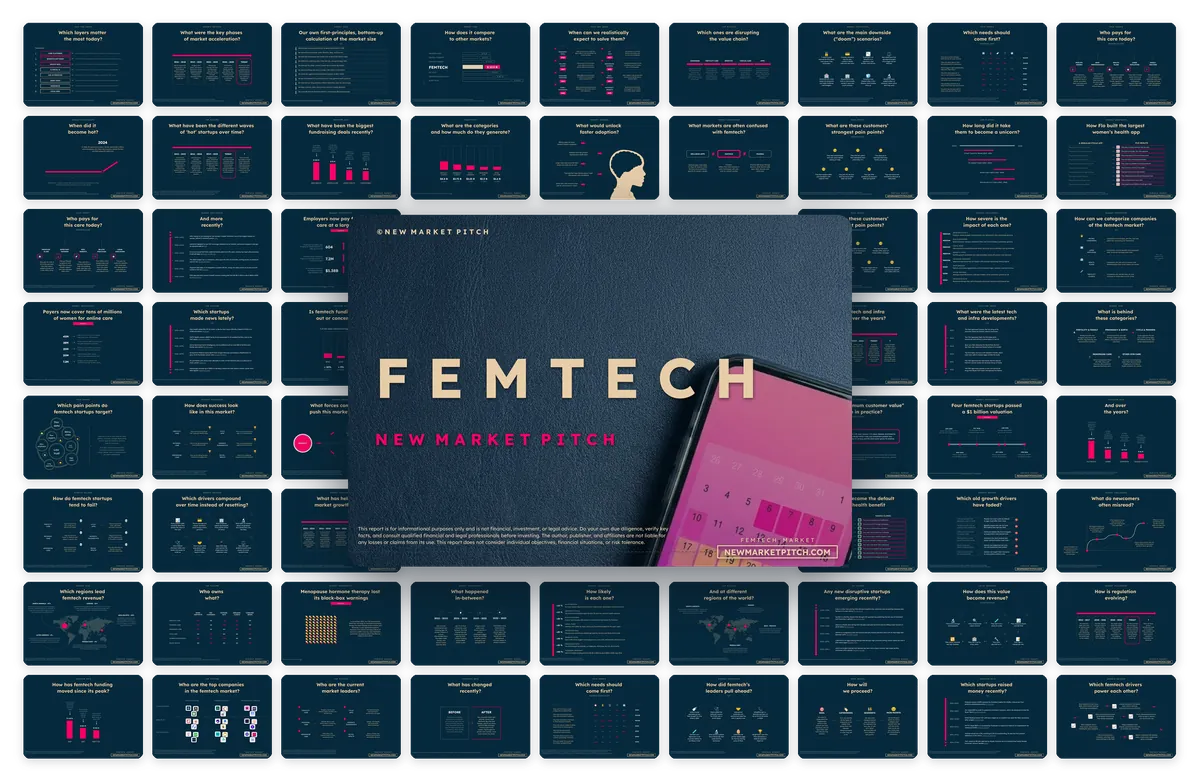
Whether you're building or investing in the femtech market, our report covers everything you need to know: the players, the money, and what's coming next.
Summary
Femtech funding is getting stronger right now, but the quarter-by-quarter story is about broader participation rather than a straight rise in headline dollars. Q2 2026 had the highest deal count in the five-quarter period and more capital outside very large rounds than Q1.
The biggest distortion sits in Q1 2026. Midi Health and Pomelo Care contributed $192M between them, so the apparent drop from $267.4M in Q1 to $105.4M in Q2 says much less about the underlying market than it first appears.
Q3 2025 already showed that deal count and funding strength can move in opposite directions. Fewer companies raised money than in Q2, yet the median round increased and more companies reached the $5M-to-$20M range.
Q4 2025 was the real low point for breadth. Only 10 companies raised money, and the relatively high median round mainly reflected the disappearance of smaller financings rather than a sudden improvement in the average company's fundraising power.
Q2 2026 looks cleaner than Q1 because the money was spread across more ordinary-sized rounds. There were no $50M+ financings, yet capital excluding those large rounds still reached $105.4M, up from $75.4M one quarter earlier.
Early-stage funding has clearly returned, with Seed and Series A representing 75% of Q2 deals. But new-company formation is still not breaking out: first financings have stayed around 20% to 30% of quarterly activity throughout the period.
Women's Primary Care has become the most persistent category shift. It moved from 6% of deals in Q2 2025 to roughly one-quarter or more of activity in most later quarters, and diagnostics companies are now adding larger rounds on top of that deal flow.
Fertility remains central despite sharp quarterly swings, while pelvic care has reappeared after three quarters with no recorded deals. That combination suggests category rotation inside femtech rather than investors abandoning the older core areas.
The clearest structural change is strategic capital. Corporate-backed deals rose every quarter, from 5.9% of activity in Q2 2025 to 40% in Q2 2026, with pharma, medtech and healthcare investors appearing around products that are closer to clinical or commercial use.
The main thing to watch next is whether breadth keeps improving without another megaround-driven quarter. Femtech currently looks better at supporting established companies and Seed-to-Series-A follow-ons than at rapidly expanding the pool of newly financed startups, and the capital totals remain unusually sensitive to a few corrected or ambiguous round sizes.

Written by the New Market Pitch teamWe track new markets so founders and investors can move faster. About us

In our report covering the femtech market, you will always find fresh funding data, taken straight from our own verified funding database.
All funding deals in the femtech market over the last years
Below is the table listing all the deals. You can find our methodology at the end of this page.
If you want a deeper understanding of the market and its current dynamics, get our report covering the Femtech Market.
| Company | Category | Date | Stage | Deal size | What they do | Region | Lead investors | Country |
|---|---|---|---|---|---|---|---|---|
| Viv for your V | Menstrual Health Tools | September 2026 | Seed | $2M | Develops menstrual-care products, including patented Cottonlock tampons designed to reduce fiber shedding. | North America | Not disclosed | United States |
| iPremom | Pregnancy Care Solutions | September 2026 | Seed | $17.7M | Develops MaiRa, a first-trimester blood test using cell-free RNA and predictive models to assess pregnancy-complication risk. | Europe | Amadeus Capital Partners; Asabys Partners | Spain |
| Kove Medical | Pregnancy Care Solutions | August 2026 | Seed | ≈$2M | Develops an implant that seals fetal-membrane punctures after in-utero surgery to reduce premature-birth risk. | Europe | Not disclosed | Switzerland |
| Ditto | Menstrual Health Tools | July 2026 | Seed | $6M | Develops time-release menstrual-health supplements and conducts clinical research focused on PMS and PMDD. | Europe | FoodLabs | United Kingdom |
| ElleMD | Pelvic Care Devices | July 2026 | Seed | ≈$800K | Develops a self-removable silicone-and-copper vaginal ring for non-hormonal contraception. | North America | Not disclosed | Canada |
| American Baby Co | Fertility Care Platforms | July 2026 | Seed | $4M | Builds technology-enabled fertility clinics using AI-assisted intake and standardized workflows for IVF and egg freezing. | North America | Wormhole Capital; Tower Research Ventures | United States |
| Womed | Pelvic Care Devices | July 2026 | Unknown | ≈$2.4M | Develops intrauterine polymer medical devices to prevent adhesions and treat uterine disorders. | Europe | Not disclosed | France |
| Juno Bio | Women's Primary Care | July 2026 | Seed | $3.8M | Provides vaginal microbiome sequencing and female sexual-health diagnostics integrated with clinical care. | North America | Ada Ventures | United States |
| Avni | Menstrual Health Tools | July 2026 | Seed | ≈$420K | Develops antimicrobial menstrual products and female-specific nutrition products for menstrual, hormonal and vaginal health. | Asia-Pacific | Proteus Partners | India |
| Mila | Pelvic Care Devices | June 2026 | Seed | $2.5M | Develops female intimate-wellness devices and formulations for sexual health, comfort and hydration. | North America | Mensch VC | United States |
| Materna Medical | Pelvic Care Devices | June 2026 | Series B | $5M | Develops devices to treat vaginismus and reduce pelvic-floor injury during vaginal childbirth. | North America | InnovaHealth Partners; Wavemaker360 Health; Band of Angels | United States |
| Ovum | Women's Primary Care | June 2026 | Seed | ≈$2.6M | Provides a female-physiology-focused AI health journal and care-navigation platform spanning reproductive and lifelong women's health. | Asia-Pacific | Admiralty Capital Group | Australia |
| June Health | Women's Primary Care | June 2026 | Seed | ≈$1.8M | Provides virtual women's healthcare and care navigation across fertility, hormonal health, menopause and other female-specific care pathways. | North America | Not disclosed | Canada |
| Clair | Hormonal Health Platforms | June 2026 | Seed | $11.6M | Develops a wrist-worn device that infers female hormonal patterns from physiological signals. | North America | Khosla Ventures | United States |
| Rejoni | Pelvic Care Devices | June 2026 | Unknown | $25M | Develops intrauterine hydrogels to support endometrial healing and reduce adhesions following uterine surgery. | North America | Not disclosed | United States |
| Dioseve | Fertility Care Platforms | June 2026 | Series A | ≈$7M | Develops iPS-cell-derived ovarian support technology to mature eggs outside the body for assisted reproduction. | Asia-Pacific | Archetype Ventures | Japan |
| Womed | Pelvic Care Devices | June 2026 | Unknown | ≈$5.8M | Develops biodegradable intrauterine devices to prevent uterine adhesions and treat fibroids and abnormal uterine bleeding. | Europe | Not disclosed | France |
| Mammogen | Women's Primary Care | June 2026 | Series A | Up To $30M | Develops blood-based RNA diagnostics for breast-cancer detection. | North America | Not disclosed | United States |
| OLI Medical | Pregnancy Care Solutions | May 2026 | Series A | ≈$4.5M | Develops a wearable maternal and fetal monitoring system designed to predict childbirth complications, initially postpartum haemorrhage. | Asia-Pacific | Not disclosed | Australia |
| Healthfab | Menstrual Health Tools | May 2026 | Series A | ≈$2.1M | Develops reusable, leakproof period underwear and menstrual-care products using proprietary textile technology. | Asia-Pacific | Atomic Capital | India |
| Plan Your Baby | Fertility Care Platforms | April 2026 | Seed | $624K | Provides virtual fertility consultations, diagnostics and IVF coordination through local testing partners and specialist clinics. | Europe | Not disclosed | United Kingdom |
| Future Fertility | Fertility Care Platforms | April 2026 | Series A | $4.1M | Develops AI tools that assess egg quality to support IVF treatment and egg-freezing decisions. | North America | M Ventures; Whitecap Venture Partners | Canada |
| ScreenPoint Medical | Women's Primary Care | April 2026 | Unknown | $14M | Develops AI software for breast cancer detection and risk assessment from mammograms. | Europe | Not disclosed | Netherlands |
| ONTO Health | Fertility Care Platforms | April 2026 | Series A | $20M | Provides physician-led fertility care combining IVF, reproductive assessments and AI-enabled clinical decision support. | North America | ARTIS; Humania | United States |
| Wavelet Medical | Pregnancy Care Solutions | April 2026 | Seed | $7M | Develops non-invasive fetal brain monitoring through the maternal abdomen to detect distress during labour. | North America | Aegis Ventures | United States |
| Osteoboost | Hormonal Health Platforms | April 2026 | Unknown | $8M | Develops a prescription vibration-therapy wearable for low bone density in postmenopausal women with osteopenia. | North America | Ambit Health Ventures | United States |
| SimpliFed | Pregnancy Care Solutions | April 2026 | Series A | $10.8M | Provides virtual lactation and maternal healthcare spanning pregnancy through postpartum. | North America | Morningside; Hesperia Capital | United States |
| Flora | Fertility Care Platforms | April 2026 | Seed | $5M | Provides individually owned fertility insurance using personalised underwriting to cover reproductive diagnostics and treatments. | North America | ManchesterStory | Canada |
| ProSeek Bio | Women's Primary Care | April 2026 | Seed | $1M | Develops blood-based ovarian cancer tests to distinguish malignant from benign masses and improve surgical triage. | Asia-Pacific | Edale Capital; Scale Investors; AngelLoop; AusHealth | Australia |
| Coral | Hormonal Health Platforms | March 2026 | Unknown | ≈$2.9M | Operates a virtual clinic combining medical care, technology and health coaching for women navigating perimenopause, menopause and midlife hormonal health. | North America | Brightspark Ventures; Diagram Ventures; AQC Capital; Anges Québec; The51 | Canada |
| myStoria | Women's Primary Care | March 2026 | Seed | $1.2M | Combines AI, longitudinal health records and trained human support to help patients navigate fertility, PCOS, endometriosis, perimenopause and other reproductive-health journeys. | North America | Graphite Ventures | Canada |
| Flourish Community Care | Pregnancy Care Solutions | March 2026 | Seed | $5.7M | Operates a technology-enabled maternal-care platform providing insurance-covered virtual and in-person doula support during pregnancy, birth and postpartum. | North America | Zeal Capital Partners | United States |
| Nadia Care | Pregnancy Care Solutions | March 2026 | Series B | $12M | Delivers community-based, in-home and virtual maternal care throughout pregnancy and postpartum through maternity navigators and clinical teams. | North America | Valtruis; Undisclosed major national payer | United States |
| EsterCare | Women's Primary Care | March 2026 | Seed | ≈$750K | Provides digital and in-person specialist women's healthcare plus an AI-enabled workplace platform covering gynecological and hormonal conditions. | Europe | Not disclosed | Sweden |
| May Health | Fertility Care Platforms | March 2026 | Series B | $11.7M | Develops the Anavi medical device, an ovarian rebalancing treatment intended to restore ovulation in women with PCOS-related infertility. | Europe | Not disclosed | France |
| 28 | Menstrual Health Tools | March 2026 | Seed | $1.6M | Provides a privacy-first period and cycle tracking app with symptom logging and women's health insights processed on-device. | Europe | Not disclosed | United Kingdom |
| Livia | Menstrual Health Tools | March 2026 | Unknown | $1M | Develops a wearable electrical-stimulation device providing drug-free relief from menstrual pain. | Middle East | Not disclosed | Israel |
| Matresa | Pregnancy Care Solutions | February 2026 | Seed | ≈$430K | Develops an AI-enabled maternal-health platform providing preventative screening and personalised support throughout pregnancy and postpartum. | Europe | SFC Capital | United Kingdom |
| OncoRes Medical | Women's Primary Care | February 2026 | Unknown | ≈$19.1M | Develops an intraoperative imaging probe that helps surgeons identify residual cancerous tissue during breast-conserving surgery. | Asia-Pacific | Not disclosed | Australia |
| Midi Health | Hormonal Health Platforms | February 2026 | Series D+ | $100M | Provides virtual clinical care for perimenopause, menopause, and associated midlife hormonal health conditions. | North America | Goodwater Capital | United States |
| Pinky Promise | Women's Primary Care | January 2026 | Seed | $1M | Operates an AI-assisted digital gynecology clinic addressing menstrual, fertility, pregnancy and other reproductive-health concerns. | Asia-Pacific | Rebalance Angel Community | India |
| Feminai | Women's Primary Care | January 2026 | Seed | $6M | Develops an AI-enabled wearable device for at-home breast-cancer screening. | Middle East | Vertex Ventures Israel | Israel |
| BrightHeart | Pregnancy Care Solutions | January 2026 | Series A | $12.8M | Develops AI software that supports prenatal ultrasound examinations and detection of fetal heart abnormalities. | Europe | Odyssée Venture; GO Capital | France |
| Pomelo Care | Pregnancy Care Solutions | January 2026 | Series C | $92M | Provides technology-enabled prenatal, pregnancy and postpartum care through virtual clinicians and in-person doulas. | North America | Stripes | United States |
| Inito | Fertility Care Platforms | December 2025 | Series B | $29M | Provides an app-connected home fertility monitor that measures reproductive hormones to identify fertile windows and confirm ovulation. | Asia-Pacific | Bertelsmann India Investments; Fireside Ventures | India |
| Metri Bio | Hormonal Health Platforms | December 2025 | Seed | $5M | Develops targeted therapies for endometriosis and other endometrial diseases using proprietary human 3D tissue models. | North America | Pillar VC | United States |
| Daye | Menstrual Health Tools | November 2025 | Unknown | Not Disclosed | Develops menstrual and gynecological health products and diagnostics, including medical tampons and tampon-based vaginal, HPV and STI testing. | Europe | Not disclosed | United Kingdom |
| Emm | Menstrual Health Tools | November 2025 | Seed | $9M | Develops a sensor-enabled smart menstrual cup and connected app that measures menstrual flow and cycle patterns to provide reproductive-health insights. | Europe | Lunar Ventures | United Kingdom |
| FamilyWell Health | Pregnancy Care Solutions | November 2025 | Series A | $8M | Embeds virtual women's behavioral-health teams and AI-enabled care into OB/GYN and health-system workflows, with a core focus on maternal and reproductive mental health. | North America | New Markets Venture Partners | United States |
| Nabta Health | Women's Primary Care | November 2025 | Unknown | $2M | Operates an AI-powered hybrid women's healthcare platform combining digital care, at-home diagnostics and testing, and in-clinic services across women's life stages. | Middle East | Not disclosed | United Arab Emirates |
| Pluro | Fertility Care Platforms | October 2025 | Series A | $14.1M | Operates a technology-enabled fertility-care platform that equips partner IVF clinics with clinical and operational support. | Asia-Pacific | Bessemer Venture Partners | India |
| Micro Inno | Women's Primary Care | October 2025 | Series A | Not Disclosed | Develops connected gynecological imaging devices and diagnostic tools for cervical screening and women’s reproductive healthcare. | Asia-Pacific | Not disclosed | China |
| Cyclana Bio | Menstrual Health Tools | October 2025 | Seed | $6.7M | Develops menstrual-fluid-derived tissue models and computational tools to discover treatments for endometriosis. | Europe | NfX; Eka VC | United Kingdom |
| Midi Health | Hormonal Health Platforms | October 2025 | Series C | $50M | Provides virtual specialist care for women experiencing perimenopause, menopause and related midlife health conditions. | North America | Advance Venture Partners | United States |
| Visana Health | Women's Primary Care | September 2025 | Series A | $24M | Provides virtual medical care for menopause, endometriosis, PCOS and other women-specific hormonal and gynecological conditions. | North America | Noro-Moseley Partners | United States |
| BeSound | Women's Primary Care | September 2025 | Seed | $6.8M | Provides AI-assisted breast ultrasound screening focused on younger women and women with dense breast tissue. | North America | Overwater Ventures; Kindred Ventures; Muse Capital | United States |
| Genie Fertility | Fertility Care Platforms | September 2025 | Seed | $1.2M | Develops non-invasive uterine-health diagnostics using menstrual-blood biomarkers to identify treatable causes of infertility. | Europe | Not disclosed | United Kingdom |
| Seven Starling | Pregnancy Care Solutions | September 2025 | Series A | $8M | Provides virtual therapy, medication management and care coordination specifically for fertility, pregnancy and postpartum mental health. | North America | Rethink Impact | United States |
| Conceivable | Fertility Care Platforms | September 2025 | Series A | $50M | Develops AI- and robotics-powered laboratories that automate IVF embryo creation. | North America | Advance Venture Partners | United States |
| Diana Health | Women's Primary Care | September 2025 | Series C | $55M | Delivers technology-enabled obstetric, gynecological and menopause care through women’s health practices and hospital partnerships. | North America | HealthQuest Capital | United States |
| Lovu | Pregnancy Care Solutions | September 2025 | Series A | $8M | Provides a digital maternal-care platform combining remote pregnancy monitoring, care navigation and postpartum support. | North America | SJF Ventures | United States |
| Gameto | Fertility Care Platforms | August 2025 | Series C | $44M | Develops stem-cell-derived ovarian support therapies for egg maturation in IVF and egg freezing. | North America | Overwater Ventures | United States |
| Ditto | Menstrual Health Tools | August 2025 | Seed | $1.8M | Develops menstrual-symptom supplements using beadlet-in-oil nutrient-delivery technology. | Europe | Eka Ventures | United Kingdom |
| Hesta Health | Pregnancy Care Solutions | July 2025 | Seed | $2.7M | Develops a digital-first postnatal-care platform integrating clinical care, pelvic-health support, breastfeeding services, and perinatal mental healthcare. | Europe | Eka Ventures | United Kingdom |
| wawa fertility | Fertility Care Platforms | July 2025 | Series A | ≈$15.4M | Develops software connecting fertility patients and clinics through treatment support, patient communication, and clinical workflows. | Europe | Not disclosed | Denmark |
| Ovasave | Fertility Care Platforms | July 2025 | Seed | $1.2M | Combines at-home fertility and hormone testing, virtual consultations, and access to egg-freezing services. | Middle East | PlusVC; Annex Investments; 25madison | United Arab Emirates |
| Solence | Hormonal Health Platforms | July 2025 | Seed | ≈$1.9M | Provides digital therapeutics combining personalized lifestyle interventions and symptom tracking for polycystic ovary syndrome. | Europe | Impact Shakers Ventures | France |
| The Blue Box Biomedical Solutions | Women's Primary Care | July 2025 | Seed | ≈$3.5M | Develops a urine-based breast-cancer screening test using chemical sensors and AI analysis. | Europe | Unconventional Ventures | Spain |

In our research about women's health technology, we turn what is vague and complex into simple, useful visuals. Market maps like this one show you at a glance where every startup stands.
Is femtech funding actually getting stronger right now?
Femtech funding looks stronger as of now because Q2 2026 put more companies back into the market even after the two huge Q1 rounds disappeared.
We counted 17 financings in Q2 2025, followed by 14 in Q3 and only 10 in Q4. Activity then came back with 15 deals in Q1 2026 and 20 in Q2, the highest quarterly count across the period.
The money moved very differently. Verified capital rose from about $39.1M in Q2 2025 to $84.3M in Q3, dropped to $52.8M in Q4 and then jumped to about $267.4M in Q1 2026 after correcting Pomelo Care’s Series C to the $92M announced by the company. Q2 came back down to about $105.4M.
That last drop looks ugly until we remove the two Q1 rounds above $50M: Midi Health’s $100M Series D and Pomelo Care’s $92M Series C. On that basis, underlying capital increased from roughly $75.4M in Q1 to $105.4M in Q2, while deal count increased by one-third.
So today we have more companies raising money and more capital spread across ordinary-sized rounds than we had one quarter earlier.
| Quarter | Deals | Verified capital | Capital ex >$50M | Median round |
|---|---|---|---|---|
| Q2 2025 | 17 | $39.1M | $39.1M | $1.70M |
| Q3 2025 | 14 | $84.3M | $84.3M | $2.58M |
| Q4 2025 | 10 | $52.8M | $52.8M | $6.70M |
| Q1 2026 | 15 | $267.4M | $75.4M | $1.70M |
| Q2 2026 | 20 | $105.4M | $105.4M | $2.73M |
Why did femtech funding jump in Q3 2025 even as deals fell?
Q3 2025 femtech funding jumped because investors started writing much bigger checks, even though three fewer companies raised money.
Deal count fell from 17 to 14, while the median round increased from roughly $1.7M to $2.6M. Several companies landed financings around or above the $10M mark, including wawa fertility, Diana Health, Visana Health, Gameto and Conceivable.
The change was especially visible in fertility and Women's Primary Care. Fertility remained responsible for roughly a third of deals, while Women's Primary Care went from just one deal in Q2 to four in Q3.
New-company activity actually became weaker during the same quarter: first financings fell from 29% to 21% of deals.
Q3 was a good quarter for companies that were already far enough along to raise a meaningful Series A or later round. It tells us much less about whether a bigger pipeline of brand-new femtech startups was emerging.
What went wrong with femtech funding in Q4 2025?
Q4 2025 was the weakest quarter for femtech deal breadth, with only 10 companies raising money and most of the disclosed capital concentrated in a handful of transactions.
Deal count fell another 29% after already declining in Q3. Inito, Pluro and Midi accounted for roughly 90% of known raw capital, so the quarter depended heavily on three companies.
The relatively high median round can be misleading here. It partly reflects the disappearance of many smaller transactions from the sample rather than a sudden improvement in what an ordinary femtech company could raise.
The stage mix also tilted toward more mature businesses. Early-stage companies made up 60% of deals, down from almost 79% in Q3, while later-stage activity continued to build.
Q4 ended up as a narrow market where a few companies could still close decent rounds while the number of funded businesses shrank sharply.

Your time is limited. In our market report about women's health technology, we put numbers on each part of the market, so you can see where it makes sense to focus.
Was Q1 2026 femtech funding basically just Midi Health and Pomelo Care?
Q1 2026 femtech funding was dominated by Midi Health and Pomelo Care, whose $100M and $92M rounds together represented about 72% of corrected quarterly capital.
That makes Q1 look very different from a normal $267M quarter. Remove those two transactions and around $75.4M remains.
There was still a real recovery underneath them. Deal count rose from 10 to 15, and ex-megaround capital increased by roughly 43% from Q4. BrightHeart closed an €11M Series A for prenatal-ultrasound AI, while other financings included pregnancy, maternal-care and medical-device companies.
Midi and Pomelo also show what kinds of femtech businesses could raise very large rounds by then. Midi was scaling a broader women's-health clinical platform after building its menopause business. Pomelo Care said its Series C would support expansion beyond maternity after reaching 25 million covered lives through health-plan and employer partnerships.
Q1 was a much better quarter than Q4, although the headline capital figure exaggerates the size of that improvement.
Did femtech funding really crash in Q2 2026?
Q2 2026 looks far healthier than the roughly 61% headline funding drop from Q1 suggests.
The comparison is distorted by $192M of Q1 capital from Midi Health and Pomelo Care. Once rounds above $50M are removed from both quarters, capital rises from about $75.4M to $105.4M instead of collapsing.
At the same time, deal count goes from 15 to 20 and the median round moves from about $1.7M to $2.7M.
The quarter also had a much deeper group of meaningful rounds. Rejoni announced $25M, ONTO Health announced a $20M Series A, ScreenPoint Medical raised $14M of equity alongside $2M of research grants, Clair raised $11.6M and SimpliFed raised around $10.8M.
Money was simply spread across more companies instead of being swallowed by two exceptional transactions.
Are femtech investors writing bigger checks now?
Femtech investors are writing more mid-sized checks these days, although giant rounds still arrive too irregularly for us to call this a steady move toward bigger financings.
Q2 2025 was dominated by small rounds. Fourteen of the 15 financings with usable size data were below $5M.
Q3 created a much stronger middle, with several $5M-to-$20M rounds and one financing above $20M. Q1 2026 then became unusually top-heavy because Midi and Pomelo sat above everything else.
Q2 2026 gives us a cleaner picture. Fourteen deals remained below $5M, but another five landed between $5M and $20M and one reached the $20M-to-$50M range.
For an ordinary funded company, the market currently looks better supplied with $5M-to-$20M checks than it did at the start of the period.
| Quarter | <$5M | $5M–<$20M | $20M–<$50M | $50M+ |
|---|---|---|---|---|
| Q2 2025 | 14 | 1 | 0 | 0 |
| Q3 2025 | 9 | 4 | 1 | 0 |
| Q4 2025 | 4 | 3 | 0 | 0 |
| Q1 2026 | 9 | 3 | 1 | 2 |
| Q2 2026 | 14 | 5 | 1 | 0 |

In our document detailing everything you need to know about femtech, we always try to gather several sources and make estimates that make sense, so you can work with solid numbers.
Are more new femtech startups actually getting funded?
New femtech startup formation still looks sluggish, with first financings stuck around one-quarter of quarterly deals.
Five of the 17 companies funded in Q2 2025 were first financings. Q3 had three, Q4 had three, Q1 2026 had three and Q2 had five.
That leaves the first-financing share between 20% and 30% throughout the period. Q2's five new financings are encouraging, especially because they attracted more dollars than the three in Q1, but the share itself remains inside the old range.
Meanwhile, companies that have already raised before keep dominating the market.
This is probably the clearest weakness in an otherwise improving Q2 picture. Femtech has shown that established companies can find follow-on money; we still have much less evidence of a rapidly expanding pipeline of newly funded startups.
Are investors moving away from early-stage femtech?
Early-stage femtech came back strongly in Q2 2026 after investors spent several quarters putting more money into mature companies.
Seed and Series A represented roughly 77% of Q2 2025 deals and almost 79% in Q3. That share then fell to 60% in Q4 and 53% in Q1 2026.
Later-stage activity moved in the opposite direction, reaching 27% of deals in Q1. Midi's Series D and Pomelo Care's Series C made that shift even more obvious in dollar terms.
Then Q2 changed the picture again. Fifteen of 20 financings were Seed or Series A, taking early-stage share back to 75%, while later-stage deals fell to 5%.
The late-stage move lasted several quarters, but it did not keep going. Early-stage companies currently make up most of the companies getting funded again.
| Quarter | Early stage | Later stage | First financing | Follow-on |
|---|---|---|---|---|
| Q2 2025 | 76.5% | 5.9% | 29.4% | 70.6% |
| Q3 2025 | 78.6% | 14.3% | 21.4% | 71.4% |
| Q4 2025 | 60.0% | 20.0% | 30.0% | 70.0% |
| Q1 2026 | 53.3% | 26.7% | 20.0% | 80.0% |
| Q2 2026 | 75.0% | 5.0% | 25.0% | 75.0% |
Is Women's Primary Care becoming femtech's biggest funding hotspot?
Women's Primary Care is the clearest sustained funding hotspot in femtech right now because its deal share jumped early and then stayed high.
The category represented only 6% of Q2 2025 deals. It rose to 29% in Q3 and then stayed between 20% and 33% for every remaining quarter.
The interesting part is that deal activity moved before the large dollars did. Women's Primary Care represented 20% of Q4 deals while contributing relatively little capital. By Q2 2026, larger diagnostics rounds from companies such as ScreenPoint Medical started to change that.
ScreenPoint announced $14M of equity from existing investors including Siemens Healthineers, plus $2M of research grants. Its Transpara breast-AI products were already deployed across more than 30 countries and had processed more than 12 million mammograms when the financing was announced.
That is a much more mature commercial story than simply funding another early diagnostic prototype.
| Quarter | Fertility | Women's Primary Care | Pregnancy Care | Pelvic Care |
|---|---|---|---|---|
| Q2 2025 | 35% | 6% | 12% | 24% |
| Q3 2025 | 36% | 29% | 21% | 0% |
| Q4 2025 | 20% | 20% | 10% | 0% |
| Q1 2026 | 7% | 33% | 33% | 0% |
| Q2 2026 | 25% | 25% | 15% | 20% |

Our report covering the femtech market gets updated several times a month, so you always get the latest view of where things stand.
Is fertility losing its place in femtech funding?
Fertility still sits near the center of femtech funding, even though its quarterly share swings wildly.
Fertility accounted for roughly 35% of deals in Q2 2025 and 36% in Q3. It then dropped to 20% in Q4 and only 7% in Q1 2026.
That could have looked like a category rotation if the decline had continued. Instead, fertility returned to five deals, or 25% of the market, in Q2.
The new cohort also covers several different approaches. ONTO Health raised $20M to expand an AI-enabled physician-led fertility platform. Future Fertility announced a Series A around its AI-based egg-quality technology. Dioseve raised more than ¥1B in an additional Series A round to push iPS-cell-based reproductive technology toward practical use.
Shionogi's participation in Dioseve is especially interesting. The pharma company had launched its corporate venture-capital operation the previous year and said it wanted to build early relationships with startups where its R&D capabilities and network could help.
Fertility funding looks volatile quarter to quarter, while the underlying investment themes remain quite active.
Is pelvic care really coming back in femtech?
Pelvic care has clearly re-entered the femtech funding picture, although one strong quarter is still too early to call a lasting boom.
We counted four pelvic-care financings in Q2 2025, none during the following three quarters and then four again in Q2 2026.
The Q2 return also included companies moving closer to real clinical and commercial milestones. Rejoni secured $25M while advancing the Juveena Hydrogel System through the FDA process and preparing for launch. Womed was funding clinical development and international expansion around intrauterine treatments.
That gives the comeback more substance than four tiny experimental rounds would have.
For now, pelvic care is back on investors' radar. Whether it stays there depends on what happens after this cluster of deals.
Why are women's-health diagnostics suddenly raising bigger rounds?
Women's-health diagnostics are raising larger rounds now because several companies have reached the expensive clinical, regulatory and commercial stages of development.
ScreenPoint Medical is a good example. Its breast-imaging AI already had commercial deployment across dozens of countries when the company raised new equity from Insight Partners and Siemens Healthineers.
Mammogen's Series A was structured for pivotal prospective clinical work and commercialization of an RNA-based breast-cancer detection platform. The company announced financing of up to $30M, so we do not treat the full upper limit as funded capital, but the intended use of the money tells us how far the product has progressed.
BrightHeart shows the same pattern in prenatal imaging. It raised €11M in Series A funding and has since received CE marking for its prenatal-ultrasound AI platform, adding a fresh product-regulatory milestone to the financing story.
SVB's 2026 women's-health research points in the same direction. It found that AI-enabled women's-health companies had median pre-money valuations around three times those of non-AI peers and highlighted clinical tools that predict or prevent costly health events as a major area of investor interest.
These days, the more convincing diagnostics stories combine software or molecular technology with real clinical workflows, regulatory progress and a plausible route into healthcare systems.

In our research about women's health technology, we look at what the winners do differently, so you can learn from the best instead of guessing.
Why are corporate investors showing up in femtech now?
Corporate investors are showing up far more often in femtech today, and this is the cleanest quarter-by-quarter trend we found.
Strategic investors appeared in about 6% of Q2 2025 deals. The share then rose to 7%, 10%, 20% and finally 40% in Q2 2026.
The jump becomes more convincing when we look at who is investing. Siemens Healthineers backed ScreenPoint, whose AI sits directly inside breast-imaging workflows. Shionogi invested in Dioseve through its CVC arm while the startup develops reproductive technology that could benefit from pharmaceutical R&D and commercialization expertise. Ascension Ventures joined Rejoni's investor base, bringing a healthcare-system connection to a company moving toward possible product launch.
Corporate participation has also spread beyond one stage or one niche. By Q2, we see it around diagnostics, fertility technology and pelvic health, including early-stage companies.
The timing makes sense: more femtech products have now moved close enough to existing pharma, medtech and healthcare businesses for strategic investors to bring something useful beyond cash.
| Quarter | Strategic-backed deals | Share |
|---|---|---|
| Q2 2025 | 1 | 5.9% |
| Q3 2025 | 1 | 7.1% |
| Q4 2025 | 1 | 10.0% |
| Q1 2026 | 3 | 20.0% |
| Q2 2026 | 8 | 40.0% |
Are the same VC firms starting to dominate femtech funding?
No small group of VC firms is taking over femtech funding, at least from what we can see in disclosed lead-investor data.
We identified 19 unique disclosed lead or co-lead names in Q2 2025, 14 in Q3, nine in Q4, 16 in Q1 2026 and 21 in Q2.
Only a few firms repeat across quarters. Overwater Ventures appears three times across Q2 and Q3 2025, Eka Ventures appears three times across Q3 and Q4, and Advance Venture Partners appears twice.
Within an individual quarter, repeated leads are also uncommon.
Lead-investor disclosure fell to around 65% in Q2 2026, so the picture is not perfectly complete. Still, the latest quarter combines a wide set of disclosed leads with much higher corporate participation, which suggests new money is entering without one VC group controlling most rounds.
Is North America pulling away in femtech funding?
North America has pulled ahead in the latest femtech quarter, with 12 of 20 Q2 2026 deals and roughly three-quarters of raw known capital.
The geographic story had been much messier before that. North America represented 35% of deals in Q2 2025, 50% in Q3, only 30% in Q4 and 40% in Q1 2026.
Q4 even looked like an Asia-Pacific funding surge in dollar terms, although that came from only three deals and was heavily influenced by several relatively large transactions.
Q2's North American lead is broader. Twelve separate companies raised money across multiple categories and round sizes, so one company cannot explain the shift.
Europe moved down to about 15% of deals in the quarter, while Asia-Pacific reached five deals but remained lighter in capital.
One quarter does not settle the geographic question, but North America's current lead has more breadth behind it than the earlier regional spikes.

Theory only gets you so far. In our market report about women's health technology, we dig up the real signals from the field and show you the ones worth watching.
Is femtech becoming a follow-on funding market for older companies?
Femtech is increasingly a follow-on market for companies that have already survived their first financing and spent several years building the business.
Follow-ons represented about 71% of deals in Q2 2025 and stayed dominant throughout the period, peaking at 80% in Q1 2026.
Company age moves in the same direction. Median age at financing went from four years in Q2 2025 to three in Q3, then four, five and six years over the next three quarters.
The change comes mainly from previously financed companies. Their median age reached about 6.5 years in Q2 2026, while companies receiving a first financing remained much younger, generally around zero to two years old.
Midi, ScreenPoint, Rejoni and other larger-round companies fit that picture well: they are raising money after years of clinical development, product work or commercial expansion.
As we saw above, new financings still make up only a minority of the market. Femtech currently looks better at financing companies through their next stage than at rapidly expanding the number of companies entering the funding system.
Which femtech funding numbers should we be most skeptical of?
The total dollars raised is the femtech metric we trust least unless each large round has been checked individually.
Several financing amounts in our deal research conflicted with company or investor announcements. Pomelo Care is the clearest newly identified example: the database field showed $12M, while Pomelo's own announcement says $92M.
ONTO Health similarly announced a $20M Series A rather than the $10M recorded in the underlying row. Rejoni announced $25M rather than $15M. Hormona's lead investor reported a $6.7M seed round rather than the smaller value in the raw field.
Other cases create the opposite risk. Mammogen announced financing of up to $30M, which does not mean the full $30M had already been funded. Dioseve disclosed more than ¥1B, so forcing that wording into an exact dollar figure would create fake precision.
We correct a value when a stronger public source makes the error clear. When the amount remains genuinely ambiguous, we leave it out of exact capital calculations rather than pretending we know more than the sources tell us.
That is why deal count, median round, stage mix, category mix, financing history and investor participation carry so much weight in this analysis. They often tell us more about where femtech funding is going than a single headline dollar number.
What is the funding trend actually telling us?
Femtech funding is currently getting broader. Q2 2026 had the highest deal count of the five quarters and more capital excluding very large rounds than Q1. The apparent collapse in headline funding mostly comes from comparing a normal quarter with one containing two enormous financings.
Strategic money is the strongest durable change. Corporate-investor participation rose in every quarter we studied and reached 40% in Q2. The investors involved also make commercial sense, with medtech, pharma and healthcare organizations backing companies close to their own products and clinical networks.
Women's Primary Care has the clearest category momentum. It went from a minor part of deal flow to a consistently large share of the market, and diagnostics companies are now starting to add bigger rounds on top of that deal activity.
Fertility remains a core femtech category despite its wild quarter-to-quarter swings. Its Q2 comeback, together with investment in AI fertility tools and companies such as Dioseve, makes the Q1 drop look temporary.
The temporary late-stage wave has also passed for now. As seen above, early-stage deals returned to three-quarters of Q2 activity after falling for several quarters. At the same time, older follow-on companies continue to absorb most financings, so the market is supporting both a maturing cohort and a new batch of Seed and Series A rounds.
The part we would watch most closely from here is new-company formation. Existing femtech companies can clearly raise serious follow-on capital today. A stronger long-term market would also need the share of genuinely new funded companies to start moving above the narrow range we have seen so far.
Our methodology
This analysis covers femtech financing from 1 April 2025 through 30 June 2026, giving us five complete calendar quarters: Q2 2025, Q3 2025, Q4 2025, Q1 2026 and Q2 2026. We identified 76 qualifying financings and treated each company-quarter financing as a separate observation.
We used a strict femtech eligibility test. Women's health had to be an overwhelming part of the company's core business at the time of financing. We focused on qualifying private-company equity financings and excluded debt, loans, public offerings and non-dilutive grants from equity totals; when an announcement combined equity and grants, we kept the two components separate.
Each financing was checked independently for date, stage, amount, investors and financing history. Duplicate reports of the same round were consolidated, while extensions, additional closes and tranches were reviewed to determine whether they represented a genuinely separate financing event.
When credible sources disagreed materially, we investigated the discrepancy rather than averaging figures. Clear database errors were corrected when stronger public evidence was available, including Pomelo Care's $92M Series C, ONTO Health's $20M Series A, Rejoni's $25M financing and Hormona's $6.7M seed round. Ambiguous structures such as financing announced as “up to” a certain amount were not forced into exact capital totals.
We ran a separate quality-control pass for missed deals, duplicates, quarter boundaries, equity eligibility, femtech fit and suspicious funding values. Because one or two large rounds can reshape an entire quarter, we also compare headline capital with capital excluding rounds above $50M and use deal count, median round, stage mix, category mix, financing history and investor participation as additional measures of market breadth.
Key sources used for this analysis include Silicon Valley Bank's Innovation in Women's Health 2026 report, Midi Health's Series D announcement, Pomelo Care's Series C announcement, BrightHeart's Series A announcement, ScreenPoint Medical's financing announcement, Shionogi on its investment in Dioseve, Dioseve's additional Series A announcement, ONTO Health's $20M Series A announcement, Mammogen's Series A announcement, Voima Ventures on Hormona's seed financing, and Rejoni's company news and product updates.

In our document detailing everything you need to know about femtech, we don't want to repeat what boring consulting reports say. Instead, we show you the real and latest market signals that matter.
Written by the New Market Pitch teamWe track new markets so founders and investors can move faster. About us