
What are the top femtech startups by total funding raised?
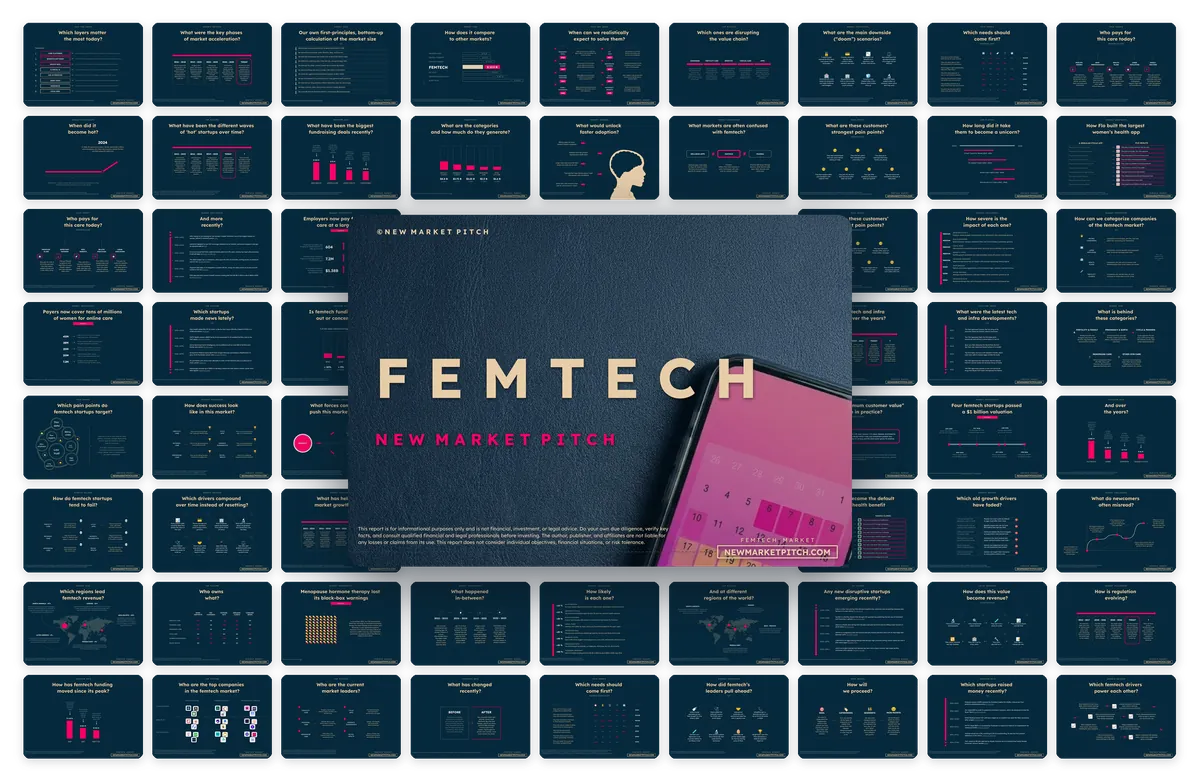
Building a startup or looking for your next investment in femtech? Our report gives you the full picture.
Summary
Maven Clinic is currently the most funded femtech startup in our ranking, with more than $400 million in cumulative equity funding, ahead of Flo Health, Midi Health, Willow and Pomelo Care.
The top of the market is unusually concentrated. Maven, Flo, Midi, Willow and Pomelo have raised roughly $1.32 billion between them, about 46% of all the equity funding represented by the top 20 companies.
The funding threshold for joining that top group has become high. Around $125 million is now needed to enter the top 10, while companies around fiftieth place are already below $30 million in cumulative funding.
There is no longer one dominant femtech business model. The largest fundraisers now span virtual care, subscriptions, menopause clinics, maternity care, breast-pump hardware, fertility, cancer diagnostics and reproductive biotechnology. Virtual care, subscriptions, clinics and hardware earn money in different ways, and we compare which models keep their margins in our femtech market report.
Menopause has made one of the biggest jumps. Midi Health has raised roughly $249 million and crossed a $1 billion valuation, while most other menopause-focused startups remain far smaller.
Maternal health is also moving into large-scale healthcare financing. Pomelo Care raised $92 million at a $1.7 billion valuation, while Diana Health, Oula and Wildflower Health are building different models around hospitals, payers and value-based care.
Biotech and diagnostics are changing what a femtech financing round looks like. Companies such as Comanche Biopharma, Mercy BioAnalytics, Gameto and ReproNovo need much more capital upfront than a conventional consumer app, which is producing unusually large early-stage rounds.
The newest financings are not concentrated in one category either. Evvy, Teal Health and Bird&Be recently raised money across vaginal-health diagnostics, at-home cervical-cancer screening and fertility products.
Large amounts of funding still do not guarantee an equally strong business outcome. Willow and Elvie together raised roughly $370 million before Willow acquired Elvie, a reminder that hardware economics can remain difficult even for heavily financed brands.
The strongest fundraisers increasingly have something harder to copy than a consumer-facing health app: insurance reimbursement, clinical evidence, proprietary biological data, regulatory authorization, specialist care networks or drug-development assets.
Femtech has become a credible institutional healthcare investment category, but it remains a two-speed market. A small group can now raise $50 million, $100 million or even $200 million at a time, while most startups remain far below those levels and large parts of women's health are still undercapitalized.

Written by the New Market Pitch teamWe track new markets so founders and investors can move faster. About us

In our report covering the femtech market, you will always find fresh funding data, taken straight from our own verified funding database.
Top startups in the Femtech market ranked by total funding raised
Here is an updated table that ranks the top startups in the Femtech market based on the total amount of funding they have raised to date.
The table also includes the total number of funding rounds, the date and size of the latest round, the financing type (e.g. Series A, equity financing), key investors, the startup’s current status (active, IPO, acquired, or shut down), and a confidence score based on the data collected (we excluded startups with very low data confidence, to make sure everything is reliable).
If you need to dig deeper and get more detailed data, please check our report covering the Femtech market.
| # | Startup | What They Do | Total Raised ($) | Total Rounds | Last Round Date | Last Round Amount ($) | Last Round Type | Key Investors | Current Stage | Confidence |
|---|---|---|---|---|---|---|---|---|---|---|
| 1 | Maven Clinic | Virtual women’s and family healthcare | $417M | 9 | October 2024 | $125M | Series F | StepStone Group, General Catalyst, Sequoia Capital | Active | Strong |
| 2 | Flo Health | Menstrual and reproductive health app | $268M+ | 5 | July 2024 | $200M+ | Series C | General Atlantic | Active | Partial |
| 3 | Midi Health | Virtual menopause and midlife care | $249M | 5 | February 2026 | $100M | Series D | Goodwater Capital, Foresite Capital, Serena Ventures | Active | Full |
| 4 | Willow | Wearable breast pumps and maternal products | $211M | ~9 | January 2024 | $81M | Series D extension | Lightstone Ventures | Active | Partial |
| 5 | Pomelo Care | Virtual maternal and pediatric care | $171M | 4 | January 2026 | $92M | Series C | Stripes, Andreessen Horowitz, Atomico | Active | Full |
| 6 | Elvie | Connected maternal and pelvic-health devices | $158M | ~8 | April 2024 | $12M | Late VC | Undisclosed investors | Acquired | Strong |
| 7 | Kindbody | Fertility clinics and family-building benefits | $150M | 7 | May 2023 | $25M | Growth equity | Morgan Health, What If Ventures, Parkway Venture Capital | Active | Strong |
| 8 | Comanche Biopharma | Preeclampsia-targeting siRNA therapeutics | $150M | 3 | January 2026 | $40M | Venture / Series B follow-on | NEA, Atlas Venture, GV | Active | Partial |
| 9 | Mercy BioAnalytics | Early cancer liquid biopsy diagnostics | $127M | 3 | September 2025 | $59M | Series B | Novalis LifeSciences, Sozo Ventures, Perceptive Xontogeny | Active | Full |
| 10 | Gameto | Cell-based fertility and ovarian therapeutics | $127M | 5 | August 2025 | $44M | Series C | Overwater Ventures, BOLD Capital Partners, Future Ventures | Active | Strong |
| 11 | Tia | Integrated primary and women’s healthcare | $127M | 3 | September 2021 | $100M | Series B | Lone Pine Capital, Threshold Ventures, Human Ventures | Active | Strong |
| 12 | TMRW Life Sciences | Digital fertility cryostorage infrastructure | $118M+ | 5 | July 2024 | $28M | Series D | 5AM Ventures, Transformation Capital, GV | Acquired | Strong |
| 13 | Diana Health | Hospital-partnered women’s health practices | $102M | 4 | August 2025 | $55M | Series C | HealthQuest Capital, Norwest, LRVHealth | Active | Full |
| 14 | Natural Cycles | Digital contraception and fertility tracking | $100M | 5 | May 2024 | $55M | Series C | Lauxera Capital Partners, Point72 | Active | Strong |
| 15 | Conceivable Life Sciences | Automated AI-powered IVF laboratories | $70M+ | 3 | July 2026 | Undisclosed | Strategic / Corporate Minority | IVIRMA | Active | Strong |
| 16 | ReproNovo | Reproductive medicine drug development | $65M | 1 | May 2025 | $65M | Series A | Jeito Capital, AXA IM Alts, M Ventures | Active | Full |
| 17 | Gesynta Pharma | Non-hormonal endometriosis drug development | $65M | 6 | October 2025 | $4M | Series B extension | XGen Venture | Active | Strong |
| 18 | Materna Medical | Pelvic and maternal health devices | $64M | 6 | June 2026 | $5M | Series B3 | InnovaHealth Partners, Wavemaker360 Health, Band of Angels | Active | Strong |
| 19 | Renovia | Pelvic-floor digital therapeutics | $62M | 4 | April 2021 | $17M | Series C-1 | Parian Global Management, Perceptive Advisors, Longwood Fund | Acquired | Strong |
| 20 | Clue | Menstrual and reproductive health tracking | $62M | ~8 | April 2023 | $8M | Equity / community round | Balderton Capital, Union Square Ventures | Active | Partial |
| 21 | Advantia Health | Integrated women’s healthcare provider network | $60M+ | 7+ | May 2025 | $5M | Series C extension | Undisclosed investors | Active | Partial |
| 22 | Evvy | Vaginal microbiome testing and care | $59M | 3 | September 2026 | $40M | Series B | Catalio Capital Management, Rethink Impact, Muse Capital | Active | Full |
| 23 | Wildflower Health | Value-based maternal health care platform | $59M | 6 | November 2024 | $18M | Series E / Growth | TT Capital Partners, Health Enterprise Partners, Hatteras | Active | Strong |
| 24 | Peppy | Employee reproductive and family healthcare | $57M | 4 | January 2023 | $45M | Series B | AlbionVC, MTech Capital, Sony Innovation Fund | Active | Strong |
| 25 | Overture Life | Automates IVF embryology laboratories | $57M | 4 | April 2025 | $21M | Strategic / Series C-stage | Overwater Ventures, GV, Khosla Ventures | Active | Partial |
| 26 | Future Family | Fertility financing and care support | $57M | ~7 | April 2022 | $25M | Series B | Munich Re Ventures, TriVentures, MS&AD Ventures | Active | Partial |
| 27 | Clairity | AI breast cancer risk prediction | $54M | 3 | November 2025 | $43M | Series B | ACE Global Equity, Santé Ventures, BCRF | Active | Strong |
| 28 | Oula | Midwife-obstetric maternity care clinics | $50M | ~5 | February 2024 | $28M | Series B | Revolution Ventures, Maverick Ventures, GV | Active | Full |
| 29 | Freya Biosciences | Reproductive microbiome therapeutics | $50M | 2 | November 2024 | $12M | Series A extension | Gates Foundation, EIFO | Active | Full |
| 30 | May Health | PCOS infertility device treatment | $48M | 3 | March 2026 | $12M | Series B extension | Nexpring Health, Bpifrance, Sofinnova Partners | Active | Full |
| 31 | Teal Health | At-home cervical cancer screening | $45M | 5 | September 2026 | $22M | Series A | .406 Ventures, Forerunner, Emerson Collective | Active | Partial |
| 32 | Inito | At-home fertility hormone diagnostics | $45M | 4 | December 2025 | $29M | Series B | Bertelsmann India Investments, Fireside Ventures, Kyra Ventures | Active | Partial |
| 33 | PinkDx | Gynecological cancer diagnostic testing | $45M | 2 | January 2025 | $5M | Series A extension | Blue Venture Fund, Sandbox Clinical Ventures, BEVC | Active | Full |
| 34 | Ava | Fertility-tracking wearable technology | $42M | 3 | May 2018 | $30M | Series B | btov Partners, Swisscom Ventures | Acquired | Full |
| 35 | Bloomlife | Maternal remote monitoring technology | $41M | 6+ | June 2025 | $14M | Series B extension | Gather Ventures, NextGen Ventures, SFPIM | Active | Partial |
| 36 | Babyscripts | Virtual maternity and remote monitoring | $39M | ~8 | December 2021 | $8M | Series B extension | Cigna Ventures, Texas Medical Center Venture Fund, Atlantic Health | Active | Partial |
| 37 | Allara Health | Virtual chronic hormonal condition care | $39M | 3 | January 2025 | $26M | Series B | Index Ventures, GV | Active | Full |
| 38 | illumigyn | Digital gynecological imaging platform | $38M | 2 | November 2021 | $33M | Series A | Yozma Group Korea, Ubicom Holdings | Active | Strong |
| 39 | Gaia Fertility | Fertility care financing and protection | $37M | 3 | January 2025 | $14M | Venture / Series A extension | Valar Ventures, Atomico, Heliad | Active | Full |
| 40 | Visana Health | Virtual comprehensive women’s medical home | $37M | 3 | September 2025 | $24M | Series A | Noro-Moseley Partners, Cigna Group Ventures, Intermountain Ventures | Active | Strong |
| 41 | HerMD | Menopause and gynecology care | $36M | 3 | July 2024 | $8M | Series A extension | Tarus Capital, JAZZ Venture Partners | Acquired | Strong |
| 42 | Alpha Medical | Virtual primary care for women | $35M | 2 | September 2021 | $24M | Series B | SpringRock Ventures, AV8 Ventures, Samsung NEXT | Active | Strong |
| 43 | Axena Health | Digital pelvic-floor disorder treatment | $34M | 2 | June 2024 | $9M | Series A extension | Cross-Border Impact Ventures, AXA IM Alts, KOFA Healthcare | Active | Strong |
| 44 | AIVF | AI-powered IVF decision software | $34M | 2 | June 2022 | $25M | Series A | Insight Partners, 166 2nd | Active | Strong |
| 45 | Stork Club | Fertility and maternity employee benefits | $33M | 2 | June 2021 | $30M | Series A | General Catalyst, Bowery Capital, Slow Ventures | Active | Full |
| 46 | AOA Dx | Early ovarian cancer blood testing | $32M+ | 5 | May 2026 | Undisclosed | Series B extension | Elizabeth Elting Foundation | Active | Partial |
| 47 | Alife Health | AI software for IVF clinics | $32M | 2 | March 2022 | $22M | Series A | Lux Capital, Union Square Ventures, Maveron | Active | Full |
| 48 | Evernow | Virtual menopause care platform | $29M | 2 | October 2022 | <$1M | Angel | Gaingels | Active | Strong |
| 49 | Caraway Health | Gen Z virtual healthcare platform | $27M | 2 | June 2023 | $17M | Series A | Maveron, GV, 7wireVentures | Acquired | Full |
| 50 | Cayaba Care / Nadia Care | Community-based maternal healthcare | $27M | 3 | March 2026 | $12M | Series B | Valtruis, First Trust Capital Partners, RH Capital | Active | Full |
| 51 | OCON Healthcare | Intrauterine drug-delivery devices | $25M+ | 7 | June 2024 | $10M | Series A / Venture | RH Capital, Features Capital, Astia Angels | Active | Partial |
| 52 | Ataraxis AI | AI cancer treatment prediction | $24M | 2 | March 2025 | $20M | Series A | AIX Ventures, Founders Fund, Thiel Bio | Active | Full |
| 53 | MobileODT | AI-enabled cervical imaging diagnostics | $24M | 4 | August 2020 | $4M | Series C | OrbiMed, Tristel, Tara Health | Active | Strong |
| 54 | Twentyeight Health | Reproductive and sexual telehealth care | $23M | 3 | January 2025 | $10M | Series A | Seae Ventures, Impact America Fund, Impact Engine | Active | Full |
| 55 | Delfina | AI-powered maternal health care | $22M | 2 | January 2025 | $17M | Series A | USVP, ARTIS Ventures, Mayo Clinic | Active | Full |
| 56 | Vara | AI breast cancer screening platform | $20M | 3 | October 2024 | $9M | Series B | IBB Ventures, Smart Family Office, FJH | Active | Strong |
| 57 | Alloy Women’s Health | Menopause and midlife telehealth care | $19M | 2 | November 2024 | $16M | Series A | Amboy Street Ventures, PACE Healthcare, Emmeline Ventures | Active | Full |
| 58 | Sonio | AI-assisted prenatal ultrasound diagnostics | $19M | 2 | July 2023 | $14M | Series A | Cross-Border Impact Ventures, EIC Fund, Elaia | Acquired | Strong |
| 59 | inne | Home hormone monitoring platform | $19M | 2 | May 2022 | $10M | Series A extension | DSM Venturing, Borski Fund, Calm/Storm Ventures | Active | Full |
| 60 | NextGen Jane | Menstrual-blood reproductive diagnostics | $18M | 4 | October 2023 | $7M | Series A extension | Material Impact | Active | Strong |
| 61 | Daye | Gynecological diagnostics and menstrual care | $17M+ | 3+ | January 2023 | Undisclosed | Early VC | EIC Fund | Active | Partial |
| 62 | Millie | Tech-enabled maternity and gynecology care | $16M | 2 | February 2025 | $12M | Series A | Foreground Capital, TMV, Pivotal Ventures | Active | Full |
| 63 | Womed | Intrauterine treatments for uterine disorders | ~$15M | 3 | July 2026 | $2M | Equity crowdfunding | Public investors | Active | Partial |
| 64 | Bird&Be | At-home fertility testing products | $15M+ | 3 | September 2026 | $13M | Series A | BDC Thrive Lab, BFG Partners, BAM Ventures | Active | Partial |
| 65 | Mahmee | Maternal and postpartum care platform | $14M | 4+ | December 2023 | $2M | Series A extension | MaC Venture Capital, Muse Capital | Active | Partial |
| 66 | Vira Health | Digital menopause treatment and support | $14M | 2 | March 2022 | $12M | Series A | Octopus Ventures, Optum Ventures, LocalGlobe | Active | Full |
| 67 | Hertility Health | Hormone testing and reproductive care | $13M+ | 3 | October 2024 | Undisclosed | Angel | Emma Watson | Active | Partial |
| 68 | Univfy | AI fertility treatment prediction | $13M | 4 | December 2021 | $6M | Series B | Atlantic Street Capital | Active | Full |
| 69 | Oova | At-home fertility hormone monitoring | $13M | 3 | June 2023 | $10M | Series A | Spero Ventures, US Fertility, Virgin Group | Active | Full |
| 70 | Cofertility | Egg sharing and freezing platform | $12M | 2 | April 2025 | $7M | Series A | Next Ventures, Offline Ventures, Initialized Capital | Active | Full |
| 71 | Elektra Health | Virtual menopause care platform | $12M | 5 | February 2025 | $5M | Seed | Undisclosed | Active | Partial |
| 72 | Plenna | Hybrid women’s healthcare clinics | $11M | 3 | June 2025 | $6M | Series A | Dalus Capital, Mazapil Capital, New Ventures | Active | Strong |
| 73 | Lady Technologies | Cervical-mucus fertility tracking | $11M | 3 | January 2025 | $7M | Series A | Relentless Consumer Partners | Active | Strong |
| 74 | iSono Health | Wearable automated breast ultrasound | ~$11M | 5+ | 2025 | $3M | Seed Preferred | Draper Associates, Transform VC, JSK Venture | Active | Partial |
| 75 | Gynoveda | Ayurvedic women’s reproductive healthcare | $11M | 2 | March 2023 | $10M | Series A | India Alternatives, RPG Ventures, Wipro Enterprises | Active | Full |
| 76 | Proov | At-home reproductive hormone testing | $11M | 4 | April 2024 | Undisclosed | Angel | Ashanti Douglas, Cornell Haynes Jr. | Active | Partial |
| 77 | Hey Jane | Virtual reproductive healthcare clinic | $10M | 2 | October 2022 | $6M | Series A | Ulu Ventures, The Helm, Amboy Street Ventures | Active | Full |
| 78 | Dorsata | Clinical software for obstetric care | $9M | 3 | April 2020 | $5M | Series A | Gore Range Capital, Labcorp, QED Investors | Active | Strong |
| 79 | Hormona | At-home hormone testing and tracking | ~$9M | 4+ | May 2025 | $7M | Seed | Voima Ventures, SuperNode Global, DLF Ventures | Active | Partial |
| 80 | Fertifa | Employer fertility benefits platform | $8M+ | 3 | June 2023 | $6M | Seed | Notion Capital, Triple Point, Speedinvest | Active | Partial |
| 81 | Nua Surgical | C-section surgical retractor technology | $7M | 1 | December 2024 | $7M | Series A | EQT Life Sciences, TMC Venture Fund, Kidron Capital | Active | Strong |
| 82 | BeSound | AI-powered breast imaging platform | $7M | 1 | September 2025 | $7M | Seed | Overwater Ventures, Kindred Ventures, Lux Capital | Active | Full |
| 83 | Fizimed | Connected pelvic-floor rehabilitation devices | $7M | 3 | March 2025 | $4M | Growth / Private Equity | Bpifrance, UNIQA, UI Investissement | Active | Strong |
| 84 | Pelvital | At-home urinary incontinence treatment | $6M | 5 | April 2024 | $2M | Seed Plus | Boomerang Ventures, Pier 70 Ventures, Life Science Angels | Active | Partial |
| 85 | Escala Medical | Incision-free pelvic prolapse treatment | $5M | 3 | June 2025 | $5M | Series A | EIC Fund, private US investors, private Israeli investors | Active | Partial |
| 86 | BioAesthetics | Regenerative breast reconstruction grafts | $5M+ | 3 | December 2020 | $5M | Series A | FemHealth Ventures, Sibling Capital Ventures | Active | Low |
| 87 | Conceive | Digital fertility coaching platform | $5M | 2 | August 2024 | $1M | Seed II | Undisclosed | Active | Strong |
| 88 | Juno Bio | Vaginal microbiome testing platform | $5M | 3+ | July 2026 | $4M | Venture round | Ada Ventures, Artesian VC, Entrepreneurs First | Active | Partial |
| 89 | Gennev | Virtual menopause healthcare | $5M | 3 | August 2019 | $4M | Seed | BlueRun Ventures, Maven Ventures, StartUp Health | Acquired | Full |
| 90 | Iron Health | Collaborative women’s healthcare platform | $5M | 1 | March 2023 | $5M | Seed | March of Dimes, Redesign Health | Active | Full |
| 91 | TBD Health | Hybrid sexual healthcare platform | $4M+ | 2 | February 2025 | Undisclosed | Seed II | Undisclosed | Acquired | Partial |
| 92 | Apryl | Employer fertility benefits platform | $4M+ | 2 | April 2022 | $4M | Seed | Breega, Atlantic Labs, Crista Galli Ventures | Acquired | Partial |
| 93 | Béa Fertility | At-home fertility treatment devices | $4M | 2 | July 2023 | $3M | Seed / Venture | Octopus Ventures, JamJar Investments, Forward Partners | Active | Full |
| 94 | Cyrcadia Health | Wearable breast cancer monitoring | $3M+ | 5+ | 2018 | Undisclosed | Seed | Undisclosed / private investors | Active | Low |
| 95 | Partum Health | Pregnancy and postpartum care platform | $3M | 1 | September 2023 | $3M | Seed | True Wealth Ventures, Tawani Ventures, Everywhere Ventures | Active | Full |
| 96 | Chiyo | Maternal nutrition and meal programs | $3M | 1 | March 2024 | $3M | Seed | Bread & Butter Ventures, Ingeborg Investments, Union Heritage Ventures | Acquired | Partial |
| 97 | Uresta | Non-surgical bladder leak device | $3M | 1 | March 2025 | $3M | Seed / Venture | BDC Capital, NBIF, Women’s Equity Lab | Active | Partial |
| 98 | Aster Health | EHR for women’s health practices | $2M | 1 | January 2024 | $2M | Pre-Seed | Cake Ventures, Cornerstone VC, Zeal Capital Partners | Acquired | Full |
| 99 | Perifit | Connected pelvic floor rehabilitation devices | <$1M | 1 | June 2017 | <$1M | Seed | Undisclosed | Active | Strong |
Maven Clinic, Flo Health, Midi Health, Willow and Pomelo Care currently sit at the top of the femtech funding market, and the gap between this group and most of the sector is already very large.
Our reconstructed dataset puts Maven above $400 million in cumulative equity funding, Flo above $268 million, Midi around $249 million, Willow around $211 million and Pomelo around $171 million. Together, those five companies have raised roughly $1.32 billion.
The next tier remains substantial. Elvie and Kindbody are around $150 million, Comanche Biopharma is also around that level, and Mercy BioAnalytics, Gameto and Tia sit close to $125 million. Fourteen of the top 20 companies have now raised roughly $100 million or more.
What stands out today is the mix of businesses. The leaders include virtual care, consumer health apps, menopause care, maternity care, breast-pump hardware, fertility clinics, cancer diagnostics and reproductive biotechnology. Femtech's biggest fundraisers no longer come from one narrow product category.
| Rank | Femtech startup | Cumulative equity funding in our dataset | Main business |
|---|---|---|---|
| 1 | Maven Clinic | $417M+ | Women's and family healthcare |
| 2 | Flo Health | $268M+ | Menstrual and reproductive health |
| 3 | Midi Health | $249M | Menopause and midlife care |
| 4 | Willow | $211M | Breast pumps and maternal devices |
| 5 | Pomelo Care | $171M | Maternal and pediatric care |
| 6 | Elvie | $158M | Maternal and pelvic-health devices |
| 7 | Kindbody | $150M | Fertility clinics and benefits |
| 8 | Comanche Biopharma | $150M | Preeclampsia therapeutics |
| 9 | Mercy BioAnalytics | $127M | Cancer diagnostics |
| 10 | Gameto | $127M | Reproductive biotechnology |

In our research about women's health technology, we turn what is vague and complex into simple, useful visuals. Market maps like this one show you at a glance where every startup stands.
How much funding has Maven Clinic raised?
Maven Clinic has raised more than $400 million, making it the clearest cumulative funding leader among the femtech startups we reviewed.
Maven announced a $125 million Series F led by StepStone Group, with General Catalyst, Sequoia, Oak HC/FT, Icon Ventures, Dragoneer and Lux Capital also participating. The company said that round brought its total funding above $425 million.
Our round-by-round reconstruction is slightly more conservative because cumulative totals can differ depending on how older financings and extensions are classified. Either way, Maven sits comfortably ahead of the rest of the ranking.
Maven's funding history also reflects how far the business has expanded beyond one reproductive-health service, with fertility, maternity, pediatrics, parenting and menopause now sitting inside a broader employer and health-plan platform.
Is Flo Health catching Maven Clinic in total funding?
Flo Health has moved much closer to Maven Clinic after raising more than $200 million from General Atlantic, but Maven still has the larger cumulative funding total.
Flo's Series C was unusually large. General Atlantic invested more than $200 million in one transaction and pushed Flo's valuation above $1 billion. Based on our dataset, that single round represents roughly three quarters of all the equity capital Flo has raised.
Flo and Maven reached the top through very different financing paths. Maven raised repeatedly over many rounds. Flo made one enormous jump.
At the time of the General Atlantic round, Flo reported nearly 70 million monthly active users, close to five million paying subscribers and expected annual gross bookings above $200 million, giving investors a much more mature subscription business than the period-tracking app Flo was once known for.

Your time is limited. In our market report about women's health technology, we put numbers on each part of the market, so you can see where it makes sense to focus.
How did Midi Health become one of the most funded femtech startups so fast?
Midi Health jumped into femtech's top tier because investors are now putting genuine growth-stage money behind menopause care.
Midi raised $100 million in a Series D led by Goodwater Capital, taking its valuation above $1 billion. Foresite Capital and Serena Ventures joined the round alongside existing investors including GV, Emerson Collective and McKesson Ventures.
For years, menopause startups mostly raised seed and Series A rounds while building smaller telehealth, wellness or consumer businesses. Midi reached a different level by combining insured clinical care, prescribing and specialist access, then expanding toward broader midlife women's healthcare. Menopause care delivered through insurance is a problem patients and payers will pay to solve, and we map who those customers are in our report on femtech.
Its funding trajectory has turned menopause into a category capable of supporting nine-figure growth rounds.
Is Pomelo Care already one of femtech's biggest companies?
Pomelo Care is already one of femtech's biggest companies by valuation even though several startups have raised more money.
Pomelo recently raised a $92 million Series C led by Stripes at a $1.7 billion valuation. Andreessen Horowitz, Atomico, BoxGroup and other investors also participated.
The company said its care model now touches nearly 7% of US births. Pomelo also works with insurers and employers and says its model reduces premature births, NICU admissions and medical costs. Selling through insurers and employers is a different way to earn, and we compare which femtech models make money in our femtech market report.
That combination of scale and measurable healthcare savings helps explain why Pomelo reached a $1.7 billion valuation on a smaller funding base than Maven or Willow.
How much funding does a femtech startup need to reach the top 10?
A femtech startup currently needs roughly $125 million in cumulative equity funding to enter the top 10 of our ranking.
Mercy BioAnalytics and Gameto both sit around $127 million, while Tia is at roughly the same level just outside the first ten depending on how ties are treated.
The threshold drops quickly after that. Around twentieth place, Clue has raised about $62 million. Around fiftieth place, cumulative totals have already fallen below $30 million.
Even a startup announcing a $40 million or $50 million round today would still need a substantial existing funding history to get close to the top 10.
How concentrated is femtech funding among the biggest startups?
Femtech funding is extremely concentrated: the top five companies in our ranking account for roughly 46% of all equity funding raised by the top 20.
Across the first 20 companies, we reconstructed about $2.86 billion in cumulative equity financing. Maven, Flo and Midi alone account for roughly $934 million, close to one third of that total.
The first ten companies together contribute around $2.03 billion, or about 71% of top-20 funding. A small group accounts for most of the capital visible at the top of the market.
| Group | Approximate cumulative funding | Share of top-20 funding |
|---|---|---|
| Maven alone | $417M | 14.6% |
| Top 2 | $685M | 23.9% |
| Top 3 | $934M | 32.6% |
| Top 5 | $1.316B | 46.0% |
| Top 10 | $2.028B | 70.8% |
| Companies 11–20 | $835M | 29.2% |
| Top 20 | $2.863B | 100% |

In our document detailing everything you need to know about femtech, we always try to gather several sources and make estimates that make sense, so you can work with solid numbers.
What are the biggest funding rounds ever raised by femtech startups?
Flo Health's $200 million-plus Series C is the largest individual round among the companies at the top of our femtech dataset, well ahead of most other financings.
Maven's $125 million Series F comes next among the major disclosed rounds we reviewed. Midi raised $100 million in its Series D, while Tia previously raised $100 million in a Series B. Pomelo Care's newest Series C reached $92 million.
The companies behind those rounds are very different. Flo is a consumer subscription platform. Maven sells healthcare through employers and health plans. Midi provides clinical care. Pomelo works deeply with insurers. Willow sells hardware. ReproNovo develops drugs.
Large femtech rounds have spread across much more of healthcare than they did during the first wave of the market.
| Company | Major disclosed round | Round |
|---|---|---|
| Flo Health | $200M+ | Series C |
| Maven Clinic | $125M | Series F |
| Midi Health | $100M | Series D |
| Tia | $100M | Series B |
| Pomelo Care | $92M | Series C |
| Willow | $81M | Series D extension |
| ReproNovo | $65M | Series A |
| Mercy BioAnalytics | $59M | Series B |
| Diana Health | $55M | Series C |
| Natural Cycles | $55M | Series C |
Which femtech startups are raising money right now?
The freshest femtech rounds show investors currently backing vaginal-health diagnostics, at-home cancer screening and fertility products alongside the larger care platforms.
Evvy recently raised a $40 million Series B led by Catalio Capital Management. The round also included Rethink Impact, Muse Capital, Labcorp Venture Fund, General Catalyst and several other investors. Evvy is using its vaginal microbiome dataset to move further into diagnostics and personalized care.
Teal Health then raised $22 million in Series A funding, bringing its total to $45 million. The company has an FDA-authorized at-home HPV cervical-cancer screening device and plans to expand through insurers, health systems, employers and providers. At-home screening that is already FDA-authorized sits on the works-today side of the line we draw in our market report about femtech.
Bird&Be also raised $13 million to expand its fertility testing and consumer products business.
Current funding is spreading across diagnostics, proprietary health data and clinically integrated consumer products rather than concentrating only in the established leaders.
Is fertility still getting most of the femtech money?
Fertility remains one of the best-funded areas in femtech, although it no longer dominates the market by itself.
Kindbody has raised about $150 million. Gameto has raised around $127 million. TMRW Life Sciences reached more than $100 million before its acquisition. Natural Cycles has raised around $100 million across contraception and fertility tracking. Conceivable Life Sciences, Overture Life, Future Family, AIVF, Alife Health, Cofertility and several smaller companies add another substantial block of capital.
Yet many of the largest companies today sit elsewhere. Maven covers a broad women's and family-health market. Midi is centered on menopause and midlife care. Pomelo focuses heavily on maternal care. Mercy works in cancer diagnostics, while Comanche is developing a treatment for preeclampsia.
The World Economic Forum's latest investment mapping found that around 90% of private women's-health investment remains concentrated in reproductive health, maternal health and women's cancers. Fertility remains a major part of that pool, but it is no longer the whole story.

Our report covering the femtech market gets updated several times a month, so you always get the latest view of where things stand.
Is menopause finally attracting serious femtech funding?
Menopause has clearly moved into serious venture territory, with Midi Health's $100 million Series D providing the strongest evidence.
Midi has now raised roughly a quarter of a billion dollars and reached a valuation above $1 billion. That puts a menopause-led company in the same funding conversation as much broader women's-health platforms.
Other menopause startups remain smaller. Evernow has raised around $29 million, Alloy Women's Health about $19 million, Vira Health roughly $14 million and Elektra Health around $12 million in our dataset.
The gap between Midi and the rest is revealing. Investors are willing to commit very large sums when menopause care connects to insurance reimbursement, medical prescribing and a broader clinical relationship with patients.
Consumer menopause products still have a place, but the biggest capital is flowing toward businesses that look like healthcare providers.
Are maternal-health startups becoming big healthcare businesses?
Maternal-health startups are becoming much larger businesses, especially when they can sell directly to insurers, employers or hospitals.
Pomelo Care is the strongest example. Its latest $92 million round valued the company at $1.7 billion, and Pomelo says its programs now reach nearly 7% of US births.
Diana Health provides another model. The company raised a $55 million Series C after building women's-health practices in partnership with hospitals. That round brought its total funding to roughly $100 million.
Oula has raised around $50 million for maternity clinics built around midwives and obstetricians, while Wildflower Health has accumulated close to $60 million around value-based maternal care.
Pregnancy creates expensive, measurable outcomes, giving insurers and hospital systems a direct financial reason to back care models that can reduce complications.
Are biotech and diagnostics taking over from femtech apps?
Biotech and diagnostics are taking a much bigger share of femtech funding now, although apps and virtual-care companies still sit at the top of the overall ranking.
Comanche Biopharma, Mercy BioAnalytics, Gameto and ReproNovo together account for well over $400 million in our dataset. Where reproductive biotech and diagnostics sit relative to femtech apps is a boundary we draw in our report covering the femtech market.
Their businesses require very different financing from a software startup. Comanche is developing an siRNA treatment for preeclampsia. Gameto is working on cell-based reproductive technologies. ReproNovo raised $65 million in its Series A to advance Phase 2 reproductive-medicine programs. Mercy BioAnalytics raised $59 million to develop liquid-biopsy cancer diagnostics.
Mercy's investor list also shows how the market is changing. Its Series B included Hologic, Bruker and Labcorp alongside venture investors, bringing strategic diagnostics companies directly into the cap table.
The old image of femtech as period apps and connected consumer devices is badly outdated. Some of the most heavily funded companies now look much closer to conventional biotech and medtech startups.

In our research about women's health technology, we look at what the winners do differently, so you can learn from the best instead of guessing.
Why are some femtech Series A rounds suddenly so big?
Some femtech Series A rounds are reaching $50 million or more because drug development and regulated diagnostics need far more capital upfront than software businesses.
ReproNovo's $65 million Series A is the cleanest example. Jeito Capital led the round, with AXA IM Alts and M Ventures among the other major investors. The money is funding multiple Phase 2 reproductive-medicine programs.
A biotech startup can spend tens of millions before commercial revenue becomes meaningful. Clinical trials, regulatory work, manufacturing and specialized scientific teams all arrive early.
That makes the round label slightly misleading when comparing femtech companies. A $65 million Series A in reproductive biotechnology does not mean the company is commercially more mature than a digital-health startup raising a $25 million Series C. The cost of reaching the next milestone is simply much higher.
As biotech becomes a larger part of women's health, more unusually large early-stage rounds are likely.
Do Willow and Elvie show that raising more femtech funding does not guarantee success?
Willow and Elvie show very clearly that a huge femtech funding total does not automatically translate into a stronger business or better outcome.
Willow has raised about $211 million in our dataset and Elvie about $158 million. The two companies therefore absorbed roughly $370 million of capital before Willow acquired Elvie.
The acquisition brought together two of the best-known wearable breast-pump brands under one company. Willow said the combination would create a broader maternal-health platform with shared global distribution and a larger product portfolio.
Their history also highlights the cost structure behind femtech hardware. Physical products require manufacturing, inventory, logistics, retail distribution, returns and continuous hardware development.
Pomelo Care provides a useful contrast. It has raised much less capital than Willow and only slightly more than Elvie, yet its latest financing valued the company at $1.7 billion.
Cumulative funding tells us how much equity capital investors have committed. It does not tell us how efficiently that capital created enterprise value.
Who are the biggest investors in femtech startups?
Femtech's largest rounds now include many of the same investors that back mainstream healthcare and technology companies.
General Catalyst appears across several women's-health businesses. GV has backed companies including Midi, TMRW Life Sciences, Oula and Allara Health. Serena Ventures appears in Midi and Teal Health. .406 Ventures has invested in Diana Health and Teal. Overwater Ventures has backed Gameto, Overture Life and BeSound. Which funds keep backing femtech, and what they now avoid, is mapped in our market report about femtech.
At the very top, General Atlantic financed Flo's $200 million-plus Series C. StepStone led Maven's $125 million Series F. Goodwater led Midi's $100 million Series D. Stripes led Pomelo's $92 million Series C.
Specialist women's-health funds still play an important role, particularly in earlier rounds. RH Capital, Amboy Street Ventures, Portfolia and similar firms appear repeatedly across the market.
The difference today is that successful femtech companies no longer depend only on specialist capital. Once they reach scale, they can compete for money from global growth, healthcare and crossover investors.
| Investor | Selected femtech investments in our dataset |
|---|---|
| General Catalyst | Maven Clinic, Stork Club, Evvy |
| GV | Midi Health, TMRW Life Sciences, Oula, Allara Health |
| Serena Ventures | Midi Health, Teal Health |
| .406 Ventures | Diana Health, Teal Health |
| Overwater Ventures | Gameto, Overture Life, BeSound |
| General Atlantic | Flo Health |
| StepStone Group | Maven Clinic |
| Andreessen Horowitz | Pomelo Care |
| Foresite Capital | Midi Health |
| HealthQuest Capital | Diana Health |

Theory only gets you so far. In our market report about women's health technology, we dig up the real signals from the field and show you the ones worth watching.
Are femtech startups finally becoming unicorns?
Femtech has now produced several billion-dollar companies across very different business models, so unicorn status is no longer a one-off event for the sector.
Flo crossed $1 billion after General Atlantic's $200 million-plus investment. Midi also moved above $1 billion after raising its Series D. Pomelo Care recently reached a $1.7 billion valuation. Maven had already reached unicorn status earlier.
The variety is more interesting than the count itself.
Flo is a consumer subscription company. Maven sells women's and family healthcare through employers and health plans. Midi is an insured clinical-care platform. Pomelo works closely with payers around women's and children's health.
Investors can now see billion-dollar outcomes through several routes.
Still, the majority of femtech startups are nowhere near this scale. Our dataset contains dozens of companies with less than $20 million in cumulative funding and only a small group with verified billion-dollar valuations.
Femtech can clearly produce unicorns now. They remain exceptional outcomes.
Is femtech starting to consolidate?
Femtech consolidation has started, particularly in categories where several startups spent years building similar products for the same customers.
Willow's acquisition of Elvie is the clearest case because it brought together two of the most heavily funded maternal-hardware companies in the market.
Other companies in the dataset have also been acquired, including TMRW Life Sciences, Renovia, HerMD, Caraway Health, Sonio, Gennev and Apryl.
That pattern makes sense as the market matures. Employers generally do not want dozens of separate healthcare vendors. Hospitals prefer broader partnerships. Hardware companies can share manufacturing and distribution. Digital-health companies can spread customer-acquisition costs across more services.
We are still far from one or two companies controlling women's health, but the period when every narrow condition or life stage could support a completely separate startup is getting harder to sustain.
More acquisitions are likely wherever companies have overlapping customers and limited independent scale.
How quickly does femtech funding drop after the top companies?
Femtech funding falls very quickly after the leaders, with the twentieth-ranked company at roughly $62 million and companies around fiftieth place already below $30 million.
That is a huge gap from Maven's $400 million-plus total or Flo's $268 million-plus.
By position 30, funding is around the $50 million mark. Around position 40, it is closer to the mid-$30 millions. Around position 75, startups have generally raised only about $10 million.
This distribution explains why the market can look richer than it really is. A handful of giant rounds dominate the headlines and push aggregate funding numbers upward, while much of the startup population is still operating on seed and Series A capital.
For a founder, crossing $100 million in cumulative equity funding remains unusual.
| Approximate ranking position | Typical cumulative funding |
|---|---|
| #1 | $400M+ |
| #5 | ~$170M |
| #10 | ~$125M |
| #20 | ~$62M |
| #30 | ~$48M |
| #40 | ~$37M |
| #50 | ~$27M |
| #75 | ~$11M |
| #90 | ~$5M |

In our document detailing everything you need to know about femtech, we don't want to repeat what boring consulting reports say. Instead, we show you the real and latest market signals that matter.
Is femtech still underfunded even after all these huge rounds?
Femtech and women's health are still badly underfunded compared with the size of the healthcare problems involved, despite the much bigger rounds appearing at the top.
Silicon Valley Bank's latest women's-health research counted about $2 billion of venture investment across the US and Europe in 2025. That came after a record $2.6 billion in 2024.
The World Economic Forum takes a broader view of private healthcare capital and estimates that women's health receives only about 6% of private healthcare investment. Roughly 90% of that money is concentrated in reproductive health, maternal health and women's cancers. Judging whether women's health is underfunded needs a view of the market's size, which we build from the ground up in our femtech market report.
Conditions including menopause, endometriosis, cardiovascular disease and osteoporosis remain much less funded relative to their health burden.
The gap still exists, even though a handful of femtech companies can now raise nine-figure rounds.
Is femtech funding growing again right now?
Femtech funding looks healthier again after cooling from its record peak, but the recovery is selective rather than a broad rush into every women's-health startup.
Silicon Valley Bank measured $2.6 billion of women's-health venture investment in 2024, followed by around $2 billion in 2025. Its latest outlook expects activity to strengthen again.
The company-level evidence we reviewed fits that picture. Midi raised $100 million, Pomelo raised $92 million, and newer financings have now arrived at Evvy, Teal Health and Bird&Be.
Those deals span menopause, maternity, vaginal-health diagnostics, cervical-cancer screening and fertility products.
The common thread is stronger than the old femtech label itself. Investors are paying up for businesses with clinical evidence, insurance coverage, proprietary health data, regulatory approvals or a clear route into large healthcare budgets.
Money is coming back, but investors appear much choosier about where it goes.
What kind of femtech startups are getting the most funding now?
The femtech startups attracting the biggest checks today usually solve expensive medical problems or control something difficult to copy, such as clinical data, regulatory approvals, specialist care networks or proprietary biotechnology.
Maven sells broad healthcare infrastructure to employers and health plans. Pomelo says it can reduce costly maternal complications. Midi combines specialist medical care with insurance reimbursement. Mercy is developing cancer diagnostics. ReproNovo and Comanche are developing drugs. Gameto is building reproductive biotechnology.
The newest rounds reinforce the pattern. Evvy has a large proprietary vaginal microbiome dataset. Teal has an FDA-authorized at-home cervical-cancer screening product. AI-heavy companies are also attracting stronger valuations when the technology is attached to actual clinical workflows.
Silicon Valley Bank found that AI-enabled women's-health startups in its dataset carried a median pre-money valuation of about $35 million, roughly three times the level of non-AI peers.
We would be careful about reading that as an automatic AI premium. Investors seem much more interested when AI works with proprietary biological data, clinical decisions or diagnostics than when it is simply added to a generic wellness product.
For now, the strongest funding pattern is clear: femtech capital is moving toward companies that look like serious healthcare businesses.

Learning from others' mistakes is the cheapest lesson there is. In our report covering the femtech market, we look at what broke startups before you, so you don't repeat it.
What does the femtech funding ranking really tell us?
The femtech funding ranking shows a market that has moved well beyond niche status, while funding remains heavily concentrated among a relatively small group of companies.
Maven, Flo, Midi, Willow and Pomelo alone account for almost half of the cumulative funding raised by our top 20. Fourteen companies in that group have reached roughly $100 million or more.
The type of company reaching those numbers has changed sharply. Today's leaders include virtual healthcare, menopause clinics, maternal-care platforms, cancer diagnostics, reproductive biotechnology, drug development, medical devices and consumer subscriptions.
Recent rounds at Evvy, Teal and Bird&Be show that new companies are still breaking through, but the standard is getting higher. The strongest fundraisers increasingly have clinical evidence, reimbursement, regulatory protection, proprietary data or a direct connection to major healthcare spending.
At the same time, Willow and Elvie show why funding cannot be treated as a scorecard for business quality. Huge cumulative investment can coexist with difficult economics and eventual consolidation.
Femtech is now a real institutional healthcare investment category, but it remains a two-speed market. A small group of companies can raise $50 million, $100 million or even $200 million at a time. Most femtech startups remain far below that level, and large parts of women's health are still severely undercapitalized.
Our methodology
Our objective was to build a defensible ranking of startups in the femtech market by cumulative equity funding raised, rather than repeat the total displayed by a single database or article. We focused on companies whose core business is genuinely centered on femtech or women's health and reconstructed their financing histories round by round.
For each company, we tried to identify the amount, date, financing type and major investors behind each transaction. Our cumulative totals include equity financing and exclude debt, grants and other non-equity funding wherever the public record allows those components to be separated.
Historical rounds remain part of the calculation because the ranking is cumulative. Recent searches were used to capture new financings that may not yet appear consistently across venture databases or company profiles.
We paid particular attention to round extensions, mixed debt-and-equity packages and undisclosed financings because headline transaction values can otherwise overstate the equity actually raised. When a financing history still contained uncertainty, we kept that uncertainty visible rather than forcing a precise-looking total.
When sources disagreed, we went back to individual rounds and gave greater weight to direct company disclosures, investor announcements, regulatory records and authoritative reporting. Where the evidence was too incomplete to reconstruct a defensible cumulative figure, we preferred exclusion.
The ranking is a measure of capital raised, not business quality, valuation or capital efficiency. That distinction is especially important in femtech because the dataset mixes software, virtual care, clinics, medical devices, diagnostics and drug-development companies with very different capital requirements.
Key sources used for the ranking and recent financing checks include Maven Clinic's Series F announcement, Flo Health's Series C announcement, Midi Health's Series D announcement, Pomelo Care's Series C announcement, Willow's announcement of the Elvie acquisition, ReproNovo's Series A announcement, Mercy BioAnalytics' Series B announcement, Diana Health's Series C announcement, and Natural Cycles' Series C announcement.
For the most recent market activity, we also used TechCrunch on Evvy's $40 million Series B, Teal Health's Series A announcement, and Bird&Be's financing announcement.
Broader market context comes from Silicon Valley Bank's women's-health investment research, including investment totals and AI valuation data, and the World Economic Forum's Women's Health Investment Outlook, which examines how private healthcare capital is distributed across women's health.
The guiding principle throughout was simple: a round-by-round reconstruction supported by checkable evidence is more useful than a cleaner cumulative total that cannot be independently reconciled. The broader dataset and market report are available in our femtech market report.

If you build or invest in the femtech market, you need to know which business models pay off now and which ones are fading. That's why our report covering it has a whole section on it.
Written by the New Market Pitch teamWe track new markets so founders and investors can move faster. About us