Grid-scale battery storage funding tracker (80+ deals)
Whether you're building or investing in the grid-scale battery storage market, our report covers everything you need to know: the players, the money, and what's coming next.
Summary
Since January 2024, grid-scale battery storage startups have completed 86 equity deals worth at least $3.5B across 66 companies. Form Energy raised the most, with $1.2B across 2 rounds. It also closed the largest single deal, a $750M financing in August 2026.
Most battery startups receive checks far smaller than the headline suggests. The median disclosed round was $13M, while a handful of companies needed much bigger sums to build factories or develop battery projects.
The largest checks do most of the work. Just 7 nine-figure deals accounted for $2.3B. Excluding rounds above $100M leaves at least $1.2B of disclosed funding.
The type of battery business makes a big difference. Integrated BESS systems and EPC attracted the most money, followed by battery cells and modules. Companies selling trading and optimization software generally raised smaller checks.
Storage owners need their own kind of funding. They have to pay for land, grid connections and equipment long before a battery starts earning revenue, which helps explain the size of their deals.
Europe was busier, with 40 deals, but North America attracted 62% of disclosed capital. More financing announcements came from Europe, while the biggest sums clustered in North American companies.
Early rounds were common; advanced venture rounds were scarce. Seed and Series A each recorded 27 deals, against 3 Series C deals and 2 Series D+ deals.
Most money also went to businesses that had raised before. We found 12 first financings and 67 follow-on rounds, a sign that returning to existing companies is a major part of this market.
These are young businesses taking on expensive work. The median company age at financing was 4 years, and only slightly higher, at 4.5 years, for companies raising rounds above $50M.
Grid-scale battery storage is firmly funded, but the market has few repeat late-stage fundraisings. Giant manufacturing and infrastructure projects pull in huge checks; many smaller companies are still working toward the next round.

Written by the New Market Pitch teamWe track new markets so founders and investors can move faster. About us

In our report covering the grid-scale battery storage market, you will always find fresh funding data, taken straight from our own verified funding database.
Our funding tracker covering the grid battery storage market
Below is the table listing all the deals. You can find our methodology at the end of this page.
If you want a deeper understanding of the market and its current dynamics, get our grid battery storage market report.
| Company | Category | Date | Stage | Deal size | What they do | Region | Lead investors | Country | Rank |
|---|---|---|---|---|---|---|---|---|---|
| Green Voltis | Battery flexibility trading | November 2026 | Series A | $15M | Operates and trades grid-connected batteries using its AI dispatch and energy-management software. | Europe | Lochpine Capital | Sweden | |
| Peak Energy | Grid-scale battery cells and modules | October 2026 | Series B | $108M | Sodium-ion grid storage batteries | North America | GM Ventures | United States | |
| Tavion | Battery ownership and operation | September 2026 | Series A | $40M | Develops utility-scale battery storage parks | Europe | Leitmotif, Oberon Capital | Sweden | |
| Form Energy | Integrated BESS systems and EPC | August 2026 | Series D+ | $750M | Iron-air long-duration battery systems | North America | T. Rowe Price | United States | |
| Ore Energy | Grid-scale battery cells and modules | August 2026 | Series A | $43M | Iron-air batteries for grid storage | Europe | Plural, HV Capital | Netherlands | |
| Rivus Batteries | Grid-scale battery cells and modules | July 2026 | Seed | $2.3M | Aqueous organic batteries for grid storage | Europe | Turbine Capital | Sweden | |
| Xingchen New Energy | Integrated BESS systems and EPC | July 2026 | Series B | $70M | Grid-scale energy storage systems | Asia-Pacific | Not disclosed | China | |
| Accure Battery Intelligence | BESS asset management and optimization | July 2026 | Unknown | Undisclosed | Battery analytics for safety and lifespan | Europe | Not disclosed | Germany | |
| Cactos | Integrated BESS systems and EPC | June 2026 | Growth Equity | $14M | Intelligent distributed battery storage systems | Europe | Union Square Ventures | Finland | |
| Eclipse | Battery flexibility trading | June 2026 | Series A | $22M | Grid-scale battery development and optimization | Europe | BNP Paribas, Noria | France | |
| Volt Harbor | Battery project development | May 2026 | Seed | $2M | Battery storage development and grid services | North America | MFV Partners | United States | |
| Moment Energy | Integrated BESS systems and EPC | May 2026 | Series B | $40M | Repurposed electric vehicle battery storage | North America | Evok Innovations | Canada | |
| CMBlu Energy | Grid-scale battery cells and modules | April 2026 | Series C | $59M | Organic solid-flow battery manufacturer | Europe | Not disclosed | Germany | |
| Tavion | Battery ownership and operation | April 2026 | Seed | $7.2M | Develops utility-scale battery storage parks | Europe | BackingMinds, Course Corrected | Sweden | |
| EnerVenue | Grid-scale battery cells and modules | March 2026 | Series B | $300M | Nickel-hydrogen grid storage batteries | North America | Full Vision Capital | United States | |
| Entrix | Battery flexibility trading | March 2026 | Growth Equity | $50M | AI battery trading and optimization | Europe | Junction Growth Investors, Korys | Germany | |
| Sinergy Flow | Grid-scale battery cells and modules | February 2026 | Seed | $8.2M | Low-cost long-duration flow batteries | Europe | CDP Venture Capital SGR | Italy | |
| Capalo AI | Battery flexibility trading | February 2026 | Series A | $13M | AI-powered battery trading optimization | Europe | Heartcore Capital | Finland | |
| Powerline | BESS asset management and optimization | February 2026 | Seed | $7M | Battery diagnostics and digital twin software | North America | MaC Venture Capital | United States | |
| Meine Electric | Grid-scale battery cells and modules | January 2026 | Seed | $750K | Iron-air long-duration battery storage | Asia-Pacific | Antler, Rebalance, Venture Catalysts | India | |
| terralayr | Battery ownership and operation | January 2026 | Growth Equity | $133M | Develops batteries and virtual flexibility | Europe | Eurazeo | Switzerland | |
| RelyEZ Energy Storage Technology | Integrated BESS systems and EPC | January 2026 | Series B | Undisclosed | Grid battery storage systems and controls | Asia-Pacific | Cowin Capital | China | |
| Spearmint Energy | Battery ownership and operation | January 2026 | Unknown | Undisclosed | Battery asset development and trading | North America | Kyuden International | United States | |
| Kodiaq | Grid-scale battery cells and modules | December 2025 | Seed | $1.1M | Organic electrolytes for flow batteries | Europe | Not disclosed | United Kingdom | |
| Hachiko | BESS asset management and optimization | December 2025 | Seed | $1.7M | Battery storage optimisation and portfolio software | Asia-Pacific | Archangel Ventures | Australia | |
| Eqore | Integrated BESS systems and EPC | November 2025 | Seed | $1.7M | Long-duration grid battery storage systems | North America | Not disclosed | United States | |
| Quino Energy | Grid-scale battery cells and modules | November 2025 | Series A | $10M | Organic aqueous flow batteries | North America | Atri Energy Transition | United States | |
| Flux XII | Grid-scale battery cells and modules | November 2025 | Seed | $4M | Flow batteries for long-duration energy storage | North America | Grantham Foundation | United States | |
| Moment Energy | Integrated BESS systems and EPC | November 2025 | Unknown | Undisclosed | Repurposed electric vehicle battery storage | North America | Not disclosed | Canada | |
| Xingchen New Energy | Integrated BESS systems and EPC | November 2025 | Series A | $42M+ | Grid-scale energy storage systems | Asia-Pacific | Not disclosed | China | |
| Return | Battery ownership and operation | October 2025 | Growth Equity | $330M | Develops European grid-scale battery infrastructure | Europe | APG | Netherlands | |
| enspired | Battery flexibility trading | October 2025 | Series B | $17M | Automated energy storage trading | Europe | Future Energy Ventures | Austria | |
| Unbound Potential | Grid-scale battery cells and modules | September 2025 | Seed | $7.2M | Membrane-based flow batteries for grid storage | Europe | Founderful, Kvanted | Switzerland | |
| XL Batteries | Grid-scale battery cells and modules | September 2025 | Seed | $7.5M | Organic nonflammable flow batteries | North America | Merrin Investors | United States | |
| Suena Energy | Battery flexibility trading | September 2025 | Series A | $8.8M | Battery storage trading and optimization software | Europe | Eneco Ventures | Germany | |
| Offgrid Energy Labs | Grid-scale battery cells and modules | September 2025 | Series A | $15M | Zinc-based stationary energy storage | Asia-Pacific | Archean Chemical Industries | India | |
| Palmer Energy Technology | Integrated BESS systems and EPC | August 2025 | Series A | $6.4M | Grid-scale battery storage systems | Europe | FirstGroup Energy, Barclays Bank, University of Oxford | United Kingdom | |
| Robestec | Integrated BESS systems and EPC | August 2025 | Series B | Undisclosed | Integrated utility-scale battery systems | Asia-Pacific | Not disclosed | China | |
| BM2Solar | BESS asset management and optimization | July 2025 | Series A | $2.2M | Battery and solar market optimization software | Europe | Axon Partners Group | Portugal | |
| Zhonghai Energy Storage Technology | Integrated BESS systems and EPC | July 2025 | Seed | $14M+ | Long-duration energy storage battery systems | Asia-Pacific | Ant Group | China | |
| Voltfang | Integrated BESS systems and EPC | June 2025 | Series B | $17M | Manufactures second-life battery storage systems | Europe | FORWARD.one | Germany | |
| Arenko | Battery flexibility trading | May 2025 | Growth Equity | $12M | Battery optimization and control software | Europe | HICO Investment Group | United Kingdom | |
| VFlowTech | Integrated BESS systems and EPC | May 2025 | Series B | $21M | Vanadium redox flow battery systems | Asia-Pacific | Granite Asia | Singapore | |
| iwell | Integrated BESS systems and EPC | April 2025 | Growth Equity | $30M | Smart commercial battery storage systems | Europe | Meridiam | Netherlands | |
| Yinfeng New Energy | Grid-scale battery cells and modules | April 2025 | Series A | Undisclosed | Vanadium flow battery storage systems | Asia-Pacific | Not disclosed | China | |
| Hachiko | BESS asset management and optimization | March 2025 | Seed | Undisclosed | Battery storage optimisation and portfolio software | Asia-Pacific | Twynam Funds Management | Australia | |
| Capalo AI | Battery flexibility trading | March 2025 | Seed | $4.1M | AI-powered battery trading optimization | Europe | VentureFriends, PROfounders | Finland | |
| AmpereHour Energy | Integrated BESS systems and EPC | March 2025 | Series A | $5M | Battery energy storage systems | Asia-Pacific | Avaana Capital, UC Impower | India | |
| Ambos Energy | Battery project development | March 2025 | Seed | $11M | Develops and operates grid-scale battery storage projects (100 MW+) as an independent flexibility provider | Europe | Not disclosed | France | |
| Moonwatt | Integrated BESS systems and EPC | March 2025 | Seed | $8.3M | Sodium-ion battery storage for power grids | Europe | Daphni, LEA Partners | Netherlands | |
| Scale Energy | Battery ownership and operation | February 2025 | Seed | $2.2M | Battery storage at industrial sites, shared profits | Europe | Climentum Capital | Germany | |
| Accure Battery Intelligence | BESS asset management and optimization | February 2025 | Series B | $16M | Battery analytics for safety and lifespan | Europe | Incharge Capital Partners | Germany | |
| Tyba | BESS asset management and optimization | February 2025 | Series A | $14M | Battery storage optimization and trading software | North America | Energize Capital | United States | |
| Cactos | Integrated BESS systems and EPC | January 2025 | Series A | $7.3M+ | Intelligent distributed battery storage systems | Europe | Union Square Ventures | Finland | |
| Moment Energy | Integrated BESS systems and EPC | January 2025 | Series A | $15M | Repurposed electric vehicle battery storage | North America | Amazon, Voyager Ventures | Canada | |
| Suqian Times Energy Storage | Grid-scale battery cells and modules | December 2024 | Series A | Undisclosed | Grid-scale vanadium flow battery systems | Asia-Pacific | Beijing Green Energy, Low-Carbon Industry Investment Fund | China | |
| Jolt Energy Storage Technologies | Grid-scale battery cells and modules | December 2024 | Series A | $4M | Organic flow batteries for grid storage | North America | Not disclosed | United States | |
| Xinhuachu Energy Storage | Grid-scale battery cells and modules | November 2024 | Seed | Undisclosed | Membrane-free zinc-nickel flow batteries | Asia-Pacific | Not disclosed | China | |
| Skip Technology | Integrated BESS systems and EPC | November 2024 | Unknown | $5M | Liquid-cooled grid battery systems | North America | Puyallup Tribal Enterprises | United States | |
| Flower | Battery flexibility trading | October 2024 | Series A | $49M | Optimizes distributed and grid-scale batteries | Europe | Northzone | Sweden | |
| Zhonghai Energy Storage Technology | Integrated BESS systems and EPC | October 2024 | Series A | Undisclosed | Long-duration energy storage battery systems | Asia-Pacific | Not disclosed | China | |
| terralayr | Battery ownership and operation | October 2024 | Seed | ~$68M | Develops batteries and virtual flexibility | Europe | Not disclosed | Switzerland | |
| Form Energy | Integrated BESS systems and EPC | October 2024 | Series D+ | $405M | Iron-air long-duration battery systems | North America | T. Rowe Price | United States | |
| Voltfang | Integrated BESS systems and EPC | October 2024 | Series A | $7.7M+ | Manufactures second-life battery storage systems | Europe | FORWARD.one | Germany | |
| Cadenza Innovation | Grid-scale battery cells and modules | October 2024 | Unknown | $2.8M | Licensable lithium ion battery pack architectures | North America | Not disclosed | United States | |
| Energy Storage Industries – Asia Pacific | Integrated BESS systems and EPC | September 2024 | Growth Equity | $28M | Iron flow batteries for grid storage | Asia-Pacific | Not disclosed | Australia | |
| Allegro Energy | Grid-scale battery cells and modules | September 2024 | Series A | $12M | Water-based battery energy storage | Asia-Pacific | Grantham Foundation | Australia | |
| Green Voltis | Battery flexibility trading | July 2024 | Seed | $10M | Operates and trades grid-connected batteries using its AI dispatch and energy-management software. | Europe | Not disclosed | Sweden | |
| Libattion | Integrated BESS systems and EPC | June 2024 | Series A | $15M | Commercial battery energy storage systems | Europe | A&G Energy Transition Tech Fund | Switzerland | |
| e-Zinc | Grid-scale battery cells and modules | June 2024 | Series A | $31M | Long-duration zinc-air energy storage | North America | Evok Innovations | Canada | |
| Xinhuachu Energy Storage | Grid-scale battery cells and modules | June 2024 | Seed | Undisclosed | Membrane-free zinc-nickel flow batteries | Asia-Pacific | Zhongxing Capital | China | |
| EnerVenue | Grid-scale battery cells and modules | June 2024 | Series B | $308M | Nickel-hydrogen grid storage batteries | North America | Not disclosed | United States | |
| Peak Energy | Grid-scale battery cells and modules | June 2024 | Series A | $55M | Sodium-ion grid storage batteries | North America | Xora Innovation | United States | |
| Relectrify | Integrated BESS systems and EPC | May 2024 | Series C | $11M | Cell-level battery controls and inverters | Asia-Pacific | At One Ventures | Australia | |
| Ore Energy | Grid-scale battery cells and modules | May 2024 | Seed | $11M | Iron-air batteries for grid storage | Europe | Positron Ventures | Netherlands | |
| enspired | Battery flexibility trading | May 2024 | Series B | $28M | Automated energy storage trading | Europe | Zouk Capital | Austria | |
| Standard Energy | Grid-scale battery cells and modules | May 2024 | Unknown | $19M | Vanadium-ion batteries for grid storage | Asia-Pacific | LB Investment | South Korea | |
| VFlowTech | Integrated BESS systems and EPC | May 2024 | Series A | Undisclosed | Vanadium redox flow battery systems | Asia-Pacific | PSA unboXed | Singapore | |
| Terra One | Battery ownership and operation | April 2024 | Seed | $7.5M | Grid connected battery storage and trading | Europe | PT1, neosfer | Germany | |
| AquaBattery | Grid-scale battery cells and modules | April 2024 | Seed | $6.4M | Saltwater long-duration energy storage | Europe | EIT InnoEnergy | Netherlands | |
| Avess Energy | Grid-scale battery cells and modules | April 2024 | Series A | $660K | Vanadium flow batteries for grid storage | Asia-Pacific | Not disclosed | Australia | |
| Alsym Energy | Grid-scale battery cells and modules | April 2024 | Series C | $78M | Non-lithium rechargeable battery technology | North America | Tata Limited, General Catalyst | United States | |
| Lightshift Energy | Battery project development | March 2024 | Growth Equity | $20M | Utility-scale battery storage projects | North America | Not disclosed | United States | |
| LiNa Energy | Grid-scale battery cells and modules | March 2024 | Seed | $3.5M | Solid-state sodium battery storage | Europe | Jacob Wolff-Petersen | United Kingdom | |
| Suena Energy | Battery flexibility trading | January 2024 | Seed | $3.3M | Battery storage trading and optimization software | Europe | Santander InnoEnergy Climate Fund, Energie 360° | Germany | |
| H2 | Integrated BESS systems and EPC | 2024 | Unknown | $16M | Utility-scale vanadium flow batteries | Asia-Pacific | STIC Investments | South Korea |

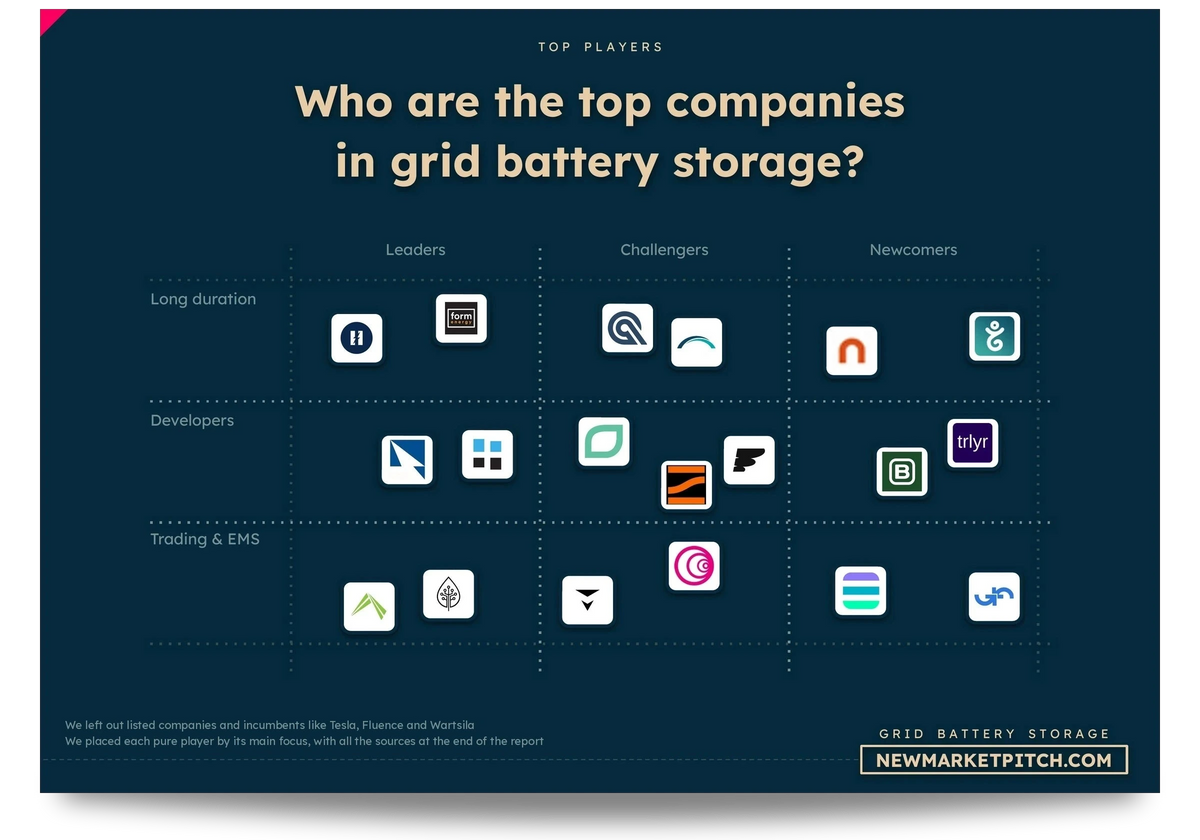
In our research about grid batteries, we turn what is vague and complex into simple, useful visuals. Market maps like this one show you at a glance where every startup stands.
How much funding are grid-scale battery startups actually getting?
Grid-scale battery storage startups are getting real money: at least $3.5B across the 86 equity deals and 66 companies we track.
That money went to a wide range of businesses. Form Energy develops iron-air batteries for multi-day storage. Peak Energy makes sodium-ion systems. Return develops battery projects and leases capacity to energy companies. Factories, grid connections and trading platforms all need cash, but they spend it in very different ways.
The median disclosed round was $13.3M, far below the checks needed to build a battery factory. Form Energy's August financing announcement described expansion at Form Factory 1 in West Virginia and work toward commercial deliveries. An early-stage software company that optimizes battery dispatch would not need the same equipment or upfront budget. We include both because grid-connected batteries are central to what they sell, but the combined funding total should not be mistaken for what a typical startup can raise.
How rare are $100M grid battery storage rounds?
$100M grid-scale battery rounds are rare, with 7 deals at that level, or 9% of rounds with disclosed amounts.
Those deals accounted for $2.3B in disclosed financing. EnerVenue raised a $300M Series B in March 2026 to expand its nickel-hydrogen storage business, while Return raised a $330M Growth Equity round in October 2025 to build battery storage assets in Europe. They face different problems, but both need far more capital than a small software developer.
The busiest size bracket was $5M to under $20M, with 34 rounds, or 46% of those with public amounts. Most founders are therefore operating in another funding market entirely from the companies announcing nine-figure deals. The expensive projects get the biggest headlines; smaller battery technology and software businesses account for much of the deal activity.

Your time is limited. In our market report about grid batteries, we put numbers on each part of the market, so you can see where it makes sense to focus.
What does a typical grid battery startup raise?
A typical funded grid-scale battery storage company raised $14M, while the median disclosed individual round was $13.3M.
A startup may raise money again, so company totals and single-round amounts answer different questions. We found 47 companies with 1 round, 18 companies with 2 rounds and 1 company with 3 or more rounds. At the smaller end, 15 disclosed financings under $5M represented 20% of rounds with published amounts. Those checks can fund product trials long before mass manufacturing makes sense.
Voltfang raised a $7.7M+ Series A in October 2024, followed by a $17M Series B in June 2025 for its second-life battery systems. Peak Energy moved from a $55M Series A in June 2024 to a $108M Series B in October 2026 as its sodium-ion storage ambitions grew. A repeat financing changes how much a company has raised, even when the latest round alone makes the news.
Is most grid-scale battery funding going to giant deals?
Yes, grid-scale battery funding is concentrated in large financings: 12 deals of $50M or more accounted for $2.7B of disclosed capital.
Taking out rounds above $50M leaves at least $852M. That is still serious funding for new battery materials, controls and trading software, but it tells a different story from the total. Form Energy needs to manufacture iron-air batteries, EnerVenue is commercializing nickel-hydrogen technology, and Return develops infrastructure that must earn money over years.
The largest checks carry distinct kinds of risk. A factory has to make reliable batteries at scale; an asset owner has to secure sites, grid access and revenue; a trading platform needs customers using its software. That is why a market with plenty of smaller financings can still have most of its money tied to a small group of industrial businesses.

In our document detailing everything you need to know about grid-scale battery storage, we always try to gather several sources and make estimates that make sense, so you can work with solid numbers.
How big is a first check for a grid battery startup?
A first check for a grid-scale battery startup is fairly small, with 12 first financings raising at least $62M at a $6.4M median.
Moonwatt's $8.3M Seed round in March 2025 backed sodium-ion storage for power grids. Volt Harbor raised a $2M Seed in May 2026 for battery projects and grid services. Libattion's $15M Series A in June 2024 financed commercial battery systems. These are different starting points, but each company needed investors before it had a long record of installations or sales.
Follow-on financing is where most published money sits: 67 deals raised at least $3.4B, with a $15M median. Another 7 rounds have an unknown first-financing status. So new businesses are getting started, while companies with earlier backing still receive the larger share of identifiable capital.
Why can Form Energy raise so much for grid storage?
Form Energy can attract unusually large grid battery checks because iron-air storage needs factories and commercial deliveries, not just promising lab results.
It raised $405M in an October 2024 Series D+ round, which it calls Series D+, and $750M in an August 2026 Series D+ round, its Series D+ and the largest individual deal in our research. Form Energy says its batteries can store power for 100 hours, which puts it in a different market from systems designed mainly to shift electricity within a day.
Form Factory 1 in Weirton is central to that ambition. In its financing announcement, Form Energy explained plans to expand production and deliver more systems. The company has also announced an agreement with Crusoe for data-center storage and work with Xcel Energy and Google. Those relationships show potential customers, although an agreement is not the same as a completed installation or profit. The size of the financing reflects the cost of trying to turn the technology into an industrial product.
Are sodium-ion grid batteries attracting real investment?
Yes, sodium-ion grid storage is receiving serious checks, including Peak Energy's $108M Series B in October 2026.
Peak Energy previously raised a $55M Series A in June 2024. Its more recent announcement named GM Ventures as lead and described a Sacramento factory and customer orders for grid and data-center power. Moonwatt's $8.3M Seed round in March 2025 shows another part of the market: a younger company trying to turn sodium-ion technology into a commercial grid product.
Sodium-ion is attracting attention because stationary storage puts a different value on size, materials, cooling and lifespan than electric cars do. Peak says its systems work without active cooling, and it is working with General Motors on battery cells. The next test is delivering installed systems that meet those claims. Strong fundraising makes that possible; it does not settle the technology race.

Our report covering the grid-scale battery storage market gets updated several times a month, so you always get the latest view of where things stand.
Are investors paying for alternatives to lithium-ion batteries?
Grid-scale battery investors are backing several alternatives to lithium-ion rather than choosing a single replacement chemistry.
Ore Energy's $43M Series A in August 2026 supported iron-air storage, while EnerVenue raised a $300M Series B in March 2026 for nickel-hydrogen batteries. e-Zinc's $31M Series A in June 2024 financed zinc-air storage. Funding also reached organic-flow and other flow-battery developers, including Quino Energy's $10M Series A in November 2025, Flux XII's $4M Seed that month and CMBlu Energy's $59M Series C in April 2026.
These technologies aim at different jobs. Some are designed to release power over many hours, while others focus on material costs, safety or long service life. Ore Energy describes a battery built around iron, water and air; CMBlu is developing organic solid-flow systems. Investors are paying to find out which approaches can compete in actual electricity markets. None has won that contest simply by closing a round.
Which grid battery business models attract the biggest checks?
Integrated BESS systems and EPC attracted the most disclosed grid-scale battery funding, at least $1.5B across 27 deals.
Battery cells and modules attracted at least $1.1B across 29 deals. Battery ownership and operation also stood out, with 8 deals and at least $587M. By contrast, battery flexibility trading raised $231M across 12 deals and BESS asset management and optimization raised at least $41M across 7 deals. System builders can need factories, electronics and installation teams, while software firms usually do not pay to manufacture every battery they help run.
The business models are easier to see through real companies. Moment Energy sells systems made with repurposed EV batteries; Return owns and develops storage assets; enspired trades and optimizes electricity from batteries. Moment Energy's May 2026 announcement discussed expanding manufacturing in Texas and British Columbia. Their customers buy different things, so their funding needs differ too.
The table below shows how disclosed financing varies across grid-scale battery business models.
| Business model | Deals | Disclosed capital |
|---|---|---|
| Integrated BESS/EPC | 27 | $1.5B+ |
| Battery cells/modules | 29 | $1.1B+ |
| Battery ownership/operation | 8 | $587M+ |
| Battery flexibility trading | 12 | $231M |
| BESS asset optimization | 7 | $41M+ |
| Battery project development | 3 | $33M |

In our research about grid batteries, we look at what the winners do differently, so you can learn from the best instead of guessing.
Why are grid battery owners raising such large rounds?
Grid-scale battery owners raise large checks because they must pay for physical projects long before those batteries start making money.
Battery ownership and operation attracted 8 deals and at least $587M, with a $40M median. Return's $330M Growth Equity round in October 2025 is an example. APG described Return's business as developing batteries and leasing storage capacity to energy companies and traders. terralayr's $133M Growth Equity in January 2026 and Tavion's $40M Series A in September 2026 also went to companies developing or operating battery assets. US developers financed by a single infrastructure fund, such as SMT Energy and Liminal Energy, are not counted, because we treat them as fund platforms rather than startups.
Before a battery earns anything, a developer needs a site, permits, equipment and a grid connection. Then the project needs customers or a convincing plan to earn money from power markets. Those costs explain why infrastructure investors back battery owners even though they might avoid an untested battery chemistry.
Can battery trading software attract serious funding too?
Yes, battery trading software can attract substantial funding, although its checks are generally smaller than those for grid-scale battery factories or asset owners.
Battery flexibility trading startups completed 12 deals worth $231M, with a $14M median. Entrix raised $50M in a March 2026 Growth Equity financing. Flower raised a $49M Series A in October 2024 for a broader storage and flexibility business. Capalo AI's $13M Series A in February 2026 and Suena Energy's $8.8M Series A in September 2025 show funding for businesses that help batteries earn money in electricity markets.
Entrix said it had grown the amount of battery capacity under contract, and enspired has discussed expansion into more electricity markets. Software that decides when a battery charges, sells power or provides grid services can make an installed system more valuable. The software company does not need to own the batteries to benefit from their growing use.

In our market report about grid batteries, we don't want to repeat what boring consulting reports say. Instead, we show you the real and latest market signals that matter.
Is grid battery funding mainly an American story?
By dollars, grid-scale battery storage funding is mainly American: North America attracted at least $2.2B and 62% of disclosed capital, even though Europe closed more deals.
Europe recorded 40 deals, compared with 23 in North America and 23 in Asia-Pacific. The United States alone had 19 deals worth at least $2.1B, including major financings for Form Energy, EnerVenue and Peak Energy. Europe was busy with Return in the Netherlands and terralayr, which operates German assets but is classified under Switzerland by headquarters.
The regional picture changes depending on whether we count deals or the money raised. APG has described Return's activities across European markets, and Eurazeo has described terralayr's German battery platform. We assign funding to each company's headquarters, not the country where every battery is installed. That distinction matters when projects, investors and customers cross borders.
Are European grid battery checks as big as American ones?
No, a typical European grid-scale battery round was smaller: the median was $11M, versus $15M in North America.
Europe generated 47% of deals but 31% of disclosed capital. North America accounted for 27% of deals and 62% of disclosed capital. European financings ranged from Voltfang's $17M Series B in June 2025 and Ore Energy's $43M Series A in August 2026 to Return's $330M Growth Equity in October 2025. Big European checks exist, but the region has more smaller deals in its mix.
The Netherlands recorded 6 deals and $428M, Germany had 10 deals and at least $170M, and Switzerland had 4 deals and $224M. These countries host system builders, storage owners and software startups that spend money differently. The gap in median rounds tells us how those financing patterns differ, not that every European battery company faces the same problem.

Learning from others' mistakes is the cheapest lesson there is. In our document detailing everything you need to know about grid-scale battery storage, we look at what broke startups before you, so you don't repeat it.
How far does seed funding take a grid battery startup?
A Seed check helps grid-scale battery startups prove a product, but the $6.7M median is far short of what most factory-scale rollouts cost.
We recorded 27 Seed rounds worth at least $199M. Rivus Batteries raised $2.3M in July 2026 to develop aqueous organic batteries; Flux XII's $4M Seed in November 2025 backed flow batteries; Moonwatt's $8.3M Seed in March 2025 funded sodium-ion systems. AquaBattery's $6.4M Seed in April 2024 supported a saltwater long-duration approach.
For most battery developers, that first work means hiring engineers, testing materials and getting a pilot ready. Utilities will later ask about safety, service life, manufacturing cost and warranties. Series A was another busy stage, with 27 deals and at least $432M, and a $14M median. The move toward larger systems takes a different level of funding, and plenty of startups never make it there.
Why do so few battery startups reach Series C?
Grid-scale battery startups rarely make it to Series C: we recorded 3 Series C deals against 27 Series A deals.
Series B had 12 deals worth at least $924M and a $34M median. Series C had 3 deals totaling $148M, and Series D+ accounted for 2 deals. Growth Equity appeared in 8 deals, which helps explain why not every mature battery company has a Series C or Series D+ label.
By this point investors expect a lot more than good laboratory results. A battery must last, fit into commercial power systems and be manufactured reliably. CMBlu Energy's April 2026 Series C and Relectrify's May 2024 Series C show that some companies do advance. Form Energy's repeat later-stage financings show another reality: a single expensive industrial program can generate several huge rounds.
The table below shows how many grid-scale battery rounds reached each stage.
| Stage | Deals | Companies |
|---|---|---|
| Seed | 27 | 25 |
| Series A | 27 | 27 |
| Series B | 12 | 10 |
| Series C | 3 | 3 |
| Series D+ | 2 | 1 |
| Growth Equity | 8 | 8 |
| Unknown | 7 | 7 |
Is growth equity replacing classic venture rounds in batteries?
Growth Equity has not replaced venture rounds in grid-scale battery storage; it mainly gives asset owners another way to fund expansion.
Growth Equity accounted for 8 deals and $616M, against 3 Series C deals and 2 Series D+ deals. Return's $330M Growth Equity in October 2025 and terralayr's $133M Growth Equity in January 2026 both backed businesses linked to operating storage assets. Their business needs are different from those of a startup inventing a new battery material.
Among deals with a named stage, early-stage financings made up 68% of deals but 18% of disclosed capital. Later-stage deals represented 32% and 82%, respectively. The money is weighted heavily toward mature projects and industrial expansion, while plenty of young battery companies still seek the early venture checks they need to get started.

If you build or invest in the grid-scale battery storage market, you need to know which business models pay off now and which ones are fading. That's why our report covering it has a whole section on it.
How old are grid battery startups when they raise money?
Grid-scale battery startups were a median 4 years old when they raised money, and only slightly older among companies closing the largest checks.
Companies raising rounds above $50M had a median age of 4.5 years, compared with 3 years for rounds under $5M. A battery company can need serious money early if it wants to build a factory or develop grid-connected projects. That does not mean it already has many years of profitable operation.
Of the companies we studied, 86% were founded since 2015, 62% since 2020 and 35% since 2022. Peak Energy's move toward sodium-ion manufacturing illustrates how quickly an industrial challenge can arrive. A younger business may still be running battery tests when another of similar age is arranging factory capacity. Age alone says little about how close either is to commercial success.
Does battery fundraising come steadily every month?
No, grid-scale battery storage fundraising is uneven, with quiet months interrupted by a few very large deals.
Across 34 completed months, the median was 2 deals and $34M of disclosed funding per month. There were 2 months with no deals and 11 months above the median deal count. October 2024 had the most announcements, with 6 deals and at least $532M. August 2026 brought in the most money, $793M from 2 financings.
That August figure came from Form Energy's $750M Series D+ and Ore Energy's $43M Series A, both in August 2026. October 2024, by contrast, combined several kinds of hardware, software and project deals. A big funding month can be the work of one standout transaction, while a busy month can represent a wider set of startups finding investors.

In our research about grid batteries, we like to show you the big picture. We know your time is precious, so we make every page quick to read and packed with as much learning as possible per minute.
What is still missing from grid-scale battery funding?
Grid-scale battery storage still lacks a deep market for companies seeking repeated late-stage venture rounds.
We found 66 funded companies, but only 19 raised more than once during the period. Seed and Series A were far more common than Series C or Series D+, and the biggest checks went to companies with unusually expensive manufacturing or battery-project plans. Plenty of money reached early ideas and a few industrial leaders; fewer companies obtained successive advanced rounds.
Battery startups must eventually show more than good tests and a promising market. They need paying customers, dependable manufacturing, warranties and systems that work on real grids. Form Energy and EnerVenue are trying to scale production, while asset owners such as Return follow a different route through infrastructure development. The unanswered question for many smaller developers is whether they can move from a pilot to repeat deliveries without needing industrial-sized capital.
So, what does grid-scale battery funding really look like today?
Grid-scale battery storage is a well-funded startup market, but most disclosed money goes to a small number of manufacturers and owners of physical battery projects.
We found an active stream of early checks, investment in competing battery chemistries and funding for trading software that helps installed assets earn money. Large industrial financings dominate the dollar total, led by Form Energy. T. Rowe Price leads the named lead-investor ranking and returned to lead Form Energy's financings. A typical startup receives far less, and only a small group gets as far as advanced venture rounds.
For founders, the key is to match the money sought to the job ahead. Proving a battery, building a factory and owning a power project are different businesses, and investors fund them differently.
The table below shows what we found.
| Question | Answer |
|---|---|
| Is grid battery funding larger than it seems? | Yes, grid-scale storage startups raise serious equity money. We counted 86 deals worth at least $3.5B. Those checks went to manufacturers, asset owners and software companies. |
| Are nine-figure battery rounds an everyday occurrence? | No, the biggest battery checks remain a rarity. Only 7 disclosed financings reached nine figures in funding. Their size still shapes the overall funding picture. |
| Does a typical startup raise factory-sized money? | No, most battery startups raise much smaller sums. The median disclosed battery financing round was $13.3M. Factory plans require a very different level of capital. |
| Did one industrial company close the largest round? | Yes, Form Energy completed the largest single financing. Form Energy's August 2026 Series D+ raised $750M. That scale reflects the cost of industrial battery manufacturing. |
| Are first-time battery startups still finding investors? | Yes, investors still back companies seeking their first check. We counted 12 first financings worth at least $62M. Follow-on funding remains far larger across grid battery companies. |
| Are integrated battery builders pulling ahead financially? | In disclosed capital, integrated BESS companies lead this group. Integrated BESS attracted at least $1.5B across 27 deals. Cell developers nevertheless attracted a larger number of financings. |
| Are battery asset owners also raising major sums? | Yes, owning batteries takes plenty of upfront money. Battery ownership and operation attracted at least $587M. Those companies finance assets instead of only inventing cells. |
| Does Europe's higher deal count mean more money? | No, more European deals have not meant more capital. Europe accounted for 40 grid battery funding deals. North America attracted the larger share of disclosed money. |
| Can a seed round pay for grid-scale production? | Usually not, because a pilot and factory cost differently. The Seed median was $6.7M among funded startups. Commercial deliveries often require much more money later. |
| Are advanced venture rounds now common in batteries? | No, only a narrow group reaches advanced rounds. Series C accounted for just 3 grid battery deals. Growth Equity provides another route for battery asset owners. |
| Does a record funding month prove broad growth? | Not necessarily, as exceptional rounds can dominate one month. August 2026 alone reached $793M of disclosed financing. The number of deals gives a different picture. |

When you build or invest in the grid-scale battery storage market, you need clarity, not confusion. In our market report about grid batteries, we always try to put numbers on and quantify whatever is usually vague and confusing.
Our methodology
Our data runs through November 14, 2026. We then reviewed this article and updated its answers on November 17, 2026, the date shown under the title. We reviewed grid-scale battery storage equity financings from January 1, 2024 to November 14, 2026, covering private company rounds at or above $300K. We excluded debt, grants, loans, unconverted convertibles, SAFEs and public offerings.
We define grid-scale battery storage as electrochemical battery systems used to store electricity for grid-scale supply and balancing. We include battery developers, manufacturers, system integrators, storage project developers, asset owners and battery-centered operating platforms. We include borderline companies when grid batteries are a principal business, while excluding household-only batteries, EV traction batteries and non-battery storage technologies. Every company counted is a startup under our definition: an independent, growth-oriented company founded in 2000 or later, privately held or listed within the last 5 years; recently acquired companies may remain in scope.
We count each equity financing once, merging duplicate announcements and reconciling dates, amounts, stage names and company identities. A company can appear in multiple financings. When the amount is undisclosed, the deal still contributes to counts, but not to disclosed capital totals; those totals are minimums, and a plus sign indicates incomplete disclosure.
We classify Seed, Series A, Series B, Series C, Series D+ and Growth Equity separately, with rounds of undisclosed stage left unassigned. Early- and later-stage proportions use deals with named stages, while dollar shares use disclosed amounts. Company headquarters determine country and region, and our categories describe the primary role a company plays in the battery storage market. We prioritize company announcements, regulatory filings and reliable reporting for the facts of each financing.
Rounds confirmed by a company announcement, a press article or a regulatory filing are counted in full. Where no article exists, a round is counted only when at least two recognised databases agree on its date (within one month) and amount (within 5%), and it is marked as low confidence; a round found in a single database stays in the company's history but is left out of totals. For companies that have raised more than $100M, every round counted is backed by an article.
We report the median of disclosed rounds rather than assuming undisclosed checks equal the public ones. Our company funding figures cover the stated period, not the companies' entire lifetime, and financing counts are not a measure of installed battery capacity. Outside evidence on factories, product performance and customer agreements helps interpret the financing rather than replace the deal count.
A press article may use a bigger industry definition, combine project debt with equity or date a transaction differently. We keep those distinctions explicit rather than inflate a single total. Recent months can also be incomplete, which is why we do not infer a persistent trend from one quiet month.
Key sources include Form Energy's August 2026 manufacturing and equity financing announcement, Form Energy's October 2024 round and lead investor, Form Energy's commercial agreement with Crusoe, Form Energy's manufacturing site and industrial scale, Xcel Energy's February 2026 plan with Google and a Form Energy battery project, Peak Energy's funding, product and GM investor announcement, Peak Energy's planned sodium-ion factory, EnerVenue's Series B extension and industrial expansion, Moment Energy's Series B and second-life battery systems, Ore Energy's iron-air Series A and chemistry, CMBlu Energy's Series C and solid-flow technology, Return's battery capacity leasing model and APG financing, terralayr's grid storage ownership and virtual flexibility model, Entrix's operating platform and expansion, enspired's battery optimization and international activity, Flower's battery and flexibility business, Voltfang's later financing and battery storage product, e-Zinc's zinc-air commercialization and funding, and Battery optimization software investment context.

A good product starts with a real problem. In our document detailing everything you need to know about grid-scale battery storage, we show you the ones customers still live with.
Written by the New Market Pitch teamWe track new markets so founders and investors can move faster. About us