Humanoid Robotics Funding: A Quarter-by-Quarter Analysis
Everything we know about the humanoid robotics market, in one place. Get our report whether you build or invest.
Summary
Humanoid robotics funding is clearly booming, but the boom is concentrated in nine-figure rounds rather than a sixfold expansion of the startup base.
From Q2 2025 to Q2 2026, disclosed capital jumped from $461 million to $2.782 billion while deal count rose from 21 to 27. The market got much richer at the top without becoming proportionally broader underneath. Dollars jumped sixfold while deals barely moved, a pattern we follow quarter by quarter in our humanoid robotics market report.
The smaller and mid-sized market barely expanded in dollars. Deals of $50 million or less generated $308 million in Q2 2025 and $262 million in Q2 2026, which means almost all of the headline growth came from much larger financings.
Q3 2025 looked like the first breakout, but Figure AI alone accounted for roughly 73% of quarterly capital. The more convincing shift came in Q1 2026, when deal count, total funding and the median round all rose together.
Q2 2026 confirmed that nine-figure rounds had become a market pattern rather than a one-company anomaly. Twelve financings exceeded $100 million, yet fifteen of the quarter's 27 deals were still below $50 million.
Existing companies are capturing most of the new money. First financings stayed scarce, while the median follow-on round climbed from $13.9 million in Q2 2025 to $102 million in Q2 2026.
Traditional stage labels are becoming less informative. Young humanoid companies can now raise hundreds of millions in rounds labeled Seed, Series A or Pre-A, so financing history, company age and use of proceeds often say more than the round name.
The category mix is widening. General Purpose Humanoids still absorb most of the capital, Humanoid AI Platforms are gaining share quickly, and component suppliers are attracting far more deals even though their typical checks remain smaller.
APAC already dominated deal volume throughout the period and by Q2 2026 it also dominated known capital. That shift coincides with much heavier activity in Chinese manufacturing, embodied-AI platforms, component suppliers and deployment programs.
Strategic investors are not appearing in dramatically more deals, but the rounds they join have become much larger. At the same time, the number of identified lead and co-lead investors widened sharply, suggesting that the capital base is broadening even while funding remains top-heavy.
The clearest read is that humanoid robotics has entered a much more capital-intensive scaling phase. Factories, robot fleets, physical-data collection and GPU infrastructure now require budgets that look increasingly like those of AI companies and industrial manufacturers combined.

Written by the New Market Pitch teamWe track new markets so founders and investors can move faster. About us

In our report covering the humanoid robotics market, you will always find fresh funding data, taken straight from our own verified funding database.
All funding deals in the humanoid robotics market over the last years
Below is the table listing all the deals. You can find our methodology at the end of this page.
If you want a deeper understanding of the market and its current dynamics, get our humanoid robotics market report.
| Company | Category | Date | Stage | Deal size | What they do | Region | Lead investors | Country |
|---|---|---|---|---|---|---|---|---|
| ENCOS | Actuation Component Suppliers | September 2026 | Series B | >$44.7M | Develops and mass-produces integrated joint actuator modules and associated motion hardware for humanoid and embodied robots. | Asia-Pacific | Not disclosed | China |
| Kinetix AI | General Purpose Humanoids | September 2026 | Seed | >$74.5M | Builds the highly anthropomorphic KAIBot general-purpose humanoid plus its onboard models, dexterous hand and embodied-AI/data infrastructure. | Asia-Pacific | Not disclosed | China |
| Simple AI (深朴智能) | Consumer Home Robots | September 2026 | Unknown | Not Disclosed | Builds the wheeled dual-arm Xiaopu Simbot and its embodied-AI model/data stack for hotel, household and other home-like service tasks. | Asia-Pacific | Not disclosed | China |
| Motion | Industrial Labor Robots | August 2026 | Seed | $2M | Provides OEM-agnostic humanoid robots as a managed monthly service for factories, warehouses and logistics operations. | Europe | Extantia Capital | Belgium |
| UniX AI | General Purpose Humanoids | August 2026 | Unknown | Not Disclosed | Builds and mass-produces wheeled and bipedal general-purpose humanoids for household and commercial-service tasks. | Asia-Pacific | Not disclosed | China |
| Digital Huaxia | General Purpose Humanoids | August 2026 | Unknown | Not Disclosed | Builds general-purpose and bionic humanoid robots plus RoboEase deployment software for public-service and commercial scenarios. | Asia-Pacific | Not disclosed | China |
| Hengxuan Robot Joint Technology (Shenzhen) Co., Ltd. | Actuation Component Suppliers | August 2026 | Unknown | Not Disclosed | Develops harmonic reducers and integrated rotary-joint modules engineered for humanoid robot joints. | Asia-Pacific | Ninebot Capital; Daoyi Capital | China |
| Guangdong Huilun Technology Co., Ltd. | General Purpose Humanoids | August 2026 | Unknown | >$14M | Develops full-stack humanoid robots and core hardware for automotive-production, security and service deployments. | Asia-Pacific | Not disclosed | China |
| Avatar Robotics | Logistics Work Robots | August 2026 | Seed | $6.5M | Builds humanoid labor systems combining two-handed robots, remote human operators and AI autonomy for warehouse and industrial tasks. | North America | AlleyCorp | United States |
| Archon Robotics | Humanoid AI Platforms | June 2026 | Seed | >$14M | Develops whole-body humanoid foundation models intended to provide human-like locomotion and manipulation intelligence to humanoid robots. | Asia-Pacific | Not disclosed | China |
| Proception Inc | Actuation Component Suppliers | June 2026 | Seed | $11M | Builds human-like dexterous robotic hands and sensor gloves for humanoid manipulation and training-data collection. | North America | First Round Capital | United States |
| AI² Robotics (Zhipingfang) | General Purpose Humanoids | June 2026 | Unknown | ≈$694M | Develops AlphaBrain embodied AI model and AlphaBot general-purpose robots | Asia-Pacific | Not disclosed | China |
| Anyverse Dynamics | General Purpose Humanoids | June 2026 | Seed | >$200M | Develops a general-purpose embodied intelligence brain together with its K15 wheeled humanoid robot hardware platform. | Asia-Pacific | JD.com-affiliated fund; C Capital; Hony Capital; Shengyu Investment; Fengyuan Investment | China |
| AGILINK | Actuation Component Suppliers | June 2026 | Unknown | ≈$139M | Develops and mass-produces dexterous humanoid hands, grippers and contact-intelligence technology for robotic manipulation. | Asia-Pacific | Future Assets; Jingming Capital; Undisclosed major internet company | China |
| Ola Dimensions | Consumer Home Robots | June 2026 | Seed | >$14M | Develops consumer-oriented embodied robots designed to learn and perform tasks in household environments. | Asia-Pacific | Not disclosed | China |
| Daimeng Robotics | Actuation Component Suppliers | June 2026 | Series A | ≈$14M | Develops tactile sensors, dexterous hands and tactile-manipulation systems for humanoid and embodied robots. | Asia-Pacific | Not disclosed | China |
| Astribot | General Purpose Humanoids | June 2026 | Series B | ≈$139M | Builds the S1 human-like general-purpose robot and its integrated AI, manipulation and data stack. | Asia-Pacific | Not disclosed | China |
| Spirit AI | Humanoid AI Platforms | June 2026 | Series A | ≈$209M | Develops general-purpose embodied foundation models and its Moz humanoid robot as an integrated humanoid intelligence stack. | Asia-Pacific | Not disclosed | China |
| HeyMan Technology (黑漫科技) | Actuation Component Suppliers | June 2026 | Unknown | >$1.4M | Develops and commercializes dexterous robotic hands for humanoid, service, industrial and specialized robots. | Asia-Pacific | Yida Capital | China |
| Xynova | Actuation Component Suppliers | May 2026 | Series A | >$29.6M | Develops humanoid-specific dexterous hands, rotary joint actuators and micro linear actuators with in-house motor and control technology. | Asia-Pacific | Li Auto Strategic Investment; CSC Capital; CSC Investment | China |
| Zhejiang Hechuan Humanoid Robot Co., Ltd. (浙江禾川人形机器人有限公司) | Actuation Component Suppliers | May 2026 | Unknown | ≈$7.1M | Develops humanoid robots plus integrated drive/joint, motor, encoder and dexterous-hand actuation components. | Asia-Pacific | Not disclosed | China |
| Five Ages (中科第五纪(杭州)智能技术有限公司) | Humanoid AI Platforms | May 2026 | Series A | >$29.5M | Builds embodied-AI “brain” models and wheeled dual-arm humanoid platforms for industrial, logistics and energy tasks. | Asia-Pacific | Futeng Capital (孚腾资本) | China |
| ATOM, Inc. | Industrial Labor Robots | May 2026 | Seed | ≈$18.8M | Develops bipedal, dual-arm humanoid AI robots and an integrated Physical-AI stack for manufacturing and logistics tasks. | Asia-Pacific | ANRI; Beyond Next Ventures; JAFCO Group | Japan |
| RoboParty | General Purpose Humanoids | May 2026 | Seed | >$20M | Develops a full-stack open-source bipedal humanoid platform spanning hardware, control software and humanoid foundation models. | Asia-Pacific | Shunwei Capital | China |
| AGILINK | Actuation Component Suppliers | May 2026 | Series A | >$29M | Designs and manufactures high-DoF dexterous hands, adaptive grippers and manipulation-control software for embodied robots. | Asia-Pacific | Not disclosed | China |
| Bowintec (博银合创科技有限公司) | Industrial Labor Robots | May 2026 | Seed | ≈$44M | Builds wheeled dual-arm industrial embodied-intelligence robots with integrated task models and orchestration software for flexible manufacturing. | Asia-Pacific | Oriza FOF (元禾辰坤) | China |
| Kepler Robotics | Industrial Labor Robots | May 2026 | Series A | >$1.5M | Develops full-stack humanoid robots for manufacturing, logistics and hazardous industrial work. | Asia-Pacific | Jiangyin Xiachuang No. 1 Artificial Intelligence Investment Partnership | China |
| ROBOTERA | General Purpose Humanoids | April 2026 | Growth Equity | >$200M | Develops full-stack general-purpose humanoid robots for logistics, industrial and commercial physical-work applications. | Asia-Pacific | SF Group; HSG; IDG Capital | China |
| Holiday Robotics | Industrial Labor Robots | April 2026 | Series A | ≈$102M | Develops full-stack dexterous humanoid robots for repetitive and physically demanding industrial work. | Asia-Pacific | IMM Investment | South Korea |
| X Square Robot | Humanoid AI Platforms | April 2026 | Series B | ≈$290M | Develops general-purpose embodied foundation models and integrated wheeled humanoid robots for complex manipulation tasks. | Asia-Pacific | Xiaomi Strategic Investment; HongShan | China |
| Booster Robotics | General Purpose Humanoids | April 2026 | Unknown | ≈$146.5M | Develops humanoid robot hardware and software platforms for embodied-AI development, research and commercial deployment. | Asia-Pacific | Beijing High-Precision Industry Fund; Beijing Guosheng Fund; Huakun Fund | China |
| TARS Robotics | General Purpose Humanoids | April 2026 | Unknown | $455M | Develops general-purpose humanoid robots together with proprietary embodied foundation models and integrated robot intelligence. | Asia-Pacific | GL Ventures; HongShan; Meituan Strategic Investment | China |
| Dexcel Robotics | Actuation Component Suppliers | April 2026 | Unknown | ≈$14M | Develops high-performance anthropomorphic dexterous hands and tactile manipulation hardware for humanoid and embodied robots. | Asia-Pacific | Fortune Venture Capital; Primavera Venture Partners | China |
| Kepler Robotics | Industrial Labor Robots | April 2026 | Series A | ≈$14M | Develops industrial humanoid robots and their integrated actuation, sensing and embodied-intelligence stack. | Asia-Pacific | SAIF Partners | China |
| EngineAI | General Purpose Humanoids | April 2026 | Series B | $200M | Develops full-stack general-purpose humanoid robots, including robot bodies, joints, motion control and embodied intelligence. | Asia-Pacific | Henan Investment Group; Luxshare Precision | China |
| Spirit AI | Humanoid AI Platforms | April 2026 | Unknown | ≈$145M | Develops general-purpose embodied-AI foundation models and humanoid robot systems built around its Spirit intelligence stack. | Asia-Pacific | Shunwei Capital; Yunfeng Fund | China |
| Galaxea AI | General Purpose Humanoids | April 2026 | Series B | $291M | Develops full-stack general-purpose humanoid and mobile-manipulation robots with embodied-AI software. | Asia-Pacific | Not disclosed | China |
| RoboParty | General Purpose Humanoids | March 2026 | Seed | $20M | Develops low-cost, high-performance full-stack open-source bipedal humanoid robots and their developer ecosystem. | Asia-Pacific | SenseTime Guoxiang Capital; Matrix Partners China | China |
| Qingxin Yichuang (Cyan Robotics) | Consumer Home Robots | March 2026 | Unknown | ≈$14M | Develops full-size and compact bipedal humanoid robots focused on embodied interaction and consumer companionship. | Asia-Pacific | Houxue Capital; Tianji Capital | China |
| Sunday Robotics | Consumer Home Robots | March 2026 | Series B | $165M | Builds Memo, a wheeled humanoid-style dual-arm robot designed to autonomously perform household chores. | North America | Coatue | United States |
| Futuring Robot | Consumer Home Robots | March 2026 | Seed | Not Disclosed | Develops wheeled dual-arm general-purpose home robots for autonomous household chores, care and companionship. | Asia-Pacific | Boyu Capital | China |
| KNOWIN | Consumer Home Robots | March 2026 | Seed | Not Disclosed | Develops dual-arm embodied robots and generative AI systems specifically for autonomous household tasks. | Asia-Pacific | Zhongding Capital | China |
| ROBOTERA | General Purpose Humanoids | March 2026 | Growth Equity | ≈$145M | Develops full-size and wheeled humanoid robots, dexterous hands and an integrated VLA embodied-AI stack. | Asia-Pacific | Not disclosed | China |
| Noetix Robotics | General Purpose Humanoids | March 2026 | Series B | ≈$145M | Develops and manufactures consumer-focused bipedal and biomimetic humanoid robots. | Asia-Pacific | Chendao Capital | China |
| Galbot | General Purpose Humanoids | March 2026 | Unknown | ≈$363M | Develops wheeled dual-arm humanoid robots and embodied AI models for industrial, retail, logistics and healthcare deployment. | Asia-Pacific | Not disclosed | China |
| UniX AI | General Purpose Humanoids | March 2026 | Unknown | ≈$43M | Builds full-stack wheeled and bipedal humanoid robots with proprietary manipulation and embodied-AI systems. | Asia-Pacific | Not disclosed | China |
| PNDbotics | General Purpose Humanoids | February 2026 | Unknown | >$29M | Develops full-stack, full-size Adam humanoid robots with vertically integrated actuators, motion control and embodied-AI software. | Asia-Pacific | CITIC Goldstone | China |
| X Square Robot | Humanoid AI Platforms | February 2026 | Series A | >$29M | Develops embodied foundation models and Quanta wheeled humanoid/mobile-manipulator robots for general-purpose task execution. | Asia-Pacific | SAIC Capital; CICC-SAIC Fund | China |
| AI² Robotics | General Purpose Humanoids | February 2026 | Series B | >$143M | Builds full-stack general-purpose robot intelligence and AlphaBot wheeled humanoid systems for productive work in real environments. | Asia-Pacific | Not disclosed | China |
| Unbounded Dynamics (无界动力(北京)技术研发有限公司) | Humanoid AI Platforms | February 2026 | Seed | >$29M | Develops integrated general embodied-intelligence brains and its own humanoid robot hardware for industrial and commercial deployment. | Asia-Pacific | Not disclosed | China |
| Linkerbot | Actuation Component Suppliers | February 2026 | Series B | ≈$215M | Designs and mass-produces high-DOF robotic dexterous hands spanning tendon, direct-drive and linkage architectures for humanoid robots. | Asia-Pacific | Daode Investment; Shengshi Investment | China |
| Galaxea AI | General Purpose Humanoids | February 2026 | Series B | ≈$144M | Builds wheeled dual-arm general-purpose humanoid/mobile-manipulator robots and its own embodied-AI control models. | Asia-Pacific | Jinding Capital | China |
| Apptronik | Industrial Labor Robots | February 2026 | Series A | $520M | Develops Apollo, a full-size humanoid designed for manufacturing, logistics and other physically demanding commercial work. | North America | B Capital; Google; Mercedes-Benz | United States |
| AGILINK | Actuation Component Suppliers | February 2026 | Unknown | >$29M | Develops dexterous robotic hands, grippers and manipulation intelligence for humanoid and embodied robots. | Asia-Pacific | Not disclosed | China |
| DroidUp | Consumer Home Robots | February 2026 | Unknown | ≈$14M | Builds highly biomimetic humanoids combining humanlike bodies with multimodal emotional interaction for companionship and eldercare. | Asia-Pacific | Shanghai Pudong Leading Area Investment Center; Shanghai Zhangjiang Sci-Tech Venture Capital | China |
| X-Humanoid | General Purpose Humanoids | February 2026 | Unknown | >$100M | Develops the full-size Tien Kung humanoid platform and Huisi Kaiwu embodied-intelligence stack for autonomous work. | Asia-Pacific | Not disclosed | China |
| Zhejiang Humanoid Robot Innovation Center Co., Ltd. | General Purpose Humanoids | January 2026 | Unknown | ≈$64M | Develops the NAVIAI family of bipedal and wheeled dual-arm humanoid robots for industrial and service tasks. | Asia-Pacific | Not disclosed | China |
| PHYBOT | General Purpose Humanoids | January 2026 | Seed | >$14M | Develops full-stack general-purpose humanoids plus self-developed joint modules, led by the M1 and C2 platforms. | Asia-Pacific | Not disclosed | China |
| X Square Robot | Humanoid AI Platforms | January 2026 | Series A | $140M | Develops embodied foundation models and Quanta wheeled humanoid/mobile-manipulator robots for general-purpose task execution. | Asia-Pacific | ByteDance; HongShan | China |
| Futuring Robot | Consumer Home Robots | January 2026 | Seed | ≈$29M | Builds wheeled dual-arm household humanoid robots with onboard embodied-AI models for chores, companionship and care. | Asia-Pacific | ZhenFund | China |
| Nirvana Robotics | Humanoid AI Platforms | December 2025 | Seed | $7.8M | Develops humanoid robots and world-model learning systems aimed at physical-world and manufacturing tasks. | North America | Not disclosed | United States |
| Xynova | Actuation Component Suppliers | December 2025 | Seed | >$14.2M | Develops high-DOF dexterous hands, miniature electric cylinders and integrated joint modules primarily for humanoid robots. | Asia-Pacific | CATL Capital | China |
| Galbot | General Purpose Humanoids | December 2025 | Unknown | >$300M | Builds embodied-AI-powered general-purpose humanoid and mobile-manipulator robots for retail, manufacturing, logistics and healthcare. | Asia-Pacific | China Mobile Chain-Leader Fund | China |
| ENCOS | Actuation Component Suppliers | December 2025 | Series A | ≈$28.3M | Develops and manufactures integrated joint modules, dexterous hands and related power-system hardware for humanoid and embodied robots. | Asia-Pacific | Huakong Fund; Shenzhen Capital Group | China |
| EngineAI | General Purpose Humanoids | December 2025 | Series A | ≈$141M | Develops and manufactures full-size general-purpose humanoid robots including the T800, PM01 and SE01. | Asia-Pacific | Huangpu River Capital; Henan Investment Group Huirong Fund; Huakong Fund | China |
| Generative Bionics S.r.l. | Industrial Labor Robots | December 2025 | Unknown | ≈$81.6M | Develops Physical AI-powered humanoid robots designed primarily for industrial work alongside humans. | Europe | Artificial Intelligence Fund of CDP Venture Capital | Italy |
| Noetix Robotics | General Purpose Humanoids | November 2025 | Unknown | ≈$28M | Develops compact and full-size bipedal humanoid robots for general-purpose embodied-intelligence applications. | Asia-Pacific | CICC Capital | China |
| Sunday Robotics | Consumer Home Robots | November 2025 | Unknown | $35M | Develops Memo, a wheeled humanoid household robot with two arms and hands for chores such as dishes, laundry and tidying. | North America | Benchmark; Conviction | United States |
| ROBOTERA | General Purpose Humanoids | November 2025 | Series A | $140M | Develops bipedal and wheeled humanoid robots, dexterous hands and embodied-intelligence models as an integrated robotics platform. | Asia-Pacific | Geely Capital | China |
| Flexion | Humanoid AI Platforms | November 2025 | Series A | $50M | Builds an autonomy software stack spanning reasoning, manipulation, locomotion and whole-body control specifically for humanoid and human-capable robots. | Europe | DST Global Partners | Switzerland |
| Booster Robotics | General Purpose Humanoids | November 2025 | Unknown | >$14M | Develops full-size and compact humanoid robots plus supporting software and development tools for research, education and real-world applications. | Asia-Pacific | IDG Capital | China |
| RoboParty | General Purpose Humanoids | November 2025 | Seed | $10M | Develops full-stack open-source bipedal humanoid robots, including robot hardware, control systems and development infrastructure. | Asia-Pacific | Matrix Partners China; Xiaomi Strategic Investment | China |
| Noetix Robotics | General Purpose Humanoids | October 2025 | Series B | ≈$42M | Develops low-cost general-purpose biped humanoids and bionic robot systems for commercial, research and consumer uses. | Asia-Pacific | Fangguang Capital | China |
| Linkerbot | Actuation Component Suppliers | October 2025 | Series A | >$28M | Develops high-DOF dexterous hands and associated control and embodied-manipulation systems. | Asia-Pacific | Jingguorui Management Co.; Bojia Capital | China |
| Leju Robotics | General Purpose Humanoids | October 2025 | Growth Equity | ≈$210M | Develops full-stack general-purpose humanoid robots such as Kuavo for industrial, service and research deployment. | Asia-Pacific | Not disclosed | China |
| Noitom Robotics (诺亦腾机器人科技(北京)有限公司) | Humanoid AI Platforms | September 2025 | Seed | >$1.4M | Provides humanoid teleoperation, multimodal data acquisition and embodied-AI data infrastructure, including the integrated ADAM-U platform. | Asia-Pacific | Not disclosed | China |
| TetherIA.ai | Actuation Component Suppliers | September 2025 | Seed | >$1M | Develops a full-stack dexterous-hand platform integrating mechanics, actuation/control, data and AI. | North America | Matrix Partners China | United States |
| OneStar Robotics | Industrial Labor Robots | September 2025 | Seed | >$28M | Develops wheeled dual-arm robots plus embodied models and robot-data systems for industrial tasks. | Asia-Pacific | Not disclosed | China |
| Figure AI | General Purpose Humanoids | September 2025 | Series C | >$1B | Develops general-purpose biped humanoids and the Helix embodied-AI system for household and commercial work. | North America | Parkway Venture Capital | United States |
| Rysenbot | Actuation Component Suppliers | September 2025 | Seed | >$1.4M | Develops high-DOF tactile dexterous hands for humanoid and embodied-AI manipulation. | Asia-Pacific | Honghui Fund; Primavera Venture Capital | China |
| Qingbao Robot | General Purpose Humanoids | September 2025 | Series A | >$1.4M | Develops anthropomorphic humanoid service robots for guiding, hospitality, retail, healthcare and automated commercial tasks. | Asia-Pacific | Zhejiang Dechuang Enterprise Management Co., Ltd. | China |
| Dexcel Robotics | Actuation Component Suppliers | September 2025 | Seed | Not Disclosed | Develops high-performance humanoid dexterous hands and tactile end-effectors, including Apex Hand, for embodied-robot manipulation. | Asia-Pacific | HLC (弘晖基金); Primavera Venture Partners (春华创投) | China |
| Andromeda Robotics | Consumer Home Robots | September 2025 | Series A | ≈$15.1M | Develops Abi, an autonomous humanoid companion that converses, leads activities and supports residents in aged-care settings. | Asia-Pacific | Forerunner Ventures | Australia |
| X Square Robot | Humanoid AI Platforms | September 2025 | Series A | ≈$140M | Develops embodied foundation models and Quanta wheeled dual-arm humanoids for general-purpose manipulation. | Asia-Pacific | Alibaba Cloud; CAS Investment | China |
| Noetix Robotics | General Purpose Humanoids | September 2025 | Unknown | >$1.4M | Develops low-cost general-purpose biped humanoids and bionic robot systems for commercial and research use. | Asia-Pacific | Not disclosed | China |
| AI² Robotics | General Purpose Humanoids | September 2025 | Series A | >$14M | Develops AlphaBot wheeled dual-arm humanoids paired with GOVLA embodied AI for industrial and commercial deployment. | Asia-Pacific | Shenzhen Capital Group | China |
| Rysenbot | Actuation Component Suppliers | August 2025 | Unknown | Not Disclosed | Develops high-DOF actuated dexterous robotic hands with integrated tactile sensing for humanoid manipulation. | Asia-Pacific | Qiancheng Capital (千乘资本) | China |
| Lingdong General Robot (安徽聆动通用机器人科技有限公司) | Industrial Labor Robots | August 2025 | Seed | Not Disclosed | Develops full-stack industrial embodied robots combining wheeled dual-arm humanoid bodies with in-house VLM/VLA perception and control models. | Asia-Pacific | Oriza Puhua (元禾璞华) | China |
| Linkerbot | Actuation Component Suppliers | August 2025 | Seed | Not Disclosed | Designs high-DOF actuated dexterous hands and manipulation infrastructure for humanoid and embodied-robot manipulation. | Asia-Pacific | Ant Group | China |
| Noetix Robotics | General Purpose Humanoids | August 2025 | Series A | Not Disclosed | Develops N-series and Dora humanoid robots with in-house motion control, perception and embodied operating software. | Asia-Pacific | GP Capital (Jinpu Investment) | China |
| Zerith Robotics | General Purpose Humanoids | July 2025 | Seed | Not Disclosed | Develops bipedal and wheeled dual-arm humanoids plus in-house embodied models and robot training infrastructure. | Asia-Pacific | Not disclosed | China |
| Booster Robotics | General Purpose Humanoids | July 2025 | Series A | Not Disclosed | Builds bipedal humanoid hardware, operating software and developer tools for research, education and commercial deployment. | Asia-Pacific | Beijing Robot Industry Development Investment Fund | China |
| Spirit AI | Humanoid AI Platforms | July 2025 | Unknown | ≈$83.6M | Develops the Moz1 force-controlled humanoid integrated with its own Spirit VLA embodied-AI model and learning/control stack. | Asia-Pacific | JD.com | China |
| AeiROBOT | General Purpose Humanoids | July 2025 | Series A | ≈$7.2M | Develops ALICE-series bipedal humanoids and proprietary actuator technology for commercial and industrial deployment. | Asia-Pacific | BonAngels Venture Partners | South Korea |
| ROBROS | Industrial Labor Robots | July 2025 | Series A | ≈$2.9M | Develops IGRIS bipedal humanoids with in-house locomotion, manipulation control and physical-AI autonomy for industrial work. | Asia-Pacific | Stick Ventures | South Korea |
| Kepler Robotics | Industrial Labor Robots | July 2025 | Series A | Not Disclosed | Develops full-size humanoids for manufacturing, warehousing, logistics, inspection and hazardous industrial work. | Asia-Pacific | Not disclosed | China |
| ROBOTERA | General Purpose Humanoids | July 2025 | Series A | ≈$69M | Develops full-size bipedal and wheeled general-purpose humanoids plus in-house embodied-AI and control software. | Asia-Pacific | CDH Investments; Haier Capital | China |

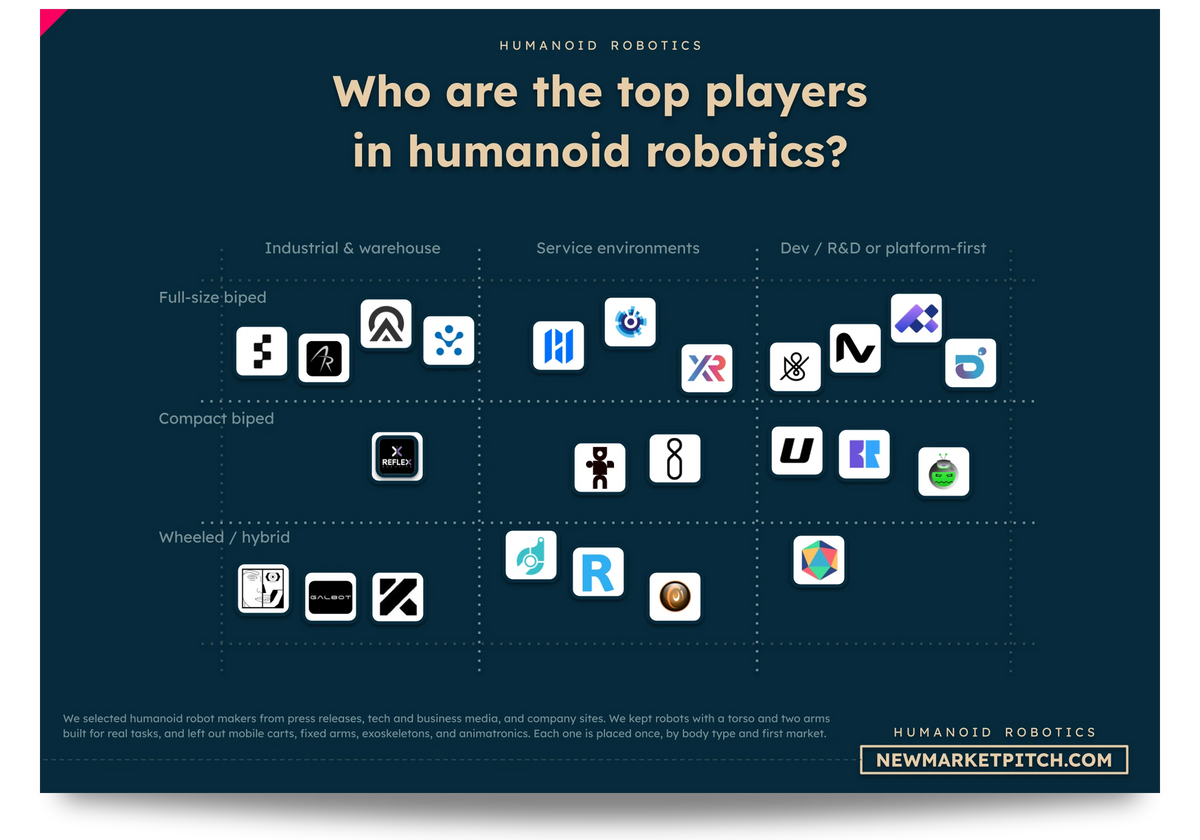
In our research about humanoid robots, we turn what is vague and complex into simple, useful visuals. Market maps like this one show you at a glance where every startup stands.
Is humanoid robotics funding actually booming right now?
Humanoid robotics funding is clearly much stronger today, although most of the extra money is flowing into very large rounds.
We counted 109 financings from Q2 2025 through Q2 2026. Deal volume rose from 21 to 27 between the two Q2 periods, while disclosed capital jumped from $461 million to $2.782 billion. Funding grew about sixfold while the number of deals increased by less than 30%.
The difference comes from the top end of the market. Deals of $50 million or less generated $308 million in Q2 2025 and $262 million in Q2 2026. The smaller and mid-sized part of the market has barely expanded in dollar terms.
The latest product developments fit that picture. Figure is ramping Figure 03 production, building a much larger physical-data pipeline through Index and, more recently, securing access to up to 100,000 next-generation GPUs for Helix. Apptronik has meanwhile moved into Apollo 2 and opened Robot Park sites built around continuous real-world data collection. The biggest companies are spending at a completely different scale from a year ago.
| Quarter | Deals | Capital | Median round | Capital from deals ≤$50M |
|---|---|---|---|---|
| Q2 2025 | 21 | $461M | $14.0M | $308M |
| Q3 2025 | 22 | $1.365B | $14.0M | $72.8M |
| Q4 2025 | 16 | $1.158B | $31.7M | $285M |
| Q1 2026 | 23 | $2.397B | $64.0M | $250M |
| Q2 2026 | 27 | $2.782B | $29.6M | $262M |
| Q2'25 → Q2'26 | +28.6% | about +503% | about +111% | about -15% |
When did humanoid robotics funding really take off?
Q1 2026 was the real turning point for humanoid robotics funding.
Q3 2025 produced a spectacular jump in capital, but the rest of the market barely moved with it. Deal count went from 21 to 22 and the median round stayed around $14 million. A spike in one quarter with little change elsewhere stands out; we go over how the past year shifted in our report on humanoid robots.
Q1 2026 looked very different. Deals jumped from 16 to 23, quarterly funding more than doubled from $1.158 billion to $2.397 billion, and the median round reached $64 million. Ten companies raised at least $100 million during the quarter, compared with four in Q4 2025.
The move continued into Q2, when deal count reached 27 and twelve rounds crossed $100 million. That two-quarter sequence is much more convincing than the earlier one-company spike.
Was the Q3 2025 humanoid robotics funding surge basically just Figure AI?
Pretty much. Figure AI explains most of the Q3 2025 humanoid robotics funding surge.
Figure announced more than $1 billion of committed Series C capital on September 16, 2025. That financing alone represents roughly 73% of the quarter's capital in our research.
The rest of the quarter looked much less extraordinary. The median round was still about $14 million, unchanged from Q2, and removing deals above $50 million brings known capital down to $72.8 million. Nine deals lacked a usable numerical amount, so that figure understates some smaller-round activity, but Figure's weight is still obvious.
The size of the round also makes more sense when we look at what Figure was already building. Earlier in 2025, the company launched Helix and announced BotQ, a factory designed for up to 12,000 humanoids per year on its first-generation line. Figure later said the Series C would fund production, GPU infrastructure and real-world data collection. Those are expensive problems, and the financing reflected that.

Your time is limited. In our market report about humanoid robots, we put numbers on each part of the market, so you can see where it makes sense to focus.
Why did humanoid robotics funding look healthier in Q4 2025 even with fewer deals?
Q4 2025 had fewer humanoid robotics deals, yet the money was spread much more evenly across the market.
Deal count dropped from 22 to 16 and total funding slipped 15%. Those headline numbers look weak until we look at round sizes.
The median financing more than doubled from about $14 million to $31.7 million. Known capital from deals of $50 million or less recovered from $72.8 million to $285 million. Four rounds topped $100 million, twice as many as in Q3.
The largest financing accounted for roughly 26% of quarterly capital, down from 73% one quarter earlier. Q4 was the first quarter where bigger checks began showing up across several companies rather than being almost entirely explained by Figure.
Did humanoid robotics really enter a scaling phase in Q1 2026?
Yes. Q1 2026 is where humanoid robotics financing starts to look like serious industrial scaling.
Apptronik gives us one of the clearest examples. On February 11, the company announced a $520 million Series A-X extension, taking its Series A above $935 million. Apptronik said the money would help ramp Apollo production, expand commercial and pilot deployments and build robot-training and data-collection infrastructure.
The investor mix also tells us something. Google, Mercedes-Benz and B Capital returned, while John Deere, QIA and AT&T Ventures joined. Mercedes-Benz was already testing Apollo inside manufacturing operations, and Google DeepMind had begun working with Apptronik on Gemini Robotics. Backers returning and new ones joining shows who is funding whom, which we lay out in our humanoid robotics market report.
Apptronik has since opened its expanded Robot Park and unveiled Apollo 2, with fleets collecting real-world training data across company and customer locations. Google DeepMind's latest Gemini Robotics 2 work also shows Apollo 2 carrying out whole-body tasks. Those more recent developments make the huge Q1 financing easier to understand: the money was going into production capacity, data, AI and deployment infrastructure that companies are now visibly using.
Was Q2 2026 broad growth in humanoid robotics, or mostly more giant rounds?
Q2 2026 broadened in deal count, while giant rounds still controlled almost all of the money.
The quarter reached 27 financings, the highest total in the five-quarter period. At the same time, the median round fell from $64 million to $29.6 million. More companies were getting funded again at the lower end.
Fifteen of the 27 deals were below $50 million. Yet twelve separate financings exceeded $100 million, and those twelve captured 90.6% of quarterly capital.
This is quite different from Q3 2025. The largest Q2 2026 round represented only 16.4% of the quarter. Funding was still extremely top-heavy, but the money was now spread across a whole group of large companies.
| Quarter | <$5M | $5M–<$20M | $20M–<$50M | $50M–<$100M | $100M+ | Amount unknown |
|---|---|---|---|---|---|---|
| Q2 2025 | 3 | 7 | 7 | 0 | 1 | 3 |
| Q3 2025 | 5 | 3 | 1 | 2 | 2 | 9 |
| Q4 2025 | 0 | 4 | 6 | 2 | 4 | 0 |
| Q1 2026 | 0 | 3 | 7 | 1 | 10 | 2 |
| Q2 2026 | 2 | 8 | 5 | 0 | 12 | 0 |
| Q2'25 → Q2'26 | 3 → 2 | 7 → 8 | 7 → 5 | 0 → 0 | 1 → 12 | 3 → 0 |

In our document detailing everything you need to know about humanoid robotics, we always try to gather several sources and make estimates that make sense, so you can work with solid numbers.
Are more new humanoid robotics startups getting funded now?
No. New humanoid robotics startups are not taking a bigger share of funding today.
First financings moved from five in Q2 2025 to two, three, two and then four in Q2 2026. There is no sustained increase.
Follow-on financings dominate every quarter. Their median size is the more striking change: $13.9 million in Q2 2025, $42 million by Q4, $64 million in Q1 2026 and $102 million in Q2.
Most of the new money is going to companies that have already raised capital and are coming back for much bigger rounds as they build factories, train models, collect data and prepare deployments.
Financing status comes from our review of publicly available funding histories, so we treat borderline cases conservatively rather than pretending every company's historical financing record is perfectly complete.
| Quarter | First financings | Follow-ons | Follow-on share | Follow-on median |
|---|---|---|---|---|
| Q2 2025 | 5 | 16 | 76.2% | $13.9M |
| Q3 2025 | 2 | 20 | 90.9% | $14.6M |
| Q4 2025 | 3 | 13 | 81.3% | $42M |
| Q1 2026 | 2 | 21 | 91.3% | $64M |
| Q2 2026 | 4 | 23 | 85.2% | $102M |
| Q2'25 → Q2'26 | 5 → 4 | 16 → 23 | +9.0 pp | about 7.3× |
Are humanoid robotics investors moving to later-stage companies?
Humanoid robotics checks are getting much bigger, while the stage mix keeps swinging around.
Early-stage financings represented 76.2% of deals in Q2 2025 and 81.8% in Q3. The share fell to 56.3% in Q4 and 34.8% in Q1 2026, then bounced back to 55.6% in Q2.
Company age is equally revealing. The median company raising money stayed around two years old for most of the period. Investors are therefore writing enormous checks surprisingly early in company life. Enormous checks going to two-year-old companies is notable; we lay out where the biggest rounds land in our humanoid robots market report.
TARS Robotics is the extreme example. The company was founded in 2025 and, according to Caixin, raised $455 million in a Pre-A round in April 2026. Calling a $455 million financing "Pre-A" shows how little the traditional stage label tells us here.
Stage coverage is also imperfect, reaching only 60.9% in Q1 and 70.4% in Q2. For humanoid robotics these days, round size, company history and what the money is funding often tell us more than the letter attached to the round.
Which humanoid robotics category has the strongest momentum right now?
Humanoid AI Platforms have the clearest momentum currently, while several other apparent category booms have already faded.
AI Platforms recorded three deals in Q2 2025, three in Q3, two in Q4, four in Q1 2026 and five in Q2. More importantly, their capital share rose from 5.0% in Q4 to 14.4% in Q1 and 24.7% in Q2. AI platforms drawing a growing share of capital is a clue to where the openings are, covered in our report covering humanoid robots.
Known median round size moved the same way, reaching $86 million in Q1 and $145 million in Q2. X Square Robot's roughly $290 million Series B is one example of investors putting large amounts behind companies combining embodied foundation models with robot hardware.
Consumer Home Robots went the other way. The category suddenly jumped to seven deals in Q1 2026 after recording only one in each of the previous two quarters, then immediately fell back to one deal in Q2. For now, that looks like a short-lived burst rather than a lasting rotation.
General Purpose Humanoids still attract huge amounts of capital, but AI Platforms show the cleanest quarter-to-quarter improvement across deal count, capital share and typical round size.

Our report covering the humanoid robotics market gets updated several times a month, so you always get the latest view of where things stand.
Are humanoid robot component suppliers finally attracting serious funding?
Humanoid robot component suppliers are getting much more investor attention, especially in the number of deals.
Actuation Component Suppliers went from two deals in Q2 2025 to five in Q3, four in Q4, two in Q1 and eight in Q2 2026. By the latest quarter they matched General Purpose Humanoids for 29.6% of all transactions.
The checks are still much smaller. Those eight Q2 component deals captured only 8.8% of the quarter's capital, with a median of about $14 million.
Linkerbot shows why we need several quarters before calling a change. Its roughly $215 million financing made component funding look unusually large in Q1. Q2 then brought many more supplier deals without another comparable giant round.
The breadth is real. Investors are increasingly financing dexterous hands, actuators and other pieces of the humanoid supply chain, even though most of the industry's biggest checks still go to full robot or AI-platform companies.
Is China taking over humanoid robotics funding?
China and the wider APAC region already dominate humanoid robotics deal volume, and by Q2 2026 they were dominating capital too.
APAC represented at least 75% of financings in every quarter we studied. Its deal share reached 96.3% in Q2 2026.
North America's earlier capital spikes came from very few companies. Figure alone pushed North America to 73.2% of Q3 2025 funding despite the region having only two deals. Apptronik had a similar, smaller effect in Q1 2026.
Q2 looked different: APAC accounted for 99.6% of known capital. The quarter included TARS's $455 million financing and several large Chinese platform and general-purpose robot rounds.
China is also pushing deployment more aggressively. In June 2026, the Ministry of Industry and Information Technology and the State-owned Assets Supervision and Administration Commission launched a real-world training program for humanoid robots and embodied AI. The program targets more than 100 high-value application scenarios and the capacity for deployment at the scale of tens of thousands of units by the end of 2026.
That policy did not create the Q2 funding boom; several large financings had already closed. It does show how closely the country's capital activity now sits alongside manufacturing, training data and real deployment programs.
Are the same investors funding every humanoid robotics company?
No. The humanoid robotics lead-investor pool actually widened as funding activity increased.
We identified 18 distinct leads or co-leads in Q2 2025, followed by 21, 18, 21 and then 35 in Q2 2026.
Even in the latest quarter, repeat activity was limited. Shunwei Capital and HongShan each appeared on two deals. Over the full period, Shenzhen Capital Group and Matrix Partners China were among the more regular names, but neither came close to controlling a large share of the market.
The move from 21 to 35 identified leads between Q1 and Q2 is especially useful because deal count only increased from 23 to 27. More financing was coming from a noticeably wider set of investors.

In our research about humanoid robots, we look at what the winners do differently, so you can learn from the best instead of guessing.
Why are strategic investors writing much bigger checks in humanoid robotics?
Strategic investors now show up in much larger humanoid robotics rounds even though their share of deals has barely changed.
Strategic participation ranged from roughly 41% to 62% of deals across the period. Q2 2026 sat at 51.9%, so there is no steady march upward in frequency.
Round size changed far more. The median strategic-backed financing rose from $27 million in Q2 2025 to $143 million in Q1 2026 and $139 million in Q2. Strategic backers writing ever bigger checks is why we study which investors are making the biggest bets in our report on humanoid robots.
The names make the shift easy to understand. Google and Mercedes-Benz participated in Apptronik's $520 million extension as Apollo moved deeper into AI training and manufacturing deployments. Meituan Strategic Investment joined the $455 million TARS financing. Xiaomi Strategic Investment appears across several Chinese humanoid, AI-platform and component deals in our research.
Mercedes-Benz offers a particularly concrete example of what strategic capital can connect to. The automaker has tested Apptronik's Apollo in production environments, including intralogistics and quality-related tasks, and separately disclosed an investment in Apptronik. That is much closer to an industrial deployment relationship than a conventional financial bet.
| Quarter | Strategic deals | Deal share | Median strategic-backed round | Main pattern |
|---|---|---|---|---|
| Q2 2025 | 13 | 61.9% | $27M | Frequent, smaller rounds |
| Q3 2025 | 9 | 40.9% | $83.6M | Figure lifts the median |
| Q4 2025 | 8 | 50.0% | $65.8M | Larger rounds spread out |
| Q1 2026 | 11 | 47.8% | $143M | Scaling rounds become common |
| Q2 2026 | 14 | 51.9% | $139M | Large strategic rounds persist |
| Q2'25 → Q2'26 | 13 → 14 | -10.0 pp | about 5.1× | Ticket size changed far more than frequency |
Are general-purpose humanoid robots losing investor interest?
General-purpose humanoid robots are losing share of the deal count, while still absorbing a huge share of the money.
General Purpose Humanoids fell from 11 deals in Q2 2025 to eight in Q2 2026. Their share of total transactions dropped from 52.4% to 29.6%.
Capital has held up much better. The category still captured 59.5% of Q2 2026 funding.
That makes sense as the industry fills out around the robot itself. More money is now reaching AI platforms, dexterous hands, actuators and other specialist layers. At the same time, building a complete humanoid remains brutally expensive, so companies such as TARS and Figure can still dominate the dollar totals.
Fresh developments at Figure underline how capital-intensive the full-stack model has become. The company said in April that BotQ had produced more than 350 Figure 03 robots and had improved output from one robot per day to one per hour. More recently, Figure announced Index, committed to spend more than $1 billion on data and compute over the following year, and signed an infrastructure agreement covering up to 100,000 GPUs. Full-stack humanoids increasingly require an AI-company-sized infrastructure budget on top of the hardware budget.

In our market report about humanoid robots, we don't want to repeat what boring consulting reports say. Instead, we show you the real and latest market signals that matter.
What's the biggest mistake people make when reading humanoid robotics funding right now?
The biggest mistake is treating the roughly sixfold jump in quarterly humanoid robotics capital as a sixfold expansion of the market.
Deal activity has grown, but nowhere near that fast. The extraordinary change is the number of companies now able to raise nine-figure sums.
As seen above, twelve $100 million-plus rounds appeared in Q2 2026, compared with only one a year earlier. At the same time, fifteen of Q2's 27 financings were still below $50 million and together accounted for less than 10% of capital.
The market has become much deeper at the top. That is a meaningful change, but headline funding totals can make the broader startup base look stronger than it really is.
Recent operating progress gives those huge financings more substance than they had a year ago. Figure says its latest Helix 2.5 system can generalize across 30 previously unseen homes, while Apptronik and Google DeepMind are working on full-body humanoid intelligence through Apollo 2 and Gemini Robotics 2. We still do not know how quickly these systems will become economical at large commercial scale, but the companies raising the biggest rounds are clearly spending the money on real manufacturing, data, compute and deployment work.
What is the humanoid robotics funding trend actually telling us?
Humanoid robotics funding has become substantially stronger since Q2 2025, with the clearest change happening at the top of the market. Nine-figure rounds went from rare to routine across multiple companies.
Q3 2025 gave an exaggerated early impression because Figure AI alone drove most of the quarter. Q4 broadened the increase in check sizes, and Q1 2026 was when the move became convincing across several companies. Q2 then showed that the big-round environment was still intact.
The startup base is expanding much more slowly. First financings remain scarce, follow-ons dominate, and the typical follow-on round has grown dramatically. Investors are mostly giving existing companies more money to scale rather than financing a wave of new entrants. With the money going mostly to existing companies, we ask who the likely future winners are in our humanoid robots report.
Humanoid AI Platforms currently have the cleanest category momentum. Actuation suppliers are also getting more attention, particularly in deal count. The short-lived Q1 spike in Consumer Home Robots shows why a single strong quarter should still be treated carefully.
Stage labels are becoming less useful in this market. A young company can raise hundreds of millions of dollars in a Seed, Series A or Pre-A round, so company age, previous financing history and what the capital is paying for often give a clearer picture.
Strategic investors are participating in much larger rounds, while the lead-investor base itself is broadening. That combination fits what we are seeing outside the funding data: more factory deployments, more real-world training programs, more physical-data collection and much heavier spending on compute.
Humanoid robotics has moved into a much more capital-intensive phase. The hard part now is converting that money into reliable robots that can work for long periods, learn from real environments and eventually deliver economics that justify the scale of investment.

Learning from others' mistakes is the cheapest lesson there is. In our document detailing everything you need to know about humanoid robotics, we look at what broke startups before you, so you don't repeat it.
Our methodology
This analysis covers private-company humanoid robotics financings announced from April 1, 2025 through June 30, 2026, giving us five complete calendar quarters from Q2 2025 through Q2 2026. The objective was to build a quarter-by-quarter view of how deal activity, round size, capital concentration, financing status, category mix, geography and investor participation changed over that period.
We applied a strict market-definition test. Humanoid robotics had to represent an overwhelming part of the company's core business at the time of financing. Borderline companies were left out rather than included simply because they had some exposure to robotics or embodied AI.
We included qualifying private-company equity financings that met the dataset's deal-size rules. Debt, grants, loans, public offerings and financings where the equity component could not be isolated were excluded. Duplicate reports of the same round were consolidated, while extensions, additional closes and tranches were reviewed individually to determine whether they represented distinct financing events.
Dates, stages, investors, previous financing history, company age, strategic-investor participation and other deal details were recorded only when public evidence supported them. We did not infer a financing stage from round size, assume that a prominent investor was the lead, or convert vague disclosures such as "several hundred million RMB" into falsely precise amounts.
Of the 109 financings in the five-quarter analysis, several amounts were disclosed as approximations or minimums and 14 deals did not have a usable numerical amount. Q3 2025 has the weakest amount coverage, which is why comparisons involving smaller rounds in that quarter deserve more caution than the deal-count comparisons.
We kept "not applicable," "not disclosed" and "could not be established reliably" separate wherever the public evidence allowed us to do so. When reputable sources disagreed or a financing structure was unusually difficult to compare, we preserved the uncertainty instead of silently choosing the cleaner-looking number.
After building the initial dataset, we ran a separate completeness and quality-control pass focused on missed deals, quarter boundaries, company fit, the equity nature of each financing and duplicate reporting. The quarterly counts, medians, capital concentration, deal-size buckets, financing-status changes, category shifts, geographic mix and investor activity were calculated from that reviewed dataset.
Key sources used for company financing and operating context include Figure's Series C announcement, Figure's BotQ manufacturing update, Figure's Index announcement, Figure's Nscale infrastructure partnership, Apptronik's Series A-X financing announcement, Apptronik's Apollo 2 and Robot Park update, Google DeepMind on Gemini Robotics and Apptronik, Google DeepMind on Gemini Robotics 2, Mercedes-Benz on Apollo testing and its Apptronik relationship, Caixin on TARS Robotics' $455 million Pre-A financing, and China's Ministry of Industry and Information Technology on the 2026 real-world humanoid robotics and embodied-AI training program.
Our guiding rule throughout was simple: when the evidence was uncertain, the uncertainty stayed in the dataset. A slightly incomplete figure that can be defended is more useful than a cleaner-looking number built on guesses.

If you build or invest in the humanoid robotics market, you need to know which business models pay off now and which ones are fading. That's why our report covering it has a whole section on it.
Written by the New Market Pitch teamWe track new markets so founders and investors can move faster. About us