What are the most valuable humanoid robotics startups?
Building a startup or looking for your next investment in humanoid robotics? Our report gives you the full picture.
Summary
Figure AI is the most valuable humanoid robotics startup today, valued at $39.0B, far ahead of AgiBot at $5.5B–$7.5B, Apptronik at $5.3B, and 1X Technologies at $4.0B–$6.0B. Figure's valuation reflects investor expectations for general-purpose robot intelligence and future mass production, even though commercial humanoid deployments remain relatively small.
Figure's $39 billion funding-round valuation in September 2025 established a remarkable benchmark for the industry. Its valuation is about six times AgiBot's central estimate of $6.5B, despite AgiBot having a much larger publicly reported shipment volume.
Our ranking identifies 27 humanoid robotics startups valued at $1 billion or more across their entire estimated ranges, with another four potentially exceeding that threshold. The sector already has a substantial collection of unicorns, long before humanoid robots have become standard industrial equipment.
China currently leads the manufacturing race. AgiBot shipped approximately 9,700 humanoids in the first half of 2026, accounting for more than 43% of worldwide shipments, while American developers remain particularly strong in financing, robot intelligence, and industrial partnerships.
Shipment growth is impressive, but the types of customers buying robots tell a more complicated story. More than 60% of first-half 2026 shipments went to entertainment, performance, research, and data-production applications, compared with just 18% for manufacturing and warehousing combined.
Agility Robotics stands out for commercial execution rather than valuation. Its Digit robots have moved more than 100,000 totes at GXO, accumulated substantial operating hours, and attracted more than $300 million in multiyear contracted orders.
Factories currently offer a clearer business opportunity than households. Manufacturers can measure productivity against specific tasks, while domestic robots must handle unpredictable environments, delicate objects, and countless chores that remain difficult to automate reliably.
Hardware prices alone give a misleading picture of robot economics. A hypothetical $30,000 robot depreciates at just $3 per productive hour over five years when used for 2,000 hours annually, but that figure rises to $12 at only 500 productive hours, before maintenance and supervision.
Robot intelligence could eventually become a more powerful competitive advantage than hardware design. Companies including Figure, NEURA Robotics, Galbot, and X Square Robot are developing systems intended to transfer learned capabilities across tasks, environments, and potentially large fleets of machines.
The biggest financial question remains profitability. Global humanoid shipments exceeded 22,000 in the first half of 2026, but the leading private manufacturers have released little information about margins or sustained profits. Today's multibillion-dollar valuations depend heavily on future commercial scale, reliable autonomy, and repeat customer orders.

Written by the New Market Pitch teamWe track new markets so founders and investors can move faster. About us

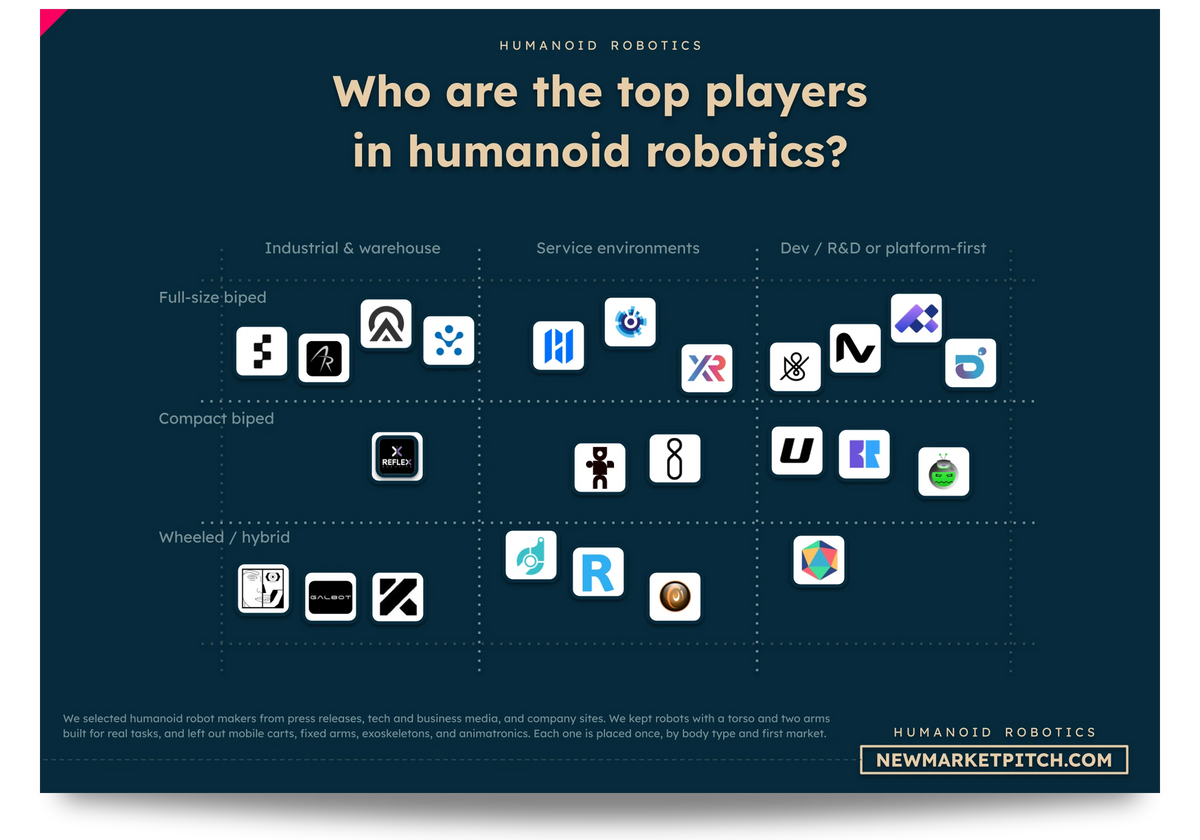
In our report covering the humanoid robotics market, we turn what is vague and complex into simple, useful visuals. Market maps like this one show you at a glance where every startup stands.
Top startups in the humanoid robotics market ranked by valuation
Here is an updated table that ranks the top startups in the humanoid robotics market based on their latest reported or estimated valuations.
If you need to dig deeper and get more detailed data, please check our report covering the humanoid robotics market.
| # | Startup | Valuation | Confidence | Valuation basis | Last round | Total funding |
|---|---|---|---|---|---|---|
| 1 | Figure AIGeneral-purpose AI humanoid robots | $39.0Bas of Sep 2025 | Full | Announced private round valuation | UndisclosedStrategic equity investment · Sep 2026 | $1.85B+valued at 21.1× this |
| 2 | AgiBotIndustrial and service humanoid robots | $5.5B–$7.5Bas of Oct 2026 | Strong | Implied valuation from raise | UndisclosedStrategic financing · Aug 2025 | $221M+valued at 29.4× this |
| 3 | ApptronikAI humanoids for industrial automation | $5.3Bas of Feb 2026 | Full | Announced private round valuation | $520MSeries A-X · Feb 2026 | $950M+valued at 5.6× this |
| 4 | 1X TechnologiesAutonomous humanoid robots for homes | $4.0B–$6.0Bas of Aug 2026 | Strong | Implied valuation from raise | $100MSeries B · Jan 2024 | $138Mvalued at 36.1× this |
| 5 | NEURA RoboticsCognitive humanoid and industrial robots | ~$4.4Bas of Mar 2026 | Strong | Announced private round valuation | UndisclosedSeries C · Jun 2026 | $215M+valued at 20.4× this |
| 6 | Foundation RoboticsAutonomous robots for industrial operations | $3.4Bas of Oct 2026 | Partial | Announced private round valuation | $300MSeries A-2 · Oct 2026 | $498Mvalued at 6.8× this |
| 7 | AI² RoboticsIndustrial humanoids and embodied intelligence | $2.3B–$4.5Bas of Nov 2026 | Partial | Comparables-based estimate | ~$694MSeries C · Jun 2026 | $910M+valued at 3.7× this |
| 8 | Galaxea AIEmbodied AI models and robots | $2.9B–$3.5Bas of Nov 2026 | Partial | Comparables-based estimate | UndisclosedSeries C · Aug 2026 | $563M+valued at 5.7× this |
| 9 | SharpaDexterous humanoids and robotic hands | $2.8B–$3.4Bas of Nov 2026 | Partial | Comparables-based estimate | $667MMultiple private financing events · Sep 2026 | $667M+valued at 4.6× this |
| 10 | GalbotGeneral-purpose embodied AI humanoids | $3.0Bas of Mar 2026 | Full | Announced private round valuation | $363MStrategic · Mar 2026 | $982M+valued at 3.1× this |
| 11 | X Square RobotGeneral-purpose embodied AI robots | $2.8B–$3.0B | Strong | Implied valuation from raise | UndisclosedSeries C · Jun 2026 | $641Mvalued at 4.5× this |
| 12 | Spirit AIEmbodied AI models for robots | $2.3B–$3.4Bas of Nov 2026 | Partial | Comparables-based estimate | ~$209MSeries A · Jun 2026 | $818M+valued at 3.5× this |
| 13 | GigaAIPhysical AI models and robots | $2.5B–$3.2Bas of Nov 2026 | Partial | Comparables-based estimate | $140MSeries B2 · Jun 2026 | ~$537Mvalued at 5.3× this |
| 14 | Agility RoboticsHumanoid robots for industrial logistics | $2.5Bas of Nov 2026 | Partial | Comparables-based estimate | UndisclosedLate VC · Sep 2025 | $651Mvalued at 3.8× this |
| 15 | LimX DynamicsGeneral-purpose humanoid robotic platforms | $2.0B–$2.5Bas of Nov 2026 | Strong | IPO or listing range valuation Estimated | ~$200MPre-IPO · Jul 2026 | $427M+valued at 5.3× this |
| 16 | Astribot1Dexterous humanoids and embodied AI | $2.1B–$2.3B | Strong | Implied valuation from raise | ~$149MNew financing · Oct 2026 | $298M+valued at 7.4× this |
| 17 | TARS RoboticsIndustrial humanoids and foundation models | $1.9Bas of Apr 2026 | Full | Announced private round valuation | $455MPre-Series A · Apr 2026 | $697Mvalued at 2.7× this |
| 18 | Rhoda AIVideo-trained AI for industrial robotics | $1.7Bas of Mar 2026 | Full | Announced private round valuation | $450MSeries A-2 · Mar 2026 | $680Mvalued at 2.5× this |
| 19 | RobotEra1Humanoid robots and dexterous manipulation | $1.4B–$1.8Bas of Nov 2026 | Partial | Comparables-based estimate | ~$140MStrategic · Jul 2026 | $744M+valued at 2.2× this |
| 20 | PsiBotEmbodied AI and dexterous manipulation | $1.3B–$1.8Bas of Nov 2026 | Partial | Comparables-based estimate | $100M+Strategic · Aug 2026 | $380M+valued at 4.1× this |
| 21 | EngineAIFull-size humanoids for industrial applications | $1.5Bas of Apr 2026 | Full | Announced private round valuation | $200MSeries B · Apr 2026 | $367M+valued at 4.1× this |
| 22 | DexForceEmbodied AI and wheeled humanoids | $1.0B–$1.8B | Partial | Implied valuation from raise | ~$138MSeries B · Jun 2026 | $140M+valued at 10.0× this |
| 23 | HumanoidIndustrial humanoid robot workforce | $1.3B–$1.4B | Strong | Implied valuation from raise | $152MSeries A · Jul 2026 | $152Mvalued at 8.9× this |
| 24 | Kunlunxing RoboticsHumanoid hardware and world models | $1.0B–$1.5B | Partial | Comparables-based estimate | UndisclosedSecond financing round · May 2026 | Undisclosed |
| 25 | Simplexity RoboticsFull-stack embodied AI robotic systems | $1.0B–$1.3B | Strong | Implied valuation from raise | UndisclosedMar 2026 | $289Mvalued at 4.0× this |
| 26 | Sunday RoboticsAutonomous household assistant robots | $1.1B–$1.2B | Strong | Implied valuation from raise | $165MSeries B · Mar 2026 | $200Mvalued at 5.8× this |
| 27 | Leju RoboticsHumanoid robots for industrial applications | $850M–$1.4Bas of Nov 2026 | Partial | Comparables-based estimate | ~$210MPre-IPO · Oct 2025 | $251M+valued at 4.4× this |
| 28 | Walden RoboticsGeneral-purpose robots for industrial work | $1.1B | Full | Announced private round valuation | $300MSeed · Jul 2026 | $300Mvalued at 3.7× this |
| 29 | Anyverse Dynamics1General-purpose embodied intelligence robots | $800M–$1.2B | Partial | Comparables-based estimate | $200M+Seed · Jun 2026 | $200Mvalued at 5.0× this |
| 30 | Moqi Intelligent TechnologyEmbodied AI commercial humanoid robots | $800M–$1.2B | Partial | Comparables-based estimate | ~$148MEarly VC · Jul 2026 | $276M+valued at 3.6× this |
| 31 | Futuring RobotIntelligent robots for household tasks | $700M–$1.2B | Partial | Implied valuation from raise | $147MPre-A · Jul 2026 | $176M+valued at 5.4× this |
| 32 | Persona AIIndustrial humanoid robotic welders | $750M–$850Mas of Nov 2026 | Strong | Implied valuation from raise | $65MSeries A · Oct 2026 | $107Mvalued at 7.5× this |
| 33 | Zhejiang Humanoid Robot Innovation CenterIndustrial humanoids and precision automation | $600M–$900M | Partial | Implied valuation from raise | ~$64MPre-Series A · Jan 2026 | $152M+valued at 4.9× this |
| 34 | Noetix RoboticsAffordable consumer and industrial humanoids | $550M–$900Mas of Nov 2026 | Partial | Comparables-based estimate | ~$145MSeries B · Mar 2026 | $230M+valued at 3.2× this |
| 35 | Dyna RoboticsFoundation-model-powered robotic automation | $600M–$850Mas of Nov 2026 | Partial | Comparables-based estimate | $120MSeries A · Sep 2025 | $144Mvalued at 5.1× this |
| 36 | Tutor IntelligenceAI-powered industrial automation robots | $500M–$938Mas of Nov 2026 | Strong | Implied valuation from raise | $75MSeries B · Nov 2026 | $121M+valued at 5.9× this |
| 37 | Holiday RoboticsDexterous industrial humanoid robots | $600M–$750M | Partial | Implied valuation from raise | $105MSeries A · Jul 2026 | $105M+valued at 6.4× this |
| 38 | ZerothAutonomous household and companion robots | $500M–$800M | Partial | Implied valuation from raise | ~$74MPre-Series A · Jul 2026 | $140M+valued at 4.6× this |
| 39 | Striding AIFoundation models for physical AI | $400M–$600M | Partial | Implied valuation from raise | $100MAngel · Jun 2026 | ~$100Mvalued at 5.0× this |
| 40 | Sanctuary AIGeneral-purpose humanoids for enterprise labor | $250M–$550Mas of Nov 2026 | Partial | Comparables-based estimate | $1.6MSeries A Follow-on · Apr 2026 | $110M+valued at 3.6× this |
| 41 | Generative BionicsHuman-centric industrial humanoid robots | $320M–$430M | Partial | Implied valuation from raise | ~$82MSeed · Dec 2025 | $82M+valued at 4.6× this |
| 42 | MagicLab1Humanoid and quadruped robotic systems | $300M–$450M | Partial | Comparables-based estimate | ~$70MStrategic · Mar 2026 | $91M+valued at 4.1× this |
| 43 | Knowin AI1General-purpose household embodied AI robots | $280M–$450M | Partial | Implied valuation from raise | $70MAngel+++ · Sep 2026 | $71M+valued at 5.1× this |
| 44 | Lumos RoboticsIndustrial humanoids and mobile manipulators | $300M–$420M | Partial | Comparables-based estimate | ~$138MSeries A · May 2026 | $147M+valued at 2.4× this |
| 45 | Wuba Intelligent TechnologyIndustrial and security humanoid robots | $275M–$415M | Partial | Comparables-based estimate | ~$70MStrategic / Series A · Oct 2025 | $70Mvalued at 4.9× this |
| 46 | Beijing Innovation Center of Humanoid RoboticsHumanoid platforms and embodied AI | $220M–$330M | Partial | Comparables-based estimate | $100M+First Market-Based financing · Feb 2026 | $100Mvalued at 2.8× this |
| 47 | DexmateWheeled humanoids and physical AI | $180M–$340M | Partial | Implied valuation from raise | UndisclosedEarly VC · Aug 2026 | $41M+valued at 6.3× this |
| 48 | RoboForceAutonomous robots for industrial labor | $210M–$310M | Partial | Comparables-based estimate | $52MSeries A · Mar 2026 | $67Mvalued at 3.9× this |
| 49 | UniX AIGeneral-purpose humanoid service robots | $200M–$300M | Partial | Comparables-based estimate | UndisclosedAug 2026 | $70M+valued at 3.6× this |
| 50 | Booster RoboticsHumanoid robots for research and education | $140M–$300M | Low | Comparables-based estimate | ~$146MSeries A-IV · Apr 2026 | $188M+valued at 1.2× this |
| 51 | CASBOTGeneral-purpose humanoids and robotic manipulators | $140M–$280M | Partial | Implied valuation from raise | $14M+Series A++ · Oct 2026 | $28M+valued at 7.5× this |
| 52 | Westlake RoboticsLegged robots and embodied intelligence | $150M–$250M | Partial | Implied valuation from raise | $15MSeries A · Aug 2026 | $99M+valued at 2.0× this |
| 53 | PNDbotics1General-purpose humanoid robotic platforms | $110M–$165M | Low | Comparables-based estimate | $29M+Series B · Feb 2026 | $29M+valued at 4.7× this |
| 54 | Matrix RoboticsFull-size industrial humanoid robots | $80M–$180M | Low | Proxy-based estimate | UndisclosedStrategic financing · Dec 2025 | Undisclosed |
| 55 | ATOM HumanoidJapanese humanoids and physical AI | $76M–$127M | Partial | Implied valuation from raise | ~$19MSeed · May 2026 | $19Mvalued at 5.3× this |
| 56 | Zerith Robotics1Commercial humanoids for service automation | $65M–$120M | Low | Implied valuation from raise | $14M+Series A · Apr 2026 | $14M+valued at 6.6× this |
| 57 | DroidUpHumanoid robots for service applications | $55M–$110M | Low | Comparables-based estimate | ~$14MPre-A+ · Feb 2026 | $28Mvalued at 2.9× this |
| 58 | Enchanted ToolsSocial robots for human assistance | $50M–$100M | Low | Comparables-based estimate | ~$11MEarly VC · May 2023 | $28Mvalued at 2.7× this |
No startups match this search.
- Total funding is a minimum: some rounds have no public amount.

Our research about humanoid robots gets updated several times a month, so you always get the latest view of where things stand.
Which humanoid robotics startups are worth the most today?
Figure AI is by far the most valuable humanoid robotics startup right now, with a valuation of $39.0B. AgiBot follows at $5.5B–$7.5B, then Apptronik at $5.3B, 1X Technologies at $4.0B–$6.0B, and NEURA Robotics at about $4.4B. Figure's lead is striking because the industry is still at an early stage of commercial adoption.
Figure announced more than $1 billion in Series C commitments in September 2025 at a $39 billion post-money valuation. Investors included NVIDIA, Brookfield, Intel Capital, and Salesforce, alongside lead investor Parkway Venture Capital. The company is betting that its Helix AI system and humanoid manufacturing operations can eventually serve several huge markets, from automotive production to household assistance.
The other leading companies have different strengths. AgiBot is already shipping robots in substantial quantities. Apptronik is developing its Apollo humanoid for industrial customers, supported by strategic investors including Google and Mercedes-Benz. 1X Technologies is aiming at homes with its NEO robot, while NEURA Robotics is building an ecosystem of cognitive robots and shared AI capabilities.
What's interesting is how much investors currently value the possibility of building a general-purpose robot platform. Figure has an enormous financial lead, although AgiBot's shipment volumes and Agility Robotics' operational track record show that the companies making the most progress commercially are not necessarily those with the highest valuations.
Why are humanoid robotics startup valuations growing so fast?
Humanoid robotics startups are attracting much larger investments because AI has made general-purpose robots more believable, and manufacturers are starting to put them to work. Investors are financing the possibility of a large new industry, years before its full commercial potential can be measured.
Goldman Sachs made a major change to its forecasts in February 2024. It increased its estimate for the global humanoid robotics market in 2035 from $6 billion to $38 billion and raised projected annual shipments to 1.4 million robots. Better AI capabilities and an estimated 40% decline in manufacturing costs were important reasons for that revision.
The financing that followed shows how quickly expectations changed. Apptronik announced a $415 million Series A in 2025 and extended it by another $520 million in February 2026. NEURA Robotics announced a Series C financing of up to $1.4 billion in June 2026. Figure's September 2025 round crossed $1 billion in commitments.
Those are enormous amounts for companies still building their first large-scale commercial operations. Investors expect the eventual opportunity to extend beyond selling machines. Robot intelligence, software updates, fleet management, and specialized applications could generate additional revenue over a robot's working life.
The gap between that future opportunity and the market today is huge. Counterpoint Research estimated that global humanoid shipments exceeded 22,000 in the first half of 2026, while the International Federation of Robotics recorded more than 600,000 new installations of conventional industrial robots during 2025. Humanoids are growing much faster from a small base, but they still represent a tiny fraction of the broader industrial robotics business.

In our market report about humanoid robots, we look at what the winners do differently, so you can learn from the best instead of guessing.
How many humanoid robotics startups are worth more than $1 billion?
Our ranking contains 27 humanoid robotics startups whose entire valuation ranges are at least $1 billion, plus four more whose ranges cross that threshold. That gives us 31 companies with a plausible billion-dollar valuation, although only 27 clear the threshold throughout their estimated ranges.
Among the largest are Figure AI, AgiBot, Apptronik, 1X Technologies, and NEURA Robotics. Further down, startups such as X Square Robot, Astribot, RobotEra, and AI² Robotics also have valuations above $1 billion.
The distinction becomes more important around the threshold. Leju Robotics is valued at $850M–$1.4B, Anyverse Dynamics at $800M–$1.2B, Moqi Intelligent Technology at $800M–$1.2B, and Futuring Robot at $700M–$1.2B. All four could qualify as unicorns, but their valuation ranges also extend below $1 billion. Foundation Robotics, by contrast, reached $3.4B with its Series A-2.
There is also a difference between a valuation established through a completed financing transaction and one estimated from a company's progress and comparable businesses. Our methodology accounts for that distinction.
We therefore count startups with a valuation of at least $1 billion across their entire range separately from those that may have reached that level. The broader figure of 31 illustrates the scale of investor interest, while 27 represents the companies that clear the threshold even at the lower end of their ranges.
Is Figure AI really worth six times more than other humanoid robotics startups?
Figure AI's $39.0B valuation is about six times the central value of AgiBot's $5.5B–$7.5B range ($6.5B) and more than seven times Apptronik's $5.3B. Its premium reflects an unusually ambitious bet on general-purpose AI and future commercial scale, rather than a demonstrated sixfold advantage in current business activity.
Figure has made genuine technical and operational progress. In November 2025, the company disclosed that its Figure 02 robots had spent more than 1,250 hours operating at BMW's Spartanburg plant, loading over 90,000 parts and contributing to the production of more than 30,000 BMW X3 vehicles. That works out to roughly 72 parts per reported operating hour.
The company then returned to BMW with Figure 03 in June 2026, demonstrating a more complex logistics task involving part sequencing and whole-body movement. In September, Figure also retired most of its Figure 02 fleet as it moved toward newer generations. That unusually fast hardware replacement cycle shows how quickly the technology is progressing, but also how much development work remains.
Meanwhile, AgiBot achieved approximately 9,700 shipments in the first half of 2026, according to Counterpoint Research. Figure has not published a comparable company-wide shipment figure.
So Figure's enormous valuation premium remains a bet on what its technology could eventually become. The BMW work and Helix demonstrations give that bet substance, but meaningful revenue, production volumes, and operating margins will ultimately determine whether Figure deserves such a large premium over its competitors.

In our document detailing everything you need to know about humanoid robotics, you will always find fresh funding data, taken straight from our own verified funding database.
Are Chinese humanoid robotics startups beating American companies?
Chinese humanoid robotics startups are currently winning the production-volume race, while American companies still command some of the industry's largest private valuations. The two countries are strong in different areas, and shipment volume is now an especially important Chinese advantage.
Counterpoint Research reported that AgiBot shipped approximately 9,700 humanoids in the first half of 2026, representing more than 43% of worldwide shipments. Galbot shipped more than 1,100, while Leju Robotics delivered roughly 650. Chinese manufacturers also benefit from domestic suppliers of motors, sensors, batteries, actuators, and precision components.
That manufacturing advantage extends well beyond humanoids. The International Federation of Robotics reported that China installed 354,000 industrial robots in 2025, accounting for 59% of global installations. Its enormous existing automation industry gives newer humanoid developers access to customers, suppliers, engineers, and manufacturing expertise.
American companies have other strengths. Figure has invested heavily in proprietary robot intelligence and manufacturing capacity. Agility Robotics has established commercial contracts with industrial customers, including GXO. Apptronik is developing Apollo with backing from major technology and manufacturing investors.
China has the lead in early humanoid manufacturing scale. The United States remains highly competitive in robot intelligence, enterprise relationships, and financing. The bigger question now is whether Chinese companies can turn their shipment advantage into higher profits.
Which humanoid robotics startups are selling the most robots?
AgiBot is the clearest shipment leader among the companies in our valuation ranking, but the latest industry data also shows that many humanoids are being sold for research, entertainment, and data collection rather than factory labor.
Counterpoint Research estimated more than 22,000 global humanoid shipments in the first half of 2026, up nearly 300% from the previous year. AgiBot accounted for approximately 9,700 units, followed within our ranking by Galbot with more than 1,100 and Leju Robotics with around 650.
One particularly interesting finding concerns what buyers are doing with those robots. Entertainment and performance applications, together with data production and research, accounted for more than 60% of shipments. Intelligent manufacturing represented 13%, and warehousing and logistics another 5%.
In other words, fewer than one in five shipped humanoids were going into those two industrial categories. The commercial market is growing quickly, but most of its early volume is still outside routine factory and warehouse labor.
Counterpoint expects more than 50,000 global shipments for the full year. Reaching that forecast would mean annual volume more than doubling the first-half total, although the composition of those shipments will be just as revealing as the final number.
| Shipment indicator | Reported result | What we can conclude |
|---|---|---|
| Worldwide H1 2026 shipments | More than 22,000 | Rapid growth from an early base |
| Annual shipment growth | Nearly 300% | Production is accelerating |
| AgiBot shipments | Approximately 9,700 | Largest volume among ranked startups |
| AgiBot global share | More than 43% | Substantial supplier concentration |
| Galbot shipments | More than 1,100 | Meaningful early production |
| Leju Robotics shipments | Approximately 650 | Smaller-scale commercial output |
| Top five global suppliers | 86% of shipments | A concentrated industry |
| Entertainment and research | More than 60% of shipments | Major early sources of demand |
| Intelligent manufacturing | 13% of shipments | Factory use remains limited |
| Warehousing and logistics | 5% of shipments | Logistics adoption is still early |
| Full-year forecast | More than 50,000 | Strong further growth expected |

Learning from others' mistakes is the cheapest lesson there is. In our report covering the humanoid robotics market, we look at what broke startups before you, so you don't repeat it.
Are humanoid robots actually doing useful work in factories now?
Humanoid robots are already doing real industrial work, especially moving materials, loading parts, and handling repetitive warehouse tasks. The strongest deployments are still quite specialized, but several have progressed well beyond short demonstrations.
Figure's work at BMW is one example. Its Figure 02 robots handled sheet-metal parts on an active assembly line, with reported 10-hour shifts on weekdays. The company also documented specific hardware lessons, including forearm reliability problems that influenced the redesigned wrist electronics of Figure 03.
Agility Robotics provides another example from logistics. Its Digit robots have been working at GXO since 2024, moving totes and placing them onto conveyors. By October 2026, the company had reported more than 100,000 totes moved at GXO and over 65,000 operating hours across customer programs and commercial operations.
Apptronik is pursuing industrial applications with Apollo, while NEURA Robotics is developing cognitive systems designed to work in industrial environments. Their commercial progress is promising, although public operating figures remain less detailed.
The useful tasks today are relatively narrow: moving containers, handling components, and performing repeated sequences. That is enough to make humanoids commercially interesting, particularly in facilities built around human workstations. Handling a much wider variety of tasks without reprogramming, though, is still difficult.
Is Agility Robotics closer to making money from humanoids than Figure AI?
Agility Robotics has stronger public evidence of repeat commercial customers, although Figure AI is also proving that its robots can work inside factories. Agility's advantage is the continuity of its logistics contracts and the expanding number of industrial customers willing to test or deploy Digit.
Agility's relationship with GXO began as a pilot in late 2023 and became a multiyear Robots-as-a-Service agreement in June 2024. In October 2026, the two companies announced plans to deploy Digit at two additional GXO facilities in North Carolina and Tennessee beginning in 2027.
The company has also disclosed a larger set of commercial relationships. Toyota Motor Manufacturing Canada, Schaeffler, Mercado Libre, and AGCO are among the customers or partners involved in Digit programs. Agility reported more than $300 million of multiyear contracted orders for Digit 5 when announcing its planned public-market transaction.
Figure's work at BMW has been substantial, and its newer Figure 03 system is targeting more complex tasks. Yet Figure has not released equivalent company-wide information about contracted orders or the economics of its deployments.
Agility's proposed transaction with Churchill Capital Corp XI included a $2.5 billion pre-money equity value and more than $620 million in expected gross proceeds. These terms offer a useful financing benchmark, although the planned listing and actual commercial revenue are separate milestones.
Agility is one of the strongest commercial-execution stories in humanoid robotics today. Figure has broader ambitions and a much higher valuation; Agility currently has more concrete proof of repeat customers and contracted demand.

Your time is limited. In our research about humanoid robots, we put numbers on each part of the market, so you can see where it makes sense to focus.
Why are investors putting nearly $1 billion into Apptronik?
Investors are putting enormous sums into Apptronik because its Apollo robot is being developed for large industrial customers, and scaling production will require much more money than building prototypes. The company has attracted an unusually strong collection of manufacturing and technology investors.
Apptronik announced a $520 million extension of its Series A in February 2026, bringing that round to more than $935 million and its total funding to more than $950M. Existing investors included Google, Mercedes-Benz, B Capital, and PEAK6, while newer participants included John Deere, AT&T Ventures, and Qatar Investment Authority.
The composition of the investor group is important. Mercedes-Benz and John Deere operate in industries where repetitive physical work and factory automation are significant costs. Their involvement gives Apptronik potential opportunities to develop robots around real operational requirements.
NEURA Robotics has attracted similar interest through a different strategy. Its June 2026 Series C, described as reaching up to $1.4 billion, included backing associated with major technology and industrial groups. NEURA intends to expand its Neuraverse platform and establish training environments for cognitive robots.
Both companies are trying to finance the transition from development into industrial-scale production. Apptronik's funding gives it resources to pursue that transition, but how much customers are ultimately willing to pay for Apollo will be a more useful test than the amount of capital raised.
Can 1X Technologies really sell humanoid robots for people's homes?
1X Technologies has made household humanoid robots available to order, but its NEO product still needs human assistance for some complex tasks. The commercial offer is real; fully autonomous household service remains a work in progress.
NEO is offered through a $20,000 early-access ownership package or a $499 monthly subscription scheduled for a later rollout. The company announced initial US deliveries for 2026, with international expansion planned from 2027.
The more revealing detail is NEO's Expert Mode. Customers can schedule a remote operator to help the robot complete unfamiliar tasks and learn new abilities. That could make the product useful earlier than a completely independent household robot, but it also means some tasks still depend on human work behind the scenes.
The monthly subscription costs $5,988 per year. For an ordinary household, that's a meaningful expense, particularly if the robot's useful capabilities remain limited to a relatively small number of chores.
Figure is pursuing household autonomy too. Its Helix 02 system demonstrated a four-minute autonomous dishwasher task in January 2026, and subsequent work expanded its domestic-task demonstrations.
These are genuine advances, but 1X still has to prove that NEO can consistently handle enough everyday chores to make the cost worthwhile for a large number of households. That's the main commercial hurdle for home humanoids.

In our market report about humanoid robots, we always try to gather several sources and make estimates that make sense, so you can work with solid numbers.
Will humanoid robots be more successful in homes or factories?
Factories are currently the much stronger market for humanoid robots because customers have repetitive work, established automation budgets, and clear ways to measure productivity. Household robotics could eventually become enormous, but the technology needs to become much more reliable and versatile.
Industrial demand is already visible. BMW has tested Figure robots in automotive production, GXO is expanding its work with Agility, and Apptronik has relationships with manufacturing groups. These customers can evaluate how many objects a robot moves, how often it fails, and whether deployment reduces operating costs.
Homes are harder. A household robot might need to fold laundry, clean kitchens, handle fragile dishes, recognize unfamiliar objects, and work safely around people. Each task adds new technical requirements.
Goldman Sachs' February 2024 forecasts anticipated more than 250,000 annual humanoid shipments by 2030, almost entirely for industrial applications. It expected consumer adoption to grow later, once hardware costs and technical limitations improved.
Even industrial adoption has plenty of room to grow. According to the International Federation of Robotics, factories worldwide installed approximately 603,000 conventional industrial robots in 2025 and had more than five million operating. Humanoids are entering a huge automation market, but they first have to prove that their flexibility justifies choosing them over conventional machines.
For now, factories offer the clearest route to customers who will pay repeatedly for useful work. Household robots have a much wider range of possible tasks, and that's precisely what makes them so difficult to build.
Are humanoid robots getting cheap enough to replace workers?
Humanoid robot prices are falling, but that doesn't automatically make them cheaper than human workers. Purchase prices are improving much faster than the evidence about reliability, supervision costs, and productive operating hours.
Goldman Sachs estimated in February 2024 that manufacturing costs had fallen from roughly $50,000–$250,000 per robot to $30,000–$150,000, depending on the type of machine. More affordable components, better designs, and improved manufacturing methods were behind much of the decline.
NEO's $20,000 early-access price shows that some household humanoid hardware is already approaching the cost of an expensive consumer product. Industrial machines with greater payload capacity, precision, and reliability requirements can cost substantially more.
Consider a hypothetical $30,000 robot used over five years. Its hardware cost would be $6,000 annually before maintenance, software, power, financing, or operator support. At 2,000 productive hours per year, that amounts to $3 per hour in hardware depreciation. At only 500 hours, it becomes $12 per productive hour.
That's a fourfold difference for exactly the same machine. A relatively inexpensive robot that repeatedly fails or needs remote supervision may deliver worse economics than a costly machine that runs reliably throughout a shift.
Cost per completed task deserves more attention than advertised robot prices. It's the measure that will ultimately determine whether industrial customers buy hundreds of humanoids rather than a handful.

If you build or invest in the humanoid robotics market, you need to know which business models pay off now and which ones are fading. That's why our report covering it has a whole section on it.
What makes some humanoid robotics startups more attractive to factories?
Factories are most interested in humanoid robotics startups that can handle useful tasks reliably and fit into existing operations without expensive changes. A robot with impressive movement capabilities has little commercial value if it cannot meet the customer's required speed, accuracy, and uptime.
Different startups are targeting different parts of that problem. Figure AI has demonstrated automotive part handling and logistics sequencing. Agility Robotics focuses heavily on warehouse workflows. Apptronik is developing Apollo for industrial applications, while NEURA Robotics combines humanoids with a wider cognitive robotics platform.
Other companies are more specialized. Persona AI is targeting industrial welding. Galbot, RobotEra, and AI² Robotics concentrate on embodied intelligence and manipulation, which could eventually support a wider range of industrial operations.
The level of commercial proof varies considerably. An operating deployment tells us more than a pilot announcement, and a repeat order says more about customer satisfaction than a single trial.
Safety matters too. ISO 10218-2:2025 sets requirements for integrating industrial robot applications and cells. Humanoids working near people must be assessed for the actual hazards of their tasks and environments, with additional requirements where the standard does not fully cover a mobile configuration.
| Startup | Industrial focus | Evidence of progress |
|---|---|---|
| Figure AI | Automotive production and logistics | BMW deployment and subsequent Figure 03 trials |
| Agility Robotics | Warehouse and factory material handling | GXO agreement, expansion and operating records |
| Apptronik | Manufacturing automation | Apollo development and industrial relationships |
| NEURA Robotics | Cognitive industrial robotics | Large Series C and manufacturing expansion plans |
| AgiBot | Industrial and service robots | High reported shipment volume |
| Galbot | Embodied AI and manipulation | More than 1,100 estimated H1 2026 shipments |
| Leju Robotics | Industrial humanoids | Approximately 650 estimated H1 2026 shipments |
| Persona AI | Industrial welding | Specialized humanoid welding development |
Are humanoid robotics startups becoming more like AI companies?
The most ambitious humanoid robotics startups now spend enormous effort developing robot intelligence because reusable AI could become more valuable than the hardware itself. A robot that learns additional tasks through software has a much larger market than one designed for a single operation.
Figure's Helix system is a clear example. In January 2026, Figure introduced Helix 02, combining high-level reasoning, visual understanding, and whole-body control. Its demonstrations included a continuous dishwasher task, while the technical system integrated cameras, tactile sensors, and motion control.
The company later demonstrated Helix 2.5 generalizing across 30 home environments. That work is significant because robots need to cope with unfamiliar objects and layouts without being individually programmed for every situation.
NEURA Robotics is developing Neuraverse as a shared intelligence ecosystem, while Galbot, X Square Robot, Spirit AI, and GigaAI are also focusing on embodied AI and robot learning. Their goal is to make useful robotic behavior more transferable across machines, tasks, and environments.
Dexterity is becoming especially important. Sharpa and Astribot are developing systems centered on sophisticated manipulation, while Figure has demonstrated tactile-assisted tasks involving small objects and controlled force.
The commercial attraction is straightforward: a developer that can improve thousands of deployed robots through software updates has an advantage over one that must redesign hardware for every new task. However, robot companies will still need to manufacture machines, repair them, and support installations. Software can improve the economics, but it won't make those physical costs disappear.

In our report covering the humanoid robotics market, we don't want to repeat what boring consulting reports say. Instead, we show you the real and latest market signals that matter.
Could cheaper Chinese humanoid robots hurt American startups?
Cheaper Chinese humanoid robots could put real pressure on American manufacturers, particularly when customers can get similar performance for much less money. The biggest risk is that hardware becomes increasingly interchangeable before startups establish profitable software and service businesses.
China already has a strong manufacturing base for robot components. TrendForce forecast in April 2026 that Chinese humanoid output could grow by approximately 94% during the year, supported by production expansion and a clearer focus on commercial applications.
AgiBot's shipment lead suggests that some Chinese manufacturers are beginning to benefit from scale. Larger production runs can help suppliers improve component sourcing, manufacturing efficiency, and product reliability.
American developers may be able to defend higher prices through better autonomy, specialized capabilities, or stronger customer support. Figure's Helix technology, Apptronik's industrial partnerships, and Agility's commercial logistics deployments offer different ways to compete.
The threat becomes more serious as hardware improves across the industry. A factory comparing two robots will eventually care more about useful operating hours and cost per task than where the technology was developed.
Price competition will become increasingly important for standardized humanoid platforms. Companies offering proprietary intelligence, reliable dexterity, or better performance in demanding industrial environments should have more room to protect their margins.
Are humanoid robotics startups profitable yet?
There is still too little reliable financial disclosure to establish that the leading private humanoid robotics startups are consistently profitable. Several have meaningful customers, financing, and shipment volumes, but those figures cannot tell us whether they are making money.
The scale of investment is considerable. Figure AI has raised at least $1.85B, Galbot at least $982M, and Apptronik $950M+, according to the financing records reflected in our ranking. NEURA Robotics announced a Series C of up to $1.4 billion, but our funding column, which leaves out commitments not yet paid, counts only $215M+ for it.
Much of that capital supports work that must happen before substantial profits are possible. Robot developers need to design actuators and hands, train AI models, build production lines, test safety systems, and maintain machines operating at customer sites.
The current shipment mix also limits what we can infer about earnings. A robot sold for research or entertainment may have a different margin and support requirement from one used continuously in a warehouse. Even large shipments don't reveal how much money remains after production and operating costs.
Agility Robotics offers a clearer view of contracted demand, with more than $300 million of multiyear Digit 5 orders disclosed alongside its planned public-market transaction. But contracted orders represent future business commitments, not current revenue or profit.
Humanoid robotics has become a commercial industry. Consistent profitability across its leading startups is another matter, and one that could take years to establish.

In our research about humanoid robots, we like to show you the big picture. We know your time is precious, so we make every page quick to read and packed with as much learning as possible per minute.
Are humanoid robotics startup valuations too high right now?
Humanoid robotics startup valuations are ahead of what today's commercial market can clearly support, although the technology has made enough progress to justify serious long-term investment. The biggest private valuations depend on an industry becoming dramatically larger over the coming decade.
The evidence for growth is convincing. Counterpoint recorded nearly 300% year-over-year shipment growth in the first half of 2026. AgiBot is shipping thousands of robots. Figure has completed a substantial BMW deployment, and Agility is expanding a commercial logistics relationship that began in 2024.
The financial scale is still much smaller than the valuations might suggest. Counterpoint expects global shipments to exceed 50,000 units in 2026. At a hypothetical average selling price of $30,000, exactly 50,000 units would generate $1.5 billion in annual hardware sales across the entire global industry. That is an illustrative calculation rather than a reported revenue figure, but it puts the current size of the opportunity into perspective.
Some valuations may eventually prove reasonable if deployments grow rapidly, autonomy improves, and customers begin ordering large robot fleets. Figure's $39.0B valuation is particularly dependent on that outcome. AgiBot, Apptronik, 1X Technologies, and NEURA Robotics also have ambitious growth expectations built into their multibillion-dollar valuations.
There are three major risks: robots may take longer than expected to perform useful tasks reliably, manufacturing costs may remain high, and customers may find cheaper conventional automation solutions. A slowdown in financing could make those problems worse for companies still spending heavily on development.
The next winners will be the companies that turn early deployments into repeat orders, sustained operating hours, and eventually profitable fleets. Investors are paying a great deal today for that possibility, and only some startups will deliver it.
Our methodology
We ranked the most valuable independent startups in the humanoid robotics market, focusing on businesses developing humanoid robots, embodied intelligence, and closely related robotic platforms. Established industrial groups and divisions whose main business lies elsewhere were excluded: a startup here is a privately funded company built to scale, or one that listed recently, not a division of an established group. We screened 112 companies in humanoid robotics and ranked 58.
Valuations were assessed using recent funding rounds, company and investor announcements, financial reporting, regulatory disclosures, comparable transactions, and commercial progress, each cross-checked round by round against funding databases and reputable financial press. Completed funding rounds with disclosed valuations generally received the greatest weight. For companies without a recent disclosed valuation, we considered financing history, investment terms, operating scale, and comparable businesses to establish a reasonable valuation range.
We placed greater weight on recent transactions than on older financing announcements. Valuations from the preceding twelve months were generally the strongest benchmarks, while older transactions were assessed alongside subsequent funding, commercialization, and market developments. The resulting ranges reflect differences in valuation certainty without treating every estimate as an officially announced company value. Where no valuation has been published, ranges are estimates based on the latest round, revenue multiples or comparable companies. In the valuation basis column, an announced valuation was published with a financing round, an implied valuation was derived from a round's amount and terms, and an estimate rests on multiples, comparables or a planned listing.
Commercial comparisons incorporated robot shipments, customer deployments, operating hours, contracted orders, manufacturing capacity, and the types of applications attracting buyers. We distinguished reported financing commitments from completed funding and contracted future orders from recognized revenue. Long-established listed robotics groups and acquired companies were treated separately from independent startups.
Our industry benchmarks draw on Counterpoint Research's H1 2026 humanoid shipment analysis, Goldman Sachs' humanoid robotics market forecast, International Federation of Robotics industrial robot statistics, and TrendForce's analysis of Chinese humanoid production.
For company valuations and operating progress, key sources include Figure AI's Series C announcement, Figure's BMW production results, its Figure 03 industrial demonstrations, Helix 02 technical developments, Apptronik's financing announcement, and NEURA Robotics' Series C announcement.
Additional commercial evidence comes from Agility Robotics' planned public-market transaction, GXO's October 2026 expansion announcement, its original commercial agreement with Agility, Digit's 100,000-tote milestone, and Agility's broader customer developments. We also used 1X Technologies' NEO pricing and product information and ISO 10218-2:2025 for relevant industrial safety context.
A company can appear in this ranking even when its total funding is undisclosed: its position depends on its valuation, not on the capital it has raised. The total funding column uses the same figures as our ranking of the most-funded startups in this market, and a + means some rounds have no published amount, so the total is a minimum.
Spotted an error or a missing round? Write to team@newmarketpitch.com and we will check it.
Written by the New Market Pitch teamWe track new markets so founders and investors can move faster. About us