What are the most valuable industrial robotics startups?
Whether you're building or investing in the industrial robotics market, our report covers everything you need to know: the players, the money, and what's coming next.
Summary
Figure AI leads the industrial robotics startup market at $39.0B. Agile Robots is second, and Figure's lead is 4.6x. Investors are putting an extraordinary price on robots that could learn many different jobs.
Figure has tested that promise in a BMW factory. Its valuation still goes far beyond what any one factory project can prove, especially when compared with companies selling robots for specific tasks today.
Agile Robots offers a different kind of challenge. The German company already has industrial systems operating at customer sites. That gives its push into humanoids a factory business to build on.
China is firmly in the race, too. AgiBot and AI² Robotics are among its highest-valued names, while Germany's NEURA Robotics and America's Apptronik are chasing similar opportunities with different hardware and customers.
Only 22 of the 182 industrial robotics startups we track are worth $1B or more even at the low end of their valuation. Just 1 clears $10B. Most companies in the market operate well below the valuations attached to the best-known humanoid makers.
Those leaders come from several countries. The United States has three of the six most valuable names, Figure AI, Apptronik and Mind Robotics, but German and Chinese companies hold the three places right behind Figure.
The race also reaches far beyond humanoids. Exotec, Dexterity and Locus Robotics sell warehouse systems for jobs customers already know they need to automate. Their valuations offer a useful comparison with the bigger promises made by general-purpose robots.
Factory arms have their own contenders. Standard Bots and RobCo aim to make traditional industrial automation easier to buy and operate. Software companies such as Mujin and Sereact work on getting robots to perform difficult tasks without endless custom programming.
The difficult part is separating a robot that works in a public demonstration from one that customers use repeatedly. Some companies have installed fleets and repeatable warehouse tasks. Others still have to turn pilots and early machines into broad deployment.
A valuation captures what investors were willing to pay at a particular moment. We can identify a clear leader today, but it would be a mistake to treat the price investors paid as a ranking of revenue, factory output or reliability.

Written by the New Market Pitch teamWe track new markets so founders and investors can move faster. About us

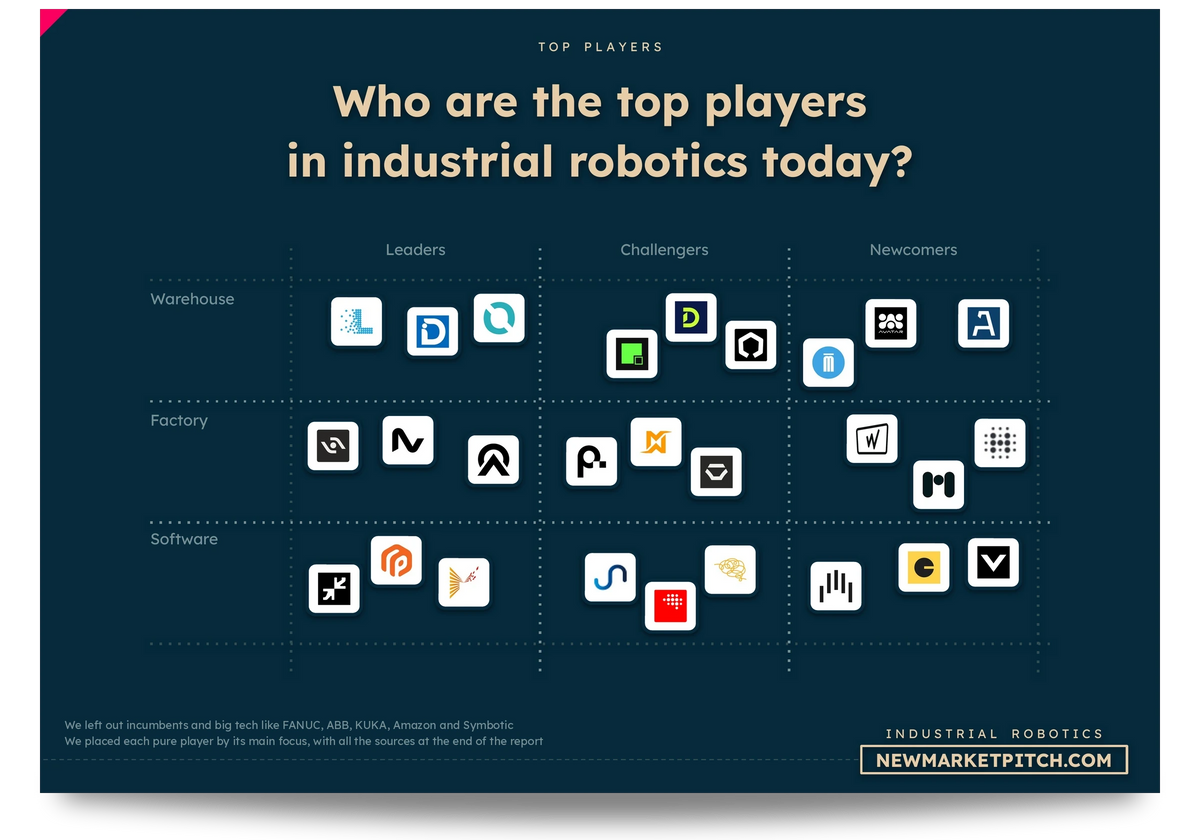
In our report covering the industrial robotics market, we turn what is vague and complex into simple, useful visuals. Market maps like this one show you at a glance where every startup stands.
Top startups in the industrial robotics market ranked by valuation
Here is the current ranking of the most valuable industrial robotics startups. For each one you will also find our confidence level and the valuation basis we used.
If you want to go deeper into the industrial robotics startup landscape, check our report covering the industrial robotics market.
| # | Startup | Valuation | Confidence | Valuation basis | Last round | Total funding |
|---|---|---|---|---|---|---|
| Private startups | ||||||
| 1 | Figure AIGeneral-purpose humanoid robots | $39.0Bas of Sep 2025 | Full | Announced private round valuation | $1.0B+Series C · Sep 2025 | $1.8B+valued at 22.2× this |
| 2 | Agile RobotsIntelligent industrial robotic systems | $8.5Bas of Nov 2026 | Full | Announced private round valuation | $500MSeries F · Nov 2026 | $730M+valued at 11.6× this |
| 3 | AgiBotGeneral-purpose humanoid robots | ~$7.0Bas of Oct 2026 | Strong | Reported private round valuation | UndisclosedStrategic · Aug 2025 | $280M+valued at 25.0× this |
| 4 | NEURA RoboticsCognitive humanoid and industrial robots | ~$7.0Bas of Jun 2026 | Strong | Reported private round valuation | UndisclosedSeries C · Jun 2026 | $203M+valued at 34.5× this |
| 5 | ApptronikIndustrial humanoid robots | $5.3Bas of Feb 2026 | Strong | Reported private round valuation | $520MSeries A-X · Feb 2026 | $948Mvalued at 5.6× this |
| 6 | Mind RoboticsAI-powered factory automation robots | $3.4Bas of May 2026 | Full | Announced private round valuation | $400MSeries A · May 2026 | $1.0Bvalued at 3.3× this |
| 7 | Galaxea AIEmbodied AI robotic systems | $2.8B+as of Apr 2026 | Strong | Reported private round valuation | UndisclosedSeries C · Aug 2026 | $490M+valued at 5.7× this |
| 8 | AI² RoboticsEmbodied AI robotic systems | ~$2.8Bas of Jun 2026 | Strong | Reported private round valuation | UndisclosedStrategic · Jun 2026 | $199M+valued at 14.1× this |
| 9 | ExotecAutomated warehouse robotics systems | $2.0Bas of Jan 2022 | Full | Announced private round valuation | $335MSeries D · Jan 2022 | $425Mvalued at 4.7× this |
| 10 | DexterityComplex warehouse handling automation | $1.65Bas of Mar 2025 | Strong | Reported private round valuation | $105MEquity offering · May 2026 | $396Mvalued at 4.2× this |
| 11 | Hai RoboticsAutomated warehouse storage and retrieval | ~$1.56Bas of Mar 2026 | Strong | Reported private round valuation | $170MSeries D · Sep 2021 | $173M+valued at 9.0× this |
| 12 | DEEP Robotics1Autonomous quadruped and humanoid industrial robots | >$1.5Bas of May 2026 | Strong | Reported private round valuation | $70M+Series C · Dec 2025 | $140M+valued at 10.7× this |
| 13 | PsiBotDexterous robotic manipulation systems | $1.48Bas of Jul 2026 | Strong | Reported private round valuation | $100M+Other · Aug 2026 | $100M+valued at 14.8× this |
| 14 | RobotEraHumanoid robots and embodied AI | $1.4B+as of Mar 2026 | Full | Announced private round valuation | ~$140MLate-stage equity · Jul 2026 | $564M+valued at 2.5× this |
| 15 | Spirit AIHumanoid robots and embodied AI foundation models (Moz humanoid, Spirit v1 model) | $1.4B+as of Feb 2026 | Strong | Reported private round valuation | $210MSeries A+ · Jun 2026 | $788Mvalued at 1.8× this |
| 16 | HumanoidIndustrial humanoid robotic workers | $1.35Bas of Jul 2026 | Full | Announced private round valuation | $152MSeries A · Jul 2026 | $152Mvalued at 8.9× this |
| 17 | Locus RoboticsAutonomous mobile warehouse robots | $1.1B–$1.6Bas of Nov 2026 | Partial | Comparables-based estimate | $42MSeries G · Aug 2026 | $450Mvalued at 2.9× this |
| 18 | Gecko RoboticsAI inspection robots for infrastructure | $1.25Bas of Jun 2025 | Strong | Reported private round valuation | $125MSeries D · Jun 2025 | $345Mvalued at 3.6× this |
| 19 | Machina LabsAdvanced metal structure manufacturing automation | $827M–$1.6Bas of Feb 2026 | Low | Estimated from last round | $124MSeries C · Feb 2026 | $155Mvalued at 7.3× this |
| 20 | Walden RoboticsGeneral-purpose AI robots for manufacturing | $1.1Bas of Jul 2026 | Full | Announced private round valuation | $300MSeed · Jul 2026 | $300Mvalued at 3.7× this |
| 21 | MytraAI-powered warehouse material handling | $800M–$1.5Bas of Jan 2026 | Low | Estimated from last round | $120MSeries C · Jan 2026 | $170Mvalued at 6.4× this |
| 22 | Quicktron RoboticsWarehouse automation and mobile robots | $850M–$1.4Bas of Nov 2026 | Partial | Comparables-based estimate | $100M+Series D · Sep 2024 | $229M+valued at 4.8× this |
| 23 | SereactAI software for robotic manipulation | $773M–$1.4Bas of Jul 2026 | Low | Estimated from last round | $6MSeries B extension · Jul 2026 | $148Mvalued at 7.1× this |
| 24 | VentionAI-powered industrial automation platform | $733M–$1.4Bas of Jan 2026 | Low | Estimated from last round | $110MSeries D · Jan 2026 | $110M+valued at 9.1× this |
| 25 | MujinIndustrial robot control software | >$1.0Bas of Oct 2026 | Strong | Reported private round valuation | $133MSeries D+ · Dec 2025 | $237Mvalued at 4.2× this |
| 26 | Standard BotsAI-powered industrial robotic arms | $1.0Bas of Jun 2026 | Full | Announced private round valuation | $200MSeries C · Jun 2026 | $239Mvalued at 4.2× this |
| 27 | Nimble RoboticsAutonomous robotic warehouse fulfillment | $1.0Bas of Oct 2024 | Full | Announced private round valuation | $106MSeries C · Oct 2024 | $106Mvalued at 9.4× this |
| 28 | FlexivAdaptive force-controlled robotic arms | $750M–$1.2Bas of Nov 2026 | Partial | Comparables-based estimate | UndisclosedLate-stage / strategic · Mar 2026 | $100M+valued at 9.7× this |
| 29 | RobCo1Modular industrial robotic systems | $667M–$1.2Bas of Jan 2026 | Low | Estimated from last round | $100MSeries C · Jan 2026 | $157M+valued at 5.8× this |
| 30 | DexoryLive warehouse digital twins from scanning robots | $667M–$1.2Bas of Oct 2025 | Low | Estimated from last round | $100MSeries C equity · Oct 2025 | $215M+valued at 4.3× this |
| 31 | Bright Machines1Software-defined robotic manufacturing systems | $650M–$1.1Bas of Nov 2026 | Partial | Comparables-based estimate | $106MSeries C · Jun 2024 | $385Mvalued at 2.2× this |
| 32 | Persona AIIndustrial humanoid robots | $750M–$850Mas of Nov 2026 | Partial | Comparables-based estimate | $65MOther · Aug 2026 | $95Mvalued at 8.4× this |
| 33 | Wandelbots1Universal industrial robot programming software | $560M–$1.1Bas of Jan 2022 | Low | Estimated from last round | $84MSeries C · Jan 2022 | $121Mvalued at 6.3× this |
| 34 | Holiday RoboticsIndustrial humanoid robots for repetitive tasks | $574M–$956Mas of Jul 2026 | Low | Estimated from last round | $115MSeries A · Jul 2026 | $128Mvalued at 5.8× this |
| 35 | Path RoboticsAutonomous industrial welding robots | $550M–$900Mas of Nov 2026 | Partial | Comparables-based estimate | $100MSeries D · Oct 2024 | $100Mvalued at 7.0× this |
| 36 | YOUIBOTAutonomous industrial logistics and inspection robots | $600M–$800Mas of Nov 2026 | Partial | Comparables-based estimate | $30MSeries D+ · Jul 2025 | $246Mvalued at 2.8× this |
| 37 | Multiply LabsRobotic pharmaceutical manufacturing systems | $500M–$938Mas of Oct 2026 | Low | Estimated from last round | $75MSeries B · Oct 2026 | $98Mvalued at 7.0× this |
| 38 | Tutor IntelligenceAdaptive robots for industrial automation | $500M–$938Mas of Nov 2026 | Low | Estimated from last round | $75MSeries B · Nov 2026 | $109M+valued at 6.3× this |
| 39 | Maven Robotics1General-purpose industrial robotic systems | $500M–$833Mas of Sep 2026 | Low | Estimated from last round | $100MSeries A · Sep 2026 | $100Mvalued at 6.5× this |
| 40 | Foundry RoboticsAI robotic assembly manufacturing services | $500M–$833Mas of Oct 2026 | Low | Estimated from last round | $100MSeries A · Oct 2026 | $100Mvalued at 6.5× this |
| 41 | Leju RoboticsIndustrial humanoid robots | ~$606Mas of Oct 2025 | Strong | Reported private round valuation | ~$210MPre-IPO private equity · Oct 2025 | $273Mvalued at 2.2× this |
| 42 | OutriderAutonomous electric yard trucks | $413M–$775Mas of Oct 2024 | Low | Estimated from last round | $62MSeries D+ · Oct 2024 | $253Mvalued at 2.2× this |
| 43 | THEKERGeneral-purpose AI industrial robotics | $425M–$708Mas of Jun 2026 | Low | Estimated from last round | $85MSeries A · Jun 2026 | $109Mvalued at 5.0× this |
| 44 | GreyOrangeAutonomous warehouse robotics and software | $350M–$750Mas of Nov 2026 | Partial | Comparables-based estimate | $135MSeries D · Dec 2023 | $385Mvalued at 1.3× this |
| 45 | VisionNav RoboticsAI-powered autonomous industrial forklifts | >$500Mas of Apr 2022 | Full | Announced private round valuation | $70MSeries C+ · Apr 2022 | $150Mvalued at 3.3× this |
| 46 | AMP RoboticsIntelligent recycling automation | $400M–$600Mas of Nov 2026 | Partial | Comparables-based estimate | $91MSeries D · Dec 2024 | $282Mvalued at 1.7× this |
| 47 | Collaborative RoboticsCollaborative mobile robotic platforms | $350M–$650Mas of Nov 2026 | Partial | Comparables-based estimate | $100MSeries B · Apr 2024 | $140Mvalued at 3.4× this |
| 48 | Tacta SystemsTactile robotic hands for industrial manufacturing | $320M–$533Mas of Jun 2025 | Low | Estimated from last round | $64MSeries A · Jun 2025 | $75Mvalued at 5.5× this |
| 49 | GrayMatter RoboticsIndustrial surface finishing automation | $300M–$562Mas of Jun 2024 | Low | Estimated from last round | $45MSeries B · Jun 2024 | $69Mvalued at 5.9× this |
| 50 | SpeedBot RoboticsIndustrial welding and handling robots | $280M–$525Mas of 2022 | Low | Estimated from last round | UndisclosedSeries B · Oct 2026 | $42M+valued at 9.1× this |
| 51 | Syrius RoboticsAutonomous mobile warehouse picking robots | $320M–$450Mas of Nov 2026 | Partial | Comparables-based estimate | UndisclosedSeries C / strategic · Jul 2023 | $20M+valued at 19.0× this |
| 52 | ForwardX RoboticsAutonomous mobile warehouse robots | $250M–$550Mas of Nov 2026 | Partial | Comparables-based estimate | Undisclosed | |
| 53 | Sanctuary AIGeneral-purpose humanoid robots for work | $250M–$550Mas of Nov 2026 | Partial | Comparables-based estimate | $1.6MUndisclosed stage · Apr 2026 | $57M+valued at 6.5× this |
| 54 | Gather AIAI drone-based warehouse inventory monitoring | $267M–$500Mas of Feb 2026 | Low | Estimated from last round | $40MSeries B · Feb 2026 | $67Mvalued at 5.4× this |
| 55 | Sojo IndustriesAutomated beverage packaging and tracking systems | $267M–$500Mas of Jun 2025 | Low | Estimated from last round | $40MSeries B · Jun 2025 | $50Mvalued at 7.3× this |
| 56 | Pickle RobotRobots unloading packages from delivery trailers | $280M–$430Mas of Nov 2026 | Partial | Comparables-based estimate | $50MSeries B · Nov 2024 | $154Mvalued at 2.3× this |
| 57 | ANYboticsAutonomous industrial inspection robots | $230M–$420Mas of Nov 2026 | Partial | Comparables-based estimate | $60MSeries B · Dec 2024 | $132Mvalued at 2.4× this |
| 58 | SeegridAutonomous industrial logistics vehicles | $220M–$400Mas of Nov 2026 | Partial | Comparables-based estimate | $25MSeries D extension · Oct 2025 | $75Mvalued at 4.0× this |
| 59 | Fulfil SolutionsFully robotic grocery fulfillment | $210M–$390Mas of Nov 2026 | Partial | Comparables-based estimate | $60MSeries B · Feb 2023 | $76M+valued at 3.7× this |
| 60 | microagiRobot model adaptation for industrial tasks | $220M–$367Mas of Jul 2026 | Low | Estimated from last round | $55MSeed · Jul 2026 | $55Mvalued at 5.2× this |
| 61 | Elite RobotsCollaborative industrial robot arms | $200M–$375Mas of Oct 2026 | Low | Estimated from last round | ~$30MSeries D+ · Oct 2026 | $144Mvalued at 1.9× this |
| 62 | Novarc TechnologiesAI-powered industrial welding automation | $200M–$375Mas of Mar 2025 | Low | Estimated from last round | $30MSeries B · Mar 2025 | $31M+valued at 8.8× this |
| 63 | Micropsi IndustriesAI control software for industrial robot arms | $200M–$375Mas of Feb 2022 | Low | Estimated from last round | $30MSeries B · Feb 2022 | $38M+valued at 7.2× this |
| 64 | SENADRobotic loading sorting and warehouse handling | $199M–$372Mas of Sep 2026 | Low | Estimated from last round | ~$30MSeries C · Sep 2026 | $102M+valued at 2.7× this |
| 65 | Plus One RoboticsAI robotic parcel handling | $200M–$350Mas of Nov 2026 | Partial | Comparables-based estimate | $50MSeries C · Mar 2023 | $91Mvalued at 2.9× this |
| 66 | CarbonSixAutonomous mobile robots for factories | $200M–$333Mas of Jul 2026 | Low | Estimated from last round | $40MSeries A · Jul 2026 | $44Mvalued at 5.9× this |
| 67 | Cellular OriginsAutomated cell therapy manufacturing systems | $200M–$333Mas of Dec 2025 | Low | Estimated from last round | $40MSeries A · Dec 2025 | $40Mvalued at 6.5× this |
| 68 | Yicheng InnovationMakes autonomous industrial transport vehicles for unattended movement of materials in facilities. | $187M–$350Mas of Nov 2026 | Low | Estimated from last round | ~$28MSeries C · Nov 2026 | $28Mvalued at 9.1× this |
| 69 | EmbotechAutonomous driving software for industrial vehicles | $180M–$338Mas of Dec 2024 | Low | Estimated from last round | $27MSeries B · Dec 2024 | $39Mvalued at 6.4× this |
| 70 | Third Wave AutomationAutonomous forklifts with remote human oversight | $180M–$320Mas of Nov 2026 | Partial | Comparables-based estimate | $27MSeries C · Oct 2024 | $82M+valued at 2.9× this |
| 71 | Oxipital AIAI machine vision for manufacturing | $173M–$325Mas of Nov 2022 | Low | Estimated from last round | UndisclosedSeries A · Jul 2026 | $84M+valued at 2.8× this |
| 72 | XYZ RoboticsAI-driven robotic warehouse manipulation | $160M–$300Mas of Nov 2026 | Partial | Comparables-based estimate | Undisclosed | |
| 73 | BrightpickAI-powered robotic order fulfillment | $160M–$300Mas of Nov 2026 | Partial | Comparables-based estimate | $21MSeries B · Dec 2021 | $21Mvalued at 10.4× this |
| 74 | DexmateHumanoid robots for industrial material handling | $164M–$274Mas of Feb 2026 | Low | Estimated from last round | UndisclosedOther · Aug 2026 | $41M+valued at 5.2× this |
| 75 | NomagicIntelligent warehouse picking and packing robots | $165M–$260Mas of Nov 2026 | Partial | Comparables-based estimate | $10MSeries B extension · Jan 2026 | $76Mvalued at 2.7× this |
| 76 | Trener RoboticsAI software for industrial robots | $160M–$267Mas of Feb 2026 | Low | Estimated from last round | $32MSeries A · Feb 2026 | $37Mvalued at 5.5× this |
| 77 | Realtime RoboticsIndustrial robot motion planning software | $141M–$264Mas of May 2024 | Low | Estimated from last round | ~$21MSeries B · May 2024 | $90Mvalued at 2.1× this |
| 78 | Rapyuta RoboticsCloud-connected warehouse robotics systems | $140M–$260Mas of Nov 2026 | Partial | Comparables-based estimate | $51MSeries C · Apr 2022 | ~$104Mvalued at 1.8× this |
| 79 | RightHand RoboticsRobotic piece picking automation | $140M–$260Mas of Nov 2026 | Partial | Comparables-based estimate | $66MSeries C · Feb 2022 | $100M+valued at 1.9× this |
| 80 | Ati MotorsAutonomous material handling robots | $133M–$250Mas of Jan 2025 | Low | Estimated from last round | $20MSeries B · Jan 2025 | $20Mvalued at 9.1× this |
| 81 | SoftWear AutomationRobotic sewing systems for apparel | $133M–$250Mas of Aug 2025 | Low | Estimated from last round | $20MSeries B · Aug 2025 | $20Mvalued at 9.1× this |
| 82 | FormicSubscription-based factory robotic automation | $137M–$228Mas of Jun 2024 | Low | Estimated from last round | UndisclosedStrategic investment · Oct 2025 | $54Mvalued at 3.3× this |
| 83 | Slip RoboticsAutonomous mobile platforms for truck loading | $130M–$230Mas of Nov 2026 | Partial | Comparables-based estimate | $28MSeries B · Dec 2024 | $39M+valued at 4.5× this |
| 84 | VerityAutonomous warehouse inventory scanning drones | $135M–$220Mas of Nov 2026 | Partial | Comparables-based estimate | $11MSeries B extension · Jul 2023 | $64Mvalued at 2.7× this |
| 85 | Sazhi RoboticsDevelops coordinated multi-arm industrial robots with embodied control for assembly and packaging. | $125M–$208Mas of Nov 2026 | Low | Estimated from last round | $25M+Series A · Nov 2026 | $40M+valued at 4.0× this |
| 86 | Ambi RoboticsAI-powered parcel sorting robots | $110M–$230Mas of Nov 2026 | Partial | Comparables-based estimate | $32MSeries B · Oct 2022 | $64Mvalued at 2.5× this |
| 87 | inVia RoboticsRobotic warehouse picking automation | $100M–$220Mas of Nov 2026 | Partial | Comparables-based estimate | Undisclosed | |
| 88 | CovariantAI foundation models for industrial robots | $75M–$250Mas of Nov 2026 | Partial | Comparables-based estimate | $75MSeries C extension · Apr 2023 | $222M+valued at 0.6× this |
| 89 | RLWRLDRobotics foundation models for industry | $104M–$173Mas of Feb 2026 | Low | Estimated from last round | $26MSeed · Feb 2026 | $41Mvalued at 3.3× this |
| 90 | Chef RoboticsCommercial food assembly automation | $103M–$172Mas of Mar 2025 | Low | Estimated from last round | $21MSeries A · Mar 2025 | $49Mvalued at 2.7× this |
| 91 | DUCO RoboticsCollaborative industrial robots for manufacturing | $84M–$210Mas of Nov 2023 | Low | Estimated from last round | UndisclosedSeries A · Jun 2026 | $21M+valued at 6.3× this |
| 92 | Corvus RoboticsAutonomous warehouse inventory drones | $100M–$167Mas of Aug 2026 | Low | Estimated from last round | $20MSeries A · Aug 2026 | ~$28Mvalued at 4.7× this |
| 93 | Robust.AICarter mobile warehouse cart with Grace software | $100M–$167Mas of Apr 2023 | Low | Estimated from last round | $20MSeries A extension · Apr 2023 | $42M+valued at 3.0× this |
| 94 | Lanxin RoboticsAutonomous mobile robots for factories | $93M–$175Mas of Nov 2021 | Low | Estimated from last round | UndisclosedSeries C · Apr 2025 | $14M+valued at 9.1× this |
| 95 | Multiway RoboticsAutonomous industrial forklifts and AMRs | $93M–$175Mas of Apr 2025 | Low | Estimated from last round | $14M+Series B · Apr 2025 | $28M+valued at 4.6× this |
| 96 | R3 RoboticsRobots for automated waste sorting | $83M–$138Mas of Feb 2026 | Low | Estimated from last round | ~$17MSeries A · Feb 2026 | $17Mvalued at 6.5× this |
| 97 | GlacierAI sorting robots for recycling facilities | $80M–$133Mas of Apr 2025 | Low | Estimated from last round | $16MSeries A · Apr 2025 | $24Mvalued at 4.4× this |
| 98 | OSAROAI robotic piece-picking software | $75M–$140Mas of Nov 2026 | Partial | Comparables-based estimate | $30MSeries C · Aug 2021 | $59Mvalued at 1.7× this |
| 99 | Vecna RoboticsAutonomous warehouse vehicles and orchestration | $85M–$110Mas of Nov 2026 | Partial | Comparables-based estimate | $31MSeries D / growth · Sep 2026 | $46Mvalued at 2.1× this |
| 100 | TwinnyAutonomous warehouse transportation and picking | $70M–$132Mas of Sep 2026 | Low | Estimated from last round | ~$11MGrowth equity · Sep 2026 | $40Mvalued at 2.4× this |
| 101 | FilicsAutonomous pallet handling robots | $74M–$124Mas of Jul 2025 | Low | Estimated from last round | $15MSeries A · Jul 2025 | $15M+valued at 6.5× this |
| 102 | SVT RoboticsWarehouse robotics integration software platform | $65M–$130Mas of Nov 2026 | Partial | Comparables-based estimate | $25MSeries A · Nov 2021 | $28Mvalued at 3.2× this |
| 103 | XiaoyubotGeneral purpose intelligent robots | $70M–$117Mas of Jul 2025 | Low | Estimated from last round | UndisclosedSeries B · Sep 2026 | $28M+valued at 3.2× this |
| 104 | Yincheng IntelligentRobots for warehouse and factory logistics | $70M–$117Mas of Sep 2026 | Low | Estimated from last round | ~$14MSeries A · Sep 2026 | $14M+valued at 6.5× this |
| 105 | Moying TechnologyRobot controllers and teaching systems | $69M–$115Mas of Apr 2024 | Low | Estimated from last round | ~$14MSeries A · Apr 2024 | $14Mvalued at 6.5× this |
| 106 | DareRobotBuilds perception-guided robot workstations for cutting, grinding and welding complex industrial parts. | $56M–$140Mas of Oct 2026 | Low | Estimated from last round | $14M+Oct 2026 | $14M+valued at 6.3× this |
| 107 | Energy RoboticsIndustrial inspection robots and operations software | $68M–$112Mas of Oct 2025 | Low | Estimated from last round | $14MSeries A · Oct 2025 | $16Mvalued at 5.6× this |
| 108 | mimic roboticsDexterous robots for industrial manipulation | $64M–$107Mas of Nov 2025 | Low | Estimated from last round | $16MSeed · Nov 2025 | $18Mvalued at 4.5× this |
| 109 | Contoro RoboticsAI-powered container unloading robots | $60M–$100Mas of Mar 2025 | Low | Estimated from last round | $12MSeries A · Mar 2025 | $18Mvalued at 4.3× this |
| 110 | Inbolt3D vision guidance for industrial robots | $48M–$121Mas of Sep 2026 | Low | Estimated from last round | $12MOther · Sep 2026 | $29Mvalued at 2.7× this |
| 111 | Smart RoboticsRobotic picking and palletizing systems | $58M–$97Mas of Apr 2026 | Low | Estimated from last round | ~$12MSeries A · Apr 2026 | $12M+valued at 6.5× this |
| 112 | AugmentusNo-code robot programming and motion planning | $55M–$92Mas of Jul 2025 | Low | Estimated from last round | $11MSeries A · Jul 2025 | $11Mvalued at 6.5× this |
| 113 | Launchpad Build AIAI software for robotic manufacturing lines | $55M–$92Mas of Oct 2025 | Low | Estimated from last round | $11MSeries A · Oct 2025 | $11Mvalued at 6.5× this |
| 114 | Galam RoboticsAutonomous robots for warehouse material handling | $54M–$91Mas of Mar 2025 | Low | Estimated from last round | ~$11MSeries A · Mar 2025 | $11Mvalued at 6.5× this |
| 115 | Q5D TechnologiesRobotic wire harness manufacturing systems | $54M–$91Mas of Jun 2025 | Low | Estimated from last round | $11MSeries A · Jun 2025 | $11Mvalued at 6.5× this |
| 116 | Eureka Robotics3D vision for robotic bin picking | $52M–$88Mas of Dec 2024 | Low | Estimated from last round | $10MSeries A · Dec 2024 | $10Mvalued at 6.5× this |
| 117 | Leap AutomationRobotic automation for fresh-produce packing | $51M–$84Mas of Sep 2024 | Low | Estimated from last round | $10MSeries A · Sep 2024 | $10Mvalued at 6.5× this |
| 118 | CynLrVision-guided robots for industrial manipulation | $50M–$83Mas of Nov 2024 | Low | Estimated from last round | $10MSeries A · Nov 2024 | $10Mvalued at 6.5× this |
| 119 | Unchained RoboticsRobotics marketplace and automation deployment platform | $48M–$81Mas of Jun 2025 | Low | Estimated from last round | ~$9.7MSeries A · Jun 2025 | $9.7Mvalued at 6.5× this |
| 120 | Anyware RoboticsMobile robots unloading trailers and handling boxes | $48M–$80Mas of Mar 2025 | Low | Estimated from last round | UndisclosedOther · Mar 2026 | $12M+valued at 5.2× this |
| 121 | UNIT AIModular robots for warehouse item retrieval | $48M–$80Mas of Jul 2026 | Low | Estimated from last round | $12MSeed · Jul 2026 | $12Mvalued at 5.2× this |
| 122 | AcuminoAI robot teaching for factories | $47M–$78Mas of Jun 2026 | Low | Estimated from last round | $12MSeed · Jun 2026 | $16Mvalued at 3.8× this |
| 123 | ISYBOTCollaborative robots for industrial sanding tasks | $33M–$83Mas of Feb 2026 | Low | Estimated from last round | ~$8.3MFeb 2026 | $8.3Mvalued at 6.3× this |
| 124 | Unbox RoboticsRobotic parcel sorting using swarms | $35M–$58Mas of Dec 2021 | Low | Estimated from last round | $7MSeries A · Dec 2021 | $9Mvalued at 5.0× this |
| 125 | Sunrise RoboticsIntelligent robots for manufacturing automation | $34M–$57Mas of Jun 2025 | Low | Estimated from last round | $8.5MSeed · Jun 2025 | $8.5Mvalued at 5.2× this |
| 126 | DiFACTO Robotics and AutomationIndustrial robotic automation systems | $32M–$60Mas of May 2024 | Low | Estimated from last round | ~$4.8MGrowth equity · May 2024 | $4.8Mvalued at 9.1× this |
| 127 | Automated Architecture (AUAR)Automated sustainable housing construction | $28M–$69Mas of Jun 2025 | Low | Estimated from last round | ~$6.9MFollow-on · Jun 2025 | $10M+valued at 4.3× this |
| 128 | ArmatrixSnake-like robots for industrial inspection | $32M–$54Mas of Nov 2026 | Low | Estimated from last round | $8.1MSeed · Nov 2026 | $10Mvalued at 4.1× this |
| 129 | Destro AIAI orchestration for warehouse robots | $32M–$53Mas of Sep 2026 | Low | Estimated from last round | $8MSeed · Sep 2026 | $8Mvalued at 5.2× this |
| 130 | Reflex RoboticsGeneral-purpose robots for warehouse operations | $28M–$47Mas of Mar 2024 | Low | Estimated from last round | $7MSeed · Mar 2024 | $7Mvalued at 5.2× this |
| 131 | CogniboticsHigh-speed robots and industrial controls | $23M–$57Mas of May 2022 | Low | Estimated from last round | $5.7MOther · May 2022 | $9.5Mvalued at 3.8× this |
| 132 | NavflexAutonomous robots for trailer loading | $28M–$46Mas of Sep 2024 | Low | Estimated from last round | $5.5MSeries A · Sep 2024 | $5.5Mvalued at 6.5× this |
| 133 | Milvus RoboticsAutonomous mobile robots for factories | $28M–$46Mas of Jul 2025 | Low | Estimated from last round | $1MSeries A extension · Jul 2025 | $5.5Mvalued at 6.5× this |
| 134 | ANSCER RoboticsAutonomous mobile robots for warehouse transport | $27M–$45Mas of May 2026 | Low | Estimated from last round | $5.4MSeries A · May 2026 | $7.4Mvalued at 4.7× this |
| 135 | ROBOSAI-powered industrial robotic automation systems | $26M–$44Mas of Feb 2024 | Low | Estimated from last round | ~$5.3MSeries A · Feb 2024 | $5.3Mvalued at 6.5× this |
| 136 | QibiTechIndustrial robot integration and automation systems | $21M–$53Mas of Mar 2024 | Low | Estimated from last round | ~$5.3MMar 2024 | $5.3Mvalued at 6.3× this |
| 137 | Avatar RoboticsRobots for warehouse material handling | $26M–$43Mas of Aug 2026 | Low | Estimated from last round | $6.5MSeed · Aug 2026 | $6.5M+valued at 5.2× this |
| 138 | BotsyncAutonomous mobile robots for industrial logistics | $26M–$43Mas of Jun 2024 | Low | Estimated from last round | $5.2MSeries A · Jun 2024 | $5.2Mvalued at 6.5× this |
| 139 | Mantis RoboticsSafe collaborative robots for factories | $20M–$50Mas of Dec 2024 | Low | Estimated from last round | $5MDec 2024 | $5Mvalued at 6.3× this |
| 140 | MolgRobotic electronics disassembly and recycling systems | $22M–$37Mas of Oct 2024 | Low | Estimated from last round | $5.5MSeed · Oct 2024 | $5.5Mvalued at 5.2× this |
| 141 | T-RoboticsAI no-code programming for industrial robots | $22M–$36Mas of Dec 2024 | Low | Estimated from last round | $5.4MSeed · Dec 2024 | $5.4Mvalued at 5.2× this |
| 142 | Jacobi RoboticsMotion planning software for industrial robots | $20M–$33Mas of Jul 2024 | Low | Estimated from last round | $5MSeed · Jul 2024 | $5Mvalued at 5.2× this |
| 143 | Tangent RoboticsRobot perception and manipulation software | $18M–$30Mas of Sep 2026 | Low | Estimated from last round | $4.5MPre-Seed · Sep 2026 | $4.5Mvalued at 5.2× this |
| 144 | MESHRobotic rebar fabrication for construction | $15M–$25Mas of Mar 2026 | Low | Estimated from last round | $3.8MSeed · Mar 2026 | $3.8Mvalued at 5.2× this |
| 145 | Revise RoboticsAI robotic systems for manufacturing | $14M–$24Mas of May 2025 | Low | Estimated from last round | $3.6MSeed · May 2025 | $3.6Mvalued at 5.2× this |
| 146 | NEOintralogisticsWarehouse automation robots offered as service | $14M–$23Mas of Jan 2026 | Low | Estimated from last round | ~$3.5MSeed · Jan 2026 | $3.5Mvalued at 5.2× this |
| 147 | Cambrian Robotics3D vision for robotic automation | $14M–$23Mas of Mar 2024 | Low | Estimated from last round | $3.5MSeed · Mar 2024 | $3.5Mvalued at 5.2× this |
| 148 | UVIONIX InnovationsAutonomous drones for warehouse inventory checks | $14M–$23Mas of Feb 2025 | Low | Estimated from last round | $3.5MSeed · Feb 2025 | $3.5Mvalued at 5.2× this |
| 149 | Extend RoboticsRemote operation software for robots | $13M–$22Mas of Sep 2026 | Low | Estimated from last round | $3.3MSeed · Sep 2026 | $3.3Mvalued at 5.2× this |
| 150 | Gobano RoboticsRobots for dexterous industrial automation | $13M–$22Mas of Sep 2025 | Low | Estimated from last round | $3.3MSeed · Sep 2025 | $3.3Mvalued at 5.2× this |
| 151 | mkindAdaptive robots for high-mix manufacturing | $13M–$22Mas of Jun 2026 | Low | Estimated from last round | $3.3MSeed · Jun 2026 | $3.3Mvalued at 5.2× this |
| 152 | Robotique Occitane – ROB'OCCAutonomous mobile robots for factories | $13M–$22Mas of Dec 2025 | Low | Estimated from last round | $3.3MSeed · Dec 2025 | $3.3Mvalued at 5.2× this |
| 153 | Deus RoboticsWarehouse robots and automation software | $12M–$20Mas of Dec 2024 | Low | Estimated from last round | $3MSeed · Dec 2024 | $3Mvalued at 5.2× this |
| 154 | MowitoEdge autonomy software for industrial robots | $12M–$20Mas of Jul 2026 | Low | Estimated from last round | $3MPre-Seed · Jul 2026 | $3Mvalued at 5.2× this |
| 155 | Yueshi RoboticsAutonomous forklifts for cold storage warehouses | $11M–$19Mas of Mar 2024 | Low | Estimated from last round | $2.8M+Seed · Mar 2024 | $16M+valued at 0.9× this |
| 156 | CuebusUrban automated robotic storage systems | $10M–$19Mas of Feb 2024 | Low | Estimated from last round | UndisclosedSeries B extension · Dec 2024 | $1.5Mvalued at 9.1× this |
| 157 | AICARobotic automation software for manufacturers | $11M–$18Mas of Mar 2025 | Low | Estimated from last round | ~$2.6MSeed · Mar 2025 | $2.6Mvalued at 5.2× this |
| 158 | PHINXT RoboticsAutonomous warehouse robot coordination software | $10M–$17Mas of Aug 2024 | Low | Estimated from last round | $2.6MSeed · Aug 2024 | $2.6Mvalued at 5.2× this |
| 159 | Solent AutomationCustom robotic automation for manufacturing | ~$12Mas of Sep 2026 | Full | Announced private round valuation | $995KOther · Sep 2026 | $1.5Mvalued at 8.0× this |
| 160 | DF Automation & RoboticsAutonomous mobile robots for factories | $7.4M–$18Mas of Nov 2024 | Low | Estimated from last round | $1.9MNov 2024 | $1.9Mvalued at 6.3× this |
| 161 | SE InnovationsRobotic automation for manufacturing lines | $8.9M–$15Mas of Sep 2026 | Low | Estimated from last round | $2.2MSeed · Sep 2026 | $2.2Mvalued at 5.2× this |
| 162 | CoLabIndustrial robotics systems for factory automation | $8.2M–$14Mas of Mar 2025 | Low | Estimated from last round | $2MSeed · Mar 2025 | $2Mvalued at 5.2× this |
| 163 | ULTIROBOTICSAutonomous robots for warehouse material handling | $7.3M–$12Mas of Jun 2026 | Low | Estimated from last round | $1.5M+Series A · Jun 2026 | $1.5M+valued at 6.5× this |
| 164 | Accio RoboticsWarehouse picking and sortation robots | $7.2M–$12Mas of Jan 2024 | Low | Estimated from last round | $1.8MSeed · Jan 2024 | $1.8Mvalued at 5.2× this |
| 165 | Progressive RoboticsRobotic palletizing for warehouse operations | $6.4M–$11Mas of Jan 2025 | Low | Estimated from last round | ~$1.6MSeed · Jan 2025 | $1.6Mvalued at 5.2× this |
| 166 | LogibotAutonomous mobile robots for warehouses | $6.2M–$10Mas of Sep 2026 | Low | Estimated from last round | $1.5MSeed · Sep 2026 | $1.5Mvalued at 5.2× this |
| 167 | MesowareAutonomous mobile robots for industrial facilities | $6M–$10Mas of Jun 2026 | Low | Estimated from last round | $1.5MSeed · Jun 2026 | $1.5Mvalued at 5.2× this |
| 168 | TEFA RoboticsCollaborative robots for manufacturing tasks | $5.9M–$9.9Mas of Aug 2025 | Low | Estimated from last round | $1.5MSeed · Aug 2025 | $1.5Mvalued at 5.2× this |
| 169 | byte roboticsRobotic automation for machine tending | $5.7M–$9.5Mas of Jun 2025 | Low | Estimated from last round | $1.4MSeed · Jun 2025 | $1.4Mvalued at 5.2× this |
| 170 | TetraGen RoboticsRobotic automation for industrial tasks | $5.2M–$8.6Mas of Aug 2026 | Low | Estimated from last round | ~$1.3MSeed · Aug 2026 | $1.3Mvalued at 5.2× this |
| 171 | ZS RoboticsAutomated pallet storage and warehouse robotics | $5M–$8.3Mas of Dec 2025 | Low | Estimated from last round | $1M+Series A · Dec 2025 | $1M+valued at 6.5× this |
| 172 | O-IDRobotic visual inspection for manufacturing | $4.8M–$8Mas of Sep 2026 | Low | Estimated from last round | $1.2MSeed · Sep 2026 | $1.2Mvalued at 5.2× this |
| 173 | SortedRobotic sorting systems for recycling | $4.7M–$7.9Mas of Aug 2026 | Low | Estimated from last round | $1.2MSeed · Aug 2026 | $3.3Mvalued at 1.8× this |
| 174 | YK-RoboticsProvides AI-driven programming, simulation and operation software for industrial robotic cells. | $4.6M–$7.7Mas of Oct 2026 | Low | Estimated from last round | ~$1.1MSeed · Oct 2026 | $1.1Mvalued at 5.2× this |
| 175 | Octobotics TechRobotic inspection systems for industrial assets | $4.4M–$7.3Mas of Feb 2026 | Low | Estimated from last round | ~$1.1MSeed · Feb 2026 | $1.1Mvalued at 5.2× this |
| 176 | TerafacIndustrial robotics and factory automation systems | $3.1M–$5.2Mas of Aug 2025 | Low | Estimated from last round | $780KSeed · Aug 2025 | $780Kvalued at 5.2× this |
| 177 | Songzhida RoboticsAutonomous mobile robots for factory logistics | $2.8M–$4.7Mas of Oct 2025 | Low | Estimated from last round | ~$700KSeed · Oct 2025 | $700Kvalued at 5.2× this |
| 178 | 120ftModular automated factories for product assembly | $2.7M–$4.5Mas of Oct 2026 | Low | Estimated from last round | ~$670KSeed · Oct 2026 | $670Kvalued at 5.2× this |
| 179 | RB-WareNo-code robotic welding systems | $2.7M–$4.4Mas of Oct 2026 | Low | Estimated from last round | $666KSeed · Oct 2026 | $666Kvalued at 5.2× this |
| 180 | Forge RoboticsModular autonomous factories and robotic welding | $2M–$3.3Mas of Sep 2025 | Low | Estimated from last round | $500KPre-Seed · Sep 2025 | $500Kvalued at 5.2× this |
| 181 | NeoAcro RoboticsRobotic automation for shipbuilding and steelmaking | $1.5M–$2.5Mas of Jul 2026 | Low | Estimated from last round | ~$370KSeed · Jul 2026 | $370Kvalued at 5.2× this |
| 182 | Control One AIAI navigation software for industrial robots | $1.4M–$2.3Mas of Apr 2024 | Low | Estimated from last round | $350KSeed · Apr 2024 | $350Kvalued at 5.2× this |
| Listed in the last 5 years or acquired in the last 3 years · not ranked | ||||||
| Agility Robotics2Bipedal robots for warehouse automation | $2.0B–$2.4Bas of Nov 2026 | Full | Public market cap | ~$465MDe-SPAC (Churchill capital Corp XI), Nasdaq: AGLT · Nov 2026 | $811Mvalued at 2.7× this | |
| Mech-Mind Robotics2Industrial robotic vision systems | $1.4B | Full | Public market cap | $302MIPO · Aug 2026 | $388M+valued at 3.6× this | |
| ROKAE2Industrial and collaborative robotic arms | ~$1.39Bas of Nov 2026 | Full | Public market cap | $129MIPO · Jul 2026 | $199M+valued at 7.0× this | |
| Dobot Robotics2Collaborative and humanoid robots for industry | $901Mas of Nov 2026 | Full | Public market cap | $96MIPO · Dec 2024 | $208Mvalued at 4.3× this | |
| SEER Robotics2Industrial robot controllers and automation | $895M | Full | Public market cap | $157MIPO · Jun 2026 | $198Mvalued at 4.5× this | |
| ESTUN CodroidCollaborative industrial robot arms | ~$68Mas of Sep 2026 | Full | Acquisition value | $18MSeed · Nov 2024 | $18Mvalued at 3.7× this | |
No startups match this search.
- Total funding is a minimum: some rounds have no public amount.
- Total funding includes the primary proceeds of its IPO.

Our research about industrial robots gets updated several times a month, so you always get the latest view of where things stand.
Is Figure AI still the most valuable industrial robotics startup?
Figure AI is the most valuable industrial robotics startup today, at $39B, with a clear lead over every other company in our research.
The American company builds general-purpose humanoid robots. Investors are betting that machines able to learn new tasks could eventually be deployed across different production lines without the redesign that many factory robots need. Its September 2025 Series C gave the company the valuation we use here.
Figure has also put robots in a real factory. In November 2025, it reported that Figure 02 had loaded more than 90,000 parts at BMW and contributed to production of more than 30,000 cars. Figure 03 later moved into a more difficult logistics-sequencing task at BMW's Spartanburg plant, as Figure and BMW described in June 2026. Those are specific jobs on an automotive production site, with a named industrial customer.
There is still a lot to prove. A successful task at BMW doesn't establish the economics of running thousands of robots at many customers. We have not seen comparable public figures for fleet profitability or repeat purchases across the industry. Figure's position as the valuation leader is settled for now; its eventual place among the largest industrial robot suppliers is not.
Is Agile Robots really Figure AI's closest rival?
Agile Robots is Figure AI's nearest rival by industrial robotics startup valuation, though the German company is still far behind at $8.5B.
Its appeal is unusually concrete. Agile Robots sells robotic arms, mobile machines, control software and newer humanoid systems. In its recent SoftBank-backed financing announcement, the company said it had installed more than 20,000 robotic solutions around the world. That is a company-reported installation figure, and it covers several product types rather than humanoids alone.
The difference in business models is important. Figure wants a humanoid to take on an expanding set of tasks. Agile Robots can sell more specialized equipment now while developing machines that handle a wider range of work later. Its installed systems give it customers, integration experience and a reason for factories to keep working with the company.
Neither installations nor valuation reveal margins or customer retention. Still, Agile Robots is a serious challenger because its ambition comes with an existing industrial business. Its announced valuation is also firmer evidence than the wide ranges we have to use for many less transparent startups.

In our market report about industrial robots, we look at what the winners do differently, so you can learn from the best instead of guessing.
Are the most valuable industrial robotics startups mostly American?
American startups hold three of the six most valuable places in industrial robotics, but the United States does not have a monopoly on the highest valuations.
Figure AI, Apptronik and Mind Robotics put the United States near the top. Germany supplies Agile Robots and NEURA Robotics, while China has AgiBot, Galaxea AI and AI² Robotics. These are individual valuations, not a total national market value.
Germany's presence stands out because its leading startups combine established factory automation with a push toward more flexible robots. China's highly valued companies include both humanoid specialists and businesses selling logistics or storage systems. American startups range from general-purpose humanoids to robotic warehouse equipment and factory arms.
The practical conclusion is that the United States has the most companies among the leaders, while individual competitors from Germany and China have already reached the top tier. The table below shows selected industrial robotics valuation leaders from several countries, in ranking order.
| Startup | Country | Valuation |
|---|---|---|
| Figure AI | United States | $39.0B |
| Agile Robots | Germany | $8.5B |
| AgiBot | China | ~$7.0B |
| NEURA Robotics | Germany | ~$7.0B |
| Apptronik | United States | $5.3B |
| Galaxea AI | China | $2.8B+ |
| Exotec | France | $2.0B |
| Humanoid | United Kingdom | $1.35B |
Is China catching up with the most valuable industrial robot makers?
Chinese industrial robotics startups have become major contenders, but Figure AI remains the world's highest-valued startup in this market.
AgiBot is China's strongest example by private valuation in our research. Galaxea AI and AI² Robotics are also near the top, while Hai Robotics builds warehouse storage systems and Flexiv makes adaptive industrial arms. China has several routes into industrial robotics, rather than one big humanoid company carrying the whole story.
AgiBot reported cumulative production of 20,000 robots in September 2026. That is serious manufacturing experience, though its machines serve retail, hospitality and other applications as well as industrial customers. We cannot count every robot built as a factory installation. The company has taken a real step toward scale without yet settling the question of which maker runs the largest industrial fleet.
Galaxea AI combines hardware for logistics and industrial work with developer platforms. That broad product range could help it find customers, but public product demonstrations cannot substitute for shipment and operating data. China's place among the valuation leaders is clear. Which Chinese company builds the strongest repeat business in factories is still open.
How many industrial robotics startups are worth over $1B?
Only 22 of the 182 industrial robotics startups we track are worth $1B or more even at the low end of their range, and only 1 reaches $10B.
A startup counts as a unicorn here only when its whole valuation range clears $1B. Some companies have estimates that stretch across the line, and we do not automatically award them unicorn status. The distinction keeps an optimistic upper estimate from turning into an apparently confirmed billion-dollar company.
Valuations above $5B are even less common. Our research places 4 startups between $5B and $10B, compared with the single company at the decacorn level. Agile Robots, AgiBot, NEURA Robotics and Apptronik form that smaller group. The press attention around humanoids can make this level of pricing look normal, but the overwhelming majority of industrial robotics startups are nowhere near it.
The businesses within the unicorn group also look nothing alike. Exotec builds warehouse storage systems, Standard Bots makes industrial arms, and Gecko Robotics inspects industrial assets. Nimble Robotics reached its announced unicorn valuation alongside a FedEx-related funding and commercial partnership in October 2024. A billion-dollar price may be attached to a running warehouse operation or to machines that still face a much bigger commercial test.

In our document detailing everything you need to know about industrial robotics, you will always find fresh funding data, taken straight from our own verified funding database.
Is Germany's NEURA Robotics catching up with China's AgiBot?
NEURA Robotics and AgiBot have the same displayed valuation of ~$7.0B, but that does not establish an exact financial tie between the German and Chinese robot makers.
The values come from reported private-round information rather than clearly comparable company-announced pricing. The approximate symbol matters here: we are using what credible sources report, not claiming the deals happened at precisely identical values or on the same day.
AgiBot has shown it can manufacture humanoid and embodied robots across several applications. NEURA Robotics is pursuing cognitive industrial systems alongside its humanoid work. In its June 2026 Series C announcement, NEURA discussed expanding production and building real-world training environments. That sets out a plan, while AgiBot's production record speaks to machines already built. Neither fact alone tells us how much each business earns from factories.
We would give AgiBot credit for demonstrated manufacturing volume and NEURA credit for a broad industrial product strategy. Calling either one the commercial winner today would require comparable industrial deliveries, customer spending and operating performance. Their similar reported valuations say more about investors' expectations than about identical businesses.
Can Apptronik really compete with Figure AI?
Apptronik is a serious competitor in industrial humanoid robots, but it has not matched Figure AI's valuation or proven a wider commercial rollout.
The American startup is reportedly valued at $5.3B. Its Apollo robot is designed for jobs in factories and warehouses, where customers want equipment that can work safely through long shifts. Apptronik has worked with logistics operator GXO on robotic picking and other tasks, making the customer relationship more useful evidence than a showroom demonstration.
GXO and Apptronik recently announced plans to expand their work. The next stage includes trials scheduled for 2027, with any broader service rollout dependent on safety and productivity results. The announcement is a serious commercial opportunity; it is not a completed deployment of a large fleet.
Figure and Apptronik are chasing overlapping buyers, though their public examples involve different tasks. The financial gap between them is clear. Whether it narrows depends on repeat orders, how independently the robots can work, and how quickly each company can support customers after installation. Apptronik deserves its place among the leaders today without being treated as a company that has already caught Figure.
Are humanoid robot startups worth more than traditional robot-arm companies?
Humanoid startups carry the richest industrial robotics valuations today, even though conventional robot arms still perform much of the work factories pay to automate.
Figure AI, Apptronik and NEURA Robotics are priced far above most businesses centered on specialized arms, including Standard Bots, Flexiv and Elite Robots. Investors hope a flexible robot can switch jobs without months of new engineering. That is attractive in factories where products and workstations often change.
Traditional arms have an advantage when the job is clear. A manufacturer can measure the cost of welding a joint, tending a machine or loading a part, then compare the robot with the current process. Standard Bots sells programmable industrial arms; RobCo builds modular automation systems; and Vention combines hardware with software for designing robot workcells. These businesses address work that manufacturers already understand.
The valuations show where expectations are highest, while factory spending still depends on throughput, safety and reliable operation. We see a large premium attached to versatility. We do not yet have evidence that humanoids will replace specialized industrial equipment across every production task.

Learning from others' mistakes is the cheapest lesson there is. In our report covering the industrial robotics market, we look at what broke startups before you, so you don't repeat it.
Are warehouse robot startups still worth billions?
Warehouse robotics startups remain some of the most valuable industrial robotics businesses, with products that customers already use at scale.
Exotec builds automated storage systems, Locus Robotics sells mobile fulfillment robots, and Dexterity tackles loading and handling jobs. Hai Robotics and Quicktron Robotics serve other storage and movement tasks. Warehouse customers can see whether a robot improves picking, space use, handling speed or the cost of getting orders out.
The evidence goes beyond product announcements. In October 2025, Exotec said its Skypod systems were operating at more than 200 customer sites. Locus Robotics said in April 2025 that its robots had completed five billion picks. Both are company-reported figures, but they describe work actually carried out in warehouses, which is more useful than a projection of future robot capability.
The biggest caution is that their valuations come from different dates and types of evidence. An announced financing price may be several years old, and a comparable-company estimate remains an estimate. The table below shows selected warehouse robotics startups, their valuation and the basis for that figure, in ranking order.
| Startup | Valuation | Basis |
|---|---|---|
| Exotec | $2.0B | Announced |
| Dexterity | $1.65B | Reported |
| Hai Robotics | ~$1.56B | Reported |
| Locus Robotics | $1.1B–$1.6B | Estimated |
| Quicktron Robotics | $850M–$1.4B | Estimated |
| Nimble Robotics | $1.0B | Announced |
| GreyOrange | $350M–$750M | Estimated |
| Pickle Robot | $280M–$430M | Estimated |
Is Exotec actually worth more than Locus Robotics?
Yes, on the evidence we have, Exotec is worth more than Locus Robotics: its announced $2.0B price sits above our $1.1B–$1.6B estimate for Locus, although neither figure comes from a recent priced round.
Exotec has an announced valuation from January 2022. Locus Robotics was reported at about $2.0B in November 2022, but it raised again in August 2026 without a published price. A later round with no price means the 2022 figure no longer stands as a current value, so we estimate Locus from comparable companies instead. That puts it 17th in our ranking, behind Exotec in ninth place. Our estimate is less certain than an announced price, and the gap does not prove a difference in commercial performance.
They also make different equipment. Exotec's Skypod moves bins through a dense automated storage system. In June 2026, Exotec described a DSV installation in Venlo that uses its robots and storage infrastructure. Locus focuses on mobile robots that help workers and automated systems fulfill orders inside warehouses. Its relationship with Radial gives a separate example of work carried out at a customer's sites.
That distinction gives buyers a reason to choose between them, depending on the warehouse problem. Exotec may transform storage and picking around a dedicated system, while Locus can change how work moves through an existing operation. We see two established warehouse robotics contenders. The valuation gap reflects the age and type of the price evidence more than a proven difference in business quality.

In our research about industrial robots, we always try to gather several sources and make estimates that make sense, so you can work with solid numbers.
Why is Dexterity worth so much in warehouse robotics?
Dexterity is reportedly valued at $1.65B because it tackles some of the hardest physical jobs in warehouse automation: moving irregular packages and loading trailers.
Its Mech system uses robots to handle packages that arrive at changing angles, sizes and positions. That is much harder than sending a mobile robot along a mapped route. The machine must see where to grip an object, move it without dropping it, and keep working around the awkward loads that a human warehouse worker deals with every day.
There is evidence that customers want this kind of system. FedEx announced an expansion of Dexterity trailer-loading technology at its Hagerstown hub in July, building on an earlier pilot. An expanded deployment at a named logistics operator is a stronger test than a promising laboratory run.
The open question is whether the system can consistently save enough time and labor across many sites to pay for itself. Dexterity has shown that major partners will test and expand the technology. Its valuation prices the chance that this work becomes routine across logistics networks.
Can industrial robot software companies become unicorns?
Industrial robot software can support billion-dollar valuations when it helps physical machines do jobs that would otherwise be difficult to automate.
Japan's Mujin is reportedly valued above $1.0B. Its robot-control software coordinates equipment, motion and warehouse or factory workflows. In its December 2025 financing announcement, Mujin described software for running industrial robots and building real-time digital models of operations. It is selling a way to make robot installations work, rather than a general AI tool with no connection to the factory floor.
Sereact in Germany carries a $773M–$1.4B valuation range, our estimate from the size of its last round. Its software helps robots pick objects, including in warehouse operations. Canada's Vention, valued at $733M–$1.4B, connects automation design software with hardware and ready-to-deploy systems. Both make programming and installing robots less painful for the customer.
The hard part for all three is delivering reliably across different facilities and machines. A model that handles one set of objects may still struggle with another. The valuation opportunity is substantial when software cuts the time factories spend setting up automation, but customers ultimately pay for robots completing work.

If you build or invest in the industrial robotics market, you need to know which business models pay off now and which ones are fading. That's why our report covering it has a whole section on it.
Can RobCo challenge the established industrial robot manufacturers?
RobCo has a credible opening in factory automation, but the German startup has not shown that it can displace the established industrial robot manufacturers.
The company makes modular robotic systems for manufacturers that want to automate welding, handling and other repeatable tasks without commissioning a costly custom installation. We estimate its valuation at $667M–$1.2B from the size of that round, because no stake sold or share price was published. That range is our estimate, not a company-announced value.
RobCo announced a Series C in January 2026, led by Lightspeed Venture Partners and Lingotto. It said it would expand in the United States and serve larger industrial customers. The plan fits the product: an easier installation process could open robotics to factories that previously found automation too expensive or cumbersome.
The real test now is customer behavior. If a manufacturer buys one workcell and comes back for many more, RobCo starts to resemble a durable industrial supplier. If deployments require extensive service every time, growth gets harder. RobCo belongs among the valuable factory-robot challengers, though its financing price alone cannot tell us how far it has eaten into the incumbents' business.
Is Standard Bots really a billion-dollar factory robot startup?
Standard Bots is a genuine industrial robotics unicorn with an announced $1.0B valuation, built around factory robot arms rather than humanoids.
The American company develops programmable arms that manufacturers can use for repetitive work. Its June 2026 Series C described a strategy focused on easier-to-use industrial robotics and domestic production. Standard Bots has raised $239M in total equity funding, a separate figure from what investors valued the company at. Its announced $1.0B still ranks behind Sereact and Vention, whose estimated ranges reach $1.4B: we place a range at its midpoint, which for both lands just above $1.0B.
Its products face a straightforward test. Can a factory install an arm, teach it the job and keep it running with less effort than the old alternatives? Buyers know the cost of a worker loading parts or a machine sitting idle, so they can measure whether the robot helps. Simpler programming and dependable support may matter more to those customers than a machine shaped like a human.
The company still has to build a long record of deliveries and service. But the announced valuation is useful evidence that investors also see a substantial business in better conventional automation. Standard Bots is pursuing an industrial product customers can understand today, even if its long-term reach remains unproven.
Can industrial inspection robots really become billion-dollar businesses?
Industrial inspection robots have already produced a unicorn: Gecko Robotics is valued at $1.25B for machines that inspect industrial assets.
Gecko's robots climb and scan difficult structures, helping maintenance teams find problems in equipment before failures become expensive. The customer is paying for better inspection and repair decisions rather than a faster production line. That still belongs in industrial robotics because the robots perform physical work at plants, infrastructure sites and other industrial facilities.
In October 2026, Gecko announced an expanded U.S. Navy contract for robotic inspection and asset assessment. The agreement shows a serious institutional use case, although a contract's maximum value would never be the same as revenue already earned. Companies such as ANYbotics also work on industrial-site inspections, while Dexory scans warehouses to build live views of inventory and operations.
Inspection has fewer obvious headlines than humanoid manufacturing, but there is a clear reason to buy these systems: people need reliable information from places that are hazardous, slow or expensive to inspect manually. Gecko's valuation shows this can become a substantial business.

In our document detailing everything you need to know about industrial robotics, we don't want to repeat what boring consulting reports say. Instead, we show you the real and latest market signals that matter.
Why are brand-new factory robot startups already worth billions?
Some brand-new industrial robotics startups have reached unicorn valuations before proving they can deploy robots widely, including Mind Robotics and Walden Robotics.
Mind Robotics, founded in 2025, carries a $3.4B announced valuation. It is building AI-powered machines for factory work and has close ties to Rivian's manufacturing environment. Kleiner Perkins emphasized that access to real production tasks and data in May 2026. That gives the startup an advantage in development, but access to a factory is only the beginning of a long product rollout.
Walden Robotics, founded in 2026, reached an announced $1.1B valuation with a July 2026 seed financing. The company aims to build general-purpose industrial machines. Investors are paying early for the team's ability to solve manufacturing problems, not for a demonstrated global installed fleet. Walden ranks just behind Machina Labs, whose $827M–$1.6B range is our estimate from its February 2026 Series C and sits slightly above $1.1B at its midpoint.
Compare these young businesses with warehouse robotics companies that can point to years of customer operations. They have different kinds of evidence behind their valuations. A startup testing inside a real factory may learn quickly, yet it still needs repeat customers, reliable production and service capacity before its high price looks earned.
Are billion-dollar industrial robots actually working in factories?
Some highly valued industrial robotics startups have robots working for real customers, while others are still proving they can turn promising trials into routine operations.
A machine in an automotive plant, a robot loading trailers and a warehouse fleet completing repeated picks are all useful evidence. They tell us the product has faced real conditions that are difficult to reproduce in a demonstration. But they measure different things. A pilot may run for a limited period, while an established installation can work across many shifts and changing product loads.
The sharpest test is what customers do next. Do they order more robots? Can the machines work safely with limited supervision? Does the company support them without endless manual intervention? Public announcements rarely provide a complete picture of downtime, support costs, customer payback or whether deployments are profitable.
Investors have reason to reward successful industrial work, and several startups already demonstrate it. The largest valuations, however, assume that today's technical successes will spread much further. Industrial robot deployment is real. Its economics still have a long way to catch up with the highest valuations.
Does more funding always mean a higher robot startup valuation?
More funding does not automatically make an industrial robotics startup more valuable.
A valuation is a price attached to ownership at a particular time. Funding raised is equity capital received across the company's history. A robot maker may need years of expensive hardware development and customer support, while another company might secure a high price after one early round. Those histories can lead to very different relationships between money raised and valuation.
Among startups with a valuation figure and a complete funding total, Nimble Robotics has the highest valuation-to-funding multiple at 9.4x. Spirit AI has the lowest at 1.8x. These are ratios of valuation to equity funding, not revenue multiples, and they say little about whether a company makes money.
The contrast continues elsewhere: Apptronik has a 5.6x multiple and Mind Robotics 3.3x. We leave minimum-only funding totals out of this comparison. A high multiple could reflect investor enthusiasm, a company's age or the amount of equity it needed to sell. It does not establish better robots, stronger demand or healthier finances.

In our report covering the industrial robotics market, we like to show you the big picture. We know your time is precious, so we make every page quick to read and packed with as much learning as possible per minute.
Why isn't Agility Robotics among the biggest private robot startups?
Agility Robotics belongs outside the private industrial robotics startup leaders because the maker of Digit humanoids is now publicly traded.
Agility completed its combination with Churchill Capital Corp XI and began Nasdaq trading under AGLT, as the company and Nasdaq confirmed. We put it in the separate public-company group, where the research records a $2.0B–$2.4B market-capitalization range. A public share price changes with trading, so it does not belong alongside prices fixed at private fundraising rounds.
The company's industrial progress remains relevant. Agility has worked with GXO and other manufacturers and logistics operators. Its listing announcement discussed commercial deployments and future orders for Digit. The order pipeline needs to be kept separate from revenue already received and robots already operating, especially for machines that still have production and delivery milestones ahead.
Mech-Mind Robotics, ROKAE, Dobot Robotics and SEER Robotics appear with Agility in the listed group, while ESTUN Codroid is shown as acquired. We track 5 listed companies and 1 acquisition separately. Agility's absence from the private ranking reflects its ownership status, not a view that Digit has lost its industrial relevance.
So, which industrial robotics startups are worth the most today?
Figure AI is the most valuable industrial robotics startup, with Agile Robots the nearest challenger and a strong group of Chinese, German and American competitors behind them.
Figure leads on valuation because investors expect humanoid robots to learn far more jobs than conventional machines. Agile Robots has a substantial base of installed industrial systems, while AgiBot and NEURA Robotics are taking different routes toward more adaptable robots. Apptronik is getting serious logistics tests, though its broader deployment plans still depend on the results.
Warehouse automation remains important because customers can measure the work directly. Exotec, Dexterity and Locus Robotics have specific jobs to automate and named industrial partners. Software specialists such as Mujin show that helping machines complete difficult tasks can itself support a large business. Young companies including Mind Robotics are being priced for what they might build next.
Our judgment is that Figure leads this valuation race decisively. It does not follow that one company already dominates every industrial robot market, or that private valuations measure which factory systems perform best. The table below shows what we found.
| Question | Answer |
|---|---|
| Can Germany challenge America's largest robot startup? | Yes, Agile Robots is the nearest competitor in this market. Its $8.5B valuation places Germany near the top. Its installed industrial systems give that price practical support. |
| Are industrial robotics unicorns now common? | Not yet, as the market still has a small expensive minority. Only 22 startups clear $1B even at their lowest estimate. Most industrial robot makers remain outside that club. |
| Can Chinese manufacturers rival the highest valuations? | Yes, China's startups have already joined the top group. Galaxea AI has a reported value of at least $2.8B. That price still says little about installed industrial fleets. |
| Is Apptronik already operating at huge scale? | Not yet, because its wider logistics rollout remains conditional. Apptronik currently carries a reported private valuation of $5.3B. Customer trials must still turn into dependable deployments. |
| Are warehouse robot companies still valuable? | Yes, warehouses keep paying to automate difficult physical work. Dexterity currently has a reported private valuation of $1.65B. Its FedEx deployments provide a concrete commercial test. |
| Can software create billion-dollar industrial robot businesses? | Yes, software can make physical robot installations much more useful. Sereact currently carries a $773M–$1.4B private valuation range. Customers still need those systems working reliably every day. |
| Are traditional robot arms losing all their value? | No, specialized arms remain useful for predictable factory tasks. Standard Bots has raised $239M in total equity funding. Its announced unicorn price supports that focused approach. |
| Can newly founded robot companies become unicorns? | Yes, investors can pay high prices before broad deployments. Walden Robotics launched with an announced $1.1B valuation. Future customers must turn that early promise into revenue. |
| Can inspection robots support unicorn valuations? | Yes, physical inspection already supports a substantial robotics business. Gecko Robotics is currently valued at $1.25B in our research. Industrial maintenance creates demand beyond factory assembly lines. |
| Do bigger funding totals guarantee higher valuations? | No, money raised and the price of equity differ. Spirit AI has a reported valuation-to-funding multiple of 1.8x. The companies have different funding histories, making simple comparisons unreliable. |
| Should listed humanoid companies share the private ranking? | No, public share prices belong in a separate comparison. Agility Robotics has a $2.0B–$2.4B public valuation range. Its trading price moves differently from private financing values. |

When you build or invest in the industrial robotics market, you need clarity, not confusion. In our research about industrial robots, we always try to put numbers on and quantify whatever is usually vague and confusing.
Our methodology
Our data runs through November 14, 2026. We then reviewed this article and updated its answers on November 13, 2026, the date shown under the title. We include startups whose main products use programmable robots or industrial robot control systems for manufacturing and closely related factory operations, including logistics, warehouse fulfillment, industrial inspection and recycling. Where a company sits near the line between industrial robotics and a neighboring market, we include it rather than exclude it by default. Every company in the main ranking is an independent startup under our definition: founded in 2000 or later and built to grow around a new product or technology with founder, venture, angel or grant support. Acquired or publicly listed companies appear separately.
Every startup in this ranking has raised equity funding, and each valuation comes with a confidence level that shows how it was obtained. A Full rating means the company announced the valuation itself, or several independent sources report the same figure. A Strong rating means a credible press report gives the valuation, or it follows directly from the terms of a funding round, such as the amount raised and the stake sold.
When no valuation has been disclosed, it is estimated. A Partial rating means the startup was compared with similar companies at the same stage, using indicators such as revenue, deal terms or recent transactions in the sector. A Low rating means the only reliable data point is the last equity round: the valuation is then derived from the amount raised and the share of the company that startups usually give up at that stage, which is why it is shown as a range and dated to that round.
Several safeguards keep these figures honest. Valuations that appear only in commercial databases, with no article or company statement behind them, are not used, and neither are share sales between existing shareholders, which often take place at a discount or a premium. Rounds older than five years are not used to estimate a valuation, debt and grants never count as equity, and companies whose claims are disputed are left out of the ranking. Startups that have since been acquired or have gone public are listed separately, valued at their acquisition price or market capitalization rather than at a past private round.
We order companies with valuation ranges by the geometric mean of their low and high endpoints, so an optimistic high endpoint cannot pull a company up by itself. Total funding counts equity only: debt, grants and post-IPO offerings are excluded, and a plus sign indicates that the published total is a minimum. We count a round when a company statement, filing or press report confirms it, or when two recognized databases independently agree on its date and amount. In that last case confidence is low, and we never use that rule alone for a company with more than $100M raised. A round appearing in just one database stays out, and we do not treat database-only valuations as facts. Rankings reflect each company's funding history rather than the shorter periods used in our separate funding trackers and trend articles.
The most important objection is that a range inferred from a last round can sit above a smaller value stated by a company. We do not pretend those are equally firm observations. A Low estimate is dated to its financing and reflects typical ownership sold at that stage; the geometric mean determines its position, and the confidence rating makes the distinction visible. For example, Machina Labs' $827M–$1.6B is our estimate from the size of its February 2026 Series C, not a company-announced valuation. It ranks ahead of Leju Robotics' reported value of ~$606M, but readers should give greater evidentiary weight to Leju's reported figure. Private values can also differ from press numbers when sources describe different dates or financing components; we consistently use confirmed equity and the rules above.
Key sources include Figure AI's announced private valuation and financing, BMW confirms Figure industrial deployment and follow-on logistics work, Agile Robots private valuation and installed systems, NEURA Robotics funding announcement and platform plans, Apptronik and GXO trials and conditional expansion, AgiBot manufacturing and shipment statements, Galaxea AI product development and financing chronology, Exotec's installed warehouse site evidence, DSV warehouse deployment of Exotec robots, Locus Robotics deployment milestone, Locus Robotics and Radial customer deployment, FedEx expansion of Dexterity trailer-loading deployment, MujinOS technology and funding composition, Sereact robotics deployment and Zalando involvement, RobCo's industrial automation approach and expansion plans, Standard Bots announced unicorn valuation and industrial arms, Gecko Robotics inspection use and Navy contract announcement, Mind Robotics factory partnership and technology strategy, Walden Robotics launch and announced valuation, Nimble Robotics and FedEx commercial partnership, Agility Robotics public listing and commercial context, and Vention manufacturing automation platform and product history.

A good product starts with a real problem. In our market report about industrial robots, we show you the ones customers still live with.
Written by the New Market Pitch teamWe track new markets so founders and investors can move faster. About us