What are the most valuable legal AI startups?

Whether you're building or investing in the legal AI market, our report covers everything you need to know: the players, the money, and what's coming next.
Summary
Harvey is the most valuable legal AI startup at $15.5 billion, followed by Legora at $8.8 billion. EvenUp ranks third at $1.9 billion to $2.3 billion, leaving a substantial gap between the two market leaders and everyone else.
Harvey and Legora are worth $24.3 billion combined, more than ten times EvenUp's highest estimated valuation. Investors are putting their biggest bets on companies that could become the main AI workspace for law firms rather than tools built around individual legal tasks.
The spending behind these valuations is real. Organization-wide generative AI adoption among law firms and legal departments rose from 14% in early 2024 to 43% two years later, according to Thomson Reuters. Legal AI has moved from experimentation into everyday professional work.
Harvey's commercial growth helps explain its lead. Its annual recurring revenue reportedly passed $400 million in August 2026, while Legora exceeded $200 million ARR in October. Both companies are growing exceptionally quickly, although their valuations represent roughly 39 to 44 times current recurring revenue.
Legora is the only startup close to challenging Harvey at scale. It serves more than 140,000 legal professionals across over 2,400 organizations, and the United States has become its largest market. The competition for major international law firms is now a genuine two-company race.
Litigation is emerging as the strongest specialist category. EvenUp, Eve, Enter, and Norm Ai demonstrate that valuable legal AI businesses can be built around personal injury cases, litigation management, and compliance without competing across every legal workflow.
Contract AI is facing a different challenge. Reading and summarizing agreements is becoming easier for general-purpose models, pushing specialists such as LegalOn, Luminance, and Ontra toward negotiation, approvals, contract management, and other workflows that customers cannot easily replace with a chatbot.
Corporate legal departments could become an especially lucrative market because their spending decisions are closely tied to measurable savings. Tools that reduce outside counsel costs, accelerate approvals, or help existing teams manage more work have a clearer financial argument than software promising general productivity improvements.
Smaller startups still have defensible positions in patents, tax, international law, and jurisdiction-specific research. Legora's integration with Blue J suggests that large AI platforms may increasingly distribute specialist products rather than replace every one of them.
The biggest risk is valuation, not lack of demand. At a future 10x revenue multiple, Harvey would need about $1.55 billion in annual revenue and Legora about $880 million to justify their current valuations. Legal AI can produce several enormous software businesses, but the leaders are already priced for years of outstanding execution.

Written by the New Market Pitch teamWe track new markets so founders and investors can move faster. About us

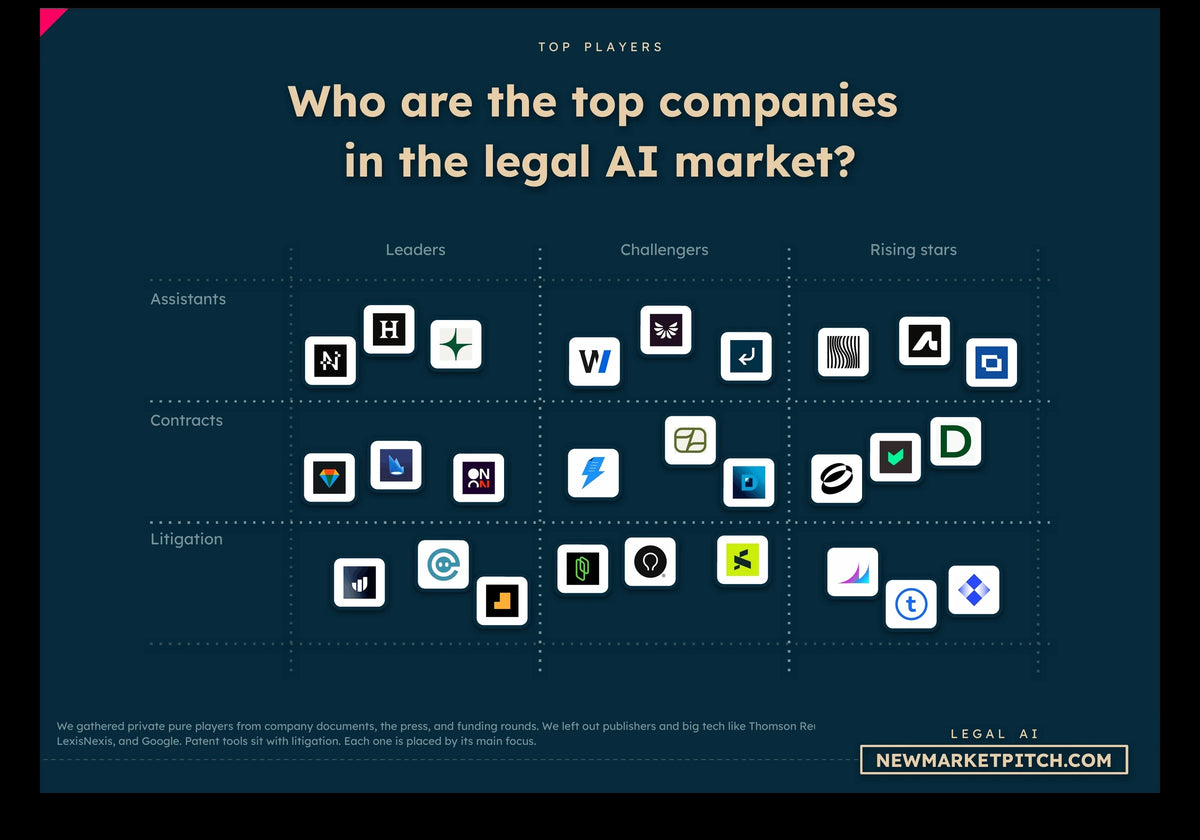
In our report covering the legal AI market, we turn what is vague and complex into simple, useful visuals. Market maps like this one show you at a glance where every startup stands.
Top startups in the legal AI market ranked by valuation
Here is an updated table that ranks the top startups in the legal AI market based on their latest reported or estimated valuations.
If you need to dig deeper and get more detailed data, please check our report covering the legal AI market.
| # | Startup Name | What They Do | Current Valuation ($) | Valuation Confidence Level | Valuation Type | Evidence Status | Total Funding ($) | Funding Confidence Level | Country |
|---|---|---|---|---|---|---|---|---|---|
| 1 | Harvey | AI platform for legal professionals | $15.5B | Full Confidence | Announced Private Round Valuation | Observed | ~$1.8B | Partial Confidence | United States |
| 2 | Legora | AI workspace for legal professionals | $8.8B | Full Confidence | Announced Private Round Valuation | Observed | $866M | Strong Confidence | Sweden |
| 3 | EvenUp | AI litigation and injury claims | $1.9B–$2.3B | Strong Confidence | Implied Valuation from Raise | Estimated | $371M1 | Partial Confidence | United States |
| 4 | Everlaw | Cloud eDiscovery and litigation software | $2B+ | Low Confidence | Announced Private Round Valuation | Observed | $315M | - | United States |
| 5 | Enter | AI-powered enterprise litigation management | $1.2B | Full Confidence | Announced Private Round Valuation | Observed | $141M1 | - | Brazil |
| 6 | Norm Ai | AI agents for legal compliance | $1.2B | Full Confidence | Implied Valuation from Raise | Estimated | $260M1 | - | United States |
| 7 | Reveal | AI-powered eDiscovery and investigations | $900M–$1.5B | Low Confidence | Comparables-Based Estimate | Estimated | $250M1 | - | United States |
| 8 | Eve | AI workflows for plaintiff firms | $1B+ | Partial Confidence | Announced Private Round Valuation | Observed | $164M | Full Confidence | United States |
| 9 | LegalOn Technologies | AI contract review and management | $650M–$950M | Partial Confidence | Revenue or ARR Multiple Estimate | Estimated | ~$192M | Partial Confidence | Japan |
| 10 | Luminance | AI contract intelligence and automation | $650M–$900M | Partial Confidence | Revenue or ARR Multiple Estimate | Estimated | $138M1 | Partial Confidence | United Kingdom |
| 11 | Ontra | AI-powered private markets legal automation | $600M–$950M | Partial Confidence | Comparables-Based Estimate | Estimated | $240M+ | - | United States |
| 12 | Manifest OS | AI-native law firm infrastructure | $750M | Full Confidence | Announced Private Round Valuation | Observed | $60M+ | - | United States |
| 13 | Lawhive | AI-enabled consumer legal services | $650M–$750M | Strong Confidence | Implied Valuation from Raise | Estimated | ~$114M | Strong Confidence | United Kingdom |
| 14 | GC AI | AI assistant for in-house counsel | $550M–$700M | Partial Confidence | Announced Private Round Valuation | Observed | $72M1 | Partial Confidence | United States |
| 15 | Genie AI | AI contract drafting and review | $470M–$700M | Partial Confidence | Implied Valuation from Raise | Implied | ~$111M | - | United Kingdom |
| 16 | Spellbook | AI drafting and contract review | $450M–$650M | Partial Confidence | Revenue or ARR Multiple Estimate | Estimated | $81M1 | Partial Confidence | Canada |
| 17 | Darrow | AI-powered litigation opportunity discovery | $350M–$650M | Partial Confidence | Revenue or ARR Multiple Estimate | Estimated | $63M+ | - | Israel |
| 18 | Eudia | Enterprise legal AI automation | $350M–$600M | Partial Confidence | Revenue or ARR Multiple Estimate | Estimated | $105M2 | - | United States |
| 19 | Orbital | AI-powered real estate legal workflows | $370M–$490M | Partial Confidence | Implied Valuation from Raise | Implied | ~$75M | Strong Confidence | United Kingdom |
| 20 | Crosby | AI-native contract review law firm | $350M–$480M | Partial Confidence | Implied Valuation from Raise | Implied | $86M | Full Confidence | United States |
| 21 | Lexroom | AI legal research and drafting | $330M–$500M | Strong Confidence | Implied Valuation from Raise | Implied | ~$73M | - | Italy |
| 22 | Supio | AI litigation intelligence for plaintiffs | $320M–$500M | Partial Confidence | Implied Valuation from Raise | Implied | $91M | Strong Confidence | United States |
| 23 | SpotDraft | AI contract lifecycle management software | $340M–$440M | Partial Confidence | Comparables-Based Estimate | Estimated | $90M | Strong Confidence | India |
| 24 | Solve Intelligence | AI patent drafting and prosecution | $350M–$400M | Strong Confidence | Implied Valuation from Raise | Implied | ~$55M | - | United States |
| 25 | Wordsmith AI | AI platform for corporate legal | $320M–$400M | Strong Confidence | Implied Valuation from Raise | Implied | $114M | Full Confidence | United Kingdom |
| 26 | Ivo | AI contract review and intelligence | $330M–$390M | Strong Confidence | Implied Valuation from Raise | Estimated | $76M1 | Strong Confidence | United States |
| 27 | DeepJudge | AI-powered enterprise legal search | $320M–$380M | Strong Confidence | Implied Valuation from Raise | Implied | ~$52M | - | Switzerland |
| 28 | Summize | AI-powered contract lifecycle management | $270M–$390M | Strong Confidence | Implied Valuation from Raise | Implied | ~$57M | - | United Kingdom |
| 29 | Patlytics | AI-powered patent lifecycle management | $290M–$350M | Strong Confidence | Implied Valuation from Raise | Implied | $59M1 | Partial Confidence | United States |
| 30 | Blue J | Generative AI tax research platform | $300M+ | Partial Confidence | Implied Valuation from Raise | Estimated | $140M1 | Partial Confidence | Canada |
| 31 | ContractPodAi | Agentic enterprise contract management platform | $200M–$400M | Low Confidence | Comparables-Based Estimate | Estimated | ~$170M | - | United Kingdom |
| 32 | Chamelio | AI-native corporate legal operations | $180M–$290M | Strong Confidence | Implied Valuation from Raise | Implied | $36M | - | United States |
| 33 | Sandstone | AI-native legal relationship management | $160M–$250M | Strong Confidence | Implied Valuation from Raise | Implied | $40M | - | United States |
| 34 | LBox | Korean AI legal research platform | $160M–$240M | Partial Confidence | Comparables-Based Estimate | Estimated | ~$40M | - | South Korea |
| 35 | Definely | AI contract drafting and review | $170M–$230M | Partial Confidence | Implied Valuation from Raise | Implied | ~$41M | - | United Kingdom |
| 36 | DeepIP | AI patent drafting and management | $165M–$230M | Strong Confidence | Implied Valuation from Raise | Implied | $40M | - | France |
| 37 | Syllo | AI litigation document analysis | $140M–$210M | Partial Confidence | Implied Valuation from Raise | Implied | ~$35M | - | United States |
| 38 | Zero Systems (HerculesAI) | Enterprise legal workflow AI automation | $120M–$200M | Partial Confidence | Implied Valuation from Raise | Implied | ~$57M | - | United States |
| 39 | Tomorro | AI contract lifecycle management | $115M–$185M | Partial Confidence | Implied Valuation from Raise | Implied | ~$43M–$63M | - | France |
| 40 | Juro | AI-powered contract automation platform | $105M–$185M | Partial Confidence | Revenue or ARR Multiple Estimate | Estimated | ~$38M | - | United Kingdom |
| 41 | Ankar | AI patent drafting and management | $110M–$170M | Strong Confidence | Implied Valuation from Raise | Implied | $24M | - | United Kingdom |
| 42 | Paxton | AI legal research assistant | $100M–$160M | Partial Confidence | Implied Valuation from Raise | Implied | $28M | - | United States |
| 43 | Jus Mundi | AI-powered international legal research | $95M–$165M | Partial Confidence | Comparables-Based Estimate | Estimated | ~$33M–$36M | - | France |
| 44 | DraftWise | AI contract drafting and negotiation | $85M–$155M | Partial Confidence | Comparables-Based Estimate | Estimated | ~$25M | - | United States |
| 45 | Finch Legal | AI-assisted personal injury casework | $95M–$145M | Strong Confidence | Implied Valuation from Raise | Implied | $20M1 | - | United States |
| 46 | Checkbox | AI legal intake and workflows | $105M–$135M | Strong Confidence | Implied Valuation from Raise | Implied | ~$30M | - | United States |
| 47 | Tavrn | AI legal case preparation agents | $85M–$140M | Partial Confidence | Implied Valuation from Raise | Implied | $21.6M1 | - | United States |
| 48 | Alma | AI-powered immigration legal services | $85M–$115M | Strong Confidence | Implied Valuation from Raise | Implied | ~$22M | - | United States |
| 49 | Tradespace | AI intellectual property lifecycle management | $75M–$115M | Strong Confidence | Implied Valuation from Raise | Implied | ~$22M | - | United States |
| 50 | Trellis | AI litigation research and analytics | $75M–$110M | Partial Confidence | Comparables-Based Estimate | Estimated | ~$31M–$36M | - | United States |
| 51 | Pandektes | AI-powered European legal research | $76M–$105M | Strong Confidence | Implied Valuation from Raise | Implied | ~$18M | - | Denmark |
| 52 | Legalfly | AI copilot for legal teams | $65M–$110M | Partial Confidence | Comparables-Based Estimate | Estimated | ~$18M–$19M | - | Belgium |
| 53 | Newcode | Configurable AI infrastructure for law firms | $68M–$100M | Strong Confidence | Implied Valuation from Raise | Implied | $20M | - | United States |
| 54 | JUPUS | AI secretarial automation for law firms | $70M–$95M | Strong Confidence | Implied Valuation from Raise | Implied | ~$24M | - | Germany |
| 55 | Jusfy | AI legal software and payments | $65M–$95M | Strong Confidence | Implied Valuation from Raise | Implied | ~$23M | - | Brazil |
| 56 | Lightbringer | AI-powered patent drafting and filing | $52M–$82M | Strong Confidence | Implied Valuation from Raise | Implied | ~$15M | - | United States |
| 57 | LegalMation | AI litigation document automation | $45M–$85M | Low Confidence | Comparables-Based Estimate | Estimated | ~$24M | - | United States |
| 58 | Alexi | AI litigation research and drafting | $45M–$80M | Partial Confidence | Comparables-Based Estimate | Estimated | $20M+1 | - | Canada |
| 59 | Stilta | Agentic AI for patent litigation | $45M–$75M | Partial Confidence | Implied Valuation from Raise | Implied | ~$11M | - | Sweden |
| 60 | LexCheck | AI contract review and negotiation | $38M–$78M | Low Confidence | Comparables-Based Estimate | Estimated | ~$25M | - | United States |
| 61 | Centari | AI intelligence for legal transactions | $46M–$70M | Partial Confidence | Implied Valuation from Raise | Implied | $14M | - | United States |
| 62 | Flank | Autonomous AI agents for legal teams | $40M–$65M | Partial Confidence | Comparables-Based Estimate | Estimated | ~$17M | - | Germany |
| 63 | Streamline AI | AI legal intake and matter management | $39M–$64M | Partial Confidence | Implied Valuation from Raise | Implied | $14M | - | United States |
| 64 | StrongSuit (Callidus Legal AI) | AI litigation research and drafting | $40M–$60M | Partial Confidence | Comparables-Based Estimate | Estimated | ~$10M | - | United States |
| 65 | BHSN | Korean enterprise legal AI solutions | $35M–$55M | Partial Confidence | Comparables-Based Estimate | Estimated | ~$12M | - | South Korea |
| 66 | Lisse | Japanese AI contract review software | $33M–$53M | Partial Confidence | Comparables-Based Estimate | Estimated | ~$16M–$25M | - | Japan |
| 67 | Theo AI | AI-powered litigation outcome prediction | $24M–$42M | Partial Confidence | Comparables-Based Estimate | Estimated | $10M1 | - | United States |
| 68 | LawGeex | Automated AI contract review | $20M–$45M | Low Confidence | Proxy-Based Estimate | Estimated | $41.5M | - | Israel |
| 69 | Clearbrief | AI-powered legal drafting and citation verification | $16M–$30M | Partial Confidence | Implied Valuation from Raise | Implied | $8.7M | - | United States |
| 70 | ThoughtRiver | AI-powered contract risk assessment | $5M–$18M | Low Confidence | Proxy-Based Estimate | Estimated | ~$11M | - | United Kingdom |
Which startups in the legal AI market have been acquired or gone public?
These startups no longer have a private-market valuation of their own, so we list them separately, using their acquisition price or their current market capitalization.
| # | Startup Name | What They Do | Current Valuation ($) | Valuation Confidence Level | Valuation Type | Evidence Status | Total Funding ($) | Funding Confidence Level | Country |
|---|---|---|---|---|---|---|---|---|---|
| 1 | Noxtua | Sovereign European legal AI platform | $550M–$850M | Partial Confidence | Implied Valuation from Raise | Implied | $223M1 | Partial Confidence | Germany |
| 2 | Evisort | AI document and contract intelligence | $311M | Full Confidence | Acquisition Value | Observed | ~$155M | - | United States |
| 3 | Henchman | AI-assisted legal drafting and knowledge | $145M–$175M | Strong Confidence | Acquisition Value | Estimated | Undisclosed | - | Belgium |
| 4 | Lexion | AI contract management and automation | $154M | Full Confidence | Acquisition Value | Observed | ~$36M | - | United States |
| 5 | Noetica AI | AI corporate transaction intelligence | $75M–$155M | Low Confidence | Proxy-Based Estimate | Estimated | ~$28M | - | United States |
- Minimum: some rounds have no public amount.
- Announced as up to $105M; actual amount may be lower.

Our research about legal AI tools gets updated several times a month, so you always get the latest view of where things stand.
Why are legal AI startup valuations rising so fast?
Legal AI startup valuations are soaring because law firms are finally spending serious money on AI, and investors believe a handful of companies could become essential software providers for the legal industry.
The shift has happened quickly. Harvey was valued at $11B in March 2026 and reached $15.5B in September. Legora climbed from $5.55B in March to $8.8B in October, a roughly 59% increase in seven months.
There is real demand behind these figures. According to Thomson Reuters' 2026 research, the share of law firms and legal departments with organization-wide generative AI tools increased from 14% in early 2024 to 43% two years later. That is a threefold increase in adoption.
Investors have responded. Crunchbase reported that legal technology startups raised a record $4.6 billion in 2025, followed by more than $2.2 billion during the first part of 2026. Much of that money went to AI-focused companies.
The scale of the change is unusual for an industry historically known for adopting new technology cautiously. Lawyers are using AI to review contracts, prepare litigation documents, research cases, and handle work that previously required hours of manual effort.
We can already see meaningful businesses emerging from this demand. The harder question is whether investors are paying reasonable prices for their future growth, especially as competition from established legal software providers and general-purpose AI becomes stronger.
Which legal AI startups are worth the most today?
Harvey and Legora are currently the two most valuable legal AI startups, at $15.5B and $8.8B, respectively. Together, they are worth $24.3 billion, putting them far above the rest of the market.
EvenUp follows with a valuation of $1.9B–$2.3B, while Everlaw is valued at $2B or more. Enter and Norm Ai are each valued at $1.2B, and Eve at $1B or more.
The next group includes Reveal ($900M–$1.5B), LegalOn Technologies ($650M–$950M), and Luminance ($650M–$900M). These businesses focus on different parts of legal work, including litigation, contract review, and electronic discovery.
One comparison captures how concentrated the market has become. Harvey's $15.5B valuation is more than six times the upper end of EvenUp's valuation range. Harvey and Legora together are worth more than ten times that same upper bound.
The gap reflects different expectations about future scale. Harvey and Legora are building platforms that can serve large parts of a law firm's daily work. Many smaller competitors concentrate on one practice area or workflow.
That doesn't mean specialized businesses cannot become highly valuable. EvenUp's position shows that a company focused on personal injury litigation can attract a multibillion-dollar valuation without attempting to serve every kind of lawyer.
For now, the biggest money is going to companies trying to become the main AI workspace for legal professionals.

In our market report about legal AI tools, we look at what the winners do differently, so you can learn from the best instead of guessing.
How many legal AI unicorns are there?
Seven legal AI startups currently have valuations of $1 billion or more: Harvey, Legora, EvenUp, Everlaw, Enter, Norm Ai, and Eve. All of them have reached that level through announced or reported financing rounds.
One other business could qualify. Reveal is valued at $900M–$1.5B, close enough to the threshold that a future financing round could establish it as a billion-dollar company.
The interesting part is what these companies actually sell. Harvey and Legora provide broad legal AI platforms. EvenUp and Eve focus on plaintiff-side litigation. Enter develops enterprise litigation management tools, while Norm Ai works on AI agents for regulated legal and compliance tasks.
That gives us at least three distinct areas producing billion-dollar businesses: general legal productivity, litigation, and compliance.
Seven startups at $1 billion or more out of 70 independent private companies also shows how concentrated the largest valuations remain. Legal AI has produced some exceptionally valuable businesses, but most companies in the sector are worth considerably less.
Why is Harvey worth $15.5 billion?
Harvey's $15.5B valuation has a strong commercial foundation: the company is growing remarkably fast and has already secured a place inside many of America's largest law firms.
According to Sacra, Harvey reached approximately $195 million in annual recurring revenue at the end of 2025, up from around $50 million a year earlier. Sacra estimated that the company crossed $400 million ARR in August 2026.
That means recurring revenue more than doubled in roughly eight months.
Harvey's customer base is just as striking. In September 2026, the company reported that 80% of Am Law 100 firms were using its platform, along with five of the Fortune 10 companies. Its March financing announcement also referred to more than 25,000 custom AI agents operating across customer environments.
Using Sacra's approximately $400 million ARR estimate, Harvey is valued at roughly 39 times annual recurring revenue.
That is a demanding price, even for a fast-growing software company. Investors are betting that Harvey will keep expanding beyond legal research and drafting into more complicated work, potentially increasing how much each firm spends on its platform.
There is also evidence that customers are using Harvey more extensively after adoption. Sacra reported that median seat counts double within 12 months, while weekly active users and monthly queries have grown sharply.
Harvey's valuation is expensive, but its operating results are exceptional. The main risk is that revenue growth slows before the company reaches the scale investors are already pricing in.

In our document detailing everything you need to know about legal AI, you will always find fresh funding data, taken straight from our own verified funding database.
Can Legora catch Harvey in legal AI?
Legora is currently Harvey's biggest valuation challenger, and its recent growth makes catching Harvey a realistic possibility rather than a distant ambition.
Legora reached an $8.8B valuation following its October 2026 Series E. That compares with Harvey's $15.5B, leaving Legora worth approximately 57% as much.
The commercial gap is narrower than the valuations might suggest. Legora reported more than $200 million in annual recurring revenue in October 2026, having reached approximately $100 million earlier in the year.
According to its October announcement, the company went from $1 million to $100 million ARR in less than 18 months, then added another $100 million in under six months.
Legora also reported more than 140,000 legal professionals using its platform across over 2,400 law firms and corporate legal teams in more than 80 markets. It now employs over 1,000 people across 18 offices.
The United States has become particularly important. Legora said it was already its largest market by revenue, with more than half of Am Law 50 firms among its customers.
Harvey remains financially larger and has exceptionally strong penetration among major US law firms. But Legora is growing quickly enough to compete for the same large customers.
One recent development makes this competition more interesting. Legora has expanded integrations with enterprise legal tools and specialist providers, including iManage, Sirion, and Blue J. Rather than developing every specialist capability itself, it is making its workspace a place where lawyers can access other products.
Harvey remains the leader today, but Legora has become a serious competitor. The next couple of years should make the differences between their strategies much clearer.
Are Harvey and Legora becoming too dominant?
Harvey and Legora have become financially dominant in legal AI, but smaller companies still have plenty of room to win business in specialized parts of the legal industry.
Their combined $24.3 billion valuation gives them a major advantage when hiring engineers, expanding internationally, and selling to large corporate customers.
Both have also used acquisitions and partnerships to broaden their capabilities. Harvey announced the addition of Aida in October 2026, while Legora has been expanding its integrations with specialist legal technology providers.
The commercial pressure on smaller companies is easy to understand. A large law firm may prefer one central AI platform that handles research, document analysis, drafting, and parts of due diligence instead of maintaining several separate applications.
However, some legal workflows are much harder to replace.
EvenUp works on personal injury cases and medical evidence. Blue J focuses on complex tax research. LegalOn Technologies handles contract review, while Solve Intelligence concentrates on patent drafting and prosecution.
These products address specific problems that require more than a general-purpose AI assistant.
An especially revealing development came in October 2026, when Legora announced an integration with Blue J. The partnership allows users to access specialist tax research inside Legora's broader workspace.
That arrangement suggests one possible direction for the market: large platforms may control the main customer interface while specialist companies provide deeper capabilities underneath.
For smaller legal AI startups, the important question is whether they can build products that remain valuable even when customers already subscribe to Harvey or Legora.

Learning from others' mistakes is the cheapest lesson there is. In our report covering the legal AI market, we look at what broke startups before you, so you don't repeat it.
Are AI litigation startups becoming the next big legal AI winners?
AI litigation startups have become one of the strongest parts of legal AI because they automate expensive, repetitive work tied directly to active legal cases.
EvenUp provides the clearest example. The company is valued at $1.9B–$2.3B and raised $150 million in an October 2025 Series E led by Bessemer Venture Partners.
In an interview with Fortune, EvenUp CEO Rami Karabibar explained that personal injury cases take approximately two years on average, while attorneys often handle around 100 cases annually.
Those numbers help explain the demand. Managing medical records, building demand packages, reviewing evidence, and tracking negotiations creates substantial administrative work.
EvenUp has built software around those tasks rather than offering a general AI chatbot.
Eve, valued at $1B or more, targets similar plaintiff-side firms with broader workflow automation. Supio ($320M–$500M) focuses on litigation intelligence, while Tavrn ($85M–$140M) develops AI agents for case preparation.
Enterprise litigation has produced substantial companies too. Everlaw is valued at $2B or more, Enter at $1.2B, and Reveal at $900M–$1.5B.
These businesses handle different stages of litigation, from preparing individual cases to managing large volumes of documents during discovery.
The appeal is that litigation software can become part of a firm's daily operations. If attorneys depend on a platform to organize evidence and prepare cases, replacing it can create real disruption.
Litigation looks like one of the strongest opportunities outside broad legal AI platforms. The next test is whether these tools consistently improve case outcomes, rather than simply reducing the time needed to prepare documents.
Are AI contract review startups still valuable?
AI contract review startups remain valuable, although basic contract summarization is becoming a weaker business on its own. The more promising companies handle the entire contract process, including drafting, negotiation, approval, and ongoing management.
LegalOn Technologies is valued at $650M–$950M, Luminance at $650M–$900M, and Ontra at $600M–$950M.
LegalOn reported raising $50 million in July 2025, bringing its announced funding total at that time to $200 million. It also reported more than 7,000 customers, up 40% year over year, with its US and UK business growing fourfold.
Luminance raised $75 million in February 2025 and reported serving more than 700 organizations across over 70 countries. Its product covers contract creation, negotiation, and post-signature analysis.
These customer figures show that contract AI has already attracted demand from companies outside the traditional law firm market.
Other businesses address similar needs from different angles. Genie AI ($470M–$700M), Spellbook ($450M–$650M), SpotDraft ($340M–$440M), and Ivo ($330M–$390M) concentrate on drafting, review, intelligence, or contract management.
The challenge is that Harvey, Legora, and general-purpose AI systems can also read and summarize contracts.
Specialist vendors therefore need to offer more than document analysis. Contract approvals, procurement integrations, negotiation history, access controls, and monitoring contractual obligations are all harder to reproduce with a standalone chatbot.
The strongest contract AI companies should remain valuable because businesses need systems that manage agreements over time. Products focused almost entirely on generating summaries face much greater pricing pressure.

Your time is limited. In our research about legal AI tools, we put numbers on each part of the market, so you can see where it makes sense to focus.
Are corporate legal teams becoming a bigger market for AI startups?
Corporate legal departments are becoming one of the most attractive customers for legal AI startups because companies want their lawyers to handle more work without constantly increasing headcount or outside counsel spending.
Thomson Reuters' 2026 research found that the proportion of general counsel identifying technology as a strategic priority doubled between 2025 and 2026.
A separate study of the UK legal market showed an equally interesting change. The share of general counsel citing technology and automation as an efficiency priority increased from 25% to 43% in one year.
Corporate legal departments are also under pressure to demonstrate their contribution to the wider business. Thomson Reuters found that 86% of surveyed general counsel believed their departments made a significant contribution to company objectives, compared with only 17% of surveyed C-suite executives.
That gap helps explain why measurable efficiency has become so important.
GC AI ($550M–$700M) targets in-house counsel directly. Eudia ($350M–$600M) develops enterprise legal automation, while Wordsmith AI ($320M–$400M) focuses on corporate legal workflows.
Chamelio ($180M–$290M), Checkbox ($105M–$135M), and Streamline AI ($39M–$64M) also address legal operations, intake, and matter management.
The opportunity is particularly attractive because corporate legal teams often handle large volumes of recurring requests: reviewing commercial agreements, approving marketing materials, advising sales teams, and managing compliance questions.
A system that reduces response times or external legal bills can be easier to justify financially than software promising a vague productivity improvement.
The difficult part is proving those savings. Corporate buyers increasingly want measurable results, and legal AI startups that cannot demonstrate them may struggle to expand their contracts.
Can smaller legal AI startups survive against Harvey and Legora?
Smaller legal AI startups can still build strong businesses by solving specialized problems better than broad AI platforms, especially in areas requiring technical expertise or jurisdiction-specific knowledge.
Patent software is a good example.
Solve Intelligence ($350M–$400M) helps with patent drafting and prosecution. Patlytics ($290M–$350M) addresses patent lifecycle management, while DeepIP ($165M–$230M), Ankar ($110M–$170M), and Lightbringer ($52M–$82M) develop related patent automation tools.
Patent work requires careful handling of technical claims, prior art, filing requirements, and specialized terminology. A general-purpose legal assistant may help prepare a first draft, but that does not automatically make it suitable for managing an entire patent prosecution process.
We see similar opportunities elsewhere. Blue J (at least $300M) focuses on tax research, Jus Mundi ($95M–$165M) on international law, and Trellis ($75M–$110M) on litigation research and analytics.
These businesses can win by being exceptionally useful to a smaller group of professionals.
However, specialization brings its own limitation. A company focused on one narrow legal workflow may eventually reach most of its potential customers, making further growth harder.
There is also the possibility that major platforms will integrate specialist tools rather than replace them. Legora's partnership with Blue J provides an early example.
Specialist legal AI companies can remain independent and profitable. Achieving valuations comparable to the largest general-purpose legal platforms will be much harder unless they expand into additional workflows.

In our market report about legal AI tools, we always try to gather several sources and make estimates that make sense, so you can work with solid numbers.
Which countries have the most valuable legal AI startups?
The United States dominates the high end of legal AI valuations, while Sweden and the United Kingdom have produced some of the strongest European companies.
Harvey, EvenUp, Everlaw, Eve, and Norm Ai are American businesses. They account for five of the seven startups valued at $1 billion or more.
Of the other two, Legora originated in Sweden and has since built a major international operation, while Enter is based in Brazil.
The United Kingdom has a particularly broad collection of legal AI companies. Luminance, Lawhive, Genie AI, Orbital, Wordsmith AI, Summize, ContractPodAi, Definely, and Juro all operate from the country.
Several other markets are developing specialist businesses. Canada has Blue J, Spellbook, and Alexi. France has DeepIP, Tomorro, and Jus Mundi. Germany has Flank and JUPUS, while Italy has Lexroom.
In Asia, LegalOn Technologies and Lisse represent Japan, while LBox and BHSN operate in South Korea. India has SpotDraft, and Brazil has Enter and Jusfy.
The geographical pattern says something about the products themselves. Legal research and drafting often require local language, jurisdiction-specific knowledge, and familiarity with national legal procedures.
That gives domestic startups an advantage in some markets.
Yet the largest valuations tend to go to companies that can expand beyond their home country. Legora is the best example: it started in Sweden but built a substantial American business, with the United States becoming its largest market by revenue.
Local specialists should remain important, especially in markets with distinct legal systems. The companies seeking the very highest valuations will probably need a convincing international growth story.
Will legal AI replace lawyers?
Legal AI is already replacing parts of lawyers' daily workload, but there is little evidence that the profession is experiencing a comparable collapse in demand for lawyers.
The immediate impact is easier to see in research, drafting, document review, and administrative work.
Thomson Reuters reported in 2026 that 31% of surveyed in-house legal professionals had reconsidered, or expected to reconsider, relationships with outside firms that failed to demonstrate AI-enabled value.
Another finding showed that 23% of surveyed law firm professionals would categorically reject a job offer without access to professional-grade AI tools.
Those figures suggest that AI capability is becoming an important part of how legal professionals choose employers and service providers.
Some startups are pushing the change further. Norm Ai operates alongside an affiliated law firm, Norm Law, where human attorneys supervise AI agents and services are priced around outcomes rather than traditional hourly billing.
Lawhive, valued at $650M–$750M, applies AI to consumer legal services. Crosby ($350M–$480M) also combines AI-powered contract work with a law firm model.
These businesses are experimenting with a different way of delivering legal services, where software performs more of the routine work and lawyers focus on oversight and judgment.
However, productivity gains can produce several outcomes. Firms may reduce junior-level work, handle more cases with existing staff, lower fees, or serve clients who previously could not afford legal assistance.
The biggest near-term effect is likely to be on routine tasks and billing models. Claims that legal AI is about to replace lawyers across the profession go considerably further than the evidence currently supports.

If you build or invest in the legal AI market, you need to know which business models pay off now and which ones are fading. That's why our report covering it has a whole section on it.
Could ChatGPT and established legal software companies crush legal AI startups?
General-purpose AI providers and established legal software companies are serious competitors for legal AI startups, especially those selling basic research and drafting features.
ChatGPT and Claude can already summarize documents, analyze text, and help prepare drafts. Improvements in these tools could make some standalone legal AI products increasingly difficult to sell.
Established legal software providers have another advantage: they already have trusted relationships with law firms and corporate legal departments.
Thomson Reuters acquired Casetext for $650 million in 2023, bringing its CoCounsel technology into an existing legal software business. LexisNexis acquired Henchman in 2024 to strengthen AI-assisted drafting and access to internal legal knowledge.
Both transactions show that established companies are willing to buy advanced AI capabilities rather than let new startups control the entire customer relationship.
Legal AI still has serious reliability problems.
A Stanford Law School study published in 2025 found that the specialized legal research tools it tested from LexisNexis and Thomson Reuters hallucinated more than 17% of the time under its evaluation conditions.
The findings should not be generalized to every product or current model version, but they demonstrate why accuracy and verification remain major concerns.
Startups that combine capable AI models with reliable legal sources, document permissions, auditability, and deeply integrated workflows can still compete.
Those offering little more than an interface around a general-purpose model are in a much weaker position.
What do legal AI acquisitions tell us about startup valuations?
Legal AI acquisitions show that specialist technologies have real strategic value, although disclosed acquisition prices have generally been much smaller than the valuations of today's largest independent startups.
Workday acquired Evisort for $311M in October 2024, according to its SEC filings. Docusign acquired Lexion for $154M in May 2024, also confirmed in its regulatory filings.
LexisNexis acquired Belgian legal AI company Henchman in July 2024. The acquisition is valued at approximately $145M–$175M.
Noetica AI, another acquired business focused on corporate transaction intelligence, has an estimated transaction-related value of $75M–$155M.
These deals illustrate how established enterprise software companies can incorporate specialized legal AI into products they already sell.
For example, Docusign integrated Lexion's technology into its agreement management platform, while Workday brought Evisort's document intelligence into its finance and human capital software.
The financial difference between these acquisitions and the largest private valuations is substantial. Evisort's $311M acquisition value represents approximately 2% of Harvey's $15.5B valuation.
The companies had different products, maturity, and growth prospects, so the figures should not be treated as directly comparable prices. They nevertheless show the wide range of potential outcomes for legal AI founders and investors.
A successful acquisition can generate attractive returns without a company ever becoming a unicorn. For investors, the purchase price relative to invested capital and ownership dilution may matter more than crossing an arbitrary valuation threshold.
| Acquired startup | Buyer | Main product | Transaction value |
|---|---|---|---|
| Evisort | Workday | AI document intelligence | $311M |
| Henchman | LexisNexis | Legal drafting and knowledge | $145M–$175M |
| Lexion | Docusign | Contract management | $154M |
| Noetica AI | - | Corporate transaction intelligence | $75M–$155M |

In our report covering the legal AI market, we don't want to repeat what boring consulting reports say. Instead, we show you the real and latest market signals that matter.
Which legal AI startups could become the next unicorns?
Reveal, LegalOn Technologies, Luminance, Ontra, Manifest OS, and Lawhive are among the companies worth watching closest to the $1 billion threshold.
Reveal's valuation range of $900M–$1.5B already crosses that level.
LegalOn Technologies ($650M–$950M), Luminance ($650M–$900M), and Ontra ($600M–$950M) have substantial positions in contract intelligence, legal automation, and private markets workflows.
Manifest OS is valued at $750M, while Lawhive is valued at $650M–$750M. Noxtua is no longer counted as an independent startup: C.H.Beck became its majority shareholder in September 2026.
The businesses have different paths to reaching $1 billion. Contract software companies can expand through larger enterprise deployments, while litigation and legal services companies may increase revenue by handling more matters.
Revenue growth deserves particular attention here.
LegalOn's expansion to more than 7,000 customers and Luminance's reported presence across more than 700 organizations are useful commercial indicators. However, customer numbers alone cannot establish whether their current valuations are attractive.
A new unicorn valuation also requires an investor willing to pay that price, whether through financing or another transaction.
Some of these companies may reach $1 billion without another funding round being necessary for their operations. Others could grow commercially while remaining below the threshold because investor pricing has become more conservative.
Are legal AI startup valuations getting too expensive?
The highest legal AI startup valuations are expensive enough that even strong companies could disappoint investors if growth slows.
Harvey's $15.5B valuation represents approximately 39 times Sacra's $400 million ARR estimate. Legora's $8.8B valuation represents less than 44 times its reported ARR of more than $200 million.
Those are substantial premiums.
To understand the expectations behind them, we can compare the valuations with a hypothetical future revenue multiple of ten times annual revenue.
At that multiple, Harvey would need approximately $1.55 billion in annual revenue to support its current valuation. Legora would need approximately $880 million.
These are illustrative calculations rather than revenue forecasts. They show the scale that both companies would need to reach if investors eventually applied more conventional high-growth software valuation multiples.
The challenge becomes clearer when we look at how difficult successive revenue doublings become.
Growing from $100 million to $200 million ARR requires $100 million in additional recurring revenue. Growing from $400 million to $800 million requires another $400 million.
Meanwhile, competition could put pressure on software pricing, and AI infrastructure costs may affect gross margins.
Smaller companies face valuation pressure too. LawGeex is valued at $20M–$45M despite having raised $41.5M, reflecting the possibility of weaker growth or a reassessment of earlier financing prices. ThoughtRiver, valued at $5M–$18M against approximately $11M raised, faces a similar situation.
Legal AI is attracting both reasonable and aggressive valuations. Harvey and Legora have strong demand behind them, but their prices leave little room for a major slowdown.

In our research about legal AI tools, we like to show you the big picture. We know your time is precious, so we make every page quick to read and packed with as much learning as possible per minute.
Is the legal AI market big enough to support all these billion-dollar valuations?
The legal AI market can support several multibillion-dollar companies, but only if AI vendors capture a meaningful share of spending that currently goes toward human legal work.
The market already includes legal research, contract management, eDiscovery, compliance, and document automation software.
AI expands the opportunity because it can automate work that law firms and legal departments previously paid professionals to perform.
However, the value of time saved does not automatically become revenue for the software vendor.
A company might save hundreds of lawyer-hours by using AI while paying only a relatively small annual software subscription. Another business might use those savings to negotiate lower legal fees rather than increase its technology budget.
According to Thomson Reuters' 2026 AI in Professional Services Report, only 18% of surveyed professionals said their organizations measured return on investment from AI. Another 40% did not know whether ROI was being tracked.
That is a surprisingly weak measurement record for technology receiving so much investment.
It also suggests why startups focused on measurable outcomes may have an advantage.
Litigation automation can be assessed through case preparation times and operational costs. Contract platforms can measure approval times and workload reduction. Corporate legal tools can track response times and external counsel spending.
Broad AI workspaces have more complicated economics because their value spans many different tasks.
The legal AI market is large enough to create several major software businesses. Supporting today's highest valuations simultaneously will require much more than widespread experimentation. Customers must keep expanding their spending, and vendors must prove that their products deliver enough value to justify those increases.
Are legal AI startups actually worth their current valuations?
Legal AI has produced several genuinely valuable companies, but the highest valuations are already pricing in years of exceptional growth. Harvey and Legora currently have the strongest commercial results to support their premiums, while much of the broader market is harder to price.
Harvey has reached $15.5B with approximately $400 million in estimated ARR and extensive adoption among major law firms. Legora is valued at $8.8B after surpassing $200 million in reported ARR and expanding to more than 2,400 law firm and corporate customers.
Both businesses have grown rapidly enough to support major valuation increases. Their next challenge is maintaining that pace as they become much larger.
The opportunity is also spreading beyond general legal research. EvenUp ($1.9B–$2.3B) and Eve ($1B or more) show how much investors value litigation automation. Enter ($1.2B) and Norm Ai ($1.2B) demonstrate that enterprise litigation management and compliance can also support unicorn valuations.
Specialist companies are developing valuable positions in contracts, patents, tax, corporate legal operations, and international legal research.
There are reasons to expect continued growth. Legal AI adoption has increased sharply, large law firms are committing to enterprise deployments, and established software companies are buying specialized technology.
But valuation risk is just as real. General-purpose AI products keep improving, enterprise customers will eventually demand clearer financial returns, and expensive software businesses can suffer large valuation corrections when growth slows.
Legal AI has earned its place among the most important enterprise AI categories. Harvey and Legora are currently the clearest commercial winners, while several litigation and specialist vendors have credible opportunities to grow much larger.
The biggest uncertainty is how much of the financial value created by AI will ultimately be captured by software companies rather than passed on to law firms and their clients. That will determine whether today's highest valuations look reasonable in hindsight.

When you build or invest in the legal AI market, you need clarity, not confusion. In our market report about legal AI tools, we always try to put numbers on and quantify whatever is usually vague and confusing.
Our methodology
This analysis ranks the most valuable independent private startups in the legal AI market as of November 2026. We focus on businesses whose products are centered on legal AI, including legal research, litigation automation, contract intelligence, compliance, patent software, and legal operations. Established software groups, their subsidiaries, and acquired companies are excluded from the private startup ranking.
We prioritize completed financing rounds, company announcements, investor disclosures, regulatory filings, revenue and ARR figures, customer growth, and comparable transactions. A recent financing round with a disclosed valuation carries more weight than older funding figures or estimates based solely on market comparisons.
Where a recent financing round established a company valuation, we use that figure directly. For companies without a disclosed current valuation, we estimate a range using funding history, revenue growth, customer adoption, commercial traction, comparable businesses, and prevailing market conditions. These estimates are not equivalent to prices established in completed transactions.
We also account for the age of financing information. Recent transactions generally provide the clearest valuation reference, while older rounds are assessed alongside subsequent business developments. Revenue multiples, funding-stage dilution, and acquisition comparisons help us evaluate companies when direct valuation information is limited.
Valuation ranges reflect differences in company maturity, growth, business model, geography, and available financial information. We use exact figures when supported by completed transactions and broader ranges when a company's current value depends on commercial and financial assumptions. Unicorn counts distinguish companies valued above $1 billion through announced financing rounds from businesses whose estimated valuations may cross that threshold.
For the largest companies, we compare valuations with recurring revenue to assess the growth expectations investors are pricing in. Harvey's revenue trajectory is based on Sacra's research, while Legora's ARR, customer numbers, and expansion figures come from its company announcements. These revenue multiples are valuation comparisons, not forecasts of future performance.
We also examine customer adoption and industry demand using Thomson Reuters' professional-services and legal-operations research, alongside Crunchbase's legal technology funding analysis. Specialist companies are assessed through their funding announcements, customer growth, product focus, and position within legal workflows.
Acquired startups are treated separately from independent private businesses. We use transaction consideration from regulatory filings where available, including Workday's acquisition of Evisort and Docusign's acquisition of Lexion. For transactions without a publicly disclosed purchase price, we use a valuation range rather than presenting an exact acquisition figure.
Key company sources include Harvey's September 2026 financing announcement, Harvey's March 2026 financing, Legora's October 2026 Series E announcement, Legora's March 2026 Series D announcement, Sacra's Harvey financial research, Norm Ai's financing announcement, Fortune's reporting on EvenUp, LegalOn Technologies' Series E announcement, and Luminance's Series C announcement.
Industry and market sources include Crunchbase News on legal technology financing, Thomson Reuters Institute on AI adoption, Thomson Reuters' 2026 AI in Professional Services Report, the 2026 Legal Department Operations Report, and Stanford Law School's research on legal AI reliability.
For acquisition comparisons, we used Workday's SEC disclosure concerning Evisort, Docusign's SEC filing covering Lexion, LexisNexis' Henchman acquisition announcement, and Thomson Reuters' announcement of its $650 million Casetext acquisition.
A company can appear in this ranking even when its total funding is undisclosed: its position depends on its valuation, not on the capital it has raised.
Written by the New Market Pitch teamWe track new markets so founders and investors can move faster. About us