What are the top robotics startups by total funding raised?
Whether you're building or investing in the robotics market, our report covers everything you need to know: the players, the money, and what's coming next.
Summary
The top robotics startups by total funding raised are Anduril (more than $12 billion), Helsing ($3.3 billion), Shield AI ($3.0 billion), Saronic Technologies ($2.6 billion), Zipline ($1.95 billion), Figure AI (more than $1.7 billion), Quantum Systems ($1.7 billion), NEURA Robotics ($1.6 billion), Neolix (more than $1.4 billion) and CMR Surgical ($1.3 billion). Together, these ten companies have raised at least $30.6 billion.
Anduril is in a league of its own. Its more than $12 billion in cumulative funding is over three and a half times Helsing's total, and its $5 billion May 2026 Series H was larger than the entire fundraising history of any other company in the top ten.
Defense robotics dominates the top of the ranking. Anduril, Helsing, Shield AI and Saronic Technologies have raised at least $20.9 billion combined, representing about 68% of the top ten's total funding. Military autonomy has become one of the industry's biggest magnets for private capital.
The latest financing rounds show that investors are increasingly comfortable committing more than $500 million to individual robotics companies. Helsing, Saronic, NEURA Robotics, Quantum Systems and Figure AI have all secured exceptionally large rounds, while newer businesses such as Bedrock Robotics and Mach Industries are attracting substantial financing too.
The United States has five companies in the top ten, Germany has three, and the United Kingdom and China have one each. However, Crunchbase's broader 2026 investment figures put China slightly ahead of the United States, with approximately $13.2 billion versus $12.1 billion in robotics startup investment.
China's strongest companies are developing a different mix of technologies, particularly humanoid robots, embodied AI, industrial automation and autonomous delivery. Neolix leads the Chinese companies in our ranking, followed by Galbot, AI2 Robotics, Spirit AI and Robot Era.
Europe's strongest robotics ecosystem is concentrated in Germany. Helsing, Quantum Systems and NEURA Robotics have raised $6.6 billion combined, while the United Kingdom's CMR Surgical and Portugal's TEKEVER demonstrate that European strengths also extend into medical robotics and autonomous surveillance.
Humanoid robotics is attracting billions, but funding and commercial progress are moving at different speeds. Figure AI, NEURA Robotics and Apptronik have raised at least $4.24 billion combined, while AgiBot leads reported shipment volumes and Agility Robotics has accumulated substantial operating experience in industrial environments.
Traditional warehouse and surgical robotics businesses have a more established commercial foundation. Symbotic has $22.5 billion in remaining performance obligations, while surgical robotics companies such as CMR Surgical, Edge Medical Robotics and Cornerstone Robotics are targeting high-value medical procedures.
Industrial robotics already operates at a scale that humanoid startups are still trying to reach. More than five million industrial robots are working in factories worldwide, with 603,000 new installations in 2025 alone. The next challenge is bringing automation into tasks that conventional industrial machines cannot easily handle.
Our view is that robotics is becoming a major investment category, but the strongest long-term businesses will be those that convert large funding rounds into reliable machines, repeat customer orders and profitable deployments. The companies with impressive demonstrations still have plenty to prove; those with operating fleets and established contracts are already further along.

Written by the New Market Pitch teamWe track new markets so founders and investors can move faster. About us

In our report covering the robotics market, you will always find fresh funding data, taken straight from our own verified funding database.
Top startups in the robotics market ranked by total funding raised
Here is an updated table that ranks the top startups in the robotics market based on the total amount of funding they have raised to date.
The table also includes the total number of funding rounds, the date and size of the latest round, the financing type (e.g. Series A, equity financing), key investors, the startup's current status (active, IPO, acquired, or shut down), and a confidence score based on the data collected (we excluded startups with very low data confidence, to make sure everything is reliable).
If you need to dig deeper and get more detailed data, please check our report covering the robotics market.
| # | Startup | What They Do | Total Raised ($) | Total Rounds | Last Round Date | Last Round Amount ($) | Last Round Type | Key Investors | Current Stage | Confidence | Country |
|---|---|---|---|---|---|---|---|---|---|---|---|
| 1 | Anduril | Autonomous defense systems and drones | $12B+ | 11 | May 2026 | $5.0B | Series H | Thrive Capital, Andreessen Horowitz | Active | Strong | United States |
| 2 | Helsing | Autonomous AI-powered defense systems | $3.3B | 5 | July 2026 | $1.8B | Series E | Dragoneer, Lightspeed, ICONIQ | Active | Strong | Germany |
| 3 | Shield AI | Autonomous defense aircraft and AI pilots | $3.0B | 11 | March 2026 | $500M | Preferred Equity | Blackstone | Active | Strong | United States |
| 4 | Saronic Technologies | Autonomous naval vessels | $2.6B | 5 | March 2026 | $1.8B | Series D | Kleiner Perkins, Advent International, Bessemer Venture Partners | Active | Strong | United States |
| 5 | Zipline | Autonomous drone delivery systems | $1.95B | 9 | March 2026 | $200M | Series H Extension | Paradigm, Baillie Gifford, Tiger Global | Active | Strong | United States |
| 6 | Figure AI | General-purpose humanoid robots | $1.7B+ | 5 | September 2025 | $1.0B | Series C | Parkway Venture Capital, NVIDIA, Brookfield | Active | Strong | United States |
| 7 | Quantum Systems | Autonomous military and mapping drones | $1.7B | 5 | July 2026 | $1.2B | Series D | Blackstone, Noteus Partners, Advent International | Active | Strong | Germany |
| 8 | NEURA Robotics | Cognitive humanoid and collaborative robots | $1.6B1 | 4 | June 2026 | $1.4B1 | Series C | Tether, Qualcomm Technologies, imec.xpand | Active | Partial | Germany |
| 9 | Neolix | Autonomous last-mile delivery vehicles | $1.4B+ | 7+ | October 2026 | ~$400M | Series E | Boyu Capital, Templewater, Vertex Growth | Active | Partial | China |
| 10 | CMR Surgical | Robotic minimally invasive surgery systems | $1.3B | 7 | April 2025 | $100M | Late-stage Equity | SoftBank, Ally Bridge | Active | Partial | United Kingdom |
| 11 | Galbot | Embodied AI and humanoid robots | ~$1.15B | 7 | March 2026 | $345M | Series C+ | National AI Fund, Sinopec, CITIC Group | Active | Strong | China |
| 12 | Mach Industries | Autonomous defense platforms and manufacturing | $1.1B | 5 | September 2026 | $600M | Series C Extension | Ribbit Capital, Infinite Capital, Bedrock | Active | Strong | United States |
| 13 | Mind Robotics | Industrial AI and robotic automation | $1.0B | 3 | May 2026 | $400M | Growth Venture | Kleiner Perkins, Volkswagen Ventures, Salesforce Ventures | Active | Full | United States |
| 14 | Symbotic | AI-powered warehouse automation systems | $1.0B2 | 4 | December 2025 | $425M | Public Equity Offering | Undisclosed | IPO | Partial | United States |
| 15 | Bedrock Robotics | Autonomous construction equipment | $950M+ | 4 | October 2026 | $600M | Series C | CapitalG, Emergence Capital | Active | Full | United States |
| 16 | Apptronik | General-purpose humanoid robots | $935M+ | 4 | February 2026 | $520M | Series A-X | B Capital, Google, Qatar Investment Authority | Active | Full | United States |
| 17 | AI2 Robotics | General-purpose embodied AI robots | $890M | 4 | June 2026 | $700M | Growth Financing | National SME Development Fund, China Culture Industry Investment Fund, Guangdong AI Fund | Active | Strong | China |
| 18 | Skydio | AI-powered autonomous drone systems | $850M | 8 | April 2026 | $110M | Series F | Undisclosed | Active | Strong | United States |
| 19 | Spirit AI | Embodied intelligence models and robotics | $832M | 7 | June 2026 | $222M | Series A+ | Undisclosed | Active | Partial | China |
| 20 | Robot Era | General-purpose humanoid robots | $736M | 6 | July 2026 | $147M | Late-stage Equity | Chengtong Fund, Jiangxi State Holding, Guoyuan Equity | Active | Partial | China |
| 21 | Galaxea AI | Embodied AI robotic platforms | $700M+ | 6 | August 2026 | Undisclosed | Series C | Undisclosed | Active | Partial | China |
| 22 | TARS Robotics | General-purpose intelligent humanoid robots | $697M | 3 | April 2026 | $455M | Pre-Series A | GL Ventures, HongShan, Meituan | Active | Partial | China |
| 23 | CloudMinds | Cloud-connected intelligent robotic systems | $694M | 6 | July 2023 | $138M | Series C | GS Capital, Moom Capital, Guangzhou Knowledge City | Active | Partial | United States |
| 24 | ICON | Robotic 3D printing for construction | $692M | 6 | October 2026 | $200M | Series D | Baillie Gifford, BlackRock | Active | Partial | United States |
| 25 | TEKEVER | Autonomous defense and surveillance drones | $677M | 4 | September 2026 | $580M | Series D | UC Investments, Baillie Gifford, Merlyn Advisors | Active | Partial | Portugal |
| 26 | Sharpa | Dexterous robotic hands and humanoids | ~$668M3 | Undisclosed | Undisclosed | Undisclosed | Undisclosed | Alibaba, HongShan, Qiming Venture Partners | Active | Low | Singapore |
| 27 | X Square Robot | General-purpose embodied AI robotic systems | $643M | 7 | June 2026 | Undisclosed | Series C | IDG Capital, China Mobile, Source Code Capital | Active | Partial | China |
| 28 | Agility Robotics | Commercial humanoid warehouse robots | $640M | 6 | June 2025 | $400M | Series C | Humanoid Global, NVIDIA Ventures | Active | Strong | United States |
| 29 | GreyOrange | AI-driven robotic warehouse fulfillment | $568M | 6+ | February 2025 | $55M | Venture Equity | Blume Ventures, Mithril Capital | Active | Partial | United States |
| 30 | Geek+ | Autonomous warehouse and logistics robots | $532M | 7 | August 2022 | $100M | Series E | Intel Capital, Vertex Growth, Gaorong Capital | IPO | Strong | China |
| 31 | Edge Medical Robotics | Minimally invasive surgical robots | $461M2 | 7 | January 2026 | $154M | IPO | Undisclosed | IPO | Partial | China |
| 32 | Locus Robotics | Autonomous mobile warehouse robots | $458M | 8 | August 2026 | $42M | Series G | Undisclosed | Active | Strong | United States |
| 33 | Exotec | Automated warehouse robotics systems | $447M | 4 | January 2022 | $335M | Series D | Goldman Sachs, 83North, Bpifrance | Active | Full | France |
| 34 | Cornerstone Robotics | Robotic-assisted surgical systems | $435M | 5 | November 2025 | $200M | Growth Financing | Undisclosed | Active | Partial | China |
| 35 | LimX Dynamics | General-purpose humanoid and legged robots | $427M | 6 | July 2026 | ~$200M | Pre-IPO Equity | IDG Capital, Lens Technology, WestSummit Capital | Active | Partial | China |
| 36 | MEGAROBO | Laboratory automation and intelligent robotics | ~$405M4 | 5+ | June 2022 | $300M | Series C | GGV Capital, Goldman Sachs, Pavilion Capital | Active | Partial | China |
| 37 | Dexterity | AI-powered warehouse automation robots | $404M | 5 | May 2026 | $105M | Private Placement | Undisclosed | Active | Strong | United States |
| 38 | Distalmotion | Robotic-assisted surgical systems | $390M | 8 | January 2026 | Undisclosed | Series G-II | Johnson & Johnson Innovation – JJDC | Active | Partial | Switzerland |
| 39 | Dobot Robotics | Collaborative industrial robotic arms | $387M2 | 11 | November 2025 | $99M | Post-IPO Placement | Undisclosed | IPO | Partial | China |
| 40 | Bright Machines | Software-defined robotic manufacturing | $385M | 5 | October 2026 | Undisclosed | Strategic Equity | Teradyne | Active | Strong | United States |
| 41 | Agile Robots | Intelligent industrial robotic systems | $380M | 5 | October 2026 | Undisclosed | Strategic Investment | NVIDIA | Active | Partial | Germany |
| 42 | PsiBot | Embodied AI for dexterous manipulation | $380M | 3+ | August 2026 | $100M | Venture | Ningbo Tuopu Group, Lens Technology, Chery-backed fund | Active | Partial | China |
| 43 | Serve Robotics | Autonomous sidewalk delivery robots | $371M2 | 7 | October 2025 | $100M | Registered Direct Offering | Undisclosed | IPO | Partial | United States |
| 44 | EngineAI | Humanoid robots and embodied intelligence | $368M+ | 6 | May 2026 | Undisclosed | Series B+ | Undisclosed | Active | Partial | China |
| 45 | Medical Microinstruments | Robotic systems for microsurgery | $346M | 5 | October 2026 | $125M | Series D | BioStar Capital, S3 Ventures, Angelini Ventures | Active | Strong | United States |
| 46 | Gecko Robotics | Industrial inspection and maintenance robots | $345M | 6 | June 2025 | $125M | Series D | Cox Enterprises, Founders Fund, USIT | Active | Strong | United States |
| 47 | Fabric | Robotic micro-fulfillment infrastructure | $336M | 4 | October 2021 | $200M | Series C | Temasek, CPP Investments, Koch Disruptive Technologies | Active | Full | United States |
| 48 | Gausium | Autonomous commercial cleaning robots | $325M | 5 | November 2021 | $188M | Series C | Capital Today, SoftBank Vision Fund 2, Jinyi Capital | Active | Strong | China |
| 49 | Flexiv | Adaptive industrial robotic systems | $324M | 6 | March 2026 | Undisclosed | Strategic / Late VC | Invus Group | Active | Partial | China |
| 50 | Dexory | Autonomous warehouse intelligence robots | $318M | 5 | October 2025 | $100M | Series C Equity | Eurazeo, LTS Growth, Endeavor Catalyst | Active | Strong | United Kingdom |
| 51 | Hai Robotics | Automated warehouse case-handling systems | $315M | 5-6 | June 2022 | $100M | Series D+ | Capital Today, Source Code Capital, 01VC | Active | Partial | China |
| 52 | Forterra | Autonomous ground mobility systems | $303M | 3 | November 2025 | $238M5 | Series C | Moore Strategic Ventures, Salesforce Ventures, Franklin Templeton | Active | Partial | United States |
| 53 | Pudu Robotics | Commercial service and cleaning robots | $300M+ | 8+ | April 2026 | ~$150M | Growth Equity | BAIC Industrial Investment, Longgang Financial Holding, Highlight Capital | Active | Partial | China |
| 54 | Walden Robotics | General-purpose AI industrial robots | $300M | 1 | July 2026 | $300M | Seed | Toyota, Deviation Capital, NVIDIA | Active | Full | United States |
| 55 | Saildrone | Autonomous maritime surveillance and mapping | $296M | 6 | October 2025 | $50M | Series C-2 / Strategic | Lockheed Martin | Active | Strong | United States |
| 56 | Standard Bots | AI-native industrial robotic arms | $287M | 5 | June 2026 | $200M | Series C | General Catalyst, RoboStrategy, Amazon | Active | Partial | United States |
| 57 | Starship Technologies | Autonomous last-mile delivery robots | $281M | 7 | October 2025 | $50M | Series C Extension | Coefficient Capital, Karma Ventures, SmartCap | Active | Strong | United States |
| 58 | Path Robotics | AI-powered industrial welding robots | $271M | 5 | October 2024 | $100M | Series D | Drive Capital, Matter Venture Partners, Tiger Global | Active | Strong | United States |
| 59 | Opentrons | Automated laboratory liquid handling systems | $270M | 4+ | October 2026 | $40M | Series E | Avego, BroadOak Capital Partners | Active | Partial | United States |
| 60 | Humanoid | General-purpose industrial humanoid robots | $270M | 2+ | July 2026 | $152M | Series A | Prime Movers Lab, Schaeffler, Bosch | Active | Partial | United Kingdom |
| 61 | AMP Robotics | AI-powered waste sorting robots | $269M | 7 | December 2024 | $91M | Series D | Congruent Ventures, Sequoia Capital, Blue Earth Capital | Active | Partial | United States |
| 62 | Vention | AI-powered industrial automation platform | $264M | 6 | January 2026 | $110M | Series D | Investissement Québec, Fidelity Investments Canada, NVentures | Active | Strong | Canada |
| 63 | THINK Surgical | Robotic orthopedic surgery systems | $249M | 3 | January 2026 | $131M | Series F | Undisclosed | Active | Partial | United States |
| 64 | Fourier Intelligence | Rehabilitation and humanoid robotics | $245M | 9 | August 2025 | $43M | Series E+ | Runyang Technology | Active | Partial | China |
| 65 | Mujin | Intelligent industrial robotic automation | $243M | 7 | October 2026 | Undisclosed | Series D Extension | SK Square | Active | Partial | Japan |
| 66 | Ecorobotix | AI-powered precision agricultural robots | $240M | 8 | October 2025 | $105M | Series D | Highland Europe, ECBF, McWin Capital Partners | Active | Partial | Switzerland |
| 67 | Quicktron Robotics | Autonomous warehouse logistics robots | $235M | 5+ | September 2024 | $100M | Series D | Golden Oriole Capital, FarGlory Group, Wuxi Liangxi Technology Innovation Fund | Active | Partial | China |
| 68 | Keenon Robotics | Commercial service and delivery robots | $228M | 4 | September 2021 | $200M | Series D | SoftBank Vision Fund 2, CICC ALPHA, Prosperity7 | Active | Partial | China |
| 69 | Seegrid | Autonomous warehouse material-handling robots | $225M | 13 | October 2025 | $25M | Series D Extension | G2 Venture Partners | Active | Partial | United States |
| 70 | Gravis Robotics | Autonomous heavy construction equipment | $223M | 2 | August 2026 | $200M | Series A | SoftBank | Active | Strong | Switzerland |
| 71 | AgiBot | General-purpose humanoid and embodied robots | $221M | 12 | August 2025 | Undisclosed | Strategic Financing | LG Electronics, Mirae Asset | Active | Partial | China |
| 72 | Nimble Robotics | Autonomous robotic order fulfillment | $221M | 3 | October 2024 | $106M | Series C | FedEx, Cedar Pine, Accel | Active | Strong | United States |
| 73 | Vecna Robotics | Autonomous warehouse material-handling robots | $215M | 6 | September 2026 | $31M | Series D | Unless, Drive Capital, Tiger Global | Active | Strong | United States |
| 74 | Monarch Tractor | Autonomous electric agricultural tractors | $214M | 3 | July 2024 | $133M | Series C | Astanor Ventures, At One Ventures, PMV | Acquired | Strong | United States |
| 75 | Noetix Robotics | Affordable humanoid and companion robots | $208M | 4+ | March 2026 | ~$140M | Series B | China Science Investment, Chendao Capital, Unity Ventures | Active | Partial | China |
| 76 | EndoQuest Robotics | Flexible endoluminal surgical robotics | $207M | 7 | July 2025 | $31M | Series D-2 | Crescent Enterprises, Dr. Fred Moll, Puma Venture Capital | Active | Strong | United States |
| 77 | ROKAE | Industrial and collaborative robotic arms | $206M | 6+ | April 2024 | $69M | Late-stage / Series E | National Manufacturing Transformation Fund, Zoucheng Industrial Fund | IPO | Partial | China |
| 78 | Mytra | AI-powered warehouse material handling | $198M | 4 | January 2026 | $120M | Series C | Avenir Growth, Kivu Ventures, D. E. Shaw Ventures | Active | Strong | United States |
| 79 | ForSight Robotics | Robotic ophthalmic surgery systems | $190M | 3 | June 2025 | $125M | Series B | Eclipse Ventures, Adani Group, Dr. Fred Moll | Active | Full | Israel |
| 80 | Performance Drone Works | Military and tactical unmanned aircraft | $187M | 4 | September 2026 | $52M | Late-stage Venture | Undisclosed | Active | Partial | United States |
| 81 | Neocis | Robot-assisted dental implant surgery | $183M | 8 | January 2024 | $20M | Series E Extension | Mirae Asset Venture Investment, NVentures | Active | Partial | United States |
| 82 | Carbon Robotics | AI-powered autonomous agricultural robots | $170M | 5 | October 2025 | $21M | Series D-2 | Giant Ventures, Anthos Capital, Bond | Active | Strong | United States |
| 83 | Ronovo Surgical | Modular robotic surgery platforms | $161M | 6+ | September 2025 | $67M | Series D | Johnson & Johnson Development Corporation, Lilly Asia Ventures, INCE Capital | Active | Partial | China |
| 84 | Capstan Medical | Robotic-assisted heart valve surgery | $153M | 3 | December 2024 | $110M | Series C | Eclipse Ventures, Gideon Strategic Partners, Intuitive Ventures | Active | Strong | United States |
| 85 | ANYbotics | Autonomous industrial inspection robots | $152M | 4 | September 2025 | $20M | Series B-III | Climate Investment | Active | Strong | Switzerland |
| 86 | Attabotics | Robotic automated warehouse storage systems | $151M | 5 | November 2022 | $72M | Series C | Export Development Canada, Ontario Teachers' Pension Plan | Acquired | Partial | Canada |
| 87 | Noah Medical | Robotic lung diagnostic procedures | $150M | 1+ | September 2025 | Undisclosed | Preferred Equity | Undisclosed | Active | Low | United States |
| 88 | Momentis Surgical | Minimally invasive robotic surgical systems | $143M | 7+ | November 2025 | ~$14M | Equity Financing | Undisclosed | Active | Partial | Israel |
| 89 | Wandercraft | Robotic exoskeletons and humanoid systems | $143M | 5 | June 2025 | $75M | Series D | Renault Group, Teampact Ventures, Bpifrance | Active | Partial | France |
| 90 | DEEP Robotics | Quadruped and humanoid robots | $141M | 7 | December 2025 | $71M | Series C | CMB International, China AMC, China Telecom | Active | Partial | China |
| 91 | Collaborative Robotics | Collaborative mobile manipulation robots | $140M | 3 | April 2024 | $100M | Series B | General Catalyst, Lux Capital, Sequoia Capital | Active | Full | United States |
| 92 | ForwardX Robotics | Autonomous mobile warehouse robots | $138M | 7 | July 2023 | $28M | Series C-II | Anhui State-owned Capital, Hefei Gaoxin Group, Hefei Industry Investment Group | Active | Strong | China |
| 93 | Virtual Incision | Miniaturized robotic surgical systems | $130M | 8 | April 2025 | Undisclosed | Bridge Equity | Invest Nebraska | Active | Partial | United States |
| 94 | Percepto | Autonomous industrial inspection drones | $123M | 5+ | June 2023 | $50M | Series C | Koch Disruptive Technologies, Atento Capital, Spider Capital | Active | Partial | Israel |
| 95 | Overland AI | Autonomous military ground vehicles | $122M | 3 | February 2026 | $80M | Growth Equity | 8VC, Valor Equity Partners, StepStone Group | Active | Strong | United States |
| 96 | Built Robotics | Autonomous construction and excavation robots | $112M | 3 | April 2022 | $64M | Series C | Tiger Global, NEA, Founders Fund | Active | Full | United States |
| 97 | eCential Robotics | Surgical navigation and robotic systems | $18M | 5 | January 2021 | Undisclosed | Mixed Financing Package | Bpifrance, Sigma Gestion, Med-Innov | Active | Partial | France |
- Series C figure is an announced ceiling, not necessarily completed.
- Includes stock-market equity raises, unlike private-only totals in this table.
- Overall total; amounts per round are unclear.
- Past funding types conflict, so the total is approximate.
- The $238M round mixes equity and debt; total counts only earlier known equity.

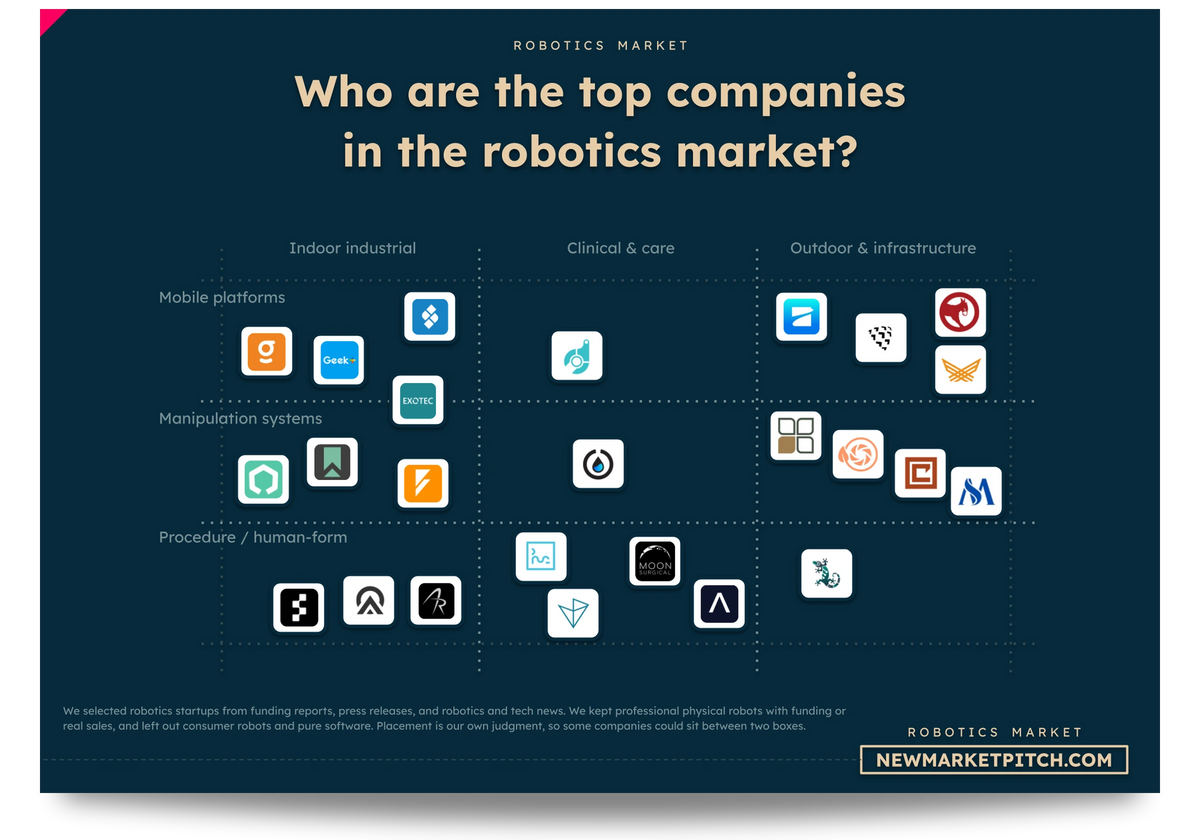
In our research about robots, we turn what is vague and complex into simple, useful visuals. Market maps like this one show you at a glance where every startup stands.
Which robotics startups have raised the most funding?
The ten highest-ranked robotics startups have raised a combined $30.6 billion or more, with Anduril alone accounting for more than $12 billion.
The gap between the leading companies is considerable. Anduril has raised more than three and a half times as much as Helsing, which occupies second place with $3.3 billion. Shield AI and Saronic Technologies follow with $3.0 billion and $2.6 billion respectively.
The top ten also show how much the industry has expanded beyond traditional factory automation. Five companies are headquartered in the United States, three in Germany, one in the United Kingdom and one in China. Their businesses range from autonomous military platforms and drone delivery to humanoid robots and surgical systems.
Here are the ten highest-funded companies in the robotics industry, ranked by cumulative funding raised.
| Rank | Startup | Total raised | Country |
|---|---|---|---|
| 1 | Anduril | $12B+ | United States |
| 2 | Helsing | $3.3B | Germany |
| 3 | Shield AI | $3.0B | United States |
| 4 | Saronic Technologies | $2.6B | United States |
| 5 | Zipline | $1.95B | United States |
| 6 | Figure AI | $1.7B+ | United States |
| 7 | Quantum Systems | $1.7B | Germany |
| 8 | NEURA Robotics | $1.6B | Germany |
| 9 | Neolix | $1.4B+ | China |
| 10 | CMR Surgical | $1.3B | United Kingdom |
How far ahead is Anduril in robotics funding?
Anduril has raised more than $12 billion, giving the American defense robotics company a lead of at least $8.7 billion over second-ranked Helsing.
Its May 2026 Series H alone brought in $5.0 billion, led by Thrive Capital and Andreessen Horowitz. That single round was larger than the entire cumulative funding of any other company in the ranking.
The company's fundraising reflects the scale of its ambitions. Anduril develops autonomous aircraft, surveillance systems, defense platforms and software that connects sensors and military equipment. It also invests heavily in manufacturing infrastructure, which requires considerably more capital than developing a standalone software product.
Government demand is another major factor. Military customers are increasingly interested in autonomous systems, and large production commitments can justify exceptionally large financing rounds.
The May 2026 announcement also brought Anduril's valuation to $61 billion. That is a separate financial measure: the more than $12 billion in our ranking represents cumulative funding raised, not the company's valuation.

In our market report about robots, we always try to gather several sources and make estimates that make sense, so you can work with solid numbers.
Which robotics startups have raised the biggest funding rounds?
Anduril's $5.0 billion Series H is the largest latest-round figure among the companies in our ranking, followed by the $1.8 billion rounds announced by Helsing and Saronic Technologies.
Several other companies have also secured financing that would have been exceptional even for established technology businesses. NEURA Robotics announced a Series C of up to $1.4 billion, Quantum Systems raised $1.2 billion, and Figure AI secured $1.0 billion.
The number of companies raising $500 million or more in individual financing events is also growing. AI2 Robotics, Mach Industries and Bedrock Robotics have all reached this level, showing that investors are committing substantial capital to companies still expanding their production capabilities.
The following are the ten largest latest-round amounts among the ranked companies, displayed in their original cumulative-funding ranking order.
| Overall rank | Startup | Last round amount | Last round type | Date |
|---|---|---|---|---|
| 1 | Anduril | $5.0B | Series H | May 2026 |
| 2 | Helsing | $1.8B | Series E | July 2026 |
| 4 | Saronic Technologies | $1.8B | Series D | March 2026 |
| 6 | Figure AI | $1.0B | Series C | September 2025 |
| 7 | Quantum Systems | $1.2B | Series D | July 2026 |
| 8 | NEURA Robotics | $1.4B | Series C | June 2026 |
| 12 | Mach Industries | $600M | Series C Extension | September 2026 |
| 15 | Bedrock Robotics | $600M | Series C | October 2026 |
| 17 | AI2 Robotics | $700M | Growth Financing | June 2026 |
| 25 | TEKEVER | $580M | Series D | September 2026 |
Who are the biggest investors in robotics startups?
Thrive Capital, Andreessen Horowitz, Blackstone, Kleiner Perkins, NVIDIA and Baillie Gifford are among the most prominent investors backing the leading robotics startups.
The investor groups are increasingly diverse. Traditional venture capital firms are participating alongside private equity funds, sovereign investment organizations and strategic technology companies.
Thrive Capital and Andreessen Horowitz led Anduril's $5.0 billion Series H. Dragoneer, Lightspeed and ICONIQ participated in Helsing's $1.8 billion Series E, while Kleiner Perkins led Saronic Technologies' $1.75 billion Series D, reported as $1.8 billion in our ranking.
Blackstone has a particularly strong position in the sector. It appears among the key investors in both Shield AI and Quantum Systems, two companies developing autonomous defense technologies.
Technology companies are also becoming important investors. NVIDIA appears among the investors in Figure AI and Agility Robotics, while Qualcomm Technologies has backed NEURA Robotics. Google has invested in Apptronik, and Amazon appears among the investors in Standard Bots.
These strategic investments give technology companies exposure to robotics hardware, manufacturing capabilities and applications across existing industries. They also give startups access to potential commercial partners and technology suppliers.

Our document detailing everything you need to know about robotics gets updated several times a month, so you always get the latest view of where things stand.
Are defense robotics startups taking most of the money?
Yes. The four highest-ranked defense robotics startups have raised a combined $20.9 billion or more, representing approximately 68% of the funding accumulated by the top ten companies.
Anduril, Helsing, Shield AI and Saronic Technologies occupy the first four positions in the ranking. Their combined funding is almost seven times the $3.0 billion raised by Shield AI alone.
The four companies address different parts of military autonomy. Anduril develops integrated autonomous defense systems, Helsing focuses on AI-powered military capabilities, Shield AI builds autonomous aircraft and AI pilots, while Saronic Technologies develops autonomous naval vessels.
The broader group includes several other well-funded defense-oriented businesses. Mach Industries has raised $1.1 billion, Skydio $850 million, TEKEVER $677 million, Forterra $303 million and Performance Drone Works $187 million.
Recent financing activity has been particularly striking. Mach Industries raised $600 million in September 2026 through a continuation of its Series C, while TEKEVER announced a $580 million Series D in the same period.
Government demand provides these businesses with an unusual commercial opportunity. Military customers are increasingly interested in autonomous aircraft, surveillance, maritime systems and unmanned ground vehicles, while defense manufacturers need enough production capacity to deliver equipment at scale.
Defense robotics has consequently become one of the strongest areas for attracting exceptionally large private financing rounds.
Are China or the United States attracting more robotics startup funding right now?
China has attracted slightly more robotics startup investment than the United States in Crunchbase's latest broad country-level figures, although the difference remains relatively small.
Crunchbase reported approximately $13.2 billion invested in Chinese robotics startups during 2026, compared with $12.1 billion in the United States. Germany followed with $1.7 billion.
These figures measure broader national investment flows, rather than the cumulative funding totals of the individual companies in our ranking. This explains why the geographical distribution of annual investment does not perfectly match the positions of the highest-funded startups.
The United States remains particularly strong in defense autonomy and humanoid robotics. Anduril, Shield AI, Saronic Technologies and Figure AI illustrate the scale of American fundraising.
China has developed a different mix of strengths, with substantial investment in humanoid robots, embodied AI, autonomous delivery and industrial automation. Neolix, Galbot, AI2 Robotics and Robot Era are among the most heavily funded examples.
Germany also deserves attention. Helsing, Quantum Systems and NEURA Robotics have collectively raised $6.6 billion, giving the country an unusually strong position among the top-funded European robotics businesses.
The competition is concentrated around two very large ecosystems, while Europe maintains several substantial specialist companies of its own.

In our report covering the robotics market, we look at what the winners do differently, so you can learn from the best instead of guessing.
Which Chinese robotics startups have raised the most money?
Neolix, Galbot, AI2 Robotics, Spirit AI and Robot Era are among the highest-funded Chinese robotics startups in the ranking.
Neolix is the highest-ranked Chinese company, with more than $1.4 billion raised. Its October 2026 Series E brought in approximately $400 million, with Boyu Capital and a state-backed Chinese fund co-leading the financing.
Galbot follows with approximately $1.15 billion, focusing on embodied AI and humanoid robots. AI2 Robotics has raised $890 million, while Spirit AI has attracted $832 million through financing for embodied intelligence models and robotics.
Robot Era and TARS Robotics have also reached substantial funding levels, with $736 million and $697 million respectively.
Chinese robotics investment is particularly visible in companies developing machines for manufacturing, logistics and commercial environments. Several are pursuing humanoid platforms, while others focus on specific applications such as autonomous delivery.
Neolix's latest round is especially notable because it combines investment in autonomous vehicles with the expansion of the operational infrastructure needed to support them.
Which European robotics startups have raised the most funding?
Helsing, Quantum Systems and NEURA Robotics are the three largest European robotics funding stories in the ranking, with cumulative funding of $3.3 billion, $1.7 billion and $1.6 billion respectively.
Germany has developed a particularly strong position. Helsing and Quantum Systems both focus on autonomous defense technologies, while NEURA Robotics develops cognitive robots, humanoid systems and collaborative automation products.
The United Kingdom also has an important player in CMR Surgical, which has raised $1.3 billion for its robotic minimally invasive surgery systems.
Portugal's TEKEVER has raised $677 million, including a $580 million Series D in September 2026. Its autonomous surveillance and defense drones have attracted growing interest from institutional investors, including UC Investments and Baillie Gifford.
France has developed a strong warehouse automation business through Exotec, which has raised $447 million. Switzerland also has several meaningful companies, including Distalmotion ($390 million) and ANYbotics ($152 million). Agile Robots, headquartered in Germany, has raised $380 million.
Europe's robotics ecosystem is more specialized than its American counterpart, with particularly strong businesses in defense, industrial automation and medical robotics.

In our research about robots, we don't want to repeat what boring consulting reports say. Instead, we show you the real and latest market signals that matter.
Are humanoid robot startups attracting billions in funding?
Yes. Humanoid robotics has become one of the most heavily financed areas of the industry, with Figure AI, NEURA Robotics and Apptronik alone accounting for at least $4.24 billion in cumulative funding.
Figure AI leads this group with more than $1.7 billion, followed by NEURA Robotics with $1.6 billion and Apptronik with at least $935 million.
Chinese humanoid and embodied-AI businesses have also attracted substantial investment. Galbot has raised approximately $1.15 billion, AI2 Robotics $890 million, Spirit AI $832 million, Robot Era $736 million and TARS Robotics $697 million.
Further down the ranking, Galaxea AI has raised at least $700 million, X Square Robot $643 million, LimX Dynamics $427 million and EngineAI at least $368 million.
Investors are backing a particularly ambitious idea: robots that can operate in environments designed for people and eventually perform a much wider range of tasks than conventional industrial machines.
The technology requires advances in computer vision, physical reasoning, manipulation, balance, navigation and the ability to learn from real-world interactions. That combination helps explain why investors are committing so much capital to companies developing general-purpose robotic platforms.
However, the amount of funding attracted by humanoid startups has moved considerably faster than the evidence of mass commercial adoption. The next question is which companies are actually getting robots into the hands of customers.
Who is actually winning the humanoid robot race right now?
Figure AI leads this group in cumulative funding, AgiBot leads Counterpoint's latest shipment estimates, and Agility Robotics has some of the strongest publicly documented evidence of extended industrial deployment.
These are three different achievements, and each tells us something about where the industry stands.
Figure AI has raised more than $1.7 billion, compared with at least $935 million for Apptronik and $640 million for Agility Robotics. Figure's September 2025 Series C brought in $1.0 billion, led by Parkway Venture Capital, with participation from NVIDIA and Brookfield.
The company has also demonstrated meaningful industrial progress. In November 2025, Figure published results from an 11-month deployment of its Figure 02 humanoid at BMW's Spartanburg plant. The robots worked ten-hour shifts, loaded more than 90,000 parts and accumulated over 1,250 hours of runtime while contributing to the production of more than 30,000 BMW X3 vehicles.
Agility Robotics has followed a particularly deployment-focused approach. Its Digit humanoid has accumulated more than 65,000 hours of operational time, and the company reported that Digit had moved more than 100,000 totes at GXO's logistics facility. Agility also reported more than $300 million in multi-year customer orders for Digit 5, subject to contractual milestones.
China's AgiBot has a different advantage. Counterpoint Research estimated that the company shipped approximately 9,700 humanoid robots in the first half of 2026, representing more than 43% of global shipments in its figures. AgiBot has raised $221 million in our ranking, substantially less than Figure AI, Apptronik or Agility.
The comparison is useful: Figure has the strongest funding position among these examples, AgiBot has the highest reported shipment volume, and Agility has particularly persuasive evidence of sustained industrial use.
No single metric settles the race. The companies will ultimately have to prove that their robots can perform useful tasks reliably and economically across a much larger number of customer sites.

Learning from others' mistakes is the cheapest lesson there is. In our market report about robots, we look at what broke startups before you, so you don't repeat it.
Are humanoid robots ready for mass commercial deployment?
Humanoid robots are entering commercial environments, but the industry still has a considerable distance to cover before they become standard equipment across factories and warehouses.
Counterpoint Research reported more than 22,000 humanoid robot shipments worldwide in the first half of 2026, representing nearly 300% year-over-year growth.
At first glance, that is impressive. The application breakdown, however, tells a more complicated story. Entertainment and performance applications, together with data production and research, still represented more than 60% of shipments. Manufacturing accounted for 13%, while warehousing and logistics represented 5%.
Much of the current shipment volume is therefore still associated with demonstrations, research, data collection and specialized applications rather than large industrial fleets.
Figure's BMW deployment and Agility's work with GXO are encouraging examples of practical use. They show that humanoid robots can perform repetitive tasks in real operating environments.
But a robot that successfully handles one task does not automatically become a commercially viable replacement for human workers across an entire facility.
Manufacturers still need better reliability, faster task execution, lower maintenance costs and the ability to operate safely alongside employees. Until those conditions improve, the strongest applications will remain relatively specific.
Which warehouse robotics startups have raised the most money?
Symbotic has raised $1.0 billion, making it the highest-funded warehouse automation company in our ranking, followed by GreyOrange with $568 million, Geek+ with $532 million and Locus Robotics with $458 million.
Warehouse robotics is one of the industry's more established commercial segments. Companies have been deploying autonomous mobile robots, automated storage systems and robotic picking solutions for years, giving the market a more developed customer base than emerging humanoid applications.
Exotec has raised $447 million, while Dexterity has attracted $404 million. Fabric, Dexory and Hai Robotics have also built substantial funding histories, with $336 million, $318 million and $315 million respectively.
Further down the ranking, Quicktron Robotics has raised $235 million, Seegrid $225 million and Nimble Robotics $221 million.
The companies address different problems. Symbotic automates large distribution centers, Exotec develops automated storage and retrieval systems, while Locus Robotics focuses on autonomous mobile warehouse robots. Dexterity uses AI-driven systems for complex picking and material handling, and Dexory develops autonomous warehouse intelligence robots.
| Overall rank | Startup | Total raised |
|---|---|---|
| 14 | Symbotic | $1.0B |
| 29 | GreyOrange | $568M |
| 30 | Geek+ | $532M |
| 32 | Locus Robotics | $458M |
| 33 | Exotec | $447M |
| 37 | Dexterity | $404M |
| 47 | Fabric | $336M |
| 50 | Dexory | $318M |
| 51 | Hai Robotics | $315M |
| 67 | Quicktron Robotics | $235M |
| 69 | Seegrid | $225M |
| 72 | Nimble Robotics | $221M |
| 73 | Vecna Robotics | $215M |
| 78 | Mytra | $198M |
| 92 | ForwardX Robotics | $138M |

If you build or invest in the robotics market, you need to know which business models pay off now and which ones are fading. That's why our report covering it has a whole section on it.
Why are surgical robotics startups attracting so much funding?
Surgical robotics startups attract substantial investment because their products address high-value medical procedures where precision, reliability and clinical performance can justify expensive equipment.
CMR Surgical leads the category with $1.3 billion in cumulative funding. Edge Medical Robotics has raised $461 million, followed by Cornerstone Robotics with $435 million and Distalmotion with $390 million.
The sector also includes companies targeting highly specialized procedures. Medical Microinstruments develops robotic microsurgery systems, EndoQuest Robotics focuses on flexible endoluminal surgery, and ForSight Robotics is developing robotic ophthalmic surgery systems.
Capstan Medical is working on robotic-assisted heart valve procedures, while Neocis focuses on dental implant surgery.
The variety of applications is one reason the category has attracted so much capital. Each procedure requires a different combination of hardware, software, clinical validation and regulatory approval.
Hospitals also tend to establish long-term relationships with equipment providers once a surgical platform becomes part of their operating procedures. This can create recurring business through instruments, maintenance, software and additional equipment.
| Overall rank | Startup | Total raised |
|---|---|---|
| 10 | CMR Surgical | $1.3B |
| 31 | Edge Medical Robotics | $461M |
| 34 | Cornerstone Robotics | $435M |
| 38 | Distalmotion | $390M |
| 45 | Medical Microinstruments | $346M |
| 63 | THINK Surgical | $249M |
| 76 | EndoQuest Robotics | $207M |
| 79 | ForSight Robotics | $190M |
| 81 | Neocis | $183M |
| 83 | Ronovo Surgical | $161M |
| 84 | Capstan Medical | $153M |
| 87 | Noah Medical | $150M |
| 88 | Momentis Surgical | $143M |
| 93 | Virtual Incision | $130M |
| 97 | eCential Robotics | $18M |
Which autonomous delivery robotics startups have raised the most money?
Zipline and Neolix are the two largest autonomous delivery robotics funding stories in our ranking, with $1.95 billion and more than $1.4 billion in cumulative funding respectively.
Zipline has developed an integrated delivery network combining autonomous aircraft, launch and landing infrastructure, logistics software and distribution operations.
The company announced in January 2026 that it had surpassed two million commercial deliveries. In March, it secured an additional $200 million, bringing the latest Series H financing to $800 million according to TechCrunch.
Neolix has taken a different approach, developing autonomous vehicles for last-mile delivery. Its approximately $400 million October 2026 Series E was one of the largest recent financings in the autonomous delivery segment.
Two other companies in this category are Serve Robotics, which has raised $371 million and is now publicly listed, and Starship Technologies, which has attracted $281 million.
Serve Robotics and Starship focus on sidewalk delivery robots, while Zipline operates aerial logistics and Neolix develops autonomous delivery vehicles.
Zipline's two-million-delivery milestone provides particularly strong evidence that autonomous delivery has moved beyond experimental projects. The commercial challenge now is expanding the network while maintaining attractive delivery economics, safety and operational reliability.

In our report covering the robotics market, we like to show you the big picture. We know your time is precious, so we make every page quick to read and packed with as much learning as possible per minute.
How many industrial robots are already working worldwide?
More than five million industrial robots are now operating in factories worldwide, showing that commercial robotics already has a substantial installed base.
According to the International Federation of Robotics' World Robotics 2026 report, the global operational stock reached 5.079 million industrial robots in 2025, an increase of 9%.
Annual installations also reached a new record of approximately 603,000 units, up 11% year over year.
China accounted for 354,000 installations, or 59% of the worldwide total. The country has become the dominant market for industrial robot deployment, supported by its manufacturing base and investment in factory automation.
The United States recorded approximately 38,500 installations, while Germany remained one of the leading European markets.
These figures put the excitement around humanoid robots into perspective. Traditional industrial robotics already operates at a massive scale, and demand continues to grow across automotive, electronics, machinery and other manufacturing industries.
The next opportunity is expanding automation into tasks and environments where conventional industrial robots have been harder to deploy economically.
Which robotics startups have gone public or been acquired?
Six companies in our ranking have reached public-market status, while two have been acquired.
Symbotic, Geek+, Edge Medical Robotics, Dobot Robotics, Serve Robotics and ROKAE are classified as IPO-stage companies.
Geek+ completed its Hong Kong Stock Exchange listing in July 2025, while Dobot Robotics listed in December 2024. Symbotic has traded on Nasdaq since June 2022, and ROKAE completed its Hong Kong listing in July 2026.
Monarch Tractor was acquired by Caterpillar in 2026, according to Bloomberg reporting. Attabotics' technology was acquired by LaFayette Systems in September 2025, allowing the business to continue under a new ownership structure.
These outcomes show how different the paths through the robotics industry can be. Some companies reach public markets and continue raising capital through equity offerings, while others become part of larger industrial businesses.
| Overall rank | Startup | Total raised | Current stage |
|---|---|---|---|
| 14 | Symbotic | $1.0B | IPO |
| 30 | Geek+ | $532M | IPO |
| 31 | Edge Medical Robotics | $461M | IPO |
| 39 | Dobot Robotics | $387M | IPO |
| 43 | Serve Robotics | $371M | IPO |
| 74 | Monarch Tractor | $214M | Acquired |
| 77 | ROKAE | $206M | IPO |
| 86 | Attabotics | $151M | Acquired |

When you build or invest in the robotics market, you need clarity, not confusion. In our research about robots, we always try to put numbers on and quantify whatever is usually vague and confusing.
Do robotics startups have real customers, or are they still selling demos?
Several robotics startups have moved well beyond demonstrations, with commercial deliveries, industrial operating hours and substantial customer commitments providing measurable evidence of demand.
Symbotic offers one of the strongest examples. Its SEC filing for the quarter ended June 27, 2026, reported $22.5 billion in remaining performance obligations for contracts longer than one year. A substantial majority related to its agreements with Walmart and Exol.
That figure represents future contracted work rather than revenue already recognized, but it gives a sense of the scale of commercial commitments behind warehouse automation.
Zipline has completed more than two million commercial deliveries, demonstrating that autonomous aircraft can support an operating logistics network.
Agility Robotics has accumulated more than 65,000 hours of real-world operation with Digit. The company has also reported more than 100,000 totes handled at GXO's facility and approximately 98% accuracy while on task.
Figure AI provides another useful example. Its BMW deployment involved more than 90,000 parts loaded and over 1,250 operating hours, with the robots contributing to the production of more than 30,000 vehicles.
These examples measure different things. Symbotic's contractual backlog shows customer commitments, Zipline's deliveries demonstrate completed commercial activity, and Agility's operating hours provide evidence of sustained use.
There is genuine demand in several parts of robotics, although the strongest commercial evidence remains concentrated in specific applications rather than general-purpose robots operating everywhere.
Is robotics funding becoming a bubble?
Parts of the robotics market look overheated, particularly humanoid robotics, but the wider industry has enough real industrial demand to make a blanket bubble comparison misleading.
The concentration of capital is striking. The ten highest-funded companies have raised at least $30.6 billion, while the four largest defense robotics companies account for at least $20.9 billion.
Crunchbase's Q3 2026 figures also show how quickly investment has accelerated. Global robotics startup funding reached $9.9 billion during the quarter, compared with $4.3 billion in Q3 2025. Funding across the first three quarters was approximately 185% higher year over year.
There are good reasons for investors to remain interested. Industrial robot installations have reached record levels, autonomous delivery companies are completing millions of transactions, and warehouse automation providers are securing enormous customer commitments.
Humanoid robotics presents a different risk. Figure AI, NEURA Robotics, Apptronik and several Chinese companies have attracted hundreds of millions or billions of dollars, even though broad commercial adoption remains limited.
Some of these companies may eventually justify their funding through large-scale deployments. Others will struggle to turn impressive demonstrations into machines that customers can operate profitably.
The biggest risk is concentrated in companies whose fundraising has moved far ahead of their commercial performance. That risk should not be confused with the broader industrial robotics market, which already has millions of installed machines and a growing customer base.

A good product starts with a real problem. In our market report about robots, we show you the ones customers still live with.
Will humanoid robots replace specialized industrial robots?
Humanoid robots are unlikely to replace specialized industrial robots across factories anytime soon, because purpose-built machines already perform many repetitive tasks faster, more reliably and at lower operating cost.
Industrial robotics has spent decades developing machines designed for specific applications. Automotive manufacturers, for example, use dedicated robotic arms for welding, painting, assembly and material handling.
These machines do not need to walk, balance or understand unfamiliar environments. They need to perform one task extremely well, often thousands of times per day.
Humanoid robots offer a different advantage. Their human-like form could allow them to work in existing environments without redesigning entire factories, making them particularly interesting for tasks that are difficult to automate with conventional equipment.
Figure AI's BMW deployment and Agility Robotics' work with GXO demonstrate the potential of this approach.
However, the current shipment mix still shows how early the industrial humanoid market is. Manufacturing accounted for 13% of humanoid shipments in Counterpoint Research's H1 2026 estimates, while warehousing and logistics represented 5%.
Specialized industrial robots will remain essential for high-speed, repetitive and tightly controlled tasks. Humanoids have a better opportunity in environments where flexibility and the ability to move between different tasks are more valuable than maximum speed on a single operation.
The two technologies are more likely to work alongside each other than compete for every industrial application.
What will make a robotics startup successful beyond fundraising?
The robotics startups most likely to succeed will be those that turn funding into reliable production, repeat customer orders and machines that deliver measurable savings.
The companies already showing the strongest commercial evidence have several things in common. Symbotic has large customer commitments and established warehouse deployments. Zipline has accumulated millions of commercial deliveries. Agility Robotics has collected tens of thousands of hours of operating experience in industrial environments.
Their progress comes from repeated use in real operating conditions, which gives the companies valuable feedback on reliability, maintenance, safety and product performance.
Manufacturing capacity will also become increasingly important. A robotics startup may have an excellent prototype, but producing thousands of machines requires suppliers, quality control, manufacturing facilities and a support network capable of handling equipment failures.
Customer economics will ultimately determine adoption. A factory or warehouse will continue using a robot when it can improve productivity, reduce costs or solve a problem that existing equipment cannot handle effectively.
The same applies to medical and defense robotics, although their purchasing processes are different. Surgical systems need clinical validation and regulatory approval, while defense companies depend on procurement relationships and the ability to deliver equipment under demanding conditions.
Fundraising gives these companies the resources to pursue those goals. The ones that turn that capital into dependable commercial products will have the strongest chance of becoming lasting businesses.
Our methodology
This analysis compares robotics startups by cumulative funding raised, focusing on companies whose core business is centered on robotics. We cover the wider robotics market, including defense autonomy, humanoid robots, warehouse automation, medical robotics, industrial systems and autonomous delivery. Companies that subsequently went public or were acquired remain included because their earlier fundraising is part of their financing history.
We examined individual financing rounds, company announcements, investor disclosures, regulatory filings and reputable financial and industry reporting. Our funding totals include equity financing and qualifying public-market equity issuances, while excluding debt, grants and other non-equity financing. Where a financing combined debt and equity, only the equity portion was counted.
We prioritized direct company and investor announcements and authoritative regulatory disclosures when sources disagreed. Particular attention was paid to financing extensions, mixed financing packages and announced funding ceilings, especially where the headline amount could differ from the equity actually raised.
Key sources include Anduril's Series H announcement, Helsing's Series E announcement, Saronic's Series D announcement, Quantum Systems' Series D announcement, NEURA Robotics' Series C announcement, Figure AI's Series C announcement, Neolix's Series E financing, and Mach Industries' financing announcement.
For broader market developments, we also used Crunchbase's Q3 2026 robotics funding analysis, Counterpoint Research's humanoid robot shipment estimates, and the International Federation of Robotics' World Robotics 2026 report.
Commercial deployment and customer activity were assessed using Agility Robotics' Digit deployment announcements, Figure AI's BMW deployment results, Symbotic's SEC quarterly filing, and Zipline's commercial delivery announcement. Public-market and acquisition developments were checked against company announcements and reporting from sources including Geek+, Attabotics and Bloomberg.
Written by the New Market Pitch teamWe track new markets so founders and investors can move faster. About us