What are the most valuable robotics startups?
Building a startup or looking for your next investment in robotics? Our report gives you the full picture.
Summary
Anduril is currently the most valuable robotics startup, valued at $85.0B–$95.0B, followed by Figure AI at $39B and Helsing at $17.5B–$18.5B. Shield AI ($12.0B–$13.5B), Saronic Technologies ($9.0B–$9.5B) and Quantum Systems ($7.8B–$8.2B) complete the leading group.
Defense autonomy dominates the upper end of robotics valuations. Anduril, Helsing, Shield AI and Saronic benefit from military procurement budgets that can support entire fleets, integrated systems and long-term contracts, rather than individual equipment purchases.
Humanoid robotics attracts some of the largest valuations despite limited commercial deployment. Figure AI's valuation is several times that of established warehouse automation specialists, reflecting expectations that general-purpose robots could eventually compete for labor spending across multiple industries.
The robotics unicorn market is already broad. Our ranking includes 60 independent startups with valuation ranges reaching at least $1 billion, including 44 valued at $1 billion or more at the lower end of their ranges. Yet their levels of commercial maturity vary enormously.
Traditional industrial robotics continues to expand. Factories installed 603,307 industrial robots worldwide in 2025, up approximately 11%, while the operational stock surpassed five million units. China accounted for about 59% of new installations.
Humanoids have begun proving their usefulness in factories. Figure AI's robots handled more than 90,000 parts at BMW, while Agility Robotics' Digit accumulated over 65,000 operating hours across commercial operations and customer programs. Neither achievement yet establishes the economics of mass deployment.
Autonomous delivery is further along commercially. Zipline surpassed 2.5 million deliveries by July 2026, including approximately one million during the preceding year, making it one of the clearest examples of robotics generating substantial repeatable activity.
Specialized robotics businesses already have meaningful scale. Exotec has deployed more than 10,000 warehouse robots across over 200 customer sites, while CMR Surgical has supported more than 45,000 patient procedures. These companies address narrower tasks but have substantial operational histories.
Capital requirements create very different financial risks. Anduril has raised approximately $12 billion to build defense technology and manufacturing infrastructure, while surgical robotics companies face costly development, regulatory approvals and hospital sales cycles. Large funding totals alone reveal little about future profitability.
Public-market and acquisition outcomes offer a reality check. Symbotic generated $721 million in quarterly revenue and $55 million in net income, while Monarch Tractor and Attabotics were acquired at estimated values below their cumulative funding. Robotics can produce substantial businesses, but investor returns are far from guaranteed.
The strongest robotics valuations will ultimately depend on repeatable deployments, manufacturing economics and customer demand. Defense and humanoid startups offer enormous potential, while delivery, warehouse automation and surgical robotics currently offer clearer evidence of commercial adoption.

Written by the New Market Pitch teamWe track new markets so founders and investors can move faster. About us

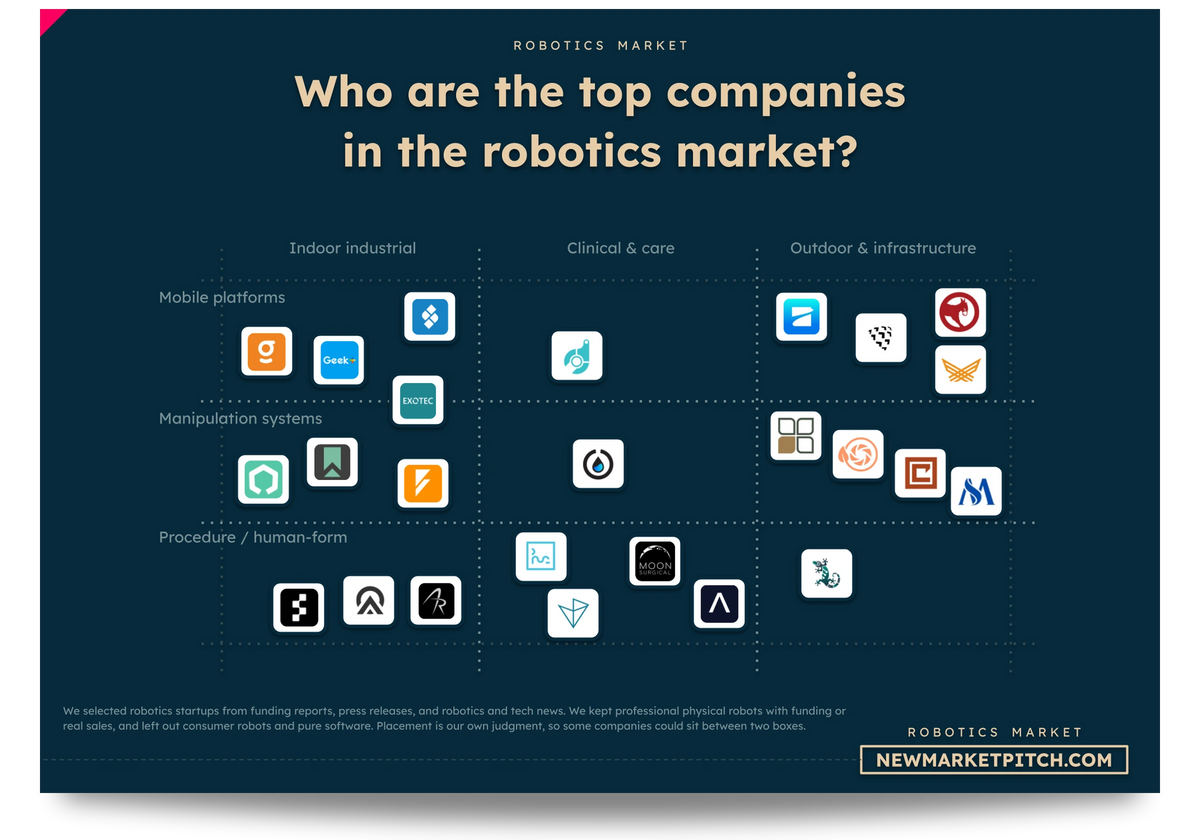
In our report covering the robotics market, we turn what is vague and complex into simple, useful visuals. Market maps like this one show you at a glance where every startup stands.
Top startups in the robotics market ranked by valuation
Here is an updated table that ranks the top startups in the robotics market based on their latest reported or estimated valuations.
If you need to dig deeper and get more detailed data, please check our report covering the robotics market.
| # | Startup Name | What They Do | Current Valuation ($) | Valuation Confidence Level | Valuation Type | Evidence Status | Total Funding ($) | Funding Confidence Level | Country |
|---|---|---|---|---|---|---|---|---|---|
| 1 | Anduril | Autonomous defense systems and software | $85.0B–$95.0B | Strong Confidence | Active Raise Valuation | Implied | $12B+ | Strong Confidence | United States |
| 2 | Figure AI | AI-powered general-purpose humanoid robots | $39B | Partial Confidence | Announced Private Round Valuation | Observed | $1.7B+ | Strong Confidence | United States |
| 3 | Helsing | AI-powered autonomous defense systems | $17.5B–$18.5B | Strong Confidence | Implied Valuation from Raise | Estimated | $3.2B | Strong Confidence | Germany |
| 4 | Shield AI | Autonomous defense aircraft and software | $12.0B–$13.5B | Strong Confidence | Implied Valuation from Raise | Estimated | ~$3.5B–$4.0B | Partial Confidence | United States |
| 5 | Saronic Technologies | Autonomous military and maritime vessels | $9.0B–$9.5B | Strong Confidence | Implied Valuation from Raise | Estimated | ~$2.6B | Strong Confidence | United States |
| 6 | Quantum Systems | Autonomous defense drones and systems | $7.8B–$8.2B | Strong Confidence | Implied Valuation from Raise | Estimated | ~$1.94B | Strong Confidence | Germany |
| 7 | Zipline | Autonomous drone delivery networks | $7.6B | Partial Confidence | Announced Private Round Valuation | Observed | $1.95B | Partial Confidence | United States |
| 8 | NEURA Robotics | Cognitive industrial and humanoid robots | $6.5B–$8.0B | Partial Confidence | Implied Valuation from Raise | Estimated | ~$1.59B | Partial Confidence | Germany |
| 9 | AgiBot | General-purpose humanoid robots | $6.4B–$7.9B | Partial Confidence | Active Raise Valuation | Estimated | ~$439M | Partial Confidence | China |
| 10 | TEKEVER | Autonomous defense and surveillance aircraft | $6.2B–$6.6B | Strong Confidence | Implied Valuation from Raise | Estimated | $676M | Strong Confidence | Portugal |
| 11 | Apptronik | AI-powered humanoid robots | $5.0B–$5.8B | Strong Confidence | Implied Valuation from Raise | Implied | $935M+ | Strong Confidence | United States |
| 12 | Skydio | Autonomous enterprise and defense drones | $4.3B–$4.8B | Strong Confidence | Implied Valuation from Raise | Estimated | ~$655M | Strong Confidence | United States |
| 13 | Cornerstone Robotics | Minimally invasive surgical robots | $3.5B–$5.5B | Partial Confidence | Implied Valuation from Raise | Estimated | ~$1.17B | Low Confidence | China |
| 14 | Bedrock Robotics | Autonomous heavy construction equipment | $4.1B | Full Confidence | Announced Private Round Valuation | Observed | $950M+ | Partial Confidence | United States |
| 15 | Mach Industries | Autonomous military systems and manufacturing | $3.6B–$3.8B | Strong Confidence | Implied Valuation from Raise | Estimated | $1.1B | Strong Confidence | United States |
| 16 | Fourier Intelligence | Humanoid and rehabilitation robots | $3.2B–$4.0B | Partial Confidence | Implied Valuation from Raise | Estimated | $235M | Partial Confidence | China |
| 17 | CMR Surgical | Robotic-assisted minimally invasive surgery | $2.8B–$4.1B | Partial Confidence | Comparables-Based Estimate | Estimated | ~$1.75B | Low Confidence | United Kingdom |
| 18 | Sharpa | Dexterous humanoid robots and manipulation | $3.0B–$3.6B | Strong Confidence | Implied Valuation from Raise | Estimated | ~$784M | Partial Confidence | Singapore |
| 19 | Mind Robotics | AI-powered industrial manufacturing robots | $3.0B–$3.5B | Strong Confidence | Implied Valuation from Raise | Estimated | $1.0B | Strong Confidence | United States |
| 20 | Galbot | Embodied AI humanoid robots | $2.8B–$3.4B | Strong Confidence | Implied Valuation from Raise | Estimated | ~$1.15B | Partial Confidence | China |
| 21 | Neolix | Autonomous urban delivery vehicles | $2.5B–$3.7B | Partial Confidence | Implied Valuation from Raise | Implied | $1.4B+ | Partial Confidence | China |
| 22 | Galaxea AI | Embodied AI robotic systems | $2.7B–$3.3B | Strong Confidence | Implied Valuation from Raise | Estimated | $700M+ | Partial Confidence | China |
| 23 | Agile Robots | AI-powered industrial automation robots | $2.0B–$3.8B | Partial Confidence | Revenue or ARR Multiple Estimate | Estimated | ~$380M | Partial Confidence | Germany |
| 24 | X Square Robot | General-purpose embodied AI robot systems | $2.8B–$3.0B | Strong Confidence | Implied Valuation from Raise | Estimated | ~$574M | Partial Confidence | China |
| 25 | Spirit AI | Embodied AI models and robots | $2.5B–$3.2B | Partial Confidence | Comparables-Based Estimate | Estimated | ~$674M | Partial Confidence | China |
| 26 | AI2 Robotics | Embodied AI and humanoid robots | $2.5B–$3.1B | Partial Confidence | Implied Valuation from Raise | Estimated | ~$893M | Partial Confidence | China |
| 27 | Agility Robotics | Humanoid robots for industrial logistics | $2.3B–$2.9B | Strong Confidence | IPO or Listing Range Valuation | Estimated | ~$590M–$641M | Partial Confidence | United States |
| 28 | Exotec | Autonomous warehouse fulfillment robots | $2.1B–$2.8B | Partial Confidence | Revenue or ARR Multiple Estimate | Estimated | $446M | Strong Confidence | France |
| 29 | LimX Dynamics | Humanoid and legged intelligent robots | $2.1B–$2.3B | Strong Confidence | Implied Valuation from Raise | Estimated | $400M | Strong Confidence | China |
| 30 | TARS Robotics | General-purpose embodied intelligence robots | $1.8B–$2.2B | Partial Confidence | Implied Valuation from Raise | Estimated | ~$697M | Partial Confidence | China |
| 31 | Dexterity | AI-powered industrial robotic systems | $1.6B–$1.8B | Strong Confidence | Implied Valuation from Raise | Estimated | $396M | Strong Confidence | United States |
| 32 | Pudu Robotics | Commercial service and cleaning robots | $1.5B–$1.8B | Strong Confidence | Announced Private Round Valuation | Observed | $300M+ | Partial Confidence | China |
| 33 | EngineAI | Advanced humanoid robotic platforms | $1.4B–$1.7B | Strong Confidence | Implied Valuation from Raise | Estimated | $368M+ | Strong Confidence | China |
| 34 | Robot Era | Humanoid robots and dexterous manipulation | $1.3B–$1.7B | Partial Confidence | Comparables-Based Estimate | Estimated | ~$760M | Partial Confidence | China |
| 35 | Gecko Robotics | Autonomous infrastructure inspection robots | $1.2B–$1.7B | Partial Confidence | Implied Valuation from Raise | Estimated | $347M | Strong Confidence | United States |
| 36 | ICON | Robotic 3D construction printing | $1.3B–$1.5B | Strong Confidence | Implied Valuation from Raise | Estimated | $700M | Strong Confidence | United States |
| 37 | Humanoid | General-purpose industrial humanoid robots | $1.3B–$1.4B | Strong Confidence | Implied Valuation from Raise | Estimated | $270M | Strong Confidence | United Kingdom |
| 38 | Forterra | Autonomous military vehicle systems | $1.1B–$1.5B | Strong Confidence | Implied Valuation from Raise | Estimated | $605M | Partial Confidence | United States |
| 39 | Gausium | Autonomous commercial cleaning robots | $1.1B–$1.5B | Partial Confidence | Comparables-Based Estimate | Estimated | $375M | Partial Confidence | China |
| 40 | Locus Robotics | Autonomous warehouse fulfillment robots | $1.1B–$1.5B | Strong Confidence | Implied Valuation from Raise | Implied | $476M | Strong Confidence | United States |
| 41 | Medical Microinstruments | Robotic microsurgery systems | $830M–$1.6B | Partial Confidence | Implied Valuation from Raise | Implied | $345M | Strong Confidence | United States |
| 42 | Distalmotion | Robotic minimally invasive surgery | $1.0B–$1.4B | Partial Confidence | Implied Valuation from Raise | Implied | $390M | Partial Confidence | Switzerland |
| 43 | Starship Technologies | Autonomous sidewalk delivery robots | $1.0B–$1.4B | Partial Confidence | Comparables-Based Estimate | Estimated | ~$330M | Partial Confidence | United States |
| 44 | Mytra | Automated warehouse storage systems | $800M–$1.5B | Partial Confidence | Implied Valuation from Raise | Implied | $200M | Strong Confidence | United States |
| 45 | Mujin | Intelligent industrial robot control systems | $1.0B–$1.3B | Partial Confidence | Implied Valuation from Raise | Implied | $635M | Partial Confidence | Japan |
| 46 | DEEP Robotics | Quadruped and humanoid robots | $900M–$1.4B | Partial Confidence | Comparables-Based Estimate | Estimated | ~$143M | Partial Confidence | China |
| 47 | Walden Robotics | General-purpose industrial physical AI robots | $1.0B–$1.2B | Strong Confidence | Implied Valuation from Raise | Estimated | $300M | Strong Confidence | United States |
| 48 | Gravis Robotics | Autonomous construction machinery technology | $950M–$1.1B | Strong Confidence | Implied Valuation from Raise | Estimated | $228M | Strong Confidence | Switzerland |
| 49 | Standard Bots | AI-powered industrial robotic arms | $950M–$1.1B | Strong Confidence | Implied Valuation from Raise | Estimated | ~$263M | Strong Confidence | United States |
| 50 | Quicktron Robotics | Autonomous warehouse mobile robots | $800M–$1.2B | Partial Confidence | Comparables-Based Estimate | Estimated | $200M+ | Partial Confidence | China |
| 51 | Keenon Robotics | Commercial service and delivery robots | $700M–$1.2B | Partial Confidence | Comparables-Based Estimate | Estimated | $229M | Partial Confidence | China |
| 52 | Nimble Robotics | Autonomous robotic warehouse fulfillment | $800M–$1.1B | Partial Confidence | Comparables-Based Estimate | Estimated | ~$221M | Partial Confidence | United States |
| 53 | Dexory | Autonomous warehouse inventory intelligence | $750M–$1.1B | Partial Confidence | Implied Valuation from Raise | Estimated | $318M | Low Confidence | United Kingdom |
| 54 | Wandercraft | Robotic exoskeletons and industrial humanoids | $800M–$1.0B | Partial Confidence | Active Raise Valuation | Estimated | ~$170M | Partial Confidence | France |
| 55 | Flexiv | Adaptive force-controlled industrial robots | $700M–$1.1B | Partial Confidence | Comparables-Based Estimate | Estimated | $222M | Partial Confidence | China |
| 56 | Bright Machines | Software-defined robotic manufacturing | $650M–$1.1B | Partial Confidence | Comparables-Based Estimate | Estimated | ~$400M–$437M | Low Confidence | United States |
| 57 | Hai Robotics | Autonomous warehouse storage robots | $650M–$1.1B | Partial Confidence | IPO or Listing Range Valuation | Estimated | $215M | Partial Confidence | China |
| 58 | Ecorobotix | AI-powered precision spraying robots | $700M–$1.0B | Partial Confidence | Implied Valuation from Raise | Implied | $276M | Partial Confidence | Switzerland |
| 59 | Saildrone | Autonomous ocean surveillance vessels | $700M–$1.0B | Partial Confidence | Comparables-Based Estimate | Estimated | $345M+ | Partial Confidence | United States |
| 60 | Opentrons | Automated laboratory liquid handling robots | $550M–$1.1B | Low Confidence | Comparables-Based Estimate | Estimated | ~$271M | Partial Confidence | United States |
| 61 | Vention | Cloud-based industrial automation platform | $730M–$920M | Partial Confidence | Implied Valuation from Raise | Implied | ~$263M | Strong Confidence | Canada |
| 62 | ANYbotics | Autonomous industrial inspection robots | $550M–$850M | Partial Confidence | Implied Valuation from Raise | Estimated | ~$152M | Strong Confidence | Switzerland |
| 63 | MEGAROBO | Automated laboratory robotics systems | $500M–$900M | Low Confidence | Comparables-Based Estimate | Estimated | $426M | Partial Confidence | China |
| 64 | Fabric | Robotic micro-fulfillment warehouse systems | $500M–$900M | Low Confidence | Comparables-Based Estimate | Estimated | $336M | Partial Confidence | United States |
| 65 | Noah Medical | Robotic lung diagnostic systems | $550M–$800M | Partial Confidence | Implied Valuation from Raise | Estimated | ~$548M | Low Confidence | United States |
| 66 | Noetix Robotics | Affordable humanoid and bionic robots | $450M–$850M | Low Confidence | Comparables-Based Estimate | Estimated | ~$160M | Partial Confidence | China |
| 67 | Path Robotics | AI-powered autonomous robotic welding | $550M–$700M | Partial Confidence | Implied Valuation from Raise | Estimated | ~$370M | Strong Confidence | United States |
| 68 | Overland AI | Autonomous off-road military vehicles | $500M–$750M | Partial Confidence | Implied Valuation from Raise | Implied | ~$142M | Strong Confidence | United States |
| 69 | GreyOrange | AI-driven warehouse automation solutions | $400M–$750M | Partial Confidence | Comparables-Based Estimate | Estimated | $568M | Partial Confidence | United States |
| 70 | Carbon Robotics | AI-powered agricultural weeding robots | $500M–$650M | Strong Confidence | Implied Valuation from Raise | Implied | ~$214M | Strong Confidence | United States |
| 71 | Collaborative Robotics | Collaborative warehouse logistics robots | $450M–$650M | Partial Confidence | Comparables-Based Estimate | Estimated | ~$140M | Strong Confidence | United States |
| 72 | Forsight Robotics | Robotic ophthalmic surgery systems | $450M–$650M | Partial Confidence | Implied Valuation from Raise | Estimated | $195M | Strong Confidence | Israel |
| 73 | Ronovo Surgical | Modular robotic surgery platforms | $420M–$650M | Partial Confidence | Implied Valuation from Raise | Implied | ~$171M | Partial Confidence | China |
| 74 | AMP Robotics | AI-powered recycling sorting systems | $400M–$600M | Partial Confidence | Comparables-Based Estimate | Estimated | ~$320M | Low Confidence | United States |
| 75 | ForwardX Robotics | Autonomous warehouse mobile robots | $300M–$600M | Low Confidence | Comparables-Based Estimate | Estimated | $149M | Partial Confidence | China |
| 76 | Neocis | Robot-assisted dental implant surgery | $250M–$500M | Low Confidence | Comparables-Based Estimate | Estimated | $179M | Partial Confidence | United States |
| 77 | Capstan Medical | Robotic transcatheter heart valve treatment | $300M–$450M | Partial Confidence | Implied Valuation from Raise | Implied | ~$153M | Strong Confidence | United States |
| 78 | Built Robotics | Autonomous construction and solar installation | $250M–$450M | Low Confidence | Comparables-Based Estimate | Estimated | ~$123M | Low Confidence | United States |
| 79 | EndoQuest Robotics | Flexible endoluminal surgical robots | $270M–$380M | Partial Confidence | Implied Valuation from Raise | Estimated | $207M | Strong Confidence | United States |
| 80 | Seegrid | Autonomous industrial mobile robots | $230M–$330M | Partial Confidence | Comparables-Based Estimate | Estimated | ~$252M | Partial Confidence | United States |
| 81 | Monteris Medical | Minimally invasive neurosurgical systems | $190M–$350M | Partial Confidence | Implied Valuation from Raise | Implied | $270M | Partial Confidence | United States |
| 82 | Percepto | Autonomous industrial inspection drones | $170M–$300M | Low Confidence | Comparables-Based Estimate | Estimated | ~$139M | Partial Confidence | Israel |
| 83 | eCential Robotics | Orthopedic surgical robotic platforms | $180M–$250M | Strong Confidence | Acquisition Value | Estimated | $155M | Partial Confidence | France |
| 84 | CloudMinds | Cloud-connected intelligent service robots | $100M–$300M | Low Confidence | Proxy-Based Estimate | Estimated | Undisclosed | Low Confidence | China |
| 85 | Momentis Surgical | Minimally invasive surgical robotic systems | $100M–$250M | Low Confidence | Proxy-Based Estimate | Estimated | $108M | Partial Confidence | Israel |
| 86 | Virtual Incision | Miniaturized robotic surgery systems | $90M–$125M | Partial Confidence | Active Raise Valuation | Estimated | ~$152M–$157M | Partial Confidence | United States |
Which startups in the robotics market have been acquired or gone public?
These startups no longer have a private-market valuation of their own, so we list them separately, using their acquisition price or their current market capitalization.
| # | Startup Name | What They Do | Current Valuation ($) | Valuation Confidence Level | Valuation Type | Evidence Status | Total Funding ($) | Funding Confidence Level | Country |
|---|---|---|---|---|---|---|---|---|---|
| 1 | Symbotic | AI-powered warehouse automation systems | $23.6B | Full Confidence | Public Market Cap | Observed | ~$1.0B | Low Confidence | United States |
| 2 | Edge Medical Robotics | Minimally invasive surgical robots | $1.6B | Full Confidence | Public Market Cap | Observed | $318M | Strong Confidence | China |
| 3 | ROKAE | Industrial robotic arms and cobots | $1.6B | Full Confidence | Public Market Cap | Observed | ~$320M | Partial Confidence | China |
| 4 | Dobot Robotics | Collaborative and industrial robots | $1.1B | Full Confidence | Public Market Cap | Observed | $78M1 | Low Confidence | China |
| 5 | Geek+ | Autonomous warehouse logistics robots | $1.1B | Full Confidence | Public Market Cap | Observed | $534M | Partial Confidence | China |
| 6 | Serve Robotics | Autonomous sidewalk delivery robots | $262M | Full Confidence | Public Market Cap | Observed | Undisclosed | Low Confidence | United States |
| 7 | Monarch Tractor | Autonomous electric agricultural tractors | $20M–$100M | Low Confidence | Acquisition Value | Estimated | $220M | Partial Confidence | United States |
| 8 | Attabotics | Automated warehouse storage systems | $5M–$30M | Low Confidence | Acquisition Value | Estimated | ~$186M | Partial Confidence | Canada |
- Excludes later IPO and PIPE proceeds.

Our research about robots gets updated several times a month, so you always get the latest view of where things stand.
Why are robotics startup valuations climbing so high?
Robotics startup valuations are reaching extraordinary levels because investors increasingly see autonomous machines as the next major application of artificial intelligence, rather than simply another category of industrial equipment. Defense autonomy, humanoid robotics and automated logistics are attracting capital on the expectation that machines will eventually perform tasks previously requiring substantial human labor.
Our ranking illustrates how far the market has expanded. Anduril is valued at $85.0B–$95.0B, Figure AI at $39B, and Helsing at $17.5B–$18.5B. These are valuations more commonly associated with established technology companies than manufacturers developing new generations of robots.
There is also a substantial industrial foundation beneath the excitement. According to the International Federation of Robotics' World Robotics 2026 report, factories installed 603,307 industrial robots in 2025, approximately 11% more than the previous year. The global operational stock exceeded five million robots, more than twice its level seven years earlier.
But the financial opportunity investors are pricing into robotics startups extends well beyond traditional factory installations. They are betting on autonomous military vehicles, increasingly adaptable manufacturing robots, delivery networks and general-purpose machines capable of switching between tasks.
Industrial robotics is already expanding at scale. The extraordinary private valuations, particularly in humanoids and defense, also depend on markets that are still developing. That's where much of the upside, and much of the risk, sits.
What are the most valuable robotics startups right now?
Anduril, Figure AI and Helsing lead the private robotics valuation ranking, but their businesses represent three fundamentally different approaches to autonomous technology.
Anduril, valued at $85.0B–$95.0B, develops autonomous defense systems, military aircraft and software. Its position reflects the scale of military procurement and the potential to combine software development with the manufacturing of sophisticated defense equipment.
Figure AI, valued at $39B, represents a different investment thesis. Its humanoid robots are designed to operate across industrial and eventually broader commercial environments. Its valuation depends heavily on the possibility that general-purpose robots will become a mass-market technology.
Helsing, valued at $17.5B–$18.5B, concentrates on AI-powered defense systems, including autonomous aircraft and precision weapons. Its opportunity is tied to Europe's growing demand for domestically developed defense technologies.
Shield AI, at $12.0B–$13.5B, and Saronic Technologies, at $9.0B–$9.5B, demonstrate the substantial valuations that military aviation and maritime autonomy can support. Zipline, valued at $7.6B, has an established autonomous delivery network.
Immediately below these leaders are other valuable robotics businesses, including NEURA Robotics at $6.5B–$8.0B, AgiBot at $6.4B–$7.9B and Apptronik at $5.0B–$5.8B.
The leading companies are not competing for a single robotics customer. They address different markets with different adoption cycles, purchasing budgets, regulatory requirements and revenue models. That explains why comparing their valuations without looking at their actual businesses can be misleading.

In our market report about robots, we look at what the winners do differently, so you can learn from the best instead of guessing.
How many robotics startups are worth more than $1 billion?
Robotics is already a substantial unicorn market, with 60 independent startups in our ranking having valuation ranges that reach at least $1 billion. Of those, 44 have lower valuation bounds of $1 billion or more.
The scale of the market is highly uneven. The first ten startups have valuation ranges reaching at least $6 billion, while the lower half includes businesses valued around $1 billion or below. Anduril alone is worth many times more than most robotics startups.
Unicorn status also extends across several business models. Agility Robotics develops humanoids for logistics, Exotec offers warehouse automation, Medical Microinstruments develops microsurgical systems, and Locus Robotics supplies warehouse fulfillment robots.
These companies don't depend on the same technological breakthrough. Some sell machines that solve established industrial problems; others aim to develop entire new classes of autonomous labor.
That makes the unicorn count interesting, but it tells us relatively little about business maturity. A robotics startup with several hundred machines operating commercially may have a more established business than a higher-valued humanoid developer still working toward its first large-scale deployment.
Why is Anduril worth so much more than other robotics startups?
Anduril commands a valuation of $85.0B–$95.0B because it is building a broad defense technology platform rather than a business centered on one robot or automation task. Its products address military surveillance, autonomous aircraft, integrated defense systems and software-enabled operations.
The central advantage is the potential size and duration of defense contracts. A manufacturer selling warehouse robots must typically demonstrate a financial return to individual industrial customers. Anduril competes for government programs where procurement can involve entire fleets, supporting infrastructure and sustained upgrades.
Its manufacturing ambitions reinforce the distinction. In January 2025, Anduril announced Arsenal-1, a major manufacturing facility in Ohio. By July 2026, the first Ohio-built Fury autonomous combat aircraft had rolled off its production line. JobsOhio reported that the current production configuration was designed for capacity of up to 150 aircraft annually.
That marks a transition from developing advanced prototypes toward industrial production. Of course, the ability to manufacture 150 aircraft annually doesn't mean the company is already delivering that many.
The comparison with other defense startups is revealing. Helsing is valued at $17.5B–$18.5B, Shield AI at $12.0B–$13.5B, and Saronic Technologies at $9.0B–$9.5B. These companies address important military applications, but Anduril's strategy spans a broader range of systems and programs.
Anduril's enormous premium reflects the possibility that an integrated defense technology manufacturer can capture spending across several categories traditionally dominated by established contractors. The difficult part now is translating manufacturing capacity and procurement opportunities into sustained, profitable production.

In our document detailing everything you need to know about robotics, you will always find fresh funding data, taken straight from our own verified funding database.
Are humanoid robotics startups becoming the most valuable companies in robotics?
Humanoid robotics has become one of the most highly valued segments of the startup market, although defense autonomy still holds the top position.
Figure AI's $39B valuation is the clearest example of investor enthusiasm for general-purpose humanoids. NEURA Robotics follows within the humanoid and cognitive robotics segment at $6.5B–$8.0B, while AgiBot is valued at $6.4B–$7.9B and Apptronik at $5.0B–$5.8B.
Other significant companies include Fourier Intelligence, Sharpa, Galbot, Galaxea AI, AI2 Robotics, Agility Robotics, LimX Dynamics and Robot Era. Together, they demonstrate how widely investment has spread across humanoid hardware, dexterous manipulation and embodied AI software.
The underlying opportunity is larger than selling replacement equipment to existing factories. Humanoid developers hope their machines can work in environments already designed around human bodies, reducing the need to rebuild every production or logistics process.
If that works economically, robotics spending could eventually draw on labor budgets across manufacturing, warehousing and services. That's a much larger opportunity than today's market for conventional industrial robots.
The catch is that valuations have moved far ahead of deployments. Successful demonstrations and limited industrial installations establish technical progress, but say much less about the cost of operating hundreds or thousands of robots continuously.
Humanoid robotics could become one of the industry's largest markets. For now, much of its valuation rests on what these machines might accomplish over the next decade rather than how many productive hours they deliver today.
Is Figure AI really worth $39B?
Figure AI's $39B valuation is a substantial bet on the commercial future of humanoid robots, supported by genuine industrial progress but not yet by evidence of mass-market economics.
The company's work with BMW offers unusually concrete operational data. According to Figure AI's November 2025 deployment report, its Figure 02 robots accumulated more than 1,250 operating hours, moved more than 90,000 parts and contributed to the production of over 30,000 BMW X3 vehicles.
BMW subsequently confirmed the results and described the robots performing repetitive sheet-metal handling tasks in an operating automotive plant.
Those numbers deserve some context. The 30,000 vehicles were assembled by BMW's broader production system; they were not manufactured independently by Figure's robots. The 90,000 parts and 1,250 operating hours are more direct measures of the work performed.
Figure then brought Figure 03 to BMW's Spartanburg facility in June 2026, demonstrating more complex sequencing and logistics activities.
That progression is encouraging. Figure moved beyond controlled demonstrations, completed sustained industrial work with Figure 02 and started testing more demanding tasks with its next-generation machine.
Still, a $34B–$42B valuation requires something much bigger. Figure must eventually show that its robots can be manufactured affordably, maintained reliably and deployed across many facilities without requiring constant engineering support. The BMW work is an important beginning, but it's a long way from proving that business at scale.

Learning from others' mistakes is the cheapest lesson there is. In our report covering the robotics market, we look at what broke startups before you, so you don't repeat it.
Are humanoid robots actually working in factories today?
Humanoid robots are already performing useful tasks in real industrial environments, although deployments remain small compared with conventional industrial automation.
Figure AI's experience at BMW demonstrates that humanoids can participate in repetitive automotive production. Agility Robotics offers another important example through its Digit robots, which have been handling material movement at GXO logistics facilities.
GXO signed its first commercial Robots-as-a-Service agreement with Agility in June 2024. In October 2026, the companies announced plans to expand deployments to additional locations in North Carolina and Tennessee beginning in 2027.
According to GXO's announcement, Digit had accumulated more than 65,000 operating hours across commercial operations and customer programs. That's substantial practical experience for a technology that was largely confined to research demonstrations only a few years earlier.
Yet conventional robotics remains on an entirely different scale. The International Federation of Robotics recorded more than 600,000 new industrial robot installations during 2025 alone.
Humanoids have crossed the threshold into credible industrial work. Mass deployment is another challenge altogether.
The next test involves productive hours, breakdown rates, maintenance requirements and total operating costs. A humanoid that can perform ten different tasks sounds impressive, but an industrial customer will still compare its economics with specialized machines and existing labor arrangements.
Are Chinese robotics startups catching up with American companies?
China is already a major center of robotics development and deployment, although American companies retain the leading positions in our overall private valuation ranking.
The competition is particularly intense in humanoid and embodied AI robotics. Chinese companies such as AgiBot, Fourier Intelligence, Galbot, Galaxea AI, X Square Robot, Spirit AI, AI2 Robotics, LimX Dynamics, TARS Robotics, EngineAI and Robot Era represent a substantial cluster of competing platforms.
China's strength goes well beyond startups. According to the International Federation of Robotics, the country installed approximately 354,000 industrial robots in 2025, accounting for 59% of worldwide installations. That compares with 295,000 installations and approximately 54% of global demand in 2024.
An increase of roughly 59,000 installations in one year is enormous. China is expanding an industrial automation market that was already the world's largest.
This domestic market gives robotics developers access to potential customers, experienced component suppliers, industrial partners and substantial manufacturing capacity. Those advantages can become particularly important as humanoid companies move from prototypes toward production.
The United States, meanwhile, has generated exceptionally high valuations for companies such as Figure AI, Apptronik and Agility Robotics, alongside its leading defense technology businesses.
China's industrial depth and America's strength in high-value private financing are both significant. The competition will ultimately depend on manufacturing costs, software capabilities, robot reliability and customer adoption, rather than which country produces the largest fundraising announcements.

In our research about robots, we always try to gather several sources and make estimates that make sense, so you can work with solid numbers.
Why are defense robotics companies attracting so much investment?
Defense robotics companies are attracting substantial investment because autonomous systems are becoming central to military procurement, particularly for surveillance, precision engagement and operations in contested environments.
Anduril, Helsing, Shield AI, Saronic Technologies, Quantum Systems, TEKEVER and Mach Industries illustrate the range of military applications represented among highly valued robotics startups.
The war in Ukraine has demonstrated that unmanned systems can operate in significant numbers. It has also exposed serious limitations involving electronic warfare, communications reliability and rapidly evolving countermeasures.
Helsing's HX-2 drone, announced in December 2024, was designed for precision strikes, resistance to electronic interference and production at scale. Shield AI develops autonomous aircraft software and systems, while Saronic concentrates on unmanned maritime vessels.
These companies face very different engineering and production challenges. Airborne drones can be manufactured and replaced on different timelines from large autonomous ships, while defense software can have different economics from producing complete vehicles.
Government procurement creates opportunities for large contracts, but also brings lengthy approvals, changing military priorities and dependence on relatively few customers.
The longer-term opportunity is substantial. As autonomy becomes integrated into defense equipment, specialized startups can compete for spending traditionally captured by established military contractors. That helps explain why defense companies occupy so many positions near the top of robotics valuations.
Is autonomous drone delivery a bigger opportunity than humanoid robotics?
Autonomous drone delivery currently has stronger evidence of repeatable commercial activity, while humanoid robotics offers a potentially broader long-term labor market.
Zipline is valued at $7.6B and operates autonomous delivery networks for healthcare, retail and other consumer products. Its progress can be measured directly through completed deliveries, customer demand and geographic expansion.
In January 2026, Zipline announced that it had surpassed two million commercial deliveries. By July, that figure had exceeded 2.5 million, including approximately one million completed during the preceding year.
In other words, roughly 40% of its cumulative deliveries reported in July had occurred within the previous twelve months. Zipline was accelerating from an already substantial base.
Humanoid robotics presents a contrasting picture. Figure AI and Agility Robotics have demonstrated real factory and logistics work, but their public records of commercial operations remain far smaller than Zipline's cumulative delivery activity.
The economics are also quite different. Drone delivery competes with conventional transportation and last-mile distribution. Humanoid robots could eventually perform physical work across manufacturing, warehousing, retail and other services.
For now, autonomous delivery has the stronger commercial track record. Humanoid robotics may have the larger ultimate opportunity, but its developers still need to prove how cheaply and reliably their machines can perform useful work.

If you build or invest in the robotics market, you need to know which business models pay off now and which ones are fading. That's why our report covering it has a whole section on it.
Which warehouse robotics startups have built real businesses?
Warehouse robotics is one of the most commercially established parts of the robotics startup market, with businesses already operating across numerous customer facilities.
Exotec offers particularly strong deployment evidence. In October 2025, the company reported that its Skypod systems were installed at more than 200 customer sites worldwide, with more than 10,000 robots manufactured and deployed.
Agility Robotics represents an emerging approach through humanoid warehouse workers. Established specialists such as Exotec and Locus Robotics, meanwhile, rely on systems optimized for particular logistics tasks.
Other private companies address different portions of the same operation. Mytra develops automated storage systems, Dexory focuses on warehouse inventory intelligence, and Nimble Robotics concentrates on fulfillment operations.
The commercial question is straightforward: does a customer need adaptable general-purpose robots, or specialized equipment performing one function at high throughput?
Warehouse automation is attractive partly because the results are measurable. Operators can calculate items handled, space utilization, order accuracy and labor requirements. If a robotic system improves those numbers enough to justify its cost, the investment case becomes fairly clear.
Public company Symbotic offers a useful benchmark. It reported $721 million in revenue for its fiscal third quarter of 2026, up 22% year over year, alongside $55 million in net income.
Those figures demonstrate that robotics businesses can generate substantial revenue and profits before general-purpose humanoids become widely available. Specialized warehouse automation already has paying customers and a functioning commercial market.
Can robotics startups compete with public companies like Symbotic?
Private robotics startups can compete with established public companies, but Symbotic illustrates the much higher level of financial scrutiny that comes with operating a mature robotics business.
Symbotic, which trades publicly rather than appearing among independent private startups, has a market capitalization of $23.6B in our public-company ranking.
Its fiscal third-quarter 2026 results offer a concrete operating benchmark. Revenue reached $721 million, up 22% from the corresponding quarter a year earlier. Net income reached $55 million, compared with a $21 million loss the previous year.
Symbotic also reported 77 systems in deployment, reflecting an operational business with substantial customer projects.
The revenue mix is particularly interesting. During the first nine months of fiscal 2026, approximately $1.90 billion of its $2.03 billion revenue came from systems. Software maintenance and support accounted for approximately $37 million, with operating services contributing roughly $95 million.
Even a sophisticated AI-enabled warehouse automation company can remain predominantly a hardware and systems business. That's an important consideration when investors apply software-like valuation expectations to robotics startups.
Another major development came in October 2026, when Walmart committed approximately $6 billion in additional multiyear spending and development funding under a new agreement with Symbotic, according to an SEC filing.
For private robotics startups, Symbotic shows what strong commercial execution can look like: substantial revenue, profitability, installations and repeat customer commitments. High private valuations are easier to defend when supported by numbers of that kind.

In our document detailing everything you need to know about robotics, we don't want to repeat what boring consulting reports say. Instead, we show you the real and latest market signals that matter.
Are surgical robotics startups as valuable as humanoid robotics companies?
Surgical robotics companies generally have lower private valuations than the largest humanoid developers, despite operating in a market with clearer clinical applications and established purchasing customers.
Cornerstone Robotics is valued at $3.5B–$5.5B, while CMR Surgical is valued at $2.8B–$4.1B. Both focus on minimally invasive procedures rather than general-purpose physical work.
Other companies specialize in narrower medical applications, including Medical Microinstruments in microsurgery, Distalmotion in minimally invasive surgery, Noah Medical in lung diagnostics and Forsight Robotics in ophthalmic surgery.
Clinical adoption offers strong evidence of commercial progress. In March 2026, CMR Surgical announced that more than 45,000 patients worldwide had been treated with its Versius surgical robotic platform.
Its newer Versius Plus system also received FDA clearance for gallbladder removal procedures in December 2025, creating an additional route into the American market.
These milestones are quite different from a humanoid robot successfully completing an industrial demonstration. Surgical robotics companies must satisfy regulatory requirements, persuade hospitals to invest in equipment and demonstrate clinical and operational value.
The business model can generate revenue from installed systems, maintenance, instruments and consumables. But sales cycles are demanding, clinical validation takes time and regulatory approvals can restrict expansion.
Surgical robotics already has credible commercial applications. Humanoid developers attract larger valuations because investors see a much broader potential market, even though many of those applications remain years away from commercial scale.
Which robotics startups have raised the most funding?
Anduril has raised the most capital among the independent robotics startups in our ranking, with approximately $12.0B in total funding, reflecting the exceptionally capital-intensive nature of autonomous defense technology.
Helsing has raised $3.2B, while Shield AI has received approximately $3.5B–$4.0B. Saronic Technologies has raised about $2.6B and Quantum Systems approximately $1.94B.
Outside defense, Zipline has raised $1.95B, CMR Surgical approximately $1.75B, and Figure AI more than $1.7B.
The amounts reflect what these companies are building. Large aircraft, maritime vessels, humanoid robots and surgical equipment require expensive engineering, manufacturing, testing and operational infrastructure before they can be distributed at scale.
Funding also needs to be considered alongside the requirements of each business. A company developing large autonomous ships may need substantially more capital before reaching commercial production than a developer of specialized warehouse software.
The following comparison illustrates how those investments translate into different commercial priorities.
| Startup | Main funding requirement | Commercial milestone to watch |
|---|---|---|
| Anduril | Defense manufacturing facilities | Production contracts and deliveries |
| Figure AI | Humanoid hardware and AI training | Repeatable paid factory deployments |
| Helsing | Autonomous defense system development | Procurement and production volumes |
| Shield AI | Autonomous aircraft and software | Aircraft deliveries and software adoption |
| Saronic Technologies | Maritime engineering and shipbuilding | Delivered vessels and fleet contracts |
| Zipline | Aircraft fleets and delivery infrastructure | Delivery volume and operating economics |
| CMR Surgical | Medical development and regulatory approval | Hospital installations and procedures |
| Exotec | Warehouse robots and integration | Customer-site expansion and repeat orders |
The strongest indication of financial progress is ultimately whether that capital produces products, customers and operating capabilities that reduce the need for continued external financing.

In our report covering the robotics market, we like to show you the big picture. We know your time is precious, so we make every page quick to read and packed with as much learning as possible per minute.
Does raising more money make a robotics startup more valuable?
Large funding rounds can support higher robotics valuations, but the relationship is far from automatic. Total capital raised measures historical financing, while valuation reflects what investors are willing to pay for a company's equity.
Anduril illustrates one extreme: approximately $12.0B in funding against a valuation of $85.0B–$95.0B. Investors are assigning substantial value to its technology, manufacturing capacity and future defense opportunities beyond the capital invested.
CMR Surgical presents a different profile, with approximately $1.75B raised and a valuation of $2.8B–$4.1B. The company has meaningful clinical adoption, but scaling medical equipment across regulated healthcare systems requires considerable investment.
Some startups show an even tighter relationship between funding and valuation. Virtual Incision has raised approximately $152M–$157M against a current valuation of $90M–$125M, following a reassessment of its commercialization prospects.
That's possible because financing accumulates across multiple rounds, while the value investors assign to a business can decline. Earlier capital doesn't guarantee that the company will eventually be worth more than the total amount invested.
There's another complication: raising a billion dollars doesn't mean a company still has a billion dollars available. Robotics development can consume large amounts of capital long before a product generates meaningful revenue.
Ultimately, funding is useful when it accelerates a company's path toward commercial scale. Without that progress, even exceptionally well-financed startups can face disappointing valuations later.
Which robotics startups are closest to becoming the next unicorns?
Several robotics startups currently have valuation ranges that approach or cross $1 billion, making their next commercial and financing milestones particularly interesting.
Wandercraft, Flexiv, Bright Machines, Hai Robotics, Ecorobotix, Saildrone and Opentrons operate in very different markets, but each has the potential to establish a higher valuation if its commercial execution strengthens.
The most promising candidates aren't necessarily those closest to $1 billion on paper. Customer demand, product differentiation, financing capacity and operational progress matter more than crossing a particular number in a fundraising announcement.
Ecorobotix, for example, develops precision agricultural spraying robots. Its growth depends on demonstrating reductions in chemical usage while delivering equipment economics that make sense for agricultural customers.
Saildrone operates autonomous ocean systems, where government and commercial surveillance contracts could support larger fleets and long-term deployments.
Wandercraft combines robotic rehabilitation technology with industrial humanoid ambitions, while Bright Machines addresses manufacturing automation. Flexiv and Hai Robotics pursue other forms of automation with their own commercial requirements.
These are different routes to becoming a robotics unicorn. We would pay particular attention to customer expansion, repeat orders, manufacturing scale and recurring revenue. A higher valuation becomes much more convincing when those figures are moving in the right direction.

When you build or invest in the robotics market, you need clarity, not confusion. In our research about robots, we always try to put numbers on and quantify whatever is usually vague and confusing.
Why are some robotics startups valued much less than their competitors?
Lower robotics startup valuations often reflect the size of the addressable application, commercialization stage, funding requirements and investor confidence rather than a straightforward difference in technological sophistication.
A company making robotic surgery equipment cannot instantly serve the same customers as a warehouse automation supplier. A specialist in agricultural robotics may offer a commercially attractive product without having the potential market associated with general-purpose humanoids.
The differences also appear within individual categories. Warehouse robotics companies vary substantially in how much engineering and installation work each customer requires, how much revenue comes from software, and whether their systems can be manufactured repeatedly without extensive customization.
Medical robotics companies face different regulatory burdens depending on their procedures, equipment and jurisdictions. Some may also depend on highly specialized surgical markets with fewer potential customers.
Our ranking includes businesses such as Neocis, EndoQuest Robotics, Seegrid, Monteris Medical and Percepto at materially lower valuations than the leading robotics platforms.
That doesn't automatically make their technology less valuable to customers. A specialized robot that solves an expensive problem reliably can be a perfectly good business, even without the prospect of becoming a $50 billion company.
The largest valuation premiums generally go to startups that investors believe can expand beyond a narrow application and serve many customers or tasks. The risk is that this flexibility may prove technically possible but commercially expensive.
A smaller, focused robotics company can ultimately deliver better shareholder returns than a much more ambitious business that consumes enormous amounts of capital trying to reach a larger market.
Which robotics startups have gone public or been acquired?
Several robotics businesses have already moved beyond private fundraising into public markets or acquisitions, offering useful examples of how investors and buyers value established robotics technologies.
Symbotic, Edge Medical Robotics, ROKAE, Dobot Robotics, Geek+ and Serve Robotics are publicly traded businesses in our ranking. Their market capitalizations reflect share prices rather than private financing transactions.
Monarch Tractor and Attabotics are listed separately as acquired companies, with estimated acquisition values rather than current independent private valuations.
Public listings provide greater visibility into financial performance, although market capitalizations can change rapidly. Acquisitions can reveal the strategic value of a technology, but the price paid may also reflect a seller's financial difficulties.
Two acquisition examples stand out. Monarch Tractor's estimated $20M–$100M acquisition value is below its $220M in reported funding, while Attabotics' estimated $5M–$30M acquisition value is below the approximately $186M it raised. Both outcomes suggest substantial commercialization or financing pressures.
Those gaps are a reminder that high startup valuations and large fundraising rounds do not automatically translate into attractive exits.
| Company | Exit status | Robotics specialty |
|---|---|---|
| Symbotic | Public | Warehouse automation |
| Edge Medical Robotics | Public | Surgical robotics |
| ROKAE | Public | Industrial arms and cobots |
| Dobot Robotics | Public | Collaborative robots |
| Geek+ | Public | Warehouse logistics |
| Serve Robotics | Public | Sidewalk delivery |
| Monarch Tractor | Acquired | Autonomous agricultural tractors |
| Attabotics | Acquired | Automated warehouse storage |
These outcomes illustrate the distance between financing success and financial success. Raising capital at an impressive valuation is one achievement; developing a profitable business or delivering a strong exit is another.
Are robotics startup valuations justified, or is the market in a bubble?
Robotics startup valuations are supported by substantial industrial demand and genuine technical advances, but some of the highest private valuations require adoption rates and commercial economics that remain years away.
The case for real demand is strong. The International Federation of Robotics recorded more than five million industrial robots operating worldwide in 2025. Zipline has completed millions of commercial deliveries. Exotec has deployed thousands of warehouse robots. CMR Surgical has supported tens of thousands of surgical procedures.
Meanwhile, Figure AI's BMW deployment and Agility Robotics' GXO partnership demonstrate that humanoid machines can perform productive industrial tasks.
There is a functioning robotics industry here, with customers, machines in operation and businesses generating substantial revenue.
But demonstrating that a robot can perform a useful task is only the beginning. Manufacturers still need to sell, deploy and maintain machines profitably, often across demanding industrial environments where downtime is expensive.
The highest humanoid valuations depend on commercial adoption far beyond current installations. Defense startups face a different challenge: turning procurement opportunities and advanced engineering into repeatable manufacturing, deliveries and profitable contracts.
The market also has examples of disappointing outcomes, including the acquisitions of Monarch Tractor and Attabotics at estimated values below their cumulative funding.
So is there a bubble? Certainly, some valuations look aggressive relative to existing operations. But calling the entire robotics market speculative ignores the considerable commercial activity already taking place.
The sharpest distinction is between companies already operating at meaningful scale and those being priced for a much larger future. Both groups may contain successful businesses, but investors are taking very different risks.
Which robotics startups are best positioned to justify their valuations?
The robotics startups best positioned to justify their valuations are those capable of converting proven technical performance into repeated customer deployments, scalable manufacturing and sustainable economics. Commercial maturity currently varies enormously across the market.
Among defense-focused businesses, Anduril has demonstrated progress toward high-volume manufacturing, while Helsing, Shield AI and Saronic Technologies target substantial procurement opportunities. Their longer-term performance will depend on successful deliveries and sustained government demand.
In humanoid robotics, Figure AI and Agility Robotics have useful experience from real industrial operations. Both now need substantially larger deployments before their businesses can be assessed against the economics of mass-market robotics.
Zipline offers a stronger record of repeated autonomous operations, with more than 2.5 million commercial deliveries reported by July 2026. Exotec has established a substantial warehouse installation footprint, and CMR Surgical has documented clinical adoption across tens of thousands of procedures.
These businesses show that robotics can become economically important without every company needing to solve general-purpose autonomy.
There is also a difference between justifying a valuation and building a successful company. A startup can create valuable technology, win customers and expand revenue while still struggling to deliver returns that match an exceptionally high entry price.
Our assessment is that robotics startup valuations reflect a real and expanding technology market, but with very different levels of execution risk. Over time, the companies that stand out will be those that can demonstrate repeatable sales, productive deployments, attractive unit economics and the capacity to manufacture reliably at scale.
Our methodology
Our analysis of the robotics market ranks independent robotics startups by valuation and compares their funding, business models, commercialization progress and operating performance. The ranking covers defense autonomy, humanoid robotics, industrial automation, warehouse logistics, autonomous delivery, agricultural robotics and medical robotics. Publicly traded and acquired companies are considered separately from independent private startups.
We use reported financing valuations where available and valuation ranges informed by private-market transactions, fundraising reports and comparable businesses where a more recent funding price is unavailable. A completed financing round establishes a transaction-based valuation, while market estimates and proposed fundraising terms can differ from the price ultimately paid by investors. Funding figures represent cumulative capital raised, not current cash reserves, revenue or enterprise value.
To assess the commercial foundations behind these valuations, we compare factory installations, operating hours, deliveries, customer deployments, manufacturing capacity, medical procedures, financial results and procurement commitments. We distinguish completed operations from planned expansions, and production capacity from actual deliveries.
Key industry and company sources include the International Federation of Robotics' World Robotics 2026 report, JobsOhio on Anduril's Arsenal-1 production, Figure AI's BMW production report, Figure AI's Figure 03 announcement, BMW Group's humanoid robotics deployment results, and GXO's commercial partnership announcement with Agility Robotics.
Additional sources include Zipline's commercial delivery figures, Exotec's warehouse deployment milestones, CMR Surgical's patient adoption announcement, Symbotic's fiscal third-quarter 2026 results, the SEC filing covering Symbotic's Walmart agreement, and Bloomberg's reporting on Zipline's fundraising discussions.
A company can appear in this ranking even when its total funding is undisclosed: its position depends on its valuation, not on the capital it has raised.
Written by the New Market Pitch teamWe track new markets so founders and investors can move faster. About us