AI coding agents: which company is ahead?
Whether you're building or investing in the AI coding market, our report covers everything you need to know: the players, the money, and what's coming next.
Summary
Cursor is still ahead in the AI coding agent race, but it is no longer an independent startup. SpaceX completed its $60 billion all-stock acquisition of Anysphere, Cursor’s parent company, in August 2026. Cognition is now the largest independent challenger, Replit leads natural-language application creation, and Factory remains the most credible candidate to disrupt the top three.
Cursor’s lead is primarily commercial. Its last disclosed figure, about $4 billion in annualized revenue in June 2026, is roughly four times the $1 billion run rate Cognition reported for September 2026. Cursor earns about four times what Cognition does, so we measure how far the challengers trail in our report on who's ahead in AI code assistants.
Cursor also still covers more of the software-development workflow than any rival. It combines interactive coding, local and cloud agents, code review, command-line tools, mobile access, enterprise controls, proprietary models, and multi-agent workspaces.
The ownership change carries a cost. OpenAI said in late August 2026 that it would end Cursor’s access to its models in November, after the SpaceX deal. Cursor now depends more on its own Composer models and on the remaining outside providers.
Cognition is the most dangerous challenger because it pairs two products. Windsurf supports developers while they work, while Devin handles longer tasks that can be delegated. In September 2026, Cognition raised more than $2 billion at a $48 billion valuation, and Bloomberg reported that its run rate passed $1 billion the same month.
Replit is competing in a slightly different race. It is strongest when a customer wants to turn an idea into a deployed application without managing an editor, database, infrastructure provider, and hosting stack separately.
Factory is moving up, but it is still hard to rank. It raised $200 million at a $5 billion valuation in September 2026, about three times its valuation five months earlier, yet it still does not disclose revenue.
Independent evidence shows that task selection matters almost as much as product selection. Agents perform much better on documentation and bug fixes than on complex new features, and a large share of agent-generated pull requests still gets rejected.
Cursor has the strongest enterprise evidence because its claims rest on large deployments and quantified outcomes at Stripe, Nvidia, Salesforce, and Amplitude, not just on a broad Fortune 500 percentage.
The strongest moats are workflow ownership and usage data, not exclusive model access. The OpenAI cutoff shows why: a model supplier can disappear within a few months, while embedded environments, repository context, enterprise policies, and agent feedback are harder to replace.
Claude Code, Codex, and GitHub remain serious threats to every company in the ranking. Anthropic said its company-wide run rate reached $65 billion in July 2026, with Claude Code a major driver, and GitHub is positioning itself as the neutral layer through which companies run several agents.
The current hierarchy is clear but less comfortable than it was: Cursor leads overall, Cognition leads independent startups and pure task delegation, Replit leads AI-native application creation, and Factory has the clearest path to an upset if its valuation jump is matched by visible revenue.

Written by the New Market Pitch teamWe track new markets so founders and investors can move faster. About us

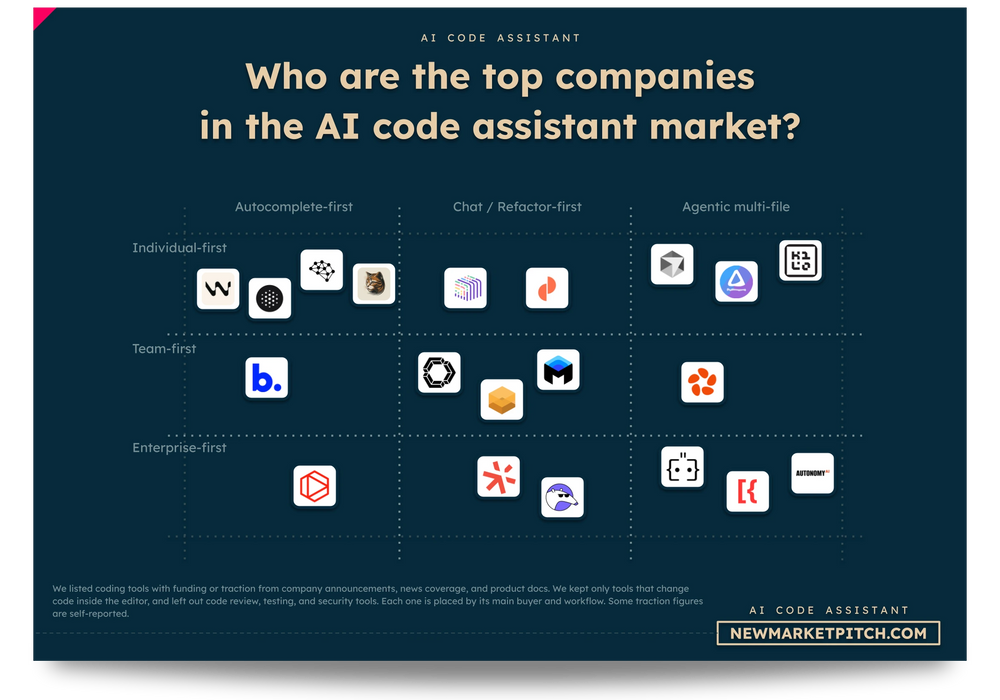
In our report covering the AI coding market, we turn what is vague and complex into simple, useful visuals. Market maps like this one show you at a glance where every startup stands.
Which AI coding agent startups belong in this race?
We compare Cursor, Cognition, Replit, Factory, Augment Code, and Poolside because these six companies are making the most serious bets on agents that can complete substantial software work.
An AI coding agent must be able to understand a repository or application, change multiple files, use development tools, run code or tests, and carry a task beyond simple autocomplete. The six companies below meet most or all of those conditions, although they target different customers. Six companies meet the bar for a real coding agent, and we cover which companies lead today in our AI code assistants report.
Cursor started as an AI-native code editor and has expanded into local agents, cloud agents, code review, command-line tools, automations, and multi-agent workspaces. Cognition combines Devin, which handles delegated software tasks, with the Windsurf development environment. Replit concentrates on building and deploying new applications from natural-language instructions. Factory sells enterprise agents called Droids across the software development lifecycle. Augment Code focuses on large repositories and organizational context. Poolside is building its own coding models alongside agent products.
We exclude Lovable, Bolt, Base44, and similar app builders because they mostly compete for fast greenfield application creation, often among users with limited coding experience. Replit overlaps with that group, but its long history as a development environment and its growing enterprise business justify its inclusion.
Magic has disclosed too little current product adoption to support a useful comparison, while CodeRabbit is primarily a code-review company. Anthropic, OpenAI, Microsoft, and GitHub are analyzed later because they are major threats to the startups rather than startups themselves.
Cursor needs a clear qualification. SpaceX completed its acquisition of Anysphere in August 2026, so Cursor is now a unit of a listed company rather than a startup. We keep it in the ranking because it built its position independently, still sells under its own brand, and remains the benchmark every startup is measured against.
Funding totals should be treated as approximate because databases sometimes classify secondary transactions and extensions differently.
| Startup | Main AI coding agent position | Approximate cumulative funding |
|---|---|---|
| Cursor | AI-native development workspace spanning interactive and autonomous coding; part of SpaceX since August 2026 | About $3.4B before its $60B all-stock sale to SpaceX |
| Cognition | Devin autonomous agent plus the Windsurf development environment | About $4.1B, including a $2B+ Series E in September 2026 |
| Replit | Natural-language application creation, development, and deployment | About $922M |
| Poolside | Proprietary coding models, agents, and supporting infrastructure | About $626M |
| Augment Code | Enterprise agents built around large-codebase and company context | About $252M |
| Factory | Model-flexible enterprise software-development agents | About $420M, including $200M at a $5B valuation in September 2026 |
Is Cursor still ahead now that SpaceX owns it?
Yes. Cursor is still ahead overall, although its lead over Cognition has narrowed and its ownership has changed the risks it faces.
The largest gap is still revenue. Forbes and The Wall Street Journal reported that Cursor passed about $4 billion in annualized revenue in early June 2026, and Dealroom carried the same figure. No newer Cursor-specific revenue figure has been published since the deal closed. Cognition reported a $1 billion run rate based on its September 2026 performance. On those numbers, Cursor is roughly four times larger, down from about eight times in June.
Cursor also covers more of the normal development workflow than any rival. Developers can work with an agent inside the editor, send tasks to cloud environments, run agents through the command line, review pull requests with Bugbot, manage several agents at once, or start work from a phone. Enterprise additions include centralized organizations, budget controls, security settings, and separate environments for cloud agents.
The SpaceX deal adds two new questions. The first is model access: OpenAI said in late August 2026 that it would end Cursor’s access to its models in November, after the acquisition. That pushes Cursor further toward its own Composer models and other providers. The second is neutrality: some enterprise buyers may hesitate to route their code through a unit of a company that also runs its own AI models.
Cognition poses the clearest challenge because it combines supervised coding through Windsurf with full task delegation through Devin. Replit leads when a customer wants a new application without configuring an editor, database, hosting, or deployment. Factory is building a credible enterprise alternative around model choice and long-running workflows. Augment and Poolside remain far less visible commercially.
Cursor’s lead is real and still large. It is just more exposed than it was in the spring, and Cognition is now close enough to make the gap a live question.

Our research about AI coding assistants gets updated several times a month, so you always get the latest view of where things stand.
Which AI coding agent has the strongest commercial traction?
Cursor still has the strongest commercial traction in AI coding, and Cognition is now clearly in the same financial league.
Cursor crossed $500 million in annual recurring revenue in June 2025 and $1 billion by November. It reached roughly $2 billion around February 2026, as TechCrunch reported, and about $4 billion by June. That is an eightfold increase in about one year from an already large base.
Cognition’s growth has accelerated. Devin went from $1 million in annual recurring revenue in September 2024 to $73 million by June 2025. After acquiring Windsurf, the combined company reported a $492 million run rate. Bloomberg then reported that Cognition passed $1 billion based on September 2026 performance, roughly doubling in about four months. Cognition confirmed the milestone publicly. Some reports around its Series E put the figure nearer $900 million, which fits a company crossing the line within weeks.
Replit has not published a new achieved revenue figure. Research firm Sacra estimates that it has passed $500 million a year, which is an estimate, not a company number. Replit still says it is on track for a $1 billion run rate before the end of 2026, and that remains a target.
Factory says its revenue doubled every month for six consecutive months, which would be a sixty-fourfold increase. Its September 2026 round at a $5 billion valuation suggests investors have seen strong numbers, but without a disclosed figure we cannot tell how large the business is.
Augment and Poolside have not released current revenue figures that can be compared meaningfully with Cursor, Cognition, or Replit.
| Company | Latest useful revenue evidence | Approximate scale versus Cursor | What we can reasonably conclude |
|---|---|---|---|
| Cursor | About $4B annualized (June 2026, last disclosed) | 100 | Clear commercial leader, now inside SpaceX |
| Cognition | $1B+ annualized (September 2026, reported and company-confirmed) | 25 | Strong second place, about four times smaller |
| Replit | Above $500M estimated by Sacra; $1B targeted by end-2026 | About 13 (estimate) | Large business, but the newest figures are an estimate and a target |
| Factory | Undisclosed | Unknown | Very fast reported growth and a $5B valuation, from an unknown base |
| Augment Code | Undisclosed | Unknown | Enterprise positioning is clearer than commercial scale |
| Poolside | Undisclosed | Unknown | Funding and technical ambition exceed visible adoption |
Is Cognition closing the gap with Cursor after passing $1 billion?
Yes, Cognition is closing the gap faster than any other startup, but Cursor is still adding more revenue in absolute terms and has the broader product.
Cognition doubled from $492 million to more than $1 billion in about four months, according to Bloomberg. Part of its earlier jump came from buying Windsurf, but this latest doubling came after the deal, which makes it a stronger signal of organic demand. Cognition had also said enterprise Devin usage grew 50% month over month for six straight months.
Capital now backs that growth. In September 2026, Cognition raised more than $2 billion in a Series E at a $48 billion valuation, up from $26 billion at its previous round. It has launched Devin Desktop, added a productivity guarantee, expanded into government deployments, and tightened the link between Devin and Windsurf. Consulting partners such as Infosys and Cognizant give it a faster route into large companies.
Cursor’s percentage growth has been less dramatic recently, but its dollar gains have been larger. It doubled from about $2 billion around February to about $4 billion by June. It has shipped cloud-agent environments, enterprise organizations, mobile access, visual prompting, a cheaper Bugbot, an agent SDK, and steady Composer improvements. The open question is how fast it grows inside SpaceX, which has not published a separate Cursor figure.
Factory may be growing faster than both in percentage terms. Its valuation went from $1.5 billion at its Series C to $5 billion about five months later. Persistent Droid Computers, Missions, model routing, a desktop agent, and a new chief revenue officer point to a larger commercial push. The missing revenue figure still blocks a direct comparison.
Replit had the most extreme earlier acceleration, from $2.8 million to more than $150 million in annualized revenue, then to about $240 million by October 2025. Its momentum is strongest in application creation, with Agent 4, parallel task execution, and the $400 million round at a $9 billion valuation it closed in March 2026.
Cognition is the startup most likely to narrow the gap with Cursor. If it keeps doubling every few months while Cursor adjusts to new ownership and the loss of OpenAI access, the race at the top could tighten within a year. Factory is the smaller challenger with the greatest upside.

In our market report about AI coding assistants, we look at what the winners do differently, so you can learn from the best instead of guessing.
Which AI coding agent is most mature and autonomous for professional software teams?
Cursor still offers the most complete AI coding agent product for professional software teams, while Cognition’s Devin remains the strongest option for handing off an entire task.
Cursor’s product has grown around the way developers already work. A developer can ask questions, edit several files, run a local agent, send longer jobs to cloud agents, compare parallel attempts, review generated code, or continue from another device. Cursor 3 brought local and remote agents into one workspace instead of separate tools and windows.
The company has also built the administrative features large customers demand. Cursor Enterprise supports organization-level administration, separate team budgets, security controls, usage visibility, and managed development environments. Pricing changes added heavier-use seats and better alerts after customers complained that agent consumption was hard to predict. Seats, heavy-use tiers and spending alerts show how these tools make money, and we compare the winning pricing models in our report covering AI code assistants.
Model choice is now a weaker point. Once OpenAI ends Cursor’s access, teams that relied on OpenAI models inside Cursor will need to switch to Composer or other providers. For many teams that is a configuration change. For some it means re-testing workflows that were tuned to one model.
Cognition is more focused on delegation. A user gives Devin a task, and the agent creates a plan, works inside a development environment, uses tools, runs tests, and returns a pull request or completed output. Devin Desktop, Devin Review, government products, MCP connections, and Windsurf integration let teams move between supervised coding and autonomous work.
Factory is pursuing longer and more complex autonomous workflows. Its Missions product coordinates several Droids across work that Factory says may take days or weeks. Droid Computers preserve files, credentials, services, and running processes between sessions, so agents do not rebuild their environment each time.
Replit is the most mature option for building a new application from an idea. Agent 4 can design, develop, test, and deploy inside the same cloud platform. Parallel tasks and automatic conflict handling let several parts of an application be built at once, and Replit says its system resolves merge conflicts automatically about 90% of the time.
Full autonomy remains less common than demos suggest. A recent study of agent-generated fixes found that 46.41% of pull requests from Copilot, Devin, Cursor, and Claude were rejected, often for incorrect approaches, failed tests, incomplete work, or lost sessions.
Cursor is the most mature overall platform. Devin is better for pure task delegation, Factory has the boldest long-horizon architecture, and Replit is strongest for autonomous greenfield application creation.
Which AI coding agent performs best on real coding tasks?
No company wins every type of coding task, but Cursor has the strongest independent record for bug fixes, while Devin shows the clearest improvement over time.
A 2026 study examined 7,156 pull requests created by Codex, GitHub Copilot, Devin, Cursor, and Claude Code. Cursor achieved an 80.4% acceptance rate on fix tasks. Claude Code performed best on documentation and feature work. Codex was consistently strong across categories, while Devin was the only agent whose acceptance rate improved steadily, by about 0.77 percentage points per week over thirty-two weeks.
Task type mattered as much as the agent. Documentation pull requests reached an 82.1% acceptance rate across the dataset, against 66.1% for new features. Choosing suitable work for an agent may create a larger gain than switching from one leading product to another.
The wider AIDev dataset contains 932,791 agent-authored pull requests across more than 116,000 repositories. That confirms agents are used in real projects, but it does not prove one product creates more valuable software, because repositories, users, and review standards differ sharply.
Company benchmarks need more care. Factory reported a 58.75% score on Terminal-Bench and held first place when the result was published. Cursor’s Composer models have posted strong results in Cursor’s own harness. Newer OpenAI models later reported much higher results on updated benchmark versions, showing how quickly a lead disappears.
Cursor has the best independent result for bug fixes. Devin has the strongest improvement trend, Replit is better suited to complete new applications, and Factory looks competitive on terminal-heavy work.

In our document detailing everything you need to know about AI coding, you will always find fresh funding data, taken straight from our own verified funding database.
Which AI coding agent startup has won the strongest enterprise customers?
Cursor has the strongest enterprise customer base, and its best deployments go well beyond small experiments. Cognition has the best list among independent startups.
Cursor says more than 70% of the Fortune 500 uses its platform. That percentage alone is broad, but several customer examples show deeper adoption.
Stripe rolled Cursor out to roughly 3,000 engineers. Nvidia reported three times more committed code across 30,000 developers. Salesforce reported a velocity increase above 30%, while Amplitude said it shipped three times more production code. Cursor has also published examples from Dropbox, PayPal, Coinbase, National Australia Bank, Wayfair, Box, and Faire. The test now is whether those customers stay as comfortable buying from a SpaceX unit as they were from an independent vendor.
Cognition’s customers include Goldman Sachs, Citi, Dell, Cisco, Palantir, Mercedes-Benz, NASA, Santander, Nubank, and Mercado Libre. Partnerships with Infosys and Cognizant give it a route into many large accounts. Its doubling to $1 billion suggests these accounts are expanding, although Cognition still discloses few seat counts or contract values.
Factory says hundreds of thousands of developers use Droids daily at companies including Nvidia, Adobe, EY, Palo Alto Networks, and Adyen. It does not show how much of that usage comes from paid contracts or how many customers have expanded.
Replit says people from 85% of the Fortune 500 have built with its platform and names customers including Atlassian, LabCorp, PayPal, Zillow, Adobe, and UKG. Its strongest position often sits outside central engineering teams, where employees build internal tools, prototypes, and smaller applications.
| Company | Best available enterprise evidence | How convincing is it? |
|---|---|---|
| Cursor | Large deployments at Stripe and Nvidia, plus repeated quantified case studies | Strongest evidence of wide and deep adoption; new owner adds a vendor-neutrality question |
| Cognition | Major banks, technology companies, manufacturers, NASA, Infosys, and Cognizant | High-quality list backed by $1B+ run rate, but few disclosed seat and contract figures |
| Factory | Hundreds of thousands of reported daily users at named large enterprises | Strong emerging position, with limited contract detail |
| Replit | Users from 85% of the Fortune 500 and several named business customers | Very broad reach, although “users from” may include small pockets of adoption |
| Augment Code | Enterprise-focused product and selected customer stories | Credible, but insufficient aggregate data |
| Poolside | Few comparable public customer disclosures | Commercial position remains difficult to judge |
Which AI coding agent gives customers the best value?
Cursor offers the safest value for established development teams, while Replit can produce better economics for new applications because it bundles coding, infrastructure, and deployment.
Subscription prices reveal only part of the cost. Agent usage also creates model charges, cloud-environment costs, failed attempts, and review work. A cheaper agent becomes expensive if engineers spend hours correcting its output.
Cursor sells several individual, team, and enterprise tiers. Its Teams structure separates normal users from heavy agent users and gives administrators better spending controls. Its growing use of its own models may reduce dependence on expensive outside inference, and losing OpenAI access makes that shift more urgent. Cursor has not published gross margins by model.
Devin uses plans and metered consumption, so customers pay more as autonomous work increases. That aligns price with usage but makes complex tasks harder to budget, especially when the agent spends time understanding an environment or retrying failed work.
Factory’s paid self-serve plans begin at $20 per month, with larger business and enterprise arrangements. Its Router chooses between models by quality, reliability, and cost, which helps enterprises avoid using the most expensive model on every task. Model independence has become a stronger selling point since OpenAI said it would cut off Cursor.
Replit’s value comes from bundling. A customer can generate the application, store data, collaborate, run the software, and publish it through one platform. Business Insider reported that Replit’s overall gross margin was about 23% in mid-2025, against approximately 80% for enterprise business. That suggests heavy consumer agent use was expensive, while larger contracts were much healthier.
Independent research remains mixed. A meta-analysis of 23 studies found a moderate positive effect on programming productivity overall, with smaller gains in open-source and enterprise settings. A Microsoft study found that engineers using command-line agents merged roughly 24% more pull requests, while noting that pull-request volume does not equal business value.
Cursor is the safest broad purchase for existing engineering teams. Replit has the clearest value for greenfield applications. Devin and Factory make more sense when a company has repeatable work that justifies heavier autonomous usage.

Learning from others' mistakes is the cheapest lesson there is. In our report covering the AI coding market, we look at what broke startups before you, so you don't repeat it.
Who has the money to scale: Cursor inside SpaceX or Cognition at $48B?
Both do. Cursor now has SpaceX’s balance sheet and computing infrastructure behind it, while Cognition has become the best-funded independent startup in the race.
Cursor raised about $3.4 billion as a startup, including a $2.3 billion Series D at a $29.3 billion valuation, before SpaceX bought it for $60 billion in stock. Its revenue run rate was already larger than all the private funding it had raised. Inside SpaceX it no longer needs to raise money on its own, and it can draw on the group’s data-center capacity for model training and cloud agents. The trade-off is that its priorities now sit inside a much larger company. A company living inside SpaceX no longer needs outside money, so we look at who is getting funded, and by whom, in our report on AI code assistants.
Cognition has raised about $4.1 billion in total, including more than $2 billion in its September 2026 Series E at a $48 billion valuation. That pays for remote development environments, model usage, enterprise support, and Devin-Windsurf integration. Its early period was efficient: Devin reached $73 million in recurring revenue while Cognition said historical net burn stayed below $20 million.
Replit has raised about $922 million, including $400 million at a $9 billion valuation in March 2026, and runs a broad cloud platform for more than fifty million users. It must support development environments, databases, hosting, deployment, collaboration, and agent inference together. That is expensive, but it gives Replit control of the whole path from idea to working application.
Factory has raised about $420 million, including a $150 million Series C and a $200 million round at a $5 billion valuation in September 2026. Its persistent Droid Computers and model-routing layer are built for enterprise use, but it has not yet shown several deployments at Cursor-like scale or disclosed revenue to measure capital efficiency.
Poolside has raised about $626 million while taking on expensive model and infrastructure work. The Financial Times reported that a major CoreWeave data-center agreement collapsed after delays, disrupting Poolside’s planned Texas project and a proposed $2 billion fundraising round. The episode showed the risk of building heavy infrastructure before commercial adoption.
Cursor now has the deepest pockets and the strongest infrastructure, but it no longer controls its own capital decisions. Cognition has enough money to fight for the top spot on its own terms, and Replit has proved it can operate at very large user volume.
What can the leading AI coding agent startups defend from copycats?
Cursor still has the strongest defensible position because competitors would need to copy its workflow, distribution, enterprise integrations, product data, and model work together.
The editor gives Cursor frequent daily use. Once a company has indexed repositories, created rules, connected tools, trained employees, set budgets, and approved security policies, switching platforms becomes inconvenient enough to support retention.
Cursor also learns from millions of agent sessions. That data shows which suggestions survive, where agents fail, how developers interrupt them, and which workflows lead to accepted code. Cursor has used it to train Composer. That investment now matters more: when OpenAI said it would end Cursor’s model access, the company’s own models became a core defense rather than a cost-saving option.
Cognition’s advantage comes from long-running delegated work. Devin creates data about planning, environment setup, retries, tool use, failed sessions, and human review. Windsurf adds interactive developer behavior and codebase navigation.
Replit sees the whole application cycle, from the first prompt through deployment and later edits. Factory is building around model-independent orchestration, while Augment’s Context Engine aims to preserve knowledge across large repositories and teams.
Anthropic, OpenAI, GitHub, and Microsoft can copy many individual features, and they can also withhold models. The durable advantage comes from owning an important workflow and learning faster from real use. Cursor still has the strongest combination of both, and Cognition is building the closest second.

In our research about AI coding assistants, we always try to gather several sources and make estimates that make sense, so you can work with solid numbers.
Can Claude Code, Codex, and GitHub overtake the AI coding agent startups?
Claude Code, OpenAI Codex, and GitHub can overtake individual AI coding agent startups, and Claude Code already rivals Cursor on developer influence.
Anthropic’s latest Claude Code-specific figure, published with its February 2026 Series G, was a run rate above $2.5 billion, with enterprise customers generating more than half of it. Since then, Anthropic told investors that its company-wide run rate reached $65 billion in July 2026, CNBC reported in August, and coverage of that figure named Claude Code as a major driver. Anthropic has not split out a newer Claude Code number.
Even the February figure made Claude Code larger than Replit and well ahead of where Cognition stood at the time. It gives developers direct access to a frontier model without a separate AI-native editor, which pushed Cursor to invest more heavily in Composer.
OpenAI is attacking the same market through a dedicated Codex application, the command line, an IDE extension, and the web. It says GPT-5.3-Codex reached 56.8% on SWE-Bench Pro and 77.3% on Terminal-Bench 2.0 while running 25% faster than the previous version. Company-run benchmarks require caution, but they show how fast model providers can erase a startup’s technical lead. OpenAI’s decision to cut off Cursor after the SpaceX deal also shows that model providers are now competitors first and suppliers second.
GitHub may have the strongest distribution position. Agent HQ lets customers run agents from Anthropic, OpenAI, Google, Cognition, and other providers inside GitHub and Visual Studio Code. GitHub can become the control layer through which several agents receive tasks, access repositories, and submit pull requests.
Cursor, Cognition, Replit, Factory, and Augment stay strongest where they offer a better workflow than direct model access. Their position weakens whenever Claude, Codex, or GitHub can offer the same experience inside software customers already use.
Can we trust the numbers used to rank AI coding agent startups?
We can trust the broad ranking, but several precise gaps remain uncertain because private companies report different kinds of numbers at different dates.
Revenue is the most useful metric when a credible publication gives the value and the period. Even then, most figures are annualized run rates, not audited yearly revenue. A strong month multiplied by twelve may overstate what a company collects. The Cursor-Cognition comparison also mixes a June figure with a September one, and Cursor has published nothing newer since joining SpaceX, so the true gap today could be smaller or larger than four times.
User statistics are harder to compare. “Millions of developers,” “hundreds of thousands of daily users,” “used by 70% of the Fortune 500,” and “users from 85% of the Fortune 500” describe different levels of adoption. None reveals paid seats, retention, customer concentration, or how much code reaches production. Adoption claims that say nothing about paid seats are why we separate real customers from empty promises in our report on who's ahead in AI code assistants.
Some figures are estimates. Replit’s revenue above $500 million comes from Sacra, not from Replit. Valuations such as Factory’s $5 billion reflect what investors paid for a stake, not proven revenue.
Company case studies prove strong outcomes can happen, but rarely show average performance. Independent studies help: one pull-request analysis found large differences by task type and no universal winner, while another found that 46.41% of agent-generated fixes were rejected.
Benchmark results age quickly. Factory once led Terminal-Bench with 58.75%, while newer models later reported much higher results on updated versions. Changes in models, prompts, agent harnesses, and benchmark design all move the ranking.
Our confidence is highest on the first three positions. Several independent indicators place Cursor ahead, Cognition second, and Replit third. Factory, Augment, and Poolside remain harder to order because they disclose fewer comparable commercial results.

If you build or invest in the AI coding market, you need to know which business models pay off now and which ones are fading. That's why our report covering it has a whole section on it.
Which AI coding agent startups are actually ahead?
Cursor is still the overall leader in AI coding agents, now as part of SpaceX. Cognition is the strongest independent startup and the closest challenger, and Replit leads the adjacent race to let anyone build complete applications.
Cursor takes first place because it combines the largest business, a mature daily product, major enterprise deployments, cloud autonomy, code review, and increasingly important proprietary models. No other company in this group has shown that whole combination at similar scale. Its main new risks are the loss of OpenAI model access and buyer doubts about a vendor owned by SpaceX.
Cognition ranks second, and the gap is closing. Devin remains the clearest autonomous software engineer, Windsurf gives it a strong interactive product, and its run rate doubled to more than $1 billion in about four months. Its $48 billion valuation and $2 billion-plus raise give it the means to keep pushing. Cursor still generated roughly four times more annualized revenue on the latest figures.
Replit ranks third because it has built a large business around a different customer need. It is the strongest startup for turning a plain-language idea into a deployed application. It would move closer to the top two by confirming its revenue publicly, reaching its $1 billion target, and proving that Agent can handle complex established codebases.
Factory ranks fourth. Its model-flexible architecture, long-running Missions, persistent computers, strong enterprise names, and $5 billion valuation give it a credible path upward. Actual revenue, retention, and deployment-depth figures would be needed to place it above Replit.
Augment ranks fifth because its work on organizational context addresses a real limitation of coding agents in very large repositories. Its newer Cosmos platform remains too new, and the company has disclosed too little adoption, to support a higher ranking.
Poolside ranks sixth. Owning coding models could become valuable, but Poolside has taken on large infrastructure and financing risk while revealing little commercial traction.
Today, Cursor is ahead overall. Cognition is the closest challenger, the leader among independent startups, and the leader in pure task delegation. Replit leads AI-native application creation. Factory has the clearest chance to disrupt that top three.
| Rank | Startup | Why it ranks here |
|---|---|---|
| 1 | Cursor | Overall leader in revenue, product breadth, enterprise deployment, and proprietary agent development; part of SpaceX since August 2026 and losing OpenAI model access |
| 2 | Cognition | Largest independent startup, with Devin, Windsurf, a $1B+ run rate, a $48B valuation, and major enterprise customers |
| 3 | Replit | Leader in building and deploying new applications through natural language, supported by a large user and revenue base |
| 4 | Factory | Fast-rising enterprise challenger with long-running agents, model flexibility, and a $5B valuation, but undisclosed revenue |
| 5 | Augment Code | Credible large-codebase and organizational-context strategy, but limited evidence of current commercial scale |
| 6 | Poolside | Ambitious proprietary-model approach with substantial capital, yet weaker proof of adoption and operational execution |

In our document detailing everything you need to know about AI coding, we don't want to repeat what boring consulting reports say. Instead, we show you the real and latest market signals that matter.
Our methodology
The answer to which AI coding agent company is ahead is not obvious because leadership can mean different things: generating the most revenue, growing the fastest, completing the most autonomous work, winning major enterprises, performing well on real coding tasks, or building the strongest long-term position. We therefore broke the main question into separate analytical dimensions rather than relying on product reputation or general market perception.
For each dimension, we reviewed recent commercial results, product releases, customer deployments, funding events, acquisitions, technical evaluations, independent research, and competitive developments. We gave more weight to achieved revenue, quantified deployments, and independent studies than to forecasts, valuations, broad usage claims, or company-run benchmarks.
We also kept category leadership separate from overall leadership. Replit can lead natural-language application creation and Cognition can lead autonomous task delegation without either company ranking first across the complete market. The final order reflects the combined pattern across commercial scale, product maturity, enterprise adoption, technical evidence, infrastructure, and defensibility.
Private-company numbers require judgment. Most revenue figures are annualized run rates rather than audited yearly revenue, some come from research firms rather than the companies, customer percentages do not reveal deployment depth, and benchmarks become outdated quickly. We used them as comparative evidence, not as standardized measurements.
Because the market moves unusually fast, we emphasized the freshest credible evidence available. Older benchmarks, product impressions, and valuation assumptions carried less weight when newer commercial or technical results showed that the competitive position had shifted.
Key sources used for this analysis include: Forbes on Cursor’s approximately $4 billion annualized revenue, the U.S. Securities and Exchange Commission filing for the SpaceX–Cursor merger agreement, Cursor’s announcement that it is now part of SpaceX, Yahoo Finance on OpenAI cutting off Cursor’s model access, Cursor’s Stripe deployment, Cursor’s Nvidia deployment, Cognition’s Series E announcement, Bloomberg on Cognition’s $1 billion run rate, Cognition’s Windsurf acquisition announcement, Replit’s introduction of Agent 4, Factory’s Series C and growth announcement, Tech Funding News on Factory’s $5 billion round, and Augment Code’s Context Engine evaluation.
Independent technical evidence came from the AIDev dataset of 932,791 agent-authored pull requests, the comparative study of coding-agent performance by task type, the empirical study of accepted and rejected agent-authored pull requests, and Microsoft’s study of command-line coding agents and development output. We also used Anthropic’s Claude Code adoption and revenue update, TechCrunch on Anthropic’s $65 billion run rate, and OpenAI’s GPT-5.3-Codex release to assess pressure from major AI platforms.
Written by the New Market Pitch teamWe track new markets so founders and investors can move faster. About us