Who are the top investors in AI drug discovery?
Whether you're building or investing in the AI drug discovery market, our report covers everything you need to know: the players, the money, and what's coming next.
Summary
Thrive Capital, ARCH Venture Partners, Foresite Capital, and Dimension Capital are the top investors in AI drug discovery today, although each leads for a different reason. Thrive dominates the largest disclosed financings, ARCH and Foresite excel at creating biotechnology companies, and Dimension has built one of the strongest specialized portfolios.
Thrive's position rests heavily on Isomorphic Labs. It led the company's $600 million financing in March 2025 and its $2.1 billion Series B in May 2026, giving it leadership of $2.7 billion in disclosed rounds. That's extraordinary financing influence, but it doesn't tell us how much Thrive invested itself.
ARCH and Foresite have a different advantage: they helped create Xaira Therapeutics before its billion-dollar launch in 2024. Their influence extends to assembling scientific teams, developing the business, and establishing the research strategy, rather than simply supplying capital.
Dimension looks particularly strong among specialist investors. Its portfolio spans Chai Discovery, Earendil Labs, and Enveda, while its third fund reached $800 million in July 2026, up 60% from its previous fund. That gives it exposure to several competing approaches to computational drug discovery.
The sector's funding boom is broader than the largest deals suggest. DealForma recorded $11 billion across 348 AI/ML drug-discovery venture rounds in 2025, up 24% in capital and 32% in deal count from 2024. The average round actually became slightly smaller, even as headline financings grew enormous.
Technology investors are becoming increasingly important. Index Ventures led Chai Discovery's $400 million Series C, while Sequoia and Kleiner Perkins also participated. These firms see opportunities in molecular-design platforms that can serve multiple pharmaceutical companies, much like enterprise AI businesses.
Strategic investors have a different economic interest. NVIDIA's involvement through NVentures sits alongside its computing business and its planned $1 billion joint AI laboratory with Eli Lilly. Alphabet similarly combines foundational AI research, Isomorphic Labs, and investments through GV and CapitalG.
Pharmaceutical partnerships are becoming almost as important as venture rounds in understanding the market. The potential value of AI drug-discovery licensing agreements reached $43.4 billion in 2025, but much of that figure depends on future milestones. Announced partnership value should never be confused with cash already invested.
The scientific evidence is improving, though it still trails investor expectations. Insilico Medicine has published Phase IIa clinical findings, and Enveda has reported encouraging early clinical results. By contrast, some of the industry's most heavily funded platforms are still working toward their first human trials.
Capital is highly concentrated at the top. Isomorphic's $2.1 billion financing alone was approximately 66 times the average AI/ML drug-discovery venture round recorded in 2025. Investors are making enormous bets on a small number of companies before the industry has established a record of commercially successful AI-originated medicines.
Our ranking therefore favors more than financing size. Thrive leads on major transactions; ARCH and Foresite on company creation; Dimension on specialized portfolio breadth; and DCVC on early scientific risk. The eventual winners may look different once clinical results, ownership returns, and successful medicines provide harder evidence.

Written by the New Market Pitch teamWe track new markets so founders and investors can move faster. About us

In our report covering the AI drug discovery market, you will always find fresh funding data, taken straight from our own verified funding database.
Why are investors pouring money into AI drug discovery now?
Investors are putting record amounts into AI drug discovery because the biggest startups are moving beyond software and trying to develop actual medicines.
DealForma recorded $11 billion across 348 AI/ML drug-discovery venture rounds in 2025, compared with $8.9 billion across 264 rounds in 2024. Funding increased 24%, while the number of deals rose 32%. More companies are getting financed, although the average round actually fell slightly, from $33.7 million to $31.6 million.
The biggest deals tell a different story. Xaira Therapeutics launched with more than $1 billion in committed capital in April 2024. Isomorphic Labs raised $600 million in March 2025, followed by another $2.1 billion in May 2026. Chai Discovery raised $400 million in July 2026 at a reported $3.8 billion valuation.
These companies have attracted investors that traditionally backed different industries. Thrive Capital and Index Ventures come from technology investing, ARCH Venture Partners and Foresite Capital from biotechnology, and NVentures from the semiconductor industry.
Modern AI systems can help design proteins, predict molecular interactions, and explore biological targets, while pharmaceutical companies have the experimental facilities and clinical expertise to test whether those predictions work.
Who are the biggest investors in AI drug discovery today?
Thrive Capital, ARCH Venture Partners, Foresite Capital, and Dimension Capital currently stand out as the strongest AI drug-discovery investors, although their investment records look very different.
Thrive has led the largest disclosed financing rounds, particularly through Isomorphic Labs. ARCH and Foresite helped create Xaira Therapeutics, one of the sector's most heavily funded companies. Dimension has built a more diversified portfolio around computational biology, including Chai Discovery, Earendil Labs, and Enveda.
Other important investors include DCVC, GV, NVentures, Index Ventures, NEA, and Catalio Capital Management. Their positions are supported by repeated investments, major financing leadership, or involvement in companies developing therapeutic candidates.
We need to distinguish the size of a funding round from the amount invested by an individual firm. When Thrive leads a $2.1 billion financing involving seven other investors, the full amount cannot be attributed to Thrive.
| Investor | Main strength | Notable AI drug-discovery exposure |
|---|---|---|
| Thrive Capital | Largest financing leadership | Isomorphic Labs, Chai Discovery |
| ARCH Venture Partners | Building biotechnology companies | Xaira Therapeutics |
| Foresite Capital | Creating AI-driven therapeutics companies | Xaira Therapeutics |
| Dimension Capital | Specialized computational biology portfolio | Chai Discovery, Earendil Labs, Enveda |
| DCVC | Early-stage scientific investing | Proxima, Chai Discovery |
| GV | AI research and biotechnology investing | Isomorphic Labs, Engine Biosciences |
| NVentures | Strategic AI-computing investments | Proxima |
| Index Ventures | Large growth-stage financing | Chai Discovery |
| NEA | Established biotechnology investing | Xaira Therapeutics |
| Catalio Capital | Clinical-stage life sciences investing | Enveda |

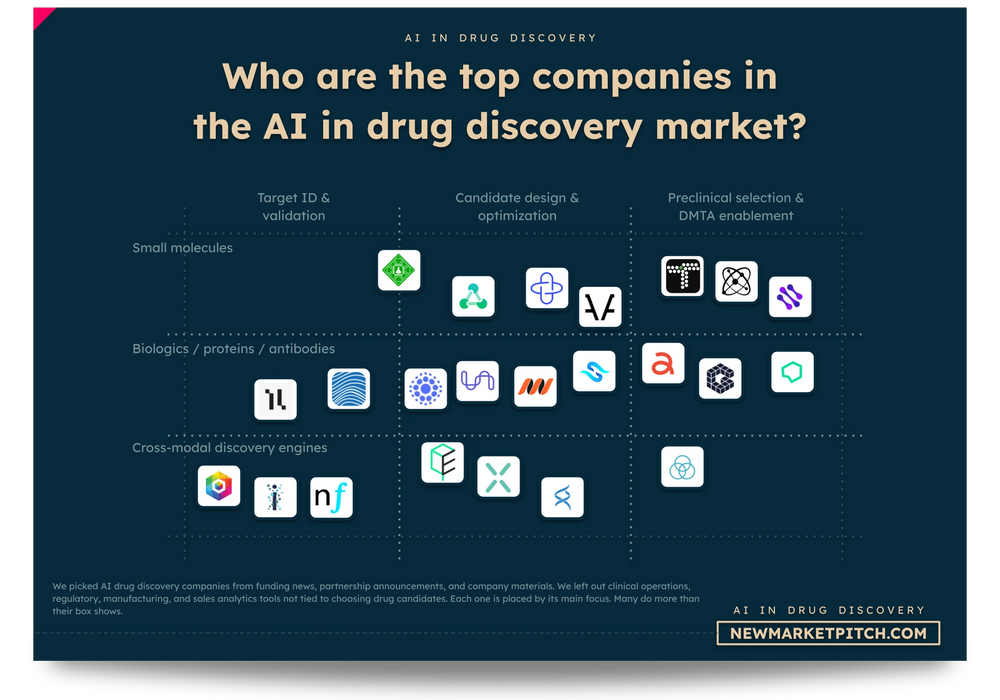
In our research about AI drug discovery, we turn what is vague and complex into simple, useful visuals. Market maps like this one show you at a glance where every startup stands.
Is Thrive Capital the biggest investor in AI drug discovery?
Thrive Capital has led some of the largest disclosed AI drug-discovery financing rounds, thanks largely to its investment relationship with Isomorphic Labs.
In March 2025, Thrive led Isomorphic's $600 million financing, the company's first external investment round. In May 2026, Thrive returned as lead investor in a $2.1 billion Series B, alongside Alphabet, GV, MGX, Temasek, CapitalG, and the UK Sovereign AI Fund.
Those two rounds brought Isomorphic approximately $2.7 billion. That is more than twice Xaira Therapeutics' initial billion-dollar commitment and nearly seven times Chai Discovery's $400 million Series C.
Thrive also backed Chai Discovery, participating in the company's earlier financing rounds as its valuation climbed from approximately $1.3 billion in December 2025 to $3.8 billion seven months later.
The concentration is striking. Isomorphic accounts for almost all the disclosed round value associated with Thrive's largest drug-discovery investments.
Thrive deserves first place if we rank investors by the size of the major financings they lead. It is much harder to put the firm first for portfolio breadth or proven investment returns.
If you want more recent data on this point, please see our latest AI in drug discovery market report.
Why are ARCH Venture Partners and Foresite Capital so important?
ARCH Venture Partners and Foresite Capital are among the most influential AI drug-discovery investors because they helped build Xaira Therapeutics from the beginning.
Xaira launched in April 2024 with more than $1 billion in committed capital. The company was jointly incubated by ARCH and Foresite Labs and brought together scientific talent associated with major advances in computational protein design.
The broader investor group included F-Prime Capital, NEA, Sequoia Capital, Lux Capital, Lightspeed Venture Partners, Menlo Ventures, and Two Sigma Ventures.
ARCH and Foresite played a particularly important role because their involvement began before the public financing announcement. They helped assemble the organization, scientific approach, and management team.
Xaira combines machine learning, large-scale biological data generation, and therapeutic development. The company wants to discover and develop medicines using an integrated research platform.
That approach requires substantial funding for laboratory research, drug development, and eventually human trials. ARCH and Foresite have experience supporting companies through these demanding stages.

In our market report about AI drug discovery, we always try to gather several sources and make estimates that make sense, so you can work with solid numbers.
Is Dimension Capital becoming the top specialist investor in AI drug discovery?
Dimension Capital has one of the strongest claims to being the leading specialized AI-biology investor, especially given how quickly it has built its portfolio and raised new funds.
Founded in 2022 by Zavain Dar, Adam Goulburn, and Nan Li, Dimension invests where advanced computing meets scientific research.
The firm announced an $800 million third fund in July 2026, just 18 months after raising its $500 million second fund. That is a 60% increase in fund size during a period when many venture firms have struggled to raise capital.
Its portfolio includes Chai Discovery, Earendil Labs, Enveda, Tamarind Bio, and other companies applying computational methods to biological research.
Chai provides a useful example of Dimension's approach. The firm co-led Chai's approximately $30 million seed round in 2024 and continued participating as the company raised increasingly large rounds.
Dimension also backed Coefficient Bio, which Anthropic acquired in 2026 for a reported $400 million. The acquisition offered an unusual outcome for a computational biology investor: a potential exit driven by the value of AI research capabilities rather than a commercialized medicine.
Dimension's portfolio extends beyond drug discovery into other areas of scientific computing, so it would be inaccurate to treat its entire $800 million fund as capital dedicated to pharmaceuticals.
If you want more recent data on this point, please see our latest AI in drug discovery market report.
Which AI drug discovery investors make the most deals?
DCVC, NVentures, Dimension Capital, and several specialized biotechnology firms are particularly active in AI drug discovery, while Thrive's position is driven by much larger individual rounds.
The broader financing market is far more fragmented than the largest announcements suggest. DealForma recorded 348 AI/ML drug-discovery venture rounds in 2025, an average of 29 per month, up from 22 per month in 2024.
That increase tells us more companies are attracting capital, but it does not identify one investor as the most active. A reliable investor-level frequency ranking would need a consistent transaction database covering both lead investors and smaller participants.
What we can establish from disclosed deals is that DCVC has repeatedly backed technically demanding companies, Dimension has returned to support existing portfolio companies, and NVentures has participated in investments related to biological AI and computing.
For example, DCVC led Proxima's $80 million seed financing in January 2026, while NVentures joined the same round. Dimension has supported Chai through multiple stages, from its initial seed financing to its much larger subsequent raises.
Thrive led both of Isomorphic's disclosed external financing rounds, demonstrating unusually strong follow-on commitment to a single company.

Our document detailing everything you need to know about AI drug discovery gets updated several times a month, so you always get the latest view of where things stand.
Is DCVC one of the best early-stage AI drug discovery investors?
DCVC is a particularly credible early-stage AI drug-discovery investor because it has shown a willingness to finance difficult scientific technologies before they reach clinical validation.
In January 2026, Proxima announced an $80 million seed round led by DCVC. Other participants included NVentures, Roivant Sciences, and Braidwell.
Proxima, previously known as VantAI, works on technologies involving protein interactions, molecular glues, and targeted protein degradation. These approaches could help researchers develop treatments against biological targets that have historically been difficult to address.
An $80 million seed round is unusually large compared with conventional software startup financing. It reflects the cost of building experimental capabilities alongside computational models.
DCVC also participated in Chai Discovery's earlier financing, giving it exposure to another company developing AI systems for molecular design.
The two businesses approach drug discovery differently. Chai develops foundation models for designing biological molecules, while Proxima focuses on particular therapeutic mechanisms.
If you want more recent data on this point, please see our latest AI in drug discovery market report.
Why are Index Ventures, Sequoia, and Kleiner Perkins backing AI drug discovery?
Index Ventures, Sequoia Capital, and Kleiner Perkins are investing in AI drug discovery because some molecular-design companies are beginning to look like major AI platforms with pharmaceutical customers.
Chai Discovery is the clearest example. In July 2026, Chai raised $400 million in a Series C led by Index Ventures, with participation from Kleiner Perkins, Sequoia, Dimension, and other investors.
The round valued Chai at approximately $3.8 billion, up from $1.3 billion seven months earlier. That represents an increase of about 192%.
Chai develops AI models capable of designing therapeutic proteins and antibodies. Its pharmaceutical relationships have expanded quickly, with collaborations involving Eli Lilly, Pfizer, Novartis, Bristol Myers Squibb, argenx, and GSK.
By October 2026, Chai had announced six pharmaceutical partnerships within approximately nine months. That is a more useful commercial indicator than its valuation alone, although the companies have not disclosed enough information to calculate Chai's revenue from these agreements.
The investment case is attractive to technology funds because a successful molecular-design platform could serve several pharmaceutical companies without having to develop every drug independently.
There is still considerable scientific risk. Better molecular predictions don't guarantee successful clinical trials, and partnerships can end without producing approved therapies.

In our report covering the AI drug discovery market, we look at what the winners do differently, so you can learn from the best instead of guessing.
Is NVIDIA becoming one of the biggest investors in AI drug discovery?
NVIDIA is becoming an influential backer of AI drug discovery through NVentures and its wider pharmaceutical partnerships, although much of its financial involvement sits outside traditional startup equity investing.
NVentures participated in Proxima's $80 million seed round in January 2026. NVIDIA has also developed tools and infrastructure intended to support molecular simulation, biological foundation models, and other computationally demanding scientific research.
Its relationship with Eli Lilly is particularly important. In January 2026, the companies announced plans to invest up to $1 billion over five years in a joint AI research laboratory.
That commitment covers research and computing infrastructure rather than a $1 billion equity investment in a startup.
NVIDIA benefits from a different part of the market than most venture capital firms. Companies training large biological models or running computational chemistry simulations need substantial computing resources, and NVIDIA supplies much of the hardware and software infrastructure used for that work.
This gives NVIDIA an unusually attractive position. It can benefit from growing computational demand even when individual drug-development programs fail. But NVentures' disclosed equity investments should be assessed separately from NVIDIA's computing sales, research partnerships, and infrastructure commitments.
Does Alphabet have a bigger advantage in AI drug discovery than venture capital firms?
Alphabet has an unusually strong position in AI drug discovery through Isomorphic Labs, its relationship with Google DeepMind, and the investment activities of GV and CapitalG.
Isomorphic Labs was founded in 2021 and developed from the scientific environment that produced AlphaFold, the protein-structure prediction system associated with Google DeepMind.
Alphabet participated in Isomorphic's $600 million financing in March 2025 and its $2.1 billion Series B in May 2026. GV also backed both rounds, while CapitalG joined the later financing.
The company has entered pharmaceutical collaborations, including agreements with Eli Lilly and Novartis, allowing its technology to be applied to actual drug-development programs.
Alphabet has exposure to several parts of this business: foundational AI research, an affiliated drug-discovery company, and investment vehicles capable of supplying capital. Few conventional venture firms can match that combination.
However, publicly disclosed financing rounds do not reveal Alphabet's complete ownership position, the amounts contributed by each affiliated investor, or the eventual financial returns.

In our research about AI drug discovery, we don't want to repeat what boring consulting reports say. Instead, we show you the real and latest market signals that matter.
Are pharmaceutical companies investing more in AI drug discovery than venture capitalists?
Pharmaceutical companies are committing substantial resources to AI drug discovery, but much of that spending takes the form of research partnerships rather than equity investments.
DealForma recorded 114 AI/ML drug-discovery research and licensing partnerships in 2025, compared with 84 in 2024. That is a 36% increase.
The combined potential value of those agreements increased from $11.8 billion to $43.4 billion. However, these headline values include future milestone payments that may never be earned.
For comparison, DealForma recorded $11 billion in venture funding during 2025. The potential value of pharmaceutical partnerships was therefore almost four times the amount raised through venture rounds.
We should not interpret that ratio as proof that pharmaceutical companies spent four times more cash. Licensing arrangements can include payments conditional on clinical progress, regulatory approval, or future sales.
Eli Lilly, AstraZeneca, Bristol Myers Squibb, and other major drugmakers have built relationships with AI-enabled biotechnology companies. Their contribution can include proprietary datasets, laboratory capabilities, clinical-development expertise, and access to commercial markets.
For a drug-discovery startup, a pharmaceutical partnership can sometimes be more valuable than additional venture capital because it provides a way to test the technology against real drug-development problems.
Are AI drug discovery investors betting on software or actual medicines?
The largest AI drug-discovery financings increasingly favor companies that can help produce new medicines, with many investors particularly interested in businesses that own drug-development programs.
Isomorphic Labs, Xaira Therapeutics, and Enveda illustrate the appeal of combining advanced computational platforms with proprietary therapeutic research.
Isomorphic raised approximately $2.7 billion across two external rounds to develop its drug-design engine and advance therapeutic programs. Xaira launched with more than $1 billion to build an integrated AI-driven biotechnology company.
Enveda offers a more clinically advanced example. The company raised $311 million in September 2026, led by Catalio Capital, after reporting positive early clinical results for two medicines discovered through its AI-enabled natural-product research platform.
Chai Discovery represents a somewhat different approach. Its foundation models are used to design biological molecules, and its relationships with pharmaceutical companies provide opportunities to generate commercial value without independently owning every resulting medicine.
Companies developing their own therapies may capture more of the value if a medicine succeeds, but they also need larger amounts of capital and face the risks of clinical development.
Platform companies can potentially earn research or licensing revenue earlier, although they may capture less of the eventual value of a successful drug.

Learning from others' mistakes is the cheapest lesson there is. In our market report about AI drug discovery, we look at what broke startups before you, so you don't repeat it.
Are investors backing AI drug discovery before there is proof it works?
AI drug-discovery investors are still making many decisions before the technology has demonstrated commercial success, but clinical evidence is improving.
Insilico Medicine offers one of the clearest examples. Its experimental treatment rentosertib, developed using AI-assisted target identification and molecular design, produced encouraging results in a Phase IIa study published in Nature Medicine in 2025.
That is meaningful clinical evidence, although the study does not establish the effectiveness required for regulatory approval.
Enveda has also advanced beyond purely computational research. In September 2026, the company announced a $311 million Series E following positive early clinical readouts for ENV-294, targeting atopic dermatitis, and ENV-308, addressing metabolic health.
Enveda reported more than $845 million raised since its founding, reflecting the enormous capital required to move multiple experimental medicines through development.
Meanwhile, Isomorphic Labs' May 2026 financing announcement followed delays to its original clinical-trial timetable. Reuters reported that the company was targeting its first clinical trials by the end of 2026, later than previously anticipated.
The companies are at very different stages. Insilico has published human clinical evidence, Enveda has announced early clinical results, and Isomorphic's exceptionally large financing has been driven primarily by confidence in its technology and future development pipeline.
As of October 2026, the field still lacks an established record of AI-originated medicines receiving FDA approval and producing substantial commercial sales.
Are AI drug discovery investors putting too much money into a handful of startups?
AI drug-discovery funding is heavily influenced by exceptionally large rounds, and those deals can make the market look more evenly financed than it actually is.
Consider three transactions: Isomorphic Labs raised $2.1 billion in May 2026, Chai Discovery raised $400 million in July, and Enveda raised $311 million in September.
Together, these financings account for $2.811 billion. That is equivalent to approximately 26% of the entire $11 billion that DealForma recorded across AI/ML drug-discovery venture rounds in 2025, although the transactions themselves occurred in a different year.
The comparison illustrates the scale of the largest deals without pretending that these transactions belong to the 2025 total.
The average financing across DealForma's 348 rounds in 2025 was approximately $31.6 million. Isomorphic's $2.1 billion round was about 66 times that average, while Chai's $400 million round was approximately 13 times larger.
These differences create a market where a relatively small number of companies can absorb enormous amounts of capital, while many other startups raise much smaller rounds to develop their research.
Large financings may be justified when companies need to run expensive experimental and clinical programs. But investors could suffer substantial losses if valuations rise much faster than the underlying scientific evidence. And right now, some valuations are moving considerably faster than clinical progress.
If you want more recent data on this point, please see our latest AI in drug discovery market report.

If you build or invest in the AI drug discovery market, you need to know which business models pay off now and which ones are fading. That's why our report covering it has a whole section on it.
Which AI drug discovery investors are gaining influence the fastest?
Dimension Capital, Index Ventures, and Catalio Capital have some of the strongest recent evidence of gaining influence in AI drug discovery.
Dimension's financial growth is particularly easy to measure. Its third fund reached $800 million in July 2026, up from $500 million for its second fund approximately 18 months earlier.
The firm's portfolio also shows a pattern of successful follow-on fundraising. Chai Discovery reached a $3.8 billion valuation, Earendil Labs raised $787 million in March 2026, and Enveda closed its $311 million Series E in September.
Those financings do not establish Dimension's investment returns, but they demonstrate that several companies it backed have continued attracting substantial capital.
Index Ventures gained influence by leading Chai's $400 million Series C, one of the largest recent financings for a company specializing in AI molecular design.
Catalio Capital led Enveda's $311 million financing at a reported $2 billion valuation, approximately double the company's valuation a year earlier. Catalio's investment is particularly interesting because Enveda had already reported early clinical results.
Thrive also reinforced its position through Isomorphic's $2.1 billion Series B, although that transaction strengthened an existing relationship rather than demonstrating new portfolio breadth.
Can AI drug discovery investors make money before a medicine is approved?
AI drug-discovery investors have several ways to generate returns before a drug receives regulatory approval, including acquisitions, share sales, and public listings.
One example is Coefficient Bio, a computational biology company backed by Dimension Capital. Anthropic acquired the business in 2026 for a reported $400 million, demonstrating that AI-related scientific expertise can attract buyers outside the pharmaceutical industry.
Insilico Medicine's December 2025 Hong Kong listing and XtalPi's 2024 public listing provide another route. However, a company reaching the stock market does not necessarily mean its earliest investors have realized a profit.
Pharmaceutical collaborations can also produce revenue before a medicine is approved. Companies may receive upfront payments, research funding, and development milestones.
Chai's growing list of pharmaceutical relationships illustrates the commercial opportunities available to AI platform businesses. Enveda, meanwhile, is building value around both its discovery platform and its own clinical pipeline.
The problem with ranking investors by returns is that their original entry valuations, ownership percentages, dilution, and realized distributions are rarely disclosed.

In our report covering the AI drug discovery market, we like to show you the big picture. We know your time is precious, so we make every page quick to read and packed with as much learning as possible per minute.
Which AI drug discovery investors should early-stage founders approach?
Dimension Capital, DCVC, ARCH Venture Partners, and Foresite Capital are particularly relevant for founders building AI drug-discovery companies, but the strongest choice depends on the scientific and financial requirements of the startup.
ARCH and Foresite are especially suited to companies that need extensive help assembling a biotechnology organization. Their work creating Xaira shows an ability to bring together researchers, management teams, intellectual property, and substantial financing.
DCVC has demonstrated interest in early-stage companies tackling difficult scientific problems. Its leadership of Proxima's $80 million seed round is a relevant example for founders working on new therapeutic mechanisms.
Dimension is attractive to companies combining machine learning with biology. Its investments span molecular-design platforms, AI-enabled therapeutics, and scientific computing, giving it experience with several possible business models.
Smaller specialist funds, including KdT Ventures, Fifty Years, and Breakout Ventures, are also worth considering for companies seeking relatively modest early financing.
The right investor for a $5 million seed round may differ from the right investor for a company preparing a $200 million clinical-development program. Founders should examine the investor's experience with similar scientific risks, ability to participate in future rounds, and relationships with pharmaceutical companies.
If you want more recent data on this point, please see our latest AI in drug discovery market report.
Who are the top investors in AI drug discovery?
Thrive Capital is currently the strongest AI drug-discovery investor by disclosed financing leadership, but ARCH Venture Partners, Foresite Capital, and Dimension Capital are equally important when we consider company creation and specialized investing.
Thrive's leadership of Isomorphic Labs' $600 million and $2.1 billion rounds puts it first for the scale of its recent transactions.
ARCH and Foresite deserve the next positions because of their foundational role in Xaira Therapeutics. They helped create one of the most ambitious AI biotechnology companies rather than simply joining a large financing syndicate.
Dimension ranks particularly highly for its specialized portfolio and repeated investments. Its $800 million third fund and early involvement in companies such as Chai, Earendil Labs, and Enveda give it broader exposure to several approaches to AI-enabled biology.
DCVC, GV, NVentures, Index Ventures, NEA, and Catalio complete our leading group. Each has a distinctive role, from early scientific financing and strategic computing investments to large growth-stage rounds.
| Rank | Investor | Main reason for ranking |
|---|---|---|
| 1 | Thrive Capital | Led Isomorphic's $600M and $2.1B financings |
| 2 | ARCH Venture Partners | Co-created and financed Xaira Therapeutics |
| 3 | Foresite Capital | Co-created Xaira and specializes in biotechnology |
| 4 | Dimension Capital | Broad computational biology portfolio and $800M third fund |
| 5 | DCVC | Early-stage leadership in technically demanding drug discovery |
| 6 | GV | Major Isomorphic investor with wider AI and biotech exposure |
| 7 | NVentures | Strategic AI-biology investments and computing connections |
| 8 | Index Ventures | Led Chai Discovery's $400M Series C |
| 9 | NEA | Established biotech investor backing Xaira |
| 10 | Catalio Capital | Led Enveda's $311M clinical-stage financing |

When you build or invest in the AI drug discovery market, you need clarity, not confusion. In our research about AI drug discovery, we always try to put numbers on and quantify whatever is usually vague and confusing.
Our methodology
This analysis identifies the leading investors in AI drug discovery using financing activity, investment leadership, portfolio development, company creation, strategic involvement, and exposure to scientific progress. We examined disclosed transactions, company and investor announcements, industry research, pharmaceutical partnerships, clinical studies, and public-market disclosures.
Our ranking combines these factors rather than treating the largest funding round as proof that its lead investor deployed the most capital. We distinguish the total value of financings led by an investor from its actual contribution, which is usually undisclosed. We also separate investors that helped create companies from those that participated in later financing rounds.
For market activity, we used DealForma's 2025 AI/ML drug-discovery review, which provides venture funding totals, transaction counts, pharmaceutical partnership activity, and announced licensing values. Its data covers a broader universe than the individual companies discussed in our ranking. We used these figures to understand market conditions, not to assign investment amounts to specific firms.
We assessed investors across several types of activity. Thrive Capital's position was measured through its leadership of Isomorphic Labs' major financing rounds. ARCH Venture Partners and Foresite Capital were evaluated partly through their role in creating Xaira Therapeutics. Dimension Capital, DCVC, and other specialized investors were assessed through portfolio composition, early-stage commitments, and repeated participation. We also examined the strategic positions of GV, Alphabet, and NVentures.
We considered clinical development and pharmaceutical partnerships when evaluating the companies behind these investors. Published human clinical findings carry more scientific weight than computational demonstrations or financing announcements. Likewise, a pharmaceutical collaboration can provide evidence of commercial interest, but the full potential value of a licensing agreement is not equivalent to an upfront cash payment or an equity investment.
We compared recent transactions and financing activity to identify investors gaining influence. Fundraising growth, large follow-on rounds, and new portfolio investments were treated as evidence of continued market access, rather than proof of realized returns. The ranking does not estimate individual ownership stakes, internal rates of return, or distributions to investors because those figures are generally unavailable.
Key financing sources include Isomorphic Labs' March 2025 financing announcement and its May 2026 Series B announcement, Xaira Therapeutics' company launch announcement, Chai Discovery's Series C announcement, DCVC's announcement of Proxima's seed financing, Earendil Labs' $787 million financing announcement, and Enveda's Series E announcement. We also used TechCrunch's reporting on Dimension Capital's third fund for fund size and portfolio developments.
For pharmaceutical partnerships and strategic activity, we examined Isomorphic Labs' Lilly and Novartis collaborations, Chai Discovery's Novartis partnership, its argenx partnership, NVIDIA's joint AI laboratory announcement with Eli Lilly, and NVIDIA's BioNeMo platform announcement.
To assess scientific progress and public-market outcomes, we used the peer-reviewed rentosertib Phase IIa study published in Nature Medicine, Enveda's clinical and research announcements, and Hong Kong Exchanges and Clearing's official Insilico Medicine allotment results, alongside subsequent company disclosures.
The final ranking is our editorial assessment of the available evidence as of October 2026. It emphasizes demonstrated financing leadership, company-building involvement, portfolio breadth, and relevant scientific exposure. It should not be interpreted as a definitive ranking of capital invested, investment performance, or future pharmaceutical success.

A good product starts with a real problem. In our market report about AI drug discovery, we show you the ones customers still live with.
Written by the New Market Pitch teamWe track new markets so founders and investors can move faster. About us