
What are the latest funding news in the AI in education market? (October 2026)
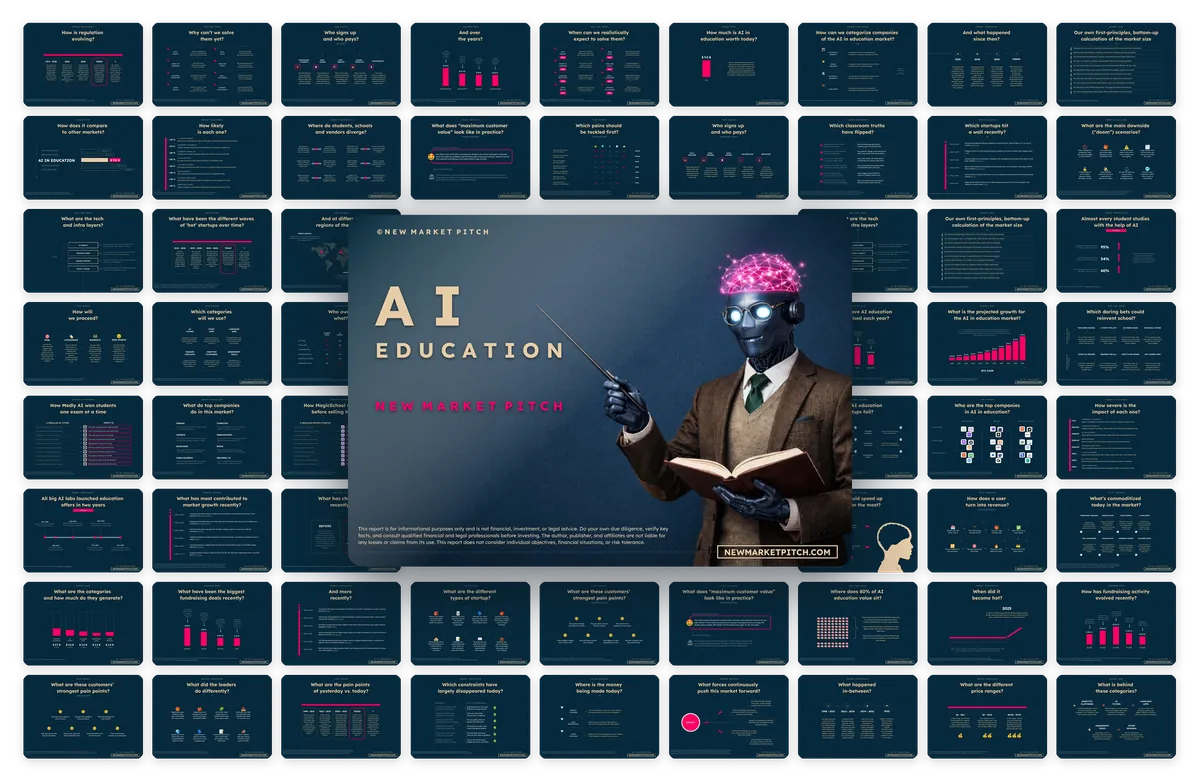
Whether you're building or investing in the AI in education market, our report covers everything you need to know: the players, the money, and what's coming next.
AI in education funding remained active through September 2026, with investors backing specialized products where artificial intelligence directly changes how students learn or how educators assess progress.
The latest deals show that personalized AI tutoring remains the market's clearest funding cluster, especially across K-12, exam preparation and university study workflows.
The 12 companies below raised about $57 million combined, with rounds ranging from $350,000 pre-seed financings to Arivihan's roughly $10.2 million Series A.
And if you want to better understand this new industry, you can download our pitch covering the AI in education market.
Insights
- AI tutoring dominates the current funding pipeline: 7 of these 12 companies are primarily tutors or exam-preparation tools, rising to 8 if Team Turing's higher-education AI study agent is included.
- The median round is roughly $5 million, showing that AI in education investors are committing meaningful capital even though most of the latest companies remain at seed or pre-seed stage.
- Eight of the 12 financings are seed or pre-seed rounds, suggesting the AI education market is still building its next generation of category leaders rather than consolidating around mature incumbents.
- Geographic specialization is becoming a competitive advantage: Indian curricula, Arabic-language learning, UK exams and South Korean university workflows all attracted funding alongside broader U.S. education products.
- India represents four of the 12 latest deals, driven by the opportunity to combine AI tutoring with local curricula, competitive exams, vernacular languages and lower-cost personalized education.
- Assessment is emerging as a separate AI education category: Ed.ai, AILA and DeweyLearn use AI to grade work, identify skill gaps or evaluate real-world performance rather than simply answering student questions.
- User traction is arriving unusually early: several seed-stage companies already report hundreds of thousands of learners, meaning investors are increasingly funding AI education businesses after visible usage rather than only technical prototypes.
- Curriculum context is becoming part of the product moat: many funded AI tutors are being designed around specific exams, languages and education systems instead of relying on a generic chatbot experience.

Written by the New Market Pitch teamWe track new markets so founders and investors can move faster. About us

In our report covering the AI in education market, you will always find fresh funding data, taken straight from our own verified funding database.
Summary table of the latest funding deals in the AI in education market as of October 2026
We define the AI in education market as products where AI is a core driver of value for teaching, learning, or assessment in K-12 or higher education.
We include AI tutors and practice tools, educator copilots for planning, creation and feedback, and assessment or grading solutions, including platforms where AI materially changes instruction or evaluation.
We exclude general-purpose AI not packaged for education workflows, school back-office operations such as HR, finance or facilities, and products where AI is only a minor feature or UI enhancement.
| Name | When | Amount in $ | Round Type | Category |
|---|---|---|---|---|
| Arivihan | September 30, 2026 | $10.2M | Series A | K-12 AI Tutoring & Exam Preparation |
| Aristotle | September 16, 2026 | $5.0M | Seed | K-12 AI Tutoring |
| Ed.ai | September 10, 2026 | ~$5.8M | Seed | AI Grading & Teacher Copilot |
| Team Turing | September 1, 2026 | ~$5.0M | Series B | Higher Education AI Study Agent |
| AILA | August 19, 2026 | $3.0M | Pre-Series A | AI Assessment & Adaptive Learning |
| Medly AI | August 19, 2026 | $8.0M | Seed | AI Tutoring & Exam Preparation |
| Wild Zebra | August 6, 2026 | $6.0M | Seed | K-12 AI Tutoring & Adaptive Practice |
| imagi | July 23, 2026 | $4.5M | Seed | K-12 AI Learning & AI Literacy |
| DeweyLearn | July 16, 2026 | $5.0M | Series A | AI Assessment & Skills Evaluation |
| sortmyprep | July 13, 2026 | $0.35M | Pre-Seed | K-12 AI Tutoring & Exam Preparation |
| YoLearn.ai | June 30, 2026 | $0.5M | Pre-Seed | Voice AI Tutoring & Exam Preparation |
| ProLearn | June 2, 2026 | ~$3.4M | Pre-Seed | K-12 AI Tutoring & Exam Preparation |
All the latest funding deals in the AI in education market as of October 2026
Arivihan raised about $10.2M in late September 2026 to expand its AI tutoring platform across India.
When was it?
Arivihan announced the financing on September 30, 2026.
Who are they?
Arivihan operates an automated AI tutoring platform that combines personalized lessons, instant doubt solving, adaptive study plans and exam preparation for Indian school students.
Geographical focus?
Arivihan focuses on India, particularly state-board students in smaller cities and rural areas, while expanding into CBSE and NEET preparation.
Why do we include them in the AI in education market?
Arivihan belongs in the AI in education market because AI directly drives its personalized teaching, question support and study planning, placing it in K-12 AI tutoring and exam preparation.
What is the company stage?
Arivihan is at the growth and early-PMF stage, with an established paid student base and capital now being used for geographic expansion.
How much did they raise?
Arivihan raised $10 million in its Series A plus roughly $0.2 million from existing GSF-linked angel investors, for about $10.2 million in reported financing.
What round is it?
Arivihan's financing was a Series A round.
Why did they raise?
Arivihan raised the capital to enter new Indian states and CBSE, improve vernacular AI capabilities, strengthen AI research and expand distribution.

In our research about AI tools for education, we turn what is vague and complex into simple, useful visuals. Market maps like this one show you at a glance where every startup stands.
Aristotle raised $5M in September 2026 to launch its voice-first AI tutoring platform nationwide in the United States.
When was it?
Aristotle announced the seed financing on September 16, 2026.
Who are they?
Aristotle provides a voice-first AI tutor that talks with students in real time, uses a shared whiteboard and teaches through Socratic questioning.
Geographical focus?
Aristotle currently focuses on students aged roughly 13 to 18 across the United States.
Why do we include them in the AI in education market?
Aristotle belongs in the AI in education market because the entire learning experience is delivered by a personalized AI tutor, placing it in K-12 AI tutoring.
What is the company stage?
Aristotle is at seed and early-PMF stage after testing the product with more than 1,000 students before its nationwide launch.
How much did they raise?
Aristotle raised $5 million in this financing.
What round is it?
Aristotle's financing was a seed round led by True Ventures.
Why did they raise?
Aristotle raised the capital to improve its tutoring product, expand the team and support its nationwide commercial launch.
Ed.ai raised about $5.8M in September 2026 to scale its AI grading platform in Europe and the United States.
When was it?
Ed.ai announced the financing on September 10, 2026.
Who are they?
Ed.ai gives teachers an AI assistant that grades scanned or handwritten assignments, suggests feedback, identifies learning gaps and generates remediation exercises.
Geographical focus?
Ed.ai is established in France and is expanding across Europe and the United States, with higher education also planned.
Why do we include them in the AI in education market?
Ed.ai belongs in the AI in education market because AI performs the core grading, feedback and remediation workflow, placing it in AI assessment and teacher copilots.
What is the company stage?
Ed.ai is at seed and emerging-PMF stage, with daily grading usage already scaling significantly before the round.
How much did they raise?
Ed.ai raised €5 million, equivalent to roughly $5.8 million at the time of the financing.
What round is it?
Ed.ai's financing was a seed equity round.
Why did they raise?
Ed.ai raised the capital to double its team, expand in France, Europe and the United States, and prepare its move into higher education.
Team Turing raised about $5M in September 2026 to expand its GPAI university study agent beyond STEM subjects.
When was it?
Team Turing announced the financing on September 1, 2026.
Who are they?
Team Turing develops GPAI, an AI study agent that helps university students understand course material, solve problems, prepare for exams and work with uploaded documents.
Geographical focus?
Team Turing originated in South Korea but GPAI has expanded internationally across markets including the United States, India and Europe.
Why do we include them in the AI in education market?
Team Turing belongs in the AI in education market because GPAI is purpose-built for academic study and coursework, placing it in higher-education AI study agents.
What is the company stage?
Team Turing is at the growth stage, with GPAI reporting more than 1.5 million sign-ups within a year of launch.
How much did they raise?
Team Turing raised KRW 7 billion, approximately $5 million.
What round is it?
Team Turing's financing was a Series B round.
Why did they raise?
Team Turing raised the capital to broaden GPAI beyond STEM, develop more university workflows and accelerate international expansion.

In our market report about AI tools for education, we always try to gather several sources and make estimates that make sense, so you can work with solid numbers.
AILA raised $3M in August 2026 to expand its Arabic-focused AI assessment and personalized learning platform.
When was it?
AILA announced the financing on August 19, 2026.
Who are they?
AILA develops AI learning technology that identifies student knowledge gaps and generates personalized assessments, practice and performance recommendations.
Geographical focus?
AILA is based in Saudi Arabia and primarily targets Arabic-speaking education markets across Saudi Arabia and the wider MENA region.
Why do we include them in the AI in education market?
AILA belongs in the AI in education market because AI drives diagnosis, assessment and personalized practice, placing it in adaptive learning and AI assessment.
What is the company stage?
AILA is at the early-growth stage and is using its Pre-Series A financing to move beyond its initial market.
How much did they raise?
AILA raised $3 million in this financing.
What round is it?
AILA's financing was a Pre-Series A round led by Rua Growth Fund.
Why did they raise?
AILA raised the capital to enter additional regional and international markets, improve its AI capabilities and reach more students and education institutions.
Medly AI raised $8M in August 2026 to expand its personalized AI tutor beyond its UK exam-preparation base.
When was it?
Medly AI announced the financing on August 19, 2026.
Who are they?
Medly AI provides an AI exam tutor that creates practice, marks student answers, tracks progress and gives personalized feedback across major school qualifications.
Geographical focus?
Medly AI started in the United Kingdom and is expanding toward the United States and other international education markets.
Why do we include them in the AI in education market?
Medly AI belongs in the AI in education market because personalized AI tutoring and automated feedback form the core product, placing it in AI tutoring and exam preparation.
What is the company stage?
Medly AI is at seed stage with strong early PMF, with more than 400,000 students reported around the financing.
How much did they raise?
Medly AI raised $8 million in this financing.
What round is it?
Medly AI's financing was a seed round led by Felix Capital.
Why did they raise?
Medly AI raised the capital to add exams and subjects, improve its AI tutor and expand across the UK and international markets.
Wild Zebra raised $6M in August 2026 to grow its Socratic AI tutoring platform for younger students.
When was it?
Wild Zebra announced the financing on August 6, 2026.
Who are they?
Wild Zebra offers an adaptive AI tutor for grades 2 to 9 that teaches math and reading through step-by-step questions instead of simply giving answers.
Geographical focus?
Wild Zebra primarily serves families and schools in the United States.
Why do we include them in the AI in education market?
Wild Zebra belongs in the AI in education market because AI controls tutoring dialogue, difficulty and learning progression, placing it in K-12 AI tutoring and adaptive practice.
What is the company stage?
Wild Zebra is at seed and early-PMF stage, with tens of thousands of students reported and an active paid family product.
How much did they raise?
Wild Zebra raised $6 million in this financing.
What round is it?
Wild Zebra's financing was a seed round led by Trilogy Equity Partners.
Why did they raise?
Wild Zebra raised the capital to hire engineers, improve the tutoring platform and expand sales and marketing.

Our document detailing everything you need to know about AI in education gets updated several times a month, so you always get the latest view of where things stand.
imagi raised $4.5M in July 2026 to scale supervised AI learning and AI literacy inside K-12 schools.
When was it?
imagi announced the financing on July 23, 2026.
Who are they?
imagi gives K-12 schools a controlled environment where students use AI tools within structured lessons covering coding, AI literacy and AI-assisted creation.
Geographical focus?
imagi has international reach but is currently making U.S. school districts its main expansion focus.
Why do we include them in the AI in education market?
imagi belongs in the AI in education market because students interact directly with AI inside curriculum-based learning workflows, placing it in K-12 AI learning and AI literacy.
What is the company stage?
imagi is at seed and early-PMF stage, with around 700,000 students reached and adoption across more than 100 U.S. school districts.
How much did they raise?
imagi raised $4.5 million in this financing.
What round is it?
imagi's financing was a seed round co-led by Brighteye Ventures and Day One Capital.
Why did they raise?
imagi raised the capital to expand structured and supervised AI access in schools, particularly in the United States, and develop additional curriculum and integrations.
DeweyLearn raised $5M in July 2026 to scale multimodal AI assessment of real-world student performance.
When was it?
DeweyLearn announced the financing on July 16, 2026.
Who are they?
DeweyLearn uses multimodal AI to analyze video, audio and learning data so educators can assess how students perform practical tasks and provide expert-style feedback.
Geographical focus?
DeweyLearn is U.S.-based and serves higher education, clinical education, K-12 and selected workforce-learning environments.
Why do we include them in the AI in education market?
DeweyLearn belongs in the AI in education market because AI directly evaluates learner performance and instructional outcomes, placing it in AI assessment and skills evaluation.
What is the company stage?
DeweyLearn is at the Series A and PMF-to-growth stage as it expands an already commercial multimodal assessment platform.
How much did they raise?
DeweyLearn raised $5 million in this financing.
What round is it?
DeweyLearn's financing was an oversubscribed Series A led by SJF Ventures.
Why did they raise?
DeweyLearn raised the capital to scale its multimodal AI platform and expand the range of complex learning and performance tasks it can evaluate.
sortmyprep raised $350,000 in July 2026 to expand its curriculum-aligned conversational AI tutor across more education systems.
When was it?
sortmyprep announced the financing on July 13, 2026.
Who are they?
sortmyprep operates sorty, a conversational AI tutor that provides curriculum-specific explanations, doubt solving, practice and exam support across several school systems.
Geographical focus?
sortmyprep serves India and international-school students following curricula including IB, IGCSE, CBSE and ICSE.
Why do we include them in the AI in education market?
sortmyprep belongs in the AI in education market because its core product is a curriculum-specific AI tutor, placing it in K-12 AI tutoring and exam preparation.
What is the company stage?
sortmyprep is at pre-seed and early-product stage, with initial international usage while it continues building its AI and curriculum infrastructure.
How much did they raise?
sortmyprep raised approximately $0.35 million in this financing.
What round is it?
sortmyprep's financing was a pre-seed round.
Why did they raise?
sortmyprep raised the capital to strengthen its AI infrastructure, cover more curricula and accelerate growth in India and international markets.

In our report covering the AI in education market, we look at what the winners do differently, so you can learn from the best instead of guessing.
YoLearn.ai raised $500,000 in June 2026 to develop and distribute its multilingual voice-first AI tutor across India.
When was it?
YoLearn.ai announced the financing on June 30, 2026.
Who are they?
YoLearn.ai provides a voice-first AI tutor supporting 22 Indian languages, school curricula and competitive exams such as JEE and NEET.
Geographical focus?
YoLearn.ai focuses on India's K-12 and competitive-exam market, with multilingual access designed for students across different regions.
Why do we include them in the AI in education market?
YoLearn.ai belongs in the AI in education market because conversational AI provides the teaching experience itself, placing it in voice AI tutoring and exam preparation.
What is the company stage?
YoLearn.ai is at pre-seed and early-PMF stage, with more than 200,000 cumulative users reported around the financing.
How much did they raise?
YoLearn.ai raised $0.5 million in this financing.
What round is it?
YoLearn.ai's financing was a pre-seed round led by DataAlpha.ai and White Swan Global.
Why did they raise?
YoLearn.ai raised the capital to improve its voice-first learning product and expand distribution across India's school and competitive-exam ecosystem.
ProLearn raised about $3.4M in June 2026 to build and launch its AI-native tutor for Indian students.
When was it?
ProLearn announced the financing on June 2, 2026.
Who are they?
ProLearn is building an AI personal tutor that combines curriculum-aligned content, conversational explanations, voice interaction, practice questions and adaptive support for Indian students.
Geographical focus?
ProLearn focuses on India, particularly students in classes 6 to 12 and learners preparing for major competitive exams.
Why do we include them in the AI in education market?
ProLearn belongs in the AI in education market because AI is the central instructional layer across subjects and study workflows, placing it in K-12 AI tutoring and exam preparation.
What is the company stage?
ProLearn was pre-product at the time of the financing and has since launched, placing the company in early product validation as of October 2026.
How much did they raise?
ProLearn raised ₹30 crore, equivalent to approximately $3.2 million to $3.5 million at contemporary exchange rates.
What round is it?
ProLearn's financing was reported as a pre-seed round led by BEENEXT.
Why did they raise?
ProLearn raised the capital to build its AI reasoning infrastructure, create curriculum-aligned content, hire product and AI talent and support its commercial launch.

In our research about AI tools for education, we don't want to repeat what boring consulting reports say. Instead, we show you the real and latest market signals that matter.
Written by the New Market Pitch teamWe track new markets so founders and investors can move faster. About us