
AI in Education Funding: A Quarter-by-Quarter Analysis
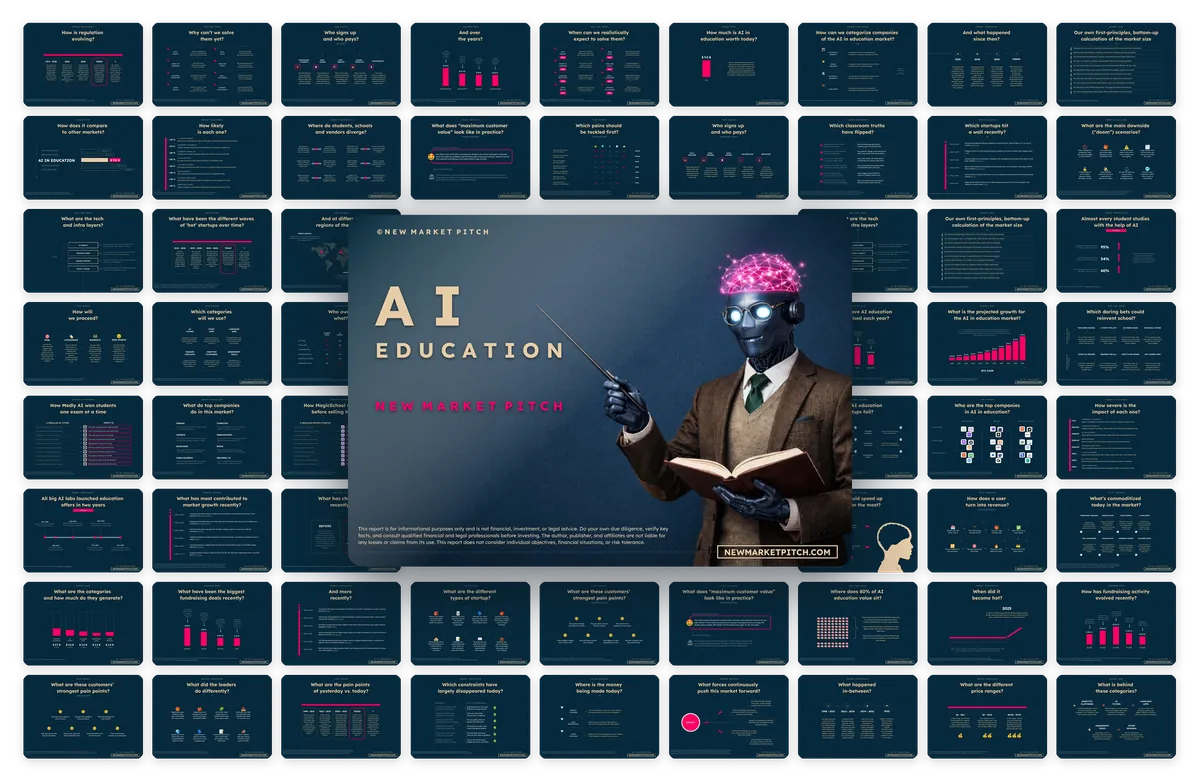
Everything we know about the AI in education market, in one place. Get our report whether you build or invest.
Summary
AI in education funding is slowing in check size, not in deal activity. Investors are still backing plenty of companies, but the typical startup is raising much less than it was a year ago.
Q2 2026 had 10 financings, almost matching the 11 recorded in Q2 2025, yet capital fell from $107.5 million to $45.1 million and the median round dropped from $7 million to just $1.02 million. The market is still active; the money is simply being spread very differently.
The Q3 2025 pullback was broader than a missing megaround. Neither Q2 nor Q3 had a deal above $50 million, so the 62% funding decline came from fewer deals and a sharp disappearance of $20 million-plus rounds.
The recovery through Q4 2025 and Q1 2026 was real, but uneven. Q4 leaned heavily on larger follow-ons, while Q1 looked healthier because deal count, funding, median round size and first financings all improved together.
Q2 2026 then turned into a barbell market. Seven of 10 rounds were below $5 million and represented only about 15% of capital, while the top three deals captured close to 85% of the quarter's money.
New companies are still getting funded. Half of Q2 2026 deals were first financings, but those five companies raised only $4.81 million combined, with a $500,000 median, versus $40.3 million for follow-on rounds.
AI Tutor Platforms have the clearest deal momentum: six financings in Q2 2026, or 60% of the quarter. But those six rounds totaled only about $20.8 million, so this looks more like a startup-formation wave than a capital boom.
AI Learning Software moved the other way, falling from four deals and $45.8 million in Q1 2026 to one roughly $637,000 deal in Q2. That reversal is large enough to notice, but one weak quarter is still too little to call a durable collapse.
Geography is being reshuffled by individual large rounds. Europe captured roughly 66% of Q2 2026 capital, while APAC generated 30% of deals but only about 9% of the money, so the regional leaderboard can flip quickly when one or two larger financings land elsewhere.
The investor base remains fragmented, strategic education investors have faded from the verified 2026 deals, and the April 2025 US AI-education executive order arrived after several major Q2 rounds were already announced. The clearest read today is that AI education funding remains open to new experiments, but big checks are increasingly reserved for companies that can already show usage, distribution or operating history.

Written by the New Market Pitch teamWe track new markets so founders and investors can move faster. About us

In our report covering the AI in education market, you will always find fresh funding data, taken straight from our own verified funding database.
All funding deals in the AI in education market over the last years
Below is the table listing all the deals. You can find our methodology at the end of this page.
If you want a deeper understanding of the market and its current dynamics, get our report covering the AI In Education Market.
| Company | Category | Date | Stage | Deal size | What they do | Region | Lead investors |
|---|---|---|---|---|---|---|---|
| YoLearn.ai | AI Tutor Platforms | June 2026 | Seed | $500K | Provides a voice-first AI tutor with a live interactive sketchpad for K-12, board-exam and competitive-exam learning. | Asia-Pacific | DataAlpha.ai; White Swan Global |
| Lytmus AI | AI Tutor Platforms | June 2026 | Seed | ≈$530,000 | Builds AI mentors for competitive-exam students, initially NEET, providing personalized guidance and real-time doubt resolution. | Asia-Pacific | Boundless Ventures |
| Makon AI | AI Practice Tools | June 2026 | Seed | $300K | Runs an AI-personalized SAT, ACT and AP prep platform with adaptive study plans, practice banks, mock exams and a 24/7 AI tutor. | North America | Not disclosed |
| ProLearn | AI Tutor Platforms | June 2026 | Seed | ≈$3,140,000 | Builds a conversational AI tutor delivering personalized K-12 and competitive-exam instruction and practice. | Asia-Pacific | BEENEXT |
| Mathew (Adaptical S.L.) | Educator Copilots | May 2026 | Seed | ≈$1,396,000 | AI education platform that helps educators create curriculum-aligned materials, automatically evaluate student work and track personalized learning progress. | Europe | Not disclosed |
| ChalkTalk (Chalk Talk Solutions, Inc.) | AI Learning Software | May 2026 | Unknown | $636.93K | AI-powered adaptive K-12 instructional platform that generates teacher materials and personalized student practice from curriculum, schedules and learner data. | North America | Not disclosed |
| Third Space Learning | AI Tutor Platforms | April 2026 | Growth Equity | ≈$5,932,000 | Provides curriculum-aligned one-to-one maths tutoring to primary and secondary students through its spoken AI tutor Skye. | Europe | Maven Capital Partners |
| Dr Connor Ltd | AI Tutor Platforms | April 2026 | Seed | ≈$338,000 | Provides a critical-thinking AI tutor for UK school students that guides homework reasoning rather than simply giving answers. | Europe | Not disclosed |
| Gizmo | AI Practice Tools | April 2026 | Series A | $22M | Turns students' notes, documents and web content into AI-generated personalized flashcards, adaptive quizzes and gamified study activities. | Europe | Shine Capital |
| Coursemojo Inc. | AI Tutor Platforms | April 2026 | Unknown | $10.34M | Provides a curriculum-aligned AI assistant teacher delivering differentiated, Socratic support to K–12 students and real-time instructional data to teachers. | North America | Not disclosed |
| Chalkie | Educator Copilots | March 2026 | Seed | $4M | Uses AI to generate curriculum-aligned lesson plans, presentations, worksheets and differentiated classroom activities for teachers. | Europe | TriplePoint Ventures |
| Nectir | AI Learning Software | March 2026 | Series A | $12.5M | Provides institution-managed AI assistants integrated with learning systems to deliver personalized academic support to students and assist educators. | North America | Rethink Impact |
| Plato Academic | AI Tutor Platforms | March 2026 | Seed | $347K | Provides an embedded, course-aligned AI study assistant that gives university students contextual academic support inside institutional learning environments. | Europe | SFC Capital |
| Pensive | AI Grading Tools | February 2026 | Seed | $6.8M | Provides AI-assisted grading, rubric-based feedback, and course-aligned tutoring tools for higher-education instructors and students. | North America | Mayfield |
| Subject | AI Learning Software | February 2026 | Growth Equity | $28M | Provides an AI-native K-12 digital curriculum and learning platform with accredited courses, personalized instruction, and AI tools supporting educators. | North America | Vistara Growth |
| EDIAND Inc. | AI Learning Software | February 2026 | Seed | $325K | Develops AI-powered medical and dental education software for university learning and assessment, including question generation, personalized study, and learning analytics. | Asia-Pacific | Not disclosed |
| Vimi | AI Tutor Platforms | January 2026 | Seed | $12M | AI math tutor delivering adaptive, curriculum-aligned one-to-one learning and practice for K–12 students. | Middle East | Viola Ventures; BRM Group |
| Sparkli | AI Learning Software | January 2026 | Seed | $5M | Multimodal AI-native learning platform that creates personalized interactive learning expeditions for children aged 5–12. | Europe | Founderful |
| Flashka | AI Practice Tools | January 2026 | Seed | $1.17M | AI-driven study platform that turns university course materials into flashcards, quizzes, practice tests and personalized study flows. | Europe | Outlast Fund |
| Savvy Learn, Inc. (Savvy) | AI Practice Tools | December 2025 | Unknown | $4M | Turns uploaded study materials into personalized AI-generated quizzes and flashcards, with an initial focus on college and graduate students. | North America | Not disclosed |
| BoodleBox | AI Learning Software | December 2025 | Seed | $5M | Provides higher-education institutions a collaborative multi-model AI workspace for student learning, teaching, and assessment. | North America | Dogwood Ventures; Osage Venture Partners |
| Teacher's Buddy | Educator Copilots | November 2025 | Seed | ≈$1,200,000 | AI workspace for teachers that creates curriculum-aligned lessons and resources and assists with marking, reporting, assessment, and instructional planning. | Asia-Pacific | Giant Leap |
| CampusKnot | Educator Copilots | November 2025 | Unknown | $1.1M | Higher-education AI teaching assistant that generates course content and activities, automates grading and feedback, tracks engagement, and summarizes discussions. | North America | Not disclosed |
| Flint | AI Learning Software | November 2025 | Series A | $15M | AI-native K-12 learning platform for personalized activities, adaptive assessments, tutoring, and real-time feedback. | North America | Basis Set Ventures; Patron |
| VideoTutor | AI Tutor Platforms | October 2025 | Seed | $11M | AI tutoring platform that turns student questions into personalized animated, voice-guided instructional lessons. | North America | YZi Labs |
| SpeakX | AI Practice Tools | October 2025 | Unknown | $16M | Generative-AI spoken-English learning platform providing conversational practice and individualized speech feedback. | Asia-Pacific | WestBridge Capital |
| Chalkie | Educator Copilots | October 2025 | Seed | $1.35M | AI copilot that generates curriculum-aligned lesson plans, presentations, worksheets and classroom activities for teachers. | Europe | Triple Point Ventures |
| The Invigilator | AI Assessment Platforms | September 2025 | Unknown | $11M | Provides AI-powered remote assessment and invigilation, including live AI monitoring and detection of AI-assisted student work for educational institutions. | Africa | Kaltroco |
| Yourway Learning | Educator Copilots | August 2025 | Series A | $9M | Purpose-built K-12 AI platform for lesson planning, differentiation, grading, communications, and adaptive instructional support. | North America | Greybull Stewardship |
| evulpo | AI Learning Software | August 2025 | Series A | ≈$10,900,000 | AI-powered curriculum learning platform providing adaptive lessons, exercises, personalized learning paths, and teacher analytics. | Europe | Serpentine Ventures |
| Hanji Inc. | AI Tutor Platforms | August 2025 | Seed | ≈$2,040,000 | Generative-AI tutor Knock gives Japanese middle- and high-school students personalized hints, explanations, and study support. | Asia-Pacific | Not disclosed |
| paddy | Educator Copilots | August 2025 | Seed | ≈$1,160,000 | AI teacher copilot for lesson planning, material creation, classroom delivery, and class-progress analysis. | Europe | High-Tech Gründerfonds (HTGF) |
| Wild Zebra | AI Tutor Platforms | August 2025 | Seed | $2M | Socratic AI tutor that personalizes math and reading instruction for school-age students. | North America | Not disclosed |
| Arivihan | AI Tutor Platforms | July 2025 | Seed | $4.5M | Runs a fully automated AI tutor that personalizes lessons, doubt-solving and study plans for Indian school and exam-prep students. | Asia-Pacific | Accel; Prosus Ventures |
| Wilgo | AI Tutor Platforms | June 2025 | Seed | $7M | Provides middle- and high-school students with an AI-first personalized tutor for homework, revision and curriculum learning. | Europe | Founders Future; daphni |
| Knowunity | AI Tutor Platforms | June 2025 | Series B | $31.17M | Provides school students with a personalized AI study companion combining curriculum-aligned content, tutoring, explanations, practice and revision tools. | Europe | XAnge |
| StudyFetch | AI Learning Software | June 2025 | Series A | $11.5M | Converts students' course materials into AI-supported study notes, flashcards, quizzes, practice activities and personalized tutoring. | North America | Owl Ventures |
| PyxiScience | AI Learning Software | May 2025 | Seed | ≈$2,250,000 | AI-powered adaptive mathematics platform that grades handwritten work, generates tailored exercises and personalizes practice for secondary and higher-education learners. | Europe | Newfund |
| Everybody Counts | AI Learning Software | May 2025 | Seed | ≈$665,000 | AI-powered full-curriculum maths learning platform for primary pupils combining adaptive learning, multilingual content, analytics and teacher support. | Europe | Fuel Ventures |
| StudyFetch | AI Learning Software | May 2025 | Unknown | $10M | AI-native learning platform that converts course materials into personalized tutoring, notes, flashcards, quizzes, practice tests and other study workflows. | North America | Not disclosed |
| Alice | AI Learning Software | May 2025 | Seed | $4.8M | AI-native study platform that turns course materials into personalized study plans, explanations, quizzes, flashcards and exam preparation. | Europe | Cherry Ventures |
| Stimuler | AI Tutor Platforms | April 2025 | Seed | $3.75M | Voice-first AI tutor for ESL learners providing speaking practice and real-time feedback on pronunciation, fluency, grammar and vocabulary. | Asia-Pacific | Lightspeed |
| Ed.ai | AI Grading Tools | April 2025 | Seed | ≈$1,860,000 | AI grading assistant that corrects student work, identifies learning gaps and generates personalized remediation activities for teachers. | Europe | AFI Ventures |
| SigIQ.ai | AI Tutor Platforms | April 2025 | Seed | $9.5M | Builds personalized AI tutors for high-stakes exam preparation, including UPSC and GRE learning products. | North America | The House Fund; GSV Ventures |
| SchoolAI | AI Learning Software | April 2025 | Series A | $25M | AI-native classroom platform combining teacher assistants, personalized student tutors, adaptive lessons, games and learning insights for K-12 education. | North America | Insight Partners |

In our research about AI tools for education, we turn what is vague and complex into simple, useful visuals. Market maps like this one show you at a glance where every startup stands.
Is AI in education funding actually slowing down right now?
AI in education funding is still busy today, but the average company is raising far less money than it was a year earlier.
We counted 10 financings in Q2 2026, up from nine in Q1 and only one short of the 11 recorded in Q2 2025. The money moved very differently. Quarterly funding came to $45.1 million, versus $107.5 million a year earlier, and the median round fell to just $1.02 million.
The path between those two quarters is useful. Deals fell to seven in Q3 2025, then recovered to eight, nine and finally ten over the next three quarters. Funding initially recovered too, climbing from $40.6 million in Q3 to $54.7 million in Q4 and $70.1 million in Q1 2026. Q2 broke that pattern: more companies raised money, while total funding dropped 36%.
So the current weakness is mostly about check size. Investors are still funding plenty of AI education companies, especially very young ones, but much less money is reaching the typical startup.
| Quarter | Deals | Capital | Median round | Largest round |
|---|---|---|---|---|
| Q2 2025 | 11 | $107.5M | $7.0M | Knowunity, $31.17M |
| Q3 2025 | 7 | $40.6M | $4.5M | The Invigilator, $11M |
| Q4 2025 | 8 | $54.65M | $4.5M | SpeakX, $16M |
| Q1 2026 | 9 | $70.14M | $5.0M | Subject, $28M |
| Q2 2026 | 10 | $45.11M | $1.02M | Gizmo, $22M |
Was Q2 2025 really an AI education funding boom?
Q2 2025 was a genuinely strong AI education funding quarter, even after we account for the one deal in the dataset that may have been counted twice.
The quarter produced $107.5 million across 11 financing records, with a $7 million median. More importantly, several companies raised substantial rounds at the same time. Knowunity closed roughly $31.2 million, SchoolAI raised $25 million, StudyFetch announced an $11.5 million Series A, and SigIQ.ai raised $9.5 million.
Those rounds were spread across different companies, so there was no single $100 million deal making the market look healthier than it really was. Knowunity's investor XAnge said the company had reached around 20 million users across 15 countries when it announced the Series B. SchoolAI was already selling an AI classroom platform to schools. SigIQ.ai emerged from stealth with a product aimed at high-stakes tutoring and exam preparation.
StudyFetch is the one complication. An SEC Form D filed in May reported $10 million of securities sold from a $12 million offering, while StudyFetch later said it raised an $11.5 million Series A in June. Public evidence does not make it clear enough whether these were two separate financings or two snapshots of the same process.
If we remove the $10 million Form D record, Q2 still comes to $97.5 million with 10 deals. It remains by far the biggest funding quarter in the period. The boom was real; the possible StudyFetch overlap just makes the peak slightly less dramatic.

In our market report about AI tools for education, we always try to gather several sources and make estimates that make sense, so you can work with solid numbers.
Why did AI education funding fall so hard in Q3 2025?
AI education funding fell in Q3 because the market suddenly stopped producing the $20 million-plus rounds that had powered the previous quarter.
Deal count fell from 11 to seven, but funding dropped much faster, from $107.5 million to $40.6 million. The median round also slipped from $7 million to $4.5 million.
Look at the top of each quarter. Q2 had Knowunity at roughly $31.2 million and SchoolAI at $25 million. Q3's biggest deal was The Invigilator at $11 million. Arivihan followed at $4.5 million, while Wild Zebra raised $2 million.
This was a broad contraction in check sizes. There were no rounds above $50 million in either quarter, so the 62% funding decline cannot be explained by one megaround disappearing from the comparison.
Q3 also had fewer first financings. Their share fell from 54.5% to 42.9%. Investors were writing fewer checks overall, and the biggest checks became much smaller at the same time.
Did AI education funding really recover in Q4 2025?
Q4 2025 brought a real rebound in AI education funding, although most of the improvement came from larger follow-on rounds.
Funding rose 35% from Q3 to $54.7 million and the number of deals increased from seven to eight. The median stayed at $4.5 million, which tells us the recovery happened mostly near the top of the quarter.
SpeakX raised $16 million, Flint raised $15 million and VideoTutor raised $11 million. Those three rounds alone represented roughly 77% of Q4 funding. At the smaller end, Chalkie raised around $1.35 million and CampusKnot $1.1 million.
New-company activity actually became weaker. Only 37.5% of Q4 deals were first financings, down from 42.9% in Q3 and 54.5% in Q2. The median first financing was around $1.35 million, compared with an $11 million median among follow-ons.
Q4 was a better quarter, but the rebound was doing most of its work through companies that had already made it through an earlier financing step. It had not yet spread across the whole market.
Was Q1 2026 the healthiest AI education funding quarter after the peak?
Q1 2026 was the healthiest rebound after the Q2 2025 peak because funding, deal activity and new-company formation all improved together.
Deals moved from eight to nine and funding rose from $54.7 million to $70.1 million. The median round increased modestly to $5 million. First financings also jumped back to 55.6% of transactions after falling for two straight quarters.
There was real new-company activity underneath the headline number. Vimi raised $12 million in its first financing, Sparkli raised $5 million and Flashka raised about $1.17 million.
Subject's $28 million growth investment was still a major part of the quarter, accounting for about 40% of all money raised. Its financing announcement focused on expanding an existing K-12 curriculum platform, a good example of what was beginning to attract the largest checks: established products with real distribution.
Even with Subject doing a lot of the heavy lifting, Q1 looks broader than Q4. New companies came back into the market and the typical round became slightly larger at the same time.

Our document detailing everything you need to know about AI in education gets updated several times a month, so you always get the latest view of where things stand.
What suddenly changed in AI education funding in Q2 2026?
Q2 2026 changed the shape of AI education funding: small rounds became much more common while a handful of companies absorbed most of the money.
Seven of the quarter's ten financings were below $5 million. Those seven deals represented 70% of transaction volume but only around 15% of the capital raised.
At one extreme, Dr Connor raised roughly $338,000, YoLearn.ai $500,000 and Lytmus AI around $530,000. ProLearn's roughly $3.14 million round already looked relatively large within this group.
At the other extreme, Gizmo raised $22 million, almost half of the whole quarter. Coursemojo added roughly $10.34 million. The top three deals together captured close to 85% of Q2 funding.
That is why deal count alone gives the wrong impression. Plenty of companies were still finding investors. What became scarce was the middle of the market: lots of very small financings, then a sharp jump to a few much larger ones.
Are new AI education startups still getting funded, or is the money moving to older companies?
New AI education startups are still getting funded regularly, while most of the serious money is now flowing to companies with more operating history.
Half of Q2 2026 deals were first financings. That is close to the 54.5% first-financing share we recorded at the start of the period, so there is little evidence that investors have stopped backing new companies.
The amounts changed much more. Those five first financings raised only $4.81 million combined, and their median was $500,000. Follow-on rounds generated $40.3 million during the same quarter.
Company age tells a similar story. The median company receiving its first financing in Q2 was around one year old. For follow-on companies, the median was six years.
At the same time, early-stage deals still dominate the market. Their share of capital stayed around 60% to 73% in every quarter we studied. We therefore do not see a wholesale move into late-stage investing. What we see these days is a much wider range inside early stage itself: tiny checks for new experiments and much larger rounds for companies that can already show users, customers or distribution.
Third Space Learning captures the mature end of that pattern. The company has operated since 2013 and said its roughly £4.4 million 2026 equity round would help scale its spoken AI tutor Skye. Its announcement also pointed to more than a decade of tutoring experience, 196,000 students served and over 4,200 schools reached.
Are AI Tutor Platforms becoming the hottest part of AI education funding?
AI Tutor Platforms currently have the clearest momentum in the market by number of deals.
The category went from one deal in Q4 2025 to two in Q1 2026 and six in Q2. In the latest quarter, tutor startups made up 60% of all financings.
The money has not grown nearly as fast as the deal count. Those six Q2 tutor financings raised about $20.8 million in total, and their median round was roughly $1.84 million.
There was also a huge spread between companies. Coursemojo raised more than $10 million and Third Space Learning roughly $5.9 million. ProLearn came in around $3.14 million. Dr Connor, Lytmus AI and YoLearn.ai were all below $600,000.
So the current tutor boom looks like a startup-formation wave first. Investors are funding a lot of different approaches to AI tutoring, from voice-first exam preparation to curriculum-aligned school tutors, but they are still making sharp distinctions between which ones deserve multi-million-dollar rounds.
| Category | Q2 2025 | Q3 2025 | Q4 2025 | Q1 2026 | Q2 2026 |
|---|---|---|---|---|---|
| AI Tutor Platforms | 4 deals | 3 | 1 | 2 | 6 |
| AI Learning Software | 6 | 1 | 2 | 4 | 1 |
| AI Practice Tools | 0 | 0 | 2 | 1 | 2 |
| Educator Copilots | 0 | 2 | 3 | 1 | 1 |
| AI Grading Tools | 1 | 0 | 0 | 1 | 0 |
| AI Assessment Platforms | 0 | 1 | 0 | 0 | 0 |

In our report covering the AI in education market, we look at what the winners do differently, so you can learn from the best instead of guessing.
Is AI education funding rotating away from Learning Software?
The latest category mix swung hard away from AI Learning Software, while Tutor Platforms gained breadth and Practice Tools picked up a large one-company boost.
AI Learning Software had dominated several earlier quarters. It generated $54.2 million in Q2 2025 and then reached $45.8 million in Q1 2026 across four deals, including Subject's $28 million round and Nectir's $12.5 million financing.
One quarter later, the category produced only a single deal, ChalkTalk's roughly $637,000 cash-equity financing.
That collapse is big enough to take seriously, but we only have one weak quarter so far. With eight to eleven deals in most quarters, a category can disappear from the top of the table very quickly when two or three financings move elsewhere.
AI Practice Tools show the opposite problem. Their Q2 total reached more than $22 million, yet almost all of it came from Gizmo. As seen above, that single $22 million Series A represented close to half of the quarter's entire market.
For now, AI Tutor Platforms give us the cleaner momentum story because the increase comes from six separate financings. Learning Software has clearly lost its former dominance in the latest quarter, while Practice Tools still need more companies to raise before we can call their funding surge broad.
Is AI education funding moving from North America to Europe?
Europe led AI education funding in Q2 2026, but one quarter is far too little to call this a geographic shift.
European companies represented 40% of Q2 deals and roughly 66% of the capital raised. North America fell well behind on dollars during the quarter.
That reverses what we saw earlier. In Q1 2026, North America generated only a third of the deals yet captured about two-thirds of all funding. It also took more capital than its deal share would suggest in Q2 2025.
The latest European total was heavily shaped by the quarter's biggest UK financing. APAC showed almost the mirror image: it generated 30% of Q2 deals but only around 9% of the money. ProLearn, Lytmus AI and YoLearn.ai gave Asia a wider startup base, although all three rounds were relatively small.
Geography is moving around much faster than the underlying market. Where the largest one or two deals happen to land can completely change the regional leaderboard from one quarter to the next.
Are the same investors controlling AI education funding now?
AI education funding still has a fragmented group of lead investors, while corporate and education-industry investors have become less visible.
We found almost no lead investor repeatedly dominating the market. Insight Partners led SchoolAI, XAnge led Knowunity, WestBridge Capital backed SpeakX, Vistara Growth led Subject and Shine Capital led Gizmo. Triple Point Ventures is one of the few clear repeat examples, backing Chalkie in Q4 2025 and again in Q1 2026.
That fragmentation has held up across the five quarters. No lead investor appears more than once inside a single quarter.
Strategic investors moved in the other direction. They participated in two of the 11 Q2 2025 deals, one deal in Q3 and one in Q4. We recorded none in either Q1 or Q2 2026.
The earlier names were meaningful. Duolingo invested in SigIQ.ai, College Board participated in StudyFetch, Educational Records Bureau backed Wild Zebra and ECMC Group invested in BoodleBox. These were companies or institutions with a direct connection to learning, assessment or education distribution.
Only half of Q2 2026 deals disclosed a lead, so the latest investor picture is less complete than the earlier quarters. Still, there is little evidence of a small VC club taking control of AI education funding, and strategic capital has clearly become less common in the deals we could verify.
| Quarter | Deals with disclosed lead | Unique disclosed leads | Strategic-backed deals |
|---|---|---|---|
| Q2 2025 | 10 of 11 | 12 | 2 |
| Q3 2025 | 5 of 7 | 6 | 1 |
| Q4 2025 | 6 of 8 | 8 | 1 |
| Q1 2026 | 8 of 9 | 9 | 0 |
| Q2 2026 | 5 of 10 | 6 | 0 |

In our research about AI tools for education, we don't want to repeat what boring consulting reports say. Instead, we show you the real and latest market signals that matter.
Did US AI education policy cause the Q2 2025 funding surge?
The US government's push for AI education helped validate the market, but the timing shows that it did not create the Q2 2025 funding boom.
Executive Order 14277 was issued on April 23, 2025. It called for stronger AI literacy, more AI training for teachers and wider exposure to AI concepts in schools.
Several of the quarter's important rounds were already public by then. SchoolAI announced its $25 million Series A on April 2. SigIQ.ai announced $9.5 million on April 7. Ed.ai's roughly $1.86 million financing was announced on April 8.
Investors were already writing checks before the executive order arrived.
The policy still gave the sector something useful: explicit federal support for AI skills and AI use in education. That made the broader adoption environment friendlier, especially for companies selling into schools or training educators.
We treat the order as supporting context for demand, not as the explanation for the quarter's funding total.
What is AI education funding actually telling us now?
As of now, AI education funding looks active at the bottom of the market and increasingly selective at the top.
The first durable change is that company formation has held up much better than funding dollars. Deal activity recovered for three consecutive quarters after the Q3 2025 low. Investors are still willing to finance new AI education startups.
The second is the collapse in typical first-round size. A new company can still get funded, but these days that can mean a $300,000 to $500,000 check rather than the multi-million-dollar first rounds we saw more often near the start of the period.
The third is that companies with real scale can still raise much more. Subject, Nectir, Gizmo, Coursemojo and Third Space Learning all show different versions of the same pattern: investors will write larger checks when they can see existing distribution, meaningful usage, institutional adoption or a longer operating history.
The strongest category momentum currently belongs to AI Tutor Platforms because several different companies are getting funded at once. AI Learning Software has gone through the sharpest reversal, and we need another quarter before deciding whether that decline will last.
Investor concentration is less obvious than company concentration. Lead investors remain scattered across many firms, while strategic participation has faded during 2026.
And the biggest trap is still the headline funding total. Q2 2026 looks weak if we only see the 36% quarterly decline in dollars. Underneath it, deal activity rose and six tutor companies raised money. The market has become much harsher about who gets a big check, while remaining surprisingly open to new experiments.
Our methodology
We studied private AI-in-education fundraising announced between 1 April 2025 and 30 June 2026, covering five complete calendar quarters from Q2 2025 through Q2 2026. The analysis includes qualifying private-company equity financings of at least $300,000 and excludes debt, grants, loans, public offerings, unconverted convertibles and rounds where an equity component could not be isolated.
We built the dataset from company and investor announcements, SEC and other regulatory records, government publications, established financial and industry media, and funding databases. When several sources were available, we cross-checked the deal amount, announcement date, stage, investors, company history and operating milestones used in the analysis.
Each genuine financing was counted separately. Duplicate reports of the same round were consolidated, while additional closes, extensions and tranches were reviewed individually. StudyFetch is the main edge case: its May 2025 SEC Form D and later $11.5 million Series A announcement may describe the same financing process, so we kept both records in the main analysis and also checked the quarter after removing the earlier filing.
We did not infer stages from deal size, assume that a prominent investor was the lead, estimate undisclosed amounts or turn vague source language into artificial precision. Non-US-dollar rounds were converted using approximate contemporaneous exchange rates, and we kept separate treatment for information that did not apply, was not publicly disclosed or could not be established reliably.
After compiling the dataset, we ran a separate quality-control pass to check date boundaries, equity eligibility, minimum round size, company fit, possible duplicates, category assignment, geography, first-financing status and investor disclosures. Borderline companies where AI in education was only a side product or loose thematic connection were excluded.
Key sources include SchoolAI's $25 million Series A announcement, XAnge on Knowunity's €27 million Series B and user scale, StudyFetch's May 2025 SEC Form D, StudyFetch's $11.5 million Series A announcement, SigIQ.ai's $9.5 million announcement, Accel on Arivihan, The Invigilator's $11 million investment announcement, Flint's $15 million Series A, Subject's $28 million growth investment, Nectir's $12.5 million Series A, Gizmo's $22 million Series A, Third Space Learning's 2026 equity investment, Coursemojo's 2026 SEC Form D, ChalkTalk's 2026 SEC Form D, and the White House executive order on AI education.

Learning from others' mistakes is the cheapest lesson there is. In our market report about AI tools for education, we look at what broke startups before you, so you don't repeat it.
Written by the New Market Pitch teamWe track new markets so founders and investors can move faster. About us