
AI in Education Funding Tracker (88 deals)
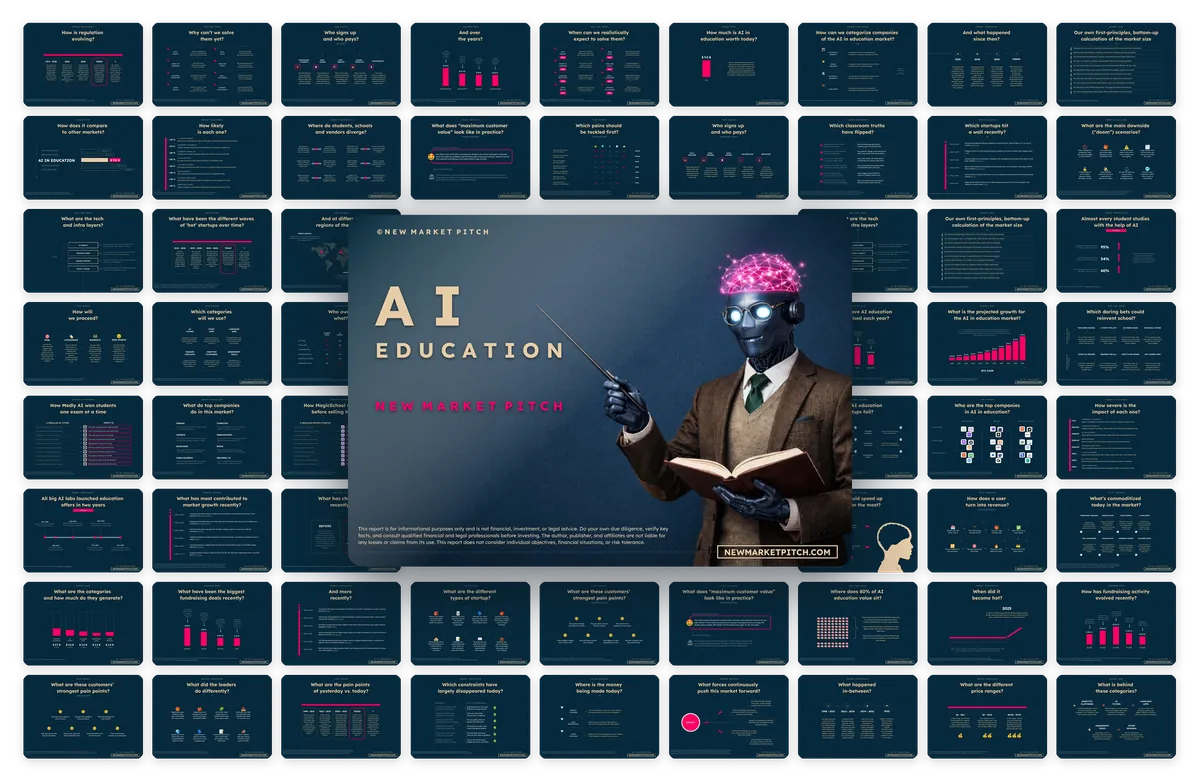
Building a startup or looking for your next investment in AI in education? Our report gives you the full picture.
Summary
Across 88 tracked deals, AI in education is a real and active venture market, but still an early one: roughly half a billion dollars has been raised, while the typical financing remains only about $4 million and no single round has crossed $50 million.
The market is broad rather than top-heavy. The largest financing is MagicSchool's $45 million Series B, so the $534.4 million total was built through dozens of small and mid-sized rounds rather than one giant transaction.
Deal count is much stronger than repeat financing. Most funded companies appear only once in the research window, while just 11 companies raised more than once, which makes the funded universe look smaller once we follow companies rather than announcements.
The center of gravity is still Seed. We found 60 Seed financings, compared with only 13 Series A rounds and four Series Bs, with no Series C or Series D+ financings at all.
That funding ladder is probably the clearest constraint in the market. Getting an AI education product funded for the first time is fairly common; getting it repeatedly funded at $10 million, $20 million or $30 million scale is much harder.
AI Tutor Platforms produce the most deals, but AI Learning Software attracts more capital. That split suggests startup formation is strongest around tutors, while larger checks more often go to broader platforms and products with heavier distribution or institutional requirements.
The biggest rounds tend to arrive after distribution is already visible. MagicSchool, Knowunity, Gizmo, Subject, SchoolAI and Nectir all reached larger financings once they had substantial user bases, school relationships, curriculum, infrastructure or institutional deployment to scale.
North America does not dominate by deal count as much as the capital totals suggest. Europe produced almost as many financings, but North American rounds were materially larger, with a median financing of $5.15 million versus $1.71 million in Europe.
Investor concentration is still low. Only three identified lead investors appear on more than one financing in the window, so the category has not yet settled into a small club of specialist firms repeatedly backing the same market.
Strategic investors are useful but not essential. They show up in only 13 of 87 financings, usually where distribution, content, infrastructure or institutional credibility creates an obvious commercial link.
The market therefore looks healthy at the entry point and much thinner later on. The next phase will depend less on whether new AI education startups can raise Seed rounds and more on how many can turn adoption into durable distribution, repeat financing and a real late-stage market. Turning adoption into durable distribution and repeat financing is one of the growth drivers we weigh in our report on AI in education.

Written by the New Market Pitch teamWe track new markets so founders and investors can move faster. About us

In our report covering the AI in education market, you will always find fresh funding data, taken straight from our own verified funding database.
Our funding tracker covering the AI in education market
Below is the table listing all the deals. You may find our methodology at the end of this page.
And, if you want to gain a deeper understanding of the market and its current dynamics, get our report covering the AI In Education Market.
| Company | Category | Date | Stage | Deal size | What they do | Region | Lead investors |
|---|---|---|---|---|---|---|---|
| Ed.ai | AI Grading Tools | September 2026 | Seed | ≈$5,800,000 | Provides an AI assistant that grades student work, diagnoses learning gaps and helps teachers generate targeted remediation. | Europe | Bpifrance (Digital Venture) |
| Fengluan Digital Technology | AI Learning Software | September 2026 | Seed | Not Disclosed | Builds K-12 AI learning software through Huanke and an AI companion-robot system for personalized home study. | Asia-Pacific | Hongruida Investment |
| Turing | AI Learning Software | September 2026 | Series B | ≈$5,000,000 | Builds AI learning products including GPAI, an AI study agent supporting university lectures, assignments, exams and projects. | Asia-Pacific | Not disclosed |
| AILA | AI Assessment Platforms | August 2026 | Unknown | $3M | Provides an AI-native learning and assessment platform that diagnoses proficiency gaps and generates personalized assessment and practice. | Middle East | Rua Growth Fund |
| Medly AI | AI Tutor Platforms | August 2026 | Seed | $7.5M | Provides an adaptive AI tutor for exam preparation, with personalized instruction, practice, marking, and feedback across school and university curricula. | Europe | Felix Capital |
| Premia | AI Learning Software | August 2026 | Seed | ≈$960,000 | Provides an AI-based learning platform that identifies learning gaps, predicts student performance, and recommends targeted interventions for K-12 and higher-education learners. | Latin America | Not disclosed |
| Wild Zebra | AI Tutor Platforms | August 2026 | Seed | $5M | Provides a Socratic AI tutor for grades 2–9 that personalizes math and reading instruction and tracks mastery over time. | North America | Trilogy Equity Partners |
| imagi | AI Learning Software | July 2026 | Seed | $4.5M | Provides K-12 schools with a guarded, curriculum-aligned platform for students and teachers to use AI tools and learn AI and coding skills. | North America | Brighteye Ventures; DayOne Capital |
| sortmyprep | AI Tutor Platforms | July 2026 | Seed | $350K | Provides a curriculum-aligned conversational AI tutor for personalized school exam preparation, doubt solving, study planning, and testing. | Asia-Pacific | Not disclosed |
| YoLearn.ai | AI Tutor Platforms | June 2026 | Seed | $500K | Provides a voice-first AI tutor with a live interactive sketchpad for K-12, board-exam and competitive-exam learning. | Asia-Pacific | DataAlpha.ai; White Swan Global |
| Lytmus AI | AI Tutor Platforms | June 2026 | Seed | ≈$530,000 | Builds AI mentors for competitive-exam students, initially NEET, providing personalized guidance and real-time doubt resolution. | Asia-Pacific | Boundless Ventures |
| Makon AI | AI Practice Tools | June 2026 | Seed | $300K | Runs an AI-personalized SAT, ACT and AP prep platform with adaptive study plans, practice banks, mock exams and a 24/7 AI tutor. | North America | Not disclosed |
| ProLearn | AI Tutor Platforms | June 2026 | Seed | ≈$3,140,000 | Builds a conversational AI tutor delivering personalized K-12 and competitive-exam instruction and practice. | Asia-Pacific | BEENEXT |
| Mathew (Adaptical S.L.) | Educator Copilots | May 2026 | Seed | ≈$1,396,000 | AI education platform that helps educators create curriculum-aligned materials, automatically evaluate student work and track personalized learning progress. | Europe | Not disclosed |
| ChalkTalk (Chalk Talk Solutions, Inc.) | AI Learning Software | May 2026 | Unknown | $636.93K | AI-powered adaptive K-12 instructional platform that generates teacher materials and personalized student practice from curriculum, schedules and learner data. | North America | Not disclosed |
| Third Space Learning | AI Tutor Platforms | April 2026 | Growth Equity | ≈$5,932,000 | Provides curriculum-aligned one-to-one maths tutoring to primary and secondary students through its spoken AI tutor Skye. | Europe | Maven Capital Partners |
| Dr Connor Ltd | AI Tutor Platforms | April 2026 | Seed | ≈$338,000 | Provides a critical-thinking AI tutor for UK school students that guides homework reasoning rather than simply giving answers. | Europe | Not disclosed |
| Gizmo | AI Practice Tools | April 2026 | Series A | $22M | Turns students' notes, documents and web content into AI-generated personalized flashcards, adaptive quizzes and gamified study activities. | Europe | Shine Capital |
| Coursemojo Inc. | AI Tutor Platforms | April 2026 | Unknown | $10.34M | Provides a curriculum-aligned AI assistant teacher delivering differentiated, Socratic support to K–12 students and real-time instructional data to teachers. | North America | Not disclosed |
| Chalkie | Educator Copilots | March 2026 | Seed | $4M | Uses AI to generate curriculum-aligned lesson plans, presentations, worksheets and differentiated classroom activities for teachers. | Europe | TriplePoint Ventures |
| Nectir | AI Learning Software | March 2026 | Series A | $12.5M | Provides institution-managed AI assistants integrated with learning systems to deliver personalized academic support to students and assist educators. | North America | Rethink Impact |
| Plato Academic | AI Tutor Platforms | March 2026 | Seed | $347K | Provides an embedded, course-aligned AI study assistant that gives university students contextual academic support inside institutional learning environments. | Europe | SFC Capital |
| Pensive | AI Grading Tools | February 2026 | Seed | $6.8M | Provides AI-assisted grading, rubric-based feedback, and course-aligned tutoring tools for higher-education instructors and students. | North America | Mayfield |
| Subject | AI Learning Software | February 2026 | Growth Equity | $28M | Provides an AI-native K-12 digital curriculum and learning platform with accredited courses, personalized instruction, and AI tools supporting educators. | North America | Vistara Growth |
| EDIAND Inc. | AI Learning Software | February 2026 | Seed | $325K | Develops AI-powered medical and dental education software for university learning and assessment, including question generation, personalized study, and learning analytics. | Asia-Pacific | Not disclosed |
| Vimi | AI Tutor Platforms | January 2026 | Seed | $12M | AI math tutor delivering adaptive, curriculum-aligned one-to-one learning and practice for K–12 students. | Middle East | Viola Ventures; BRM Group |
| Sparkli | AI Learning Software | January 2026 | Seed | $5M | Multimodal AI-native learning platform that creates personalized interactive learning expeditions for children aged 5–12. | Europe | Founderful |
| Flashka | AI Practice Tools | January 2026 | Seed | $1.17M | AI-driven study platform that turns university course materials into flashcards, quizzes, practice tests and personalized study flows. | Europe | Outlast Fund |
| Savvy Learn, Inc. (Savvy) | AI Practice Tools | December 2025 | Unknown | $4M | Turns uploaded study materials into personalized AI-generated quizzes and flashcards, with an initial focus on college and graduate students. | North America | Not disclosed |
| BoodleBox | AI Learning Software | December 2025 | Seed | $5M | Provides higher-education institutions a collaborative multi-model AI workspace for student learning, teaching, and assessment. | North America | Dogwood Ventures; Osage Venture Partners |
| Teacher's Buddy | Educator Copilots | November 2025 | Seed | ≈$1,200,000 | AI workspace for teachers that creates curriculum-aligned lessons and resources and assists with marking, reporting, assessment, and instructional planning. | Asia-Pacific | Giant Leap |
| CampusKnot | Educator Copilots | November 2025 | Unknown | $1.1M | Higher-education AI teaching assistant that generates course content and activities, automates grading and feedback, tracks engagement, and summarizes discussions. | North America | Not disclosed |
| Flint | AI Learning Software | November 2025 | Series A | $15M | AI-native K-12 learning platform for personalized activities, adaptive assessments, tutoring, and real-time feedback. | North America | Basis Set Ventures; Patron |
| VideoTutor | AI Tutor Platforms | October 2025 | Seed | $11M | AI tutoring platform that turns student questions into personalized animated, voice-guided instructional lessons. | North America | YZi Labs |
| SpeakX | AI Practice Tools | October 2025 | Unknown | $16M | Generative-AI spoken-English learning platform providing conversational practice and individualized speech feedback. | Asia-Pacific | WestBridge Capital |
| Chalkie | Educator Copilots | October 2025 | Seed | $1.35M | AI copilot that generates curriculum-aligned lesson plans, presentations, worksheets and classroom activities for teachers. | Europe | Triple Point Ventures |
| The Invigilator | AI Assessment Platforms | September 2025 | Unknown | $11M | Provides AI-powered remote assessment and invigilation, including live AI monitoring and detection of AI-assisted student work for educational institutions. | Africa | Kaltroco |
| Yourway Learning | Educator Copilots | August 2025 | Series A | $9M | Purpose-built K-12 AI platform for lesson planning, differentiation, grading, communications, and adaptive instructional support. | North America | Greybull Stewardship |
| evulpo | AI Learning Software | August 2025 | Series A | ≈$10,900,000 | AI-powered curriculum learning platform providing adaptive lessons, exercises, personalized learning paths, and teacher analytics. | Europe | Serpentine Ventures |
| Hanji Inc. | AI Tutor Platforms | August 2025 | Seed | ≈$2,040,000 | Generative-AI tutor Knock gives Japanese middle- and high-school students personalized hints, explanations, and study support. | Asia-Pacific | Not disclosed |
| paddy | Educator Copilots | August 2025 | Seed | ≈$1,160,000 | AI teacher copilot for lesson planning, material creation, classroom delivery, and class-progress analysis. | Europe | High-Tech Gründerfonds (HTGF) |
| Wild Zebra | AI Tutor Platforms | August 2025 | Seed | $2M | Socratic AI tutor that personalizes math and reading instruction for school-age students. | North America | Not disclosed |
| Arivihan | AI Tutor Platforms | July 2025 | Seed | $4.5M | Runs a fully automated AI tutor that personalizes lessons, doubt-solving and study plans for Indian school and exam-prep students. | Asia-Pacific | Accel; Prosus Ventures |
| Wilgo | AI Tutor Platforms | June 2025 | Seed | $7M | Provides middle- and high-school students with an AI-first personalized tutor for homework, revision and curriculum learning. | Europe | Founders Future; daphni |
| Knowunity | AI Tutor Platforms | June 2025 | Series B | $31.17M | Provides school students with a personalized AI study companion combining curriculum-aligned content, tutoring, explanations, practice and revision tools. | Europe | XAnge |
| StudyFetch | AI Learning Software | June 2025 | Series A | $11.5M | Converts students' course materials into AI-supported study notes, flashcards, quizzes, practice activities and personalized tutoring. | North America | Owl Ventures |
| PyxiScience | AI Learning Software | May 2025 | Seed | ≈$2,250,000 | AI-powered adaptive mathematics platform that grades handwritten work, generates tailored exercises and personalizes practice for secondary and higher-education learners. | Europe | Newfund |
| Everybody Counts | AI Learning Software | May 2025 | Seed | ≈$665,000 | AI-powered full-curriculum maths learning platform for primary pupils combining adaptive learning, multilingual content, analytics and teacher support. | Europe | Fuel Ventures |
| StudyFetch | AI Learning Software | May 2025 | Unknown | $10M | AI-native learning platform that converts course materials into personalized tutoring, notes, flashcards, quizzes, practice tests and other study workflows. | North America | Not disclosed |
| Alice | AI Learning Software | May 2025 | Seed | $4.8M | AI-native study platform that turns course materials into personalized study plans, explanations, quizzes, flashcards and exam preparation. | Europe | Cherry Ventures |
| Stimuler | AI Tutor Platforms | April 2025 | Seed | $3.75M | Voice-first AI tutor for ESL learners providing speaking practice and real-time feedback on pronunciation, fluency, grammar and vocabulary. | Asia-Pacific | Lightspeed |
| Ed.ai | AI Grading Tools | April 2025 | Seed | ≈$1,860,000 | AI grading assistant that corrects student work, identifies learning gaps and generates personalized remediation activities for teachers. | Europe | AFI Ventures |
| SigIQ.ai | AI Tutor Platforms | April 2025 | Seed | $9.5M | Builds personalized AI tutors for high-stakes exam preparation, including UPSC and GRE learning products. | North America | The House Fund; GSV Ventures |
| SchoolAI | AI Learning Software | April 2025 | Series A | $25M | AI-native classroom platform combining teacher assistants, personalized student tutors, adaptive lessons, games and learning insights for K-12 education. | North America | Insight Partners |
| Brisk Teaching | Educator Copilots | March 2025 | Series A | $15M | Provides an AI teaching agent for K-12 educators that creates instructional materials, gives feedback, assesses student work and supports personalized learning. | North America | Bessemer Venture Partners |
| Study Hall Ltd (StudyHall.AI) | AI Tutor Platforms | March 2025 | Seed | ≈$648,000 | Provides personalized AI learning agents and reading coaches for children's reading, writing, research and exam preparation. | Europe | Not disclosed |
| Medly AI | AI Tutor Platforms | February 2025 | Seed | ≈$697,000 | Provides a curriculum-aligned AI tutor for GCSE, A-level and IB students with adaptive practice, real-time marking and personalized feedback. | Europe | Eka Ventures |
| MagicSchool AI | Educator Copilots | February 2025 | Series B | $45M | Provides a K-12 AI copilot for educators plus guided student AI tools for lesson planning, differentiation, feedback, tutoring and learning. | North America | Valor Equity Partners |
| Letterly, Inc. | AI Practice Tools | February 2025 | Seed | $2.5M | Provides a human-in-the-loop AI writing practice platform for K-12 students with personalized, standards-aligned feedback and coaching. | North America | Epipelagic Ventures |
| Nectir | AI Tutor Platforms | December 2024 | Seed | $4M | Provides customizable AI learning assistants trained on course materials and embedded in school learning systems to give students personalized academic support. | North America | Long Journey Ventures |
| Teachy | Educator Copilots | November 2024 | Series A | $7M | Provides an AI workspace for K-12 teachers to create curriculum-aligned lessons, exercises, assessments, and automated grading and feedback. | Latin America | Goodwater Capital; Reach Capital |
| Buddy.ai | AI Tutor Platforms | October 2024 | Seed | $11M | Conversational AI tutor using proprietary speech and AI technology to teach children through personalized, game-based lessons. | North America | BITKRAFT Ventures; Educapital |
| Medly AI | AI Tutor Platforms | October 2024 | Seed | ≈$1,568,000 | AI tutor for GCSE and A-Level students offering curriculum-aligned adaptive learning, exam practice and instant question support. | Europe | Eka Ventures |
| AILA | AI Learning Software | October 2024 | Seed | $1.15M | Generative-AI learning platform delivering personalized, curriculum-aligned daily learning pathways for students. | Middle East | Saba Fund |
| Voovo | AI Practice Tools | October 2024 | Seed | $500K | AI-powered flashcard and microlearning app that turns study materials into personalized active-recall and spaced-repetition practice. | Europe | Techstars |
| Brisk Teaching | Educator Copilots | September 2024 | Seed | $5M | AI teaching assistant that helps K-12 educators create instructional materials, differentiate content, provide feedback, and build student learning activities within existing web tools. | North America | Owl Ventures |
| Prof Jim Inc. | Educator Copilots | September 2024 | Seed | $1.5M | Generative-AI education platform that turns educational text and lessons into interactive multimedia, quizzes, and other digital learning experiences. | North America | Don Douglas |
| Stimy AI | AI Tutor Platforms | September 2024 | Seed | $425K | AI math tutor that analyzes students' written mathematics step by step and provides personalized explanations, guidance, and practice. | North America | AIP Seed |
| Stylus | AI Grading Tools | September 2024 | Seed | ≈$658,000 | AI-marked, human-moderated service that processes paper assessments and generates marking, personalized feedback, and learning insights for schools. | Europe | Sure Valley Ventures |
| Alfa Space | AI Tutor Platforms | September 2024 | Seed | ≈$348,000 | AI-powered digital math tutor for grades 5–12 that personalizes learning, answers questions, diagnoses knowledge gaps, and recommends practice. | Europe | Not disclosed |
| Heeyo | AI Tutor Platforms | August 2024 | Seed | $3.5M | Provides adaptive AI companions and personalized learning games for children, including tutoring, reading, science, trivia and interactive lessons. | North America | Not disclosed |
| MagicSchool AI | Educator Copilots | June 2024 | Series A | $15M | Provides a generative-AI copilot for K-12 teachers to create lessons, quizzes, rubrics and differentiated materials, alongside supervised AI tools for students. | North America | Bain Capital Ventures |
| Conan AI (柯南(广东横琴)智能科技有限公司) | AI Learning Software | June 2024 | Seed | ≈$1,380,000 | Develops AI-powered children's learning devices and software combining a proprietary multimodal model, educational AI tools and AI courses. | Asia-Pacific | Not disclosed |
| Taskbase AG | AI Learning Software | June 2024 | Series A | $3.9M | Provides AI-powered adaptive-learning technology that gives students personalized formative feedback and helps education providers create exercises. | Europe | Mediahuis Ventures; Acrobator |
| Zhejiang Jingzhunxue Technology Co., Ltd. (浙江精准学科技有限公司) | AI Learning Software | May 2024 | Series B | ≈$27,600,000 | Builds AI-driven K-12 learning systems and devices that diagnose knowledge gaps and personalize practice and tutoring. | Asia-Pacific | Alibaba Group |
| Solvely.ai | AI Tutor Platforms | May 2024 | Seed | $5M | Provides an AI tutor that solves STEM problems from images and gives students step-by-step, tutor-style explanations. | North America | Not disclosed |
| Teachino FlexCo | Educator Copilots | May 2024 | Seed | Not Disclosed | Provides an AI teaching workspace that helps teachers plan lessons, create and differentiate materials, and personalize instruction. | Europe | Klett Group |
| Edia | AI Learning Software | April 2024 | Series A | $9.4M | Provides an AI-powered K-12 math platform that gives students personalized feedback and teachers real-time learning data for targeted instruction. | North America | Felicis |
| Lirvana Labs | AI Tutor Platforms | April 2024 | Seed | $5.3M | Develops Yeti Confetti Kids, an LLM-powered personalized learning companion delivering adaptive English, math, social-emotional and critical-thinking instruction to young children. | North America | Kapor Capital III; Transcend Capital Partners II; Chingona Ventures |
| Arivihan | AI Tutor Platforms | March 2024 | Seed | $500K | Provides a fully automated AI tutor for K-12 and exam-preparation students with adaptive lectures, study plans, and doubt solving. | Asia-Pacific | Accel Atoms |
| EdLight, PBC | AI Assessment Platforms | March 2024 | Seed | $4M | Uses AI to analyze handwritten student math work, identify misconceptions and mastery, and recommend instructional next steps to teachers. | North America | Not disclosed |
| Alice | AI Tutor Platforms | March 2024 | Seed | $1.09M | Provides an AI tutor that turns students' course materials into personalized study support and learning activities. | Europe | Not disclosed |
| Smartschool | AI Tutor Platforms | March 2024 | Seed | $1.5M | Provides an AI-guided K-12 tutoring system that diagnoses learning gaps and delivers personalized instruction and feedback. | North America | Inovo VC; The Explorer Fund |
| Yondemy Inc. | AI Learning Software | March 2024 | Seed | $880K | Operates an AI-powered reading education platform that personalizes children's book recommendations and learning activities. | Asia-Pacific | XTech Ventures |
| Graide | AI Grading Tools | February 2024 | Seed | ≈$2,090,000 | Provides an AI-powered grading and feedback platform that helps educators assess student assignments and generate tailored feedback. | Europe | XTX Ventures |
| ConveGenius | AI Learning Software | February 2024 | Series A | ≈$1,800,000 | Provides AI-powered personalized and adaptive K-12 learning, conversational learning, and assessment tools for schools and public education systems. | Asia-Pacific | Searce Inc. |
| ConveGenius | AI Learning Software | January 2024 | Growth Equity | $7M | Provides K-12 schools and public education systems with conversational AI, personalized adaptive learning, and AI-supported assessment software. | Asia-Pacific | UBS Optimus Foundation; Mount Judi Ventures |
| Echo Labs | AI Learning Software | January 2024 | Seed | $7.4M | Provides higher-education institutions with AI-powered transcription and audio-description software integrated into learning and video management systems. | North America | Not disclosed |

In our research about AI tools for education, we turn what is vague and complex into simple, useful visuals. Market maps like this one show you at a glance where every startup stands.
Is AI in education funding actually big right now?
AI in education funding is real and active today, but $534.4 million across 87 financings still puts this market in the early stages of becoming a major venture category.
We found 75 companies raising money from the start of 2024 through the end of our research window. The median financing was $4 million and the average quantified round was $6.29 million. The biggest deal was MagicSchool's $45 million Series B, and no individual financing crossed $50 million.
That last point changes how we should read the headline total. Some AI markets reach billions of dollars largely because one or two companies raise several hundred million dollars at once. AI education has built its $534.4 million with a much broader collection of small and mid-sized rounds.
Activity is still coming through at the end of the window. Ed.ai, for example, followed its earlier €1.7 million financing with a fresh €5 million equity Seed round and said the money would support expansion in Europe and the United States. Recent activity still looks alive; what we have yet to see is funding at the scale reached by mature software or frontier-AI companies.
| Indicator | Result |
|---|---|
| Distinct financings | 87 |
| Funded companies | 75 |
| Quantified capital | ≥$534.4M |
| Median financing | $4.0M |
| Average quantified financing | $6.29M |
| Largest financing | $45.0M |
| Financings above $50M | 0 |
| Companies raising more than once in the window | 11 |
How many AI education startups are actually getting funded?
The AI education funding market currently comes down to 75 companies, and most of them only appear once during our research window.
We counted 64 companies with a single financing, ten with two and only one with three or more. In other words, 85.3% of the companies we tracked never show up for a second financing between the beginning of 2024 and the end of the period.
That gives the market a different shape from the constant flow of AI education launches might suggest. Plenty of startups can get into the funded population, but only a small group has so far demonstrated repeated access to capital.
The money follows the same pattern. Companies appearing once still account for $384.3 million because that group includes later-stage businesses whose earlier rounds happened before our window. The 11 companies that raised more than once during the period collected another $150.1 million.
So 87 deals sounds fairly broad at first. Once we follow the companies themselves, the investable market looks more compact.
Is AI education funding concentrated in a few winners?
A clear top tier has already formed in AI education funding: ten companies hold 48.9% of the capital we identified, while MagicSchool alone accounts for 11.2%.
MagicSchool raised $60 million across two rounds in our window. Knowunity follows at roughly $31.2 million, then Subject at $28 million, Zhejiang Jingzhunxue at around $27.6 million and SchoolAI at $25 million.
The concentration is meaningful without becoming extreme. The top five companies hold 32.1% of capital, which still leaves roughly two-thirds spread across the rest of the market. Removing MagicSchool would leave close to $475 million of quantified funding. Where a few leaders pull ahead of a long tail is what the market maps in our market report about AI in education lay out.
Where MagicSchool changes the picture much more is inside its own category. Its two rounds represent about 41.8% of all Educator Copilot capital. Gizmo has a similar effect on AI Practice Tools, where its $22 million Series A makes up around 47% of the category's funding.
The broader market therefore has several real scale-up candidates rather than one company surrounded by tiny startups. At category level, though, individual winners can dramatically change how well-funded a segment appears.

In our market report about AI tools for education, we always try to gather several sources and make estimates that make sense, so you can work with solid numbers.
What does a normal AI education startup raise today?
A normal AI education financing today is about $4 million, and more than half of all deals stay below $5 million.
We found 49 financings under $5 million, equal to 56.3% of the market. Another 30 landed between $5 million and $20 million. Only six reached the $20 million to $50 million range.
The interesting part is where the dollars sit. Those 49 small rounds collectively contribute only $86.8 million, or 16.2% of known capital. The 30 rounds between $5 million and $20 million contribute $268.9 million, just over half the entire market.
For founders, the gap between a normal round and a genuinely large AI education round is substantial. Raising $2 million to $5 million is common. Getting beyond $10 million puts a company into a far smaller group. A $20 million-plus financing already belongs near the top of this market.
Which parts of AI education are getting the biggest checks?
AI Learning Software is getting the most money today, while AI Tutor Platforms are producing the most financings.
Tutors account for 32 deals, more than any other category, but they attract $152.5 million. AI Learning Software has 26 deals and receives $192.5 million, making it the largest destination for capital.
Educator Copilots form another serious pocket of funding. We counted 14 deals worth $107.7 million. That is one-sixth of all financings but roughly one-fifth of the money.
At the smaller end, AI Grading Tools generated five financings worth $17.2 million. AI Assessment Platforms reached $18 million across only three deals, and one company, The Invigilator, represents most of that amount.
This is why simply counting startups gives an incomplete picture. Tutors are where we find the most funded companies. Broader learning platforms and teacher-facing software are where the larger checks show up more often.
| Category | Deals | Companies | Capital | Median financing |
|---|---|---|---|---|
| AI Learning Software | 26 | 25 | $192.5M | $5.0M |
| AI Tutor Platforms | 32 | 28 | $152.5M | $3.32M |
| Educator Copilots | 14 | 11 | $107.7M | $4.0M |
| AI Practice Tools | 7 | 7 | $46.5M | $2.5M |
| AI Assessment Platforms | 3 | 3 | $18.0M | $4.0M |
| AI Grading Tools | 5 | 4 | $17.2M | $2.09M |
| Total | 87 | 75 | ≥$534.4M | $4.0M |
Why do AI learning platforms and teacher copilots get bigger checks?
The biggest checks in AI education tend to arrive once a product has become expensive to distribute, support and operate inside schools.
MagicSchool makes the pattern easy to see. When the company announced its $45 million Series B, it said millions of people were using the platform monthly and that it was working with more than 10,000 schools. The new money was going into product and engineering, partnerships, customer experience and safety.
Subject gives us another version of the same story. Vistara Growth's announcement for its $28 million investment describes accredited K-12 curriculum, AI-powered teaching products and expansion across school districts. The company said it would use the capital to expand courses, deepen automation and scale go-to-market.
Knowunity reached roughly $31.2 million with a different model. XAnge said the platform had 20 million users across more than 15 countries and around 380,000 student creators when it raised. At that point, the company was funding an international consumer platform rather than an early product experiment.
Nectir's $12.5 million Series A also fits the institutional side of the picture: the company described its product as purpose-built AI infrastructure for higher education.
Across these cases, the larger financing needs come from distribution, curriculum, integrations, safety, customer support and international expansion. The AI model itself is only one part of what investors are paying to scale.

Our document detailing everything you need to know about AI in education gets updated several times a month, so you always get the latest view of where things stand.
How young are AI education startups when they raise money?
AI education startups are getting funded very early: the median company is only two years old at the time of financing.
Among the 74 companies where we could establish a usable founding year, 41 were founded in 2023 or later. That is 55.4% of the documented cohort. Almost one-third were founded in 2024 or later.
The age also changes by product. AI Tutor Platforms, Educator Copilots and AI Grading Tools all have a median company age of two years when they raise. AI Practice Tools come in at three years and AI Learning Software at four.
There are some very fast examples. MagicSchool was founded in 2023 and reached a $15 million Series A the following year. Sparkli, founded in 2025, raised $5 million soon after launch. Wilgo also raised around $7 million in its first year.
A different group comes from older education businesses adding or pivoting toward AI. ConveGenius, Third Space Learning and SpeakX fall closer to that model. Those companies bring years of operating history into the current AI cycle, which helps explain why age alone does not perfectly track stage.
Still, the center of gravity is clearly young. Investors are often making their first meaningful bet on an AI education company before it has accumulated much operating history. Backing companies with so little history carries risks, and we rate the less obvious ones in our report covering the AI in education market.
Where does AI education funding start to break down?
AI education funding narrows sharply after Seed: we found 60 Seed financings, 13 Series A rounds and only four Series B rounds.
The check size jumps at the same time. A Seed financing has a median size of $1.93 million. Series A moves to $11.5 million, and Series B reaches $29.39 million.
For every Series A in the market, there are roughly 4.6 Seed financings. The ratio from Series A to Series B is another 3.25 to one.
That tells us where the difficult part begins. Starting an AI tutor, teaching assistant or learning product and raising an initial round has become relatively common. Turning one of those products into a company investors will back with $10 million, $20 million or $30 million is much rarer.
The latest rounds show that companies can make the jump. Flint raised $15 million at Series A, Gizmo raised $22 million and Subject reached $28 million in growth capital. There are simply far fewer companies operating at that level than the Seed activity might lead someone to expect.
| Stage | Deals | Share of all deals | Capital | Median financing |
|---|---|---|---|---|
| Seed | 60 | 69.0% | $180.7M | $1.93M |
| Series A | 13 | 14.9% | $158.0M | $11.5M |
| Series B | 4 | 4.6% | $108.8M | $29.39M |
| Series C | 0 | 0% | $0 | - |
| Series D+ | 0 | 0% | $0 | - |
| Growth Equity | 3 | 3.4% | $40.9M | $7.0M |
| Unknown | 7 | 8.0% | $46.1M | ≈$4.0M |

In our report covering the AI in education market, we look at what the winners do differently, so you can learn from the best instead of guessing.
Why is there almost no Series C money in AI education?
Series C money is basically absent from AI education today: after only four Series B financings, our entire window contains no Series C or Series D+ rounds.
The age of the cohort explains part of it. More than half of the companies with known founding dates started in 2023 or later. Many simply have not had enough time to go from Seed through A, B and C.
Age does not explain the whole gap, though. The ladder is already thinning long before Series C. As seen above, only 13 Series A financings emerge from 60 Seed deals, and just four Series Bs appear after that.
That points to a commercial test as much as a chronological one. A young AI education product can attract early capital on product quality, founder credibility and early adoption. The next rounds require something harder: sustained usage, distribution, school or district adoption, convincing economics and enough growth to support much larger checks.
For now, AI education has a large early-stage funnel and only the beginnings of a late-stage class. We still do not really know how many of today's Seed and Series A companies will grow into businesses large enough to build a proper Series C market.
Are investors still funding new AI education startups, or mostly doubling down on existing ones?
Investors are still backing new AI education startups, but the larger checks overwhelmingly go to companies that have raised before.
We classified 36 financings as first financings, equal to 41.4% of all deals. Their median size was just $1.27 million, and together they contributed about $95 million.
Follow-on financings look very different. We counted 50 of them, with a median of $5.55 million and roughly $436 million of capital. More than four-fifths of the quantified money in the market therefore sits in follow-ons.
There is plenty of fresh company creation underneath that. Vimi entered with a $12 million first financing, SigIQ.ai with $9.5 million, Wilgo with roughly $7 million and Sparkli with $5 million. Smaller first checks appear constantly throughout the dataset as well.
The pattern becomes much more selective once companies return for more money. Brisk Teaching moved from a $5 million Seed financing in our window to a $15 million Series A. Ed.ai went from around $1.9 million to roughly $5.8 million. Wild Zebra returned with $5 million of fresh cash after its earlier financing.
So new entrants are still getting a shot. Investors reserve most of the serious capital for companies that have already passed an earlier funding test. Companies that fail the next funding test are worth studying, and we ask what stalled startups share in our report on AI in education.
Does AI education funding come steadily, or in bursts?
AI education deal flow is fairly steady, while the dollars still jump around whenever a large round lands.
Across completed months in our research period, the average was 2.63 deals and the median was three. The busiest month had five. We are dealing with a low-volume market, but one where financing announcements arrive relatively regularly.
Monthly capital is much less smooth. The median complete month produced about $14.3 million. One of the biggest months reached roughly $49.7 million because Knowunity, StudyFetch and Wilgo all raised meaningful rounds around the same period.
Another month reached roughly $48.2 million almost entirely because MagicSchool raised $45 million.
Deal count and capital tell different stories. Three small financings can make a month look active without adding much money, while one major Series B can make an otherwise quiet month look enormous.
For anyone following this market through headlines, that distinction is useful. A sudden jump in dollars can be one company. A genuine widening of the market would show up in the number of companies getting funded as well.

In our research about AI tools for education, we don't want to repeat what boring consulting reports say. Instead, we show you the real and latest market signals that matter.
Does North America really dominate AI education funding?
North America currently dominates the money side of AI education, even though Europe is almost as active by deal count.
North America produced 34 financings versus 29 in Europe. That is a modest difference in activity. Capital is much further apart: North America captured $296.7 million, compared with $126.1 million in Europe.
The median financing makes the gap even clearer. North America's median is $5.15 million, while Europe sits at $1.71 million and Asia-Pacific at $1.80 million.
European companies can still reach serious scale. Knowunity raised roughly $31.2 million, Gizmo $22 million and Nectir $12.5 million. The issue is frequency: Europe generates plenty of funded AI education startups but fewer large checks across the cohort.
Asia-Pacific shows a similar pattern. It produced 18 deals, including Alibaba-backed Zhejiang Jingzhunxue, yet captured only 14.3% of total capital.
So the geographic imbalance currently sits more in financing size than startup creation.
| Region | Deals | Companies | Capital | Median financing |
|---|---|---|---|---|
| North America | 34 | 30 | $296.7M | $5.15M |
| Europe | 29 | 24 | $126.1M | $1.71M |
| Asia-Pacific | 18 | 16 | $76.5M | $1.80M |
| Middle East | 3 | 2 | $16.2M | $3.0M |
| Latin America | 2 | 2 | $8.0M | $3.98M |
| Africa | 1 | 1 | $11.0M | $11.0M |
| Total | 87 | 75 | ≥$534.4M | $4.0M |
Which investors keep coming back to AI education?
Very few lead investors keep coming back to AI education: only three appear on more than one financing in our window.
We could identify a lead on 66 of the 87 deals, and those financings involve 78 different disclosed leads because several were co-led. Owl Ventures, Triple Point Ventures and Eka Ventures are the only names that lead more than one deal.
Even those repeat appearances are limited. Owl Ventures shows up on Brisk Teaching and StudyFetch. Triple Point Ventures backed two Chalkie financings. Eka Ventures appears across two Medly AI tranches.
Together, recurring leads cover only six of the 66 deals where we know the lead investor.
Compare that with the larger financings. Valor Equity Partners led MagicSchool's $45 million Series B. XAnge led Knowunity. Insight Partners led SchoolAI. Shine Capital led Gizmo. Vistara Growth led Subject. Bessemer led Brisk Teaching's Series A.
There is no obvious small club controlling access to AI education capital right now. Investors are coming into the category from many different directions, and most only appear once. With no small club of specialist funds yet, we follow what investors back and avoid in our AI in education market report.
Do strategic investors actually matter in AI education?
Strategic investors matter around specific distribution and infrastructure deals, but they appear in only 14.9% of AI education financings.
We found 13 deals with at least one strategic investor. Their median financing was $5.4 million, compared with $3.9 million for deals without a strategic.
More revealing is who those investors are. College Board participated in StudyFetch. Alibaba backed Zhejiang Jingzhunxue. Klett invested in Teachino. Educational Records Bureau backed Wild Zebra. Searce participated in ConveGenius. La Poste Ventures joined Ed.ai.
Adobe Ventures is the clearest repeat strategic investor, taking part in both MagicSchool financings in our window.
These deals tend to have an understandable commercial connection. Assessment groups can help an assessment or learning company. Education publishers bring content and distribution. Infrastructure businesses can support deployment. Large technology groups bring AI ecosystems and market reach.
Still, 74 of the 87 deals happened without a strategic investor. AI education venture funding works perfectly well without corporate capital, even if the right corporate partner can become useful once a startup needs distribution, integration or industry credibility.

Learning from others' mistakes is the cheapest lesson there is. In our market report about AI tools for education, we look at what broke startups before you, so you don't repeat it.
What do the biggest AI education rounds have in common?
The biggest AI education rounds are going to companies that already have meaningful distribution and now need money for school deployment, curriculum, support, safety or international growth.
MagicSchool had millions of monthly users and partnerships with more than 10,000 schools when it announced its $45 million round. Knowunity had 20 million users in more than 15 countries when it raised €27 million. Gizmo said it served more than 13 million learners across more than 120 countries when it announced its $22 million Series A.
Institutional businesses show the same pattern through a different route. Subject's $28 million financing supports accredited curriculum and district expansion. SchoolAI's $25 million Series A went into a platform built around teachers, students and school systems. Nectir raised $12.5 million to scale AI infrastructure for higher education.
Once a company reaches that point, the expensive part is no longer just building the product. It has to win distribution, support users, integrate into institutions, satisfy schools on safety and reliability, and keep improving the software while the organization grows.
That is currently the clearest dividing line between an ordinary AI education funding round and one of the market's biggest checks.
What should we actually take away from the funding data?
AI education is currently a genuine venture market, but it is still young. We found 75 funded companies and more than half a billion dollars of quantified capital, with very little evidence yet of the late-stage financing layer we would expect from a mature category.
The typical company is operating with much less money than the biggest announcements suggest. Small rounds dominate deal count, while $5 million to $20 million financings supply most of the actual capital.
There is also a clear difference between where startups are being created and where large checks go. AI Tutors generate the most deals, while broader learning software and educator-focused platforms attract more capital relative to their numbers.
The funding ladder is probably the most important thing to watch now. Seed capital is plentiful compared with Series A, Series B is already rare, and Series C has yet to appear in our cohort. The next few years will show how much of today's early-stage activity can survive that progression.
Geography matters mostly once companies begin raising larger rounds. Europe produces almost as many financings as North America, yet North American companies raise much larger checks across the market.
Investor concentration remains surprisingly low. The companies are beginning to separate into winners, but the funds backing them are still highly fragmented. There is no dominant group of AI education venture firms repeatedly underwriting the category.
Finally, the largest rounds tell us what investors are willing to pay for these days. Serious money tends to arrive when an AI education company has already built distribution and needs to operate at scale. The companies that can turn product adoption into durable school, consumer or institutional distribution are the ones most likely to define the next stage of this market.
Our methodology
Our objective was to build a quantitative and realistic picture of AI in education fundraising between January 1, 2024 and September 21, 2026, rather than reproduce the output of a single funding database.
We researched company and investor announcements, regulatory filings, official records, reputable financial and industry reporting, and established funding databases. Whenever several credible sources were available, we cross-checked the material facts before recording a financing.
We included qualifying private-company equity financings announced during the period with an identifiable equity value of at least $300,000. Debt, grants, loans, public offerings, unconverted convertibles and SAFEs were excluded unless a separately identifiable qualifying equity component could be established. When a financing mixed fresh equity with converted SAFEs, cancelled debt or another non-cash component, we used the identifiable fresh equity amount where the public evidence allowed us to do so.
AI in education also had to be central to the company's business at the time of financing rather than a minor feature attached to a broader company. Borderline businesses were left out instead of being stretched into the dataset.
Each genuine financing event was counted separately. Duplicate reporting of the same round was consolidated, while extensions, additional closes and separately announced tranches were reviewed individually. StudyFetch is one example: its May 2025 Form D showed $10 million already sold from an offering, while the company later announced an $11.5 million Series A. We treated those disclosures as the same financing progressing toward its final announced amount rather than adding them together.
Stages, lead investors, strategic investors, company age, previous-financing status and other deal characteristics were recorded only when public evidence supported them. We did not infer a Series A or Series B from check size, assume that the most prominent investor in a syndicate was the lead, or assign a precise dollar value to a vaguely disclosed round.
Foreign-currency rounds were converted into US dollars for comparison, which introduces some exchange-rate sensitivity. For consistency, the analysis primarily follows public announcement or disclosure dates, so monthly activity should be read as the rhythm of observable funding news rather than a perfect legal-closing calendar.
After building the dataset, we ran a separate quality-control pass focused on missed financings, duplicate rounds, the start and end dates of the research window, minimum-size eligibility, equity versus non-equity funding, market eligibility and unusual transaction structures.
Key sources include MagicSchool's $45 million Series B announcement, MagicSchool's $15 million Series A announcement, Vistara Growth on Subject's $28 million investment, XAnge on Knowunity's €27 million Series B, SchoolAI's $25 million Series A announcement, Gizmo's $22 million Series A announcement, Flint's Series A announcement, Nectir's $12.5 million Series A announcement, StudyFetch's $11.5 million Series A announcement, StudyFetch's SEC Form D, Ed.ai's €5 million Seed announcement, Accel on Arivihan, Klett Group on Teachino, South China Morning Post on Alibaba's investment in Zhejiang Jingzhunxue, and Brisk Teaching's $15 million Series A announcement.
The principle throughout was simple: when public evidence could not support a clean answer, we kept the uncertainty rather than hiding it behind artificial precision.

If you build or invest in the AI in education market, you need to know which business models pay off now and which ones are fading. That's why our report covering it has a whole section on it.
Written by the New Market Pitch teamWe track new markets so founders and investors can move faster. About us