
What are the most valuable AI in education startups?
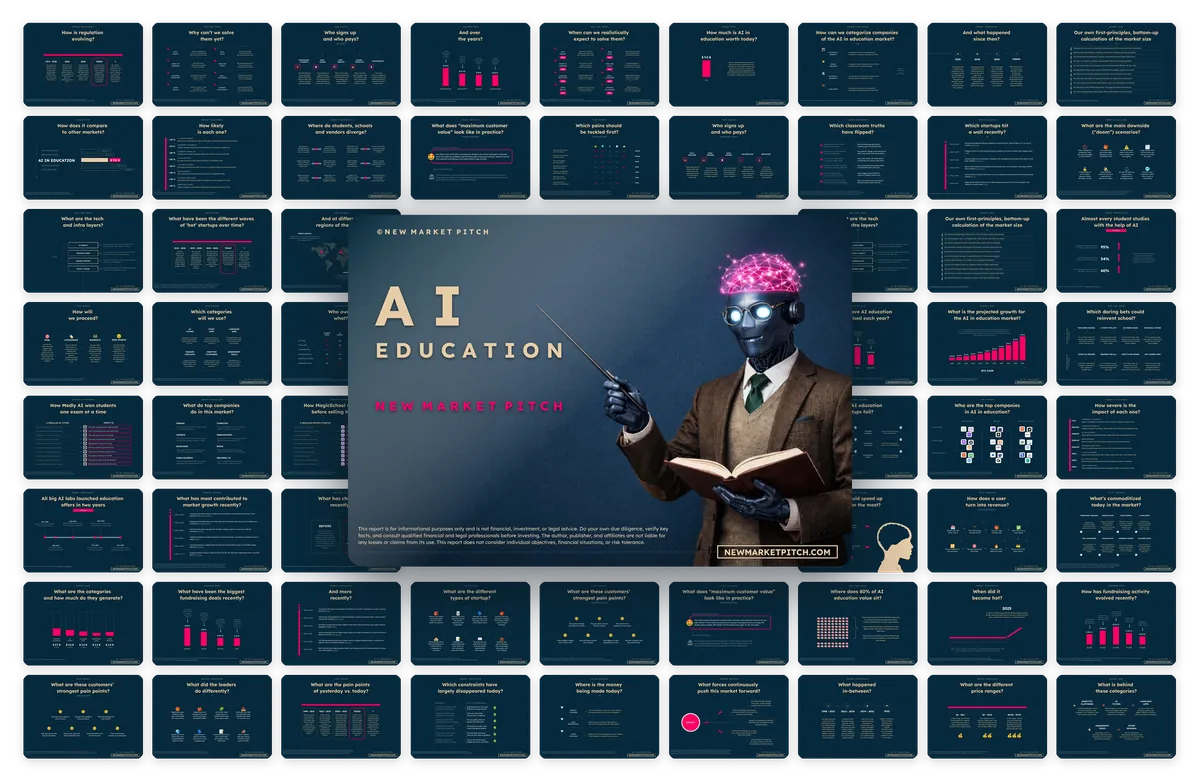
Everything we know about the AI in education market, in one place. Get our report whether you build or invest.
Summary
AMBOSS, Squirrel AI, Speak and Preply currently form the top tier of AI in Education valuations, with AMBOSS estimated at $1.7 billion to $3.2 billion and the other three sitting at or above the billion-dollar mark.
The market is surprisingly top-heavy. Only four of the 98 companies in our ranking are clear unicorns, and valuations fall below roughly $400 million by around the 15th position.
Language learning is the strongest cluster near the top. Speak and Preply are confirmed unicorns, Lingokids is close to the threshold, and a long tail of smaller AI conversation products is forming behind them. Language learning crowding the top is why we map who does what across AI education in our AI education market report.
Medical education has produced the highest valuation in the ranking because AMBOSS can follow users from studying into clinical work. That gives it access to a much more valuable professional workflow than a conventional study app.
Generative AI has created fast-growing companies such as MagicSchool, Yoodli and Gizmo, but it has not displaced older businesses with strong distribution. AMBOSS, Squirrel AI and Preply all predate the current generative-AI wave.
That is becoming a recurring pattern across the market: the underlying AI is getting easier to reproduce, while audiences, proprietary data, institutional relationships, curriculum integration and trusted brands remain difficult to copy.
Consumer products currently have the highest valuation ceiling, but institutional software has produced a broad layer of substantial companies. MagicSchool, Carnegie Learning, DreamBox, Magma Math and EdSights show that slower school and university procurement can still create valuable businesses.
Funding is concentrated in companies that already have visible distribution. Recent large rounds went to AMBOSS, Preply, Lingokids, EdSights and Speak rather than to brand-new AI tutor products with little evidence of adoption.
Math and exam preparation are among the most crowded categories because AI works naturally with structured practice and objectively checkable answers. That same fit also makes basic solving, explanation and question-generation features increasingly easy to replicate.
Valuation and educational effectiveness are not the same thing. Investors have consistently rewarded growth, distribution and monetization faster than the market has produced rigorous evidence that newer generative-AI tools improve learning outcomes.
The clearest takeaway is that access to powerful models is already becoming a commodity. The largest AI in Education companies are valuable because they control something around the model: customers, data, marketplaces, institutional distribution, professional workflows or very large consumer audiences.

Written by the New Market Pitch teamWe track new markets so founders and investors can move faster. About us

In our report covering the AI in education market, we turn what is vague and complex into simple, useful visuals. Market maps like this one show you at a glance where every startup stands.
Top startups in the AI in Education market ranked by valuation
Here is an updated table that ranks the top startups in the AI in Education market based on their latest reported or estimated valuations.
If you need to dig deeper and get more detailed data, please check our report covering the AI in Education market.
| # | Startup Name | What They Do | Current Valuation ($) | Valuation Confidence Level | Valuation Type | Evidence Status | Total Funding ($) | Funding Confidence Level |
|---|---|---|---|---|---|---|---|---|
| 1 | AMBOSS | Medical learning and clinical intelligence | $1.7B–$3.2B | Partial Confidence | Implied Valuation from Raise | Implied | ~$291M | Strong Confidence |
| 2 | Squirrel AI | Adaptive AI-powered K-12 tutoring | $1.0B–$2.5B | Partial Confidence | Comparables-Based Estimate | Estimated | ~$128M | Strong Confidence |
| 3 | Speak | AI conversational language learning | $1.1B–$1.5B | Strong Confidence | Announced Private Round Valuation | Estimated | ~$166M | Strong Confidence |
| 4 | Preply | Online language tutoring marketplace | $1.2B | Full Confidence | Announced Private Round Valuation | Observed | ~$320M | Strong Confidence |
| 5 | Lingokids | Interactive learning platform for children | $700M–$1.2B | Partial Confidence | Implied Valuation from Raise | Implied | ~$182M | Strong Confidence |
| 6 | EdSights | AI student retention platform | $530M–$1.0B | Partial Confidence | Implied Valuation from Raise | Implied | ~$88M | Strong Confidence |
| 7 | Photomath | AI camera-based math problem solver | $500M–$550M | Partial Confidence | Acquisition Value | Estimated | $29M+ | Strong Confidence |
| 8 | Carnegie Learning | Adaptive K-12 curriculum and tutoring | $350M–$600M | Partial Confidence | Comparables-Based Estimate | Estimated | $31.1M | Strong Confidence |
| 9 | MagicSchool AI | AI tools for educators | $430M–$480M | Strong Confidence | Announced Private Round Valuation | Estimated | ~$63M | Strong Confidence |
| 10 | Riiid | AI personalized test preparation | $300M–$600M | Low Confidence | Comparables-Based Estimate | Estimated | ~$257M | Strong Confidence |
| 11 | DreamBox Learning | Adaptive math and reading software | $300M–$500M | Partial Confidence | Acquisition Value | Estimated | $175.6M | Strong Confidence |
| 12 | Brainly | AI homework and learning platform | $300M–$450M | Partial Confidence | Revenue or ARR Multiple Estimate | Estimated | $148.5M | Strong Confidence |
| 13 | Yoodli | AI communication and roleplay coaching | $311M–$330M | Strong Confidence | Announced Private Round Valuation | Observed | $60.8M | Full Confidence |
| 14 | Mathpresso (QANDA) | AI math learning platform | $250M–$350M | Partial Confidence | Comparables-Based Estimate | Estimated | ~$134M | Strong Confidence |
| 15 | Knowunity | Social AI student learning platform | $208M–$390M | Partial Confidence | Implied Valuation from Raise | Implied | ~$54M | Strong Confidence |
| 16 | Magma Math | AI-powered K-12 math platform | $200M–$333M | Strong Confidence | Implied Valuation from Raise | Implied | ~$56M | Strong Confidence |
| 17 | Embibe | AI personalized learning and test prep | $220M–$280M | Partial Confidence | Acquisition Value | Estimated | $82.6M | Strong Confidence |
| 18 | Noon Academy | Social AI learning platform | $180M–$320M | Low Confidence | Comparables-Based Estimate | Estimated | ~$63M | Strong Confidence |
| 19 | Outsmart Education | AI-native higher education platform | $125M–$210M | Partial Confidence | Implied Valuation from Raise | Implied | $38M | Full Confidence |
| 20 | Praktika | AI-avatar language tutoring | $120M–$200M | Partial Confidence | Revenue or ARR Multiple Estimate | Estimated | $38M | Full Confidence |
| 21 | Gizmo | AI-powered study and quiz platform | $110M–$180M | Strong Confidence | Implied Valuation from Raise | Implied | $25.5M | Full Confidence |
| 22 | Osmo | Interactive physical-digital learning games | $120M | Full Confidence | Acquisition Value | Observed | $30M+ | Strong Confidence |
| 23 | Oboe | AI-generated personalized learning courses | $80M–$133M | Strong Confidence | Implied Valuation from Raise | Implied | $20M | Full Confidence |
| 24 | Amira Learning | AI reading assessment and tutoring | $80M–$120M | Partial Confidence | Comparables-Based Estimate | Estimated | $43.6M | Strong Confidence |
| 25 | Flint | Personalized AI tutors for schools | $75M–$125M | Strong Confidence | Implied Valuation from Raise | Implied | ~$17M | Strong Confidence |
| 26 | Matific | Game-based adaptive mathematics learning | $70M–$120M | Partial Confidence | Revenue or ARR Multiple Estimate | Estimated | $58.1M | Strong Confidence |
| 27 | SchoolAI | Classroom AI tutors and assistants | $80M–$105M | Partial Confidence | Comparables-Based Estimate | Estimated | ~$32M | Strong Confidence |
| 28 | ELSA | AI English speaking coach | $85M–$95M | Strong Confidence | Comparables-Based Estimate | Estimated | $48.5M | Full Confidence |
| 29 | Kyron Learning | Conversational AI interactive video lessons | $65M–$110M | Partial Confidence | Implied Valuation from Raise | Implied | $21.0M | Full Confidence |
| 30 | Nectir | AI infrastructure for higher education | $63M–$104M | Strong Confidence | Implied Valuation from Raise | Implied | ~$19M | Strong Confidence |
| 31 | Ello | AI reading and math teacher | $60M–$100M | Partial Confidence | Comparables-Based Estimate | Estimated | $15.6M | Strong Confidence |
| 32 | Branching Minds | K-12 intervention management software | $60M–$100M | Low Confidence | Comparables-Based Estimate | Estimated | $1.2M+ disclosed | Partial Confidence |
| 33 | Memrise | AI-assisted language learning platform | $62M–$93M | Partial Confidence | Proxy-Based Estimate | Estimated | $25.1M | Strong Confidence |
| 34 | Brisk Teaching | AI teaching assistant platform | $60M–$90M | Partial Confidence | Announced Private Round Valuation | Estimated | ~$22M | Strong Confidence |
| 35 | AI Hay | Vietnamese AI knowledge search platform | $50M–$80M | Strong Confidence | Implied Valuation from Raise | Implied | $18.5M | Full Confidence |
| 36 | Vimi | AI one-to-one math tutor | $48M–$80M | Partial Confidence | Implied Valuation from Raise | Implied | $12M | Full Confidence |
| 37 | Kidaptive | Adaptive-learning analytics and personalization | $40M–$80M | Low Confidence | Comparables-Based Estimate | Estimated | $47.4M | Strong Confidence |
| 38 | Teachy | AI productivity tools for teachers | $40M–$70M | Partial Confidence | Comparables-Based Estimate | Estimated | ~$9M | Strong Confidence |
| 39 | Buddy.ai | Conversational English tutor for children | $40M–$70M | Partial Confidence | Comparables-Based Estimate | Estimated | $17.4M | Strong Confidence |
| 40 | iEduGPT | AI professional exam preparation | $40M–$67M | Partial Confidence | Implied Valuation from Raise | Implied | $10M | Full Confidence |
| 41 | SigIQ.ai | Personalized AI exam tutoring | $38M–$63M | Partial Confidence | Implied Valuation from Raise | Implied | $9.5M | Full Confidence |
| 42 | CampusAI | AI skills learning platform | $40M–$61M | Partial Confidence | Proxy-Based Estimate | Estimated | ~$15M | Strong Confidence |
| 43 | TinyTap | User-generated educational games platform | $48M | Full Confidence | Acquisition Value | Observed | $16.6M | Full Confidence |
| 44 | TeachFX | AI instructional coaching for teachers | $35M–$60M | Partial Confidence | Acquisition Value | Estimated | $11.5M | Strong Confidence |
| 45 | Prep Edu | AI language and exam preparation | $35M–$58M | Partial Confidence | Implied Valuation from Raise | Implied | $9M | Full Confidence |
| 46 | Medly AI | AI tutor for school exams | $32M–$53M | Partial Confidence | Implied Valuation from Raise | Implied | ~$10.3M | Strong Confidence |
| 47 | Giant | AI interactive storytelling for children | $32M–$53M | Strong Confidence | Implied Valuation from Raise | Implied | $8M | Full Confidence |
| 48 | Edexia | AI essay grading for schools | $33M–$37M | Strong Confidence | Announced Private Round Valuation | Observed | ~$4.2M | Strong Confidence |
| 49 | AASOKA | AI-enabled K-12 learning platform | $25M–$45M | Low Confidence | Proxy-Based Estimate | Estimated | Not separately disclosed | Low Confidence |
| 50 | Pensive | AI grading for higher education | $27M–$41M | Strong Confidence | Implied Valuation from Raise | Implied | $6.8M | Full Confidence |
| 51 | Knowre | Adaptive personalized mathematics learning | $26M–$39M | Partial Confidence | Proxy-Based Estimate | Estimated | $15.2M | Strong Confidence |
| 52 | Curipod | AI interactive classroom lesson platform | $23M–$35M | Partial Confidence | Proxy-Based Estimate | Estimated | $4.6M | Strong Confidence |
| 53 | eSpark Learning | Personalized elementary math and reading | $23M–$34M | Partial Confidence | Comparables-Based Estimate | Estimated | $30.7M | Strong Confidence |
| 54 | Knowledgehook | Math assessment and teacher guidance | $20M–$35M | Partial Confidence | Revenue or ARR Multiple Estimate | Estimated | $15.9M | Strong Confidence |
| 55 | Alice.Tech | Personalized AI exam preparation | $19M–$32M | Partial Confidence | Implied Valuation from Raise | Implied | ~$5M | Strong Confidence |
| 56 | Socratic | AI-assisted homework learning app | $18M–$32M | Low Confidence | Acquisition Value | Estimated | $7.5M | Strong Confidence |
| 57 | Ora AI | AI medical education platform | $18M–$30M | Partial Confidence | Comparables-Based Estimate | Estimated | $1.8M | Full Confidence |
| 58 | bettermarks | Adaptive online mathematics coursework | $15M–$30M | Low Confidence | Revenue or ARR Multiple Estimate | Estimated | $29.6M | Strong Confidence |
| 59 | Chalkie | AI lesson planning for teachers | $16M–$27M | Partial Confidence | Implied Valuation from Raise | Implied | $4M | Full Confidence |
| 60 | Arivihan | AI tutoring for Indian students | $18M–$25M | Strong Confidence | Announced Private Round Valuation | Observed | $4.9M | Full Confidence |
| 61 | RevisionDojo | Personalized AI exam preparation | $16M–$25M | Partial Confidence | Revenue or ARR Multiple Estimate | Estimated | $3.4M | Full Confidence |
| 62 | Edumentors | AI-enabled online tutoring marketplace | $16M–$24M | Partial Confidence | Revenue or ARR Multiple Estimate | Estimated | ~$6M | Strong Confidence |
| 63 | Diffit | AI differentiated teaching materials | $15M–$25M | Low Confidence | Comparables-Based Estimate | Estimated | Undisclosed | Low Confidence |
| 64 | Thinkster Math | Personalized online math tutoring | $12M–$25M | Low Confidence | Comparables-Based Estimate | Estimated | $4.7M | Strong Confidence |
| 65 | CENTURY Tech | Adaptive AI learning platform | $14M–$20M | Partial Confidence | Revenue or ARR Multiple Estimate | Estimated | $6.8M | Strong Confidence |
| 66 | Jungle AI | Generates gamified AI study questions | $12M–$20M | Partial Confidence | Revenue or ARR Multiple Estimate | Estimated | Undisclosed | Low Confidence |
| 67 | MATH 42 | AI step-by-step math solver | $15M | Full Confidence | Acquisition Value | Observed | ~$1.3M | Strong Confidence |
| 68 | LoveHeart | AI assistant for early educators | $10M–$18M | Partial Confidence | Implied Valuation from Raise | Implied | ~$1.6M | Strong Confidence |
| 69 | YouLearn | Personalized AI college tutor | $10M–$18M | Partial Confidence | Revenue or ARR Multiple Estimate | Estimated | ~$500K | Strong Confidence |
| 70 | Prepia | AI professional exam preparation | $10M–$18M | Partial Confidence | Revenue or ARR Multiple Estimate | Estimated | ~$1.7M | Strong Confidence |
| 71 | Knewton | Adaptive digital courseware technology | $10M–$17M | Strong Confidence | Acquisition Value | Observed | $182.3M | Full Confidence |
| 72 | Teacher's Buddy | AI tools for teacher workloads | $12M–$14M | Strong Confidence | Announced Private Round Valuation | Observed | ~$3.2M | Strong Confidence |
| 73 | Univerbal | Conversational AI language tutor | $8M–$15M | Low Confidence | Comparables-Based Estimate | Estimated | $2.0M | Strong Confidence |
| 74 | SuperKalam | AI-powered competitive exam preparation | $8M–$14M | Partial Confidence | Comparables-Based Estimate | Estimated | $1.96M | Strong Confidence |
| 75 | MyBuddy.ai | AI English tutor for children | $7M–$14M | Low Confidence | Proxy-Based Estimate | Estimated | ~$2.0M | Strong Confidence |
| 76 | CuePilot AI | AI operating system for preschools | $7M–$12M | Strong Confidence | Implied Valuation from Raise | Implied | $1.8M | Full Confidence |
| 77 | MathDash | Competitive gamified mathematics learning | $7M–$12M | Partial Confidence | Implied Valuation from Raise | Implied | ~$1.7M | Strong Confidence |
| 78 | Flashka | AI study app for universities | $6M–$10M | Partial Confidence | Implied Valuation from Raise | Implied | ~$1.2M | Strong Confidence |
| 79 | Frizzle | AI grading for handwritten math | $6M–$10M | Partial Confidence | Implied Valuation from Raise | Implied | $1.5M | Strong Confidence |
| 80 | NPrep | AI nursing exam preparation | $6M–$9M | Strong Confidence | Implied Valuation from Raise | Implied | $1.5M | Full Confidence |
| 81 | Smartail AI | AI grading and learning analytics | $5M–$9M | Partial Confidence | Comparables-Based Estimate | Estimated | $700K | Strong Confidence |
| 82 | Studdy | Personalized AI math tutor | $5M–$8M | Partial Confidence | Comparables-Based Estimate | Estimated | ~$500K | Strong Confidence |
| 83 | Darsel | Low-bandwidth AI math tutoring | $5M–$8M | Partial Confidence | Revenue or ARR Multiple Estimate | Estimated | ~$500K | Strong Confidence |
| 84 | Blue Canoe Learning | AI English pronunciation coaching | $4M–$8M | Low Confidence | Revenue or ARR Multiple Estimate | Estimated | $5.9M | Strong Confidence |
| 85 | Educato | AI-powered exam preparation platform | $4M–$7M | Low Confidence | Revenue or ARR Multiple Estimate | Estimated | $500K | Strong Confidence |
| 86 | Liulishuo | AI English language learning | $2M–$7M | Low Confidence | Proxy-Based Estimate | Estimated | Undisclosed / historical financing | Low Confidence |
| 87 | Toko | AI English conversation practice | $3M–$6M | Low Confidence | Proxy-Based Estimate | Estimated | $0.5M | Strong Confidence |
| 88 | Excellence Learning | AI math and science tutoring | $3M–$6M | Partial Confidence | Implied Valuation from Raise | Implied | $500K | Strong Confidence |
| 89 | Mathos AI | AI math solver and tutor | $3M–$6M | Low Confidence | Comparables-Based Estimate | Estimated | $500K | Strong Confidence |
| 90 | CampusKnot | AI teaching assistant platform | $2M–$6M | Low Confidence | Comparables-Based Estimate | Estimated | ~$2.1M | Partial Confidence |
| 91 | Miyagi Labs | AI-powered exam preparation tutor | $2M–$5M | Partial Confidence | Implied Valuation from Raise | Implied | ~$500K | Strong Confidence |
| 92 | Chiron | Real-time AI handwritten math tutor | $2M–$5M | Partial Confidence | Implied Valuation from Raise | Implied | ~$500K | Strong Confidence |
| 93 | Bodhi AI | AI platform for coaching institutes | $2M–$5M | Partial Confidence | Revenue or ARR Multiple Estimate | Estimated | ~$225K | Strong Confidence |
| 94 | PrepAI | AI quiz and assessment generation | $2M–$5M | Low Confidence | Proxy-Based Estimate | Estimated | Undisclosed | Low Confidence |
| 95 | Tegore | Curriculum-aligned AI math tutor | $2M–$4M | Partial Confidence | Implied Valuation from Raise | Implied | $500K | Strong Confidence |
| 96 | Vidya AI | AI tutoring and automated grading | $1M–$3M | Low Confidence | Proxy-Based Estimate | Estimated | Undisclosed | Low Confidence |
| 97 | to teach | AI-generated personalized teaching materials | $1M–$2M | Low Confidence | Implied Valuation from Raise | Implied | $200K+ | Partial Confidence |
| 98 | Shepherd | AI and human study assistant | $0.5M–$0.8M | Low Confidence | Proxy-Based Estimate | Estimated | ~$125K | Partial Confidence |

Our research about AI tools for education gets updated several times a month, so you always get the latest view of where things stand.
Which AI in Education startups are worth the most today?
AMBOSS, Squirrel AI, Speak and Preply currently sit at the top of the AI in Education market, and there is already a sizeable gap between that group and most of the sector.
Our ranking puts AMBOSS first at an estimated $1.7 billion to $3.2 billion, followed by Squirrel AI at $1 billion to $2.5 billion. Speak sits at $1.1 billion to $1.5 billion, while Preply has a directly observed $1.2 billion valuation from its latest financing.
Lingokids is the next company to watch, with an estimated range of $700 million to $1.2 billion. EdSights follows at $530 million to $1 billion. After that, the ceiling drops to roughly $600 million for Carnegie Learning and Riiid, around $550 million for Photomath, and $480 million for MagicSchool AI.
The businesses at the top look quite different. AMBOSS combines medical education with clinical decision support. Squirrel AI focuses on adaptive K-12 learning. Speak has built an AI language tutor. Preply still revolves around human tutors, with AI increasingly built around that experience.
There is no single AI education model that has won. The biggest valuations currently belong to companies solving specific, recurring problems in markets where people already spend serious money on learning.
| Rank | Startup | Main focus | Current valuation |
|---|---|---|---|
| 1 | AMBOSS | Medical learning and clinical intelligence | $1.7B–$3.2B |
| 2 | Squirrel AI | Adaptive K-12 tutoring | $1.0B–$2.5B |
| 3 | Speak | AI language learning | $1.1B–$1.5B |
| 4 | Preply | Language tutoring marketplace | $1.2B |
| 5 | Lingokids | Children's learning | $700M–$1.2B |
| 6 | EdSights | Student retention software | $530M–$1.0B |
| 7 | Photomath | AI math solver | $500M–$550M |
| 8 | Carnegie Learning | K-12 curriculum and tutoring | $350M–$600M |
| 9 | MagicSchool AI | AI tools for educators | $430M–$480M |
| 10 | Riiid | AI test preparation | $300M–$600M |
| 11 | DreamBox Learning | Adaptive math and reading | $300M–$500M |
| 12 | Brainly | Homework and learning platform | $300M–$450M |
| 13 | Yoodli | AI communication coaching | $311M–$330M |
| 14 | Mathpresso / QANDA | AI math learning | $250M–$350M |
| 15 | Knowunity | Social AI learning | $208M–$390M |
How many AI in Education unicorns are there right now?
We count four clear billion-dollar AI in Education companies today, with Lingokids close enough to the threshold that it could become the fifth.
Speak crossed $1 billion in its Series C. Preply reached $1.2 billion in its latest Series D. Our current estimates place both AMBOSS and Squirrel AI comfortably inside unicorn territory.
Lingokids is trickier because its latest financing disclosed a large amount of capital but no formal valuation. Our $700 million to $1.2 billion range leaves the company right around the unicorn line rather than giving us a defensible point estimate above it.
EdSights reaches $1 billion only at the very top of its estimated range, so we would not count it as a unicorn today.
That leaves roughly 4% of the 98 companies in our dataset clearly above $1 billion. Even if Lingokids eventually proves to be worth more than $1 billion, the share would still be only around 5%.
AI has produced an explosion of education startups, but billion-dollar outcomes remain rare.

In our market report about AI tools for education, we look at what the winners do differently, so you can learn from the best instead of guessing.
Why is AMBOSS worth more than most AI education startups?
AMBOSS can justify a much higher valuation than a typical study app because the company follows medical users from education into an expensive professional workflow.
The latest major piece of evidence came when AMBOSS completed a €240 million financing with KIRKBI, M&G Investments and Lightrock. The company said the money would support international growth and expansion beyond physicians into other healthcare professions.
That financing is enormous by current edtech standards. HolonIQ counted only about $1 billion of venture funding across the entire global edtech market in the first half of 2026. A single €240 million AMBOSS transaction therefore represents an unusually large commitment of capital. A single €240 million round in a shrinking edtech market shows where investor money goes, which we trace in our report on AI education.
AMBOSS also has a different economic ceiling from a normal homework platform. Medical students can start with AMBOSS while preparing for exams, then continue using the product as doctors for clinical decision support. The customer does not necessarily disappear when the education phase ends.
Healthcare makes that especially valuable. A physician looking up diagnostic or treatment information has a much higher-stakes need than someone asking a general-purpose chatbot to explain a school exercise.
That combination of medical specialization, recurring professional use and a large recent financing is why our estimate reaches $1.7 billion to $3.2 billion. Few education companies in the ranking have access to a similarly valuable adjacent market.
Is language learning the most valuable part of AI education?
Language learning has become the strongest cluster near the top of the AI in Education market, with two confirmed unicorns and several other sizeable companies.
Speak reached a $1 billion valuation after raising $78 million. According to the company, users had spoken more than one billion sentences through Speak during 2024. The business also reported more than 200 enterprise customers and an 85% adoption rate among employees offered the product at work.
Preply reached $1.2 billion after raising another $150 million. The company connects more than 100,000 tutors with learners across 180 countries and more than 90 languages.
Lingokids adds another large consumer-learning business, although its focus extends beyond languages. The company secured $120 million in financing after surpassing 185 million downloads and reaching millions of monthly users.
Below those companies, we find Praktika at an estimated $120 million to $200 million, ELSA around $85 million to $95 million, Memrise around $62 million to $93 million, and several smaller conversational language products.
The category fits today's AI unusually well because speaking is repetitive, interactive and expensive to practise with a human every time. Voice models can offer almost unlimited practice while keeping the cost far below one-to-one tutoring.
There is also a huge global customer base that already understands why language learning has value. English proficiency can affect university admission, migration, international work and salary prospects.
Those factors have pushed language learning ahead of most other consumer education categories in our ranking.
| Company | Main model | Current valuation | Funding |
|---|---|---|---|
| Speak | AI conversation tutor | $1.1B–$1.5B | ~$166M |
| Preply | Human tutoring + AI | $1.2B | ~$320M |
| Lingokids | Children's learning | $700M–$1.2B | ~$182M |
| Praktika | AI-avatar tutoring | $120M–$200M | $38M |
| ELSA | AI speaking coach | $85M–$95M | $48.5M |
| Memrise | AI-assisted language learning | $62M–$93M | $25.1M |
| Prep Edu | Language and exam preparation | $35M–$58M | $9M |
| Buddy.ai | English tutor for children | $40M–$70M | $17.4M |
| Univerbal | Conversational AI tutor | $8M–$15M | $2.0M |
| Toko | English conversation practice | $3M–$6M | $0.5M |

In our document detailing everything you need to know about AI in education, you will always find fresh funding data, taken straight from our own verified funding database.
Has generative AI already created a new generation of big education startups?
Generative AI has already created several valuable education companies, but the young AI-native group has not taken over the top of the ranking yet.
MagicSchool AI is the clearest example. The company raised $45 million in a Series B after only around 18 months in market. MagicSchool said at the time that millions of people were using the product monthly and that it had partnerships with more than 10,000 schools.
Yoodli has moved even faster financially. The AI roleplay company raised $40 million in a Series B only months after its previous financing. GeekWire reported that Yoodli's valuation had roughly tripled to around $300 million while revenue had increased sharply.
Gizmo shows what can happen on the consumer side. TechCrunch reported that the study app grew from roughly 300,000 users in 2023 to more than 13 million users across 120 countries before raising a $22 million Series A.
Flint, SchoolAI, Brisk Teaching, Oboe and Nectir belong to the same broader wave. Most were built around a world where large language models already existed rather than adding AI years later.
Still, AMBOSS, Squirrel AI and Preply were all built well before the generative-AI boom. Their continued position near the top tells us something useful: cheap access to powerful models has accelerated startup creation much more than it has erased established distribution.
Today, almost anyone can build a decent AI tutor prototype. Reaching millions of learners, getting into thousands of schools or becoming trusted enough for professional education is the hard part.
Are AI tools for teachers becoming a big market?
AI tools for teachers are becoming a serious edtech category, and MagicSchool AI has already shown that one of these businesses can reach a valuation in the high hundreds of millions.
MagicSchool currently stands far above most direct competitors in our ranking at roughly $430 million to $480 million. Brisk Teaching follows around $60 million to $90 million, Teachy around $40 million to $70 million, TeachFX around $35 million to $60 million and Curipod around $23 million to $35 million.
The category has expanded quickly because teachers spend a lot of time on work that language models handle reasonably well: lesson plans, quizzes, differentiated materials, feedback, parent communication and classroom exercises. Lesson plans and feedback eating teachers' time is the kind of problem schools pay to solve, and we profile those buyers in our report covering the AI education market.
MagicSchool's adoption numbers make that more concrete. The company said millions of educators were using the platform monthly when it announced its Series B and that educators in nearly every U.S. school district had used the product.
U.S. education policy has also become more accommodating. Department of Education guidance has explicitly identified AI-assisted instruction, tutoring, differentiated learning and reductions in administrative workload as legitimate uses, provided schools handle privacy, transparency and evidence properly.
The main challenge is still who pays. A teacher can adopt a free AI tool in minutes, while converting that enthusiasm into a district-wide software contract can take much longer.
That gap between usage and procurement helps explain why we see a lot of teacher-AI startups but only one currently approaching the half-billion-dollar level.

Learning from others' mistakes is the cheapest lesson there is. In our report covering the AI in education market, we look at what broke startups before you, so you don't repeat it.
Are school AI companies worth more than consumer AI learning apps?
Consumer AI learning apps currently have the higher valuation ceiling, while school and university software has produced a wider group of businesses in the $50 million to $500 million range.
Speak and Preply show how quickly a consumer or consumer-adjacent business can scale internationally. Lingokids has also reached an enormous global audience without selling district by district.
School-focused companies have a different route. Carnegie Learning, MagicSchool, DreamBox, Magma Math, SchoolAI and Amira Learning sell into systems where purchasing is slower but contracts can become deeply embedded.
Magma Math is a useful current example. The company recently raised $40 million and says it works with school systems across more than 30 U.S. states, while already serving much of its home market in Sweden.
Higher education has fewer large companies in our ranking, but EdSights stands out. The student-retention company secured an $80 million growth investment from JMI Equity and now works with more than 240 colleges and universities. Retention gives EdSights a particularly clean sales argument because losing students also means losing tuition revenue.
Nectir, Outsmart Education and several university-focused grading or learning platforms sit lower down the ranking, generally between a few tens of millions and about $200 million.
Consumer companies therefore have the clearest path to explosive growth. Institutional companies can compensate with longer relationships, recurring contracts and tighter integration into everyday school operations.
Which AI in Education startups have raised the most money lately?
The largest recent AI in Education financings have gone to a small group of companies that already had substantial distribution, rather than to brand-new AI tutoring apps.
AMBOSS closed a €240 million financing. Preply raised $150 million. Lingokids secured $120 million. EdSights received an $80 million growth investment. Speak raised $78 million at a $1 billion valuation.
The next group includes MagicSchool's $45 million Series B, Yoodli's $40 million Series B and Magma Math's $40 million Series A. Gizmo raised another $22 million after reaching more than 13 million users.
There is a pattern across those companies even though they sell completely different products.
AMBOSS has a valuable medical niche. Preply already has a global marketplace. Lingokids has huge consumer reach. EdSights sells into hundreds of colleges. Speak has demonstrated intense language-learning usage. MagicSchool already reaches thousands of schools.
Investors currently seem much more willing to write large checks once distribution is visible.
| Company | Major recent financing | Current valuation in our ranking |
|---|---|---|
| AMBOSS | €240M | $1.7B–$3.2B |
| Preply | $150M | $1.2B |
| Lingokids | $120M | $700M–$1.2B |
| EdSights | $80M | $530M–$1.0B |
| Speak | $78M | $1.1B–$1.5B |
| MagicSchool AI | $45M | $430M–$480M |
| Yoodli | $40M | $311M–$330M |
| Magma Math | $40M | $200M–$333M |
| Gizmo | $22M | $110M–$180M |

Your time is limited. In our research about AI tools for education, we put numbers on each part of the market, so you can see where it makes sense to focus.
Which AI education startup has seen its valuation jump the fastest?
Speak has one of the cleanest recent valuation jumps in AI education: its valuation doubled from $500 million to $1 billion in only six months.
Speak disclosed both numbers itself. The company reached approximately $500 million during a Series B extension, then raised $78 million at $1 billion in its next round.
Preply has also been repriced sharply. The company's latest $1.2 billion valuation is almost three times the roughly $432 million level associated with its previous major financing.
Yoodli is the smaller but faster-moving example. After raising a Series A, the communication-training startup returned for a $40 million Series B only months later. GeekWire subsequently reported a valuation around $300 million, roughly triple its earlier level.
Those three companies are useful because we have enough transaction evidence to see genuine repricing rather than simply comparing two modelled estimates.
They also share something beyond AI. Speak sells frequent conversational practice, Preply has a large marketplace, and Yoodli increasingly sells communication training to organizations.
The market has been willing to mark companies up quickly when AI is attached to visible usage and an obvious paying customer.
Does raising more money make an AI education startup worth more?
Money raised is a poor shortcut for valuation in AI education, especially for companies that collected huge rounds during the last edtech boom.
Riiid is one of the clearest examples. The company has raised around $257 million, including a $175 million SoftBank investment, yet our current valuation estimate is only $300 million to $600 million. Startups that raised heavily and still ended up worth less often had things in common, which we look at in our AI education market report.
Knewton is more extreme. The adaptive-learning pioneer raised more than $180 million over its lifetime. Wiley eventually acquired its assets in 2019 for an undisclosed amount after the company had once been one of the best-funded names in adaptive education. Our acquisition-based estimate sits around $10 million to $17 million.
Compare that with Gizmo. The company has raised only around $25.5 million but already reaches an estimated valuation of $110 million to $180 million after its user base jumped above 13 million.
Nectir has raised roughly $19 million and sits around $63 million to $104 million in our ranking. Oboe raised $20 million and already lands around $80 million to $133 million on an implied basis.
Historical funding measures how much capital a company managed to attract. Current valuation depends on what happened after the money arrived.
That distinction is particularly important in edtech because 2020 and 2021 produced some enormous rounds at prices that would be difficult to reproduce today.

In our market report about AI tools for education, we always try to gather several sources and make estimates that make sense, so you can work with solid numbers.
Are older AI education companies getting crushed by newer generative-AI startups?
Older AI education companies are splitting into two groups: businesses with real distribution still have value, while companies whose main advantage was the algorithm itself face much tougher competition today.
Photomath is a good example of the first group. Google acquired the company after Photomath had turned smartphone-based math solving into a globally recognized consumer product. The European Commission formally cleared Google's acquisition in 2023.
DreamBox also survived the change in technology. Discovery Education acquired the adaptive-learning company after DreamBox had reached more than six million students and 600,000 educators. Its distribution, curriculum and school relationships were valuable even though its core adaptive technology predated modern generative AI.
Knewton shows the other outcome. The company was once one of the most prominent names in personalized learning, raised more than $180 million and promoted adaptive algorithms long before ChatGPT existed. That early technical advantage did not translate into an equally durable independent business.
Generative AI has made many once-specialized capabilities much cheaper. Explaining a math problem, generating practice questions or adapting a paragraph to a student's level no longer requires years of proprietary AI development.
Established companies still have an edge when years of work produced customers, content, data, curriculum integration or a trusted brand. Those assets have aged much better than the old claim of simply having an “AI-powered” learning engine.
Why are there so many AI math startups?
Math has become one of the most crowded parts of AI education because the subject fits software unusually well: answers can often be checked objectively, skills can be broken into small steps and students practise the same concepts repeatedly.
Our ranking includes Squirrel AI, Photomath, Carnegie Learning, QANDA, Magma Math, Matific, Ello, Knowre, bettermarks, Thinkster Math, MATH 42, MathDash, Frizzle, Studdy, Darsel, Mathos AI and Tegore, among others.
The valuations cover almost the entire market.
Squirrel AI reaches an estimated $1 billion to $2.5 billion. Photomath sits around $500 million to $550 million. Carnegie Learning reaches $350 million to $600 million. QANDA is around $250 million to $350 million and Magma Math around $200 million to $333 million.
Then the curve drops quickly. Matific sits around $70 million to $120 million, while many younger math products remain below $20 million.
That's a pretty wide spread, and it shows how little value there is in simply being able to solve equations with AI these days. General-purpose models already handle large parts of that job.
The more valuable math businesses have built something around the solving engine: large student datasets, school distribution, curriculum integration, teacher workflows or a recognized consumer brand.
Squirrel AI, for example, says its systems draw on data from more than 24 million students and 10 billion learning behaviors. That is a very different asset from launching another AI chat interface that can explain algebra.

If you build or invest in the AI in education market, you need to know which business models pay off now and which ones are fading. That's why our report covering it has a whole section on it.
Can human tutoring still be worth billions when AI tutors are getting better?
Preply's $1.2 billion valuation shows that human tutoring can still support a billion-dollar education company even as AI tutoring becomes dramatically cheaper.
Preply now connects more than 100,000 tutors with learners across 180 countries. The company has also been adding AI features around the human lesson rather than trying to remove the tutor from the experience.
That positioning works because AI and human tutors are good at different things. We separate what AI tutors already do well from what is still on paper in our report on AI education.
AI can give learners unlimited practice, instant corrections and conversations at almost any hour. Human tutors still bring accountability, motivation, cultural nuance and the ability to understand when a learner is confused in ways that are difficult to capture from a single prompt.
Preply's latest financing suggests investors expect the hybrid model to remain valuable. The company raised $150 million at $1.2 billion, then later completed an employee tender offer at the same valuation.
Speak gives us the opposite model: conversational practice led primarily by AI. Speak is also worth around $1 billion.
Both can therefore work at scale. The market currently supports a billion-dollar AI-native language tutor and a billion-dollar human-tutor marketplace at the same time.
Why are there so many AI exam-prep startups?
AI exam preparation is crowded because the customer has an unusually clear reason to pay: passing the test can decide whether someone gets a degree, professional licence, university place or job opportunity.
Riiid is the largest exam-prep specialist in our ranking at roughly $300 million to $600 million. Below it, iEduGPT sits around $40 million to $67 million, SigIQ.ai around $38 million to $63 million and Prep Edu around $35 million to $58 million.
Medly AI, RevisionDojo, SuperKalam, NPrep, Educato, Prepia and Miyagi Labs add another group below roughly $50 million.
Riiid's history shows both the attraction and the danger of this market. SoftBank invested $175 million during the previous edtech funding cycle after Riiid had built significant traction around AI-driven test preparation.
Today, a new startup can generate practice tests, explanations and personalized study plans with far less capital.
That makes specialization much more important. A defensible exam-prep startup increasingly needs exclusive content, superior distribution, a tightly defined professional niche or evidence that users actually improve their scores.
The willingness to pay is still there. The software itself has simply become much easier to reproduce.

In our report covering the AI in education market, we don't want to repeat what boring consulting reports say. Instead, we show you the real and latest market signals that matter.
Do AI education valuations actually reflect better learning outcomes?
AI education valuations currently reflect growth and distribution much more consistently than proven learning outcomes.
Some companies do have meaningful evidence. DreamBox has been tested in multiple studies, including randomized research and more recent district-level evaluations. Discovery Education says moderate and high DreamBox usage has been associated with significantly higher assessment scores in several student groups.
EdSights publishes examples of colleges reporting improved student retention after implementing its platform. Magma Math has also been building an evidence base around math performance and has recently highlighted external validation of its outcomes.
Many younger generative-AI products have nowhere near that history yet. MagicSchool, Gizmo, Oboe and other fast-growing businesses can show adoption much sooner than they can show multi-year learning results.
The pressure to prove outcomes is increasing. Recent U.S. Department of Education guidance asks schools and providers a very direct question: what evidence shows that a technology actually improves student learning? The Department also says schools should reconsider tools when the evidence stays weak.
For institutional edtech, that could eventually affect valuation. School districts have become more cautious about paying for overlapping software, and AI makes the supply of new tools even larger.
For now, though, we should not read this valuation ranking as a ranking of educational effectiveness. Investors and educators are measuring different things.
How concentrated is the AI in Education startup market?
AI in Education is extremely concentrated by valuation even though the number of startups has exploded.
Only four companies in our 98-company ranking clearly sit at or above $1 billion today. By the time we reach roughly the 15th position, valuations have already fallen below $400 million. Around rank 30, the market is close to $100 million.
More than half of the ranking then sits below roughly $50 million, and the bottom portion is made up mostly of companies worth less than $20 million.
This shape is not surprising. Modern AI has made it cheap to launch tutoring, grading, quiz-generation, study and lesson-planning products. Hundreds of teams can now attack the same problems.
Distribution remains far scarcer.
Reaching 10 million consumers, becoming embedded across thousands of schools or earning enough trust to support doctors requires years of work. Much of the valuation difference comes from that.
| Valuation band | What we see in the ranking |
|---|---|
| $1B+ | A very small group of clear market leaders |
| $500M–$1B | Several established or rapidly scaling platforms |
| $250M–$500M | Strong regional, institutional or category leaders |
| $100M–$250M | Growing companies with meaningful traction |
| $50M–$100M | A crowded group of emerging platforms |
| $20M–$50M | Many early-stage AI education companies |
| Below $20M | Large long tail of young or lightly funded startups |

In our research about AI tools for education, we like to show you the big picture. We know your time is precious, so we make every page quick to read and packed with as much learning as possible per minute.
Is AI in Education going through another funding boom right now?
AI in Education is getting plenty of attention from investors, but today's funding market is much more selective than the 2020–2021 edtech boom.
HolonIQ counted about $1 billion of global edtech venture funding in the first half of 2026, down 26% from roughly $1.35 billion during the same period in 2025. Deal activity held up better than the dollar total, which means investors were still doing deals but writing smaller checks on average.
Earlier in the year, HolonIQ recorded $512 million across 63 first-quarter deals and found that capital remained heavily concentrated in AI-enabled and career-linked education. What has to happen for funding to broaden beyond AI-enabled and career-linked education is covered under growth drivers in our market report about AI education.
That backdrop makes the large financings in our ranking more interesting.
Preply still raised $150 million. Lingokids secured $120 million. EdSights attracted $80 million. Magma Math raised $40 million. Gizmo raised $22 million after a huge increase in users.
Investors are clearly willing to fund education, especially when AI gives the product a strong new use case. The bar for a large round is simply much higher these days.
The current market rewards companies that can already point to millions of users, school-system distribution, measurable institutional value or a strong professional niche.
Which AI education startups could become the next unicorns?
MagicSchool AI, Lingokids and EdSights currently sit closest to the billion-dollar zone in our ranking, while several smaller companies could move much higher if their recent growth continues.
Lingokids already reaches $1.2 billion at the top of our estimate. Its $120 million financing and very large consumer audience put it closest to crossing the threshold on firmer evidence.
EdSights reaches $1 billion at the top of our range after attracting an $80 million growth investment. The opportunity is unusually valuable because student retention has a direct financial impact on colleges.
MagicSchool is farther away at roughly $430 million to $480 million, but its speed is striking. The company reached millions of monthly users and thousands of school relationships within its first couple of years.
Magma Math is smaller at $200 million to $333 million but has already established school-system distribution in more than 30 U.S. states. Yoodli has climbed past $300 million after a rapid sequence of rounds and strong reported revenue growth.
Gizmo deserves attention from the consumer side. More than 13 million users is a huge audience for a company that has raised only around $25 million in total.
The companies with the clearest path to a much higher valuation all have something beyond a clever AI tutor. They already control distribution, a valuable workflow or a large audience.

When you build or invest in the AI in education market, you need clarity, not confusion. In our market report about AI tools for education, we always try to put numbers on and quantify whatever is usually vague and confusing.
So what does the AI in Education valuation ranking actually tell us today?
AI in Education is already producing billion-dollar companies, but the biggest winners are being defined by distribution and customer value far more than by access to the latest AI model.
AMBOSS, Squirrel AI, Speak and Preply currently form the clearest top tier. Lingokids sits near the billion-dollar line, followed by a second group that includes EdSights, Photomath, Carnegie Learning, MagicSchool, Riiid, DreamBox and Brainly.
The ranking also makes the strongest categories easier to see. Language learning has produced two confirmed unicorns. Math has produced a huge number of companies but also heavy competition. Teacher AI is growing extremely quickly, with MagicSchool well ahead of the pack. Medical education has produced the highest company in our ranking because AMBOSS can expand into clinical work. Institutional AI is attracting serious capital where schools and universities can connect the product to an economic outcome.
Generative AI has widened the market dramatically. A small team can now build functions that once required years of specialized machine-learning development.
That has raised the value of everything around the model.
Speak has consumer usage. Preply has marketplace liquidity and more than 100,000 tutors. AMBOSS has medical knowledge and clinical trust. Squirrel AI has years of student-learning data. MagicSchool has educator distribution. EdSights has university relationships. Gizmo has a large student audience.
Those assets are much harder to copy than the underlying AI.
Our overall judgment is clear: AI in Education is becoming a large and valuable startup category, but simply building an AI tutor is no longer enough to create a valuable company. The market is already separating companies that have real distribution, trusted data or a valuable workflow from the much larger group that mainly has access to the same models as everyone else.
Our methodology
This analysis ranks the most defensible current valuations in the AI in education market. We focus on companies whose business is genuinely centered on AI-enabled education, learning, tutoring, teaching or closely related education workflows rather than diversified technology companies where education is only a side activity.
We separate three types of valuation evidence. An observed valuation comes directly from a completed financing, acquisition or other disclosed transaction. An implied valuation can be inferred from financing evidence when the amount raised is known but the valuation is not. An estimated valuation relies more heavily on operating metrics, revenue evidence, comparable companies or relevant transactions.
Recent completed financings with disclosed valuations receive the most weight. Older valuation marks remain useful as historical anchors, but we reassess them when newer fundraising, growth, customer data, acquisitions or major changes in comparable-company valuations provide better information.
When a company raises capital without disclosing its valuation, we may use reasonable stage-appropriate dilution assumptions to establish a range. Where useful revenue or ARR evidence exists, we can also use comparable valuation multiples while adjusting for growth, business model, geography and maturity. These figures are shown as ranges rather than exact-looking point estimates.
Operating metrics such as users, tutors, schools, universities, enterprise customers and product adoption help support the estimates when stronger financial information is unavailable. They do not override a recent completed financing or acquisition where a clear transaction value exists.
We also distinguish funding from valuation. A company that has raised hundreds of millions of dollars is not automatically worth more today than a younger company that raised much less, particularly because the 2020–2021 edtech cycle produced large rounds at valuations that may no longer be reproducible.
The same caution applies to educational outcomes. This is a valuation ranking, not a ranking of teaching quality or learning effectiveness. Research evidence can strengthen an institutional product's commercial position, but adoption, distribution, monetization and transaction evidence currently provide clearer valuation anchors for many companies in the dataset.
Key sources include AMBOSS on its €240 million financing, Preply on its $150 million Series D and $1.2 billion valuation, Preply on its subsequent employee tender at the same valuation, Speak on its $78 million Series C and $1 billion valuation, TechCrunch on Speak's financing and earlier $500 million valuation, Lingokids on its $120 million financing, and JMI Equity on the $80 million EdSights investment.
Other important sources include MagicSchool on its $45 million Series B and school adoption, Yoodli on its $40 million Series B, GeekWire on Yoodli's roughly $300 million valuation, Magma Math on its $40 million Series A, TechCrunch on Gizmo's $22 million financing and user growth, and Squirrel AI for its student and learning-behavior data.
For historical transactions and outcome evidence, we also use Discovery Education on its DreamBox acquisition, Discovery Education's DreamBox research, the European Commission decision on Google's acquisition of Photomath, Wiley on its acquisition of Knewton's assets, HolonIQ for current edtech funding data, and the U.S. Department of Education for current guidance on responsible education technology use and evidence.

A good product starts with a real problem. In our document detailing everything you need to know about AI in education, we show you the ones customers still live with.
Written by the New Market Pitch teamWe track new markets so founders and investors can move faster. About us